


NIO CEO William Li Outlines 'Detailed Accounting' Strategy to Hit Q4 Profit Target
On June 3, NIO released its financial results for the first quarter of 2025. The data showed revenue of RMB 12 billion, a year-on-year increase of more than 21%; new vehicle deliveries reached 42,000 units, up more than 40% year on year. However, the net loss remained at RMB 6.75 billion, leaving only two quarters to reach William Li’s target of profitability by the fourth quarter.
During the earnings call following the report, William Li outlined NIO’s profitability formula: total monthly sales across the three brands must exceed 50,000 units; gross margin should be controlled between 17% and 18%; selling, general and administrative expense ratio around 10%; and research and development expense ratio between 6% and 7%.
Looking solely at the loss figures, one might wonder if NIO is returning to the ICU crisis of 2019. If we look at the 50,000-unit monthly sales target set by William Li, comparing it with December 2024 when NIO set a delivery record of 31,000 units, how can this 50,000-unit goal be achieved?
These two questions represent the biggest concerns among observers.
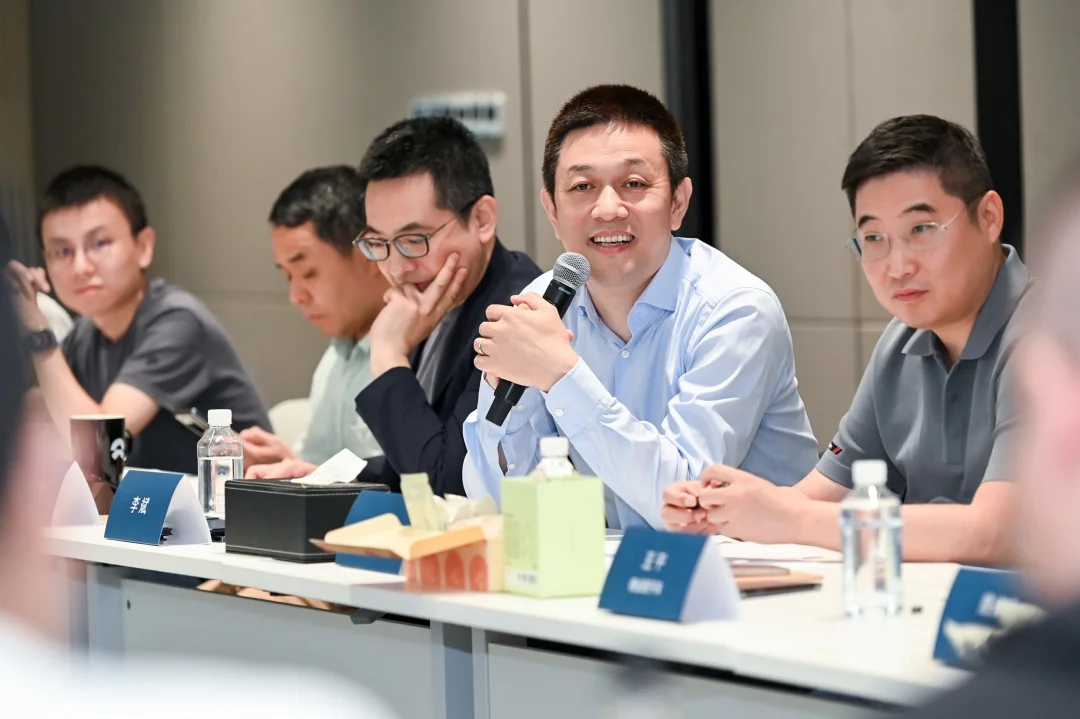
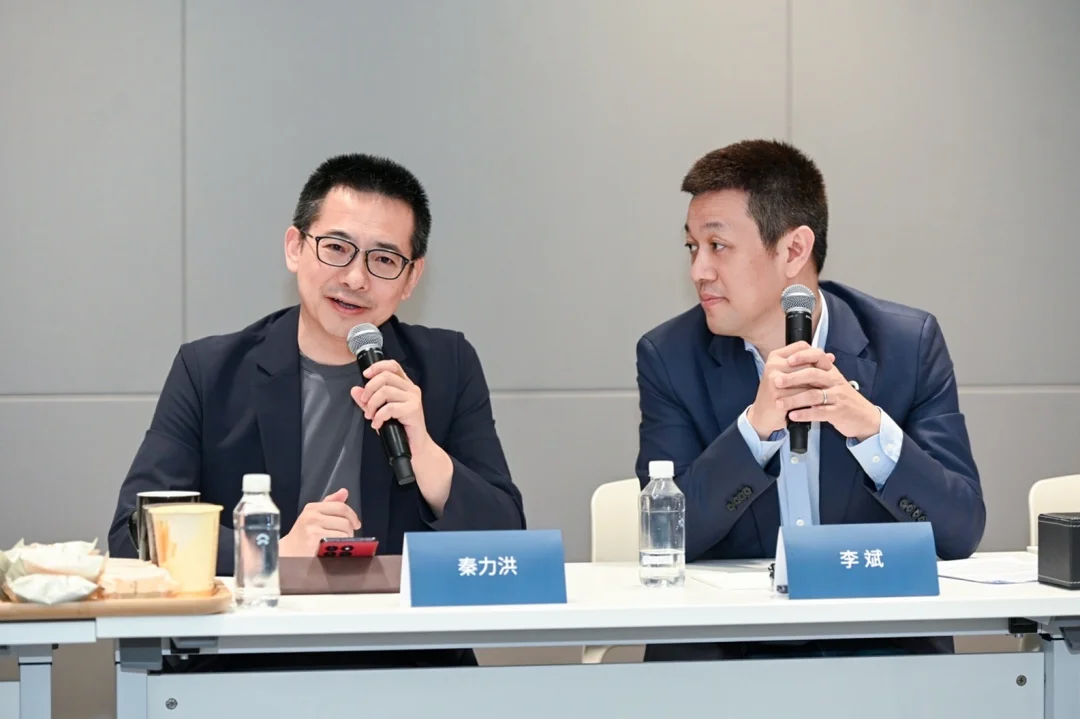
This morning, 42HOW Auto and several other media outlets jointly interviewed NIO founder, chairman and CEO William Li, as well as co-founder, director and president Qin Lihong. They revealed important information regarding business adjustments, technology pacing and operational strategies behind the financial report.
With only two quarters remaining until the profit commitment, how far is NIO from that goal?
01Losses Persist, Structure Shifting
As in previous quarters, "loss" remains the key theme in NIO's Q1 earnings report for this year, although the loss was slightly smaller than in the previous quarter. Nevertheless, William Li expressed confidence in achieving profitability in Q4 during the earnings call: "The past few years have been a period of high investment; we entered the harvest phase in Q2 this year. We are very confident about realizing profitability in Q4."
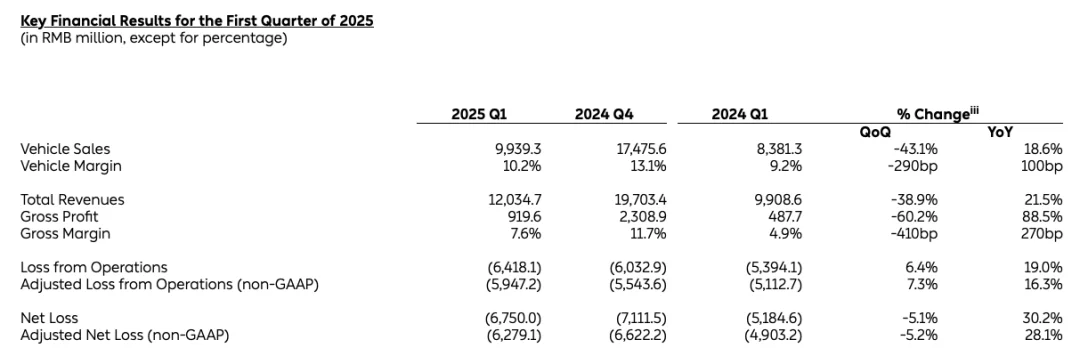
Total revenue reached RMB 12.035 billion, up 21.5% year-over-year but down 38.9% quarter-over-quarter.
Automobile sales amounted to RMB 9.94 billion, up 18.6% year-over-year and down 43.1% quarter-over-quarter.
Gross profit was RMB 920 million, up 88.5% year-over-year but down 60.2% quarter-over-quarter. The gross margin stood at 7.6%, compared to 4.9% in the same period last year and 11.7% in Q4 last year. Automobile gross margin was 10.2%, compared to 9.2% in the same period last year and 13.1% in Q4 last year.
Net loss was RMB 6.75 billion, up 30.2% year-over-year but down 5.1% quarter-over-quarter.
As of March 31, 2025, cash reserves (including cash, cash equivalents, restricted funds, short-term investments, and long-term time deposits) totaled RMB 26.01 billion, a decrease of RMB 15.89 billion from the previous quarter.
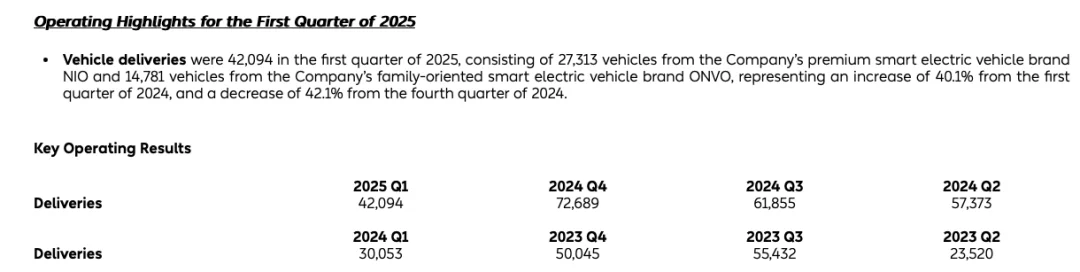
Pressure on the revenue side stems partly from changes in delivery pacing and price structure. In Q1 this year, NIO delivered 42,094 new vehicles (27,313 NIO brand and 14,781 ONVO brand), a 40.1% increase year-over-year. This figure was lower than the 72,689 units delivered in Q4 last year due to seasonal factors.
William Li and Qin Lihong are both optimistic about sales growth. At today’s media briefing, William Li said: “The lowest point in the first quarter has already passed; from the second quarter onwards, we have been on an upward trajectory from that trough.” This is a fairly vivid way to describe the situation.
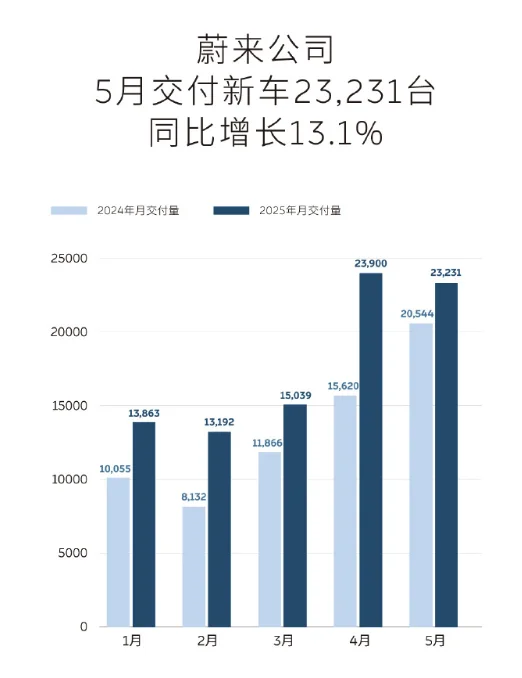
Regarding upcoming sales, William Li said that total deliveries for the second quarter are expected to reach between 72,000 and 75,000 units, representing a year-on-year increase of 25.5% to 30.7%, setting a new quarterly delivery record.
Based on the officially reported delivery figures for April and May, NIO’s June sales are projected to be between 25,000 and 28,000 units.
On profitability, due to promotional pricing before the facelift of the core '5566' models in the first quarter, the average selling price dropped 15.3% year-on-year to RMB 236,000, which weighed on automotive gross margins.
William Li said during last night’s earnings conference call that with the launch of the 2025 '5566' series new vehicles, NIO’s new car average selling price in the second quarter has risen by more than 10%, and gross margins have simultaneously increased by nearly 10 percentage points. CFO Qu Yu added that NIO brand’s per-vehicle gross margin will rebound to around 15% in the second quarter.
Between sales volume and gross margin, William Li’s attitude leans more toward the latter, so he also indicated that there would be no particularly aggressive sales targets set.
Driven by multiple factors including sales growth, price recovery, and cost optimization, NIO is attempting to put its profitability path back on track in the coming period. However, the reality is that this recovery still requires time and remains subject to hard constraints on cash flow and resource allocation capabilities.
Regarding the significant reduction in cash reserves, Qu Yu stated that first-quarter sales dropped by nearly 30,000 units quarter-on-quarter, resulting in an operating cash outflow of approximately RMB 10 billion. However, based on second-quarter sales guidance, NIO’s cash flow is expected to improve significantly and gradually return to normal.
William Li also noted that NIO completed a lightning placement of more than HKD 4 billion on the Hong Kong stock exchange at the end of March, with funds arriving in April and thus not included in the first-quarter financial statements. "The increase in sales during April and May will directly improve NIO's cash flow. Based on current full-year targets, NIO should achieve positive free cash flow inflow."
02'Monetizing tuition fees this year'
During a media briefing lasting over two hours today, William Li rarely reviewed NIO’s ten-year development trajectory and its experiences emerging from various 'life-and-death crises,' candidly admitting that the company failed to meet set goals across multiple dimensions.
William Li divided the roughly ten years since NIO’s founding into three stages:
The first stage spans from the company’s establishment through 2021, covering the lifecycle of the launch and initial sales of its first-generation products. This period initially established the 'user enterprise' business model and the 'chargeable, swappable, and upgradable' charging and swapping system.
Looking back at the first stage, the ES8, ES6, and EC6 models captured more than 40% of the premium pure-electric vehicle market priced above RMB 300,000 (as of 2021). During this phase, NIO promoted the 'vehicle-battery separation' model, which achieved a closed loop in August 2020. Additionally, innovative attempts such as NIO House, NIO Day, user communities, and the user trust were largely completed in the first stage.
This is the foundation NIO has built.
William Li said that NIO also experienced a life-and-death crisis in 2019, and emerged from intensive care after 2020. William Li said that NIO raised funds globally to develop electric vehicles in China.
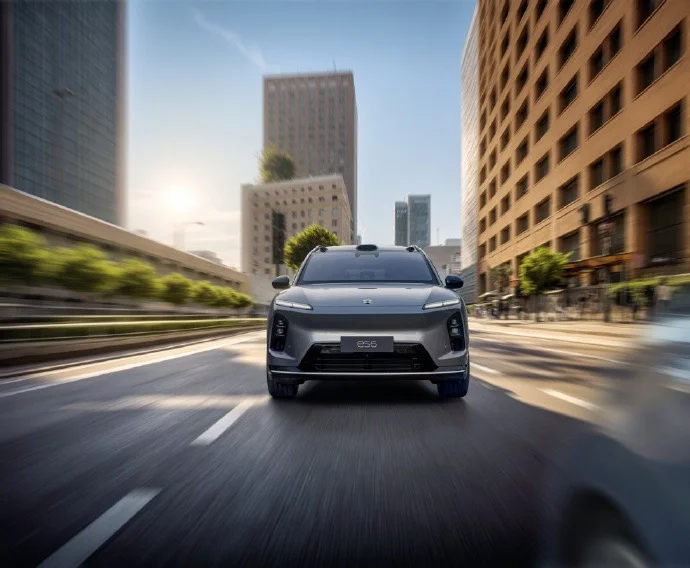
The second phase covers 2022–2024. This stage can be summarized in two sentences: first, it did not meet operational targets; second, NIO made significant counter-cyclical investments.
He believes that the reasons NIO failed to meet its operational targets during the 2022–2024 period include changes in the external market environment, but primarily stem from deviations in internal strategy and pacing.
William Li pointed out that one aspect was product issues, particularly a misalignment between the positioning of high-end products and user needs. For example, the ES8, an eight-series model, had "a gap with user expectations" in terms of design, pricing, and user experience.
On the other hand, the pure-electric route faced dual challenges from policy and market structure during this phase. Against the backdrop of a sharp rise in lithium resource prices in 2022, "the pure-electric route came under pressure, while range-extended and plug-in hybrid models saw growth rates significantly higher than those of pure-electric vehicles."
Beyond product issues, William Li also reflected on the limitations of channel coverage. Although NIO performed steadily in the Yangtze River Delta region, with cumulative ownership exceeding 700,000 units—accounting for more than half of its total—in broader regional markets such as Shandong, Hubei, Henan, and Jiangxi, it still lagged noticeably behind traditional fuel vehicles from BBA.
Channel issues are not new, but with profitability becoming a phased goal, selling cars in a broader market has become more important than ever.
"We have an internal metric called the 'NIO-BMW Index' (NBI)," William Li explained. "In some areas of Jiangsu, Zhejiang and Shanghai, we might achieve 70%, 80% or even over 100% of BMW's sales volume. But in places like Jiangxi it is only 10%, and there are also significant gaps in the Northeast and other northern regions."
In the second stage of NIO's ten-year journey, even if operational targets are not fully met, investment in infrastructure and R&D will remain resolute.
William Li said that this raises a question: the company has incurred relatively large quarterly losses over the past two years. However, preliminary results have been achieved in three areas. First, the layout of the three brands is crucial for increasing long-term delivery volumes. Second, foundational technologies, including NIO’s 12 full-stack core technologies such as chips, operating systems, intelligent chassis, and AI. Third, the charging and battery-swapping network, where investments exceeded RMB 100 billion last year, and this pace has not slowed.
According to William Li, NIO entered its third stage this year, hoping that "previous investments and accumulation will enter a harvest period this year."
One aspect is products. William Li shared the latest delivery figures and new car plans:
ET9 deliveries in its first month (April) surpassed those of the BMW 7 Series and Audi A8 in the same period.
Four new models designated as 5, 5, 6 and 6 have begun deliveries, completing the switch to main-selling products.
ONVO delivered 6,281 units in May, setting a new high for the year. Sales staff have been reduced by 40%, yet sales volume increased by more than 40%. For 60% of ONVO users, battery swapping is the primary decision factor. Current ROI calculations for planned station construction show that half exceed 1. ONVO will maintain independent branding and stores, but its back-office operations will be integrated.
Yinghuochong recorded its first full delivery month with 3,680 units, surpassing the combined April sales of MINI (pure electric) and smart, with user satisfaction exceeding 90%.
The L90 launches in Q3, aiming to "change the three-row SUV landscape and become a significant turning point."
The ES8 launches in Q4, which William Li calls a "king's return."
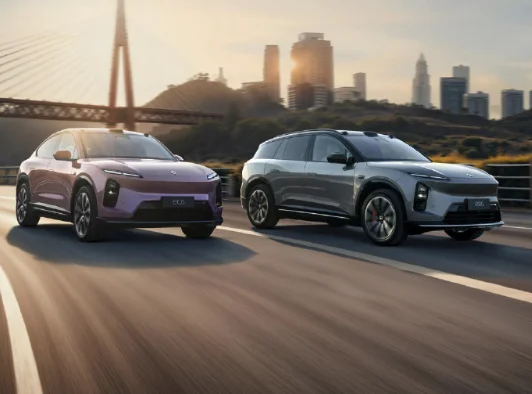
However, compared to the 2019 crisis that was resolved through "external blood transfusion," NIO now places greater emphasis on its internal cash generation capabilities to emerge from the trough of the past three years.
Starting last year, NIO began reviewing its systemic capabilities, and this year it has started improving product control and management efficiency. William Li provided the following timeline: starting from Q1, results will be visible in Q2 (60%–70% of adjustments completed), acceleration continues in Q3 (80%–90% of adjustments completed), and profitability targets are achieved in Q4.
"This time we must rely on our own management to get out of it. This is a consensus reached throughout the company," William Li said.
From William Li’s remarks, NIO’s current core work revolves around three directions: first, driving price recovery and restoring the brand’s fundamental base through product updates; second, continuing to reduce costs via in-house chip development and organizational optimization; and third, systematically advancing toward its Q4 profitability target by tracking core metrics. The overall pace is more pragmatic than last year, with a clearer understanding of where improvements are needed and how to execute them.
However, based on actual performance in the first quarter, this strategy is still in its early stages of recovery: sales growth has been limited, gross margins remain under pressure, cash reserves have declined rapidly, and the synergy and market differentiation among the three brands still need to be verified.
“We believe the lowest point was already reached in Q1 this year, and we have entered an upward trajectory starting from Q2,” William Li said.
03"This time, we must generate our own blood"
In the interview segment, William Li addressed several key issues regarding the profitability formula, organizational adjustments, product and technology pacing, and sales volume, attempting to deconstruct the possibilities of NIO moving from its current reality to its expected goals from a deeper mechanism perspective. Below is the content of this interview, edited for clarity without changing the original meaning:
Q: How much help will bringing the World Model into vehicles bring in terms of sales volume?
William Li: NWM will definitely help boost sales. Over the past year, NIO has invested heavily in active safety, but building reputation has been slow, and users generally do not experience it in their daily lives. We previously placed urban Navigate on Pilot (NOP) lower on the priority list, but this time we have filled that gap.
The new '5566' models won't be launched until the end of June, leaving a three-week gap. This is because migrating from Banyan to our own chips takes time and requires extensive testing. By mid-June, test drives of our main-selling models should allow customers to experience them well, which will certainly help improve sales conversion.
Q: There are rumors that NIO has fallen behind peers at multiple autonomous driving milestones over the past year. I am curious how William Li views this narrative?
William Li: Many things are quickly forgotten. We were actually among the first in China to develop NIO Pilot, and we were the first to implement navigation-assisted driving on highways. Regarding rule-based versions, last year we were the first to enable coverage across more than 700 cities, which was just a year ago. When it came to end-to-end technology, we initially prioritized safety applications, which aligns with NIO’s R&D priorities. Indeed, our performance in urban areas lagged behind competitors by about half a year.
If we layer autonomous driving capabilities, its value lies in two aspects: reducing accidents and freeing up driver attention. Reducing accidents has always been our highest priority, though this benefit is less perceptible to users. At last year’s NIO Day, four insurance companies presented data demonstrating that accident rates had decreased by more than 20%, and the current figure is certainly higher. We have not been falling behind; we used to lead, and we still lead in safety-related scenarios. In urban driving, we have returned to the industry’s first tier. To evaluate intelligent driving comprehensively, one must look at the full picture.
Q: The all-new ES8 is highly anticipated this year. What competitive advantages does it have relative to rivals? Where did the learning costs go? What are your expectations for it?
William Li: The ES8 will be delivered in the fourth quarter. It will definitely feature comprehensive technological leadership, superior user experience, and best-in-class service, while maintaining very competitive costs. During the second generation, we considered the global market too much, so the dimensions were somewhat conservative. With the third-generation ES8, we have liberated our thinking regarding space.
Qin Lihong: The Ministry of Industry and Information Technology (MIIT) announcement for the third-generation ES8 is expected to be released within June according to schedule. You will see some of its information very soon.
Q: During last night’s earnings call, it was mentioned that ONVO aims for a monthly sales volume of 25,000 units across its three models in the fourth quarter. What are NIO’s specific expectations for the L60, L80, and L90 respectively?
William Li: We certainly hope to have as many L90s and L80s as possible, which would relatively improve gross margins. However, the L60 has the potential to return to a steady state of 10,000 units in monthly sales. If we use reasonable expectations for the L80 and L90, our target is for the two models combined to achieve around 15,000 units in monthly sales.
Q: The monthly sales target of 50,000 units we previously planned—was this based on actual calculations or just expectations? Could there be a situation like ONVO, where targets are not met?
William Li: Quarterly reports have a lag; the reality is that the most challenging quarter has already passed, and our sales are now continuously rising.
With improvements across various areas, we are confident that ONVO can reach 25,000 units in Q4, while Yinghuochong could see levels between 3,000 and 5,000 units. Last December, we also reached 30,000 units, and currently, we can see about 25,000 units per month. There are still major models yet to be released, and the effects of channel layouts and other initiatives are gradually beginning to show. Our vehicles are all the latest new models, so there is no reason why we shouldn't succeed.
Overall, we remain confident. Although our initial expectations for the L60 were indeed higher, we have now returned to goals that are achievable with effort. Last year, we had basically no new models except for the L60, yet we still grew by approximately 40%. I believe that if we execute well in the coming months this year, hitting 50,000 units is not unrealistic.
Qin Lihong: We have our own targets and pace, but I can add one more point: even if we fall slightly short of the 50,000-unit target, it is not a cause for alarm. Although June has only just begun in Q2, our sales will likely grow by more than 70% compared to Q1, and gross margins will definitely improve while expenses will further decrease. As a listed company, we cannot make irresponsible profit forecasts or investment advice due to pressure from others; doing so would violate listed company management laws. We cannot speak in that manner, but the fact is that the low point has already passed, and now is actually a good time.
Q: If we look for incremental growth in lower-tier markets, do you have any new plans regarding channels?
Qin Lihong: There are two ways to enter, which can be understood as a combination of 'positional warfare' and 'guerrilla warfare.' Some areas rely on direct-sales systems, which have relatively high short-term investments but stand firmer in the long run. Other areas use marketing methods that leverage battery swap stations plus teams to interact with potential local users, which is currently being practiced extensively.
Q: What concrete reforms has NIO implemented so far?
William Li: This round of adjustments aims to build a bottom-up, company-wide culture of operational accountability. It is no longer just William Li and Qin Lihong who are responsible for the company’s overall financial results; every individual must be accountable for the outcomes of their own responsibilities. We are not simply chasing sales volume, but rather pursuing final operating results—specifically, whether you generate profit or loss. Every person must bear responsibility for their P&L.
Starting in May, every frontline fellow can clearly see how much the company spends on them and how much they earn for the company. Each vehicle is treated differently, and we view each fellow as a basic unit of operation. Under the logic of company-wide operation, many colleagues have left over the past few months, whether voluntarily or involuntarily.
Q: During the earnings call, management mentioned plans to control R&D expenses at between RMB 2 billion and RMB 2.5 billion per quarter. Is this a temporary strategy, or does NIO intend to maintain this level of R&D intensity long-term?
William Li: Our R&D focus remains on improving efficiency. Although our current R&D spending is approximately RMB 3 billion per quarter, we will reduce it to RMB 2 billion–RMB 2.5 billion. This implies an improvement in R&D efficiency of more than 20%. In simple terms, RMB 2 billion–RMB 2.5 billion in R&D expenditure is sufficient to maintain our current R&D intensity. We will mainly cancel projects with low ROI and concentrate personnel on high-output projects.
From the perspective of our current R&D management direction, RMB 2 billion–RMB 2.5 billion in R&D expenditure can meet our competitive needs without affecting our competitiveness in R&D.
Q: Is NIO facing greater challenges now, or were things harder in 2019?
William Li: Overall, 2019 was definitely harder. In 2019, thanks to luck—including strategic investors from Hefei and Anhui—we were rescued from the 'intensive care unit.' In 2019, we truly relied on external help to get out of that situation.
The landscape has changed. NIO’s risk-resilience is significantly stronger than it was in 2019. Moreover, investments made over the past three years—or even longer—are finally starting to yield returns this year.
But the challenges this year are different as well. In 2019 and 2020, industry competition was not as fierce; everyone was struggling. Today, competition is much more intense. To climb out of the trough, the entire company must elevate its capabilities and strengthen itself fundamentally. The challenge in 2019 was finding external capital to keep us afloat; this time, we must generate our own cash flow. The difference is substantial.
Q: Chinese automakers have entered another round of price wars. How long do you think this round will last, what impact will it have on upstream and downstream industries, and will it affect NIO’s profitability in the fourth quarter?
William Li: We have always opposed price wars, and I am very pleased to see that relevant national departments are now regulating industry chaos, with industry associations also issuing appeals. The mindset behind price wars is still "winner takes all." I have always believed that this mindset does not align with the overall development laws of the automotive industry. After all, the automotive sector is not a platform business; it would keep the entire industry in low-level and vicious competition. I hope the industry can truly compete on technology, quality, and service, so that the industry can develop healthily and sustainably. Only then can we maintain the hard-won positive situation of China's intelligent electric vehicle and new energy industries.
By Dayong Edited by James