Horizon Robotics CEO Yu Kai: After 15 Million Chips, the Goal Is to Be an Open Computing Platform
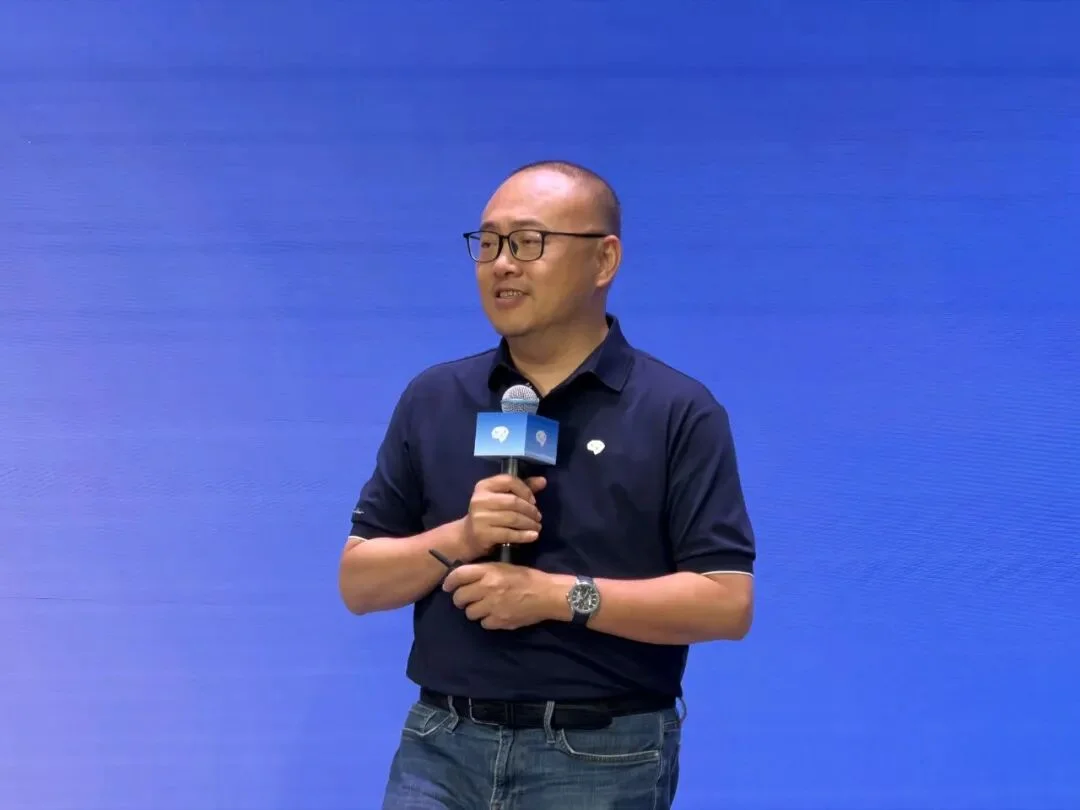
"I was happy for two seconds, then I moved on."
This was Yu Kai's reaction when asked about Horizon Robotics' autonomous driving chip shipments reaching 15 million units.
Recalling the anxiety of his early days in chip development: the team was young, and there was no certainty whether a single chip would succeed. The entire core team once went together to Lingyin Temple to burn incense. In Yu Kai's memory, most of this journey has been muddy, with rare and fleeting moments of glory.
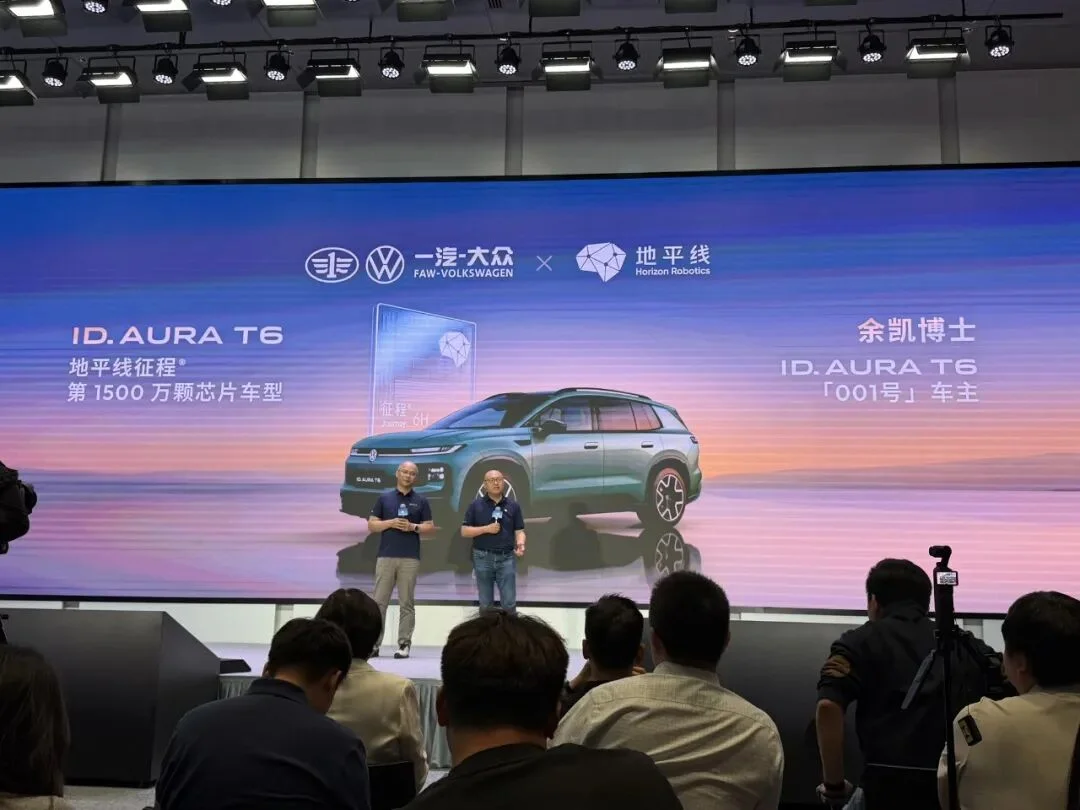
On the afternoon of September 15, at the Horizon Robotics building in Shanghai's Lingang area, we witnessed the milestone shipment ceremony. The 15 millionth Horizon Robotics chip was installed in a FAW-Volkswagen ID. AURA T6, and Horizon Robotics founder and CEO Yu Kai became the owner of this vehicle.
In a subsequent conversation between Yu Kai and reporters from 42HOW Auto and other media outlets, he offered a judgment on the industry's endgame: there may ultimately be only two or three global core technology suppliers for autonomous driving; automakers might see 80% choose to cooperate with suppliers, while 20% insist on vertical self-research. He joked: "Right now, every OEM thinks it is that 20%."
Horizon Robotics has prepared different cooperation models for these two types of automakers: selling chips and software, as well as providing technology licensing to self-developing automakers. Yu Kai hopes that Horizon Robotics can become an open computing platform for the intelligent automotive era.
Yu Kai shared data on the market share of ADAS chips: in the domestic brand ADAS market, Horizon Robotics' share rose from 3.7% in 2022 to 50.0% in the first half of 2026, approximately double that of second-place Mobileye. During the same period, Mobileye's share dipped slightly from 26.1% to 25.1%, while shares for Renesas, Xilinx, and Texas Instruments contracted significantly.
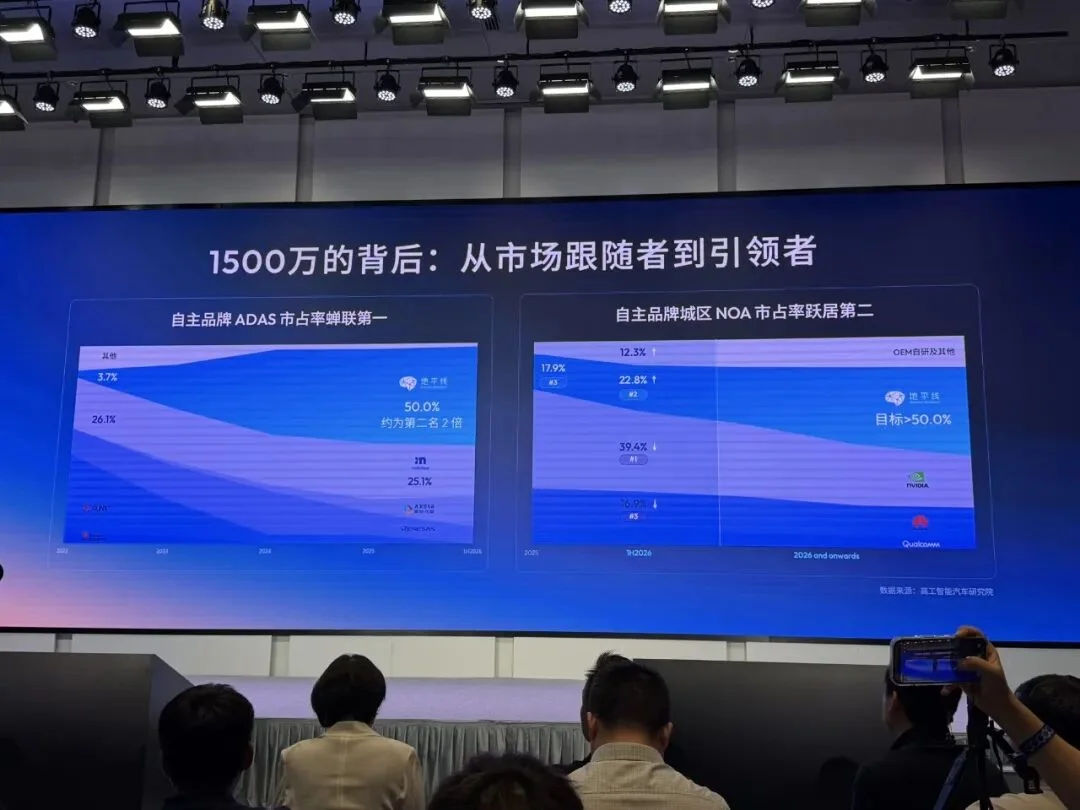
In the domestic brand urban NOA (Navigate on Autopilot) market, Horizon Robotics' share increased from 17.9% in 2025 to 22.8% in the first half of this year, ranking second behind NVIDIA's 39.4%. Yu Kai aims to become the market leader in this segment next year.
Horizon Robotics' most important product this year, HSD, has also seen new developments. Yu Kai revealed that HSD 2.1 is imminent, featuring new capabilities such as full-scenario reverse parking, allowing vehicles to back out if they enter a dead end.
Additionally, HSD will be mass-produced in a leading new energy vehicle manufacturer's models within the year. Yu Kai described this company as "the world's largest new energy vehicle manufacturer." It can be inferred that HSD is about to be mass-produced in BYD vehicles.
When discussing the experience of driver assistance, Yu Kai expressed confidence: "Anyone can test drive it. The capabilities of any HSD-equipped model are comparable to those of luxury cars priced above RMB 300,000."
However, when asked whether consumers should be charged a subscription fee, he offered a different metric: driver assistance "does not truly provide a safety net for drivers." At this stage, purchasing driver assistance remains a one-time configuration purchase. In his view, to enable continuous subscriptions, the technology must first be good enough to truly drive for people, reaching L4-level capability.
The following is the main content of the conversation between 42HOW Auto, several industry media outlets, and Yu Kai, founder and CEO of Horizon Robotics, lightly edited.
01How Can 100,000-Yuan-Class Models Access Better Driver Assistance?
Q: What will be the relationship between supplier solutions and automakers’ in-house development in the future?
Yu Kai: I have always believed that the industry’s endgame will converge. Perhaps 80% of OEMs will partner with suppliers, while the top 20% of automakers will pursue vertical in-house development.
I say this to avoid offending any OEM, because every OEM believes it belongs in that top 20%. Every OEM should have its own ambition to master core technologies, which I believe is worth encouraging.
From an industrial perspective, when a mature supplier ecosystem does not yet exist, division of labor is neither specialized nor efficient; at this stage, vertical in-house development may offer a first-mover advantage. But as the industry matures into its later stages, supplier specialization emerges, bringing more professional and efficient players. At this point, open cooperation often yields higher efficiency.
The mobile era followed a similar pattern, with the ARM-plus-Android model emerging later. Even Apple uses ARM instruction sets for its chips. Therefore, I believe open division of labor will become the mainstream, while vertical in-house development will remain the pursuit of only a very small number of top-tier manufacturers.
Q: How can urban NOA (Navigate on Autopilot) be scaled down to 100,000-yuan-class fuel SUVs while maintaining performance under cost pressure?
Yu Kai: Through technology. Horizon Robotics does not engage in low-quality cost-cutting; instead, we provide customers with overall solutions that offer greater cost competitiveness.
For example, the Journey 6M has 128 TOPS of computing power, which is considered mid-range. We will not reduce costs for customers by turning a chip into a low-priced product. Instead, we achieve performance that typically requires hundreds of TOPS through joint software and hardware optimization, all within a competitive cost structure.
The 'involution' I refer to is homogeneous competition within a fixed boundary, relying on low-quality price cuts. What we aim to do is expand boundaries through technology, delivering higher value and more competitive cost structures to customers, while ensuring Horizon Robotics itself remains profitable.
I just mentioned a fuel-powered vehicle model that is about to be released; let’s keep that aside for now, but you can go experience it. I believe its urban NOA (Navigate on Autopilot) outperforms many models priced above RMB 300,000, yet it allows ordinary buyers who can only afford an RMB 110,000 car to enjoy it. This is the significance of our work: using technological progress to make the best technology accessible to everyone.
Q: What should your vision of 'smart driving equity' ultimately look like?
Yu Kai: I’ll use the development of mobile communications as an analogy again. In the past, there were significant differences in communication capabilities between phones at different price points. With 4G, video became smooth, and both entry-level and high-end devices adopted 4G, which later enabled a variety of applications.
I believe current smart driving is somewhat similar to that stage. High-end models feature urban NOA, while lower-end models may lack even basic driver assistance, with intermediate tiers offering front-view integrated systems or highway NOA.
If autonomous driving suddenly becomes exceptionally good and smooth at some point, I think it will become standard equipment even in entry-level models. That would be the inflection point.
We still need to continue working hard and pushing forward. I believe that when drivers no longer need to focus on the act of driving and can instead attend to other matters, it will become very difficult for people to refuse such features.
Q: Will consumers be willing to pay for subscriptions during the driver-assistance phase?
Yu Kai: I believe it requires the technology to be sufficiently mature.
We are currently in the driver-assistance stage, and the system does not truly assume full liability for the driver. In this context, it is simply a vehicle feature—whether standard or optional. You purchase the feature and pay for it.
If, in the future, a robot drives you, you would still need to pay for a ride-hailing service. Therefore, paying on a monthly or per-mile basis seems like a natural progression. I believe subscription models will eventually become standard, but autonomous driving must first reach a high level of performance.
Q: What have you learned from automakers through your collaboration with Volkswagen?
Yu Kai: We have learned a great deal from the German industrial system’s rigorous requirements for quality and safety. This includes testing, version iteration, software release criteria, and hardware quality assurance systems; they execute these processes with meticulous care and strict standards.
We never view ourselves as disruptors entering the automotive industry, but rather as partners. We have our strengths, and they have theirs. It is natural to approach collaborations with an open mindset, fostering mutual benefit.
During the partnership, we also observed that Volkswagen’s chassis engineering is exceptional. Their expertise in tuning, stability, and response latency is evident. These fundamentals directly enhance the user experience of autonomous driving.
Latency is critical. If you are even slightly late, processing may become unsafe; compensating with repeated braking would degrade the user experience. I believe whether a car feels comfortable to drive and handles sudden road conditions with composure depends on the integration between the intelligent driving system and the vehicle as a whole.
02From Selling Chips to Entering OEMs' In-House R&D Systems
Q: Compared to suppliers like NVIDIA, what do you hope Horizon Robotics will rely on to build its advantage?
Yu Kai: I think we should downplay who we aim to surpass and focus more on who we want to become. Horizon Robotics hopes to become an open computing platform for the automotive era.
For years, we have been developing two business models. One is the Wintel model, akin to the PC era's Windows and Intel, providing both hardware and software platforms to support numerous PC manufacturers.
The other is the ARM-plus-Android model from the mobile era. ARM defines open hardware standards, while Android defines open software standards. We refer to this as the AA model.
Applied to Horizon Robotics, one approach is directly selling chips and software; the other is licensing chip and software IP technology. Technology licensing is more open and suits automakers that wish to master core technological capabilities and insist on in-house research and development.
I believe the direct provision of chips and software is suitable for about 80% of original equipment manufacturers (OEMs). Their core competency lies in integrating components and supplier technologies to launch products for complete vehicles.
Q: How will technology licensing change Horizon Robotics's market space?
Yu Kai: The shipment of the solution using 15 million chips discussed today mainly comes from the first model. We are also developing the second IP licensing model.
The first model brings direct market share; the second allows us to stand behind OEMs with in-house R&D capabilities, bringing extended market share.
I hope to combine these two parts so that Horizon Robotics can become the definer of computing platforms in the future automotive era, playing a role similar to Microsoft, ARM, and Android. This is not only for the Chinese market but also for the global automotive industry.
In the past, we followed a strategy of "encircling the cities from the countryside," starting with small computing power, then moving to medium and large computing power. If we look at the share of large computing power, we were roughly second this year. I hope to be first next year, but we still need to work hard.
Q: The leading new energy vehicle manufacturers mentioned this time also place great emphasis on in-house R&D. How did HSD reach a cooperation agreement with them?
Yu Kai: We have maintained long-term partnerships with these leading players. Horizon Robotics offers an open collaboration model, enabling cooperation regardless of whether an automaker pursues a supplier-based strategy or in-house development.
We aim to build the toughest technology while maintaining the most flexible approach, so we will maintain long-term cooperative relationships with various manufacturers. We can discuss specifics privately.
Q: As the number of customers and projects increases, will this lead to a continuous rise in engineering investment and result in diseconomies of scale?
Yu Kai: Our revenue comes from two sources: direct sales of chips and software, and technology licensing. Revenue from human services accounts for a very small share.
How does the "softest approach" support customers? Through technology IP licensing. We collaborate with many partners in the hardware and software fields, outsourcing direct manpower engineering services to them, while Horizon Robotics focuses on the underlying technology platform.
I mentioned this year that 95% of Horizon Robotics' shipments go through partners. For example, in the collaboration with Volkswagen, there are also partners involved.
We've secured orders globally, in markets we haven't even visited ourselves. How did we achieve this? Through partners.
03As features converge, why do suppliers continue to consolidate?
Q: If consumers find it increasingly difficult to perceive differences in driver assistance systems, what competitive advantage do core technology suppliers still have?
Yu Kai: There is a category of technology that is highly convergent, difficult to differentiate, yet extremely hard to execute. Autonomous driving and mobile phone baseband chips share this characteristic.
Mobile communication operates in an open world with no script. In sparsely populated rural areas, in the high-rise dense Lujiazui financial district, or inside subways, you encounter different types of interference. Ensuring smooth, uninterrupted connectivity across varying times and locations is difficult.
Autonomous driving also operates in an open world without a script. It must enable vehicles to travel from point A to point B smoothly, safely, and without interruption, which is equally challenging.
I estimate that by the end, there will likely be no more than two or three core autonomous driving technology suppliers worldwide, as the market converges significantly.
Q: Currently, many intelligent driving talents are moving toward embodied intelligence. What is your view?
Yu Kai: On one hand, this is natural. Horizon Robotics has always used the English name 'Horizon Robotics.' We believe that the first step toward the era of robots is to perfect intelligent driving. Talent fully trained in intelligent driving naturally moves on to embodied intelligence next.
On the other hand, it indicates that the intelligent driving industry has already highly converged. Early in the industry's development, many new companies emerged; now, consolidation has begun. In the future, whether through OEM self-research or third-party tech companies, the number of players will decrease, and talent will flow to the next stage.
I believe Horizon Robotics is in a good position. The industry is reaching an inflection point, moving toward organic and healthy growth. We focus on our own business, delivering each generation of products and every vehicle model well, without needing to tell new stories.
Several years ago, the intelligent driving sector was characterized by the continuous emergence of new companies, both in the United States and China. Now, it has basically converged.
Q: Horizon Robotics has already partnered with major global automakers. What do you consider to be the true entry into the global automotive industry?
Yu Kai: We have already collaborated with global automotive groups such as Volkswagen and Toyota, proving that we have the capability to mass-produce alongside world-leading automakers.
The collaboration is deeply intertwined; we learn from them, and they learn from us. It is not a one-way output process; we have become part of the global ecosystem.
Our strategic positioning and business model enable us to find partners in many areas. As long as we persist in win-win cooperation and altruism, I believe we will earn respect in the global market in the future.
Many people are concerned with whether a company wins in a flashy way; we care more about whether Horizon Robotics is long-term viewed as valuable and beneficial to others. A company that survives healthily for a long time is far more important than one that merely shines brightly. In this way, partners will not feel you are aggressive, but rather see you as an enterprise suitable for long-term cooperation.
04Overseas Orders Exist, but Urban NOA Still Requires Patience
Q: Now that domestic brands are expanding overseas, how does Horizon Robotics view the overseas ADAS market?
Yu Kai: Going global is certainly a major long-term priority, but in the short term, overseas consumers' demand remains focused on basic driver assistance. For the high-end market segment, our strategy is to actively expand our layout.
"We now have over 20 million sets of overseas orders. On the other hand, global automakers will invest in R&D for future high-level driver assistance systems. We can support them through licensing during the R&D phase and generate revenue through direct shipments once they reach mass production."
"We adopt different business models and strategies at different stages to adapt to the progress of various automakers."
"In China, if a car doesn't feature urban NOA this year, it's almost embarrassing to sell. I think it may take another five years for overseas markets to reach that state. Therefore, we need to actively lay out our strategy while maintaining long-term patience."
"Q: With continued consolidation in the domestic vehicle industry, would you prefer a fragmented or concentrated landscape?"
"Yu Kai: Naturally, a more fragmented market is better for me. But there's no point dwelling on it; things will happen as they will. The only thing I can control is what I do and how well I do it."
"I don't think Chinese automakers will consolidate that quickly. This involves significant local government investment, employment, and industrial output value. The automotive industry is simply too important."
"Q: How will cockpit-driving integration change Horizon Robotics' products? What is the current status of mass production?"
"Yu Kai: I believe cockpit-driving integration is inevitable. In-vehicle computing will move toward central computing, with all processing becoming more centralized. Starry is expected to begin mass production in October this year, with larger volumes next year. Another benefit is the reduction of DDR memory usage. By integrating two sets of DDR into one, we can save costs for automakers."
05Highlight moments are rare and fleeting
Q: From the first chip to 15 million units shipped, looking back, what was that journey like?
Yu Kai: We have been established for 11 years; we were founded in 2015. The nine years I mentioned on stage refer to my first visit to Lingang nine years ago. At that time, it was a wasteland with no surrounding buildings. Going from the first chip to shipping 15 million chip solutions involved many challenges. Most of the time was not filled with highlight moments; most of the time was muddy and difficult.
The chip team was very young at the beginning. Looking back, the journey was certainly stumbling. Sometimes, when developing a chip, we felt uneasy about whether it would succeed, and the core team even went to Lingyin Temple to burn incense.
Journey 5 was eventually mass-produced, but the outside world criticized its insufficient CPU computing power. I stubbornly told outsiders at the time that because we were working on end-to-end systems, future needs for high CPU computing power would be low. In reality, I was just being stubborn because we could not afford ARM IP at the time.
Highlight moments are rare and fleeting. Recently, someone asked me if I was happy about the mass production and shipment of 15 million chips. I said yes, but I only felt happy for two seconds before moving on.
More difficult challenges lie ahead, and harder tasks will always follow. After all, we are climbing such a steep slope.
Q: AI is currently very hot, and there is much discussion about bubbles. Will Horizon Robotics be affected by these changes?
Yu Kai: We shouldn't harbor the illusion that Horizon Robotics can single-handedly pull back the entire AI wave or bubble. It is already remarkable enough to get its own homework done.
Horizon Robotics' values are encapsulated in eight characters: empower customers, endure solitude. In strategic choices, we often take less popular paths. When artificial intelligence first surged in popularity, while others focused on facial recognition, we developed chips; when autonomous driving became the hottest topic with Robotaxi leading the charge, we focused on driver assistance systems.
We are not the brightest or most popular today, but we enjoy this state. It helps us stay clear-headed and better reflect on our product rhythm and core strategy. In the vortex of the times, staying clear-headed is actually quite difficult.
Every day, as soon as I open my eyes, a barrage of artificial intelligence news comes rushing in. It feels like being swept along, and it brings anxiety about missing out on the current wave of the times. In the past twenty years, such moments have never been absent.
But I think nothing stays hot to the point of turning purple forever; there are always cycles. Some fields that are cold today may become hot tomorrow, and some that are hot today may turn cold tomorrow. We can't do all the homework. With so many opportunities in the world, even Horizon Robotics can't grab them all.
We are fortunate to be doing something of value to humanity. Rather than standing by the pool envying the fish, it is better to go home and weave a net. Focus on perfecting your own work and ensuring that Horizon Robotics acquires the knowledge it needs.
Q: In the field of embodied intelligence, what role does Horizon Robotics ultimately aim to play?
Yu Kai: We didn't name the company Horizon Robotics just because robotics is currently trending. When we founded the company eleven years ago, that was already the name. It has always embodied our original aspiration and ambition at the time: to build a computing platform for the era of robots.
What is a computing platform? It is the entity that defines hardware and software standards, enabling global robots to develop upon this foundation.
The first step is to become a computing platform for the automotive industry. Beyond chips, HSD aims to establish software standards through direct shipments and IP licensing partnerships. We are also expanding from intelligent driving to the cockpit with our Starry product.
Once we have established ourselves as the standard-setter for automotive computing, the next phase is to move into robotics. We believe that automotive computing is an essential pathway to future robotic computing.
I often draw parallels between the automotive and smartphone industries. Smartphones achieved scale and low costs by miniaturizing technologies such as computing, mobile communications, and sensors; these technological dividends enabled the widespread development of the Internet of Things. I believe the automobile will lead to ubiquitous, generalized robots in the future.
By the time I retire, I hope Horizon Robotics will be the standard-setter for computing in the global robotics industry, encompassing both hardware and software.
Written by: James Edited by: Daji