


Interview with Yu Kai, Founder of Dipingxian: Entering Urban Assisted Driving Is Not Too Late; Aim to Create Products That Make Users Scream
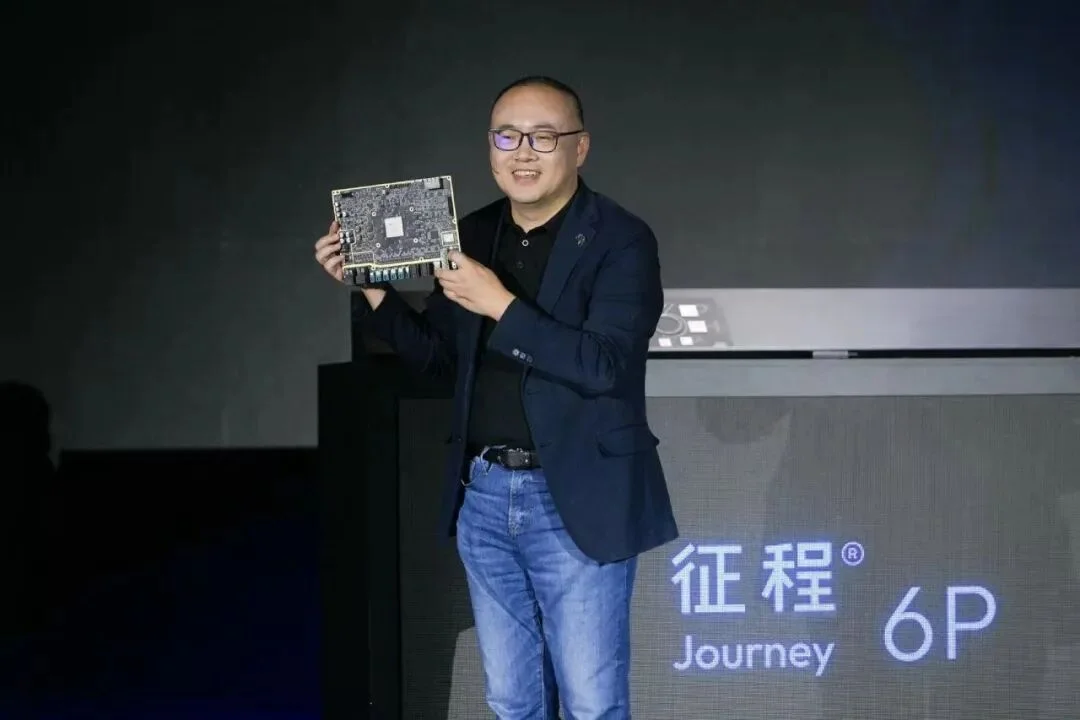
On the tenth anniversary of its founding, Dipingxian founder and CEO Yu Kai announced two major developments last night: the company’s most powerful driver-assistance chip to date, the Zhengcheng 6P, and the mass production of its urban assisted driving system, HSD, scheduled for September this year. The system will debut on the Chery Xingtu brand.
During a nearly three-hour press conference, Yu Kai shared his entrepreneurial reflections and discussed several "counter-consensus" viewpoints on driver assistance. As the company at the forefront of this year's wave of democratizing driver assistance—with one in every three smart vehicles equipped with Dipingxian—Yu Kai's views are also driving the entire industry to return from aggressive promotion to rational pragmatism.
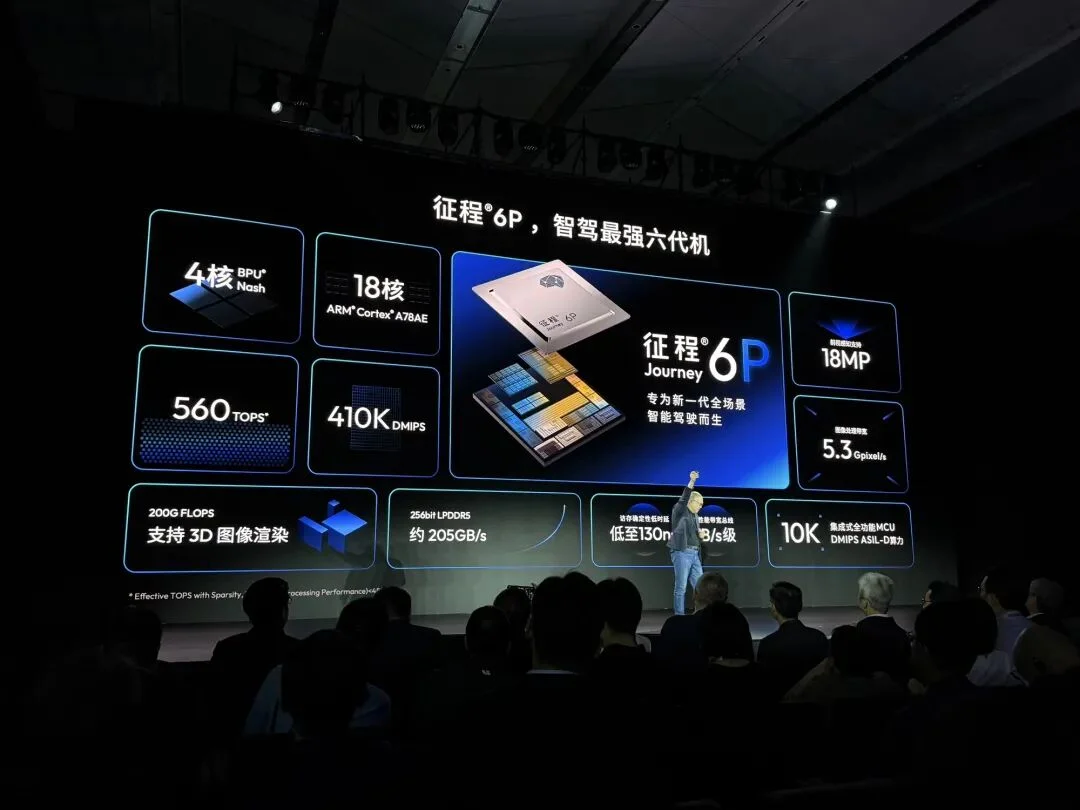
On the eve of last year's Beijing Auto Show, Dipingxian released the Zhengcheng 6 series of driver-assistance chips. Over the past year, the Zhengcheng 6E and 6M variants achieved early mass production in vehicles, while the higher-end Zhengcheng 6P was officially unveiled last night. Key architectural features of the Dipingxian Zhengcheng 6P include:
AI computing power of 560 TOPS, CPU computing power of 410K DMIPS, and GPU computing power of 200G FLOPS;
A four-core Nash Jiagou BPU;
An 18-core Arm Cortex A78AE architecture CPU;
Support for front cameras with up to 18-megapixel resolution (compared to the industry standard of 8 megapixels).
Image processing bandwidth: 5.3 Gpixel/s;
256-bit LPDDR5 memory, with a bandwidth of approximately 205 GB/s;
Integrated full-function MCU, delivering 10K DMIPS of ASIL-D compute power;
Memory access deterministic latency: 130 ns.
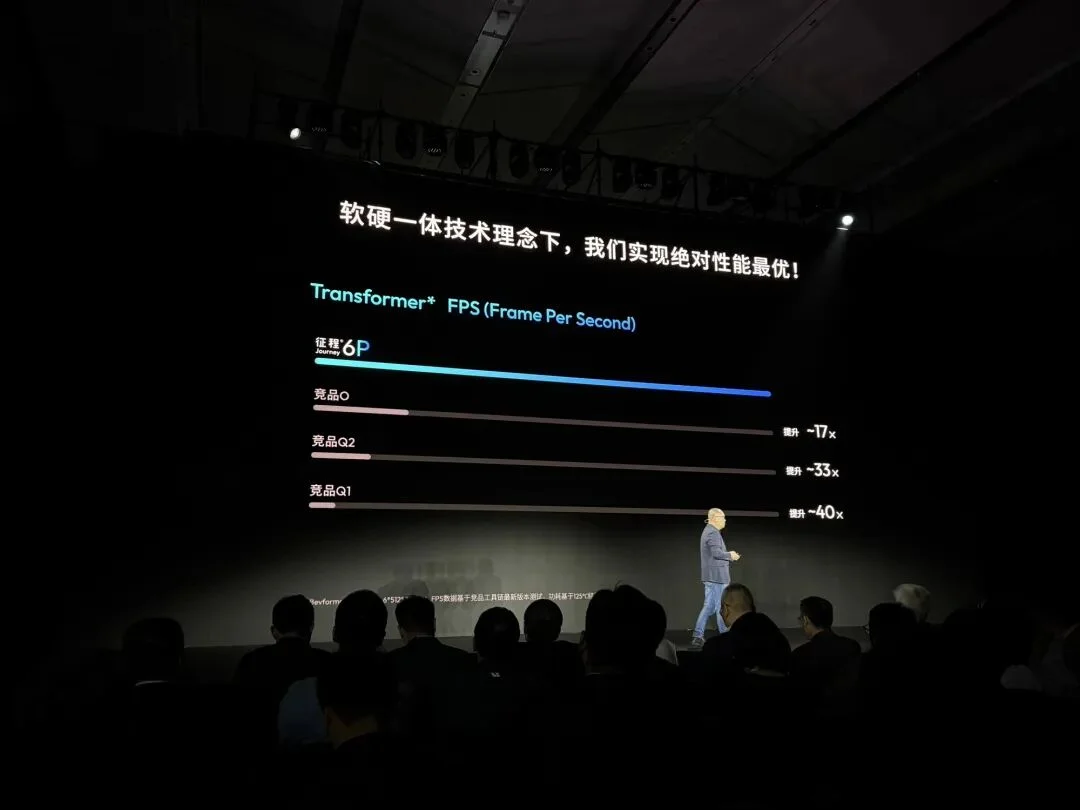
In terms of performance, when running Transformer networks, the Zhengcheng 6P processes frames per second (FPS) at a rate 17 to 40 times higher than competing products. Additionally, the Zhengcheng 6P offers superior cost-effectiveness, achieving an FPS-per-dollar ratio that is 4 to 12 times better than competitors.
How should we understand the relationship between performance and cost?
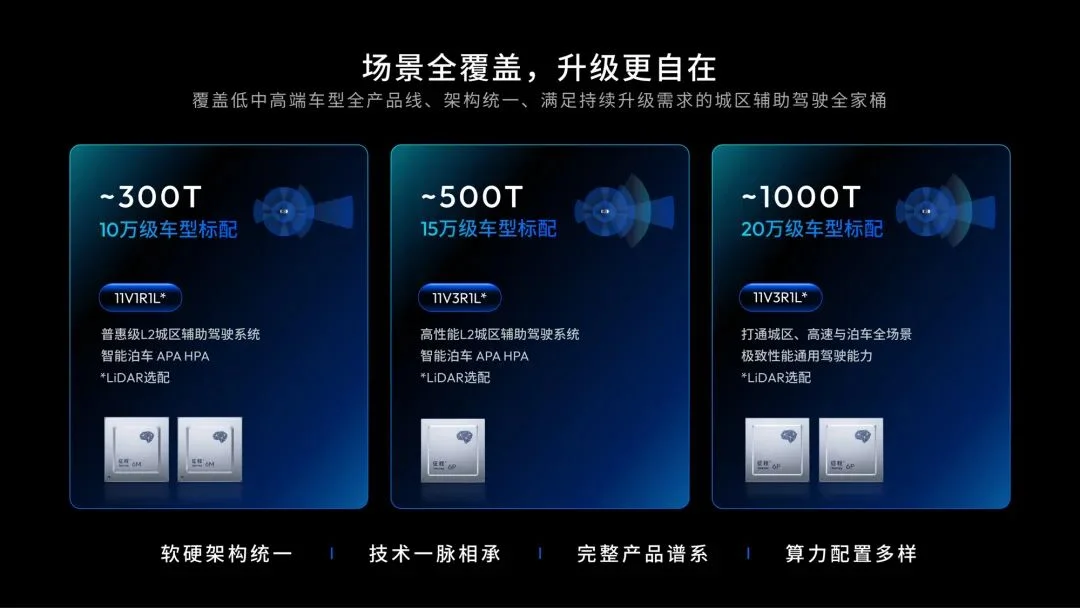
Dipingxian’s answer is the Horizon Cell, a modular, plug-and-play reference design for domain controllers. A domain controller equipped with dual Zhengcheng 6M chips delivers approximately 300 TOPS of computing power, enabling standard fitment in vehicles priced around RMB 100,000; one with a single Zhengcheng 6P chip provides about 500 TOPS, suitable for models around RMB 150,000; and a unit with dual Zhengcheng 6P chips offers roughly 1,000 TOPS, fitting cars in the RMB 200,000 segment.
The secret to democratizing driver assistance lies here.
When discussing the naming of Dipingxian’s urban driver assistance system, HSD, Yu Kai joked: "Before last night, we called it... I won't say."
Through numerous videos, Yu Kai aims to demonstrate that HSD is an urban driver assistance system that mimics human driving behavior while earning user trust. He presented a formula: User Trust in Smart Driving = (Sense of Security × Professionalism × Intimacy) / Exaggeration.
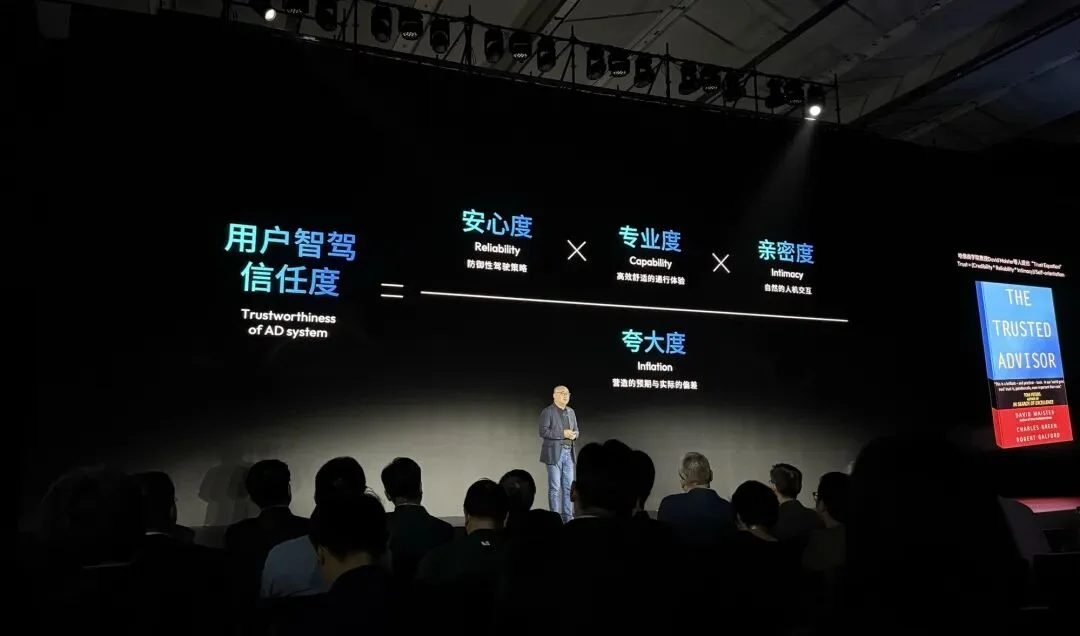
First is the sense of security. Yu Kai noted: "If a user experiences three panic-induced takeovers within 10 kilometers of using an urban driver assistance system, 80% will abandon the feature, leading to a collapse in trust."
During urban driving, test vehicles equipped with HSD can smoothly yield to pedestrians while maintaining efficiency. The system handles blind spots calmly and navigates irregular construction zones effectively.
Regarding professional capability, Yu Kai noted that current industry ADAS solutions achieve highway driving efficiency at 90%–120% of human drivers, but urban ADAS efficiency is only 65%–80% of human levels. This significant gap results in a situation where drivers are hesitant to use the system for commuting and reluctant to use it after work.
Yu Kai demonstrated the capabilities of test vehicles equipped with HSD in scenarios such as roundabouts, mixed traffic of pedestrians and vehicles, U-turns on narrow roads, and merging from auxiliary roads onto main roads. He also presented comparisons of urban ADAS efficiency versus human drivers, along with footage showing pets inside the vehicle.
In terms of intimacy, Yu Kai showcased the HMI (Human-Machine Interface) that previously won an iF Design Award, presenting a realistic and authentic human-machine interaction interface.
The denominator of this formula is 'exaggeration.' Yu Kai stated, 'We must remain calm during the frenzy and steadfast in pessimism. Actions speak louder than words; we do more and say less.'
According to the plan, HSD will be integrated into Chery's Xingtu brand models featuring the Lieyingfangan solution in September this year.
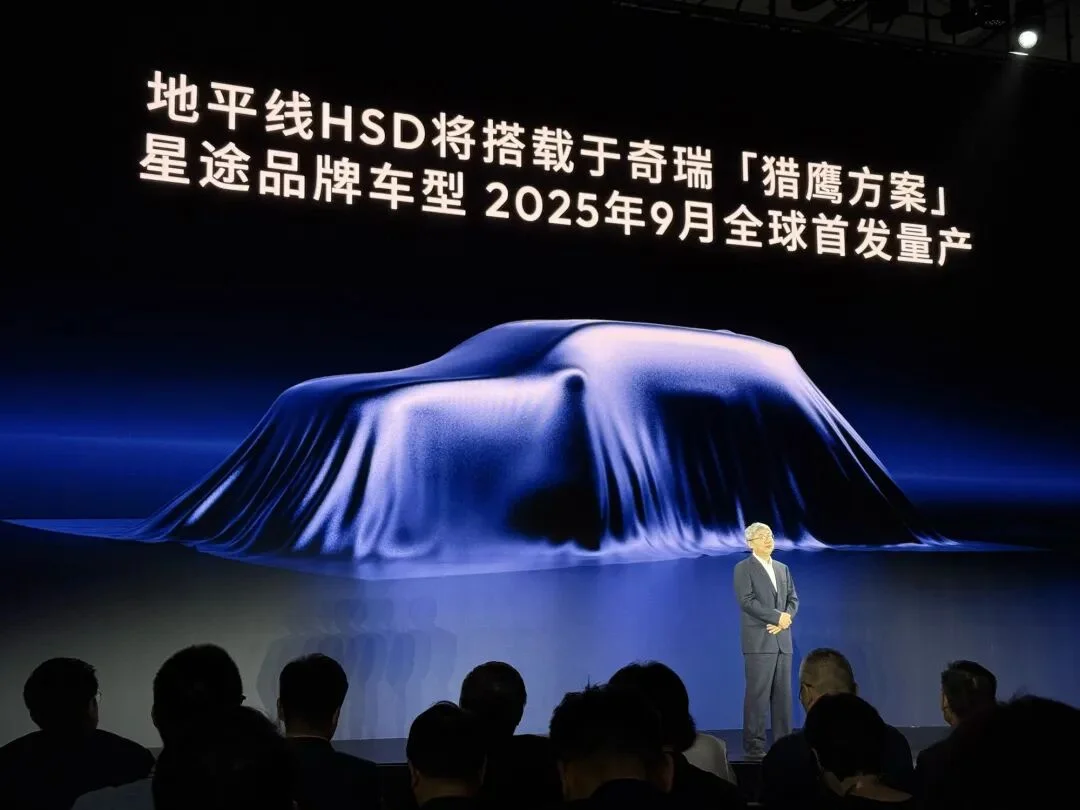
Chery Automobile Chairman Yin Tongyue attended last night's launch event. He remarked, 'For the past 20 years, Chery has relied on engines; for the next 20 years, we must rely on intelligence—or rather, on Yu Kai.'
Technological development has not stopped. At last night's launch event, Yu Kai also discussed future trends in ADAS. Since the beginning of this year, various automakers have been actively embracing L3 technology. So, how is L3 defined?
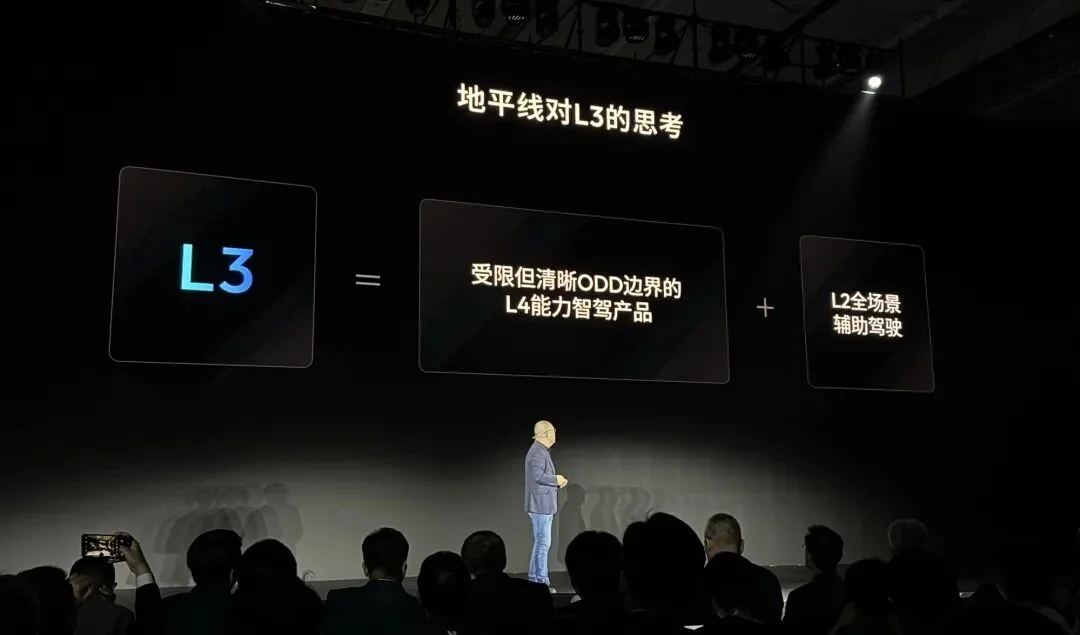
Yu Kai noted that some automakers' definitions of the operational design domain (ODD) for L3 systems are unclear, making them largely unusable for users. Conditions such as clear weather, good lighting, and distinct lane markings remain vaguely defined. Dipingxian aims to position L3 as a product combining L2 all-scenario driver assistance with L4 capabilities that have restricted but clearly defined ODD boundaries.
How should clear ODD boundaries be defined? Take the Beijing Fourth Ring Road as an example.
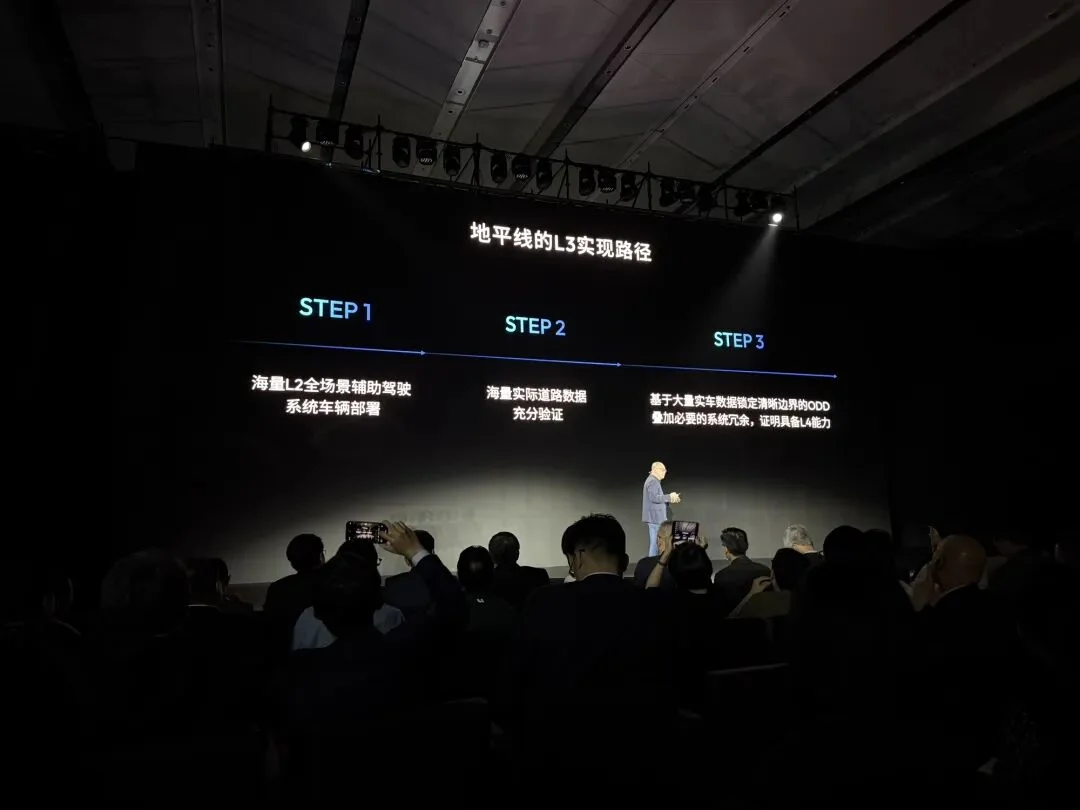
To achieve L3, Dipingxian plans to proceed in three steps: First, deploy a massive number of vehicles equipped with L2 all-scenario driver assistance systems; second, fully validate these systems using extensive real-world road data; third, based on this large volume of vehicle data, lock in clearly defined ODD boundaries and add necessary system redundancy to demonstrate L4 capability.
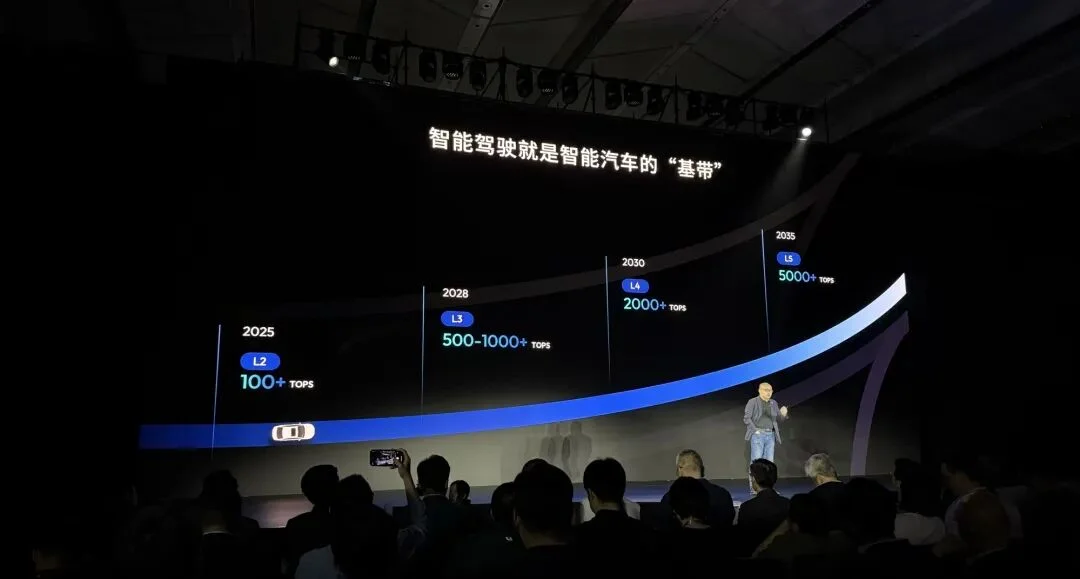
Yu Kai also provided a timeline: L3 systems with 500–1,000+ TOPS of computing power will see widespread adoption by 2028; L4 systems with over 2,000 TOPS will land by 2030; and L5 autonomous driving with 5,000+ TOPS is expected to arrive ten years later, in 2035.
This morning, 42HOW Auto joined several industry media outlets to interview Yu Kai, founder and CEO of Dipingxian. He provided detailed answers regarding topics such as the HSD urban driver assistance system, L3, and robotics, which were released last night. Below are the key points from the on-site conversation.
Q: How have Dipingxian's mission and vision changed from 2015 to 2025? The mission has become increasingly focused. How do you view Dipingxian's short-term and long-term business changes, and how do you think about them?
A: Yes, it has become more focused. I believe we aim to dominate the intelligent driving field within three to five years. As for the robotics business, it may be a bit early within that same three-to-five-year window; I feel it will require at least five years of cultivation. I think current robots, such as robot vacuums, are too simple. For humanoid robots, I feel they are still quite far from true practical usage, so I estimate that timeline might be after five years, or perhaps five to ten years out. So, the automotive business could be dominated within three to five years, followed by the robotics business being dominated within five to ten years. I believe the market size for the automotive business can reach tens of billions of U.S. dollars within three to five years. What I am actually referring to is more of an abstract concept, implying that the inflection point for autonomous driving has appeared, but not yet for robotics.
Q: It is now difficult to openly discuss high-level intelligent driving. What changes do you expect in the industry, and what impact will they have?
A: We cannot use the term 'high-level,' but we can talk about higher levels of intelligent driving. This remains unchanged: using superior technology to outperform lower-tier solutions, and speed to beat slowness. I believe the trend toward L5 autonomous driving in the human world will not materialize. Currently, regulation is needed; you must properly call it driver assistance. Such regulation is good for the industry. In recent years, due to various anxieties and competitions, everyone's actions have indeed become distorted. Returning to a normal track does not mean slowing down industry development; rather, I believe it accelerates it. Just as high-speed trains can reach 600 kilometers per hour because they have tracks, only with regulated tracks can the train of autonomous driving technology truly develop rapidly.
Q: From the user's perspective, the distinctions are unclear, and users do not know how to choose. What is your view on this?
A: I think it was like that before, but now it may be less so. Because I feel that in the past, highway driver assistance actually provided scenarios where users could reach autonomous driving experiences, but these were indeed quite sparse. At least, for example, when you went to a 4S store and said you wanted to experience driver assistance, and the staff member said, "How about we go to the highway?" requiring a 40-minute drive, it would likely scare away 99% of people. So, in the past, autonomous driving was essentially just a configuration—a single line written during car sales—but ordinary people couldn't truly experience it. However, with urban driver assistance, you can use it right at the entrance of your 4S store or during your daily commute.
I believe that at this stage, quality becomes crucial. Like picture-in-picture color TVs in the past: having it is better, but if it's missing, we won't buy it; however, if it exists, we don't necessarily need it. Now, I believe the true inflection point is that urban driver assistance will allow every ordinary person to truly access and experience this technology during their daily commute. Therefore, I believe consumers will definitely demand to know whether it is good or not. You cannot just brag or write a few lines of text.
For users, they do not care about your computing power. But from a technical complexity standpoint, greater computing power means higher model complexity, which likely leads to a better user experience; this is certain. Computing power is an important indicator, but ordinary consumers focus on three indicators for driver assistance: first, is it sufficiently safe? Second, is it sufficiently comfortable? Third, is it sufficiently efficient?
Q: You mentioned at yesterday's press conference that 99% of human data is not worth learning from. Do you believe data is unimportant, or do we need to find another solution path?
A: The large model approach does not mean data is unimportant; it means human behavior is not the primary target. In the context of driver assistance, 99% of drivers actually drive poorly. Braking, turning, and lane changes often lack sufficient comfort. From what I understand, Tesla uses its own proprietary fleet, employing specially trained drivers rather than ordinary users, and combines this with reinforcement learning as it moves toward this platform.
In the era of artificial intelligence, essentially all AI products must surpass human levels. This does not mean setting human performance as the goal. It is neither about exceeding nor falling short of human capability, but rather approaching it closely. Ideally, the system should know what you are thinking and recommend content accordingly. This is the logic behind AI products.
Q: Has the Scaling Law not taken effect yet? As we move toward higher computing power and more parameters in the future, will we also see diminishing marginal returns?
A: That is certainly the case. Regarding autonomous driving, the Scaling Law has only just begun and has not yet reached its limit. Currently, as we continue to increase computing power and expand the scale of neural network models, we still see sustained improvements in performance. I believe that for the next ten years, autonomous driving will require continued increases in computing power, although the rate of improvement will eventually slow down to a certain extent.
L3 requires highly capable, full-scenario driver assistance. Once this is achieved, progress will likely slow down, and tackling various corner cases will become extremely difficult. I believe we will ultimately succeed in solving these issues.
It is similar to mobile communication baseband chips, where only a few companies in the industry excel. It is challenging to ensure mobile phone connectivity amidst urban high-rises, subway systems, sparsely populated rural areas, and mixed environments with different suppliers' base stations. I think this is very much like autonomous driving: dealing with scenarios both with and without lane markings, and even off-road conditions. If autonomous driving can be made truly perfect, your technology may improve rapidly, but once you reach a certain level, you will hit a bottleneck. Going from 90 points to 100 points will be extremely difficult.
Q: What is Dipingxian's layout in the robotics field?
A: We provide the infrastructure for the robotics era. We believe that truly breakthrough applications for robots may not be visible in the immediate future, so we are committed to long-term ecosystem cultivation. Just as CUDA did not see such rapid explosive application growth initially, NVIDIA still invested early in the CUDA ecosystem. From Dipingxian's perspective, our goal is to make the D-Robotics computing chip platform the first choice for all robot developers. That is our current objective. As for which company will eventually achieve an explosion in popularity, it is difficult to predict. We lay the foundation; we do not know where a towering tree will grow, but as long as it grows on our land, that is sufficient. We will not build robots ourselves. We firmly believe that making operating systems and chips is the best path.
Q: What is the relationship between Xitongyi and Xitonger, and how will they operate? Will you develop world models?
A: We do not consider VLM to be Xitonger; we believe that the true game of reinforcement learning is what constitutes Xitonger. Incorporating these large language models is an excellent way to enhance autonomous driving capabilities, but it does not represent a true interactive game. Therefore, for Xitonger, we primarily focus our efforts on reinforcement learning.
We are definitely working on world models. Our HMI is so beautifully designed because, by inputting sensor data, it can generate dynamic and static models based on our world model.
The long-term technical architecture is dual-system. However, the interactive game of reinforcement learning will constantly feed back to enhance Xitongyi, that is, more systems. New drivers usually think, while experienced drivers do not think; when you turn a lot of thinking into habits, it becomes Xitongyi. So actually, many things in Xitonger, once slowly become habitual, will become part of Xitongyi, but in the long run, both architectures will definitely coexist.
Q: After HSD, will you develop a more aggressive version?
A: We do not believe autonomous driving needs to be aggressive. I feel that autonomous driving should make users feel comfortable, secure, and reassured. We do not view aggressive development as necessary for autonomous driving; instead, we prioritize user experience.
Q: Is the view that '99% of human driving data is not worth learning' likely to become mainstream in the industry?
A: I am arguing that user data is not worth learning from, whether for large models or driver assistance. If you look at Lixiang, some reports indicate they only use high-quality 'golden data' for training. Other reports mention that Tesla uses data collected by its dedicated fleet and specialized training datasets, along with simulation technologies introduced late last year. Essentially, this is the current approach. I believe we should think more critically; it is through thinking and clashing ideas that we find the right direction. If everyone just blindly follows the crowd and brags about the same thing, this industry won't be very interesting.
Q: How does Dipingxian help automakers and developers?
A: If you want to compete in artificial intelligence computing for servers and data centers, catching up to the CUDA ecosystem is extremely difficult. In fact, I don't think any company has achieved this yet. NVIDIA's server computing capabilities are designed to address boundless possibilities, making it nearly impossible to keep up. Therefore, Dipingxian's strategy is to compete where there is little competition.
We focus on autonomous driving and robotics. These fields primarily involve perception, motion, and decision-making. Within this relatively focused domain, our operators are also concentrated.
We choose a narrow path, but within that narrow gate, clarity may suddenly emerge, revealing a vast new field. NVIDIA did exactly this back then. We entered through autonomous driving and discovered robotics, which naturally has diverse applications. There are excellent prospects for flying vehicles, and countless uses in homes. Perhaps taking this narrow path will lead to sudden breakthroughs.
Many chip companies rushed in recklessly but failed to open up the market because their toolchains and software ecosystems were non-existent. A chip company with only hardware capabilities and no software strength cannot survive.
Q: Are L4 companies closer to the ultimate goal of autonomous driving?
A: Their overall system costs remain too high, and their product starting points differ. Their system costs revolve around operational scenarios, whereas we consider how consumers can afford passenger vehicles. Our different starting points lead to divergent paths.
Q: When did the collaboration between Dipingxian and NIO begin? Why did Yinghuochong use Zhengcheng 5 instead of Zhengcheng 6?
A: That collaboration started quite early. We began working together in 2023, at which time Zhengcheng 5 was selected because Zhengcheng 6 had not yet been released.
Q: How do you view automakers developing their own chips?
A: The leaders of these automakers are actually good friends of mine. Whenever they consider developing their own chips, I always tell them they should go ahead and ask if there is anything I can help with. If they are willing to endure such a difficult entrepreneurial journey, they must have very grand dreams. Each of them likely hopes to become the next Steve Jobs or the next Elon Musk.
I believe that without such ambitious dreams, it would be impossible to support people through such arduous entrepreneurial experiences. Therefore, their efforts deserve applause. My focus is on the endgame of the industry: who will become the Steve Jobs or Elon Musk of this sector. I estimate there is only about a 20% probability that someone in this space will achieve that level of success. However, for the remaining 80%, the industry will likely return to open industrial synergy and collaboration. We can see this pattern in the smartphone industry, and it is even more pronounced in the PC industry, where companies rarely develop their own chips. I am concerned with the endgame; there will definitely be a large market segment that requires suppliers. Therefore, we should simply focus on doing our work well. I cannot influence or change others' decisions.
Q: What are the respective technical advantages and disadvantages of HSD compared to Huawei and Tesla?
A: I believe FSD currently has the highest level of autonomous driving among mass-produced vehicles globally. Huawei’s capabilities are also formidable, and ours are equally impressive, making direct comparison difficult. Ultimately, I think the key lies in user experience. This is not a complex matter requiring professional agencies to evaluate. It essentially boils down to three metrics: first, safety; second, comfort; and third, efficient traffic flow. I believe these three indicators are not difficult to achieve. When user reputation improves, the results will naturally become apparent and obvious.
Q: Dipingxian focuses its business on autonomous driving and robotics. How are investments allocated between these two areas, including financial and human resources?
A: I find it difficult to provide a specific figure, but roughly 1 in 20 people are working in the robotics field. Look at the current state of robots; do you really expect them to be profitable yet?
Q: What is Dipingxian's plan for L3?
A: The foundation of L3 is sufficiently capable urban assisted driving. I believe we still need to make significant efforts to achieve 'sufficiently good' urban assisted driving. Crucially, urban assisted driving requires extensive deployment because you must rely on actual operational statistics to prove that it is safe enough. Therefore, I don't think this is something to be decided by guesswork. That is why I have not been overly aggressive in promoting this concept; I believe we should first focus on doing a good job with current urban assisted driving.
Q: Dipingxian's Clip System has launched three versions. What are the mass-production timelines for these three versions, and why are there three versions?
A: If we followed our own preferences, we would prefer to sell only the dual-Zhengcheng 6P configuration. However, each automaker has different understandings and positioning strategies. In my view, industry trends will inevitably converge toward the middle ground. Urban assisted driving will become a standard feature on every vehicle. I believe that within three years, it will become standard on models priced around RMB 100,000, meaning both single-Zhengcheng 6P and dual-Zhengcheng 6P configurations will become standard. Of course, the dual-Zhengcheng 6M offers cost advantages.
But all AI systems follow this scaling law: the more products, the larger the model, and the better the performance. I believe users will ultimately purchase high-compute solutions. I often like to compare basebands with autonomous driving, and you'll find an interesting phenomenon. When 3G first emerged, only high-end phones used it, while many low-end phones still relied on 2G basebands, making 3G an optional feature. However, when 4G arrived and video streaming suddenly became smooth, everyone switched to 4G, including low-end phones. Therefore, I believe autonomous driving will experience a '4G moment' in the next two to three years, with urban assisted driving becoming standard equipment, provided that urban assisted driving is sufficiently good.
Q: Dipingxian proposes the integration of software and hardware. Does this mean transitioning from Tier 2 to Tier 1?
A: Actually, the commercial essence of Dipingxian has remained unchanged. If you look at the past few years, we have provided automakers not only with chips but also with extensive software toolchains and development tools. This is precisely what allows Dipingxian to stand out among other autonomous driving chip companies. Fundamentally, you need to deploy software on top of the chips.
So you need to help automakers deploy software quickly, which makes chip companies that understand software crucial. In the past, chip companies without software capabilities have struggled. From a business model perspective, there has been no fundamental change; we remain a tier-2 supplier. Otherwise, there wouldn't be so many tier-1 suppliers visiting us last night. I believe this division of labor is very clear. Therefore, Dipingxian must focus its core efforts on core technology R&D—specifically platform-level research and development—and avoid spending too much energy on adapting and testing specific vehicle models.
I believe we should still respect industrial laws: do what we are good at, and achieve win-win cooperation with partners.
Q: Do you think the timing for Dipingxian to launch urban driver assistance is late? Other companies have been working on it for several years.
I have only one standard: creating products that make users scream. Everything else is just a result, not my goal. So our purpose is to build products that make users scream. Whether it is early or late, I don't know, and I don't care. After all, there are currently no products that make users scream, and it seems almost no cars sell well solely because of their driver assistance systems. So why talk about being early or late? We are most concerned with whether the product is good.
Written by: James Edited by: Daji