


Do Early Buyers of High-Priced Advanced Driver Assistance Regret the Cost?
In the first half of 2024, automakers' stories about intelligent driving have become increasingly compelling, with a round of battles to capture users' minds taking place in limited time.
In late March, Xiaomi unveiled the SU7, setting its autonomous driving goals for this year squarely at the industry's first tier. In early April, Elon Musk announced he would launch Robotaxi in August. By late April, after Elon Musk visited China, speculation about Tesla FSD entering the Chinese market was rampant. By late June, Wei Jianjun personally tested NOA in Chongqing and announced that NOA would be rolled out first in four cities—Baoding, Shenzhen, Chengdu, and Chongqing—in August.
Today, Lixiang announced the full rollout of its mapless NOA, removing previous city restrictions. Additionally, several automakers including NIO, Lixiang, and XPENG are ramping up efforts on end-to-end large models to gain an edge in the new round of intelligent driving competition.
The entry of Xiaomi and the news of Tesla FSD entering China have undoubtedly created a new wave of catfish effect. However, although the overall acceptance of intelligent driving in the domestic market continues to rise, willingness to pay is decreasing.
The "2024 Maikenxi China Automotive Consumer Insight Report" shows that, under the impact of price wars, Chinese consumers' acceptance of autonomous driving has increased, but their willingness to pay has declined significantly.
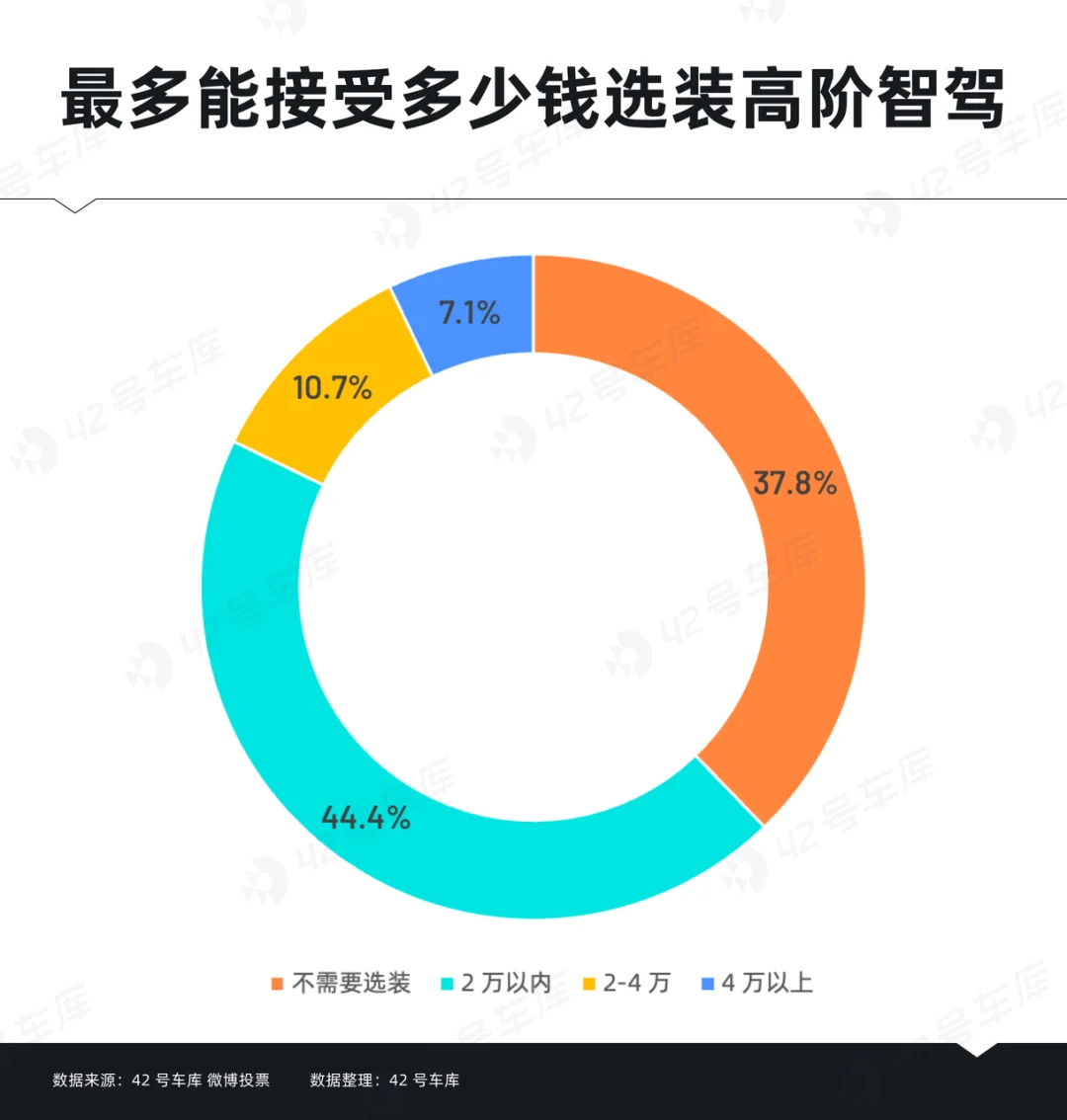
We launched a vote on Weibo regarding willingness to pay for intelligent driving. Among the participants, 44.4% indicated that the maximum price they could accept for intelligent driving was under RMB 20,000, while 37.8% selected "no need to purchase as an option."
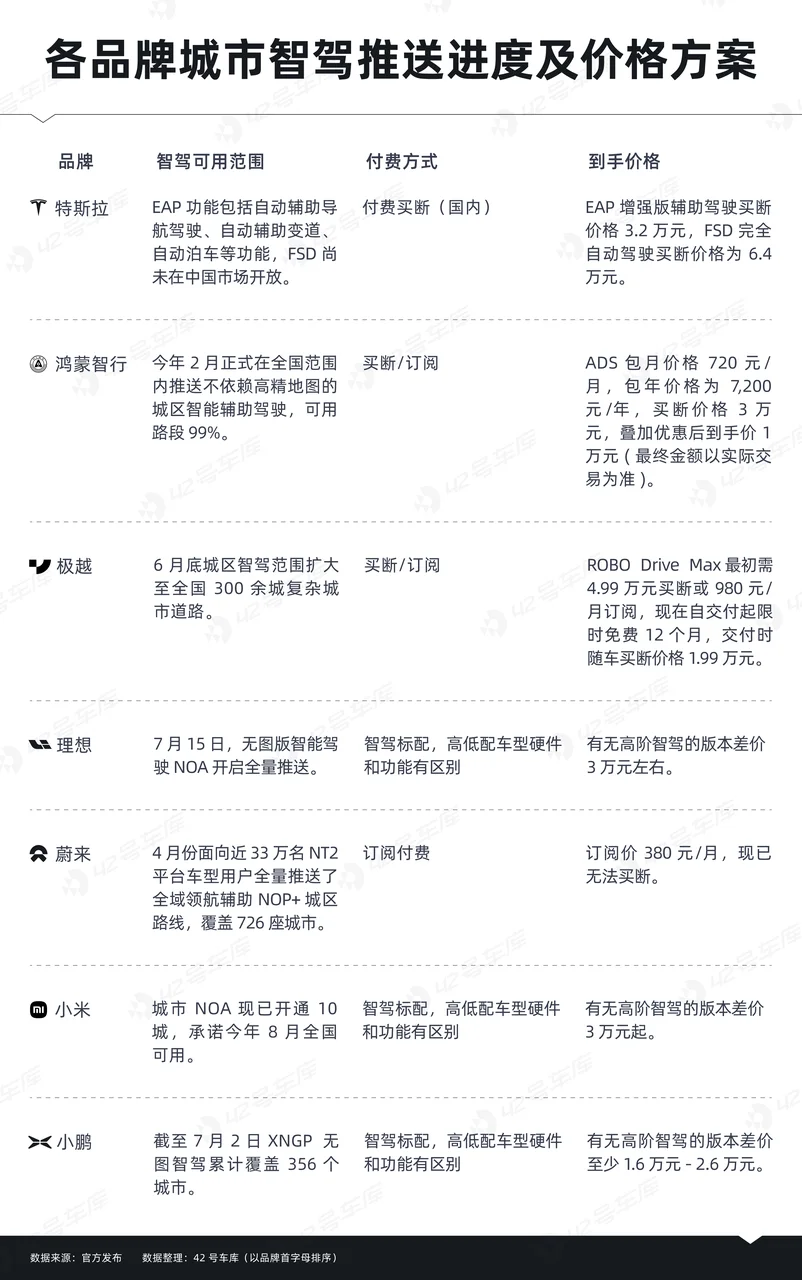
Here is a summary of the rollout progress and current pricing plans for several brands that have launched urban NOA features:
In the shared imagination of automakers and car owners, intelligent driving is safe and reliable, replacing humans in all tedious driving tasks to smoothly navigate every road a human can drive... Now, 'drivable nationwide' and 'drivable wherever there are maps' have become key selling points for automakers promoting their intelligent driving capabilities.
For users who opted for high-end intelligent driving versions or subscribed to paid services, how does the actual experience of the rolled-out features compare? Is current intelligent driving worth paying for? For those who did not choose it, has the price become a barrier?
We interviewed several owners whose vehicles are equipped with intelligent driving features to gauge the current state of development from their perspective, attempting to sense how close we are to the true era of human-machine co-driving.
Owner 'Sleep Well': It Doesn't Drive Like a Human Yet
City: Chengdu
Vehicle Model: Li L8 Pro
Profile: 32 years old, bank employee
Owner's Statement:
I bought my car in 2022. I was among the first batch of blind-reservation buyers for the Li L8 and likely one of the first few units delivered in Chengdu. I chose the Pro version, which lacks a lidar sensor and therefore does not support urban autonomous driving features.
At the time, the price difference between the Pro and Max versions was less than RMB 40,000. I did not choose the Max version primarily because I intended to use the vehicle as a temporary car, planning to upgrade in two to five years. If the price gap had been under RMB 20,000, I might have considered the Max version.
At that time, Tesla’s autonomous driving system was the only one on the market that performed adequately. Consequently, when purchasing the car, I prioritized brand value and family needs; autonomous driving was not a critical factor but merely an added benefit, so cost-effectiveness became the main consideration.
Due to my work, I have interacted extensively with original equipment manufacturers (OEMs) in the automotive industry. I learned that integrating lidar with vision-based solutions is technically challenging. Additionally, I believed cars were evolving into digital products with rapid update cycles. Since lidar is hardware that cannot be upgraded later, I worried that buying the Max version would make me an early adopter who gets left behind—essentially becoming a "leek" (someone who loses money due to poor timing or decisions).
Looking back now, anyone who bought a new energy vehicle at that time felt somewhat like a "leek."
To date, I have driven a total of 24,000 km, with nearly 3,000 km covered using autonomous driving features. This accounts for more than 10 percent of my total mileage. I mainly use these features on enclosed roads such as urban elevated highways and expressways.
If there are no multiple entrances or exits, the intelligent driving performance is acceptable. I do not dare to use it on highways because it struggles to identify obstacles such as water barriers and traffic cones. If there is a concrete barrier ahead, it might crash directly into it; I have encountered many situations where we nearly collided.
Additionally, when turning left at intersections, the system cannot enter the left-turn waiting zone. It has also had issues recognizing traffic lights, with strong jerkiness during temporary braking to avoid hazards. Its lane-change decisions are very conservative, requiring ample distance from vehicles ahead and behind.
Therefore, I mainly use intelligent driving on straight, flat roads without merging ramps, or in heavily congested commuting scenarios where lane changes are impossible. I have now become familiar with the points where it hesitates; for example, if I anticipate a ramp 5 km ahead, I turn off intelligent driving first.
Overall, intelligent driving feels barely adequate. It helps save some mental effort, but I don't feel it drives like a human.
I was previously very interested in new energy vehicles and test-driven more than ten models equipped with intelligent driving features. My experience is that, at least at this stage, no hardware, software, or algorithmic strategy can fully replace human drivers. Intelligent driving is only suitable for relatively common scenarios, so I do not hold high expectations for current systems.
I hope LiDAR and vision-based solutions can be integrated soon to increase safety redundancy. Regarding exterior design, having a LiDAR mounted on the roof looks odd; I prefer a sleek, smooth design.
I also expect the Pro version to handle urban intelligent driving using vision-based solutions. When I asked the official team, they replied that the Pro version will catch up but primarily applies to highways and specific urban scenarios. I hope memory navigation features are launched soon to address fixed commuting routes, as the technical difficulty may be lower.
Car owner "Hello Coffee Duck": My psychological expectation for the price of the intelligent driving package is within RMB 8,000
City: Hangzhou
Model selected: AITO M5 Smart Driving Edition + Zhijie S7 Max RS
Identity: 36-year-old doctor
Owner's Statement:
I took delivery of my AITO M5 last June, and I just received the Zhijie S7 and am currently experiencing it. At the time of purchase, I chose the smart driving version because Huawei’s main selling point is intelligence and autonomous driving, representing the top tier in both areas. Therefore, buying a model with smart driving capabilities was essential; otherwise, purchasing this car would be meaningless. Without Huawei’s technology, I likely wouldn’t have considered these vehicles.
Before getting involved with smart driving, my expectation was to reach a level like today’s: no longer needing to take manual control, capable of driving on any road autonomously. I imagined it as quite sci-fi. The actual experience had some gap from this expectation. After buying the AITO M5, it took a year to finally realize this dream; the current version is already quite user-friendly.
Compared to other brands, Huawei’s smart driving is really quite good. I’ve tested cars from Lixiang and NIO, but I still feel AITO gives me more sense of security.
Initially, the coverage in Hangzhou was relatively poor, with only certain sections of the main urban area available for use. As a result, usage frequency was not very high, and smart driving mileage on highways and elevated roads accounted for only forty to fifty percent.
I basically use intelligent driving every day now. As of now, my total mileage is 36,900 km, with nearly twenty-six or twenty-seven thousand kilometers driven using intelligent driving. Since April this year, the proportion of my mileage covered by intelligent driving has reached around ninety percent.
The greatest convenience intelligent driving brings me is that I can drive wherever there is a road, which helps relieve some of my tension. Especially its AEB function, which can monitor the vehicle's surroundings 360°, clearly identifying all vehicles ahead even in heavy fog, helping me avoid many potential losses and providing a strong sense of security.
During my 1- to 2-hour commute, I typically intervene fewer than ten times during peak hours. The intelligent driving style is relatively conservative and safety-focused. Over the past two months, its efficiency has gradually improved, but this has also brought about some more aggressive behaviors, such as sudden acceleration.
The frequency of being cut off in the current version has also decreased significantly, and it is now exhibiting some game-theoretic interactions that resemble human behavior.
After getting used to intelligent driving, I found that my own driving habits have been changed by it. For so many years, I was always the driver; now, as a passenger, I observe that my previous actions might not be very friendly to others or may affect traffic flow. So now, when I drive, I consider other people's feelings more. When I don't use intelligent driving features, my driving has also become more conservative and standardized.
When I bought the AITO M5, I took advantage of the launch benefits and paid RMB 3,000 to option ADS. For my newly delivered Luxeed, I used the benefits available before July 1 and spent RMB 6,000. Compared to the price of opting for intelligent driving, I feel the experience is well worth the money, and the pricing is very reasonable compared to brands like Tesla.
After July 1, the price for ADS implementation rose to RMB 10,000, which feels a bit expensive to me; my psychological expectation was under RMB 8,000.
Some remaining issues with Huawei's intelligent driving system include the inability to correctly identify variable lanes and overhead signs, decision-making logic that deviates from map data, and difficulties navigating complex road sections.
For example, when approaching a traffic light, lane markings transition from dashed to solid. At relatively low urban speeds, the distance available for lane changes is very short. If ADS does not set its thresholds correctly, it may initiate a lane change while still on a dashed line, causing the rear wheels to cross onto the solid line.
Next, I hope it can truly drive on all roads without any discontinuities. It would be best if it could recognize variable lanes, tidal lanes, and bus lanes. The recognition of these needs optimization, and I look forward to improvements in the next version.
Owner "pink_dude": It will take at least 10 years to reach a state where autonomous driving can be fully trusted.
City: Wuhan
Model purchased: NIO ES6
Profile: 24 years old, freelancer
Owner's Statement:
I placed my deposit for the ES6 as soon as it was released last June. This is my first car, and intelligent driving was not a high priority in my decision-making process. Although intelligent driving is quite useful on highways and expressways, I feel that the performance of various systems in urban areas cannot yet be left unattended. It has not met my expectations.
Before getting involved with intelligent driving, my expectations weren't very high. I hoped it would free my hands, that I wouldn't have to pay too much attention to distractions on the road, and that driving would be more relaxed. Previously, I thought that given the current level of development, we might reach L4 level in two or three years. But now, looking at it, there is still quite a distance from my expectations.
When I bought my car, the NIO Pilot intelligent driving package came with a two-year free subscription. If it later requires a paid subscription, based on the current version and pricing, I would be unwilling to pay for it; I might only subscribe for a month during very long trips. Compared to the experience, RMB 380 per month is quite expensive, and I prefer driving myself. However, if it eventually reaches true Level 4 autonomy, I would likely have the willingness to pay.
Intelligent driving has also brought me some convenience. On highways, expressways, and elevated roads, it allows for smooth, uninterrupted travel, providing a very good experience. I can even take a look at the scenery alongside the road; its logic for acceleration, deceleration, and lane changes is relatively efficient and comfortable.
When I used to drive my dad's gas car, which had no driver assistance features, I would feel extremely tired after driving on the highway for more than two hours straight. But now with NOP, as long as there is enough battery, I don't need to stop for breaks along the way.
In urban areas, the system works best in stop-and-go traffic during rush hour. With NOP enabled, the car can automatically follow traffic, eliminating the need to constantly switch between the brake and accelerator pedals. Lane centering is also very stable; on long, straight roads with light traffic, you can hand over control to the autonomous driving system.
NIO's intelligent driving system now covers more than 99% of my travel scenarios, but there may be a gap of tens of meters when switching between expressways and urban roads.
Overall, I feel the efficiency of intelligent driving is still not high. It doesn't drive as well as I do. I am a relatively aggressive driver, and it is far too cautious, so when urban road conditions are complex, I take over control.
For example, when changing lanes, the system requires a large gap. If other drivers do not strictly maintain lane centering and drift toward my lane, the system may misinterpret this as the vehicle ahead changing lanes. Additionally, if illegally parked vehicles on the roadside encroach slightly into the motor vehicle lane, the system may judge them as moving vehicles, making it difficult to navigate around them.
The logic for intelligent driving lane changes can be a bit strange. Sometimes, in extremely congested traffic where a lane change is physically impossible, the system keeps flashing its turn signal, forcing me to disengage it. I have also encountered alarming situations: if the car initiates a lane change and then detects a vehicle behind, it immediately returns to the original lane. However, by that time, a car from that lane has moved up, causing the system to brake and get stuck in the middle, which is very dangerous.
In addition, there have been instances of misidentified traffic signals, though these rarely affect driving in most cases. Turning at complex intersections can be slow, and the system may stop for pedestrians even when they are several meters away.
I find Wuhan's road conditions relatively harsh, with some sections being quite risky and frequent unexpected events. Some drivers do not strictly follow the rules, so when traffic is heavy, I basically don't use autonomous driving. However, NIO's overall autonomous driving strategy is conservative, and its safety is acceptable. If you can accept the system driving cautiously and slowly without needing to take over, it can be used.
I haven't had an in-depth experience with urban autonomous driving systems from other brands, but based on the information I've gathered online, even if I were using another brand's system, I wouldn't feel confident enough to rely on it for full-time urban driving.
For now, I am not very optimistic about the pace of autonomous driving development. The end-to-end solutions currently being promoted are not a perfect solution. If we want to reach a state where no human intervention is needed at all, like in movies, it will likely take at least 10 more years.
I feel that the promotion of autonomous driving has not yet reached a mature stage; most people are still waiting and seeing. When automakers promote autonomous driving, they need to be more objective in their safety messaging. Many people may blindly accept promotional claims and place blind trust in autonomous driving, leading to unsafe behaviors such as taking their hands off the steering wheel or playing with their phones, which I consider a significant safety hazard.
Car Owner "Mr. Nie": Overall, Current Autonomous Driving Falls Far Short of Expectations
City: Shanghai
Model selected: AITO M5 Rear-Wheel Drive Intelligent Driving Edition
Identity description: 28 years old
Owner's Statement:
Due to my work, I have had in-depth experience with the intelligent driving systems of many new energy vehicles on the market. Based on these experiences, I believe that highway intelligent driving across various brands has no major issues. The best performance in urban intelligent driving is Huawei's ADS, but overall, current intelligent driving falls far short of expectations.
I have been following intelligent driving through press conferences, car owner groups, and news reports since 2019. My expectation for intelligent driving is that it can be used in most of my daily travel scenarios, significantly alleviating the driving fatigue I experience during everyday commutes.
When I first bought the car, I approached intelligent driving with a novelty-seeking mindset, even recording videos to share in car owner groups or online communities. But once that initial excitement wore off and I started treating intelligent driving as a regular feature or experience, I found myself less inclined to use it. Now, when driving on city roads, I usually prefer to drive manually unless traffic is exceptionally smooth or it's very late at night.
For nearly two years, their functionality has been restricted, unavailable in many places, and the ride experience has been very poor.
Take the simplest example: compared to my own driving, intelligent driving always exhibits jerkiness when starting and braking at traffic lights. Furthermore, its proficiency in accelerating and decelerating during normal driving, as well as its smoothness in vehicle control, is far inferior to mine.
In terms of decision-making, intelligent driving performance falls far short of human capability. For instance, the system often fails to identify a reasonable timing and speed for lane changes. It also struggles to determine the appropriate method and trajectory to signal its intent to other drivers without appearing overly aggressive.
When a human becomes a skilled driver, they recognize that the most critical aspect of a lane change is timing: finding the right window for time, distance, and speed. A perfect lane change is one that neither disrupts the vehicles ahead or behind nor compromises the driver’s own progress.
In my own operations, almost 100% are perfect lane changes, but if intelligent driving operates, at most one or two out of ten times succeed. Even when it eventually completes the maneuver, the ride feel is uncomfortable.
Furthermore, factors such as game-theoretic interactions with other vehicles due to the lack of driving awareness in intelligent driving, suboptimal lane-changing decisions, and the possibility of failing to recognize road signs like traffic lights and tidal lanes, along with being honked at or flashed by other vehicles, all exacerbate my driving anxiety.
All in all, there is too much for intelligent driving to understand. I enjoy using it on highways, but in urban areas, even when I don’t need to play with my phone while driving, these negative experiences stimulate me to take back control of the cockpit.
Most domestic automakers now offer intelligent driving features across different trim levels. Opting for a higher-spec model equipped with urban intelligent driving typically costs an additional RMB 20,000 to RMB 30,000.
At present, although a price difference of 20,000 to 30,000 RMB might be a loss for manufacturers, I believe the experience upgrade brought by advanced intelligent driving is not worth the extra cost, and the improvement in experience is very slow. If this money were used to select other configurations, the experience upgrade might be more direct.
For example, situations where the road narrows from three lanes to two, or when merging from an on-ramp onto a main highway. This feature has been present since the earliest iterations of highway navigation assist, spanning roughly four years. Various manufacturers have released different versions through continuous iteration, yet they still struggle to time lane changes effectively, merely improving the success rate of merging.
For example, traffic light recognition—a function essential for daily driving—has only recently become achievable by some manufacturers in the past couple of years, while many others still cannot implement it.
The expectations and perceptions of intelligent driving vary significantly across different groups. Most people around me simply consider it an ordinary feature, not yet indispensable.
However, since intelligent driving has now become a standard part of the configuration choices, regardless of the actual experience, it will inevitably force manufacturers who lack this feature to adopt it. Based on current usage experiences, I believe that even in a few years' time, its progress will remain relatively limited.
At the same time, I feel that the commercialization of intelligent driving is becoming increasingly unlikely. This is because the bill-of-materials costs and R&D costs for intelligent driving are very high, resulting in products with almost zero gross margin, while users do not find them particularly useful. Once people have come to accept paying 20,000 to 30,000 RMB for an intelligent driving system, there is no going back to the original software subscription model.
So I think the overall trend is that intelligent driving will eventually become a mandatory feature. However, domestic manufacturers aim to create differentiation advantages for new energy products through intelligent driving, which helps automakers attract a growing number of users interested in this technology.
If things continue like this, intelligent driving will basically be unable to help automakers make money. Automakers' labor costs are rising, the products they produce are becoming increasingly technology-driven, yet the profits they earn are shrinking.
Car Owner "Lucas": Current intelligent driving is not very smooth
City: Guangzhou
Model selected: Jiyue 01 Max
Profile: 33 years old, copywriter
Owner's Statement:
I traded in my gasoline vehicle to buy this car. My first car was a Chuanqi GS4, which I drove for about eight years. When I bought it, my needs were high intelligence, autonomous driving capabilities, comfort, and an original, handsome design. Among my many considerations, intelligent driving ranked fourth; the top three were price, exterior design, and model type.
I chose the Jiyue 01 because it uses a pure vision solution, with no LiDAR on the roof. The overall exterior design of the Jiyue is also very attractive, and it adopts Baidu's intelligent driving solution. I also heard that the Jiyue uses Geely's production lines, and vehicles under the Haohanpingtai platform feature excellent build quality and materials.
Before Jiyue, I had never experienced intelligent driving. At first, my hope was that this car's intelligent driving system would be capable of handling scenarios such as my daily commute to and from work or trips.
The most obvious benefit of highway intelligent driving for me is that I don't need to stare at the road conditions all the time, so I'm not as tired on the highway. If you get on the highway at night, a human driver might be limited by poor visibility and lighting, driving relatively slowly, but if the car drives itself, it can still maintain a speed of 120 km/h. I think the Jiyue's lane changes and overtaking are better than my own.
The real issue is that I can't use intelligent driving at all for my daily commute. Guangzhou has only enabled the feature in four central districts: Tianhe, Liwan, Yuexiu, and Haizhu. Moreover, it's only available on certain roads within those areas. Since my commute doesn't pass through these districts, nor do I need to take highways or elevated roads, the more than 100 kilometers I travel each day round trip make PPA completely unusable. On weekends, when I travel nearby, I'm still in areas not covered by PPA. Essentially, I can only use it on highways now, and the feature I use most frequently is automatic parking.
Jiyue's highway autonomous driving efficiency is acceptable, but its decision-making sometimes fails to match human drivers. Previously, it tended to follow closely behind large trucks. When a large truck approached from behind, a normal driver would accelerate to pass, whereas Jiyue would choose to slow down. On the highway, it would sometimes come to an abrupt stop in certain situations, increasing the risk of rear-end collisions. It also exhibited unnecessary lane changes and 'snake-like' swerving, and currently cannot perform U-turns.
When highway traffic is heavy, I turn off the autonomous driving system because the ride feels jerky, and the following distance is too long, making the vehicle susceptible to being cut off. My experience shows that LCC (Lane Centering Control) is not very effective; it operates mechanically and stops abruptly when encountering obstacle vehicles.
When I picked up my car at the end of March, Jiyue's autonomous driving was only available in five cities. Although it now claims coverage in 300 cities, the specific mileage covered in each city has not been disclosed. Jiyue stated that by the end of the year, wherever Baidu Maps is available, the system will work nationwide. Jiyue's OTA updates occur monthly, offering a 'new car every month,' but the autonomous driving experience has not seen significant improvement.
I feel that current autonomous driving systems are not yet smooth. I hope advanced autonomous driving continues to improve, eventually achieving L4 capability and becoming smoother. Personally, I do not blindly pursue 'zero interventions'; I prefer shared driving between human and machine. Technically, I suggest adopting end-to-end large models, allowing AI to learn more rather than relying on specific instructions, which can cause 'stuttering.'
Car Owner Mr. Huang: The continuous improvement of autonomous driving is inevitable
City: Ningbo
Model Purchased: XPENG G9 702 Long Range MAX
Profile: 35 years old, Product Manager
Owner's Statement:
I chose the XPENG G9 because it was the only 800V vehicle available at the time, and XPENG was one of the few automakers to announce a rollout plan for urban intelligent driving. XNGP already had a concrete timeline.
In addition, dual-chamber air suspension is a configuration that is rare in the market; many features, such as the 5D music cabin, are two or three years ahead. However, the factor I value most is intelligent driving.
I think XPENG released the best car on the market at that time. Even if this car were launched today, it would sell exceptionally well if priced appropriately, but its marketing was very poor.
When I bought the XPENG G9, there were two versions available: the Pro version and the MAX version. The Pro version has only one Orin chip and no LiDAR, while the MAX version has two Orin chips and two LiDARs.
The price difference between these two versions is only twenty thousand yuan. I think skipping the MAX version would be a significant loss; for twenty thousand yuan, you get two LiDARs, an additional intelligent driving chip, and 5G connectivity.
The most critical difference is that subsequent updates have primarily focused on the MAX version, which emphasizes urban intelligent driving. Therefore, if you buy an XPENG, you should opt for the intelligent driving version. In my experience, it offers excellent value for money.
When I bought the car, XPENG’s urban intelligent driving feature wasn’t yet available. During test drives, I could only experience highway NGP. My expectation for XNGP was that it would operate without human intervention, allowing me to sit in the driver’s seat like a mascot. After iterations up to now, I feel it has reached 80 percent of my expectations.
Beyond Huawei’s intelligent driving, I have basically experienced all the urban intelligent driving systems available on the market. Highway intelligent driving is like elementary school problems; performance across brands is generally acceptable. However, XPENG offers the best overall comfort and urban intelligent driving performance. For example, it reacts quickly to vehicles cutting in, and its braking ensures safety without compromising ride comfort. Additionally, XNGP’s visual recognition can now identify bus-only lanes and speed limit signs, with highly accurate traffic light recognition.
A core highlight of XPENG's intelligent driving is that while other automakers were still researching features like urban NOA, it had already launched AI Drive, which can remember and mimic my driving habits, making me feel as though it drives just like I do.
Beyond AI driver assistance, XPENG's intelligent driving is also very strong in vehicle-to-pedestrian and vehicle-to-vehicle interactions. If it detects a person at an intersection, it won't slam on the brakes to stop abruptly; instead, it will try to move forward slightly. If the person doesn't move, it continues forward. When changing lanes to the left, if there is a car behind in the left rear, the system typically returns to its lane if it detects a problem with the lane change. However, if the lane change has already exceeded fifty percent, it will continue because it knows the car behind will slow down.
My driving habits have been completely changed by XPENG's intelligent driving, and now more than 90% of my mileage is covered by it. My commute is about 13 km. When XNGP performs best, there are zero interventions; when it performs poorly, there are two to three interventions.
However, XPENG's intelligent driving also has areas that need improvement. In earlier versions, the distance to large vehicles was a bit too close, and emergency braking could feel uncomfortable; these issues have long been resolved in current versions. XPENG's software update speed is arguably the fastest in the industry.
The remaining issue is comfort: intelligent driving causes motion sickness more easily than human driving. Additionally, when activating or deactivating the system, the vehicle may accelerate or decelerate abruptly, which often feels uncomfortable. There are also some less intelligent behaviors, such as only reacting to pedestrians near a crosswalk after passing it and then pausing, or turning right very slowly at intersections.
One area where XPENG needs improvement is that it doesn't need to be overly rigid; the system's obstacle-avoidance capabilities could be loosened. For instance, when a vehicle ahead is moving extremely slowly and requires crossing a solid line to bypass it, the intelligent driving system may simply follow behind. A human driver would not make such an illogical move.
However, I am an internal tester for XPENG's new version of XNGP and use the unlimited NGP feature, which allows driving on any road. When it is pushed to all users in July, this issue may be resolved.
I believe the rollout of high-level autonomous driving has been a mess across the board. I’ve spoken with many people around me, both those who have ridden in my car and those who haven’t. Those who haven’t tried it simply can’t believe that intelligent driving has advanced to its current state, while those who have say, 'XPENG is really impressive.' So, letting users experience it firsthand to form embodied cognition is crucial; it’s far more effective than watching countless short videos.
I’m convinced that intelligent driving will keep getting better. Promoting it can significantly boost urban traffic efficiency. If we also leverage vehicle-to-infrastructure coordination, accidents caused by pedestrians suddenly stepping into the road ('ghost probes') would decrease. As long as we reduce the proportion of humans—the unstable factor—traffic efficiency will rise. That’s the future of intelligent driving.
Final Thoughts
Has intelligent driving truly integrated smoothly into owners' lives as initially imagined?
Through these in-depth exchanges on intelligent driving experiences, we witnessed the complex emotions and genuine feedback of car owners toward intelligent driving technology. Their expectations for intelligent driving mirror their anticipation for a technological revolution: filled with curiosity yet accompanied by caution, maintaining a clear-headed awareness of the technology's limitations.
Currently, while everyone enjoys the convenience brought by intelligent driving, there is still a considerable distance to go before the technology achieves full maturity and grants drivers complete freedom to take their hands off the wheel.
The speed of city expansion, the pace of software pushes, and the number of chips do not directly represent the level of intelligent driving capability. What ultimately determines whether users are willing to pay for and use intelligent driving remains the actual feel and stability it provides in real-world scenarios.
Furthermore, the efficiency of problem resolution and the speed of updates also impact the owner experience. The night after Mr. Huang was interviewed, XPENG conducted an OTA update to resolve issues such as the inability to bypass solid lines and the need to stop before initiating a bypass. Prior to this article’s publication, NIO also pushed a new version. Owner 'pink_dude' evaluated it as follows: 'The lane-changing logic has improved significantly; following vehicles is much smoother now, very close to human driving, and overall efficiency has increased substantially compared to the previous version.'
The promotion and refinement of intelligent driving technology require not only technological breakthroughs but also a deep understanding of user experience and continuous optimization. Owners' concerns regarding the safety, reliability, and price sensitivity of intelligent driving remind us that technological maturity and market education are equally important. The future of intelligent driving depends not just on technical sophistication, but on its ability to win consumer trust and support.
With the continuous advancement of intelligent driving technology, there is reason to believe it will become increasingly intelligent and powerful, gradually integrating into owners' daily lives.
Before that happens, manufacturers must listen to owner feedback, continuously optimize products, and enhance services to ensure that every iteration of intelligent driving delivers a better user experience. Only in this way can intelligent driving truly become a vital link connecting people and the future.
Written by: Da Yong Edited by: James JJJJ