


Li Auto Unveils VLA Driver Model, Claims Path to Autonomous Driving
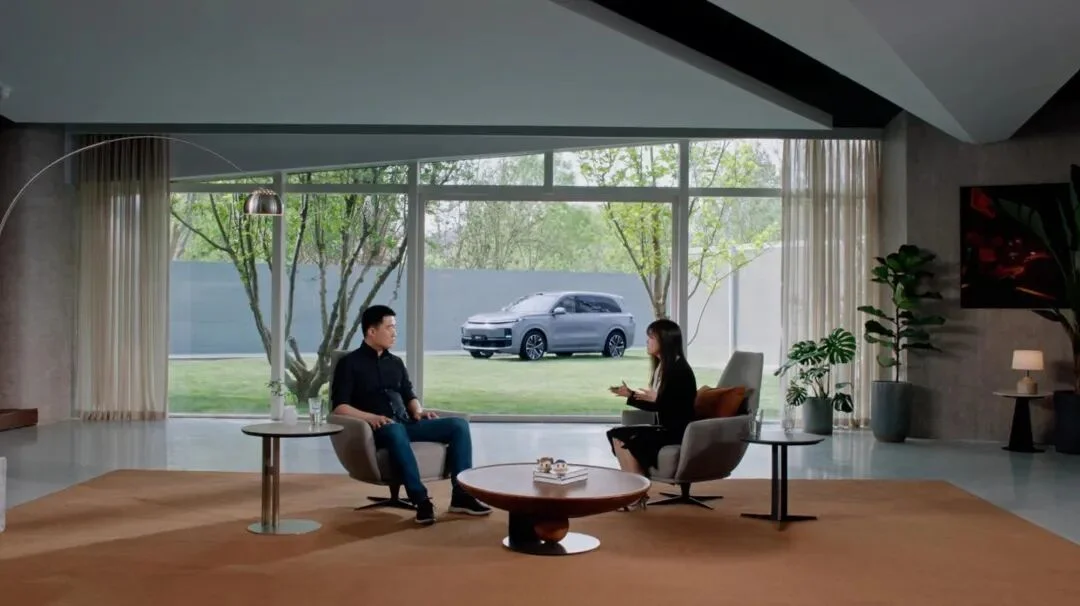
After a 130-day hiatus, Li Auto’s AI Talk returned last night. In response to sharp questions from Zhang Xiaojun, Xiang Li, founder, chairman, and CEO of Li Auto, delivered two core messages: first, a detailed explanation of the VLA large model soon to be implemented; second, his latest reflections on entrepreneurship.
In fact, at the end of 2024, during an AI Talk session, Xiang Li had already announced that Li Auto is not an automotive company but an artificial intelligence enterprise. Over the past few months, DeepSeek has gained global popularity, and the robotics industry has seen unprecedented heat. As an enterprise positioned as an AI company, Li Auto’s core achievement in recent months has been the VLA (Vision-Language-Action) large model.
The latest released video shows that the driver-assistance system based on the VLA model allows drivers to control the vehicle via voice commands, including passing through manual toll lanes, making U-turns, pulling over to park, and parking in area C3 of a parking lot. These are experiences never before offered by driver-assistance systems.

Xiang Li stated, 'VLA can solve the path to fully autonomous driving, and there is even a chance it could surpass human capabilities.'
However, driver assistance is currently at a new crossroads, with some voices in the industry suggesting it should be paused. Yet Xiang Li believes this is like the darkness before dawn. Li Auto aims to solve problems the industry cannot resolve, just as extended-range electric vehicles solved charging difficulties and high battery costs, while 5C fast-charging technology addressed slow charging and long waiting times.
However, like several leading companies in the industry, Li Auto has entered a 'no-man's land' where no one has yet achieved mass production. According to Xiang Li: 'DeepSeek hasn’t walked this path, OpenAI hasn’t, nor have Guge or Waymo.'
So what exactly is VLA? Why did Li Auto pursue it, and how will this technology be implemented? Xiang Li provided a detailed explanation during last night’s AI Talk. The session also made it clear how Li Auto has transformed from a follower to a leader in driver assistance.
01VLA Raises the Ceiling for Driver Assistance
In March this year, Li Auto unveiled its next-generation autonomous driving technology—the MindVLA large language model—at the NVIDIA GTC 2025 conference. At that time, the company released three videos demonstrating MindVLA’s three core functions:
When instructed via voice to find a Starbucks, the vehicle navigates there independently while allowing the driver to control speed and turning direction through voice commands.
By showing the ground to MindVLA via a photo, the car departs from an underground garage, passes through gates autonomously, uses visual perception to identify the pickup location, and even allows the owner to sit in the front passenger seat.
During an underground garage tour, MindVLA locates parking spaces on its own. If it encounters a dead end, it can reverse out independently.
At the second season of last night’s AI Talk, Xiang Li showcased additional capabilities of the VLA model. While in driver-assistance mode, the vehicle accurately executes all driving commands issued by the driver via voice.

When experiencing these features firsthand, Xiang Li did not consider it an 'Aha Moment' (a moment of sudden realization or surprise). Instead, he viewed the driver assistance system behaving like a human as a normal and expected outcome. However, I believe that for ordinary users seeing VLA test videos for the first time, the performance will still be surprising.
It is clear that VLA can once again raise the upper limit of driver assistance capabilities. At the same time, VLA has been recognized as a landmark technological breakthrough in the development of driver assistance in 2025.
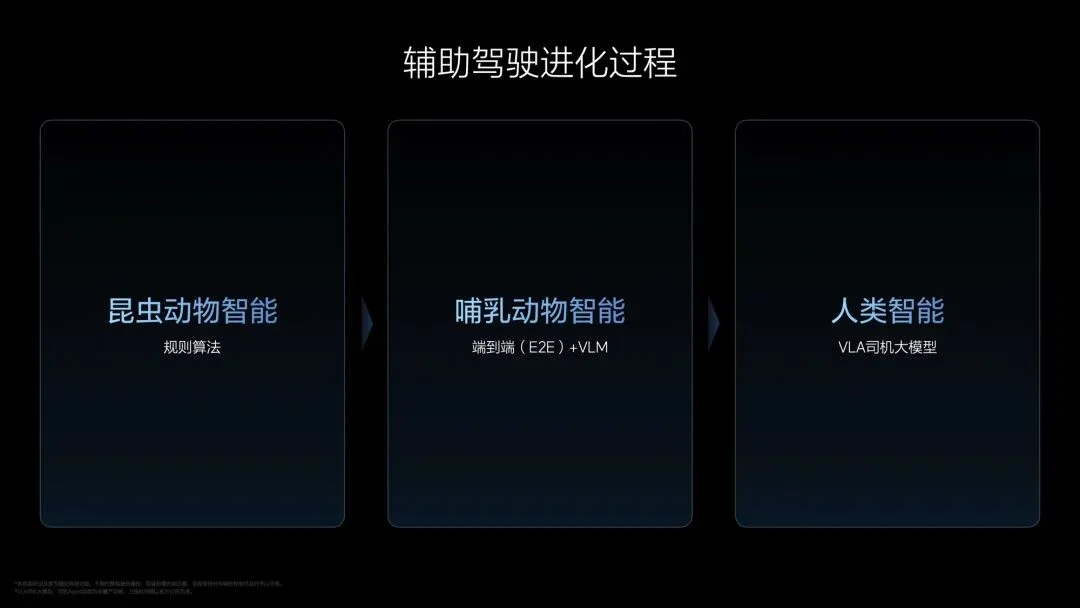
How significant is the breakthrough of VLA? Xiang Li broke down driver assistance into three stages of development, using different species in nature as vivid metaphors:
Stage 1: Insect intelligence. This corresponds to the era of rule-based algorithms and high-definition map-assisted driving, resembling the movement and task-completion methods of ants.
Stage 2: Mammal intelligence. This refers to the end-to-end + VLM (Vision-Language Model) era. Large models learn human driving behaviors (similar to animals trained in a circus), but their understanding of the physical world is insufficient, making it difficult to solve problems they have never encountered before. VLMs can only play an auxiliary role.
Stage 3: Human intelligence. The VLA stage achieves a way of observing the world similar to humans. VLA possesses its own 'brain system' to further understand the physical world, and also features language and chain-of-thought systems—this is what we call the VLA Driver Large Model.
From the current dual-model architecture of "end-to-end + VLM" to VLA, which unifies spatial intelligence, language intelligence, and behavioral intelligence into a single model, what exactly is VLA? Is it merely a combination of end-to-end and VLM?
Xiang Li believes that in the field of driver assistance, VLA functions as a driver large model—a system designed to operate like a human driver. For users, the goal of VLA is to become a "Driver Agent." As demonstrated in previous videos, the vehicle transforms into an intelligent agent capable of communicating with users and understanding their intentions.
Technically, compared to the previous end-to-end + VLM architecture, all modules in VLA have been newly designed. The 3D spatial encoder integrates with a language model for logical reasoning to generate reasonable driving decisions, outputting a set of action tokens. These action tokens encode the surrounding environment and the ego-vehicle's driving behavior. A diffusion model then further optimizes these outputs to determine the optimal driving trajectory. The entire inference process occurs on-board and must run in real time.
With the VLA technical path established, the next step is mass production implementation. Xiang Li noted: "Once DeepSeek was open-sourced, we accelerated our timeline by nine months to complete the VLA."
Xiang Li's original plan had been to deliver a VLA model meeting requirements by the end of this year.
Recalling a conversation he had with DeepSeek founder Liang Wenfeng just days before the release of ChatGPT o1 last September, Xiang Li described Liang Wenfeng as highly disciplined and someone who actively researches and learns best practices and methodologies from around the world.
It was precisely the significant benefits and assistance provided by DeepSeek to Li Auto that led Xiang Li to decide to open-source the vehicle operating system, Xinghuan OS. "To put it bluntly, it’s purely out of gratitude to DeepSeek," Xiang Li said.
02Li Auto’s Path Through Uncharted Territory
On February 5, the first working day after the Spring Festival holiday, Li Auto held an internal meeting focused on AI. Xiang Li stated at the meeting that DeepSeek is more akin to the launch of Linux, while Li Auto aims to chase its "Android" moment.
Xiang Li hopes that Li Auto's VLA model will strengthen vision (V) and action (A), while leveraging language (L). In the automotive and transportation sectors, VLA represents a more critical large model, which is where Li Auto sees its opportunity.
Xiang Li's strategy involves embracing DeepSeek while also developing its own foundation model. This is because training a VLA model requires vision and language capabilities specific to driver assistance, differing from other industries, and necessitates combining V and L. Neither OpenAI nor DeepSeek possesses such data, scenarios, or demands; therefore, Li Auto must build this independently.
To train its foundation model, Li Auto purchased three times more training cards than originally planned this year.
Currently, Li Auto has trained a 300B-parameter model for "Lixiangtongxue," while the VL component within the VLA model consists of a 32B-parameter model.
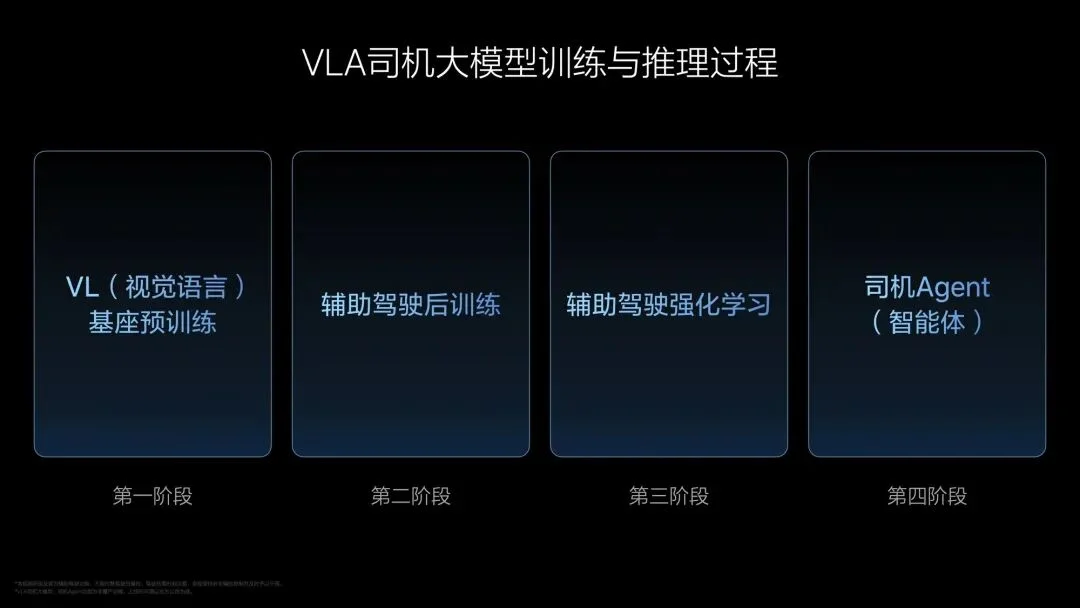
With the foundation model established, Li Auto completed the first step of VLA model training: pre-training.
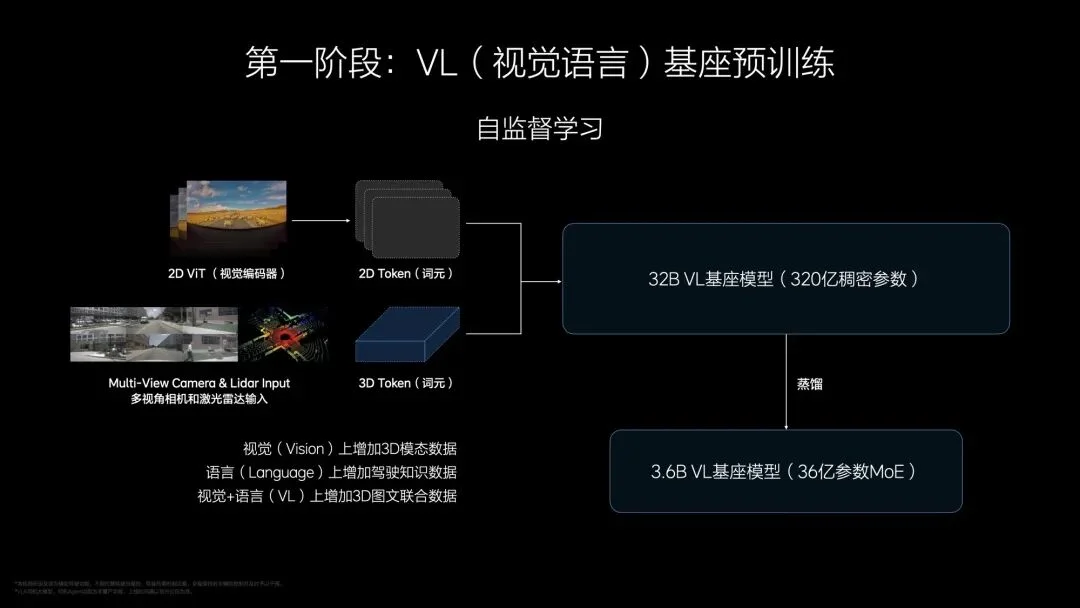
The second step of VLA training is post-training, which transforms the model into a VLA (Driver Large Model). At this stage, action data is incorporated into the training process. This remains a form of imitation learning, akin to learning how to drive at a driving school. Xiang Li explains: 'At this point, the model scale expands from approximately 3.2 billion parameters to nearly 4 billion.'
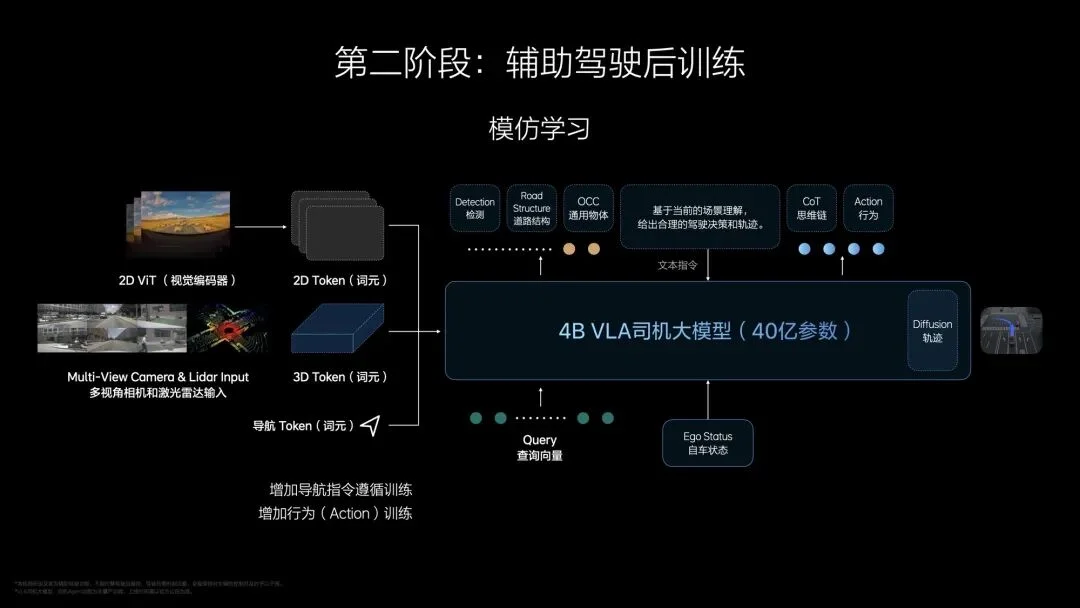
At this stage, the VLA can directly process visual perception, move through understanding, and output final actions. Xiang Li specifically notes that long chain-of-thought reasoning is avoided; typically, only two or three steps are used, as longer latency would fail to meet safety requirements. Additionally, after an action is completed, the VLA employs a diffusion model for 4 to 8 seconds to predict trajectories and the surrounding environment based on performance.
The third step of VLA training involves reinforcement learning, a phase more comparable to a driver navigating real-world traffic. Reinforcement is divided into two parts: first, RLHF (Reinforcement Learning from Human Feedback) incorporates human feedback; second, pure RL uses the RL model for training within Li Auto’s world model. The goal of this step is to enable the vehicle to drive better than humans. For training metrics, Li Auto assesses the comfort of driver assistance using G-force values, while also incorporating collision feedback and traffic rule compliance.
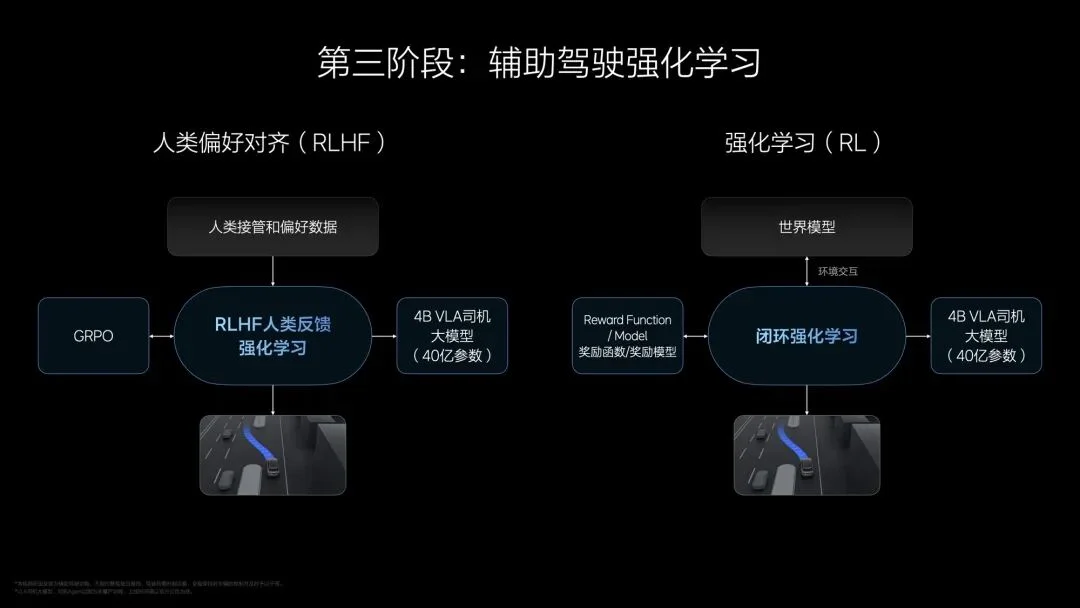
Once these three steps are completed, the VLA model capable of running on the vehicle’s edge hardware is generated.
Finally, Li Auto builds a Driver Agent to allow in-cabin drivers to instruct the driver assistance system on how to drive using natural language.
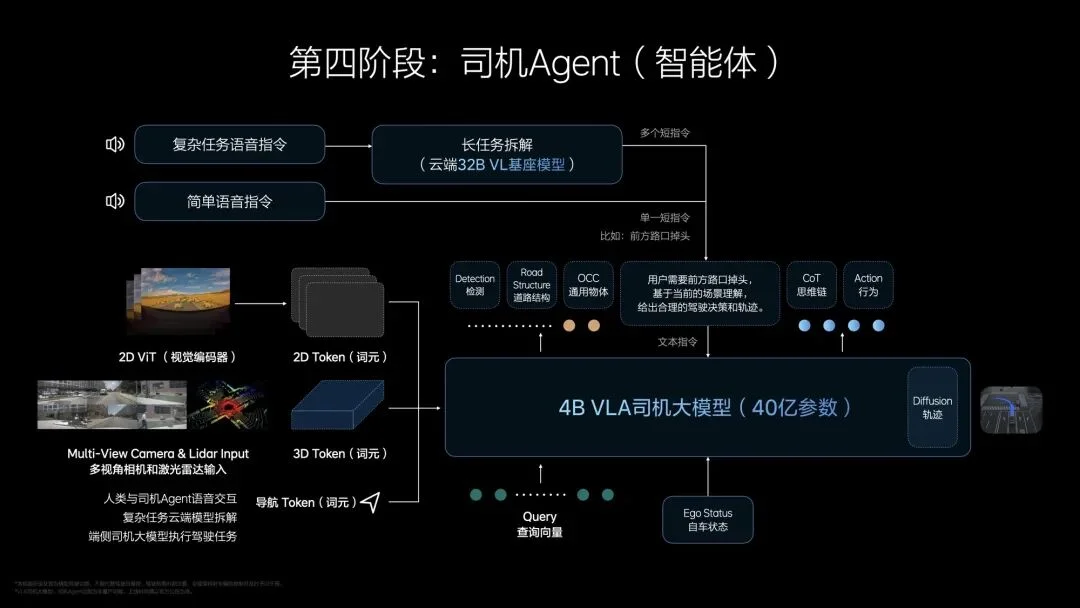
In the complex process of training VLA, Xiang Li could not say which step was the most difficult. "I don't think it's possible to predict," he said. "Because no one has walked this path before us. DeepSeek hasn't either, OpenAI hasn't, Guge hasn't, and Waymo hasn't. We are essentially walking through uncharted territory."
However, beyond Li Auto, more players have now entered this uncharted space for VLA, competing together toward mass production.
03You Cannot Skip End-to-End to Achieve VLA
When discussing the ultimate metrics for VLA, Xiang Li believes that the VLA model and the driver Agent should be viewed together. The criteria for judging VLA are the same as those for human driving ability, roughly divided into three aspects: driving skill (how strong the model is), professionalism, and safety. On the other hand, trust and understanding are built through the Agent and memory.
Ultimately, it is the combined effect of VLA and the driver Agent that creates a product usable by customers.
Xiang Li even believes that if VLA can achieve full autonomous driving, it represents the most capable architecture at this stage, being closest to humans and even having the potential to surpass human driving capabilities. However, whether VLA is the most efficient solution remains an open question.
Given how powerful VLA is, does that mean skipping end-to-end and going straight to VLA is the correct path?
Xiang Li does not think so. Based on Li Auto's own experience, skipping end-to-end to implement VLA is simply not feasible. In fact, end-to-end is the foundation of VLA. "To put it bluntly, you cannot just eat the tenth bun and expect to be full," Xiang Li said. "Although people might feel that eating the tenth bun makes them full, every preceding bun is indispensable." He added, "It's not about courage overcoming everything; I see no shortcuts. Many companies today struggle with end-to-end because they didn't do well with rule-based algorithms earlier."
There is another important reason why Xiang Li is betting on VLA: he believes that the transportation scenario will be the first to see its practical application. On one hand, although the driving environment is complex, the rules are clear. Vehicles can only drive on roads; they cannot fly in the sky or navigate through water. On the other hand, a vehicle has only three degrees of freedom (forward/backward, left/right, and rotation), whereas robots "start with 40 degrees of freedom," making the challenge significantly greater. Additionally, comfort inside the car can be reflected by G-force values; traffic rule compliance is governed by explicit regulations; and collision avoidance has clear metrics. Xiang Li believes that under these indicators, driver assistance systems will continuously improve.
Furthermore, safety remains a perennial topic in driver assistance. In this regard, Li Auto established a "Super Alignment" team of more than 100 people late last year to specifically address model safety issues.
After processing 10 million clips (video segments), occasional issues arise where the model's capabilities are so strong that they create a sense of insecurity for occupants. For example, the driver assistance system may cut in during traffic congestion. Xiang Li analyzes that it may have learned behaviors from drivers that it should not have learned.
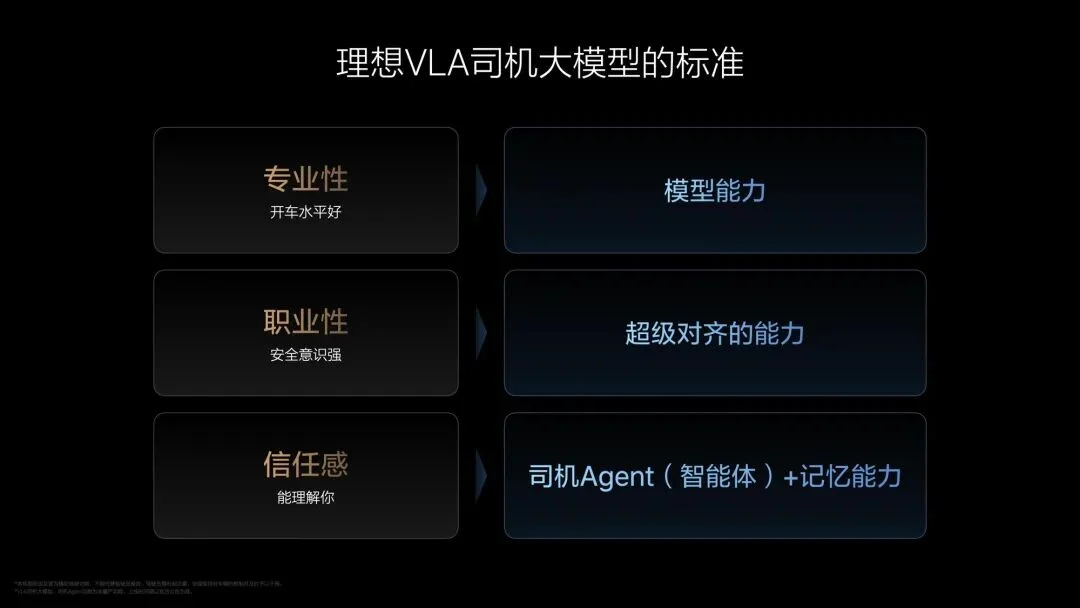
Xiang Li drew an analogy between building model safety capabilities and employee recruitment: "For example, when I hire an employee or evaluate whether to accept one, the first criterion is their professional competence, the second is their professionalism, and the third is their ability to understand others and build trust. If all three are strong, I consider them an outstanding employee."
04Li Auto's Tenth Anniversary: Still Learning from Tesla and Apple
In July this year, Li Auto will celebrate its tenth anniversary. Looking back on this entrepreneurial journey, Xiang Li highlighted the following key milestones:
Li ONE was first released in 2018, and its price was announced at the Shanghai Auto Show in April 2019. Li Auto started from scratch.
In 2022, the Li L9 was launched. As of today in 2025, at least five other companies are developing products identical to the Li L9.
Following the launch of the Li L9, Li Auto reported a quarterly loss of nearly RMB 2 billion, with voices predicting its demise becoming incessant.
In 2023, the company achieved growth of nearly three times, reaching an income of RMB 120 billion.
Xiang Li stated: 'If we look at it along a timeline, there were certainly more hardships, but after enduring enough suffering, one gets used to it.'
At the same time, Xiang Li noted that in today's highly competitive environment, including external uncertainties, is the best time for every company to solidly hone its fundamental skills. 'I think many top American companies, such as Apple and Tesla, have particularly solid fundamentals.'
This year, Tesla pushed the FSD feature to Chinese users. Xiang Li assessed that Tesla is likely using a model prior to version 12.5, which still has a significant gap compared to Tesla's true capabilities. However, it is also evident that Tesla's fundamentals are very solid, including its perception distance, operating frame rate, and vehicle control stability.
However, Xiang Li also predicted that if Tesla directly implements end-to-end models from version 13.0 onwards without specifically learning Chinese road conditions, it will still face challenges.
When discussing Apple, Xiang Li said: 'When you reach an income of hundreds of billions, and then look at the capabilities of a trillion-income company, you begin to vaguely understand some things. But when we were at a small scale, we couldn't understand why Apple did what it did.'
Xiang Li believes that his current mindset and approach to life are 90% similar to those he had in high school. This means tackling problems head-on, addressing issues others are unwilling to handle, solving the biggest challenges consumers face, and seeking out more people to learn from.
Written by: James Edited by: Daji