NVIDIA’s Wu Xinzhou on His Long-Term Commitment to Autonomous Driving
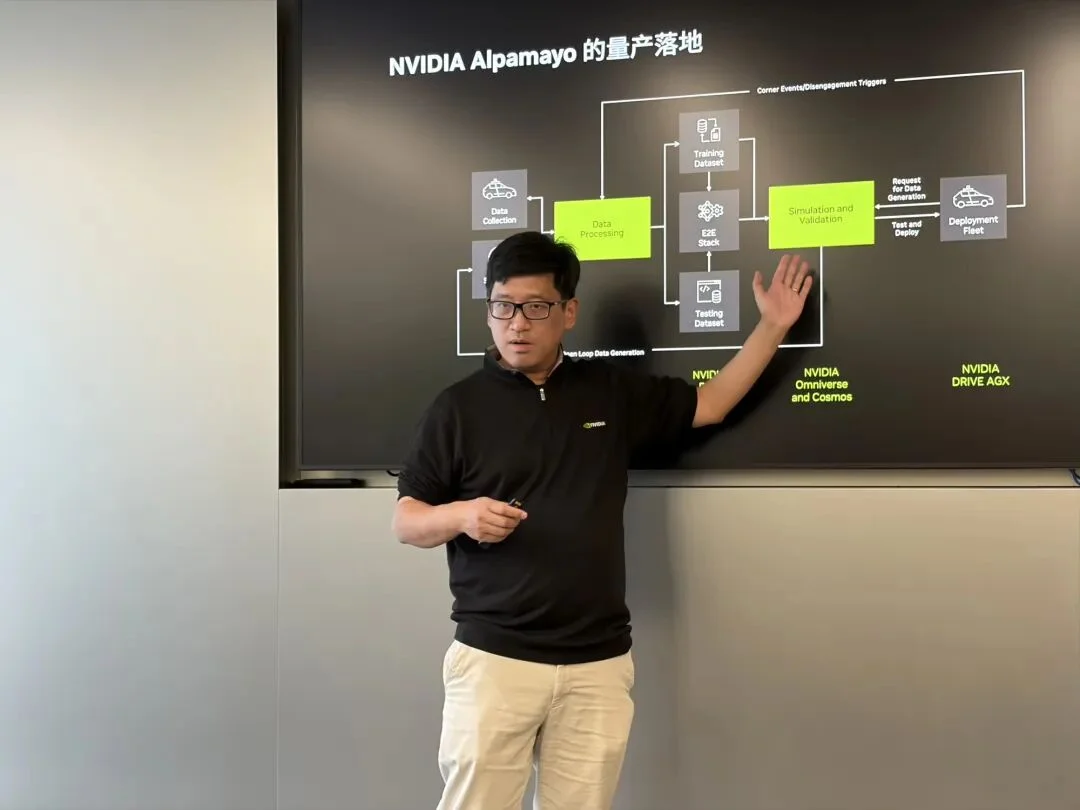
Over the past six months, two unusual developments have emerged in NVIDIA's automotive business.
In October last year, NVIDIA partnered with Uber to deploy L4-level Robotaxis in Los Angeles and San Francisco by 2027. In January this year, the Mercedes-Benz CLA equipped with NVIDIA's full-stack driver assistance solution launched in the U.S., offering point-to-point assisted driving capabilities.
The unusual aspect is that NVIDIA, traditionally regarded as a "shovel seller" in the global autonomous driving industry, has now begun mass-producing full-stack solutions.
Both initiatives were spearheaded over the past two and a half years by Wu Xinzhou, NVIDIA's Global Vice President. When discussing his move to NVIDIA, Wu Xinzhou emphasized that promoting advanced driver assistance across all vehicle models represents a significant achievement in his career.
From 2018 to 2023, Wu Xinzhou drove the deployment of highway and urban assisted driving features at XPENG Automotive. Since then, competition among Chinese automakers in this sector has intensified.
Having left China's fiercely competitive market, Wu Xinzhou describes his current daily efforts in overseas markets as "déjà vu." He believes that while the global penetration trend for assisted driving will continue, it remains a process of user education and overcoming safety and regulatory hurdles.
In the domestic market, new passenger vehicles equipped with L2-level combined driver assistance reached a penetration rate of 69.15% in January and February this year. Overseas adoption is significantly slower, but Wu Xinzhou notes that assisted driving is a product users find hard to give up once they try it. Once more influential global brands such as Mercedes-Benz and BMW introduce their own systems, the entire industry is likely to follow suit rapidly.
Meanwhile, the halo effect of intelligent driving has faded compared to a few years ago. Leading companies are becoming increasingly dominant, while opportunities for new entrants are shrinking, and many industry veterans have shifted their focus to the robotics sector. Wu Xinzhou stated, "I will stay at my post until the very end."
01The Best Choice
In 2023, Wu Xinzhou decided to return to the United States, where he had worked for a long time, due to family and career considerations. Since then, he has not publicly discussed the details of joining NVIDIA.
In fact, a year before officially leaving XPENG—in August and September of 2022—Wu Xinzhou and Jensen Huang had a conversation. At that time, Wu Xinzhou could already see that joining NVIDIA meant not just joining a hardware supplier, but joining a company that would have a greater impact on the entire autonomous driving industry through its work in training, simulation, and in-vehicle systems. For him, this was highly attractive.
Wu Xinzhou interviewed no other companies besides NVIDIA, as he believed this was already the best choice.
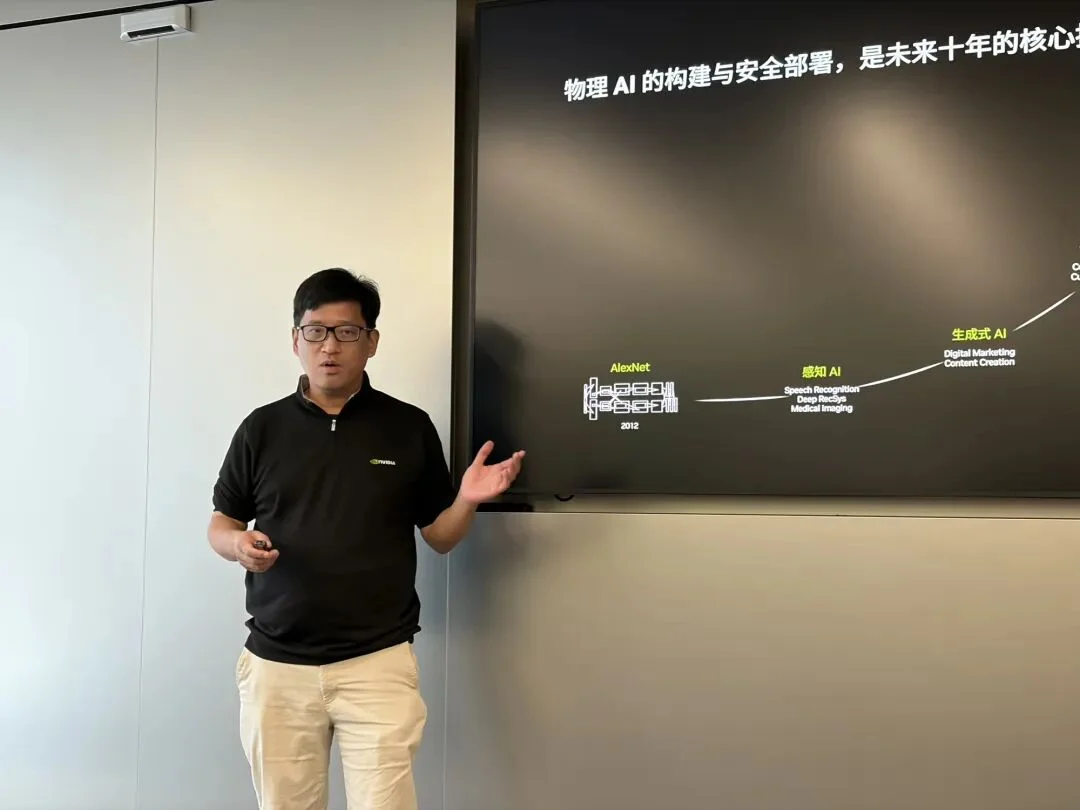
In August 2023, after Wu Xinzhou officially joined NVIDIA, the most urgent challenge he faced was mass-producing the driver assistance project in collaboration with Mercedes-Benz. In addition to the Chinese market, NVIDIA will build a full-stack driver assistance system for Mercedes-Benz, including complete hardware and software algorithms.
"NVIDIA is more of an ecosystem company; it provides accelerated computing hardware, operating systems, models, reference designs, and training frameworks," Wu Xinzhou said. "Our core work is to build end-to-end applications and collaborate with OEMs in certain areas. When I first joined NVIDIA, these areas were just getting started. Today, we can leverage a flexible, open platform to create more value for the broader automotive ecosystem."
These are precisely the experiences Wu Xinzhou accumulated while leading XPENG’s efforts to mass-produce highway and urban driver assistance systems. Additionally, he spent 13 years working at Qualcomm (2006–2018) and is familiar with the operational style of Silicon Valley companies.
Wu Xinzhou said, 'Looking back, I think it was all his (Jensen Huang’s) best choice.'
The cooperation model between Mercedes-Benz and NVIDIA is also quite unique in the autonomous driving industry; both parties adopt a software revenue-sharing model. According to Wu Xinzhou, NVIDIA does not charge during the development phase. After the vehicle is officially launched, the automaker shares revenue with NVIDIA for every set of driver assistance options sold.
This cooperation model is attractive to automakers because the upfront development costs are relatively low. However, the driver assistance market in overseas regions is still in its infancy. There is still a long way to go to build trust among more users so that they are willing to choose and use these features.
On one hand, most overseas automakers offer driver assistance functions as optional extras rather than standard equipment. This means many users have never tried driver assistance or are unaware that such an option exists.
At the same time, the price for driver assistance options is not cheap. Taking the Mercedes-Benz CLA as an example, for the CLA 250+ with an official guide price of USD 47,000 in the United States, the price for the driver assistance option is USD 3,950 for a three-year term. In comparison, Tesla’s FSD subscription price in the U.S. market is USD 3,564 for three years (USD 99/month × 36 months).
Moreover, this creates a vicious cycle: because fewer users opt for it, manufacturers must raise prices; otherwise, they cannot recover their development investments. As prices rise, even fewer users choose the driver assistance option.
This is also a major difference between China and overseas markets. Chinese manufacturers are more willing to include driver assistance hardware as standard equipment. The cost of standard hardware is already included in the vehicle price, allowing them to collect additional revenue through software subscriptions.
This is another cycle: all users have driver assistance, and manufacturers are not worried about recovering development costs. However, to collect more money, they must fully demonstrate that they can provide a safe and reliable driver assistance experience. As the driver assistance experience improves, cars sell better, and more users are willing to pay for driver assistance.
Wu Xinzhou believes that although there are differences between domestic and overseas markets, the wave of driver assistance is advancing at full speed. This is a process of user education; once drivers experience driver assistance, it becomes difficult to go back.
He said, "Expanding driver assistance capabilities in the global market feels like déjà vu to me. Even with some differing voices, I am not surprised at all."
Wu Xinzhou predicts that promoting the adoption of driver assistance systems in overseas markets will be faster at this stage, as the technology has reached a relatively mature phase. "I think it will happen quickly, within three years," Wu Xinzhou assessed regarding the timeline for the widespread adoption of driver assistance systems in European and American markets.
02The Five-Layer Cake of Smart Cars and Three Computers
The open and flexible cooperation model is a hallmark of NVIDIA's automotive business. Automakers can choose to adopt a full-stack driver-assistance solution, or select specific platforms as needed to develop their own in-house solutions.
Wu Xinzhou breaks down the full-stack solution for smart vehicles into three computers and a "five-layer cake." The three computers include one for local inference installed in the vehicle, one for cloud-based model training, and one for simulation.
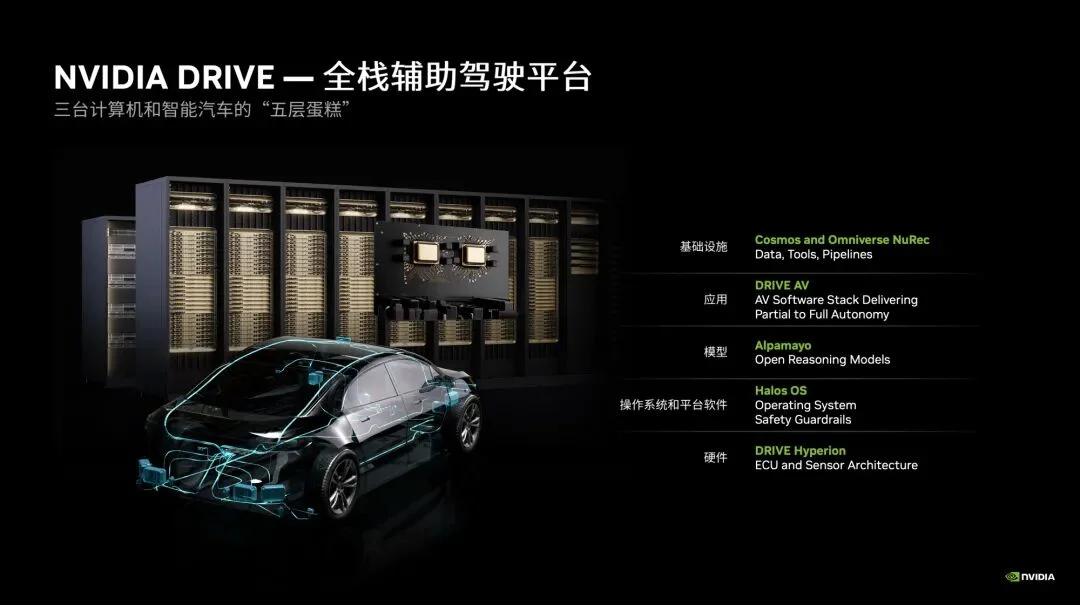
The "five-layer cake" architecture is tightly integrated with three computing units. The bottom layer consists of the hardware required for driver assistance and autonomous driving, including chips responsible for computation and sensors responsible for perception; NVIDIA refers to this as NVIDIA DRIVE Hyperion. The latest generation platform is Hyperion 10, which supports L4-level autonomous driving. The inference computer within the trio of computers resides in this bottom "cake" layer.
One level up lies Halos OS, an operating system that serves not only as a traditional vehicle OS but also as a security hub. It unifies chips, models, and software operations within a verifiable framework, achieving a full-process security closed loop from cloud-based training to on-vehicle execution.
At the model layer, NVIDIA has introduced Alpamayo, the world's first open-source autonomous driving inference model. Using a vision-language-action (VLA) model, it can explain decision-making processes in complex scenarios and handle long-tail problems. Alpamayo will not run directly in vehicles; instead, it acts as a "teacher model," distilled into deployable on-vehicle models.
The fourth layer is the application layer. DRIVE AV is the autonomous driving software stack, responsible for translating model capabilities into actual driving behaviors, including perception, localization, decision-making, and control. It can support both traditional modular algorithms and end-to-end AI models.
At the top layer are the infrastructure tools for training and simulation, including the Cosmos world model, the Omniverse simulation platform, and the Omniverse NuRec neural reconstruction system. The core function of these tools is to address the most difficult challenge in autonomous driving: data. By generating high-quality synthetic data and large-scale simulation environments, the system can continuously learn extreme and rare long-tail scenarios, forming a continuously evolving data flywheel. Today, the competition in autonomous driving is essentially shifting from algorithmic capability to data capability.
Wu Xinzhou explained that automakers can freely mix and match the three computing units and the five-layer cake architecture. For example, automakers with relatively strong self-research capabilities may choose to select only the chips and deploy their own software on them. Alternatively, they can opt for NVIDIA's full-stack solution, such as Mercedes-Benz.
He noted that the platform will be more open now. Automakers can choose to use their own models, NVIDIA's models, or models from other companies, offering many options and flexible adaptation capabilities.
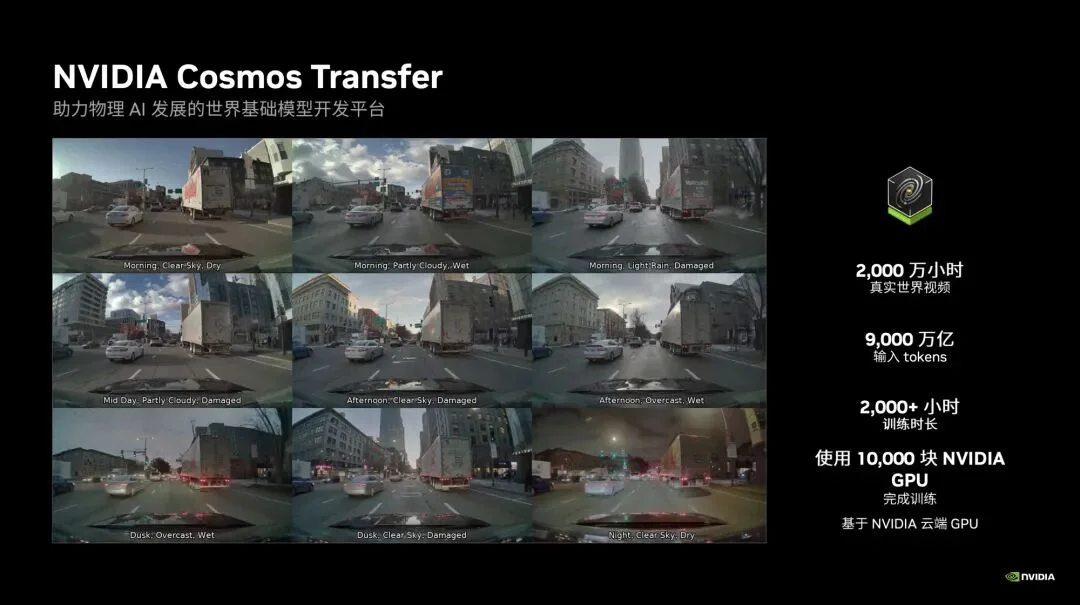
Wu Xinzhou also highlighted the advantages of the simulation computer in autonomous driving development, emphasizing the role of Cosmos. By taking a video from the real world, Cosmos can freely alter road conditions, traffic participants, and weather, significantly increasing data richness for the same scenario. Wu Xinzhou stated, 'Now compute is data; computing power is data.'
About a year and a half ago, NVIDIA shifted its focus from scaling L2 driver assistance to accelerating the arrival of L4 autonomous driving.
Wu Xinzhou said he observed two phenomena at the time: first, Tesla in overseas markets and numerous players in the domestic market had already achieved excellent results in L2 driver assistance. Second, generative AI and foundation models were likely key to enabling large-scale deployment of L4 autonomous driving.
In October 2025, NVIDIA announced an L4 autonomous driving partnership with Uber. Automakers will build L4 autonomous vehicles based on Hyperion 10, while Uber will integrate these vehicles into its ride-hailing network.
Specifically, leveraging an expanding roster of automaker partners, NVIDIA and Uber plan to launch a fully software-driven autonomous fleet by NVIDIA globally. The project is set to debut in Los Angeles and San Francisco in the first half of 2027, gradually expanding to 28 cities worldwide by 2028.
However, NVIDIA is not directly involved in Robotaxi operations; instead, it helps automakers build vehicles with L4 autonomous driving capabilities based on the NVIDIA DRIVE Hyperion platform.
On the hardware side, NVIDIA also provides a wide range of options, including Thor, which is well known in the industry for being built on the NVIDIA Blackwell GPU. The latest generation of Thor chips incorporates the newest advantages in accelerated computing, AI, and deep learning.
Because automotive manufacturers typically have long design cycles, NVIDIA must ensure they leave sufficient room in their designs to support next-generation software-defined smart cars. Therefore, NVIDIA has planned a next-generation hardware roadmap beyond Thor. Thanks to the advantages of the NVIDIA DRIVE architecture, developers can continuously design for future mass-production models and reuse their software capabilities across multiple generations.
At the GTC 2026 conference in March, Wu Xinzhou shared data showing that while global vehicles travel a total of 13 trillion miles annually, only 700 million of those miles are covered by driver assistance systems—a mere 0.006%. This highlights the vast potential of the assisted and autonomous driving market.
NVIDIA envisions a future where every mile driven is autonomous. If NVIDIA can secure a significant share of this fully autonomous driving market, it represents an enormous opportunity.
Wu Xinzhou stated, "Jensen Huang places the highest value on 'Zero-to-Trillion-Dollar Businesses' like autonomous driving, which presents the best opportunities for NVIDIA." This concept refers to sectors that currently generate little to no revenue but have the potential to grow into trillion-dollar industries.
Consequently, NVIDIA began laying the groundwork for its intelligent automotive business as early as 2015. Over more than a decade, the department has grown to nearly 4,000 employees, with annual headcount increases of 5% to 10%.
03Appendix: Full Transcript
Open Source Is in NVIDIA's Blood
Q: NVIDIA’s Alpamayo is the world’s first open-source autonomous driving inference model. Does "first" refer specifically to "inference"?
A: I think that’s accurate.
Q: So it’s not about reasoning?
A: We are definitely the first when it comes to open-source models.
Q: Why does NVIDIA insist on open source?
A: Open source is extremely important for the automotive ecosystem. The benefits of open source are twofold: first, it allows participants in the current ecosystem to accelerate their development processes and reduce costs; second, it attracts more people to join the ecosystem. For us, it is crucial to have more players within NVIDIA’s overall hardware and software platform ecosystem.
I believe open source is in NVIDIA’s blood, part of its DNA. It’s not just autonomous driving; other areas are also open-sourcing. Jensen Huang has mentioned in various settings that he highly praises DeepSeek and China’s open-source efforts.
Because many large model companies in the US are gradually moving toward closed-source models, as their business models do not support open source. However, there are other reasons in China, which Jensen Huang has discussed in some interviews. In China, particularly with DeepSeek and Qwen, I think these are very important for NVIDIA. With these models, not only are they used in China but also in the US, including by ourselves. But NVIDIA aims to encourage all players to go deeper and further in AI.
Actually, NVIDIA could easily support our open-source efforts with commercial models. Our investment in open source is substantial. You may have heard of Cosmos and Nemotron; Nemotron actually requires even greater investment, with a 128-billion-parameter model designed for enterprise use.
The investment in open-source models is huge, with training costs accumulating to over a billion. Why do we do it? Because if we provide good models, others can use them. Once they use them, they will buy GPUs. Thus, we can form a complete closed loop, which is entirely self-consistent. Therefore, NVIDIA is the most steadfast company in developing open-source AI models, and this applies equally to autonomous driving.
Q: With NVIDIA opening up its platform and driving users into its ecosystem, automotive clients might use cloud computing services from other divisions. Does this create performance pressure for your department?
A: I think you may have seen this discussed elsewhere. NVIDIA operates as a unified company. It only breaks down revenue by segment—automotive versus other businesses—in each earnings report. For me personally, there is absolutely no pressure in this regard.
Jensen Huang takes a long-term view on strategy. As I mentioned earlier, our business logic is to turn every mile of driving into autonomous driving data. If NVIDIA can collect a proportional fee for each of those miles, that represents a massive business opportunity. Jensen’s key focus is the 'Zero-Trillion Dollar Business.' These are ventures with trillion-dollar potential that are currently at zero scale. This is where NVIDIA sees its best opportunities.
Since autonomous driving is still a Zero-Trillion Dollar Business, I have no concerns about this.
Q: You mentioned earlier that autonomous driving accounts for a very small portion of total vehicle mileage. NVIDIA’s vision is to have every mile driven by assisted or autonomous systems. Are open-source models and L4 autonomy the necessary path to get there?
A: When I joined, my goal was to land L2++ solutions. We had a global cooperation agreement with Mercedes-Benz at the time. Our contract structure was different from others; we monetized through software revenue sharing. We co-developed all our software and provided it as open source to them, charging no development fees before launch. This was quite attractive to automakers because it kept their upfront development costs low.
Once the software was developed and ready for sale, we adopted this software revenue-sharing partnership model.
At the time, my biggest challenge was getting these solutions deployed. The initial progress was not smooth, but after two and a half years of effort, I believe our collaboration with Mercedes-Benz is now running very smoothly, built on strong mutual trust.
Moving toward L4 is, I believe, based on our assessment of the overall technological evolution over the past two years. We clearly recognize internally that while Tesla remains the sole player in North America for L2++, several companies in China have already achieved satisfactory results. Under these circumstances, with L4 technology advancing rapidly, generative AI, reasoning large models, and foundation models—though not yet widely applied to L4—will be a crucial key to unlocking the challenges of L4 from our perspective.
Based on these two points, about a year and a half ago, we shifted our overall goal toward enabling L4 and bringing L4 forward sooner. We will continue working on L2++, which will also be an important part of L4, but we are adjusting our overall goal toward L4.
Q: Are there too many competitors in L2++, making the ROI too low?
A: Not really. There aren't that many competitors outside of China.
The Wave of Driver Assistance Is Advancing at Full Speed
Q: NVIDIA now offers flexible cooperation models, such as purchasing chips only, utilizing cloud-based training capabilities, or leveraging NVIDIA's full-stack solutions. How are these different modes defined?
A: Much of what we are presenting at CES and GTC has been refined over the past few months. Previously, the landscape was relatively straightforward, essentially boiling down to two options: using NVIDIA chips combined with an operating system to build your own solution, or adopting our complete end-to-end solution. The latter approach is limited to just a handful of companies.
With the current end-to-end solutions in place, we also need to provide stronger capabilities, especially since we have significantly enhanced our OS. This gives automakers more options based on the Thor hardware platform. They can choose to develop their own models, use third-party models, or use ours—all are acceptable. We believe this approach provides more flexibility for everyone to move forward technologically.
Q: Will the global market, outside of China, actively promote driver assistance systems?
A: I think it’s a matter of time, because the situation in China is similar. When we first started developing urban driver assistance in China, many people were skeptical. They asked why we were tackling such a difficult task when highway assistance wasn’t even performing well, and questioned the need for urban features. I believe this is a natural process of development. Some markets may be more open to adoption, while others might progress more slowly, but I feel the overall trend is already established. The U.S. market also needs an education and cultivation phase, but it will definitely happen.
Q: Is the rollout of driver assistance to global markets not going smoothly either?
A: For me, it really feels like Déjà vu—we’ve seen it all before in China, and now we’re watching it again. Automakers always say these features are useless or that users don’t want them; those comments will inevitably arise. But as I said before, it’s ultimately a process of user education. Inside Mercedes-Benz, I still frequently hear differing voices, but to me, it’s not surprising at all. Back when I joined XPENG, the P7 had just launched. Among the senior executives, only one person ordered the high-spec version; everyone else chose the mid-spec.
For me, I remain calm. I also believe this wave is irreversible, provided you can deliver a sufficiently good experience. People often used the phrase “once used, hard to return to”—meaning that once drivers experience it, they won’t go back.
Q: How long do you think it will take for global market adoption to advance?
A: It’s difficult to predict. I’d estimate that the penetration rate of intelligent driving in China is currently above 50% (Note: Data from the Ministry of Industry and Information Technology shows that from January to February this year, the penetration rate of new passenger cars equipped with L2-level combined driver assistance reached 69.15%). In 2020, when I first proposed developing urban driver assistance, no one believed it. I had to explain why we needed urban capabilities. Only five years have passed since then.
It might be slower in Europe and America—perhaps seven years? I’m not sure. However, I believe it should proceed faster than before because technology has reached a very favorable juncture. As long as the feature is available in vehicles, consumers start using it, and the price isn’t too high, I think adoption will accelerate quickly—possibly within three years.
Q: Overseas automakers are advancing driver assistance through optional packages. Since users select these options infrequently, adoption is inevitably slow.
A: Yes, I believe there is another factor at play: competition. The market in China is intensely competitive. Once one company launches a solution, others rush to follow. In Europe and the United States, for example, when Mercedes-Benz or BMW release their systems, the entire industry tends to follow suit. Additionally, as more advanced L3 and L4 systems emerge, pricing for L2++ features may decrease.
Our business model is also evolving. We will no longer share profits from L2++ solutions with partners. This change allows us to offer lower prices to end users.
Q: You have launched both software and hardware. Are you concerned about safety risks?
A: We establish clear liability distinctions with automakers. These boundaries are negotiated beforehand, with specific responsibilities assigned to the automaker and, in some cases, to NVIDIA. As long as these terms are agreed upon in advance, it works well.
For L3 and L4 systems, liability issues may arise, including questions regarding the role of operators such as Uber, alongside automakers and software providers. I have not delved deeply into these negotiations, but I know this is a significant topic being discussed among all three parties. It is certain that for L3 and L4, responsibility will lie with the provider rather than the driver.
Q: With NVIDIA partnering with Uber, will you become an operator? Will other autonomous driving companies using NVIDIA’s platform be concerned?
A: We will not become an operator ourselves. Uber remains the entity connecting the market and users; we do not intend to operate directly. We focus on two things: providing driving software, and offering the Hyperion and Halos combination—the underlying hardware and software stack—that supports other autonomous driving companies in developing on our platform. Uber or other operators can choose to collaborate with autonomous driving companies. Currently, Uber is essentially collaborating with everyone.
We have another very important mission: to enable all automakers to build L4-ready vehicles using our Hyperion platform. This serves as a critical connection we provide.
Q: Is this generation of Thor sufficient to support L4?
A: Thor comes in several configurations that can support OEMs from L2++ to L4 levels; we collectively refer to them as Thor.
For an L4-level product, redundancy is essential. It requires a primary chip and a secondary ECU acting as a satellite auxiliary chip. From our current perspective, Thor may already be sufficient, though achieving 30 frames per second is another matter due to higher computational demands.
Additionally, we offer Hyperion, which connects two Thor chips via a high-bandwidth link, enabling L4 capabilities with dual Thor units. We are discussing Hyperion solutions with companies such as WeRide and Pony.
Looking ahead, we will advance to higher capabilities with our next-generation chip, which will outperform the current one. It will not be available this year; it might arrive next year, but SOP (Start of Production) is still some time away, and I cannot specify exactly how long.
Q: How do you ensure software can overtake competitors on the curve? What is the ratio between simulation and real-world data?
A: I believe the golden age of autonomous driving is approaching. It is no longer just about inference; the current architecture incorporates several new elements.
First is the foundation model. The foundation model itself can reduce reliance on data. As we discussed regarding Alpamayo, it is trained using an internet-scale foundation model to perform distillation. In our experience, a foundation built from such a model already possesses a deep understanding of the physical world.
Above that lies reasoning, which can also lower the demand for data volume. Reasoning is language-based. Language is crucial because it is humanity’s most important tool for summarizing the world.
Take a simple example: if I were teaching students to drive, I would give them a driver’s manual and administer a test. This essentially assesses what they should and should not do, followed by letting them drive for two or thirty hours on the road to obtain a license.
With language capabilities in the future, we might not need them to read a manual; providing 20 hours of video could enable them to learn driving, though that remains difficult. However, at least with language, we can offer an intermediate step. For instance, telling the model 'do not hit obstacles on the road' allows it to generalize better even for scenarios it has never encountered, significantly enhancing its generalization capability through human summarization.
Therefore, both foundation models and reasoning capabilities will drastically change data requirements. The old approach is no longer viable; this offers a completely new direction. This is why we believe L4 autonomous driving will advance much faster on this basis.
The third element is simulation, which can greatly augment road collection and testing data. You can place objects on the road to observe vehicle reactions, all based on real-world scenarios rather than fabricated ones, allowing you to modify your real-world environment. Regardless of how the car drives, you can reconstruct the surrounding world with pixel-level accuracy. Additionally, you can use Cosmos to generate similar elements or alter environmental conditions like weather, thereby significantly enhancing data richness.
We now have the concept that 'compute is data,' a key message currently promoted by NVIDIA. From a data volume perspective, I believe there will be significant changes in the future, moving away from the simplistic strategy of merely stacking data.
The concept that compute equals data is particularly vital for end-to-end models. Meanwhile, reasoning enhances generalization capabilities. Waymo may have taken 10 years to gradually resolve all corner cases. In the leap from L2++ to L4, current players may see their timelines drastically shortened. We hope to achieve commercial unmanned driving by 2028.
The Influence of Jensen Huang
Q: Why did you choose to join NVIDIA? Do you and Jensen Huang complement each other?
A: I believe both factors played a role. My first conversation with Jensen (Jensen Huang) likely took place in August or September 2022, about a year before my official departure from XPENG. At that time, due to some family reasons, I was considering returning to the United States. Although my relationship with XPENG remained very strong, joining NVIDIA represented an excellent opportunity for my career.
By 2022, I could see that joining NVIDIA offered the chance not just to serve a single automaker, but to influence the entire industry, particularly the autonomous driving sector. This was highly attractive to me. Moreover, at that point, I could already foresee the future direction of AI. I discussed these aspects extensively with both XPENG and Jensen. Joining NVIDIA at such a pivotal moment meant being at the core of driving AI forward, which I considered the best choice for me.
Given the significant impact my move would have on XPENG, I did not interview with any other companies. For me, this was undoubtedly the optimal decision.
Jensen has always aimed to develop AVs (Autonomous Vehicles). However, I view NVIDIA as an ecosystem company, where the core lies in hardware and the software that supports it. In contrast, end-to-end application development and direct service to automakers were just beginning when I joined. Consequently, the organization’s structure was very flat across both software and hardware domains. Regardless of the vertical industry, the focus had historically been on selling hardware first, followed by the software layer above it.
My experience at Qualcomm ensured that I understood NVIDIA’s working methods. Having worked at XPENG for a long period and achieved decent results, I possessed a deep understanding of vertical industries and automaker needs. Therefore, helping Jensen execute this vision was, in my view, his best choice then and remains so upon reflection.
Thus, after our conversation in 2022, although he did not extend an offer immediately, we recognized that this was a solid match for both of us, given my overarching goal of returning to the U.S.
Q: How frequently do you typically communicate with Jensen Huang?
A: He regularly communicates with senior executives, including me. His vision is highly long-term; he employs clear and prudent strategies to tackle complex challenges across the globe, while leveraging deep technical involvement to ensure our vision is feasible and possesses practical execution capability.
Q: Do you discuss upcoming changes in technology or shifts in industry business practices?
A: Yes, because our team is also quite large. The Research team has many people working on it as well. We hold Group Meetings where Jensen Huang reviews everyone's work and provides feedback.
Q: Is it one or two hours, or longer?
A: About the same, one or two hours.
Q: Do you think Jensen Huang has a very thorough understanding of intelligent driving and automobiles?
A: Yes. With the emergence of large models, commonalities across various fields are becoming increasingly strong. Jensen oversees the big picture and has excellent foresight regarding future technological developments; he also provides forward-looking guidance on how technology is applied in each domain. I believe Jensen is exceptionally capable, and his insights are generally highly accurate.
He doesn’t micromanage granular details. His strength lies in maintaining a strategic perspective: as long as execution is sound, he automatically filters out technical minutiae, yet from a holistic standpoint, he guides the team on which direction to pursue.
Q: Is there any particular feedback that left a deep impression on you?
A: One incident stands out in my memory, related to reasoning models. Based on Jensen Huang’s feedback at the time, we made a significant adjustment to our internal strategic direction.
To be honest, most of my daily energy is devoted to implementation—ensuring the smooth deployment of L2 driver assistance systems, a task that carries a heavy burden. Strengthening our R&D in inference capabilities was also a core initiative strongly pushed by Jensen Huang; we began ramping up efforts in this area about a year ago.
Q: How many people does NVIDIA currently have working on autonomous driving?
A: Nearly 4,000. The headcount grows by about 5% to 10% annually, which isn’t substantial growth. Moreover, AI tools are becoming increasingly powerful and effective, so I don’t foresee a need for large-scale personnel expansion in the near future.
Q: NVIDIA has been ambitious about autonomous driving, but there are now hotter fields, such as robotics. Many ADAS talent are moving into robotics.
A: After years of development, the focus of the autonomous driving industry naturally shifts, and fatigue among practitioners is inevitable. Meanwhile, emerging tracks like robotics are developing rapidly. Therefore, it is understandable that some investors and core engineers in the ADAS field choose to pivot to new areas to seek opportunities.
Q: How long do you think you can continue working in autonomous driving?
A: I believe I will stay in the role until my final shift.
As I’ve said before, promoting autonomous driving across all vehicles would be a significant achievement for my career. Especially since this technology has the potential to save lives and grant everyone the freedom to travel.
Written by James Edited by Daji