


NVIDIA’s Auto Strategy: Jensen Huang’s Long-Term Bet on End-to-End AI
Today, NVIDIA is undoubtedly held in high esteem.
After all, whether measured by its actual influence in the AI field or by the financial achievements it has already secured, NVIDIA under Jensen Huang stands as a prominent AI technology giant that commands attention across numerous industries—the automotive sector, which is currently undergoing transformation driven by AI, is no exception.
Nevertheless, a closer examination reveals a contradiction: NVIDIA’s role in the automotive industry does not align with the financial success it has achieved in this area.
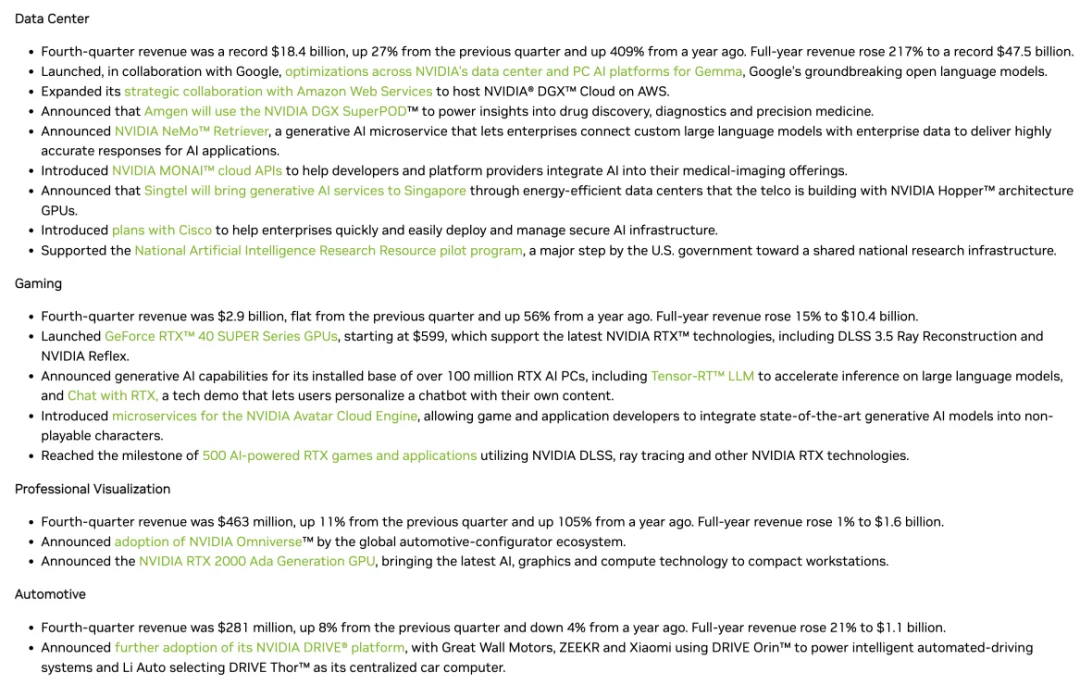
A typical example is that in the fourth quarter of 2023, NVIDIA’s total revenue reached USD 22.1 billion, surging by 265%, with a profit margin as high as 76.7%. At the same time, revenue from its automotive business amounted to only USD 281 million. This figure represents a very small overall share (less than 1.5%) and experienced a year-over-year decline of 4%, while the long-term losses associated with this business are well known.
Consequently, there has been considerable skepticism regarding the logic behind NVIDIA’s continued investment in the automotive sector.
However, with the annual GTC conference now underway, the latest updates NVIDIA released at this event regarding AI technology development and commercial implementation, along with its newest initiatives in the automotive business and related fields, have effectively provided the best response to these doubts.
Redefined DRIVE Thor
During the keynote address at this year's GTC, Jensen Huang personally announced a significant development directly related to the automotive industry: BYD, the world's largest electric vehicle manufacturer, has expanded its partnership with NVIDIA and chosen to build its next-generation smart EVs on the DRIVE Thor platform.
Given BYD's scale and the forward-looking nature of DRIVE Thor, this collaboration marks an important commercial milestone for NVIDIA's automotive business.
However, few have noticed that compared to the technical capabilities and specifications claimed when it was first unveiled, DRIVE Thor has undergone several very obvious adjustments.
For instance, regarding computing power, when DRIVE Thor was launched in September 2022, NVIDIA primarily claimed its AI computing power reached 2,000 TOPS, while also providing a floating-point performance of 2,000 trillion operations per second.
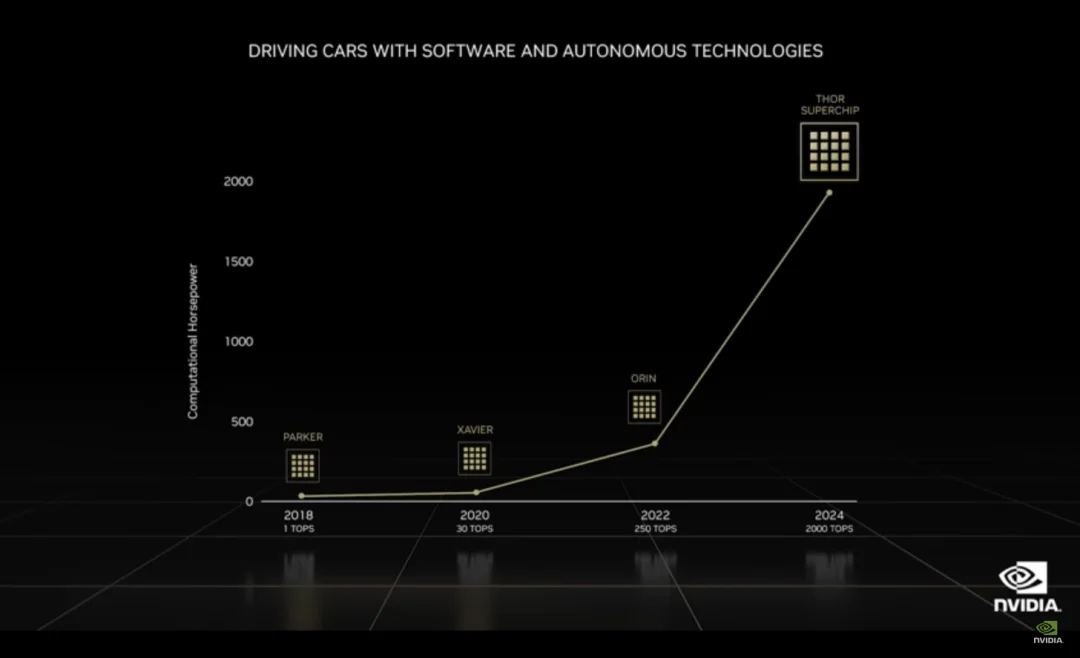
At the same time, NVIDIA emphasized that DRIVE Thor is its first autonomous driving automotive platform to adopt an inference Transformer engine; it also utilizes an upgraded ARM Poseidon AE core, making it one of the highest-performance processors in the industry.
In terms of functionality, as a central computing platform, DRIVE Thor helps automakers efficiently integrate digital dashboards, infotainment, parking, and driver assistance systems onto a single system-on-chip (SoC), significantly improving development efficiency and the speed of software updates and iterations. It even enables vehicles to run Linux, QNX, and Android simultaneously on a single computer.
From the technical specifications at the time, DRIVE Thor indeed followed a path of massive AI computing power combined with central computing and a Transformer engine. In terms of AI computing power especially, the 2,000 TOPS standard did shock the entire industry.
However, judging from this GTC event, the positioning of DRIVE Thor has shifted significantly.
For example, in terms of positioning, NVIDIA DRIVE Thor is positioned as an in-vehicle computing platform built specifically for generative AI applications that are becoming increasingly important in the automotive industry—more importantly, it features the new NVIDIA Blackwell architecture, which was designed specifically for Transformer, large language model (LLM), and generative AI workloads.
Thus, it is clear that with the explosion of large language models and generative AI, along with the gradual application of these technologies in vehicles, NVIDIA has fine-tuned the product positioning of DRIVE Thor to add underlying support for LLMs and generative AI.
More importantly, regarding computing performance, according to the latest information released by NVIDIA, DRIVE Thor delivers 1,000 TFLOPS of performance. By contrast, according to information released by NVIDIA in September 2022, DRIVE Thor’s floating-point performance was 2,000 TFLOPS.
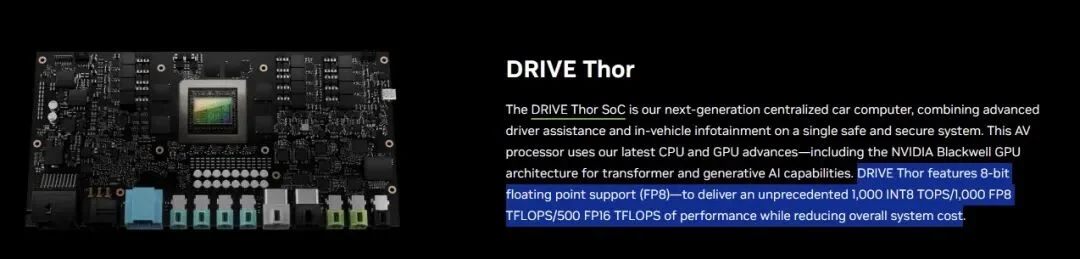
In response, some industry observers commented that DRIVE Thor’s computing power had seen a significant reduction.
Notably, NVIDIA officially announced that DRIVE Thor, featuring the new NVIDIA Blackwell architecture with cutting-edge capabilities such as a generative AI engine, will begin mass production as early as next year. As a specific comparison, the widely deployed DRIVE Orin currently uses GPUs based on the Ampere architecture, which was released in March 2020.
From this perspective, DRIVE Thor is not merely a technical parameter adjustment; it is also an example of NVIDIA leveraging current AI development trends to commercialize its latest technological advancements for autonomous driving and the automotive industry.
Starting in 2025: More Than Just OEMs
As the next-generation autonomous driving computing platform, NVIDIA’s DRIVE Thor represents, to some extent, the direction of underlying computing power development in the autonomous driving field. Consequently, among manufacturers dedicated to advancing autonomous driving technology and its commercialization, DRIVE Thor is a critical product that requires early investment and strategic layout.
For NVIDIA, manufacturers’ adoption signifies the implementation of DRIVE Thor—yet this is not easy.
In fact, looking at the deployment status following DRIVE Thor’s release, from its initial launch in September 2022 until before CES 2024, only one Chinese OEM, Zeekr, had confirmed the use of the DRIVE Thor chip in its next-generation models.
An insider told us that even before officially releasing DRIVE Thor in 2022, NVIDIA had conducted in-depth discussions with a group of Chinese OEMs. Both new-energy vehicle startups and state-owned automakers hoped to be the first OEMs to adopt DRIVE Thor—but ultimately, Zeekr became the first brand to announce the adoption of the DRIVE Thor chip.
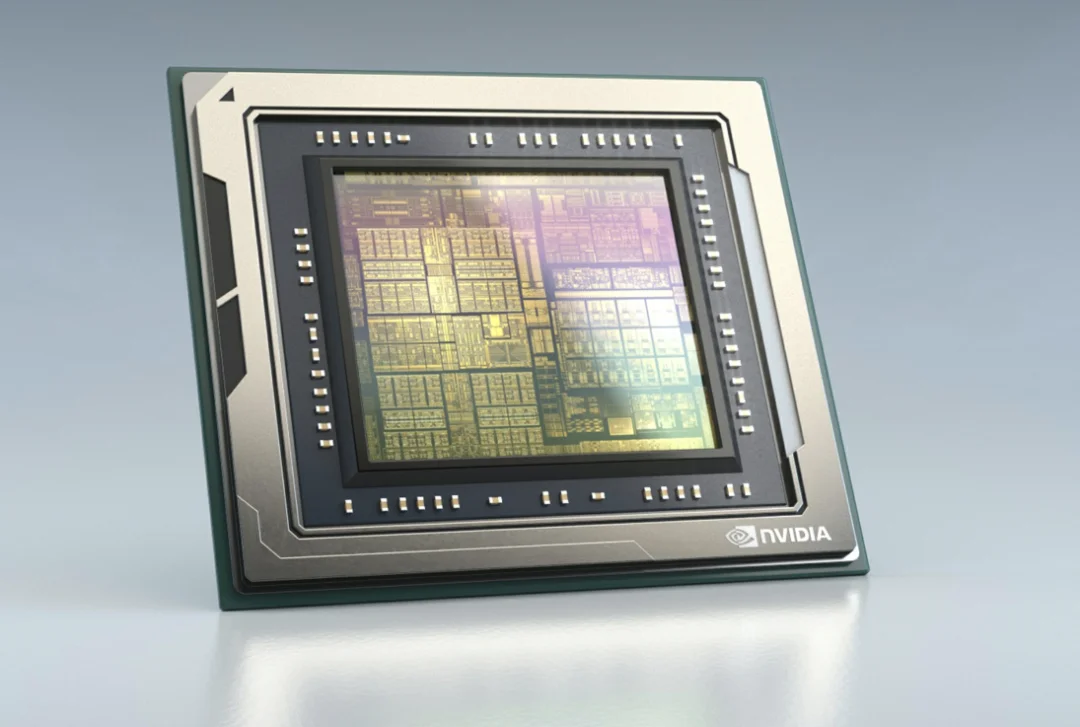
However, by 2024, DRIVE Thor had gained increasing support from OEM customers. For instance, during the CES 2024 event, Li Auto announced that it would build its future automotive products on top of DRIVE Thor.
More notably, during the GTC event, BYD announced it will build its next-generation electric vehicles on the DRIVE Thor platform. Meanwhile, Guangqiaian stated that its premium luxury brand Haobo will adopt the DRIVE Thor platform for its next-generation EVs; mass production of the new models is scheduled to begin in 2025, with L4-level autonomous driving capabilities.
Additionally, XPENG announced that it will use the NVIDIA DRIVE Thor platform as the "AI brain" for its next-generation electric vehicles. This new in-vehicle computing platform will support the automaker’s self-developed XNGP intelligent driver-assistance system.
Beyond traditional automakers, DRIVE Thor is also being selected by manufacturers in other niche segments, including trucks, robotaxis, and delivery vehicles. Specifically:
Silicon Valley-based autonomous delivery vehicle manufacturer Nuro has chosen DRIVE Thor to power its integrated autonomous driving system, Nuro Driver.
Global autonomous driving software solution provider Plus announced that the next generation of its L4-level SuperDrive solution will run on the DRIVE Thor automotive-grade centralized computing platform.
Waabi, which is developing autonomous driving AI, will leverage DRIVE Thor to launch its first generative AI-powered autonomous trucking solution, significantly enhancing the safety and reliability of autonomous trucks at scale.
Wenyuanzhixing is collaborating with Lianxiangchejisuan to create multiple commercial L4-level autonomous driving solutions based on DRIVE Thor. These solutions are integrated into Lianxiangchejisuan’s first autonomous driving domain controller, AD1.
Overall, the commercial application scenarios for DRIVE Thor extend beyond well-capitalized automakers to include a range of solution providers dedicated to advancing frontier autonomous driving technologies.
So why has DRIVE Thor attracted so many potential customers for deployment?
An industry analyst told us that when NVIDIA DRIVE Thor was first launched, its 2,000 TOPS of computing power was indeed very high. However, at the time, the technical roadmap for autonomous driving was unclear, and the industry was not certain whether such high computing power was necessary. Meanwhile, the cost of NVIDIA DRIVE Thor was extremely high, making it difficult even for relatively wealthy automakers to afford.
However, the situation changed in the second half of 2023.
With the emergence of ChatGPT and the boom in large language models, Tesla shifted toward an end-to-end solution in response. The entire autonomous driving sector suddenly saw another round of technological progress driven by large models and generative AI in this field. As a result, many automakers and L4 solution providers wanted to seize this opportunity to gain an advantage, leading them to seek cooperation with NVIDIA on the development of DRIVE Thor.
Of course, the industry analyst noted that from NVIDIA’s perspective, after communicating with multiple automakers and solution providers, it lowered the computing power standards for DRIVE Thor, thereby reducing costs accordingly. This ultimately gained recognition from downstream automakers and some solution providers, who were then willing to pay for it.
From Vehicle-Side Solutions to the Entire Automotive Industry Ecosystem
For NVIDIA, developing autonomous driving computing chips for vehicles is actually just one of the pillars of its business in the automotive industry. In fact, based on the announcements made at this GTC event, NVIDIA’s ambitions in the automotive sector far exceed the DRIVE Thor business itself.
In addition to DRIVE Thor, NVIDIA’s cooperation with automakers also involves other business segments.
For instance, in the collaboration announced between NVIDIA and BYD at the GTC event, BYD plans to leverage NVIDIA’s AI infrastructure for cloud-based AI development and training. The company will also use the NVIDIA Isaac and NVIDIA Omniverse platforms to develop tools and applications for virtual factory planning and retail configurators.
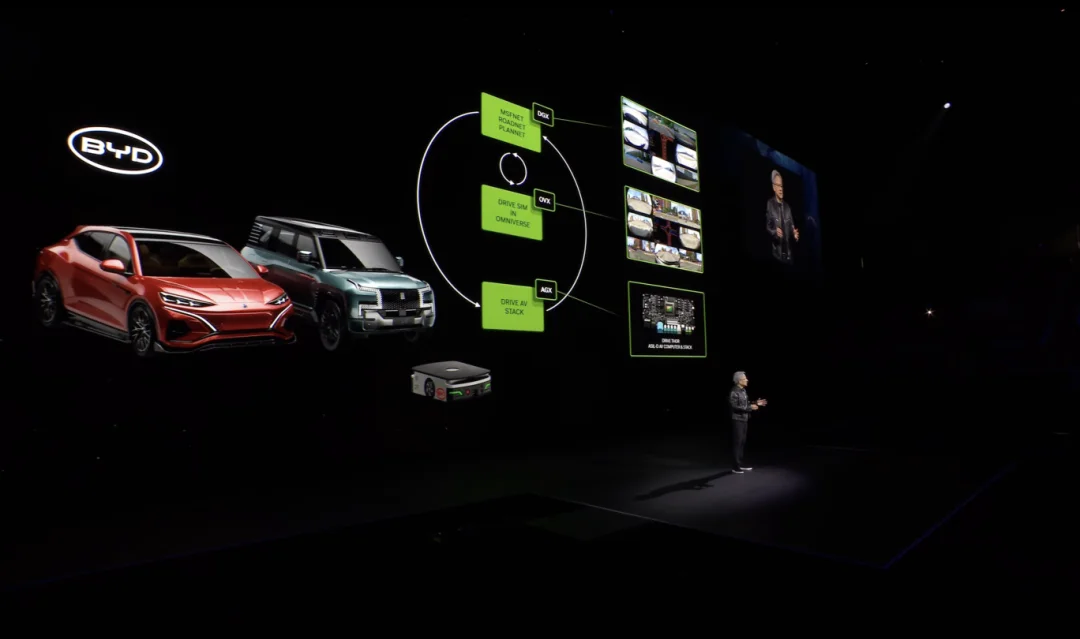
In fact, numerous automakers have already purchased NVIDIA’s AI infrastructure for cloud-based AI development and training.
One key customer in this segment is Tesla.
As early as August 2021, to train autonomous driving algorithms in the cloud, Tesla’s supercomputer deployed for cloud operations already comprised 11,544 GPUs, all supplied by NVIDIA. Although Tesla has since initiated research and development of its Dojo supercomputer system and moved into deployment, it continues to purchase NVIDIA GPUs even today amid the AI boom.
Beyond Tesla, Chinese automakers such as XPENG, NIO, and Li Auto are also buying NVIDIA GPUs for cloud deployment and training. Revenue from this segment is substantial but is not categorized under NVIDIA’s automotive business; instead, it is reported within the data center business.
Danny Shapiro, Vice President of Automotive Business at NVIDIA, stated in an exclusive interview with 42HOW Auto:
For us, competition is not just about chips; it also involves software. And that’s only what happens inside the vehicle. Data centers are equally critical components of artificial intelligence. I don’t know if there are other companies besides NVIDIA collaborating on both vehicle AI and data center AI. From a data processing perspective, the cycle of collection, training, testing, validation, and deployment is continuous, and that represents our advantage.
From a financial reporting perspective, the revenue from this business segment is indeed small. However, if we calculate the revenue NVIDIA derives from the automotive industry—including revenue from data center operations with automakers—the total is substantial.
Beyond data center services, NVIDIA’s collaboration with BYD also involves its Omniverse virtual reality and simulation platform, which represents a key strategic layout for the company in the automotive sector.
According to NVIDIA, Omniverse can help automakers accelerate the digitalization of their product lifecycles, covering stages from concept generation and styling to exterior design and retail. For instance, during vehicle development, engineers can use Omniverse to modify interior designs within a virtual environment, enabling high-efficiency design improvements and validation through collaboration and sharing. In manufacturing, automakers can leverage Omniverse to develop and run complex AI-driven virtual environments for designing factories and warehouses.
BMW Group has already established the world’s first virtual factory using NVIDIA Omniverse, as part of its digital transformation and efficiency improvement initiatives. For NVIDIA, this serves as a business extension of its virtual reality and simulation platform into the automotive industry.
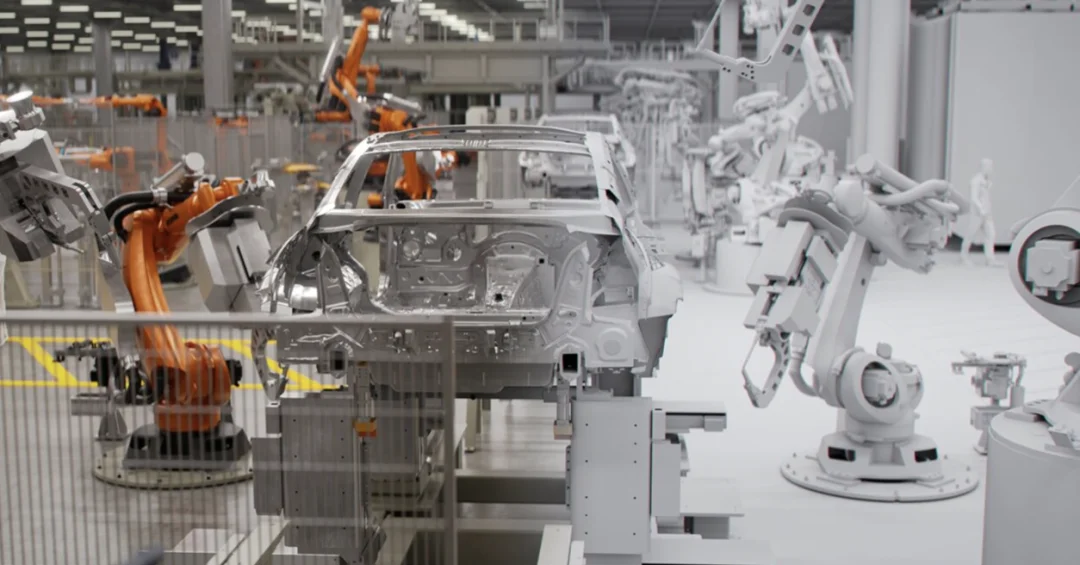
At this year’s GTC conference, NVIDIA also upgraded its robotics platform-related offerings, which are closely tied to the automotive sector.
Specifically, NVIDIA officially launched Project GR00T, a general foundation model for humanoid robots, targeting humanoid robotics and embodied intelligence. Additionally, NVIDIA introduced Jetson Thor, a new humanoid robot computer based on the NVIDIA Thor system-on-chip (SoC).
Jetson Thor includes a next-generation GPU with a transformer engine, based on the NVIDIA Blackwell architecture, delivering 800 trillion 8-bit floating-point operations per second of AI performance to run multimodal generative AI models such as GR00T.
In a sense, NVIDIA’s business layout shares similarities with Tesla’s use of its FSD chips for the Optimus robotics division. Under Tesla’s plan, once the Optimus robotics business matures, it has the potential to become the most valuable segment of the company.
Clearly, NVIDIA’s recent moves appear to draw inspiration from Tesla’s business vision, positioning itself in advance.
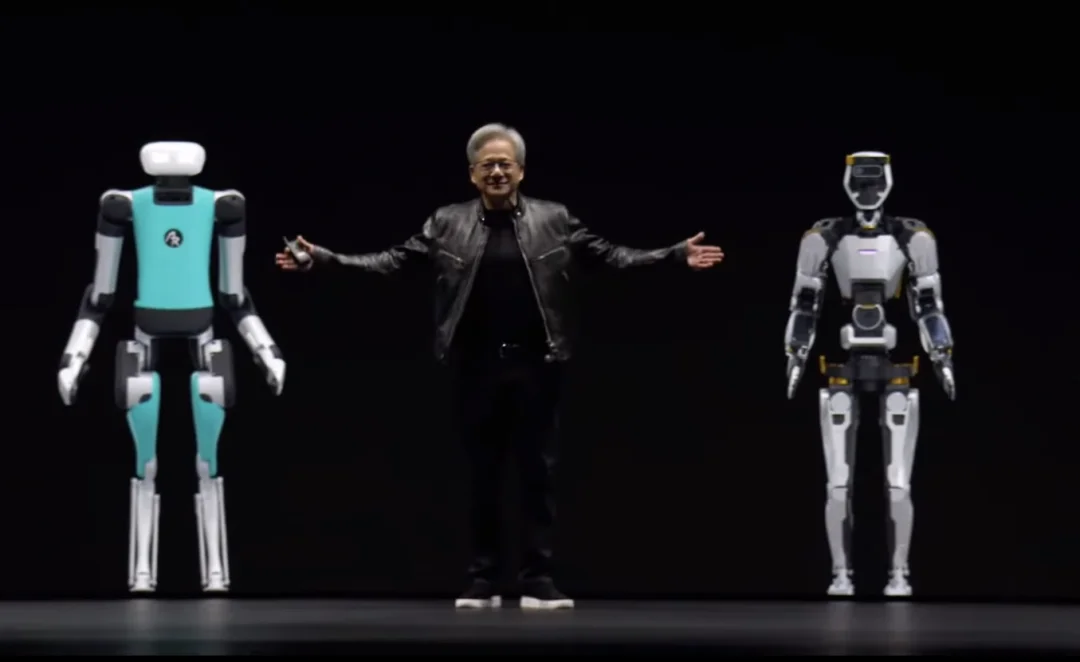
It is important to note that NVIDIA is developing a comprehensive AI platform for a group of leading humanoid robotics companies, including 1X Technologies, Agility Robotics, Apptronik, Boshidundongligongsi, Figure AI, Fuliyezhineng, Sanctuary AI, Unitree, and XPENG Pengxing.
Among these, XPENG Pengxing is a business unit under XPENG Motors.
Overall, through its platform-based layout across multiple sectors, NVIDIA has diverse opportunities for business implementation during the intelligent transformation of the automotive industry. The revenue generated by these implementations does not appear on financial reports—although the DRIVE computing platform business, which provides autonomous driving compute power for vehicles, is one of the more visible segments.
Final Thoughts
From a holistic business perspective, NVIDIA’s core strategy in the automotive sector is closely tied to a personal obsession of Jensen Huang.
An industry insider who previously worked at NVIDIA and had direct contact with Jensen Huang told us that after the AI boom began in 2012, Huang initially overlooked the autonomous driving market because he believed its profit margins were low, especially compared to the 60% to 70% margins in the server sector.
However, Jensen Huang is deeply committed to the edge deployment of AI. It was this conviction that led him to identify business scenarios for NVIDIA in automotive autonomous driving and robotics back then. Although these businesses have not generated significant financial returns, NVIDIA has persisted under Jensen Huang’s leadership, continuing this commitment to the present day.
At its core, what Jensen Huang and the NVIDIA he leads have persisted in building is an "end-to-end" (cloud to edge) business platform for the automotive industry—the value of which cannot be measured solely by financial figures.
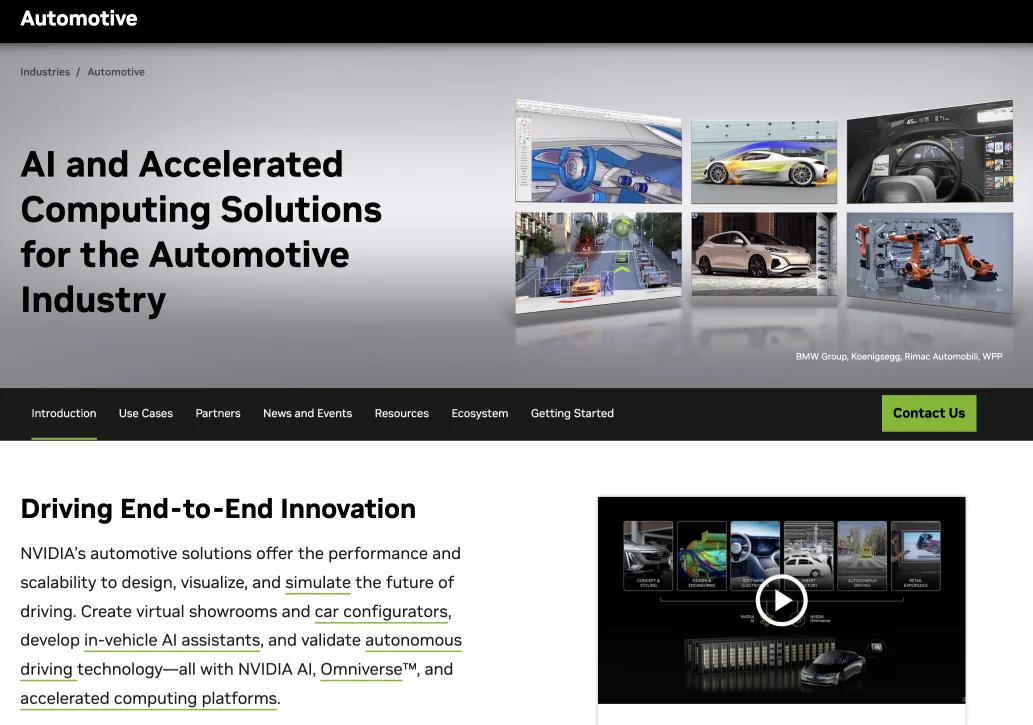
Thus, we can confirm that in this automotive industry revolution centered on digitalization and intelligence, NVIDIA will undoubtedly continue to play a crucial role, and Jensen Huang himself possesses the patience and resolve to advance this position.
As Danny Shapiro, Vice President of Automotive at NVIDIA, stated during an interview with 42HOW Auto at Muniheichezhan in September 2023:
"Autonomous driving is very important to NVIDIA. Jensen Huang is extremely patient. In fact, he had already invested more than ten years in the AI field before seeing actual revenue returns. Therefore, he will undoubtedly continue to invest in autonomous driving—this segment is still small, but it holds excellent potential for growth."
We view this business as a long-term endeavor. It requires substantial investment, and its growth curve is relatively slow. Over the next six years, we project automotive hardware and software revenue of USD 14 billion.
Written by: 308 Edited by: Daji