Robotaxi and Humanoid Robots: How Is NVIDIA Capturing the Physical AI Market?
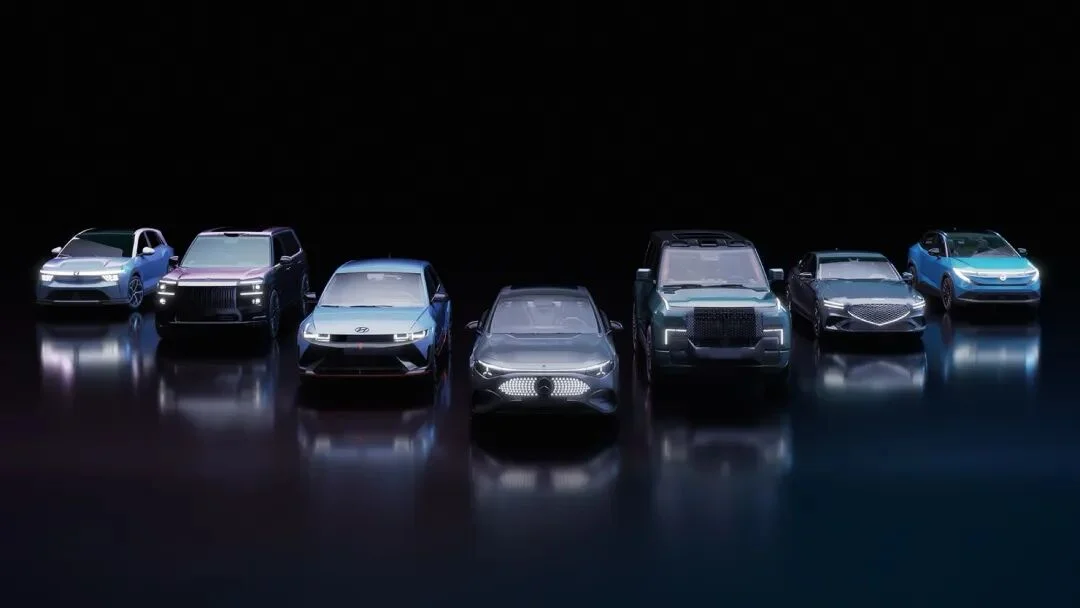
The 2026 NVIDIA GTC Taipei conference, which kicked off on June 1, saw Jensen Huang, clad in his signature leather jacket, unveil a series of new developments to the global tech community. These include the start of mass production for Vera Rubin, an entry into the AI PC chip market, and the Cosmos 3 multimodal model.
In the realm of smart vehicles and autonomous driving, NVIDIA introduced the 32-billion-parameter VLA inference model, Alpamayo 2 Super. Compared to the previous 10-billion-parameter Alpamayo 1.5, this represents a more than threefold increase in parameters. The model has expanded from front-camera-only perception to 360-degree perception and added new features such as meta-action output.
Also released alongside Alpamayo 2 Super are new tools, models, and agent skills. These will establish a complete pipeline spanning real-world data collection, closed-loop training, and vehicle-side deployment. This includes NVIDIA AlpaGym, NVIDIA OmniDreams, and the newly announced NVIDIA Omniverse NuRec model.
This marks further progress in NVIDIA’s integrated hardware-software layout for autonomous driving. For automakers or autonomous driving companies, the open-source Alpamayo 2 Super teacher model can be distilled into compact models for execution on vehicle hardware. Vehicle hardware options include Thor or the Hyperion reference design, both provided by NVIDIA. Consequently, automakers and autonomous driving firms can significantly simplify their development processes without starting from scratch.
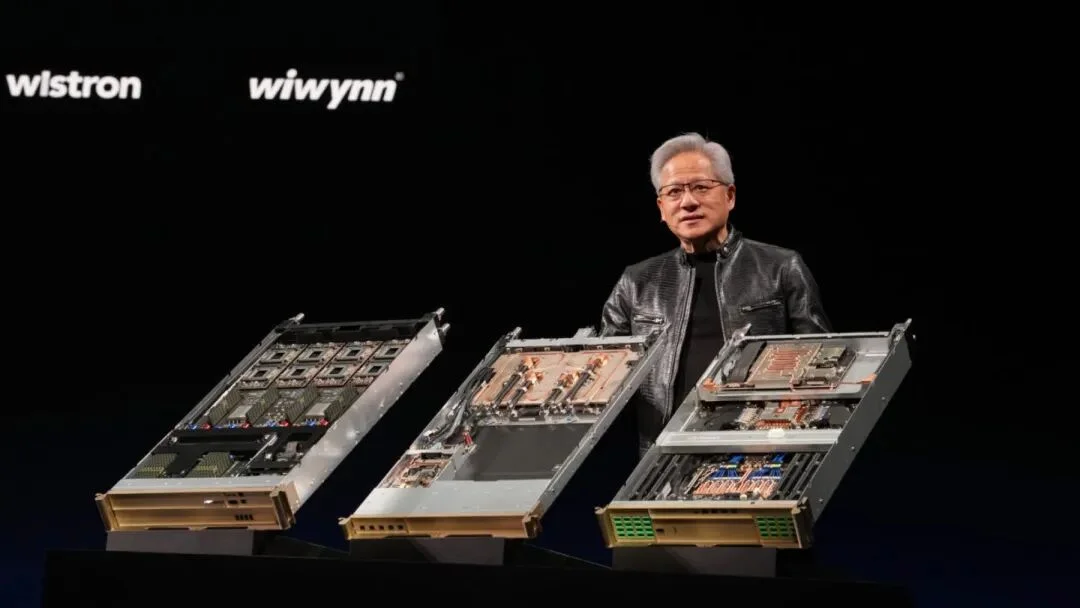
Meanwhile, NVIDIA announced collaborations with several companies in the L4 autonomous driving sector. Partners include manufacturer Foxconn, emerging automaker VinFast, and ride-hailing platforms Uber and HUMAIN.
Essentially, an autonomous vehicle is a complex robot that moves on four wheels. Both face identical technical challenges: how to achieve high-precision scene perception, real-time reasoning and game-theoretic interaction, and safe closed-loop decision-making and action execution within the uncertain three-dimensional physical world.
At the NVIDIA GTC Taipei conference, Jensen Huang also unveiled an open reference design for humanoid robots. Built on the Unitree H2 robot body, dual Sharpa Wave tactile five-finger dexterous hands, and most importantly, the NVIDIA Jetson AGX Thor T5000 onboard computing module, it delivers 2,070 FP4 TFLOPS of compute power. Leading research institutions including Ai2, ETH Zurich, the Stanford Robotics Center, and the Advanced Robotics and Control Laboratory at the University of California San Diego will adopt this humanoid robot reference design to advance frontier humanoid robotics research.
From underlying agent reasoning models to top-level global mobility network deployments, NVIDIA is no longer just a "pickaxe seller" or chip supplier; it is reshaping the rules of the AI industry.
01Alpamayo 2 Super Reshapes the Automotive Brain
In recent years, the autonomous driving industry has been engaged in a grueling battle. Traditional rule-based algorithms, or imitation learning models that rely solely on piling up massive amounts of data, often struggle when faced with the endless long-tail scenarios of the real world.
How can cars, like experienced human drivers, not only see the road but also understand complex traffic interactions and make reasonable inferences? NVIDIA's latest solution, Alpamayo 2 Super, has now been unveiled.
Alpamayo 2 Super is built on the NVIDIA Cosmos world foundation model and features 32 billion parameters. This represents more than a threefold expansion in parameter scale compared to the previous 10-billion-parameter Alpamayo 1.5. The increase in parameters means that Alpamayo 2 Super will significantly enhance reasoning, 3D spatial understanding, and trajectory prediction capabilities in long-tail scenarios.
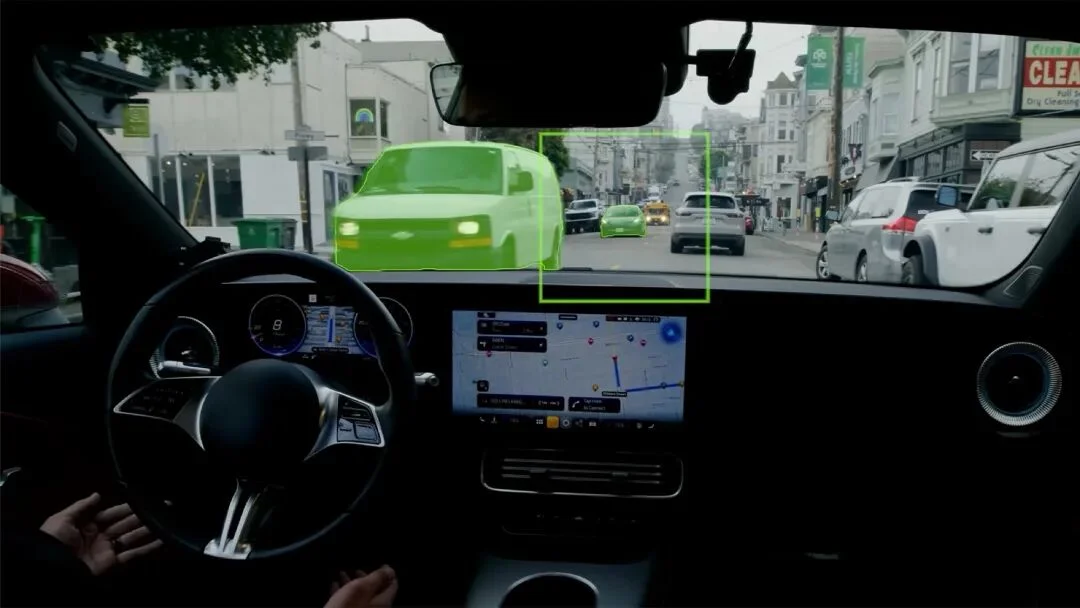
On the perception front, Alpamayo 2 Super has upgraded from forward-facing camera perception to 360-degree panoramic perception covering the front, sides, and rear. This panoramic field of view provides the model with more complete scene information input, improving vehicle safety during lane changes, merging, and intersection navigation.
At the decision-making level, the model introduces a "Meta-Action" output mechanism. This means the model can not only predict trajectories and trace causal chains but also output high-level macro driving decisions such as yielding, changing lanes, and stopping, providing downstream planning systems with more logical and interpretable instructions.
The evolution of large models relies heavily on high-quality data feeding and validation environments. To support the deployment of Alpamayo 2 Super, NVIDIA simultaneously released a series of development tools.
In both academia and industry, autonomous driving model training has long been plagued by the challenges of "open-loop evaluation." Open-loop training refers to evaluating a model's single-round actions based on pre-recorded historical data. However, in real-world driving, any minor decision made by an autonomous system (such as an inappropriate brake or steering choice) instantly alters the reactions of surrounding vehicles and pedestrians. Static datasets cannot simulate this chain reaction of interactions, leading to what is known as "compound errors."
To address this pain point, NVIDIA launched the open-source, high-throughput closed-loop reinforcement learning framework NVIDIA AlpaGym.
AlpaGym is built on the AlpaSim microservice simulation stack and NVIDIA Omniverse NuRec. It allows models to undergo continuous cycles of decision-making and observation in virtual environments, where every action choice immediately reacts back upon the environment, thereby exposing edge-case failures and compound errors that static datasets overlook.
Additionally, the most expensive and time-consuming stage in previous data pipelines was manual annotation. NVIDIA has now open-sourced an automated causal-chain annotation pipeline that generates labels with decision-causal associations directly from raw driving video clips without human intervention. This technology compresses the annotation cycle for foundation models from months to days, significantly boosting efficiency.
The release of Alpamayo 2 Super and its supporting toolchain provides autonomous driving companies and automakers with standardized underlying infrastructure. As a "teacher model," it can be distilled into smaller models and run on Thor or Hyperion reference designs.
02Driving Global Robotaxi Deployment
If reasoning models have solved the thinking problem for autonomous driving systems, the next challenge for the entire industry is how to safely and efficiently connect these intelligent machines to commercial networks and achieve profitability.
At this GTC conference, NVIDIA announced it will expand its L4 autonomous driving partnerships, broadening its reach to automakers, Tier 1 suppliers, and ride-hailing platforms across Asia, Europe, and the Middle East.
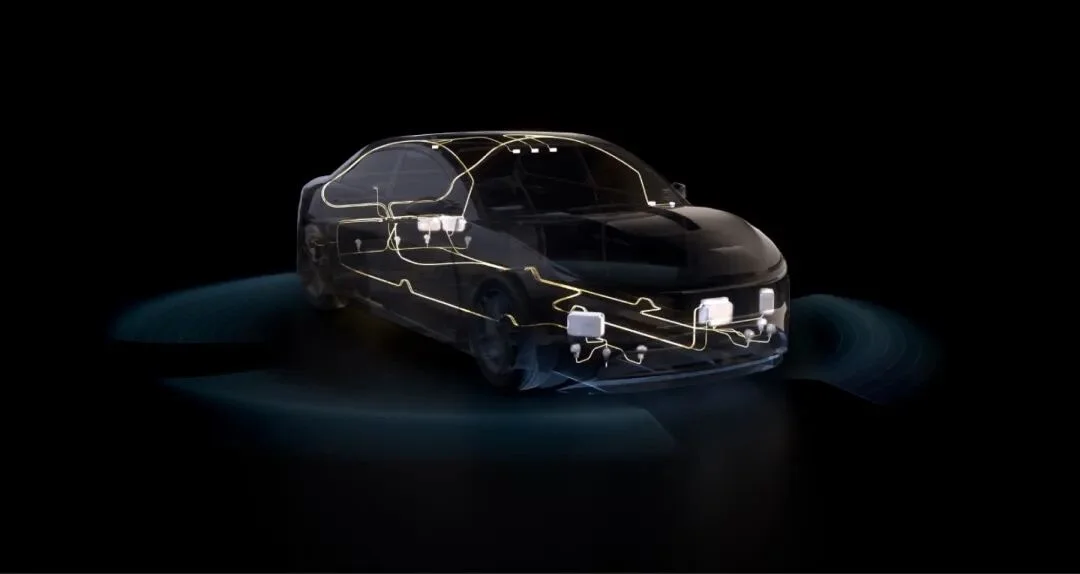
During the NVIDIA GTC Taipei conference, NVIDIA announced an expanded collaboration with Foxconn. The partnership will integrate Foxconn’s contract design and manufacturing capabilities to drive the rapid integration, scaled advancement, and deployment of L4 electric vehicles based on the NVIDIA DRIVE Hyperion platform.
According to the plan, the initial deployment of this project will launch in Taiwan, with Kaohsiung potentially among the first cities to receive the service before expanding to other Asian markets. Foxconn plans to officially launch Robotaxi services by 2028, with initial routes connecting airports to city centers, followed by expansion along railway networks.
For the Southeast Asian market, which features more complex traffic conditions, new carmaker VinFast has partnered with autonomous driving software company Autobrains to introduce L4 autonomous vehicles based on the NVIDIA DRIVE Hyperion platform.
Additionally, in Europe, Uber is collaborating with Autobrains. The two companies will launch a driverless taxi project based on NVIDIA DRIVE Hyperion in Munich, Germany, later this year. The project integrates Autobrains’ agentic AI autonomous driving software, allowing automakers to focus solely on manufacturing L4 hardware while leveraging the software for autonomous operation. This move will further expand Uber’s footprint in the European ride-hailing market.
In the Middle East, HUMAIN is using NVIDIA DRIVE Hyperion to bring Robotaxis to Saudi Arabia.
03Building a Robot Reference Platform Based on the Unitree H2
If smart cars are physical AI with wheels, then general-purpose humanoid robots represent the ultimate form of physical AI in broader industrial applications. Jensen Huang pointed out at the conference: "Humanoid robots will bring physical AI to the world's largest industries, unlocking a multi-trillion-dollar economic opportunity."
However, researchers worldwide still face a highly fragmented development process when creating general-purpose humanoid robots. This process spans hardware integration, data collection, simulation, model training, evaluation, and final deployment. To break this state of isolated proprietary black boxes across these stages, NVIDIA has launched its first open humanoid robot reference design—the NVIDIA Isaac GR00T Humanoid Robot Reference Platform.
This design tightly integrates top-tier hardware (the body) with an open software stack (the brain), aiming to eliminate the infrastructure burden of "reinventing the wheel" for research teams through standardized modules.
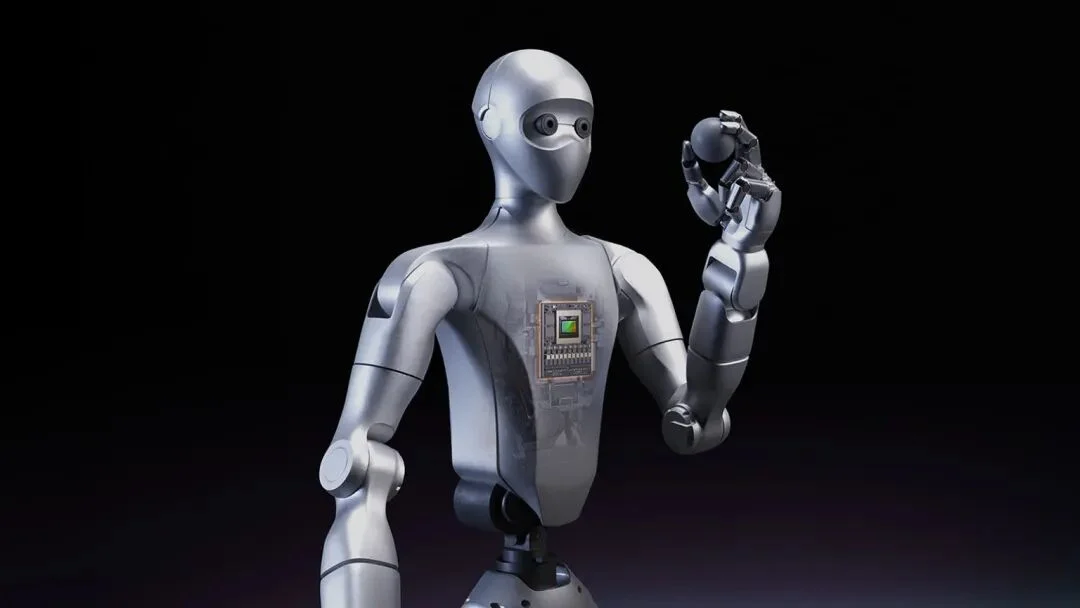
On the hardware side, the reference platform integrates industry-leading reducers and motor solutions, forming a test body suitable for human-scale environments:
Body: The Unitree H2 Plus humanoid robot, standing approximately 1.82 meters tall and weighing about 68 kilograms, features 31 degrees of freedom across its entire structure.
Dexterous Manipulation End: Equipped with dual Sharpa Wave tactile five-finger dexterous hands, it adds 22 degrees of freedom. This brings the total degrees of freedom for the robot's body and hands to 75, significantly enhancing its operational range for dexterous tasks.
Actuator torque control: Enables full-body control, with arm torque reaching up to 120 N·m and leg torque up to 360 N·m. The arms have a rated load capacity of 7 kg and a peak load capacity of 15 kg, ensuring the robot's lifting ability in real-world operating conditions.
Sensor perception: A multi-view perception network includes a wide-angle stereo camera mounted on the head (with a horizontal field of view of 140° and a vertical field of view of 102°), wrist cameras for close-range manipulation, and an inertial measurement unit (IMU) for motion tracking.
To meet the stringent requirements of physical AI for precise movement, interaction, and operation in dynamically changing environments, this reference design embeds the computing core directly within the robot itself.
It integrates the NVIDIA Jetson AGX Thor T5000 onboard compute module, which features an NVIDIA Blackwell GPU delivering up to 2,070 FP4 TFLOPS of AI performance. It also includes a 14-core Arm CPU and 128 GB of unified memory. Power consumption can be dynamically configured between 40W and 130W, designed specifically for real-time sensor processing and edge-side robotic inference.
This reference design not only boasts powerful onboard capabilities; NVIDIA also provides a full-stack platform for humanoid robot development called Isaac GR00T. This platform includes NVIDIA Isaac Teleop for collecting high-quality robotic demonstration data; the Isaac GR00T open foundation model for multi-task behavior reasoning; NVIDIA Isaac Sim and Isaac Lab for simulation and policy training prior to actual deployment; and accelerated NVIDIA Isaac ROS middleware responsible for deploying trained policies to hardware.
The modular design allows researchers complete control over their own robot data, training data, telemetry data, and logs. Currently, multiple research institutions including Ai2, ETH Zurich, the Stanford Robotics Center, and the University of California San Diego plan to adopt this reference design. According to the schedule, Unitree Technology will officially launch this humanoid robot reference platform by the end of this year.
NVIDIA’s open standard combining software and hardware is accelerating the speed at which creative innovations in frontier scientific research, such as robotics, are translated into physical hardware.
Whether it is a humanoid robot moving on two legs or an autonomous vehicle driving on four wheels, they face the same ultimate technical challenge: enabling machines to perceive, reason, and operate safely in uncertain environments. By using vision-language-action (VLA) large models as the 'brain' and high-throughput closed-loop simulation systems as the 'training ground,' NVIDIA is effectively empowering both fields with the same methodology.
As foundational large models, open reference designs, simulation toolchains, and the global industrial manufacturing ecosystem mature, the traditional boundary between automobiles and robots is rapidly dissolving. Future transportation will no longer be mere vehicles fulfilling a carrying function; they will become wheeled intelligent robots with advanced reasoning capabilities, integrated into the global digital and physical networks. The convergence of physical AI technologies is transforming the world in which humans and machines coexist at an unprecedented pace.
Written by: James Edited by: Daji