


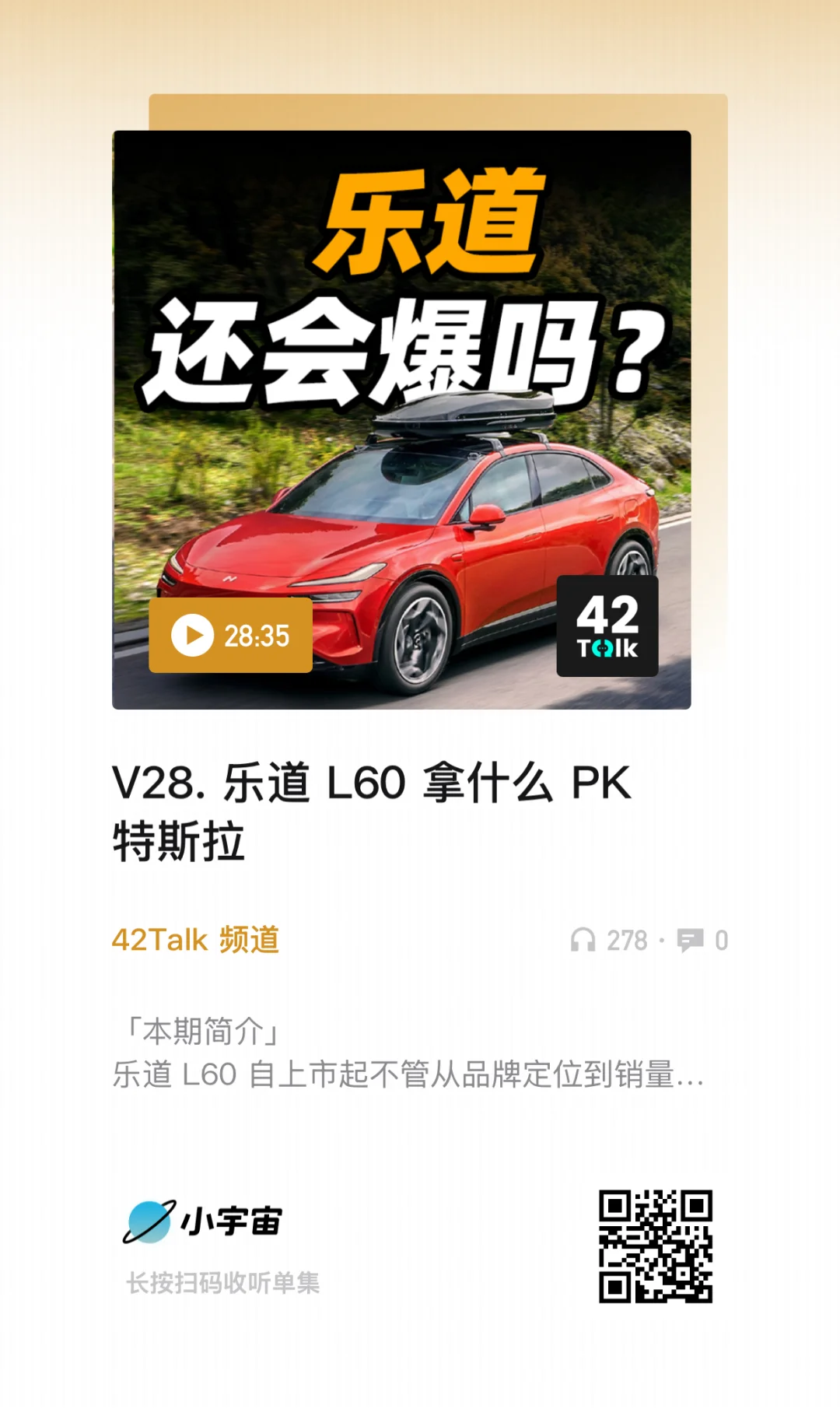
ONVO L60 vs. Tesla: What Can It Compete With? | 42Talk Vol. 28 Transcript
"42Talk" is an online chat show produced by 42HOW Auto, aimed at new energy vehicle owners. The program aims to help listeners purchase the most suitable new energy vehicles through the authentic voices of real car owners.
42Talk: Discovering the Most Authentic Voices of Car Owners.
Guests for this episode:
Chen Nianwangshi, Guiyang, ONVO L60 owner, Li L9 owner
Wen Tao, Shanghai, 42HOW Auto editor, ONVO L60 owner, NIO ET5t owner
(For the podcast version, please click "Read Original Text" at the end of the article to access the "42Talk Channel" on the Xiaoyuzhou APP.)
01Why Buy an ONVO
Reasons for Buying an ONVO
Wen Tao:
I previously owned an ES6 on the NT1.0 Pingtai platform, which I later sold and traded in for this ONVO L60.
The hardware in that previous ES6 is somewhat outdated by today's standards, and since mine was the non-air-suspension version, its chassis quality was relatively inferior. Although it featured electromagnetic shock absorbers, the overall ride comfort was still not very good; however, the air suspension experience improved significantly after a later OTA update. Based on this generational gap in driving feel, I decided to replace the ES6 with the ONVO L60.
The ONVO L60 has the battery swap feature I want, is based on the more advanced NT3.0 Pingtai platform, and offers a smarter infotainment system. Its chassis is also an improvement over the ES6. For me, brand or interior quality isn't the top priority; what matters more to me is the vehicle's current technological level and the experience improvements it brings.
In terms of space, the previous-generation ES6, despite being a mid-to-large pure electric SUV, did not offer particularly spacious second-row seating. With child seats installed in the rear and children seated behind them, legroom was often insufficient, leading to frequent kicking of the front seats. As the children grew taller, the space became increasingly cramped. The second row of the ONVO L60 is significantly larger than that of the older ES6.
Chen Nianwangshi:
I first switched to an extended-range electric vehicle, the Li L9. After driving our other gasoline car for over a year, we also wanted to replace it. Since we already had one extended-range vehicle that could basically meet our long-distance travel needs, we looked for a pure electric model for daily commuting.
Actually, when I switched to the Li L9 two years ago, I also considered NIO. But at that time, the battery swap network in our area was relatively sparse, and the vertical screen design and gear-shifting method of NIO's NT2.0 version made me hesitate, so I didn't consider the ES8. It wasn't until last year, when the battery swap network in our area improved and news about ONVO came out, that I noticed it featured a horizontal screen and column-mounted shifter, which led me to start paying closer attention to the L60.
The gasoline car I traded in was a Leikesasi CT200, a small premium vehicle with space that isn't very practical. Like Teacher Wen Tao, we feel the ONVO L60’s platform is more advanced, and its rear passenger space is indeed quite good.
ONVO vs. Tesla
Laven:
Did you compare the Tesla when shopping for a car?
Wen Tao:
I didn’t consider Tesla because my goal was clear: to switch from one battery-swap-capable vehicle to another. Additionally, I frequently drive the Tesla Model Y, and its chassis comfort is not ideal for family passengers.
Chen Nianwangshi:
I did consider it. In April last year, there was a local auto show where we test-drove the Model Y and almost placed an order. At the time, the Model Y offered five years of interest-free financing, which significantly lowered the upfront cost. However, after the test drive, two factors deterred me: first, I found the chassis too stiff; having previously driven Li Auto vehicles known for their comfort, and primarily using cars for family purposes, a stiff ride would be unsuitable. Second, the rear space was indeed cramped, so I ultimately ruled out the Model Y.
One more reason I shifted my attention from NIO to other brands is that my Li L9 comes with a slow-charging port. ONVO has also reintroduced the slow-charging socket, so I don’t need to install an additional charger. This expands my usage scenarios: I can charge via AC, swap batteries, or refuel with gasoline, covering essentially all current vehicle-use cases on the market.
Laven:
If we gave you either a Model Y or an ONVO, which would you choose?
Wen Tao:
I’d still pick the ONVO.
If it were just for personal use, I might consider the Model Y. But since I have children and a family, I’d lean toward the ONVO L60 because of its larger space, better comfort, and battery-swap capability.
When taking long trips or visiting areas around Shanghai with the kids, choosing the ONVO means I don’t need to plan the itinerary in such detail. Charging at service areas takes considerable time, whereas battery swapping hardly delays the journey; once swapped, we can set off immediately.
Chen Nianwangshi:
I would also choose ONVO because I have children and use the car more for family scenarios. ONVO performs well in terms of space and energy consumption.
Moreover, when my child is sitting in the back seat, I turn on the front-facing monitoring feature, which allows me to see the child via the screen’s camera. When ONVO was launched, it also offered a child seat that provides ventilation after being connected to the vehicle’s seat. I think ONVO has done quite well with its accessories.
02Driving Experience
Battery Swapping and Charging
Laven:
Do you mostly swap batteries or charge your car in daily use?
Wen Tao:
I swap batteries more often because there is a battery swapping station about two kilometers from my home.
I just picked up my car, and nearby there was one NIO Generation 1 station and two Generation 2 stations, none of which support battery swapping for the ONVO. However, about four kilometers away, there is a Generation 4 station available for swapping. Recently, another Generation 4 station has been added within two kilometers of my home, so battery swapping is now very convenient for me.
There are many battery swap stations in Shanghai, including both the original Generation 3 stations and newly deployed Generation 4 stations, making the overall swapping experience quite convenient. There is also currently a layout on highways; you can basically swap batteries when traveling to areas around Shanghai.
Chen Nianwangshi:
For now, I use battery swapping and charging equally, each accounting for half of my usage.
When I bought my car, there was only one swap station here, but now there are five, with four new ones added in the past six months. NIO plans to achieve county-level coverage in Guizhou by the end of this year. We will see how their progress goes.
Wen Tao:
The number of swap stations near Mr. Chen's home is even greater than those near mine.
Laven:
Mr. Chen, have you ever taken the ONVO on a longer trip?
Chen Nianwangshi:
Over the past six months, I’ve driven the ONVO more often because of its good overall energy efficiency and handling.
On the highway, the ONVO has a lower, more aggressive stance. I’m in a plateau region with frequent ups and downs, and I feel the ONVO is more stable at high speeds than taller SUVs.
I’ve made four or five trips to Chongqing in the last six months, each about 380–400 km one way. At first, I drove the Li L9, but lately, I’ve been driving the ONVO.
Laven:
Is battery swapping convenient on your highways?
Chen Nianwangshi:
There are battery swap stations on several highway directions, but not all. A NIO colleague responsible for energy infrastructure stated that they aim to complete the network of swap stations at major highway junctions in Guiyang by the end of this year.
ONVO Service
Chen Nianwangshi:
I think ONVO’s service is quite good.
My spouse is a photographer and often goes to nearby places for shoots. Less than ten days after we took delivery of the car, we went to a tea factory for a shoot, where a tire got punctured. Because I had purchased the RMB 399 service package that includes on-site tire repair, staff drove thirty or forty kilometers to come and fix it for us. Next year, I plan to switch directly to the RMB 1,099 service package.
Laven:
Teacher Wen Tao, what differences do you see between ONVO’s service and NIO’s?
Wen Tao:
There isn't much difference; the overall experience is similar to NIO's because they share the same service infrastructure. After picking up my car, I also had a tire repaired. Previously, there was an issue with the interior ambient lighting—the driver’s side wasn’t illuminating. After sending it in for repair and getting it back, I felt that ONVO’s service was no different from NIO’s.
NIO may offer more additional services. For example, if you get into an accident, you can leave the car there, and a specialist will come to handle the follow-up issues. I’m currently unsure whether ONVO’s service package includes this feature.
Overall, NIO’s service is more comprehensive, while ONVO focuses more on providing basic services.
Pros and Cons of ONVO
Chen Nianwangshi:
I am quite satisfied with the space, energy consumption, and infotainment system.
In terms of energy consumption, the contrast is obvious. With Sentry Mode enabled, ONVO’s energy consumption is surprisingly low, whereas Li Auto’s is relatively higher.
Regarding space, ONVO’s second-row seating is arguably the best in its class.
The most significant drawback, which we have actually joked about, is whether Teacher Wen Tao shares the same sentiment: the Bluetooth response distance for the headlights is too long. Often, when you are dozens of meters away from the car, the lights suddenly turn on, shining directly at others, which can startle people or invite criticism. However, after today's OTA update, this has been optimized; the high beams no longer illuminate upon unlocking.
Wen Tao:
The sensing distance is indeed quite far, making it easy for the lights to activate and unlock the car from a distance, but I am not particularly bothered by this issue.
My main concern is that the vehicle's infotainment system does not display the outside temperature. During seasons with significant temperature fluctuations, such as now, if you are traveling with children who wear less clothing in the morning heat and strong sun, the outdoor temperature may drop by afternoon. Without seeing the temperature inside the car, it becomes difficult to decide whether to dress the child more or less heavily before getting out; you have to check your phone manually. The car does have automatic climate control and an external temperature sensor; they simply are not displayed on the infotainment screen.
The aspects we are satisfied with are similar to what Mr. Chen mentioned: spacious interior, especially in the rear seats, and notably low energy consumption, which offers clear advantages for urban use.
Laven:
What is your typical energy consumption during daily driving?
Chen Nianwangshi:
I chose the four-wheel drive and 20-inch wheels. In urban areas, energy consumption is around 13-14 kWh. In winter, it sometimes reaches 14-15 kWh. On highways at speeds of about 110 km/h to 120 km/h, comprehensive energy consumption is between 16-18 kWh.
Wen Tao:
I'm about the same. I just checked, and my energy consumption for the last 100 kilometers was 13.7 kWh. Usually, it stays around 13 to 15 kWh.
I also chose 20-inch wheels, but I have a single motor. If the road is not congested and I drive at a constant speed, the energy consumption can basically be around 11 kWh plus. On the highway, I usually drive at or near the speed limit or at 130 km/h, and the energy consumption is basically around 19 kWh.
Laven:
Mr. Chen, if you were to give your ONVO L60 an overall score, what would it be?
Chen Nianwangshi:
I’d say around 80.
Laven:
Where did the 20 points get deducted?
Chen Nianwangshi:
One point was for the infotainment system not displaying the outside temperature, as mentioned by Teacher Wen Tao. Another factor is the speed of OTA updates; recently, updates have been slower, likely due to new regulatory policies.
Laven:
How often does it update now?
Chen Nianwangshi:
Before the last major version, updates typically occurred every month or two weeks. However, there has been no update for nearly three months since this latest major version, with the only exception being an update before the Chinese New Year.
Wen Tao:
I picked up my car with version 1.1.1, and after driving it for three months, I still haven't received an OTA update.
Laven:
Could it be because Li Auto updates too frequently?
Chen Nianwangshi:
Actually, that's quite possible. My Li Auto is part of the 'Ten-Thousand-Person Group' (a beta testing community), which receives updates very quickly, but Li Auto hasn't updated recently either. This is because the Ten-Thousand-Person Group primarily focuses on driver assistance systems, and updates in this area appear to have been paused nationwide.
03Issues with ONVO
Why They Didn't Buy the ONVO
Laven:
Have you had friends who considered buying an ONVO but ultimately didn’t?
Chen Nianwangshi:
Actually, yes. The reasons for not buying were twofold: first, the battery-swap infrastructure in our area is still relatively weak; second, public opinion played a role.
At the end of last year, due to delivery delays, several friends who originally wanted to take advantage of the subsidies available at that time ended up buying other cars. At that point, Guizhou’s subsidy policy, when stacked with national subsidies and trade-in incentives, was likely the most generous in the country. In addition to the national subsidy and trade-in allowance, there was also a policy allowing buyers in Guizhou to purchase Maotai liquor at face value. As a result, the total subsidy for the car reached over RMB 20,000, approaching RMB 30,000.
Laven:
How long did you wait for your car?
Chen Nianwangshi:
On September 19 last year, I attended the launch event. The next day, September 20, I placed a reservation deposit, and picked up the car around October 15. The wait was less than a month—about twenty days.
Wen Tao:
Most of the friends I recommended it to ended up buying it. After the Chinese New Year, a few friends asked about it again, and I recommended ONVO to them, but they hesitated.
This hesitation is partly related to ONVO’s marketing. Many people know NIO but are unfamiliar with ONVO. When I mentioned ONVO, they didn’t recognize the brand. Given this lack of awareness, they likely wanted to observe further. However, after test-driving the vehicle, they were all quite satisfied.
Laven:
They still had some concerns regarding brand recognition.
Chen Nianwangshi:
To add, this issue is also closely tied to the density of battery swap stations.
Wen Tao might not face this issue in Shanghai, but last week I drove an ONVO back to my hometown and gave test drives to two friends. One was particularly interested and was ready to place an order immediately. However, after learning about the pace of battery swap station expansion, he became concerned that refueling would be inconvenient and ultimately decided against buying the car.
Wen Tao:
This is indeed a valid concern. People seem overly focused on NIO or ONVO’s battery swapping capability while forgetting that they can also be charged.
Buying an ONVO Is Just a Way of Saying You Can’t Afford a NIO
Laven:
Have you seen this kind of commentary online: 'Buying an ONVO is just a way of saying you can’t afford a NIO'?
Wen Tao:
Many people claim that ONVO is designed for those who cannot afford a NIO, but I don’t have any strong feelings about this statement. Car purchases vary: some buyers seek high emotional value, while others lean toward pragmatism.
Previously, brands like Nissan and Toyota in the Japanese automotive sector established their mainstream offerings first before launching premium lines. BYD followed a similar path, solidifying its Haiyanghewangchaoxilie series before introducing higher-end marques such as Yangwang and DENZA. NIO’s approach is inverted: it began with a premium brand before expanding into the mainstream segment, effectively developing more expensive vehicles first and then trickling down technology to more accessible models.
Some critics have disparagingly suggested that ONVO is designed for those who cannot afford NIO, essentially offering a cheaper alternative. However, from a consumer perspective, if one seeks higher emotional value, a luxury brand is the natural choice; if one focuses on practicality, an ONVO vehicle fits that need. Moreover, ONVO’s product strength is not lacking. In terms of configuration, space, and energy efficiency, it holds clear advantages within its price bracket.
Chen Nianwangshi:
Vehicle configurations vary, and driving experiences differ widely. I believe the best approach is to choose what suits you best.
Purchasing a car is a long-term decision-making process during which such noise is filtered out. However, marketing rhetoric from manufacturers can inadvertently guide public perception—for instance, claims that "ONVO owners are banned from Niuwu." For actual owners, these issues are largely irrelevant. It is users with less in-depth knowledge who may be swayed by such narratives.
Why ONVO Hasn’t Sold Well Yet
Wen Tao:
I attribute this primarily to lingering effects from inadequate initial marketing and delivery capabilities.
Our perspective within the industry may differ, but for friends outside who are buying cars, there is often a strong herd mentality. They tend to focus on brands with high sales volumes. For example, a friend of mine recently looked at BYD first because many people around him had bought BYDs.
Bin tends to have higher moral constraints and avoids promoting sales figures or 'battle reports.' However, in China’s automotive market, consumers do care about these metrics. The more cars seen on the road and the higher the sales volume, the more attention it draws from average buyers.
As Mr. Chen said, his friend missed the trade-in subsidy and therefore did not buy ONVO. We also discussed that if ONVO had offered a fallback policy at the time and scaled up production capacity, given its product strength, it certainly would not be in the current situation.
Chen Nianwangshi:
We have followed ONVO for a relatively long time and are familiar with the car's overall specifications, so we consider it a good product that stands the test of time. However, as Teacher Wen Tao pointed out, issues regarding delivery and marketing pacing are indeed a consensus among owners, who feel there is room for improvement.
For instance, during the livestream from the Flaming Mountains on May 15 last year, expectations were that the car would launch in July or August. Instead, it was announced that the launch would be pushed back to late September.
The original plan was to launch in July or August, deliver a batch of vehicles before the National Day holiday, and gain exposure during peak highway travel. Then, as production ramped up, it would align with the Spring Festival peak season. Additionally, with local national subsidies tightening at the end of December, another wave of interest could have been generated.
A wave of exposure during the National Day holiday, followed by another during the Spring Festival, could drive significant sales. ONVO has sold only about 30,000 units in total; if those opportunities had been seized at the time, sales might have reached 50,000 units. The impact of 50,000 units is different from that of 30,000.
My salesperson told me that, due to the lack of a fallback policy, he had at least five customers choose competing models from other brands released around the same time, such as Zeekr, Xiaomi, or XPENG. It failed to capitalize on this momentum. With market competition intensifying after the Spring Festival, it will be increasingly difficult to boost sales later on.
So overall, I personally feel that the marketing pace could be accelerated. This includes the ONVO L90, which is also scheduled for release in September. People are worried whether it will follow the same pattern as last year.
04NIO's Future
Are you worried about NIO going out of business?
Wen Tao:
I’m not worried. When I bought my first ES6 in 2019, NIO was in a very difficult situation, and its stock price was only one dollar. Although NIO is currently operating at a loss, most of its spending has gone into R&D and infrastructure construction such as battery swap stations and charging piles. These funds haven’t been wasted; they’ve been converted into assets.
In today’s context where electric vehicles are becoming increasingly homogenized, everyone is competing on driver assistance, configurations, and charging speeds. However, NIO’s battery swap model may carve out a different path. I’ve been driving NIO cars for several years now, and I can clearly feel that the user experience is gradually improving as the number of swap stations increases.
Although the convenience of swap stations hasn’t yet reached an optimal level, once the number of swap stations reaches 5,000, the improvement in swap experience driven by infrastructure expansion will boost sales growth. As William Li previously stated, building swap stations first can drive car sales, and I believe this logic holds true. With the advancement of NIO’s swap station construction plan, its sales have grown significantly. Moreover, NIO possesses solid technical capabilities. While its driver assistance systems may not be keeping up at present, their vision is long-term. Coupled with William Li’s excellent fundraising abilities, I don’t worry about NIO going bankrupt. Even in the worst-case scenario, I personally believe the worst that could happen is simply that the CEO is no longer William Li.
Laven:
What would you like to say to automakers as a NIO and ONVO owner?
Wen Tao:
Regarding NIO, I have two points. First, improve product planning. Second, strengthen marketing and enhance the systematic capability from marketing to delivery, so that delivery issues no longer hold the brand back.
NIO’s previous product planning was extensive, modeled after the BBA luxury lineup. The 5 Series and 6 Series are fine, but the 7 Xilie has significant problems. The ES7 and the subsequent ES6 have a certain degree of product overlap. The EC7 is priced too high, its target audience is too niche, and its vehicle R&D costs are high, leading to a disproportionate return on investment.
For brands with sufficient sales scale, like BMW, this can support them in developing niche models to cover specific segments. However, for an emerging brand like NIO, it should better focus on building its core flagship products, such as the 5566 series, because they are the highest-selling products. It is unnecessary to try covering more market segments before the core products have firmly established themselves.
Chen Nianwangshi:
Personally, I am not worried about NIO going out of business, but I fully understand the concerns of other owners. From the perspective of sustainable operations, NIO has been investing heavily in its early stages and remains in a loss-making state, with a longer period of losses than Tesla experienced at a similar time.
I strongly agree with Wen Tao’s point on product focus. In my view, NIO’s lineup is somewhat too fragmented. With base sales volumes still relatively low, the sheer number of models makes it difficult to achieve cost efficiencies in the supply chain.
Recently, William Li also mentioned in an interview that many components across NIO’s different models are not interchangeable. Given the modest base sales and diverse model range, overall supply chain costs remain high. This is one of the reasons for NIO’s persistent losses, alongside continuous R&D investment and infrastructure build-out, which place significant pressure on the supply chain.
I don’t believe NIO will go bankrupt. As Wen Tao noted, NIO’s infrastructure investments—particularly its battery swap stations—have created a deep moat. Even in extreme scenarios, such as if William Li were no longer CEO, or if sales performance were poor, the NIO Power business line would likely remain stable.
NIO and CATL began collaborating this year. CATL is now involved in producing Qiaokelihuandianzhan (chocolate-style swap stations). NIO’s original plan for Jiaonanghuandianzhan (capsule-style swap stations) is also being developed jointly with CATL. These moves indicate a strategic adjustment in NIO’s overall approach. Furthermore, NIO has set a firm target to achieve profitability in the fourth quarter of this year. Therefore, it may be prudent to wait and see how things develop by year-end.
Expectations for ONVO's Future
Laven:
What are your predictions for the steady-state sales volume of the ONVO L60 moving forward?
Wen Tao:
If this round of reforms succeeds, its steady-state sales volume could reach around 7,000 units.
Chen Nianwangshi:
In my opinion, in the pure electric vehicle segment at the RMB 200,000 price point, its sales performance is acceptable; we simply had overly high expectations for it previously.
I recall several automotive media outlets conducting live prediction discussions, with forecast figures ranging from 8,000 to 15,000 units. Some analysts even predicted as high as 20,000 units, which raised everyone's expectations.
It resembles the initial predictions for the Li MEGA. At that time, many analysts expected sales of 8,000 units, but when the steady-state sales eventually settled at around 1,000 units, people felt it fell short of expectations. In reality, the pure electric models priced above RMB 500,000, such as the ES8, have seen their steady-state sales stabilize between 800 and 1,000+ units. The XPENG X9, which is significantly cheaper, also saw its steady-state sales return to around 1,000 units.
The ONVO L60’s current sales volume has indeed declined compared to the period of concentrated deliveries. This is partly due to a relatively slow market response and partly because our previous expectations were indeed too high.
Under normal circumstances, I believe it can first stabilize at a monthly sales volume of 4,000 to 5,000 units. Subsequently, through adjustments or the introduction of new models in the second half of the year, it could reach 7,000 to 8,000 units, or even 10,000 units. For a pure electric model, maintaining sales at this level would be considered a decent achievement from an industry perspective.
Owner Q&A
Laven:
Is there anything else you'd like to ask each other?
Wen Tao:
Mr. Chen, as a member of Li Auto's 'Ten-Thousand People Group,' after comparing the two, do you feel that ONVO's progress in driver assistance is lagging behind?
Chen Nianwangshi:
Its progress is indeed relatively slower. Currently, I mainly use ONVO's driver assistance on highways. My daily commute is 20 kilometers one way, and Li Auto's driver assistance features have achieved 'parking spot to parking spot' functionality. However, there are also differences in hardware configurations between ONVO and Li Auto; my Li L9 is equipped with a LiDAR, which may allow for faster feature iterations. ONVO's progress might be slower due to recent regulatory impacts.
Wen Tao:
Currently, I also mainly use driver assistance on highways, and rarely use it in urban areas.
Wen Tao:
Are you planning to upgrade from the ONVO L60 to the ONVO L90?
Chen Nianwangshi:
I’m keeping an eye on the ONVO L90, but I wouldn’t necessarily switch. My main interest is seeing how far it can push its space and energy efficiency.
Someone in a car enthusiast group chat mentioned that when XPENG’s X9 and Li MEGA launched simultaneously last year, despite a price difference of RMB 100,000–200,000, the X9’s rear-wheel steering left the MEGA in an awkward position.
Now that the ONVO L90 has introduced the concept of a front trunk (frunk), I wonder if it will put pressure on the Li i8. Enthusiasts in both communities are watching these two models closely, as they appear to be the only pure-electric three-row six-seaters launching this year.
Their release schedules are also close: the Li i8 arrived in July, while the ONVO L90 is expected in Q3, likely August or September, aligning their timelines perfectly. Additionally, the Li i8 uses NVIDIA’s Thor chip, whereas the ONVO L90 uses the Shenjixinpian, marking a capability showdown between domestic and NVIDIA chips. Coupled with comparisons of traditional versus bullet-nose designs regarding energy consumption, I believe these two vehicles represent distinct directions, making their ongoing comparison highly worth following.
Wen Tao:
I’ve been closely following these two vehicles; they are currently the only six-seat pure electric SUVs in their class.
This content is compiled from the podcast episode "42Talk".
Click "Read Original Text" below to unlock more past episodes.