NIO and Geely Holding Group Announce Strategic Charging and Battery Swap Partnership
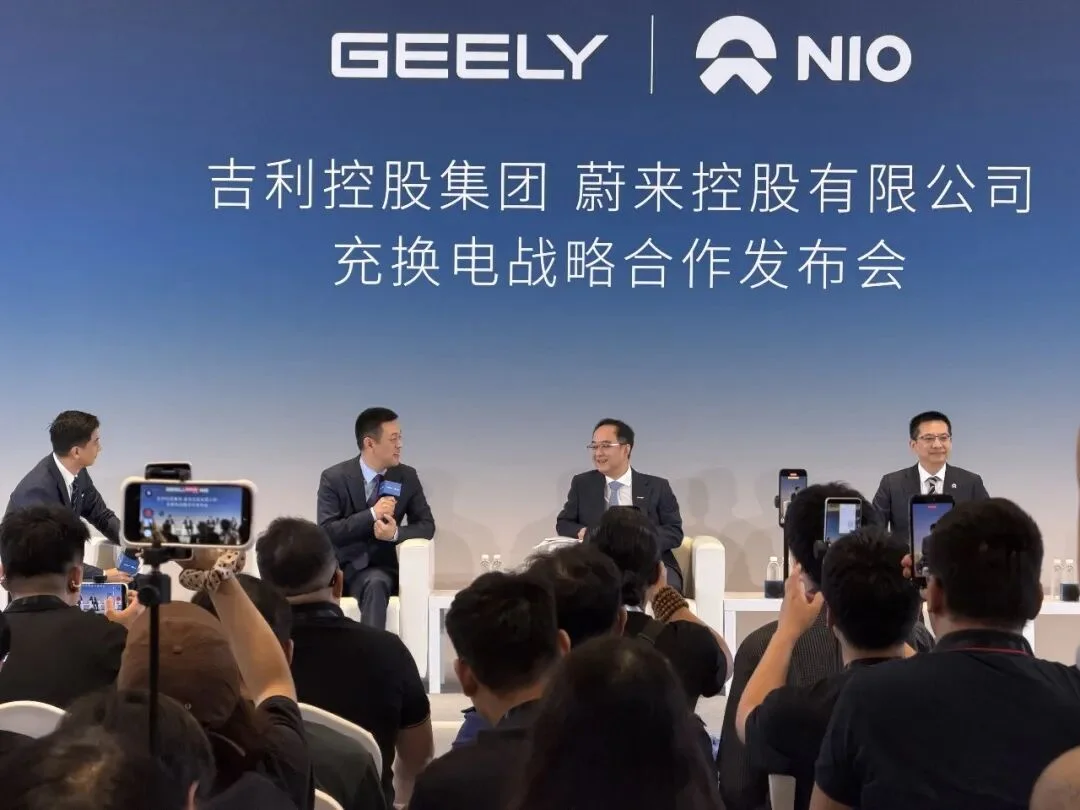
On September 28, 2026, NIO and Geely Holding Group announced a comprehensive strategic partnership in the charging and battery swapping sector in Hangzhou. Geely will acquire a 30% stake in NIO Energy through the transfer of its 100% equity in Yiyi Hulian and an additional RMB 640 million in cash; upon completion of the transaction, Yiyi Hulian’s commercial vehicle battery swapping operations will be integrated into NIO Energy. NIO will also invest in Haohan Energy, holding a 10% stake after the transaction, with both parties’ charging resources becoming fully interoperable. The two companies will jointly develop unified C-end (consumer-facing) battery swapping technologies and standards, and Geely will develop battery-swappable models for private car users.
A few days prior to this announcement, we received communication from NIO stating that this was a “significant business development” for the company, with all information kept strictly confidential.
Today, following the public release of the information, NIO issued an announcement on the Hong Kong Stock Exchange, and executives from both Geely and NIO appeared together to announce the partnership. Judging by the scope of the cooperation, it is indeed substantial. Previously, no two automakers had ever partnered via equity stakes in their battery swapping businesses.
In November 2023, the two parties signed a strategic cooperation agreement covering battery standards, swapping technology, network operations, swapping model development, and battery asset management. That earlier collaboration already proposed the joint development of swapping standards for both private and commercial vehicles, as well as models compatible with both brands’ swapping systems.
Alongside the equity transactions, another arrangement directly impacting future purchasing choices was announced: the two companies will build unified C-end battery swapping technologies and standards. Geely will develop battery-swappable models for private users, with services provided by NIO Energy.
By bundling funding, operational assets, and new model development into a single cooperative framework, this deal provides a more concrete pathway for cross-brand battery swapping, further connecting previous technological and standardization efforts to actual products and operations.
However, there remains a gap between signing the agreement and completing the transaction. According to a separate announcement from NIO, the deals are subject to regulatory approvals and other customary closing conditions. Upon completion, Geely’s subsidiary will hold a 30% stake in NIO Energy, while NIO Holdings will retain 63.6% to maintain consolidated financial statements. Wuhan Guangchuang Fund will hold 6.4%, and NIO Energy’s post-transaction valuation is approximately RMB 16 billion.
Also present at the event, NIO and Geely Holding Group announced a series of plans. NIO Energy aims to build a cumulative total of 10,000 battery swap stations by 2030. For comparison, as of September 27, 2026, NIO had completed 4,126 swap stations nationwide, with cumulative swap services exceeding 125 million. Geely plans to build more than 22,000 charging stations and over 100,000 charging guns by the end of 2027, achieving comprehensive coverage across all county-level cities in China.
Behind these figures for battery swapping lies a relationship that requires joint advancement: the number of models supporting swapping and the volume of vehicles must grow alongside the scale of swap stations.
A denser swap network makes it easier for users to accept swapping when choosing a car, and provides automakers with a service infrastructure to rely on when developing swapping-capable models. Meanwhile, the launch of more models and the entry of more vehicles into the network generate sustained demand for stations, improving the utilization efficiency of equipment, batteries, and sites, thereby providing support for future construction.
This is also the significance of this cooperation combining equity, operational vehicle business, and C-end model development. Network expansion requires capital and service targets; model development requires technical standards and, crucially, swap stations that users can access after purchasing a vehicle.
Another figure worth expanding upon is NIO’s estimate that the annual electricity demand of its swap network will exceed 10 billion kilowatt-hours by 2030.
This means that as the network and vehicle scale expand, NIO Energy’s management of electricity procurement and dispatch will also enter a larger scale. When and where to purchase electricity, how to charge it, and how to arrange station battery charging while meeting swap demands will all impact network operating costs and efficiency. Furthermore, the demand for 10 billion kilowatt-hours implies that swap stations, acting as energy storage facilities within the power grid, can exert greater value, which will continue to enhance NIO Energy’s competitiveness in the energy business.
After the press conference, William Li, Founder, Chairman, and CEO of NIO; Lihong Qin, Co-founder and President of NIO; An Conghui, CEO of Geely Holding Group; and Gan Jiayue, CEO of Geely Automobile Holdings, accepted group interviews with the media.
The following is the edited content of the media group interview at the NIO and Geely Holding Group Charging and Swapping Strategic Cooperation Press Conference, edited and organized by 42HOW Auto without altering the original meaning.
01From Independent Technology Validation to Joint Efficiency Gains
Q: What impact will this cooperation have on the models of the new energy vehicle refueling industry?
An Conghui: I believe that the strategic partnership formed between NIO and Geely Holding Group is highly demonstrative. First, from the perspective of the automotive industry as a whole, there are inherent laws governing it. To meet future industry competition, joint cooperation among companies is undoubtedly the right path.
While we were backstage earlier, Mr. Bin was also discussing this, jokingly saying, "Unity is strength." Today, having formed this strategic partnership, like Mr. Bin and I said, we would be more willing for more enterprises to join in. The fundamental purpose is to promote the better development of China's new energy vehicles and to provide users with better experiences and services.
Q: The automotive industry has entered a new stage of high-quality development. Why did the two companies start their open cooperation in the field of charging and swapping infrastructure? What trend does this reflect?
William Li: China's intelligent electric vehicle industry currently faces brand-new challenges, but also brand-new opportunities. How do we enter a truly high-quality development stage? In previous years, everyone independently validated their respective technology routes. Now, how can we converge these efforts to reduce redundant investment, which is essentially reducing waste and improving the operational efficiency of each company? This is an important issue facing every Chinese automotive enterprise.
We are already discussing cooperation with Geely in many areas. The charging and swapping sector is particularly easy to calculate in terms of cost-effectiveness. Relatively speaking, the foundation for interconnectivity, co-construction, and sharing is quite good. Whether it is battery swapping, which we have been discussing for years, or charging, consensus is easier to reach.
As Mr. An mentioned, infrastructure should be shared by all automotive users. Since day one, NIO's charging piles have been open to users of all brands. More than 85% of the electricity volume—now actually reaching 87% or 88%—comes from users of brands other than NIO. NIO Energy has always had a gene of open cooperation, so this partnership with Geely is a natural progression.
We also hope that this cooperation will inspire new development paradigms for China's automotive industry. What should the new paradigm be in the era of high-quality growth? It should be open collaboration, synergy, and win-win outcomes.
In the past, there was much talk about 'competition.' Of course, competition still exists objectively; even between our two companies, there is some competitive overlap. Healthy competition is not 'involution' (self-destructive internal rivalry). Competition will naturally exist, but I believe the scope for cooperation is equally vast. We should not view them as mutually exclusive—assuming that where there is competition, there can be no cooperation is poor business logic. I feel this initiative is very rational, and reaching this agreement represents an innovative exploration.
Q: Why this timing?
William Li: Autumn is the season of harvest. As Mr. An mentioned, our teams from both sides have been discussing since November 2023. This is not a short-term partnership. Over the years, Mr. An, Mr. Gan, and Chairman Li Shufu have engaged in extensive discussions together. Today, we can say these efforts have borne fruit.
An Conghui: As a veteran in the automotive industry with 31 years of experience, I remember that over ten years ago, at the Beijing and Shanghai Auto Shows, leaders from government, the industry, and enterprise heads frequently discussed one question: How do we make battery swapping work well, and how do we unify standards? What will be the future charging technology route for China? This question came up at every auto show back then.
Through more than ten years of effort, I believe the future landscape of new energy vehicles has basically taken shape. There are two main routes: ultra-fast charging and battery swapping. These two technological paths address different user needs and scenarios, complementing each other. At this juncture, I believe NIO and Geely have reached a consensus to jointly provide users with a better charging experience.
02Once the cars are on the road, how does the B-end support the network?
Q: After integrating commercial vehicle battery swapping into NIO Energy, how does NIO view this segment of business? What changes will the synergy between ToB and ToC businesses bring to NIO?
Lihong Qin: To be frank, I believe that commercial vehicles represent an ideal scenario for the rapid, large-scale expansion of battery-swapping technology and service networks. I would like to share three key considerations.
First, the primary operational scenarios for commercial vehicles are concentrated within urban areas. Taking Hangzhou, where we are located today, as an example: I specifically reviewed Hangzhou’s 2024 planning documents yesterday. The built-up area of Hangzhou covers 801 square kilometers; for calculation purposes, let us use 800 square kilometers. If we were to distribute 50 battery-swap stations very evenly across this area, it would ensure that any location in downtown Hangzhou is within a 5-kilometer radius of the nearest swap station. This assumes an ideally uniform theoretical layout.
What is the current situation? As of today, NIO Energy has deployed 80 battery-swap stations in Hangzhou, while Geely’s swap stations number more than 20 in the city center. Together, they exceed 100 stations. Assuming we could achieve full interoperability, intelligent scheduling, and even distribution, my rough calculations show that the theoretical distance from any point in downtown Hangzhou to the nearest swap station would be just 1.5 kilometers. Under normal urban traffic conditions, this translates to a travel time of approximately five minutes. For commercial operators, having a charging or swapping facility within a five-minute drive or roughly one-plus kilometers provides immense network support for operational efficiency. This is the first aspect: it facilitates strong network effects.
Second, compared to currently deployed mainstream charging technologies, battery swapping offers significantly higher time efficiency. Our simple calculations indicate that, leveraging a high-quality swapping network, a commercial vehicle can save up to 90 minutes per day. Converting these 90 minutes of energy-refueling time into business revenue suggests potential income growth of 15%–20%. This represents substantial gains for operators.
Third, many may already know that swap stations are not merely facilities for rapid energy replenishment but also serve as the physical foundation for battery asset management. Through flexible battery asset scheduling, business models similar to NIO’s Battery-as-a-Service (BaaS) subscription model can fundamentally address the depreciation of vehicle residual value caused by the mismatched lifespans of vehicles and batteries. Over a vehicle’s lifecycle, this approach can reduce costs by as much as 40%.
Therefore, envision a future where Geely’s and NIO’s swapping networks are fully integrated, with NIO Energy serving commercial vehicle scenarios. We would see a landscape where drivers reach a station within a five-minute drive, operating revenues increase by 15%–20%, and operating costs drop by up to 40%. Of course, this scenario is not achievable overnight; it requires continued effort. This is our operational target.
Over the past few years, Geely’s swapping network has already established relatively comprehensive coverage in major cities nationwide to support commercial vehicles. Furthermore, Yiyi Hulian has accumulated extensive experience in high-frequency swapping, vehicle scheduling, battery monitoring, and maintenance. The further integrated NIO Energy will combine NIO’s infrastructure advantages in swapping networks with Geely’s operational expertise in serving commercial vehicles.
At the same time, I want to reassure NIO’s C-end users that there is no need to worry about service capabilities. The deeper collaboration between NIO and Geely will enrich our resources and accelerate the pace of swapping network deployment. Consider this comparison: which is more efficient and offers a better user experience—having only one swap station supporting 100 vehicles, or deploying 100 swap stations to support 10,000 vehicles? The answer is undoubtedly the latter.
William Li, NIO’s CEO, stated that the company aims to deploy 10,000 battery swap stations across China by 2030. Today, we can look at China’s highly mature refueling infrastructure, which currently consists of approximately 30,000 gas stations. If NIO can reach 10,000 swap stations in four years and provide targeted services supported by intelligent scheduling and infrastructure, I believe the slogan “charging is more convenient than refueling” will transition from a marketing phrase to an achievable reality. Therefore, I am confident that the partnership between Geely and NIO represents a synergy where 1+1 is far greater than 2. Please rest assured.
Q: Geely has consistently adopted the battery swap model for its commercial (ToB) vehicles. Will there be future expansion into the consumer (ToC) passenger car segment?
An Conghui: The strategic cooperation established between NIO and Geely Holding Group is built on a consensus grounded in national strategy, industry trends, and user demand. These three elements must align, leading us to make the right decision at the right time. This decision follows exploratory cooperation between the two companies that began in 2023, culminating in today’s formal confirmation and implementation.
For Geely, the company has long invested in R&D and technological innovation regarding the battery, electric motor, and electronic control systems (“three-electric” systems) for new energy vehicles, not only in complete vehicles but also in charging piles and cloud-based platforms. All vehicles operated under CaoCao Mobility utilize Geely’s battery swap technology, which will now be fully integrated into the NIO Energy network.
Looking ahead for Geely, our upcoming Robotaxi products will also fully adopt battery swap technology. I expect this product to launch soon.
Q: What are the key priorities for advancing the battery swap aspect following the collaboration between the two parties?
William Li: After the transaction closes, we will operate two distinct networks: one for the consumer (C-end) market and one for the commercial (B-end) market. These serve different user bases. The B-end network is based on Yiyi Hulian, including CaoCao Mobility and future Robotaxi operations as mentioned by Mr. An. There are areas requiring integration between both parties, spanning R&D, supply chain, manufacturing, and operations. The first challenge is how to efficiently operate both networks simultaneously.
Secondly, we will accelerate network construction. We will speed up the build-out of C-end swap stations and ensure compatibility and service readiness for Geely’s future C-end swap-capable models. Additionally, the B-end commercial vehicle swap network will be scientifically laid out and operated efficiently to meet the specific needs of partners like CaoCao Mobility and Robotaxi, involving significant synergies. As I mentioned earlier, given the increased demand, I feel more confident about achieving the goal of building and operating 10,000 swap stations by 2030.
Third, we will actively explore the energy attributes and business potential of this infrastructure. There is significant room for collaboration, including integration with Geely Smart Charging. In some stations, we can imagine co-building power facilities where electricity can be supplied to C-end swap stations, B-end swap networks, and Geely Smart Charging, thereby significantly improving construction efficiency. Both parties will further delve into the energy attributes of swap and charging stations to refine these operations. Previously, participation in peak shaving and frequency regulation was more common, but proactive layout in this area has been insufficient.
03After 'Fast', the Next Challenge: Temperature
Q: Geely recently unveiled its next-generation AI intelligent charging technology. Will this technology be integrated into this cooperation? What are Geely's plans for the next phase of its charging layout?
Gan Jiayue: Geely released the Zhi Chong (Smart Charging) technology on September 23.
I have always pondered one question: What is the most critical aspect of energy replenishment? I believe it comes down to three characteristics: Safety is the foundation; Timeliness ensures customers have a good, fast charging experience; and Convenience means network layout must be highly accessible to customers.
Based on these three points, Geely has invested heavily in technology and resources from the very beginning of its new energy transition to study the future development of charging and replenishment technologies. NIO also recognizes that timeliness and speed are crucial for customer experience in energy replenishment. Therefore, in 2021, Geely took the lead in the industry by releasing fast-charging technology. At that time, the industry focused on 400 V systems with single-gun peak power around 120 kW, requiring several hours for charging. Geely pioneered single-gun peak power reaching 360 kW, reducing charging time from several hours to 30 minutes.
By 2022, we launched the second generation, achieving a single-gun peak power of 600 kW, further shortening the time from thirty minutes to around fifteen minutes. In 2023, we introduced ultra-fast charging technology with a single-gun peak power of 800 kW. In 2025, Geely launched megawatt-level charging technology with a single-gun peak power of 1,500 kW, reducing the total charging time to around eleven minutes.
On September 23, we released the Zhi Chong technology. This technology not only addresses speed but also ensures safety on top of that. With this technology, charging from 10% to 70% takes just 4 minutes and 30 seconds, while charging from 10% to 97% takes approximately 8 minutes and 40 seconds.
But speed alone is not enough; safety is paramount. Where does this focus on safety lie? We believe it starts with temperature control, which is critical for batteries. Achieving precise temperature control is a systematic engineering challenge that requires starting from materials and thermal management technologies. We have comprehensively upgraded all raw materials, including cathodes, anodes, electrolytes, and separators. Furthermore, we are launching the industry's first AI large model, Xingrui PowerMind Energy Brain. What can this model do? It can accurately predict changes in battery temperature 30 seconds in advance, with precision at the millisecond level. Once we predict a temperature change, we use power splitting to ensure the battery charges quickly and safely throughout the process.
We also consider battery lifespan, as safety and lithium plating are the core factors determining both battery safety and longevity. For high temperatures, we use our AI model for thermal control. Additionally, we have pioneered a five-end control solution in the industry. The 'five ends' span from energy storage stations to charging stations, charging guns, charging ports, and finally the vehicle's battery, implementing a liquid-cooling solution across the entire chain. These technologies may carry higher costs than industry averages, but we believe they are well worth it. To address battery lifespan and mitigate lithium plating, we employ lithium-ion pulse repair technology. This reactivates lithium ions accumulated at the anode, allowing the battery to 'charge and nourish' simultaneously during fast charging, thereby extending battery life by more than 20%.
The second part concerns future planning. Geely's Smart Charging Stations are already in the first tier, but we continuously reflect on ourselves: while our technology is excellent, our communication with the market and customers needs improvement. Geely will next strengthen dialogue between technology and the market/customers, ensuring the best technologies are communicated to customers promptly and clearly. Next, through our cooperation with William Li, we aim to be the first to achieve county-level coverage for charging infrastructure nationwide. This 'county-to-county' connectivity relies on a 3-kilometer charging circle: in first-tier cities, a Smart Charging Station should be within 2 kilometers; in second- and third-tier cities, within 2.5 kilometers; and in other cities, within 3 kilometers. Under this push, users can resolve usage anxiety more conveniently.
Q: If battery swapping is convenient, won't it pressure new car sales? If swapping is easy, everyone might just swap batteries and drive one car for over a decade.
Gan Jiayue: I think this is a very good question. From a technical perspective, the integration of charging and swapping in the future will make things more convenient for customers. In fact, battery swapping also includes charging functionality.
A previous question asked what work we can do in the future. I believe there are two areas. First, synergy between stations and resource coordination between B2B (ToB) and B2C (ToC). Some scenarios have significant room for growth; ToB can support the construction of station sites for ToC, and if there is ample space in ToC sites, we can add other features to meet customer needs. Second, synergy between charging and swapping. Coordination here can achieve much; for instance, some current charging setups require energy storage cabinets. By fully utilizing swapping infrastructure and batteries, we can eliminate the need for separate energy storage, saving substantial resources for society. Therefore, once charging and swapping technologies are integrated, customers will undoubtedly find it more convenient and enjoy a better experience.
04The Second Revenue Stream of Battery Swapping Stations
Q: Energy business is a key component of NIO's second growth curve. What does today's strategic cooperation with Geely mean for NIO's energy business?
William Li: The essence of our energy business is twofold. On one hand, it must better serve users by enhancing the competitiveness of NIO’s products through superior charging and battery-swap experiences; as you’ve seen, we have consistently maintained high user satisfaction in the premium segment. On the other hand, the energy business itself represents a highly sustainable and substantial commercial opportunity.
Last year alone, our battery-swap stations (excluding charging piles) handled an electricity demand of over 2 billion kilowatt-hours of electricity. We anticipate that as Geely’s commercial vehicles and other models join the swap network, combined with our internal target to facilitate 10 billion kWh of swaps by 2030, this will indeed become a large-scale business. With the national push for a new energy system and new power trading mechanisms, I believe there are significant opportunities within the emerging power market.
As I mentioned earlier, just days ago we launched the world’s first zero-carbon, off-grid solar-storage-swap station at Xingxingxia. Next, we plan to integrate Geely’s smart-charging capabilities into these sites, creating integrated solar-storage-charging-swap stations with far greater potential. A swap station is inherently an energy storage facility; adding charging piles and photovoltaic panels expands its utility. Consider this: if we reach a transaction volume of 10 billion kWh, and Geely operates roughly 100,000 charging piles by the end of 2027 alongside an estimated fleet of over 100,000 swap stations, the total power market scale will be substantial, offering considerable commercial space.
Q: Energy replenishment is a typical sector characterized by heavy assets and long cycles. How does Geely balance long-term strategic investment with commercial sustainability? And given your capability to build infrastructure independently, why choose co-creation with partners?
An Conghui: Investing in energy replenishment is undoubtedly a heavy-asset commitment for any enterprise. However, companies must adhere to long-termism and remain steadfast in their investments in this area. Ultimately, automotive manufacturing is not merely about delivering competitive vehicles; more importantly, it is about providing customers with an enhanced experience after purchase. This represents a significant shift in the industry, and automakers must excel in this aspect.
To mitigate risks and accelerate scale expansion, joint cooperation is essential. This is the significance of today’s partnership between NIO and Geely. Both companies embrace long-termism and require substantial capital investment, making this a heavy-asset endeavor. By collaborating, we can reduce risks while expanding scale and improving user experience.
I believe NIO and Geely have set a paradigm today. We also believe that more automotive enterprises will join this effort in the future, playing a crucial role in shaping a brighter future for China’s new energy vehicles.
05Looking Ahead to the Next Three Years
Q: Mr. Lihong Qin mentioned earlier that after the cooperation, there will be a noticeable improvement in benefits and operations for owners of ride-hailing vehicles. Many NIO owners are concerned about what changes to benefits and experience they can expect in the future.
Lihong Qin: To put it simply, the change you will feel is that things will get better and more convenient. The core of the entire battery-swap system lies in the number and layout of swap stations, as well as intelligent scheduling based on a more perfect network infrastructure.
I believe that with stronger capabilities, NIO Energy will, after a period of development and integration, be able to better serve both the B2B (commercial) and B2C (private) networks, improving vehicle experiences for users on both sides. There is no need to worry; looking at this from a developmental perspective, the biggest beneficiaries of today’s cooperation are still the owners of private and commercial vehicles.
Q: This represents an important cooperation between the two companies in the field of charging and swapping. Will there be further cooperation with Geely in other areas in the future?
William Li: Geely is a leading enterprise in China’s automotive industry and was also one of the first to truly achieve globalization. Geely Holding Group has a very broad global business layout. Sometimes we joke internally that if we were to find a global automaker to partner with, there is no need to look far away; Geely is the best choice, right here beside us as a global automaker.
I think whether discussing with Chairman Li Shufu, Mr. An, or Mr. Gan, our two teams have discussed many possibilities during our exchanges. Of course, things happen step by step. This charging and swapping cooperation took three years for both parties to gradually reach a consensus and finally make the decision to pool resources and work together. I believe that starting from this point, there will be many possibilities for future cooperation.
Written by: Yisong Edited by: Yisong