


Talking to 10 AITO M7 Owners: Why Did They Choose It?
The AITO M7 has sent a new "shockwave" through the entire Chinese automotive market.
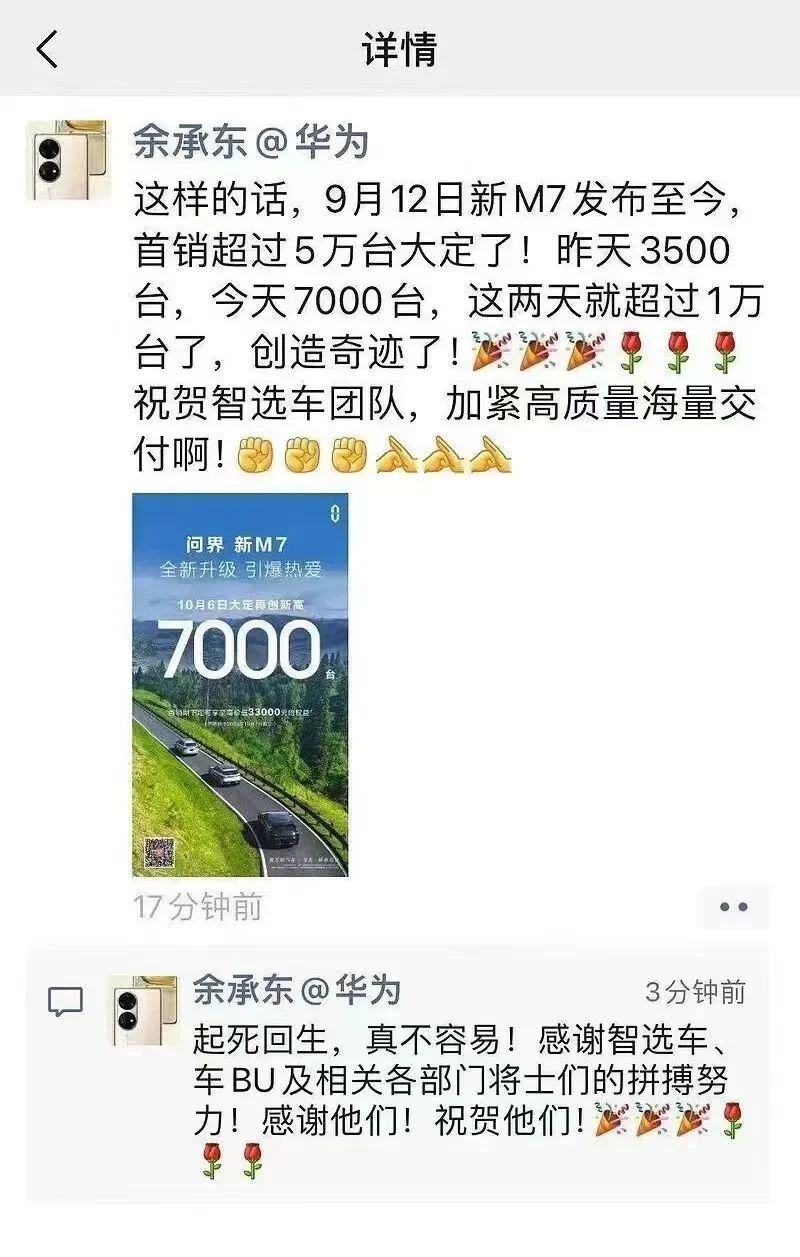
On the final day of the National Day holiday, October 6, single-day confirmed orders for the AITO M7 exceeded 7,000 units. Accompanying this result, within 25 days of its official launch, the AITO M7's total confirmed orders have surpassed 50,000 units.
In fact, on October 5, the previous day, confirmed orders for the AITO M7 had already exceeded 3,500 units—a result sufficient to surprise the entire auto industry. After the figures for the following day were released, the AITO M7 secured more than ten thousand confirmed orders within two days. Regarding this achievement, Richard Yu posted on WeChat Moments on October 6, calling it a "miracle."
He also stated, "Bringing it back from the brink was truly not easy."
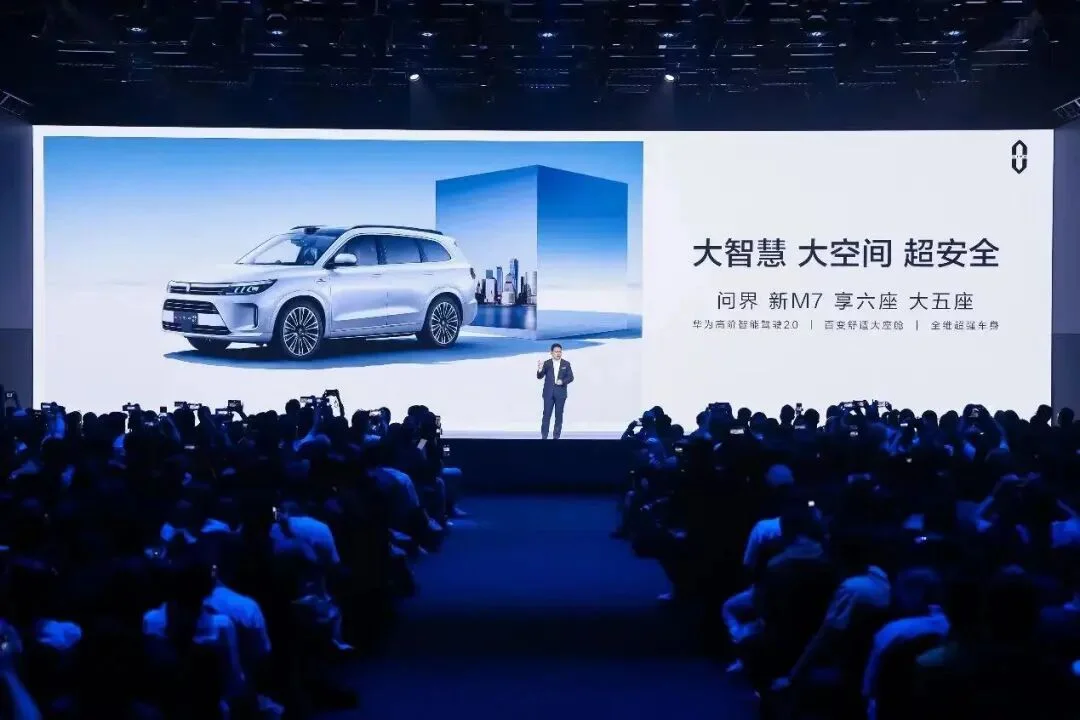
From a product perspective, the AITO M7 primarily emphasizes 'great intelligence, spacious interior, and exceptional safety,' with its core highlight being the ADS 2.0 advanced intelligent driving system it is equipped with. In addition to supporting high-level intelligent driving on highways and in urban areas, it also enables capabilities such as smart parking.
In terms of space, the AITO M7 has newly launched a large five-seat version, with an effective cabin length L1 reaching 3,338 mm (L1 refers to the distance from the foot pedals to the rear tailgate inside the vehicle, serving as an objective metric for measuring effective interior space). Regarding safety, in addition to redesigning the body structure on the passive safety front, it has also introduced its first omnidirectional collision avoidance system on the active safety front.
At the price level, the AITO M7 starts at RMB 249,800, bringing the entire product range down to the 250,000-yuan tier.
In fact, the AITO M7 has added further dimensions to buyers' choices, including five-seat and six-seat versions, as well as intelligent driving and non-intelligent driving variants. The two Max-labeled intelligent driving versions are priced at RMB 309,800 (five-seat) and RMB 329,800 (six-seat).
Additionally, to boost sales, the AITO M7 offered a benefits package worth RMB 33,000 during its initial sales period.
Of course, the launch of the AITO M7 coincided with an undeniable backdrop: the release and sales of the Huawei Mate 60 series, which sparked significant interest in Huawei chips. While this cannot be directly linked to the number of confirmed orders for the AITO M7, it undoubtedly increased brand visibility for Huawei and drove foot traffic to Huawei's offline retail stores. This, in turn, helped the M7 reach more potential buyers, contributing to the rise in confirmed orders.
So, the question arises: how did those who placed confirmed orders for the AITO M7 make their decision?
To find out, we spoke with 10 owners who had already placed confirmed orders for the AITO M7, discussing their purchasing decisions in depth. Through these real voices, we may gain insight into why the AITO M7 became a hit this time.
Owner 'Gong Bu Tang Juan': Without intelligent driving, I wouldn't have even considered this brand
City: Xi'an
Trim Selection: AITO M7 Five-Seat Intelligent Driving Version
Owner's Statement:
I placed my order on the evening of October 6, choosing the five-seat intelligent driving version with the software package.
I hesitated for a long time before buying this car because it wasn't an absolute necessity for me. Although I had been considering getting a new vehicle, I kept leaning toward a fully electric option because I already owned a hybrid—specifically, the BYD Qin DM-i.
As a heavy user of intelligent driving, I drive from Shaanxi to Hunan two or three times a year for self-driving trips, each covering 3,000 kilometers. Intelligent driving can truly liberate me. During the recent Double Festival holiday, I completed a 3,000-kilometer self-driving trip. The lane keeping and adaptive cruise control in the BYD Qin DM-i significantly reduced my fatigue, but it still left me suffering greatly. Therefore, I urgently need an intelligent driving system with high availability and reliability.
As a second car, I needed an SUV. The first-generation XPENG G9 had poor driving dynamics and was directly rejected by my wife. I was very interested in the G6 after its launch, but concerns about its exterior design, long delivery wait times, and limited comfort features kept me waiting until now. Li Auto is a brand that proved difficult to bypass during my purchasing process. My wife really liked the Li L7 for its larger second-row space, more attractive styling, and strong sales figures. I have been following Chehejia since its inception, but ultimately did not choose Li Auto.
I've also seriously considered the AVATR 11. Its hardware setup includes two more LiDAR units than the AITO, but I can't accept its interior design.
To be honest, I pay close attention to new energy vehicles. AITO's sales have been mediocre, so I hadn't paid much attention to it because I couldn't find anything that appealed to me; the design is hardly attractive. Before the AITO M7's intelligent driving capabilities went viral, there was simply nothing to draw me in. But this time, the combination of the AITO M7's intelligent driving breakthrough and the momentum from Huawei smartphones created a massive impact. The promotional effect of the vast amount of intelligent driving review content on short-video platforms was exceptionally strong.
The store arranged a test drive of the AITO M5 with intelligent driving capabilities, but it was only about five kilometers long. If my expectation before the test drive was 100 points, I would give this experience only 70 points—a barely passing grade. This may be because the test drive specialist was too eager to showcase the vehicle's intelligent driving features, resulting in abrupt lane changes, obstacle avoidance, acceleration, and deceleration throughout the process. However, based on reviews from various short-video platforms, I remain confident in its intelligent driving system, so I still placed an order.
Of course, this new AITO M7 isn't a pure EV, yet it still convinced me to place an order. As I mentioned earlier, what won me over was the intelligent driving capability, Huawei, and its price advantage compared to Li Auto. Without the intelligent driving feature, I wouldn't have even considered the brand—although I know the new AITO M7 will likely launch a rear-wheel-drive intelligent driving version and a pure EV variant later, I no longer want to wait.
If I were to score the entire decision out of 10, eight points would be due to Huawei's brand and technology. From the infotainment system, intelligent driving capabilities, chassis handling, and suspension tuning, Huawei's presence is everywhere; it has essentially given this car its soul. Additionally, I work at a state-owned enterprise and recently switched from the Apple ecosystem to the Huawei ecosystem—including my phone, watch, and earbuds—due to work requirements. The ecosystem integration was also a factor in my consideration, though it carried less weight.
Car Owner "Nuo Han Ba": I've researched new energy vehicles for a long time, but I still made an impulse purchase
City: Jinhua
Trim Selection: AITO M7 Five-Seat Intelligent Driving Edition
Owner's Statement:
I placed a blind order back in August, and at the time I was looking at the Max version because I was specifically after Huawei’s autonomous driving. Actually, last year I had looked at the previous-generation AITO M7, but without autonomous driving, if it only had the HarmonyOS cockpit, the advantage wasn’t significant; I took one look and that was it.
For this car purchase, I originally had no intention of buying a new energy vehicle. I’ve been paying close attention to them and have done some research, but I didn’t make an impulsive purchase. With two children at home, the next model I considered was a 5-meter MPV or SUV. After test-driving several models, I felt the DENZA D9 was quite suitable, though it still didn’t trigger an impulse buy. I also test-drove the AVATR 11, but its space ruled it out for me.
By June, I had watched some videos and seen the capabilities of the M5 with autonomous driving. I realized that I tend to lose focus while driving and had nearly been involved in an accident. So I went to test-drive the AITO M5 with autonomous driving, but found its size fell short of expectations.
At that point, I remained focused on AITO. As NEVs increasingly resemble smartphones, lacking OTA updates significantly weakens competitiveness. Backed by Huawei, AITO offers a higher OTA frequency than other brands.
Furthermore, when it comes to intelligent driving, Huawei is in a league of its own. I also noticed on short-video platforms that only Huawei dares to stream its intelligent driving capabilities live, while other brands' systems have been cut off during such broadcasts. This has reinforced my confidence in Huawei's intelligent driving technology.
Of course, in terms of intelligent driving, it’s not just Huawei; other manufacturers are doing quite well too. Their performance on highways is largely comparable. However, I personally prefer urban NCA over highway NCA, and Huawei is still pushing forward with mapless solutions. The city where I live is likely to launch urban NCA this year, so basically, I have no choice.
I want to emphasize that I’ve studied new energy vehicles for a long time, but I never felt the urge to place an order. My goals were very clear. Instead, it was the intelligent driving feature that triggered my impulse purchase. Of course, buying this car also involved considering Huawei’s investment intensity in other areas, including the chassis and materials; otherwise, I wouldn’t have considered it. This is a very realistic issue.
One more thing: after I placed my order, I referred four customers to our local user center. Three of them also placed orders, and they all chose the autonomous driving versions.
Car Owner "Milong": I Seriously Exceeded My Budget This Time
City: Chongqing
Trim Selection: AITO M7 Five-Seat Intelligent Driving Edition
Owner's Statement:
Trim Selection: AITO M7 Five-Seat Intelligent Driving Version AITO announced the pre-sale price for the new AITO M7 in late August. I visited the engineering vehicle on September 2, found no issues, and placed a firm order for the five-seat intelligent driving version.
I already own a pure electric vehicle. The main reason for buying another car is that my elderly family members have retired, so we need an additional vehicle. Therefore, I was considering purchasing a car priced around one hundred thousand yuan. Actually, I had looked at many cars before, but it was clear that the Li L7 and NIO ES6 were over budget. I also looked at the DEEPAL S7 and TANK 300, but didn't make a decision. After the old AITO M5 was released, I paid close attention to it, but it wasn't very attractive, mainly due to insufficient intelligence.
Of course, there is a paradox here: I severely exceeded my budget this time. I originally only planned to spend 150,000 RMB. The reason is that I hate driving and have no interest in cars whatsoever. As a man, I still have no interest in cars.
So, for me, intelligent driving is a very strong necessity.
I’m exhausted from work, and sometimes I check messages while commuting. I find that dangerous. NCA can help reduce those risks. Also, in highway scenarios, my parents are retired and occasionally go out for two or three trips, often involving highways. My father sometimes smokes in the car to stay awake, so having NCA would be a significant improvement.
As a Huawei phone user, I follow their product launches and chat with other Huawei fans. After watching the live stream of Huawei’s autonomous driving demonstration, I felt it could meet my essential needs.
This wasn’t just brand loyalty. If Tesla could deliver this level of intelligent driving and make it available domestically, I would buy it; but they can’t. I’ve also experienced XPENG’s and Li Auto’s intelligent driving systems, but Huawei’s performance is clearly superior.
I looked at the AVATR 11 as well. I really liked its four-seat version, but the space was too small for me. The exterior design was also too flashy—it looks good, but it doesn’t suit my taste.
So, when the AITO M5 Intelligent Driving Edition came out this year, it attracted me greatly. However, the price was an issue. My psychological expectation was RMB 250,000, and adding the NCA package cost another RMB 18,000, plus insurance and other fees, making it feel not worth it. I was about to decide to buy it anyway. Then the salesperson told me the AITO M7 Intelligent Driving Edition was coming, so I placed my order.
Honestly, I hoped this model would be fully electric, but since there’s no pure EV version yet, I accepted it. I considered the infotainment system too, but it carried less weight in my decision-making.
To be honest, buying the intelligent driving version maxed out my budget. The total cost for this car, including everything, was around RMB 330,000, which I had already accepted. Getting a discount of RMB 10,000 made me feel quite satisfied.
Owner 'Xin': The product itself convinced me to buy
City: Guangzhou
Trim Selection: AITO M7 Five-Seat Intelligent Driving Version
Owner's Statement:
I placed the firm order on the evening of August 29.
I used to drive an older Hanlanda. It was quite old and had high fuel consumption. Although I didn't mind the cost of fuel, it still felt awkward. So, starting from late last year, I began looking for a new car. Initially, I wasn't considering new energy vehicles; instead, I looked at models like the Tanxianzhe.
Because I'm a bit taller, I feel that space is quite important, so I was able to rule out many cars. I looked at brands like BYD, Aian, and Chuanqi. I also checked pure electric brands like AVATR and XPENG, but their space didn't meet my requirements—plus, sometimes I need to drive long distances, so I felt that range-extended or hybrid options would be better.
One day, while shopping with my family, I saw a Li Auto store and test-drove the Li L9. I thought the Li L9 was quite good, and there were in-stock units available that day, so I was basically about to place an order. However, due to some coincidental matters over those two days, I didn't take delivery of the car.
Later, I test-drove the Li L9 and found that it stopped during an automatic parking maneuver in a narrow space. Considering that my wife also needs to be able to drive and reverse, I decided not to consider it.
Later, I searched online for automatic parking and saw on B Zhan that the AITO M5 intelligent driving version performed particularly well. However, for me, the AITO M5 intelligent driving version had fatal flaws: one was the space, and the other was the lack of sunshades, making the roof too hot.
I’ve actually been following AITO for quite a while. I have a Huawei authorized store near my home, and I kept an eye on the older M7 models, but since there was no five-seat version, I continued to watch. In late August this year, just as Huawei released its new phone, the AITO M7 was also about to launch. I got along well with my salesperson and placed a firm order directly.
The first reason I placed a firm order for the new AITO M7 was that its large five-seat version came out, meeting my rigid demand for space.
The second is AEB. To be honest, I’m not very interested in intelligent driving; I feel it hasn’t yet developed to the point where it reacts faster than humans. However, I am very interested in AEB active safety, and my wife firmly believes that safety is the most important thing. I feel that everyone around me who ordered this car was interested in AEB; everything else was secondary.
I didn’t really consider the brand when buying this car; it was mainly the product itself that convinced me to buy. Of course, I also look at the sales staff’s professionalism when buying a car. The salesperson I met this time was very professional and knowledgeable about cars, which is why I decided to place my order with him.
Car Owner 'Gouzi': Intelligent Driving Capability Is Decisive
City: Qingdao
Trim Selection: AITO M7 Five-Seat Intelligent Driving Edition
Owner's Statement:
I placed a small deposit on August 27 and finalized the order at a local auto show in Qingdao on September 9, choosing the five-seat intelligent driving version.
I had plans to buy an additional new car last year. Due to my interest in Huawei, I also looked at the older AITO M5; but honestly, I was dissatisfied with the old M5 because I felt that without Huawei's intelligent driving empowerment, the depth of integration was insufficient; however, its handling and quality were acceptable. I also test-drove the older AITO M7, thinking its chassis was okay, but the quality wasn't very good, the space in the six-seat version wasn't great either, and the price was quite high.
By the end of July this year, the Xingyue L I had been driving was involved in an accident. I opted for a total loss settlement and decided to replace the vehicle. Initially, I considered the AITO M5 with intelligent driving capabilities, but its interior space felt somewhat limited. Additionally, the compensation payout was delayed, which caused me to postpone the purchase. As a result, I waited until the AITO M7 with intelligent driving features was released.
I also looked at models from other brands, including pure electric vehicles. I checked out the XPENG G6 and G9, and the Zeekr 009; while I liked their driving styles, they were a bit pricey. In the end, I felt that an extended-range vehicle was a better fit. I also test-drove the Li L9 and L7, and the experience was excellent—very comfortable. So, the L7 remained on my shortlist. By the final stage of selection, it came down to choosing between the L7 and the M7.
I ultimately placed a firm order for the new AITO M7 this time, primarily because of the significant advantage its autonomous driving capabilities provide; this factor was decisive.
I actually started getting involved with intelligent driving around 2010, beginning with ACC and later LCC. I find that I can relax much more when driving long distances. Since I personally enjoy self-driving tours, I have always paid close attention to driver assistance systems.
I’ve been paying attention to Huawei’s intelligent driving capabilities because I am a long-time Huawei user and have consistently followed the company’s development. After the AITO M5 with intelligent driving features came out, numerous live-stream videos (as opposed to edited clips) circulated online, which significantly boosted my trust in Huawei’s autonomous driving technology.
I also test-drove the M5 with Huawei’s intelligent driving system, so by the time the new AITO M7 launched, I had already built a high level of trust in Huawei’s autonomous driving capabilities. For me, the Li L7’s autonomous driving lacked sufficient reliability, which became a significant drawback.
Another key decision factor for buying the new AITO M7 was the price; a starting price of around RMB 250,000 is very attractive.
Additionally, the new AITO M7 offers a five-seat version with more interior space, which is a major product advantage for me. Although the trim I purchased costs just over RMB 300,000, at that same price point, the Li L7 only offers the Air version.
I feel my purchasing decision was largely rational. Huawei’s brand influence had minimal impact on me; if anything, it only increased my interest in the M9, but I couldn’t wait any longer.
I was also concerned about AITO’s factory delivery capacity, as my own reservation deposit order delivery was delayed. This remains a challenge for AITO.
Owner 'Fenghua': I Gained Confidence in Autonomous Driving
City: Taiyuan
Version Selection: AITO M7 Six-Seat Intelligent Driving Edition
Owner's Statement:
I placed my order on September 18. After the AITO M7 launch event, a friend kept recommending it to me. A few days later, I visited the store and placed my order within half an hour.
This was an additional purchase for me; my family already owns two gasoline cars. Due to work requirements, I felt we needed a six-seater. At the same time, considering fuel economy and some range anxiety, I hoped for a plug-in hybrid or extended-range model with a budget between RMB 300,000 and RMB 450,000. So I looked at plug-in models like the Li L8, Lynk & Co 09, and WEY Lanshan, and also checked brands such as BYD, Kaidilake, and Woerwo.
The main reason I didn't buy the Li L8 is that I felt its exterior design did not match my aesthetic preferences. I also test-drove the Lynk & Co 09, but it lacked in terms of intelligent features; for instance, its lane-keeping assist did not give me much confidence.
So, the new M7 actually has quite a strong appeal to me. I was already aware that the previous-generation M7 had some issues, and people advised me against it. However, after the salesperson showed me some real-world test videos, and I learned that Huawei spent 500 million yuan on improvements, all of this gave me confidence.
I bought the intelligent driving version. Besides the six seats, the intelligent driving features were another key factor in my decision to purchase this car. To be honest, while intelligent driving isn't an absolute necessity for me, it is for my wife, who is a new driver. Her primary needs are AEB and parking assistance. Of course, I also rely on NCA on highways to help reduce fatigue.
Actually, I didn't have much trust in autonomous driving at first, but I gradually built confidence. One reason is that there are many review videos about autonomous driving on B Zhan; later, I test-drove the AITO M5 with intelligent driving capabilities and tried it out on my daily commute route, which helped me gradually accept it.
Additionally, I am a Huawei phone user myself and have also purchased the Mate 60 Pro, so the interaction between the car's infotainment system and my phone is one of the factors I considered. Of course, part of my motivation for buying this car was to support domestic products.
Owner 'Teapot zw': If cars lack autonomous driving next year, they might not sell
City: Kunming
Trim Selection: AITO M7 Five-Seat Intelligent Driving Version
Owner's Statement:
I placed a preliminary reservation in late August and finalized the order on September 17 for the five-seat intelligent driving version. I previously owned an internal combustion engine vehicle and this was an additional purchase. Considering range anxiety and my need to take long-distance trips seven or eight times a year, I felt a plug-in hybrid or extended-range electric vehicle was necessary, with a budget of around RMB 300,000.
Starting from July this year, I looked at several brands, including NIO, XPENG, and Li Auto. After test-driving the Li Auto, I was quite interested, particularly in features like refrigerators and large screens, but ultimately decided some configurations had gaps and excluded it. With NIO, I found the space a bit small; for XPENG, we looked at the G9, but my wife did not like it, so we excluded that as well. I also considered BYD. While I acknowledged their strong electrification capabilities, I perceived a gap in intelligence, so I did not consider them further.
I’ve been following AITO because I’m a Huawei fan, and I’ve paid attention since the earliest M5. Personally, I place great importance on intelligence; if it were only about electrification, I would have little demand.
In my view, when discussing intelligence today, the smart cockpit is no longer the focus; the true core is intelligent driving. I even believe that by next year, if your car lacks autonomous driving, it might not sell.
I’ve been paying close attention to the real-world deployment of intelligent driving since Huawei’s earliest collaboration with Arcfox. With heavy traffic on my daily commute, I had a strong personal need for technology to reduce fatigue. After watching videos and live streams showcasing Huawei’s intelligent driving capabilities, my initial doubts gradually faded.
I conducted my own comparisons and found AITO to have a slight edge. I test-drove the AITO M5 with intelligent driving features, but its cabin space was too small for me. Beyond intelligent driving, I also placed significant importance on the smart cockpit. As a Huawei smartphone user, I highly value seamless interoperability between devices.
Additionally, when considering the new AITO M7, I felt confident about Huawei’s statement at the launch event regarding spending 500 million yuan to make improvements. I have strong trust in the Huawei brand and believe it can resolve previous issues, so any prior doubts were dispelled.
Another factor was the attractive pricing. The starting price was slightly below my budget; although the final configuration pushed the total cost over budget, the overall value for money remained compelling.
Owner "Da Xiong": I Thought It Might Explode, But Was Unprepared for How Impressive It Is
City: Hangzhou
Trim Selection: AITO M7 Five-Seat Intelligent Driving Version
Owner's Statement:
I placed a small deposit on August 27 and a large deposit on August 30, initially ordering the rear-wheel-drive five-seat version. After the September 12 launch event, I changed my order to the intelligent driving version.
I have had my driver's license for a short time, and this is also my first car purchase. Considering it is the first car in my life, I thought about it quite clearly: first, it needs to be an SUV with large space; second, it needs to be a new energy vehicle, so many joint venture cars were ruled out. I considered the XPENG G6, but still felt there was some range anxiety, and it could not be purely electric, so it was ruled out. So only a few limited options remained.
I went to look at Li Auto, but it was beyond my budget, so I didn’t consider it; Leapmotor and DEEPAL were also out of the question. That left AITO.
I had actually looked at the AITO M5 before. But after test-driving it, I felt its space was relatively small; space is my primary consideration when buying a car. If the intelligent driving version of the M5 were priced appropriately, I would likely buy the intelligent driving version directly.
Actually, intelligent driving isn’t a strict necessity for me. So initially, I ordered the non-intelligent driving version of the AITO M7. After researching online, I felt its autonomous driving capabilities still lagged behind human drivers. But I knew Huawei had invested significantly in this model, not just in the smart cockpit but potentially in other areas as well.
Compared to intelligent driving, I actually care more about the infotainment system. I believe it has a significant impact on the driving experience. So in this car-buying decision, the infotainment system carried more weight than intelligent driving.
But later, I switched back to the intelligent driving version because they announced at the launch event that the NCA intelligent driving package would be 15,000 cheaper, which tempted me. Without that 15,000 discount, upgrading to intelligent driving would have cost me an additional twenty thousand yuan—but with it, I decided to go for it.
So I made an impulse purchase, spending an extra 60,000 yuan as the price went from 249,800 to 309,800.
I talked it over with my parents. They lean toward BBA, given the price point. Some asked why I didn't choose Li Auto at this price. For me, a technological moat is essential. To me, AITO feels like a car under RMB 300,000, offering better value than Li Auto.
Additionally, the decision was influenced by my awareness that autonomous driving is a trend. Buying a car now means it will likely feature smart driving capabilities in the future.
Another reason for this purchase: although I don't use Huawei phones, I worked at Huawei previously, which holds some sentimental value for me. I've followed Huawei's journey and found it quite challenging. I anticipated this model would be popular, but not to this extent.
Owner 'Little Lettuce': Over budget, but high cost-performance ratio
City: Shenzhen
Version Selection: AITO M7 Six-Seat Intelligent Driving Edition
Owner's Statement:
I placed the firm order on September 17, choosing the six-seat smart driving edition.
I previously drove a gasoline car, but it wasn't registered in my name. This purchase counts as my first car; I had actually planned to buy one two years ago, but put it off until I restarted my search in May or June of this year with a budget of around RMB 300,000.
Over the past few months, I first looked at the BYD Tang DM-i, considering its fuel efficiency. However, since I work in the cabin industry, I evaluated its interior performance and ruled it out.
Next, I went to look at the Yinhe L7 and DEEPAL S7. They were decent, but the price didn't fit, so I decided to keep looking. I also visited NIO; while the overall experience was very good, considering my need for long-distance trips back to my hometown, I felt I still needed to consider a hybrid or extended-range vehicle. So, I went to look at the Lynk & Co 09 and WEY Lanshan.
I also looked at the Li L8, which was my most difficult decision. I initially considered the five-seat Li L7, but later felt the six-seat Li L8 better suited my needs. Its product strength was quite good, but after a test drive, we found that my wife easily got carsick in the back seat. Also, the version with lidar was too expensive and exceeded our budget, so we gave it up.
The reason I looked into the lidar-equipped versions is that I have certain requirements for autonomous driving, mainly highway NCA, which has basically become a must-have for me to make things easier. Another, more important factor is AEB—it's even more critical—I can even say that what ultimately made me decide to buy the new AITO M7 was mainly because of AEB.
I had been paying attention to AITO for a long time, but I didn't include it in my purchase options because I felt it was a product of a joint venture. However, after actually visiting the store and seeing it, I thought it was pretty good. The problem with the M5 smart-driving version is that it's too small, although its AEB capabilities are quite notable.
I learned about Huawei's AEB capabilities through a colleague who was also shopping for a car. He recommended Huawei's intelligent driving and active safety systems as being highly effective. I then watched some videos on B Zhan and agreed that they were indeed quite good.
Additionally, since I work in the cabin sector, the cabin is a major consideration for me; if not for the smart cabin features, BYD might have been a good option as well. AITO has made significant efforts in this area over the past two years, particularly regarding smartphone-to-vehicle integration, which is its key advantage. As a Huawei phone user myself, I pay considerable attention to this.
For me, the most critical aspect of the cockpit is its ability to undergo stable, long-term iterations. Brands like NIO, XPENG, and Li Auto can sustain continuous investment and updates in this area, whereas other brands may face risks.
Ultimately, I spent over RMB 300,000 on this car. It exceeded my budget, but I believe the overall value for money is high and it was worth it—although I consider myself rational, to be honest, there is a slight element of support for Huawei involved.
Owner 'Mao Taotao': The current test is delivery
City: Shenyang
Trim Selection: AITO M7 Five-Seat Intelligent Driving Version
Owner's Statement:
I placed a firm order on September 17, choosing the five-seat intelligent driving version.
This purchase is an additional vehicle; I already own a gasoline-powered car. After identifying my needs, I looked around at gasoline cars but didn’t find any that were particularly satisfactory. So this time, I focused mainly on new energy vehicles. Since I live in Northeast China, I feel that extended-range electric vehicles have an advantage over battery-swapping options, reducing anxiety.
As a female driver, I first pay close attention to the exterior design and am also concerned about the battery, electric motor, electronic control systems, and autonomous driving capabilities. After visiting the experience store at a mall near my home, I looked at BYD but eliminated it based on its appearance; NIO’s exterior was nice, but I didn’t like its battery swap design. I also visited Li Auto, but nothing particularly caught my interest.
I don’t know much about cars myself, but I’ve studied hard. I feel I have greater confidence in Huawei, for example, regarding its capabilities in the battery, electric motor, and electronic control systems, as well as autonomous driving. Of course, I’m not blindly trusting them; I watched many videos to understand the technology before confirming that it is safe.
I went to look at AITO. I initially checked out the intelligent driving version of the M5 and took a test drive. My family felt that the space in the M7 might be larger, and the price wouldn't differ much, so we wanted to wait for the intelligent driving version of the M7.
The main reason I chose the autonomous driving version is the active safety capabilities it brings, including automatic emergency braking (AEB). Because I had seen some videos on B Zhan about this car’s autonomous driving capabilities and AEB, I gained more confidence in it. Additionally, I believe the lidar adds an extra layer of safety.
Another factor is my strong demand for intelligent driving. I actually experienced the highway NCA during a test drive of the AITO M5 Intelligent Driving Edition, and it performed very well, primarily due to its stability; therefore, I have a strong need for such an NCA. In fact, I’m quite lazy, so I’m very willing to use intelligent driving features—wherever it can operate, I want it to take over.
Many experienced drivers may have some doubts about autonomous driving, but I am different. I clearly recognize my shortcomings and seek to make up for them through technology, so I actually have a very high acceptance of intelligent driving—provided, of course, that I have test-driven it, which gave me confidence.
Beyond autonomous driving, I also pay close attention to the infotainment system’s performance. As a Huawei smartphone user with other ecosystem devices like tablets and smartwatches, I consider the connectivity between my phone and the car’s infotainment system crucial, especially the terminal interconnection capability, which is particularly easy to use.
For me, the decision to ultimately buy the autonomous driving version of the new AITO M7 was based on the vehicle itself and was essentially a rational one. I believe it is a good product launched at an appropriate price point, which came to the attention of more people at the right time—of course, the current test for it lies in its delivery.
Final Thoughts
In these conversations, extended range, intelligent driving, and interior space emerged as the three core product attributes that led these owners to choose the AITO M7. If there is a fourth factor, it is price and promotions.
Interestingly, during their purchasing process, the Li L series was the most frequently compared model among the interviewees, particularly the Li L7. However, the primary reasons they ultimately chose the AITO M7 were its intelligent driving capabilities and price.
Notably, all ten owners who placed substantial deposits in this round of interviews selected the AITO M7 with intelligent driving features, with eight opting for the five-seat version.
While they may not represent the choices of all AITO M7 buyers, their preference for the intelligent driving version is genuine and reflects the growing influence of autonomous driving on purchase decisions. Moreover, even users who do not consider intelligent driving a necessity pay close attention to the active safety features derived from the AITO M7’s autonomous driving system, especially Automatic Emergency Braking (AEB).
This highlights, from another perspective, the value that AI-enabled intelligent driving brings to users.
Of course, during our discussions, these owners also expressed concerns about delivery delays. Due to the massive volume of orders, their estimated delivery times have been delayed to varying degrees, leading to complaints. Therefore, ensuring the timely delivery of substantial deposit orders has become a critical test for AITO in the near future.
Written by: 308 Edited by: 308