


Why 800 V Is Becoming a Must-Have for Pure EV Buyers
In 2023, pure electric vehicles (EVs) with 800 V architectures saw a notable surge in adoption.
In addition to the Porsche Taycan, which launched in 2020 with a starting price nearing RMB 1 million, mainstream models such as the XPENG G9 and XPENG G6, along with distinctive options like the Jienisaisi GV60 and Audi e-tron GT, all feature standard 800 V architectures.
However, what exactly makes 800 V systems better is difficult to perceive through static and dynamic experiences alone. Potential buyers who have not yet purchased a vehicle cannot experience just how much the 800 V architecture significantly shortens charging times.
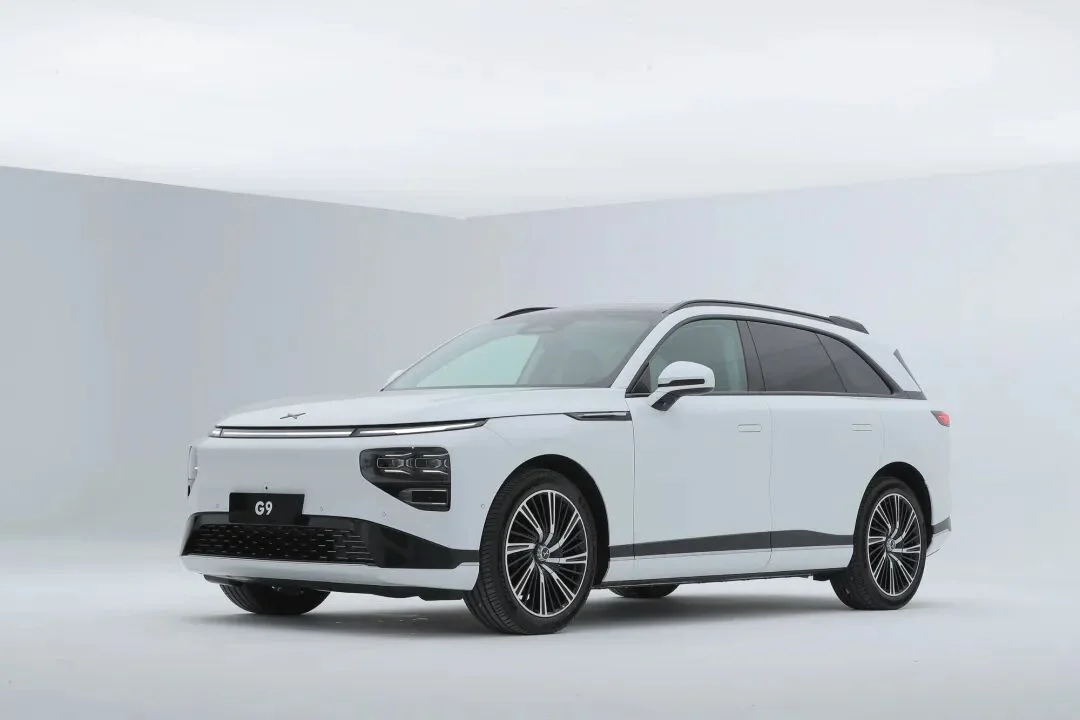
The XPENG G9 is renowned in the automotive circle for its fast charging, with slogans like "200 kilometers of range added in five minutes" and "one kilometer per second." We recently took our self-purchased XPENG G9 to test various third-party charging stations. With this model adopting a full-domain 800 V architecture, just how fast can it perform in terms of peak charging speed, ultra-fast charging intervals, and total charging duration?
01How Fast Is the Charger Determines How Fast the G9 Charges
Many EV owners have noticed that their vehicles struggle to reach the maximum power output of charging stations. Even under ideal temperature conditions and without other vehicles sharing the charger, the charging power often remains below the station's limit.
The XPENG G9 demonstrates outstanding charging performance, consistently reaching the maximum power supported by chargers from four different brands: Kaimaisi, Xingxingchongdian, Xiaojuchongdian, and Telaidian.
For instance, at a Kaimaisi 180 kW charger, the XPENG G9 achieves a peak charging power of 170.1 kW; at a Telaidian 150 kW charger, it reaches up to 148.6 kW.
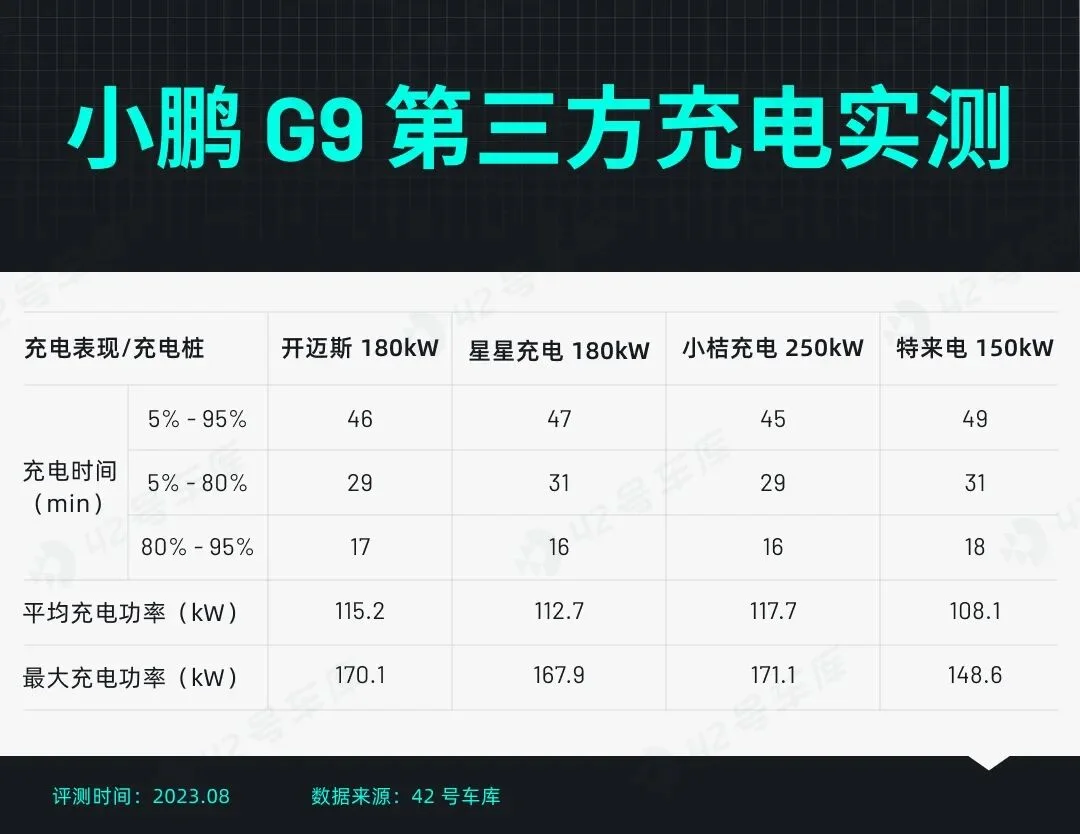
In terms of charging time, the fastest is the Xiaojuchongdian 250 kW charging pile, which takes only 45 minutes to charge from 5% to 95%. The slowest is the Telaidian 150 kW charging pile, which also takes only 49 minutes to charge from 5% to 95%, with a very small difference between the two.
This duration is roughly equivalent to having lunch: you park, plug in, finish your meal, and depart with a full battery.
Another pain point for electric vehicle owners is that charging slows down as the battery level increases. Specifically, once the charge exceeds 80%, the charging power drops significantly.
Especially for EV owners planning long trips, saving time on the road often means stopping charging at 80% rather than filling up completely, thereby sacrificing 20% of the range. If a fully charged car can drive 400 km on the highway, it may need to recharge after just 300 km, noticeably degrading the user experience.
In other words, many users pay extra for electric vehicles with longer range, but find no advantage in urban driving where charging is convenient, and still see no benefit from the extra range on long trips if they choose not to charge fully.
The XPENG G9, equipped with a full-domain 800V architecture, effectively addresses this pain point. Its charging time from 80% to 95% capacity takes as little as 16 minutes at the fastest and no more than 18 minutes at the slowest, with minimal variation across different third-party charging stations.
Through calculation, it can be found that in the entire charging process of less than 50 minutes, approximately 2/3 of the time is spent on fast charging (5% - 80%), and only 1/3 of the time does the power gradually decrease (80% - 95%).
This performance yields a very high average charging power for the XPENG G9, consistently exceeding 110 kW. Consequently, the vehicle can go from nearly empty to fully charged in under an hour.
For XPENG G9 owners, this means they can truly enjoy the long-range advantages provided by large battery packs during long-distance travel.
02Why Does the 800V Architecture Enable Faster Charging?
By recording charging times and real-time power, we plotted the XPENG G9’s charging curves across different stations.
The curves show that chargers from Kaimaisi and Telaidian exhibit relatively smooth profiles, whereas those from Xingxingchongdian and Xiaojuchongdian display fluctuations in charging power. The cause of these fluctuations remains unverified; however, it is confirmed that during our testing period, only the XPENG G9 was charging at the test station, ruling out load sharing as the reason for the power variations.
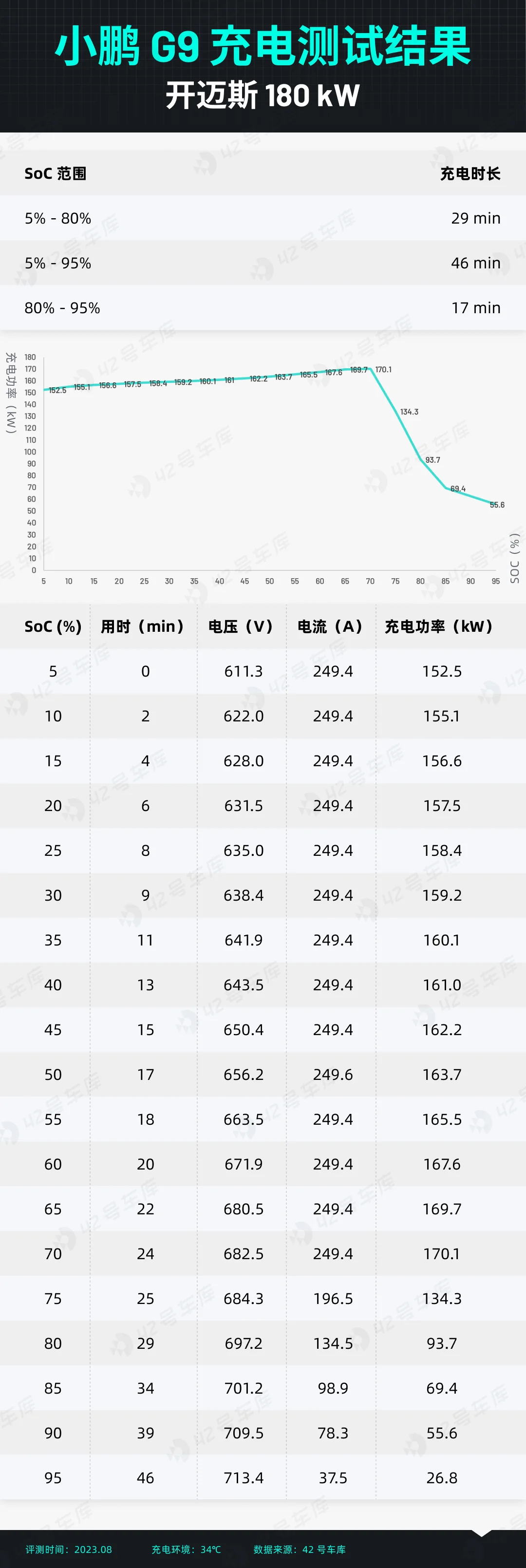
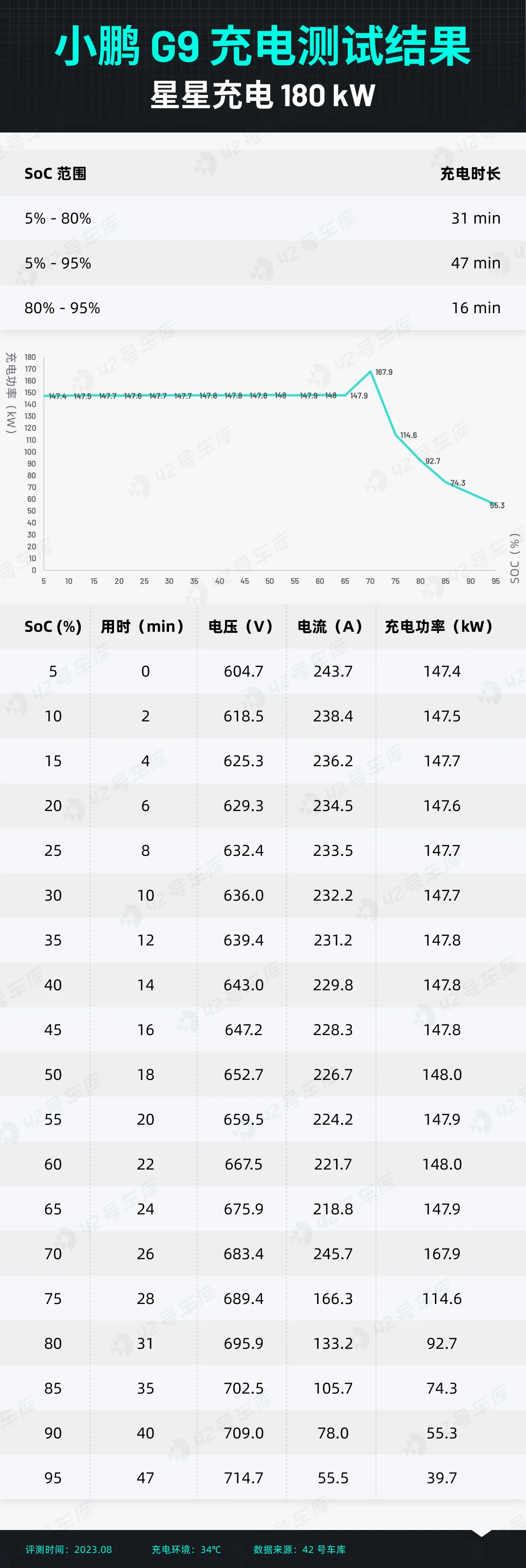
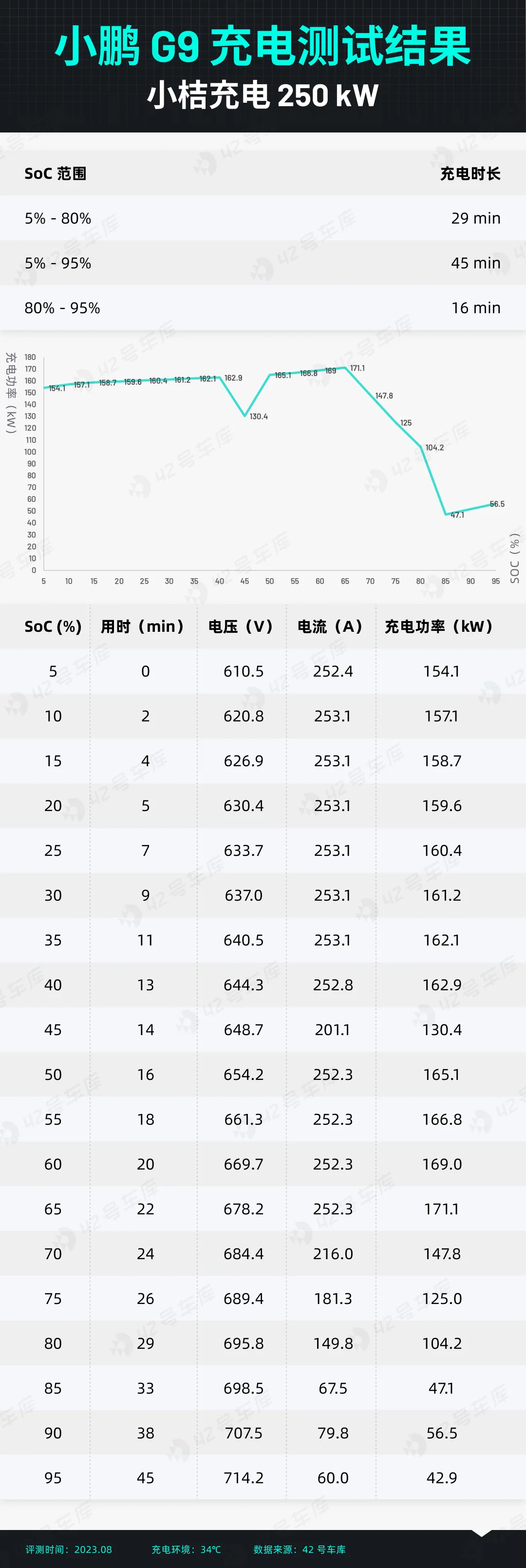
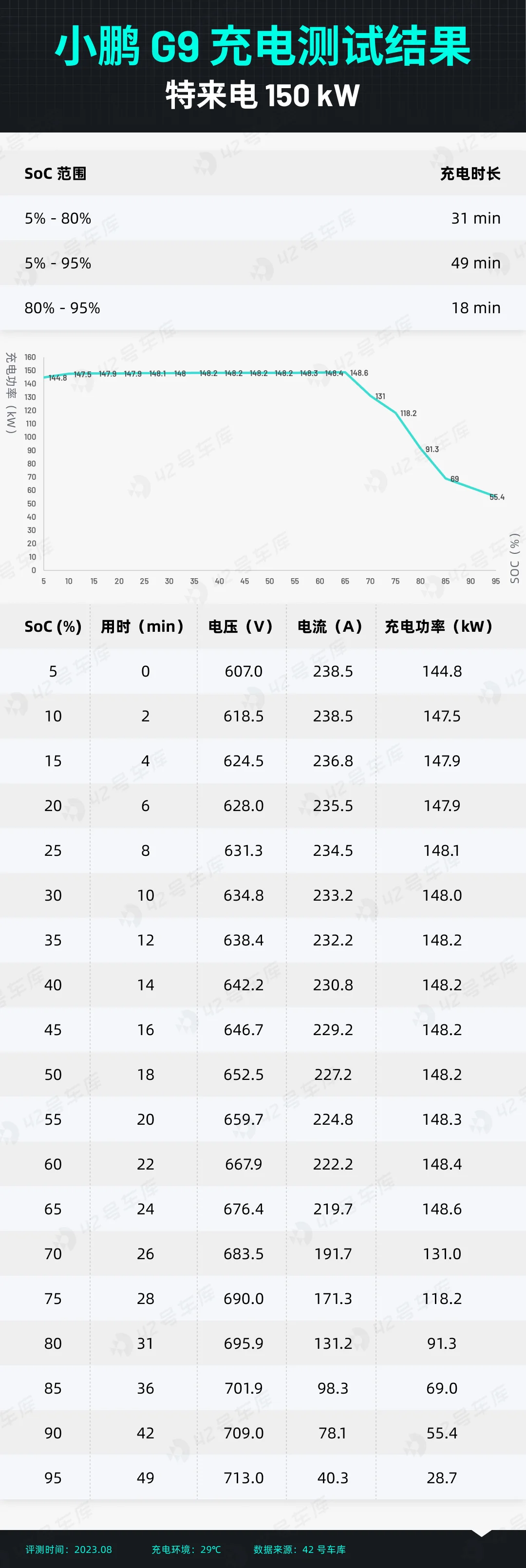
If you are in a hurry and want to gain the most charge in the shortest time, Kaimaisi, Xingxingchongdian, and Telaidian recommend stopping at around 70% state of charge (SoC), while Xiaojuchongdian suggests stopping at around 65%.
This allows you to gain more than 350 km of range as displayed on the instrument cluster in just over 20 minutes, which is sufficient for a single inter-city trip.
After analyzing hundreds of charging data points, we found even more details.
At the start of charging, the XPENG G9’s charging power was almost always around 150 kW. From 5% to 75% SoC, the power gradually increased, fully utilizing the power provided by the charging pile. Even before charging ended, the XPENG G9 maintained a charging power of more than 50 kW.
We compared it with a vehicle using a 400 V architecture, which started with a charging power of only slightly over 80 kW, nearly half that of the XPENG G9. As it approached full charge, the charging power dropped to only twenty or thirty kW.
Ultimately, the full charging cycle for 400 V models takes nearly 90 minutes, while the XPENG G9 cuts that time in half.
The advantage of the 800 V architecture becomes even more pronounced in scenarios with poor charging experiences due to multiple vehicles sharing a single charger. Since only current is divided, the XPENG G9, equipped with an all-domain 800 V architecture, charges faster than adjacent vehicles.
From this perspective, buying an 800 V vehicle allows you to enjoy its benefits immediately after purchase. As long as the number of 400 V vehicles on the road remains higher, the charging experience for 800 V models will consistently feel superior.
03Conclusion
After reviewing the charging data for the XPENG G9, I believe that as of today in 2023, an 800 V architecture should be a mandatory choice for users.
Before the test, I questioned whether the 800 V architecture offered advantages only at XPENG’s self-built charging stations and performed similarly to other vehicles at third-party chargers. The answer is no; the advantages of the 800 V architecture are significant regardless of whether using XPENG’s proprietary chargers or third-party stations.
The XPENG G9 features an all-domain 800 V high-voltage SiC platform, which increases charging power through high voltage and high current solutions. Additionally, XPENG’s S4 supercharging piles can deliver up to 480 kW / 670 A of charging capacity.
Furthermore, regarding energy consumption, our tested 650 Performance Max model maintained speeds close to the limit throughout the test, achieving an average speed of 105 km/h. After covering 461 km on the highway, it still had 18 km of remaining range. Supported by the all-domain 800 V architecture, the XPENG G9 also demonstrated excellent highway energy efficiency.
Clearly, technological advancements have enabled features once exclusive to million-yuan pure electric vehicles to become mass-producible in mainstream family cars.
In 2023, would a full-domain 800 V architecture be a must-have for you when buying an electric vehicle?
Written by: James Edited by: Daji