


From D9 to N7: DENZA Moves From Blue Ocean to Red Ocean With 'Tianshenzhiyan'
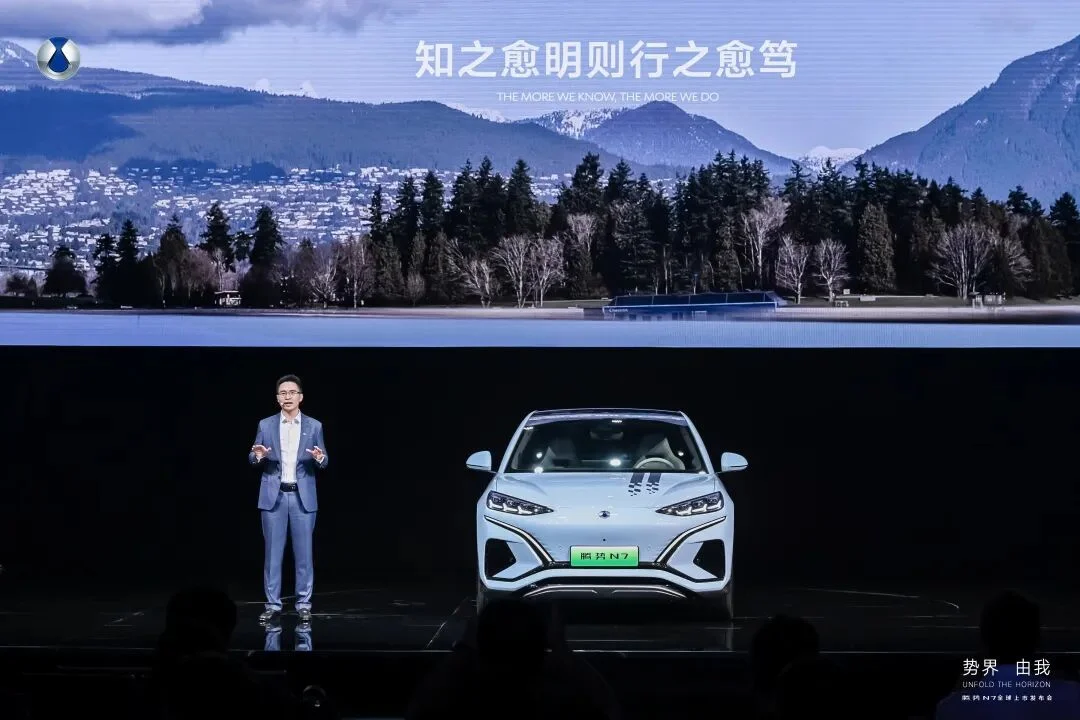
The BYD Intelligentization Half-Time Game Changer — DENZA N7 Has Finally Arrived.
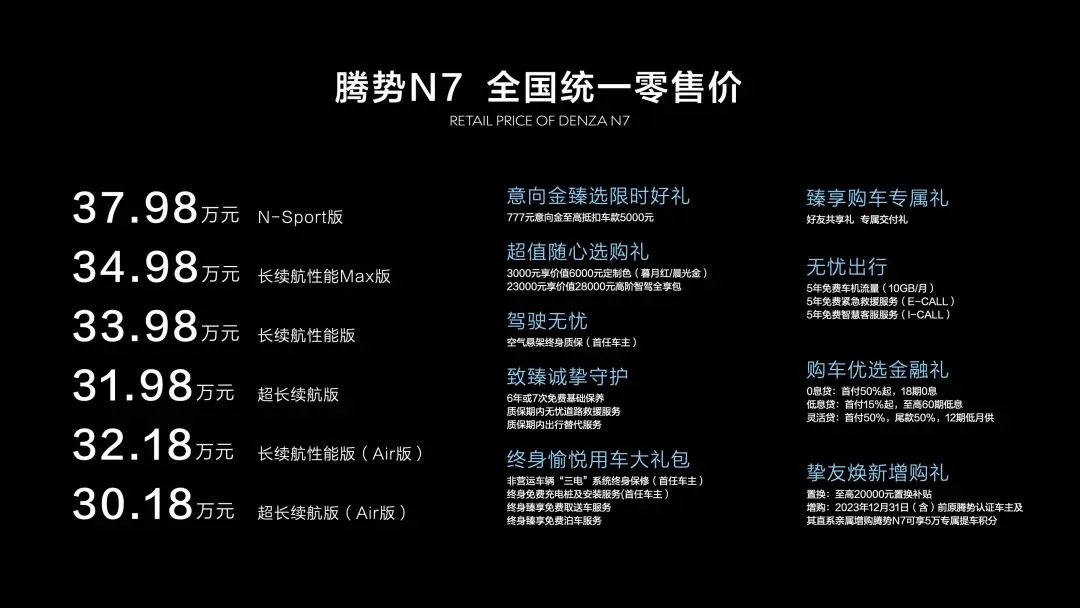
On July 3, the global launch event for the DENZA N7 was held in Beijing; during the event, the pricing for the DENZA N7 was fully revealed: the starting price is RMB 301,800, and the highest price is RMB 379,800.
As the first pure electric SUV model launched by the DENZA brand after the D9 MPV, the DENZA N7 has attracted significant attention—it not only bears the responsibility of boosting sales volume for the DENZA brand in the RMB 300,000 to 400,000 price segment but also sets the pricing tone for the brand's future product lineup.
More importantly, with the release of the DENZA N7, BYD has taken a crucial step forward in intelligentization, particularly in the realm of autonomous driving.
01Starting Price Above RMB 300,000, But 'What Should Be Standard Must Be Standard'
In terms of pricing, the DENZA N7 covers most of the space between RMB 300,000 and RMB 400,000; specifically:
N-Sport version, priced at RMB 379,800;
Long-range performance MAX version, priced at RMB 349,800;
Long-range performance version, priced at RMB 339,800;
Super long-range version, priced at RMB 319,800.
Additionally, to further lower the entry threshold for users, DENZA launched an Air version without the Yunnian-A system, which is priced at RMB 18,000 less than the standard version, namely:
Long-range performance version (Air version), priced at RMB 321,800;
Super long-range version (Air version), priced at RMB 301,800.
It is evident that DENZA’s pricing structure, particularly the distinction between the Air and Max versions, draws lessons from new energy vehicle brands.
To support this pricing, DENZA has differentiated its product attributes in several areas.
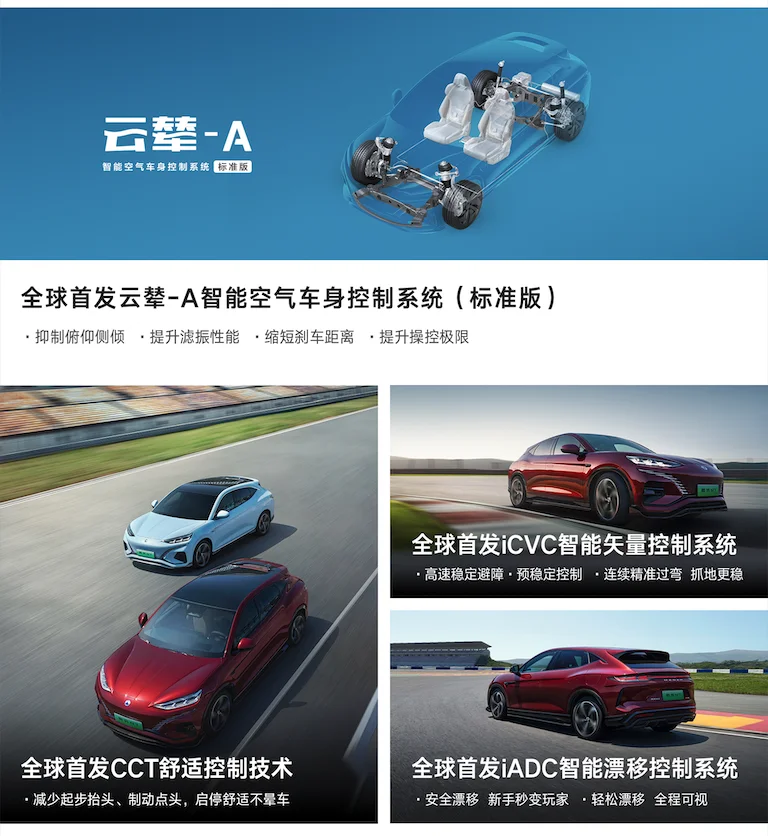
For example, regarding vehicle dynamics control, the DENZA N7 is built on the upgraded e-Platform 3.0 DENZA. The standard version debuts the Yunnian-A intelligent air body control system, featuring CCT comfort control technology and iCVC intelligent vector control system for intelligent chassis management, along with an iADC intelligent drift control system.
The upgraded e-Platform 3.0 DENZA adopts a highly integrated vehicle platform architecture, incorporating CTB battery-to-body integration technology, iTAC intelligent torque control, an SUV-exclusive four-wheel-drive high-performance architecture, and an intelligent domain control architecture. This evolves from the previous 'battery sandwich' structure to a full-vehicle 'sandwich' structure, providing greater interior space while significantly enhancing off-road capability and safety.
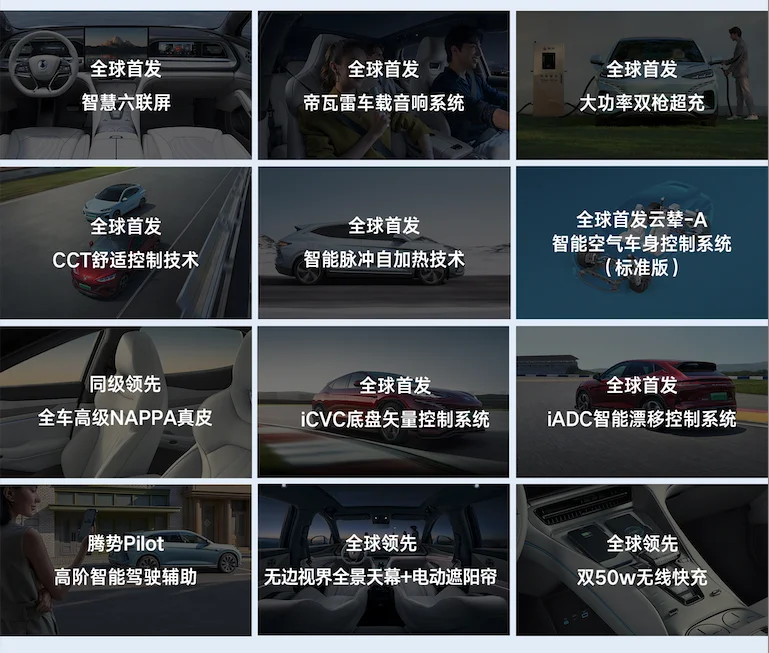
In terms of interior equipment, the DENZA N7 comes standard with over 200 luxury features across all trims, including French Diwalei audio systems, a six-screen setup, premium NAPPA leather throughout the cabin, and electric sunshades. It also features DENZA’s pioneering 5D cloud-feel ergonomic seats, with seat adjustment, massage, ventilation, and heating included as standard.
According to Zhao Changjiang, General Manager of DENZA’s Sales Division, 'what should be standard must be standard.'
Regarding the intelligent cockpit, the DENZA N7 offers customized functions tailored to different seating positions. It features a six-screen configuration comprising a central control screen, passenger screen, instrument cluster display, AR-HUD, and dual smart air vent displays, supporting multi-screen information sharing and interaction.
Notably, to address range anxiety associated with pure electric SUVs, the DENZA N7 employs an all-scenario charging and replenishment system. This includes intelligent pulse self-heating technology, a globally first dual-gun supercharging technology, and V2V mobile power station capabilities. These features enable users to enjoy convenient high-power flash charging exceeding 230 kW, achieving efficient integration of all-weather, all-scenario temperature control and energy replenishment.
Among these, as the pioneering dual-gun high-power supercharging technology, the dual-gun charging power can reach up to 230 kW, and the single-gun charging power can reach up to 150 kW. It is compatible with mainstream public DC charging piles nationwide, enabling a fastest recharge of 350 km in 15 minutes and 100 km in 4 minutes. It also supports vehicle power replenishment of up to 60 kW, effectively addressing the pain points of pure electric vehicles in terms of charging.
Overall, in terms of product capabilities, the DENZA N7 embodies a philosophy attributed to Zhao Changjiang: 'What is top-tier for others is standard for us.' Through this differentiation strategy, DENZA aims to enter the highly competitive market for pure electric SUVs priced between RMB 300,000 and RMB 400,000.
02With so many 'N' models ending in 'A', this one is called 'Tianshenzhiyan'
The highlight of the DENZA N7 launch event was the official debut of BYD's advanced driver assistance system, 'Tianshenzhiyan'.
According to official statements, 'Tianshenzhiyan' is built on a system architecture featuring deep collaboration between BYD's proprietary central computing platform and zone controllers. It introduces an industry-first vehicle-level system solution that fuses direct physical sensing with indirect software-based algorithmic sensing.
So, what are the advantages of BYD's 'Tianshenzhiyan'? According to the official description:
It is the first globally to propose a vehicle-level fused perception platform, integrating direct physical sensing with indirect software algorithmic sensing.
Pioneering a distributed control algorithm layout, the system scientifically distributes algorithms for optimal decision-making and precise control.
Proprietary millisecond-level control over drive, steering, and braking ensures efficient execution.
Early identification, rapid correction, and precise control.
Notably, BYD announced that 'Tianshenzhiyan' is based on the world’s first in-vehicle computing platform fully designed, developed, and manufactured by an automaker. On the software side, BYD independently developed the BOS BYD operating system; regarding proprietary algorithms, BYD utilizes BEV combined with large models, effectively leveraging massive data accumulated from large-scale mass-produced vehicles.
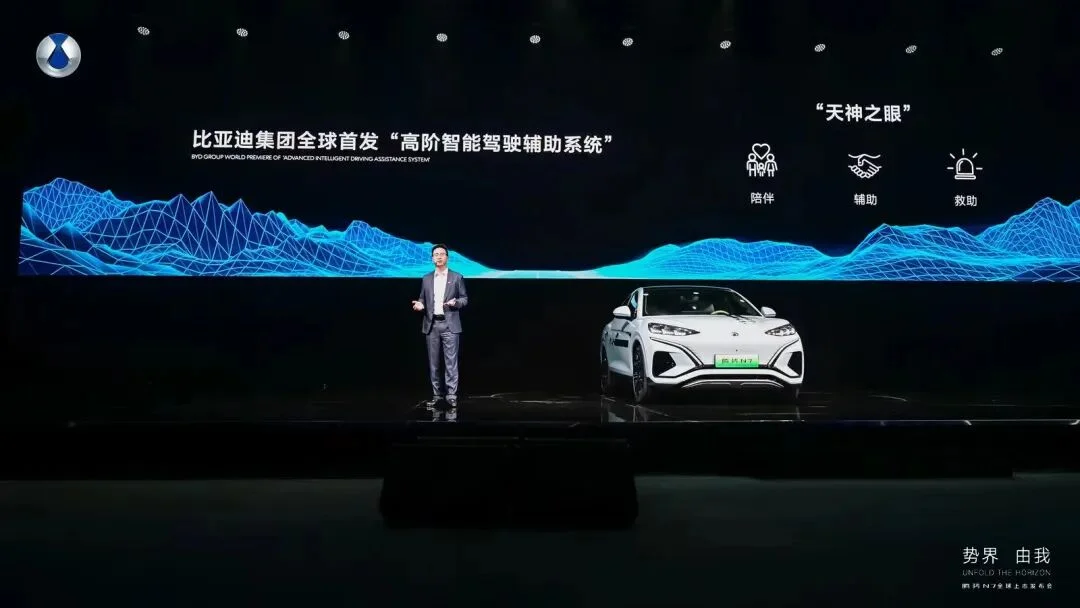
BYD stated that supported by its fully self-developed BOS operating system and in-vehicle computing platform, along with massive data accumulation from large-scale production vehicles, it achieves precise decision control. Additionally, to develop 'Tianshenzhiyan', BYD noted that it invested in a smart driving R&D team of more than 2,000 people, built its own vehicle smart driving experimental center, and persisted in independent research and continuous innovation.
Specifically for the DENZA brand, the DENZA N7 features the global debut of BYD's 'Tianshenzhiyan' high-end intelligent driving assistance system. Based on 'Tianshenzhiyan', DENZA Pilot offers two intelligent driving assistance platform solutions: a standard version and a high-end version.
The high-end version of the DENZA Pilot intelligent driving assistance system includes one NVIDIA Orin-X smart driving chip with computing power reaching 254 TOPS. Perception hardware comprises 33 sensors and one domain controller: 2 LiDARs, 5 millimeter-wave radars, 2 front-facing cameras, 4 side-view HD cameras, 4 surround-view cameras, 1 rear-view camera, 12 ultrasonic radars, 1 OMS camera, 1 DVR camera, and 1 DMS camera.
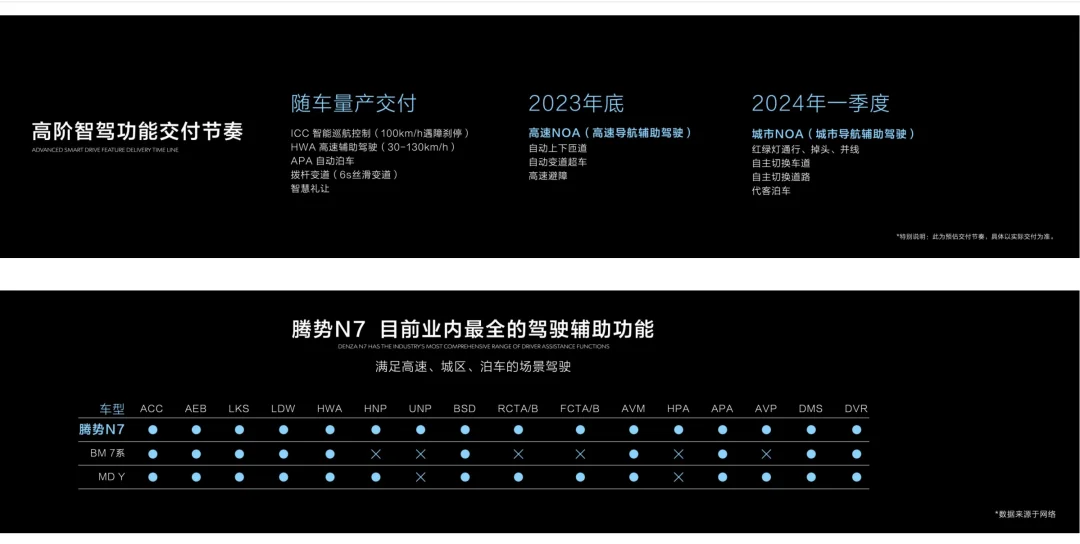
At the launch event, Zhao Changjiang also revealed the software rollout schedule for DENZA Pilot High-End Intelligent Driving Assistance System.
Among these features, the DENZA N7 will be delivered with production-ready basic driver assistance functions such as ICC Intelligent Cruise Control (which includes automatic emergency braking at speeds up to 100 km/h when encountering obstacles). The DENZA Pilot High-End system is scheduled to enable Highway NOA in the fourth quarter of this year and City NOA in the first quarter of next year. According to official statements, it will even achieve the currently most challenging feature: making U-turns at traffic lights.
Notably, buyers can opt for a 'High-End Smart Driving Full Package' that includes both hardware and software for the entire DENZA N7 lineup. Priced at RMB 28,000, it is currently available at a discounted price of RMB 23,000—this effectively represents the cost of the hardware and software for the DENZA Pilot High-End Intelligent Driving Assistance System.
03BYD's High-End Intelligence: Starting in a Red Ocean
Within DENZA's brand positioning, the DENZA N7 is a volume-driven product.
Zhao Changjiang stated that the monthly sales target for the N7 after its launch is between 5,000 and 10,000 units. The reason the target does not go higher is due to production capacity constraints; the maximum output for this year is capped at 10,000 units.
With the delivery of the N7, the combined sales volume of DENZA's D9 and N7 models is expected to reach 25,000 units in October.
To achieve this goal, DENZA N7 has not prioritized profit margins in its product and pricing strategy.
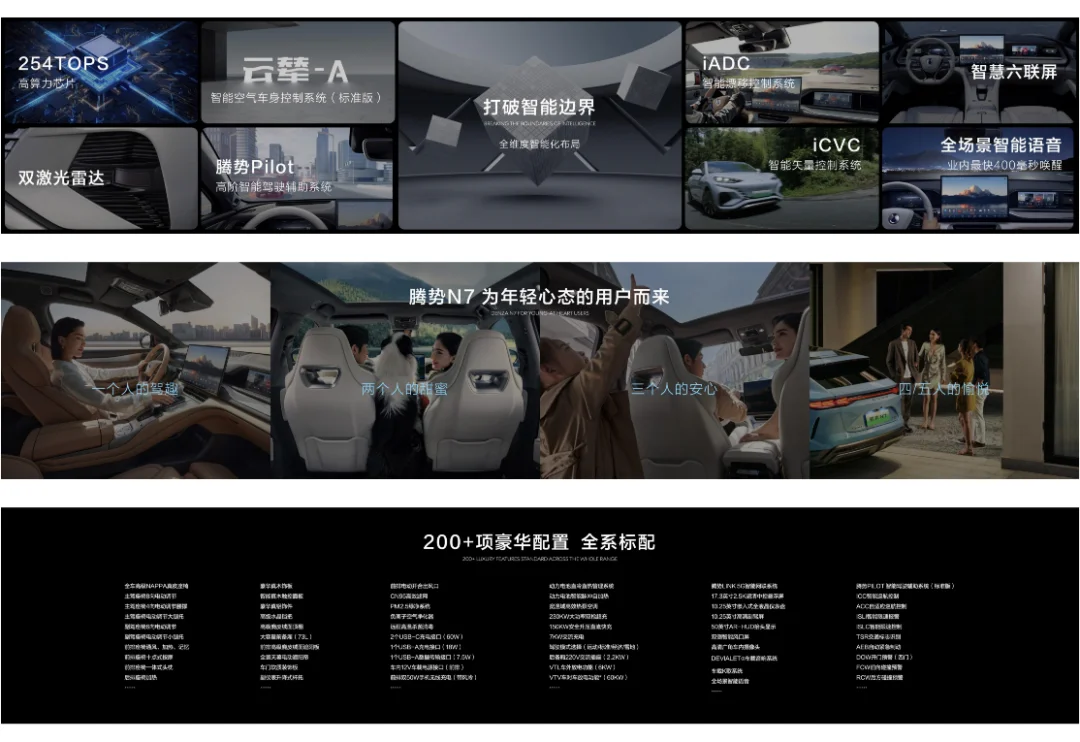
Specifically, regarding product features and pricing, Zhao Changjiang emphasized that DENZA’s logic is to offer competitors’ top-tier specifications as standard equipment on the N7. Furthermore, the vehicle’s gross margin has been set below 10%, with a long-term target of adjusting to 15%. From an external market perspective, this move is highly reasonable.
The strategy for the premium SUV market above RMB 300,000 differs significantly from the logic used to compete with joint-venture brands in the segment below RMB 200,000.
In the new energy SUV market segment where the DENZA N7 is positioned—priced between RMB 300,000 and RMB 400,000—the competition includes core models from emerging automakers such as the NIO ES6, Li L7, XPENG G9, and AVATR 11. These vehicles all demonstrate notable performance in intelligent capabilities.
All these models have already rolled out highway navigation assist. XPENG and AVATR have launched urban navigation assist, while the other two are scheduled to release their urban navigation features within the year.
As a latecomer in this segment, the N7 faces a highly competitive battle.
BYD Chairman Wang Chuanfu has stated on multiple public occasions that the first half of the new energy vehicle era was defined by electrification, while the second half will be driven by intelligence. The DENZA N7’s “Tianshenzhiyan” advanced driver assistance system represents BYD’s first major product launch in this second-half phase.
Regarding specific feature delivery milestones, the DENZA N7 equipped with advanced driver assistance is expected to begin delivering Highway NOA in late 2023, followed by Urban NOA, traffic-light-assisted U-turns, and valet parking features in the first quarter of 2024.
Over the next six months, as more vehicles equipped with urban navigation assist are delivered, user attention to city-level assisted driving will rise incrementally. Consequently, BYD’s second half of its high-end intelligentization strategy begins in a highly competitive red ocean market.
With the rollout of advanced intelligent driving features on the N7, leading domestic new energy vehicle players will officially enter a comprehensive competition in intelligent driving.
We will also provide a detailed review of this system’s actual performance through 42Mark’s assisted driving tests in subsequent articles.
04Conclusion
Compared to the current cutthroat intelligent technology battlefield, good news for the DENZA N7 is that order volumes remain optimistic, and a significant share of the existing market still consists of internal combustion engine vehicles.
Zhao Changjiang revealed that the DENZA N7 secured 25,000 orders during its pre-sale period. Replacement and trade-in users account for 68% of these orders, with more than 55% of them being former BBA owners. Zhao Changjiang’s view on this data is direct: 'The DENZA brand was created to replace traditional BBA fuel vehicles.'
During this media briefing, DENZA also disclosed its product roadmap for the next three years:
By 2025, DENZA will launch a total of seven models, including one MPV, three SUVs, and three sedans. The product lineup will span the RMB 300,000 to RMB 800,000 price range. The DENZA N7 is the first of these three SUVs to be released. The subsequent N8 and N9 models are positioned higher than the N7. The N8 is a six-seat mid-to-large SUV and will offer a plug-in hybrid version.
Before that, the market performance of the N7 will play a crucial role in defining DENZA's brand positioning.
Written by: Willa Edited by: 308, Reinhardt