


What Do Buyers Really Need in a Six-Seat SUV? | 42Talk Vol. 31 Transcript
「42Talk」 is an online chat show produced by 42HOW Auto, designed for new energy vehicle owners. The program aims to help listeners purchase the most suitable new energy vehicles by sharing authentic owner experiences.
42Talk: Discovering the Most Authentic Voice of Car Owners.
Guests for this episode:
Wukong de Weixiao (Smile of Wukong), Shenzhen, AITO M9 & M8 Owner
Wen Tao, Shanghai, Editor at 42HOW Auto, ONVO L90 Prospective Buyer
(For the podcast version, please click "Read Original" at the end of the article to access the "42Talk Channel" on the Xiaoyuzhou APP.)
01Why Buy a Six-Seat SUV?
Laven: Why do people want to buy a six-seat SUV?
Wen Tao:
I have owned both gasoline and electric vehicles. My first EV, purchased in 2019, was the NIO ES6. I later also bought the NIO ET5T and the ONVO L60.
I switched to a six-seat SUV because, although my family has only one child, I felt that five-seat SUVs could not meet our needs in many scenarios.
For example, when taking children and elderly relatives out together, installing a child seat in a five-seat car leaves room for only two more passengers in the rear row. This separates one person from the child, making interaction inconvenient; sitting in the front passenger seat and turning around to interact is also uncomfortable.
In a six-seat vehicle, the second row features two independent seats. A mother or grandmother can sit in the second row while another person sits in the third, facilitating interaction with those in the second row.
This is especially true if a rotating child seat is installed. By swiveling the seat sideways, elderly relatives in either the second or third row can easily interact with and care for the child. Based on this reasoning, I traded in my five-seat car for a six-seat SUV.
Wukong's Smile:
I have two children, so a six-seater is a necessity. My family previously owned two five-seat gasoline cars: one was an Xuefolankeluzi purchased in 2010; later, at the end of 2014, we bought an Audi Q3. Both vehicles had limited space. Now that we have two kids and live with my parents, our need for passenger space has grown significantly, especially for weekend trips or holidays when we return to our hometown.
Laven:
How often do you use the six-seat configuration in daily life?
Wukong’s Smile:
We use it quite frequently. In our household, the front passenger seat usually remains empty. Even when my parents aren’t traveling with us, and it’s just me, my spouse, and the two kids going out, the front passenger seat stays vacant.
My wife finds the front passenger seat too sunny because we’re based in Shenzhen, where the sun is intense. She prefers the second row because the seats are more comfortable and feature privacy glass. With the two curtains drawn, it becomes completely shaded.
One child likes the second row, while the other prefers the third row because they can lie down flat, almost like a bed. Our younger child gets motion sickness easily, so lying down in the back makes them more comfortable. As a result, my front passenger seat is permanently empty.
02Criteria and Concerns When Choosing a Six-Seat SUV
Criteria for Choosing a Six-Seat SUV
Laven: What are your key criteria when shopping for a new energy six-seat SUV?
Wukong de Weixiao:
First and foremost, I prioritize range. My hometown is in Guangxi, but I currently work in Shenzhen, so I frequently travel between the two provinces. For example, every two or three months, I take my children and parents back to our hometown, making range a critical factor.
I opted for the extended-range version because I still have some anxiety about the range of pure electric vehicles. Although charging at highway service areas has become quite convenient, long queues during holidays make it a hassle. Therefore, an extended-range model was my primary consideration.
The second point is safety. I started looking at cars in early 2024, and my top choice for safety was the Woerwo XC90. Later, I heard that Volvo was going to release a new model, the EX90 electric vehicle, which would be equipped with intelligent features such as LiDAR. However, there were no updates on this car, and the plan was eventually delayed until it could be delivered in 2026 or 2027, so I gave up on it.
I then looked at the Li L9. It basically met my needs, and we had even negotiated the price and were close to finalizing the purchase. Around late April 2024, Huawei held the pre-sale launch event for the AITO M9. After reviewing its specifications, I felt it outperformed the Li L9 in several aspects, so I decided to wait for this model. I also considered MPVs, including the VOYAH Dreamer.
Third is space. I did look at the AITO M7, but its six-seat version had limited space, especially in the third row, which felt more like small benches than proper seats.
Another factor is the brand, since cars still carry a certain social dimension, so I also considered brand reputation.
Laven:
Compared to the Li L9, what aspect of the AITO M9 appealed to you most and made you willing to wait for it?
Wukong's Smile:
It’s mainly in terms of intelligence; it has several features that are not available elsewhere in the industry. For example, its projection headlights and its intelligent driving system.
I work in the technology sector, so I have high standards for smart features. Plus, with multiple screens, a child in the back can connect a tablet to achieve seamless multi-screen continuity. These features feel slightly superior to those of Li Auto, which is why I chose the M9.
Wen Tao:
My selection criteria might be different. My first requirement is pure electric. After switching from an internal combustion engine vehicle to a new energy vehicle, both my first car and subsequent ones have been fully electric, so I no longer consider extended-range or plug-in hybrid models. Because these types of vehicles have smaller batteries, requiring frequent charging for daily commuting at home, pure electric offers a better experience for me.
The second factor is long-distance charging needs. When I buy a six-seater, I will definitely take my family on road trips to nearby or farther destinations during weekends or holidays, so I focus heavily on charging speed. Battery swapping has a clear advantage in this regard; since all my previous EVs supported swapping, I never felt anxious about recharging on long trips.
Considering these two points, many brands were already ruled out. Looking at space and price, my budget is around RMB 300,000, which makes the M8 slightly too expensive. Although it will release an electric version later, I was mainly deciding between the Li i8 and the ONVO L90. Given my consistently positive experience with battery swapping, I ultimately chose the L90. Another feature I particularly like about the L90 is its front trunk.
Laven:
For you, is charging speed more important, or is the vehicle's overall range more important?
Wen Tao:
I believe the two are complementary. First, the battery cannot be too small; highway range should be at least around 300 kilometers. Then, combined with the certainty of charging availability and charging speed, the two work together effectively.
Concerns Before Buying
Laven: Do you have any concerns before buying a car?
Wen Tao:
I’m fine with it. My main concern is whether my family members will find it inconvenient to drive such a large vehicle. However, since I work in this industry and often take test drives home, she has driven quite a few large cars as well, so I don’t think that will be an issue.
Wu Kong’s Smile:
My concerns are somewhat similar to Teacher Wen Tao’s. The primary issue is the vehicle’s length; the width is less of a problem. And this concern actually materialized once. I got my driver’s license in 2007, making me a veteran driver with over ten years of experience. Previously, I drove an Audi Q3, which was only four point five meters long and very agile. My muscle memory had long adapted to handling such a compact car.
Later, when I switched to the AITO M9, just one month after taking delivery, I turned the steering wheel too early while exiting a parking space in my residential community. The rear bumper behind the back wheels scraped against a nearby Mercedes-Benz. This was my first accident in nearly ten years, caused entirely by the vehicle’s length. After that incident, I became extremely cautious when driving. Additionally, if there is a large vehicle oncoming or if it’s difficult to exit due to large vehicles on either side, I would ask Xiaoyi to use the assisted driving system to maneuver the car out.
Laven:
Teacher Wen Tao, you’ve tested many cars. Have you encountered any models that, despite their large dimensions, do not feel significantly bulky to drive?
Wen Tao:
I found the Li i8 surprisingly easy to drive, not feeling like a large vehicle at all. With a width of 1960 mm, it is relatively narrow for its SUV class. Its low seating position and short front overhang provide excellent visibility, so it never feels bulky behind the wheel.
Vehicles equipped with rear-wheel steering also offer agile handling. Rear-wheel steering reduces the turning radius; for example, despite its size, the NIO ET9 remains quite nimble to drive.
Wukong's Smile:
I agree. From a driving perspective, I have driven the Li L9, AITO M9, and the previous-generation NIO ES8. In these electric vehicles, you do not feel like you are piloting a large car. The scraping incidents I mentioned earlier were due to physical length limitations, but during normal driving, there is no sense of the clumsiness associated with large internal-combustion-engine vehicles. New energy vehicles excel in this regard.
Another area that frustrates me is storage space. Since I use all three rows of seats regularly, the trunk capacity is indeed limited. For instance, when traveling back to my hometown, especially during Chinese New Year when we need to transport many goods, the trunk fills up quickly, forcing us to stuff items into the front cabin. We might place things in the third-row aisle since children’s legs do not need to be fully extended, or squeeze a small suitcase next to the air vents. Only by maximizing the front space does it become sufficient. Ironically, I feel my previous Audi Q3 had better storage capabilities than the current AITO M9.
Third-Row Space and Trunk Capacity
Laven: Which is more important: third-row space or trunk capacity?
Wukong's Smile:
Third row is more important. The third row has many use cases, such as every weekend family trips where the third row is needed.
Wen Tao:
I don't want to sacrifice either the third row or the trunk; I want both spacious third-row space and sufficient trunk space.
Wukong's Smile:
Yes, it would be best if we could 'have our cake and eat it too.'
Laven:
But a car's length is fixed; making the trunk larger reduces third-row space, and expanding the third-row space shrinks the trunk. Compromises are inevitable.
Wukong's Smile:
So having a frunk is a pretty good solution.
Laven:
Right, so Teacher Wen Tao bought the ONVO L90.
What are your requirements for third-row space? Is it enough for adults to sit comfortably, or just for children, or is bigger always better?
Wukong's Smile:
I think at least adults should be able to sit there with their legs in a normal position. Like when we looked at the AITO M7 before, adults sitting in the third row have very uncomfortable legroom.
Wen Tao:
I feel the third row needs to allow adults to sit comfortably. For families like ours with kids, grandparents are more likely to sit in the third row. If you're going out on a weekend trip, you might drive for two or three hours straight, or if you're heading back to your hometown for Chinese New Year, you could be driving for seven or eight hours a day, and even over ten hours if there's traffic. In those situations, if the third-row space is too small, it would be really tough for the elderly.
Moreover, in Chinese family settings, grandparents often feel sympathetic toward the younger generation and are likely to choose the third row for themselves; therefore, the comfort of the third row is truly important.
Criteria for Choosing a Car Again
Laven: If you were to choose a car again, would your criteria change?
Wukong's Smile:
Currently, range remains the most critical factor. I believe this issue can only be resolved once solid-state batteries are adopted in vehicles, thereby alleviating range anxiety.
Laven:
What range do you think an all-electric vehicle needs to eliminate range anxiety?
Wukong's Smile:
If we go by the CLTC standard, the actual range is over 700 kilometers, which is about right.
Laven:
Have you ever tried NIO’s battery swap? Have you considered battery swapping as a charging method?
Wukong's Smile:
I did consider it when I was looking at cars. It is indeed very convenient in Shenzhen, but when I return to my hometown, there are fewer swap stations. My hometown is a fourth- or fifth-tier small county town, and I travel back and forth quite often. If I have to look for swap stations on the way, I need to plan the route specifically, which is quite troublesome.
03The Most Important Aspect of Large Vehicles
SUVs and MPVs
Laven: Recently, the Li i8 launched. Many people think that from its appearance, it looks like an MPV. What do you think is the difference between an MPV and an SUV?
Wukong's Smile:
I think the main difference lies in the driver's experience. I've looked at the VOYAH Dreamer before, and when I drove it myself, it felt like being a professional driver rather than an owner enjoying the fun of driving.
MPVs tend to feel cumbersome to drive, and their handling is not as good as that of SUVs, although they are indeed very comfortable for passengers.
Wen Tao:
I think this point Teacher Wukong mentioned is a significant distinction: MPVs and SUVs balance the experiences of the first, second, and third rows differently.
MPVs place greater emphasis on the second and third rows, especially the second row. Some needs of the front row (such as driving dynamics similar to those in sedans) are considered secondary; instead, priority is given to the comfort, space, and trunk capacity of the second and third rows.
To accommodate the riding experience of the second and third rows, driving dynamics are compromised. The steering agility, acceleration responsiveness, and overall ease of driving will definitely differ significantly from those of SUVs.
SUVs offer a more balanced approach. They can ensure adequate space for the second and third rows while also maintaining driving flexibility. Some SUVs even provide driving pleasure. That is the key difference between the two.
Laven:
Did you rule out MPVs when buying your car because there are no battery-swap models available?
Wen Tao:
Not exactly. If I had a budget of RMB 500,000 and really wanted to choose an MPV, I might have picked the Li MEGA. It’s not a battery-swap model either, but my main reason for not considering it is that I don’t want to drive such a large vehicle. In daily use, I prefer something I can handle with ease.
I don’t just want to play the role of a driver. Since I’m already thinking about the second- and third-row space experience for my family, I also hope to get some consideration for myself.
Are Refrigerators, Large Screens, and Plush Seats Essential?
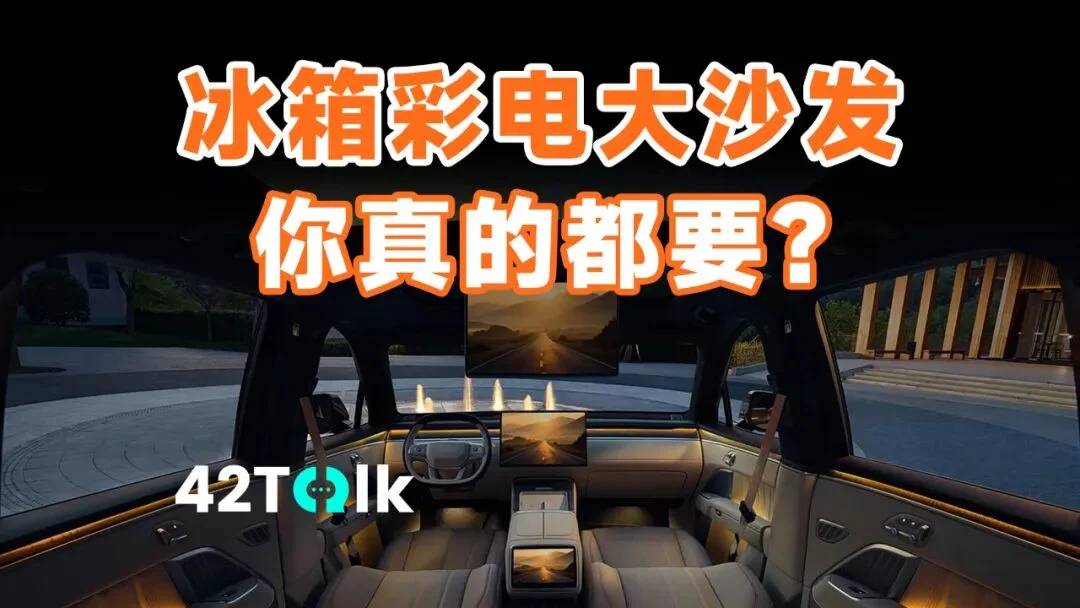
Laven: What do you think is the most important aspect of these large vehicles? Many manufacturers love to advertise refrigerators, large screens, and plush seats. For you as real owners, what truly matters?
Wen Tao:
I believe the most important factor is third-row comfort. Features like refrigerators, large screens, and plush sofas ultimately serve to enhance the comfortable riding experience for family members, meeting their diverse needs during daily travel.
For instance, as Teacher Wukong mentioned, his family dislikes sitting in the front passenger seat; when I drove a five-seater, that seat was rarely occupied.
If three adults with children or two adults with children go out, they are likely to sit in the rear rows to accompany the kids. In this scenario, having a high-quality second-row seat, such as a zero-gravity seat, allows a mother to recline comfortably, watch TV, and keep an eye on the children simultaneously.
Wukong's Smile:
I strongly agree with Teacher Wen Tao’s viewpoint; it is almost identical to mine.
The refrigerator seems to be a lower priority, but the sofa is indeed very comfortable. Moreover, if the rear space is spacious enough, both the wife and elderly relatives can sit in the back to accompany the children, watch TV together, and enjoy a harmonious family atmosphere—that feeling is wonderful.
Laven:
How often do you use your projector?
Wukong's Smile:
Not particularly high. But when using the projector, it’s often not for watching TV; sometimes it’s for blocking out light. Kids can watch tablets, placed on a stand. If two kids want to watch different content, turning on the projector might cause them to fight over what they want to see. With individual tablets, each can watch their own thing without disturbing the other.
"Fridge, color TV, and big sofa" are bonus features, not essentials.
04Li i8 and ONVO L90
Laven: What are your thoughts on the Li i8 and the ONVO L90?
Wukong's Smile:
Both cars are actually quite good, each with its own strengths.
From a personal perspective, ignoring family needs, I really like the Li i8. I appreciate its avant-garde styling, along with Li Auto’s intelligent capabilities, including its autonomous driving system, which is very close in level to Hongmengzhixing. Also, its fast charging speed helps alleviate my range anxiety.
However, the design is somewhat controversial, as aesthetics vary from person to person. My family members, for instance, find the Li i8’s styling unappealing, describing it as rather ugly. Ultimately, you cannot please everyone. But when considering the needs of a family SUV, design ranks relatively low on the priority list. Since we spend most of our time inside the vehicle, exterior appearance matters less; even if I personally dislike the look of Hongmengzhixing vehicles, including the M8 and M9, familiarity sets in over time, and driving comfort becomes far more important.
When comparing the Li i8 and the ONVO L90 in terms of overall family needs, I would lean toward the L90. As mentioned earlier, my primary requirement is storage space. The L90 offers at least a front trunk (frunk), whereas the i8 does not. Additionally, the L90’s rear cargo area appears slightly larger than that of the i8, while interior passenger space is roughly comparable.
Laven:
If you were buying a car today, you would choose the ONVO L90, given its relatively larger space?
Wukong's Smile:
Yes, the space is larger. Furthermore, its design is balanced and conventional, resembling a standard SUV. Most people would likely have no objections; some may find it attractive, others average, but it is unlikely to provoke strong rejection.
With the i8, however, family members may have differing opinions on its looks—some find it attractive while others do not—which can easily lead to disagreement.
Wen Tao:
Both vehicles have their strengths and weaknesses. I believe the Li i8, aside from its exterior design, is actually very well-suited for family use. Its ground clearance is low; although it is classified as an SUV, the clearance is nearly identical to that of a sedan. This makes it easy for children or elderly passengers to enter the second row without much effort, which is quite comfortable. Additionally, the interior detailing and craftsmanship are refined.
However, the i8’s drawback lies in its storage capacity. For short urban trips, it poses no problem. But for long-distance self-driving tours or returning home for Chinese New Year—as Teacher Wukong mentioned, when you need to transport large quantities of holiday goods—the i8’s trunk may be too small, lacking sufficient storage space.
The ONVO L90’s advantage is its front trunk (frunk) and larger rear trunk, providing more ample overall storage capacity. The interior space is not significantly smaller than the i8’s, resulting in a better experience regarding storage convenience.
I would actually like to see these two models combined into one: a vehicle with low ground clearance, spacious interior, and both front and rear trunks. Even if it lacks battery swapping capability, it would be fine as long as there are plenty of 5C charging stations, similar to Li Auto’s network.
Laven:
The ONVO L90 offers electric running boards as an optional feature.
Wen Tao:
Yes, but stepping onto the electric running boards requires leverage. For example, when elderly people or children step up, they may need to pull themselves over the sill. Elderly passengers might also need to hold onto the door frame to get in. However, if the ground clearance is sufficiently low, this issue disappears; you can simply step in and sit down in one smooth motion.
I think the Li i8 might be a better fit for families with elderly members who don't have high demands for storage space; it's actually quite suitable.
Laven:
Aside from these two models, if you were to buy a car now, which one would you choose?
Wukong's Smile:
I might consider the NIO ET9. But it's a bit awkward because I wish it had six seats.
For pure electric vehicles, its battery swapping is indeed an advantage. Additionally, there is still a certain need for social attributes associated with the brand.
Wen Tao:
If the L90 weren't available right now, I might choose the Li i8. But if the budget allows, I might wait for the NIO ES9 or the Xinkuan ES8. The advantages of the L90 are basically covered by the Xinkuan ES8, and the ES8 is larger, offering more spacious second- and third-row seating.
Wukong's Smile:
I wasn't aware of the ES9. If it existed, I would likely choose the ES9, just like Teacher Wen Tao.
Wen Tao:
I think it won't be much larger than the ES8, but it may lean more toward an executive style, somewhat resembling the SUV version of the ET9.
05Q&A
Wen Tao:
Teacher Wukong, I have a question that interests me. You previously mentioned that you care a lot about range. Now NIO is implementing its 'county-to-county' battery swap network, with swap stations being built in many counties; Li Auto's 5C supercharging stations are also proliferating, reaching 3,000 locations.
As these charging facilities become increasingly comprehensive, will you insist on waiting until pure electric vehicles achieve a 1,000-kilometer range before buying one? Or will you accept a smaller battery and shorter range once the charging infrastructure is sufficiently mature?
Wukong's Smile:
That is acceptable. If battery swap stations and 5C supercharging stations are sufficiently numerous—for example, if they are convenient to use, allowing you to swap batteries or find a 5C charging pile without deliberately planning your route—then there would certainly be no range anxiety.
This content is compiled from the podcast program '42Talk'.
Click 'Read Original Text' below to unlock more past episodes.