


From Critic to Owner: Why the NIO ES8 Won Fans | 42Talk Vol.33 Transcript
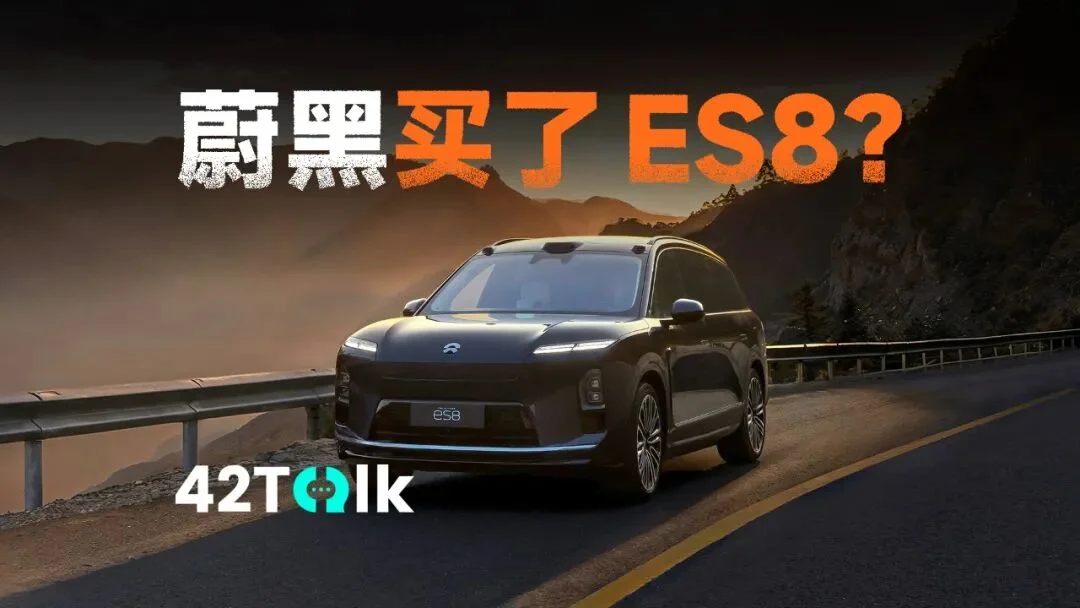
「42Talk」is an online chat show produced by 42HOW Auto for new energy vehicle owners, aiming to help you find the most suitable EV through authentic owner voices.
42Talk: Discovering the Most Authentic Owner Voices.
Guests for this episode:
Lao Cui, Tianjin: NIO ES8 (3rd generation) owner, Tesla Model Y owner, XPENG X9 owner
Xiangyu, Chengdu: NIO ES8 (1st & 3rd generation) owner
Qiran, Shanghai: Editor at 42HOW Auto
(For the podcast version, please click 'Read Original' at the end of the article to access the '42Talk Channel' on the Xiaoyuzhou APP.)
01Why the ES8?
Reasons for Choosing the ES8
Qiran:
The two guests we invited today are both NIO ES8 owners. As we know, the NIO ES8 has been a hit this year. Since its launch, it has garnered immense attention and delivered particularly impressive order figures. When did our two owner guests place their firm orders, and when did they take delivery of their vehicles?
Lao Cui:
I ordered the NIO ES8 just 56 seconds after large orders opened. I took delivery around October 20th, roughly late October, waiting about a month and a half in total. After all, this car was only launched in early September.
Xiangyu:
I placed my order in under two minutes. I took delivery more than 40 days ago, so there was also a wait involved.
Qiran:
Why did you both decide to switch to the all-new NIO ES8? Did you compare it with other models, or was it an immediate choice for the NIO ES8?
Lao Cui:
I originally ordered the all-new XPENG P7. I already owned a XPENG P7+, and since these two are similar in type, with prices around RMB 170,000 and RMB 210,000 respectively, I felt the P7+ had too much of a cheap feel. Wanting something with better quality, I placed my order for the all-new XPENG P7.
Later, my friend sent me a message saying that if the battery rental plan for the NIO ES8 could reach 400,000 yuan, he would go straight for the NIO ES8. At the time, I even told him that if the battery rental plan for the NIO ES8 were 400,000 yuan, it definitely wouldn't sell well. But just two days later, the NIO ES8 officially started pre-sales. My friend sent another message saying that this car's battery rental plan was less than 300,000 yuan.
To be honest, I wasn’t particularly interested in NIO cars themselves. While I’ve always appreciated NIO’s service quality and its battery swap station network, I remained skeptical about its brand and profitability model. However, that price point really shook my resolve. After comparing the XPENG P7 and the NIO ES8, I concluded that the ES8 better suited my current needs.
When people buy a car like the ES8, they usually compare it horizontally with MPVs, such as large six-seaters like the AITO M9 or Li L9. When choosing my car, I didn’t hesitate much; I simply treated those two models as my backup options.
Xiangyu:
I am an owner of the first-generation NIO ES8, likely one of the last batch to purchase it. I took delivery in June 2022, primarily because I needed a six-seat configuration.
Before the launch event for the third-generation ES8, we had planned to add an MPV to our family fleet. I had already paid a reservation deposit for the Zeekr 9X in June or July. At that time, I had not considered switching back to the ES8. As Lao Cui mentioned, I also assumed its price would be at least RMB 400,000.
Later, NIO invited me to Chengdu to attend the pre-sale launch event as a first-generation owner. When the prices were announced, the audience erupted in excitement. I was genuinely surprised that the battery-as-a-service option started at just over RMB 300,000.
As a first-generation ES8 owner, I could apply several benefits toward the purchase, such as six free battery swaps per month, which directly deducted RMB 30,000 from the cost. Combined with a RMB 12,000 loyalty repurchase subsidy, the final price came down to approximately RMB 240,000.
Two days before the official launch event, I sold my old ES8 to NIO's official channel for 15.2w. In effect, I switched to the third-generation ES8 without spending more than 100k.
I also selected the Antarctic Star Blue paint and calipers, along with the NOMI package. Without these options, the price would have been even lower. Including these additions and a RMB 15,000 national subsidy, the total on-the-road cost was around RMB 250,000.
To be honest, the depreciation on trading in my old car was significant, but I found it acceptable. Price was only one factor; the primary reason was that the third-generation ES8 truly addressed our family’s pain points.
With two children now, we mostly used four seats in the first-generation ES8, rarely utilizing the six-seat layout. The manual adjustment of the third-row seats was inconvenient, and the space was cramped. We had actually decided to switch to an MPV. However, after test-driving the third-generation ES8, I found the third-row space vastly improved, and it added a front trunk. Now, I can keep the third row open for long-term use without having to fold it away to save space.
Battery-as-a-Service or Full Purchase
Qiran:
It seems both of you opted for the BaaS version. What drove your decision to choose battery leasing?
Lao Cui:
The main reason is that battery leasing directly reduces the price by 108,000 RMB, which instantly lowers the barrier to entry. If this car cost over 400,000 RMB, I would definitely have hesitated before buying. Now, spending just over 1,000 RMB a month feels negligible to me. I liken this to renting: some people dislike buying homes and prefer paying rent each month, even if it’s purely an expense. Choosing between leasing the battery or buying it outright is simply a matter of individual preference; that’s the first point.
Secondly, leasing helps mitigate various risks. Issues like battery degradation or physical damage are covered under the lease agreement, which includes insurance. For us as lessees, vehicle damage claims exclude the battery, with NIO assuming full responsibility for that component. This provides considerable peace of mind. After weighing all factors, we chose leasing.
Xiangyu:
My reasoning aligns closely with Lao Cui’s. First, leasing drastically lowers the initial cost threshold. Additionally, NIO’s partnership with Bank of Chengdu brings the monthly rental down to 1,068 RMB, which has no significant impact on my finances.
Another point is that my first-generation ES8 was purchased with a battery buyout, but when it came time to sell, I felt that leasing the battery would have been more cost-effective. My habit of using vehicles is to replace them every two to three years; this was the case for my previous four or five cars. Since I cannot guarantee that this new ES8 will last long without being replaced, BaaS (Battery as a Service) is very suitable for me.
Additionally, William Li mentioned during the launch event that the standard ES8 uses the third-generation platform’s 900-volt battery, which should be 120 kWh; this battery version will be released later. The initial monthly rental fee for the first-generation ES8 battery lease was RMB 1,680, which later dropped to over RMB 1,100. I hope that if rental fees decrease in the future, I can benefit from those reductions, and when new batteries are released, I can directly switch to leasing them, making things much more flexible.
Qiran:
Xiangyu just mentioned that when selling the first-generation ES8 previously, was the price difference between the battery-buyout and battery-lease versions actually not that large?
Xiangyu:
The price difference was about RMB 30,000, but after calculating it out, buying the battery outright cost an additional RMB 30,000 to RMB 40,000.
Qiran:
Because many people online discussed before that selling a car with a leased battery would affect its second-hand value, seeing it this way now, leasing the battery turns out to be quite cost-effective from purchase to sale.
Xiangyu:
Because if you buy the battery outright, the entire vehicle depreciates along with the battery when selling a used car, resulting in significantly greater losses.
The Convenience of Battery Swapping
Qiran:
As the previous two speakers mentioned, another key reason for choosing NIO is that battery swapping adds considerable convenience. Do you find battery swapping convenient now? Are there swap stations near your home?
Lao Cui:
First, regarding the 102 kWh battery in the ES8, the coverage rate of third- and fourth-generation swap stations nationwide is not yet high, as this battery was previously dedicated to the ET9. I live in Tianjin, and locally I rarely use swap stations because I have a home charging pile; electricity costs range from three mao to five mao per kWh, which is very cheap. In contrast, swapping in Tianjin costs at least nearly nine mao per kWh, making it two to three times more expensive than home charging. Therefore, for city commuting, I have no need for battery swapping.
But we often travel, such as going skiing in Chongli last week. For long-distance trips, battery swapping is essential. Overall, the swapping experience is quite good, although the price is higher. However, when traveling, one tends to overlook these costs, so the overall feeling remains positive.
Xiangyu:
When I drove the first-generation ES8, battery swapping was my primary charging method—about 99% of the time. This was because I had an entitlement to six free swaps per month, and there were many swap stations near my home, making it very convenient.
After getting the new car, I used up my battery-swap entitlements, so I haven’t swapped batteries in the past forty-plus days. First, there’s a Level 2 AC charger downstairs at home. Second, there is a 600-kW fast-charging station right outside my door. I tried it once: reaching eighty to ninety percent state of charge took just over twenty minutes, which is very fast. Since I haven’t taken any long trips recently, I haven’t needed to swap.
Qiran:
Do you usually swap on the highway or after arriving at your destination?
Lao Cui:
I always swap after arriving at my destination. On our last trip to Chongli, there were two NIO third- and fourth-generation stations locally, but neither had available batteries. In the end, I swapped at a station on the northern sixth ring road in Beijing, which is essentially a city-residential-area swap station. After swapping, I headed straight onto the sixth ring road, so it worked out well.
I noticed that while swap stations are now quite numerous, many first- and second-generation stations do not support this new battery type. We have to wait for later upgrades, so there is indeed an iteration issue at play.
William Li also said that the plan is to replenish batteries at third- and fourth-generation stations around January. However, it remains uncertain whether this will actually happen, as NIO’s current focus appears to be on the ONVO L90, specifically doubling the supply of batteries for the L90 and L60, which has consumed most of their attention.
Xiangyu:
That’s right; they are primarily focused on ensuring delivery volumes at present. When asked this question in person, the response was that priority is given to securing deliveries. In fact, there are still many empty slots for batteries at third- and fourth-generation stations; it is simply a matter of when the batteries can be replenished.
02Product Experience
Highlights of the ES8
Qiran:
When using the ES8, were there any standout features that left a deep impression on you and made you feel the car is truly well-designed?
Lao Cui:
For me, the ES8’s biggest convenience is its front trunk and rear cargo area, which I use frequently. When taking the kids out or when my wife plays golf, the ES8 is one of the few cars I’ve seen—perhaps the only one—that allows you to store a golf bag upright in the sunken rear cargo space without folding down the third-row seats, while still closing the tailgate elegantly.
I also own an XPENG X9. As an MPV, it naturally has ample rear cargo space and can easily accommodate an upright golf bag. However, no other large six-seater models offer this capability; they all require folding down the third row.
Another highlight I love is its sky screen. I really enjoy this display. For instance, the 2.5-generation 5566 equipped with the same Cedar OS lacks this sky screen, resulting in a completely different interior ambiance. I have high standards for such atmosphere, and I didn’t expect the ES8 to deliver so well. This is what makes driving this car most satisfying for me.
The ES8’s themes, desktop canvases, ambient lighting, and their linkage effects with the sky screen are all executed exceptionally well, elevating the overall premium feel. If I were to rate NIO’s aesthetics and design on a scale of ten, I’d give it between 9.5 and 10—it’s truly impeccable.
The evaluation of the ambiance can be rated as top-tier. Every time I get in the car, I feel that sense of prestige, which is better than the first and second generations of ES8, and even more outstanding than the 2.5 generation's 5566, basically giving an ET9-like feeling. Although their vehicle prices differ by nearly double or more, don't look down on this sky screen just because it's not large; its cost might not be that high either, but the experience is truly excellent. This isn't about practicality; it's purely a sensory enjoyment.
Xiangyu:
Lao Cui and I share the exact same sentiment: the quality of the third-generation ES8 is exceptional, and I’ve always appreciated its interior ambiance. I’ve been a fan of NIO for some time. Previously, I drove a Volvo before switching to NIO. When I bought the first-generation ES8 in 2022, despite the product limitations of that era, the ES8 was already considered a very good offering at the time.
NIO’s recent lineup, both in interior and exterior design, demonstrates consistently strong aesthetics. Moreover, regarding originality, NIO significantly outperforms many other domestic automakers. Whether it’s interior design, exterior styling, or the creation of atmospheric details—including the new ES8’s ambient lighting and the sky screen Lao Cui just mentioned—these elements are handled with particular precision.
Lao Cui:
Yes, I should add one more point. The ES8 uses high-quality materials, and the door-closing feel is very substantial. My previous car was an XPENG P7+, whose doors lacked that solid feel compared to the ES8. Although the ES8 has soft-close doors, I now deliberately apply a bit of force when closing them just to hear the sound. That deep, muffled thud feels particularly premium.
I owned a Mercedes-Benz E300 four years ago. Its doors were also heavy, but the closing sound was quite ordinary. In contrast, the ES8’s closing sound is very satisfying when you shut it firmly, clearly demonstrating its robust build quality.
Qiran:
It seems everyone has a high opinion of the ES8. Xiangyu previously mentioned that the trunk space is particularly large, so there is usually no need to fold down the third-row seats for storage.
Xiangyu:
This is because it features a recessed storage compartment. I currently store four camping chairs, a tent bought from the NIO Mall, a folding table from the NIO Mall, and various small cleaning supplies in that space, and there is still room left. With the cover closed, I keep the upper space empty, which is perfectly fine for storing large items like children’s bicycles.
Frunk Experience
Qiran:
NIO’s ES8 also features a frunk. Both the ONVO L90 and the ES8 have highlighted how useful this front trunk is. I’m curious, has it brought you significant convenience in your daily use?
Lao Cui:
The frunk is an essential part of my life. My Tesla Model Y doesn’t come with a power-operated frunk, so I spent over 2,000 RMB to have one retrofitted at an auto parts market just for the convenience. It’s incredibly practical whether I’m grocery shopping, buying seafood, or stocking up at the supermarket.
We usually park facing outward toward pedestrian walkways. Loading items into the frunk makes retrieving them very convenient. NIO states the ES8’s frunk offers ten different opening methods, all of which are easy to use—whether via voice command, knock sensor, button press, or foot kick. I find it highly convenient and use it frequently.
Xiangyu:
I feel the same way. Having never owned a car with a frunk before, I only realized how great this design is after driving the ES8. Two scenarios stand out as particularly convenient: First, there’s a mall near my home with very small, fully occupied parking spots. Previously, getting the stroller required walking all the way to the rear trunk, which was cumbersome. Now, I can grab it directly from the frunk in one step.
Second, we visit Sam’s Club near our home almost every week. In the past, we had to drive the car out just to load groceries into the rear trunk, which was troublesome. Now, we can push the Sam’s cart right up to the front of the car, load the items into the frunk, and leave. The improvement in convenience is substantial.
ES8's Drawbacks
Qiran:
Are there any specific details you feel are still imperfect and could be improved?
Lao Cui:
There are indeed some minor issues, though most are isolated cases. For instance, after I took delivery of my car, the air conditioning failed to heat. Although NIO eventually resolved the issue, the repair process was far from professional. It took four visits to fix the AC problem, spanning ten days from drop-off to pickup.
When I first brought it in for service, I suggested the issue was likely with a valve. Instead, they started by checking the coolant and then the entire AC assembly. When they finally identified the valve as the culprit, they replaced the wrong one before getting it right on a subsequent attempt. It was a frustrating back-and-forth. However, this is an isolated case; most owners haven't experienced this.
Then there are minor issues stemming from driving habits. I insist on using single-pedal mode with maximum regenerative braking, avoiding the brake pedal whenever possible. However, NIO’s system does not allow single-pedal mode to bring the vehicle to a complete stop; at speeds below 10 km/h, you must press the brake pedal to halt. I understand the logic behind this design. Because I rarely use the brake, pressing it occasionally causes squealing noises from the brake pads. I discussed this with NIO, and they advised me to turn off regenerative braking and use the brakes more frequently to wear down the discs. This has been somewhat bothersome, given my preference for single-pedal driving.
Another major issue with this car, which may not be improvable, is the absence of electric running boards. The ONVO L90 has electric running boards, which are very convenient during test drives. Even a model one segment below the ES8 has them, yet the flagship ES8 does not. Moreover, it likely won't be available as an option later on, because there may not have been a reserved mounting position or related tooling design for it.
William Li once mentioned that the air suspension could adjust its height to make it easier for children to get in and out, but adjusting the suspension is entirely different from having electric running boards. For instance, when parking near high curb stops, lowering the car can cause the stopper to wedge between the wheel and the rear bumper, leading to scrapes when driving off. Many owners have posted videos online documenting this issue.
Being able to lower the body and having electric running boards are not mutually exclusive. With two kids at home—one three years old and the other seven—my younger one always struggles to climb into the back seat, which is quite inconvenient.
Xiangyu:
I’ve also encountered issues with the suspension lowering. The 'Comfort and Convenience Entry' feature automatically lowers the vehicle after parking, so I disabled it right after taking delivery of my first-generation ES8. Once, while parked on the side of the road with the door open, the suspension lowered and knocked the door against the curb.
As for the electric running boards, it really depends on personal preference. We don’t have high expectations for them, and they work fine for us.
I think the main issue with this car is occasional software bugs in the infotainment system. I’ve experienced it twice: the screen wouldn’t turn on upon entering the car, and it took a few minutes to recover. However, I believe these issues can be resolved through future OTA updates. Some members of our owner’s group have reported minor issues like rattling noises from the air vents, but I haven’t encountered anything like that yet.
If I had to point out the biggest problem right now, it would be the driver assistance system. Of course, I didn’t buy the ES8 primarily for its autonomous driving capabilities, but given its strong hardware, the software performance is quite disappointing.
Level of Autonomous Driving for the ES8
Qiran:
Xiangyu: Are you using the driver assistance system in urban areas or on highways?
Xiangyu:
Xiangyu: It works fine on highways, but mainly in urban areas. I previously drove an AITO M9 for two to three thousand kilometers. I wouldn’t say it’s fully autonomous driving, but it does help me drive for a while when needed.
For the third-generation ES8’s driver assistance, I think the biggest issues lie in object recognition and lane-change logic. During normal cruising, it’s actually okay. With lane-level navigation now indicating which specific lane to take, if I need to turn right and there are left-turn, straight, and right-turn lanes ahead, the system tends to stay in the leftmost lane until it’s only ten or twenty meters from the intersection before realizing it needs to change lanes. The timing is clearly too late.
That’s a major logical flaw. NIO has also stated that a major version update will address this later, but I feel it may not be easily resolved in the short term.
Lao Cui:
I’m a loyal enthusiast of driver assistance systems. With the ES8’s driver assistance, whether I used it after taking delivery or during the test drive back then, the issues were quite obvious—after all, this was its first-generation world model.
I recall Lihong Qin mentioning at a press event that the second-generation model would be released around late December or in the first quarter of 2026, promising significant improvements. I am quite looking forward to it. At its current level, urban assisted driving is really poor; highway use, however, has no major issues. Some owners have reported that when the system detects blue road signs, the car suddenly brakes hard, dropping speed from 120 km/h to sixty or seventy, which is very dangerous, though I haven't encountered this myself.
The second issue is that NIO's assisted driving performs surprisingly well on low-speed, narrow roads—such as those under 20 km/h that are dilapidated and congested. However, once the speed enters the typical urban range of 20–70 km/h, the performance collapses completely.
I have also experienced the urban road logic issues Mao Ge described, including problems with traffic light recognition and lane selection, which are simply chaotic. On my first test drive, an incident occurred: I needed to go straight through an intersection, assuming any car could do so smoothly, but the vehicle stayed in the left-turn lane intending to go straight. Although the straight lane was full, it did not merge immediately. As its wheels slowly scraped against the left-turn lane, the straight-lane light turned green, yet the car attempted to push forward against the red light for the left turn. I quickly took control of the steering wheel and executed a left turn. This poses a significant safety hazard.
I noticed this problem during the test drive, which lowered my expectations for NIO's assisted driving. With over 1,000 TOPS of computing power and three LiDARs, the hardware and redundancy are more than sufficient to support good assisted driving. The current first version of the world model is indeed subpar, but I remain hopeful about the second version, pending whether it will be delivered on schedule.
Qiran:
Is assisted driving now a key factor in your purchasing decision?
Lao Cui:
It accounts for 90% of my purchase considerations.
Xiangyu:
I don't have high expectations for urban assisted driving, but highway assisted driving is a must.
NIO's Service
Qiran:
When it comes to NIO, many people say its service is excellent. Lao Cui just mentioned an unsatisfactory maintenance experience. Aside from that, how do you feel about NIO's other services?
Lao Cui:
To be honest, regarding service attitude and the final outcome of after-sales handling, I would give it an eight or nine out of ten—it's very good. The main issue lies in the lack of professionalism in the after-sales department; it doesn't quite keep up.
I picked up my XPENG P7+ last August and sold it this October, having driven it for a year. I encountered the exact same problem: the air conditioning could cool but not heat, which turned out to be a valve issue. XPENG fixed it in one day. They told me, 'Brother, the valve is broken. Drive it as is for a few days until the part arrives, and we'll replace it immediately.' And indeed, once I dropped the car off, they finished the repair in a single day.
On the other hand, NIO’s air conditioning repair took four attempts to get right. It’s possible that NIO’s AC valves rarely fail, so technicians encounter this issue infrequently and lack specialized experience; XPENG, by contrast, likely deals with it more often and has become more proficient. We won’t delve deeper into this point.
Overall, I feel there are no major issues with service. Having driven both Tesla and XPENG, I find NIO’s service comparable to theirs—perhaps slightly better—but it lacks the stunning impression of NIO’s peak era. I haven’t experienced its highest level of service; Mao Ge would be in a better position to comment on that.
Xiangyu:
Yes, let me add my perspective. NIO’s current service isn’t as good as when I first bought the first-generation ES8, but compared to the industry today, it remains quite competitive. Many owners simply don’t know how to utilize these services effectively.
Since purchasing my NIO, they launched the home car wash service. Since then, I’ve never washed my car outside again; I always call for the home service.
Lao Cui:
Is this an older service, or is it still available now?
Xiangyu:
You can now treat it as a paid service. It does so much—truly anything you need, like picking up kids or parents. I’ve used it for my parents many times. They live in another city, and when they visit, I simply book NIO Jiaxiang (Premium Ride) to pick them up. I’ve done this over ten times, and the price is reasonable: RMB 100 for the first hour, then RMB 50 for each additional hour.
Moreover, Jiaxiang can even help your children play badminton or table tennis, acting as a temporary coach. Basically, it handles all sorts of errands.
Let’s talk about mobile car washing. There are several tiers, with the top tier costing around RMB 260. You can offset this with points or benefit vouchers, making it very cost-effective. This highest-tier wash is cleaner than the premium detailing services outside, which often charge seven hundred to nine hundred yuan. Two staff members work together, spending four to five hours on the job with meticulous care. Previously, they arrived in vans; now they use Wuling’s compact commuter vehicles, yet still carry fully equipped toolkits to wash your car right in your garage.
I’ll mention another excellent service. I’m not sure if new ES8 owners still have this benefit, but NIO previously offered 12 free annual mobile charging visits. I used it once in 2023, and it left a deep impression. It was Chinese New Year’s Eve, and I had to rush back to my hometown due to an urgent matter. My hometown is a remote small county where there were no charging piles at the time. I placed a NIO One-Click Power order, hoping for the best.
The service was free at the time, and that benefit has now transferred to my new ES8. NIO directly dispatched an Iveco mobile charging vehicle, which drove in from roughly four or five hundred kilometers away. On New Year's Eve night, the charging truck arrived in my hometown more than an hour before I did, waiting there for over an hour. As soon as I arrived, they immediately charged my car and then left.
Later, I learned that without the free benefit, this mobile charging service costs RMB 180 per visit, which is still quite affordable.
Lao Cui:
Yes, new ES8 owners no longer have this benefit; only the original Founders Edition owners retain it. This service is genuinely good and deserves high praise.
03Changes at NIO
Similarities and Differences Between the Old and New ES8
Qiran:
I’d like to ask Xiangyu: as both a first-generation ES8 owner and someone who recently took delivery of the third-generation ES8, what aspects of NIO’s strengths have remained consistent in your experience, and where do you feel the third-generation ES8 has improved?
Xiangyu:
The first-generation ES8 was actually fine to drive; it just didn’t quite fit my current needs. I’ve put over 70,000 kilometers on it. It’s genuinely easy to drive, but only under good road conditions. If the roads are slightly rougher—such as going over speed bumps, especially at an angle—the chassis of the first-generation ES8 really fell short, shaking noticeably. Having driven many cars, I can confidently say its suspension performance was poor when handling speed bumps or small potholes.
But the third-generation ES8 is different. I feel it has completely addressed those chassis shortcomings, offering a much better driving texture. To me, it’s now a pretty perfect car with no obvious flaws.
From the first to the third generation, as I mentioned before, NIO’s design and attention to detail remain excellent—a consistency I find impeccable. The only real difference is that the first-generation ES8 had a smaller body, which indeed didn’t suit my current usage environment. My first-gen ES8 remained enjoyable to drive until I sold it. After more than three years of ownership, the only issue I encountered was a single window regulator failure. Fortunately, NIO offers door-to-door pickup and delivery service; they picked up the car, fixed it within two or three hours, and returned it. Overall, the first-generation ES8 was reliable during my time with it, demonstrating solid quality.
Of course, I've only driven the third generation for over forty days. It's flawless right now, and I hope it stays that way, but I don't know how it will hold up in the long run.
Evaluation of NIO
Qiran:
Lao Cui previously mentioned having some concerns about NIO. Now that you've used it, has your impression of the NIO brand changed?
Lao Cui:
Overall, my impression of NIO is quite positive. Among the new energy vehicle brands like XPENG, Li Auto and Zeekr, I currently prefer NIO the most. I used to criticize NIO heavily—I was even a top hater in various owner groups, with my nickname being 'NIO's Number One Hater.' However, I never criticized its design. Even when William Li said things that some found controversial, I didn't think much of it; businesspeople do marketing, and this is all quite normal.
At that time, the only thing I couldn't accept about NIO was its loss problem. Losing an average of RMB 80,000 per car sold—I really couldn't understand that. At that point, neither the ONVO L90 nor the ES8 had seen explosive sales; this was a problem and risk, mainly making me worry for NIO's owners.
The second point is that its cars are too expensive. I bought the first batch of Tesla Model Ys in 2021, and even with full options, it cost just over RMB 370,000. At that time, the NIO ES6 also cost around RMB 370,000 to RMB 380,000. Judging solely by the vehicle itself, its energy consumption and range could not compare with the Model Y, so why sell it at such a high price? Perhaps its service was indeed unbeatable, but that was something you couldn't feel back then.
With the price drops of the ES8 and ONVO L90, my immediate reaction was that NIO had little left to criticize, and I even began to think quite highly of it. Once I became an owner, I realized its service quality is significantly stronger than most other brands. Of course, compared to the founding edition owners from 2021 and 2022 like Mao Ge, current service levels have undoubtedly declined, but overall the experience remains very good, leaving me with a positive impression of NIO.
Xiangyu:
Before buying a car, I had always been a fan of the NIO brand.
Regarding the issue of losses, I certainly acknowledge them. However, I later learned that NIO keeps all expenditures and losses transparent, and the money lost comes directly from investors' funds.
I cannot guarantee its long-term survival, but at least for this year and next, NIO will be fine. The future depends on how well subsequent models like the ES9 and other refreshed versions sell. As existing owners, we all hope NIO continues to improve.
What truly moves me about NIO—which I may have mentioned several times—is its dedication to independent innovation and the meticulous details in its design. In my view, among domestic automakers, they do this best; their aesthetic standards are impeccable.
Moreover, the female owners of NIO, whether seen in car enthusiast groups or on the NIO App, have exceptionally high appeal. Currently, among those picking up the EC6 and ET5, the proportion of female drivers even exceeds that of male owners, demonstrating the charm of NIO’s design. This extends to the NIO logo and various merchandise, all of which maintain a consistent standard of style.
Lao Cui:
The NIO Mall’s products are also exceptionally stylish. I used to open the Tesla and XPENG apps only when I needed to use my car. NIO is now heavily investing in private domain operations, and both I and the NIO owners around me strongly support this approach.
Mao Ge lost a significant amount of money on his first-generation ES8, yet he was still willing to upgrade to the third generation. This demonstrates the appeal of brand loyalty and design aesthetics, which long-time owners deeply appreciate.
Tesla’s brand power is undeniably strong, but I genuinely couldn’t bring myself to buy another new Model Y. That is the difference in brand influence. While Tesla’s brand power far exceeds NIO’s, it cannot compare to NIO in terms of customer retention.
Xiangyu:
Exactly. Take holiday benefits as an example: NIO has been giving gifts to owners every Mid-Autumn Festival for ten consecutive years, including red wine and gift boxes.
All our camping gear is from NIO. You might say I’m taking advantage of perks, or you could view it as the first-generation owners who paid significantly above market price for their cars finally enjoying those benefits. All these items—stools, tables, kettles, cookware, various-sized tents, and refrigerators—were redeemed using points at the NIO Mall.
Although NIO doesn’t manufacture these items itself and relies on supply chain partners, both the design and quality are impeccable. They may seem slightly more expensive than similar products on the market, but once you start using them, you’ll notice the superior texture.
Expectations for the ES8
Qiran:
Is there anything else you’d like to add about the NIO ES8? What do you think its future holds?
Xiangyu:
Although I don’t have high demands for urban assisted driving, given the powerful hardware provided, I hope NIO can further improve its urban assisted driving capabilities.
We need to acknowledge the gap between NIO and Huawei. While I understand this gap exists, the current performance of urban assisted driving is indeed subpar. Aside from that, I really can’t find any flaws with this car; I just hope its assisted driving gets better.
Lao Cui:
My thoughts are similar to Xiangyu’s, and my expectations and suggestions for NIO are the same.
04Car Buying Advice
Early Adoption vs. Late Discounts
Qiran:
Another topic frequently debated by netizens is whether it is better to buy a car early for the joy of ownership or wait for discounts. What do you two think about buying the NIO ES8: should one act quickly or wait and see?
Lao Cui:
It depends on the timing. Mao Ge and I both took delivery of our cars relatively early, and we have been quite satisfied with them. However, I did have a minor disagreement with NIO regarding my delivery timeline. I placed my firm order 56 seconds after it opened, expecting delivery within 25 days, but ended up waiting 45 days. That said, I fully understand NIO’s situation; they have never produced this many vehicles before. As William Li himself put it, he has never fought such a prosperous battle.
The same applies to XPENG. When I ordered the XPENG P7+ last year, it was already considered a semi-hit model, and XPENG had not experienced such high demand either. This situation will improve as production lines expand and supply chain coordination becomes more mature. Recently, there was controversy over alleged downgrades regarding the Type-C and video interfaces of the ES8, which were essentially issues related to supplier coordination.
I hope NIO continues to improve. Personally, I still believe in buying early. To be honest, the price of approximately RMB 280,000 to 290,000 is already very attractive. I estimate that by late 2026 or around April–May 2026, the only differences might be an additional five-year interest-free financing policy or, if sales are sluggish, a free one-year battery swap voucher. I do not believe the NIO ES8 will see further price cuts; its profit margins are already compressed to the limit, leaving no room for reduction.
Xiangyu:
Since we’re on the subject, I’ll add a quick note: I’m fairly familiar with the used-car market. You can say my first-generation ES8 lost a lot of value, but I believe the third-generation ES8 will have the best resale value among all NIO models.
The price of the first-generation ES8 has already hit rock bottom. I sold mine for RMB 152,000; in three years, its price will likely be around RMB 70,000 to 80,000 and won’t drop further. At that price point, a first-generation ES8 is highly attractive in the used-car market.
As for the second-generation ES8, you can now buy a nearly new one with a battery purchase option for about RMB 230,000 to 240,000. The third-generation ES8, whether new or used, will see minimal price fluctuation. After all, used-car buyers don’t focus solely on NIO; given the market competition, its price won’t sink further, so its resale value will remain relatively strong.
As I just said, the third-generation ES8 really has no room for price cuts; prices are likely to remain stable at this level for a long time. For example, current orders are already scheduled through April 2026, so there definitely won't be any preferential policies before April 2026.
Beyond April, sales performance for customers who no longer need to wait is hard to predict. With vehicle updates happening so rapidly, other brands may launch better, more cost-effective models to capture market share—this remains uncertain. But in the short term, prices won’t drop.
Lao Cui:
In December 2025, automakers’ sales data were generally poor. December has historically been a sales highlight, as it’s the final quarter of the year when companies push for annual targets. Brands that typically sell 30,000 units monthly usually aim for 35,000 to 40,000 units in Q4. However, NIO’s November deliveries were weak—I believe they exceeded 30,000 units—and December will likely be even tougher across the industry.
Competition in 2026 will be fierce. Despite favorable factors like tax exemptions in 2025, sales were still lackluster. Competition in the large SUV segment will intensify significantly, with many new models yet to be launched. I estimate NIO might offer at most three or four years of interest-free financing, but outright price cuts are unlikely. They might instead provide optional feature credits, such as NOMI-related packages.
This content is compiled from the podcast program "42Talk"
Click below to unlock more past episodes