


Talking to Li Auto Owners: Does It Really Matter Whether You Choose Range-Extended or Pure Electric? | 42Talk Vol.34 Transcript
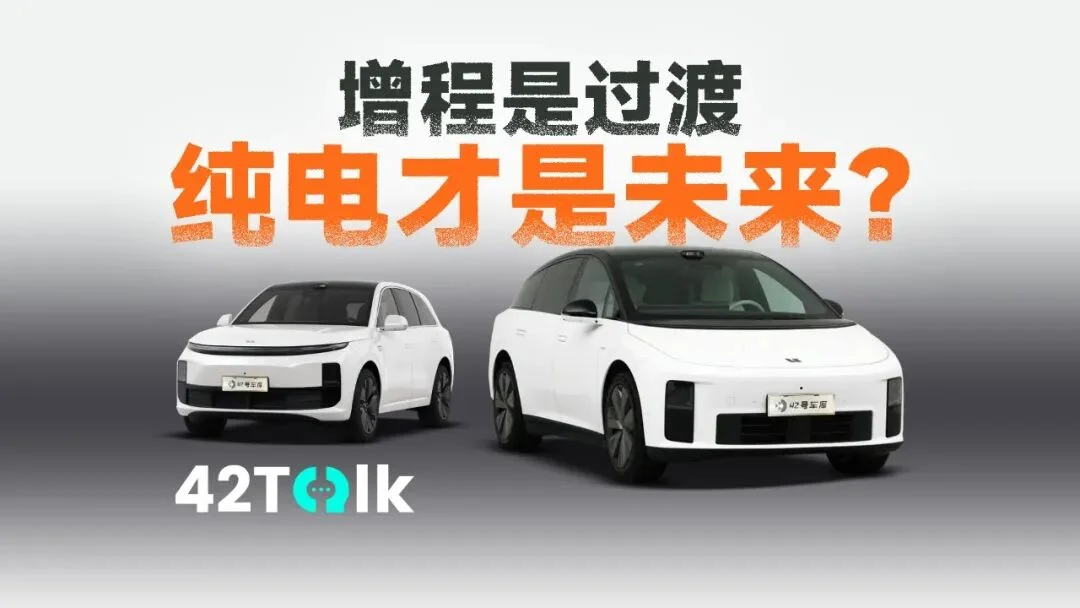
"42Talk" is an online chat show produced by 42HOW Auto for new energy vehicle owners. We hope the voices of these real owners can help you choose the most suitable new energy vehicle.
42Talk: Discovering the Most Authentic Owner Voices.
Guests for this episode:
Luo Bo, Hangzhou, Zhejiang, Li Auto L6 owner
Mr. Zheng, Shaoxing, Zhejiang, Li Auto i6 owner, Li Auto L9 owner, former Li Auto ONE owner
(For the podcast version, please click "Read Original Text" at the end of the article to access the "42Talk Channel" on the Xiaoyuzhou APP)
01Comparing Car Purchases and Usage
The Biggest Pain Point of Buying an EV
Luo Bo:
I bought my L6 in June last year, so it has been less than a year.
When I was buying the car, I compared both pure electric and extended-range options. Based on my needs, I had two main concerns.
First, I take a long-distance road trip once a year, and I worry about charging on highways during holidays. Second is the lifespan of lithium batteries. I am not sure how long the current generation of batteries lasts—for example, whether they only last six or eight years. Battery capacity directly affects the resale value of the car several years from now. Even if I do not sell the car, the cost of replacing the battery later is something I care about deeply.
Mr. Zheng:
I reserved my i6 when it launched last year and picked it up on November 1. I am also an L9 owner, and I previously sold my Li Auto ONE. The Li Auto ONE was my first EV. At the time, I felt it offered higher specifications and stronger performance than gas cars at the same price point. Ultimately, I valued cost-effectiveness; I believe EVs offer slightly better value for money than gas cars.
Lü Liang:
Did you have no concerns about the battery at all?
Mr. Zheng:
I didn’t have any concerns and didn’t give the battery much thought. I felt its pure-electric range was sufficient for my daily needs, plus my Li Auto ONE came with a lifetime warranty. I did look at pure-electric vehicles back then, but they were still quite expensive. A model that met my requirements cost nearly RMB 500,000, and its range performance wasn’t quite up to par.
I tend to drive aggressively on highways, so the pure-electric models available at the time didn’t fit my usage scenario well, which is why I chose an extended-range vehicle. Now, however, pure-electric models can fully meet my needs, so I’ve switched from extended-range to pure-electric.
Why I Bought an Extended-Range Vehicle
Luo Bo:
First, there’s a prerequisite: when I bought my car, the Li Auto i6 hadn’t been released yet. If it had already launched, I might have hesitated.
I’m not originally from Hangzhou, though I currently live there. I return to Shandong every year to visit family, a one-way trip of roughly 700 km via the notoriously congested Beijing-Shanghai Expressway. In the past, seeing electric vehicles queuing at highway service areas for charging always gave me anxiety. That route is incredibly busy, and 700 km just exceeds the range of most pure-electric models.
Additionally, I enjoy traveling and take road trips frequently. While I can accept a pure EV for non-holiday travel, having the option to refuel with gasoline is more convenient and allows for greater flexibility in itinerary planning, without needing to specifically schedule charging stops.
Another point is that at the time, the i6 had not yet been released. Based on its specifications and pure electric range, I would have been able to accept it. What I did not anticipate was that after the i6 launched, the cost-performance ratio of the pure electric version ended up being higher than that of the extended-range version.
Lü Liang:
Given that the i6's pure electric range still cannot cover your essential 700 km trip, are you still willing to accept it?
Luo Bo:
If I only need to charge once during the journey, I can accept that. Considering its cost-performance ratio, doing this just one or twice a year is fine; if necessary, I can simply exit the highway to charge.
Lü Liang:
Based on the current situation, it seems you are able to accept a pure electric vehicle.
Luo Bo:
If the actual pure-electric range on the highway were 500 km, I could charge once anywhere in the 400–500 km range and make it home. That would work for me. Highway range drops significantly, so I have to account for real-world conditions. For example, during Chinese New Year trips to visit family, if the weather is cold and I’d need to charge twice, that would be unacceptable.
Why Buy Pure Electric
Mr. Zheng:
The reason I chose pure electric is actually quite similar to what Luo Bo said. For trips of six or seven hundred kilometers, even if they go a bit farther, charging once or twice is enough. If there is 5C supercharging, the charging speed will be even faster. And since you naturally need to stop at service areas to rest and use the restroom, that time can easily cover the charging duration. I think it's quite convenient.
However, charging during holidays remains inconvenient. When I drove my L9 to Jinan for Chinese New Year, I noticed long queues at service area chargers. For daily travel, especially on slightly longer routes, I now drive the i6 instead of the L9. This also lowers costs, since charging is cheaper than refueling.
I previously owned a small pure-electric vehicle, but it wasn’t suitable for long-distance driving. I replaced it with the i6. Now, for family trips and road trips outside of peak holiday periods, I can rely on the i6. That’s why I chose it.
Lü Liang:
You’re quite representative. It seems you’ve fully transitioned from range-extended vehicles to pure electric ones, even a step ahead of Luo Bo. Luo Bo’s next move is likely to be exactly this one.
Luo Bo:
That’s very possible.
Mr. Zheng:
However, during holidays, I would still choose the L9 for travel. If the queues are too long, it can indeed be inconvenient.
Comparing Range-Extended and Pure Electric Vehicle Usage
Lü Liang:
Mr. Zheng just mentioned that he uses a pure electric vehicle for daily driving and the L9 (range-extended) during holidays. In your daily use, such as comparing the L9 and the i6, do you have any insights regarding usage scenarios, driving mileage, and costs? How significant is the difference between the two?
Luo Bo:
I rarely use fuel for my daily commute. My round-trip distance is about thirty kilometers, so I mostly drive in pure electric mode. During holidays, highway charging costs are relatively high. I once paid around one point eight yuan per kilowatt-hour (kWh), which brought the cost per kilometer to roughly the same as using fuel—about five mao. On highways, electricity costs approximately three to four mao per kilometer, which is not significantly different from fuel costs.
In urban areas, I haven’t conducted specific comparisons or kept detailed data, but since I have a home charging pile installed, I still habitually charge before trips.
Lü Liang:
So how often do you charge? Every few days, or do you keep it plugged in daily?
Luo Bo:
My daily round trip is 35 kilometers. In summer, I charge about once every five days; in winter, about once every two days.
Lü Liang:
Is refueling really that rare for you?
Luo Bo:
Refueling is very infrequent. Since buying the car, I’ve only filled up three or four tanks of gas. It’s true that I only use fuel when taking long trips.
Lü Liang:
In that case, the i6 actually seems to suit you better. You’re essentially using the L6 as a pure electric vehicle. Like Mr. Zheng, Luo Bo also only uses fuel on highways. As an owner of both models, Mr. Zheng can provide a more direct cost comparison.
Mr. Zheng:
Yes. However, even with the L9, I mostly used it in electric mode. Aside from long trips, my usage pattern was similar to Luo Bo’s: fuel was only needed for self-driving tours. In terms of cost, the i6 is relatively cheaper because its energy consumption is slightly lower. The L9 has higher energy consumption, which is expected given its larger body size.
When I drove the L9, I plugged it in every day. Sometimes the next day’s itinerary was uncertain, and if I needed to drive further, having half a battery the previous night might mean resorting to fuel the next day. So, I made it a habit to charge fully daily. I rarely used fuel, except during self-driving tours.
Lü Liang:
From a maintenance perspective, I believe the i6 has an advantage.
Mr. Zheng:
The i6 is particularly low-maintenance. I checked, and it only requires a brake fluid change at 80,000 kilometers. For the cabin air filter, I buy them on Taobao and replace them myself—it’s very simple. The L9, however, requires more frequent servicing, with annual maintenance checks.
Luo Bo:
I believe a minor service costs around RMB 799, while a major service is about RMB 929. A minor service must be performed at least once a year.
Mr. Zheng:
That’s right. It’s mandatory once a year, regardless of mileage.
Luo Bo:
I’ve owned my car for less than a year. The manual previously stated that maintenance costs approximately RMB 799 per service, scheduled annually regardless of mileage. I find this requirement unreasonable. However, I understand that the new generation range extender allows maintenance to be based on the extender’s operating hours, which would be more logical. Currently, even if the engine hasn’t been used much, you must still go for maintenance once a year.
Lü Liang:
Compared to traditional internal combustion engine vehicles, I feel these cars are easier to maintain overall. Whether it’s a range-extended electric vehicle (REEV) or a pure electric vehicle (BEV), there are fewer maintenance items required.
Luo Bo:
Primarily, I believe the range extender’s engine operates under lower load because it does not directly drive the wheels. This results in less wear and more ideal operating conditions. Therefore, I view its maintenance as merely procedural, without needing the rigorous attention required for conventional gasoline cars.
02Used Car Resale Value
Resale Value of New Energy Vehicles
Lü Liang:
There is a serious question regarding electric vehicles: their resale value. Given that EVs are updated so rapidly, how do you view depreciation?
Luo Bo:
I don’t have high expectations for resale value. We can look at the Li Auto ONE from five years ago, along with other EVs from that same period; their current residual values are abysmal, so I never expected much to begin with.
Another worry is that in six, eight, or even ten years, the car might end up as scrap because battery degradation will make it difficult for future buyers to feel confident purchasing a used unit.
Lü Liang:
You are primarily concerned about battery longevity.
Luo Bo:
It mainly comes down to battery lifespan and the high cost of replacement, which can exceed the value of a used car.
Lü Liang:
So how did you convince yourself to buy an electric vehicle?
Luo Bo:
I told myself not to consider resale value as a factor in buying a car. If I plan to change cars in three years, then resale value doesn't matter; if I intend to keep it for five or six years, I just treat it as driving it until it's scrapped. That was my mindset at the time.
Lü Liang:
So you essentially bought it outright. Mr. Zheng is more representative: didn't you just sell your Li Auto ONE?
Mr. Zheng:
I sold my Li Auto ONE quite some time ago.
Resale value isn't a major concern for me; what matters most is whether the car fits my driving needs.
The resale value of the Li Auto ONE was decent at the time. In June 2022, I went to see the Li Auto L9 and felt that the L9 would definitely sell well, which would then affect the resale value of the Li Auto ONE. So, before the L9 actually started deliveries, I sold my Li Auto ONE.
At that time, news about the discontinuation of the Li Auto ONE had not yet been released. I had driven it for two and a half years, covering more than 70,000 kilometers—a relatively high mileage—and still managed to sell it for over RMB 230,000. It originally cost RMB 328,000, so that’s a bit more than a seventy percent retention of its original price.
For that mileage, I found the second-hand price acceptable.
Lü Liang:
In other words, I didn’t lose money on it.
Mr. Zheng:
Not a loss. The L9’s resale value was comparable to that of the Li Auto ONE from the same period. I checked secondhand prices after driving it for about two and a half years, and they were decent. Compared horizontally with other cars from that timeframe, the L9’s resale value wasn’t bad; I found it acceptable. At the time, it could still fetch around RMB 270,000 to RMB 280,000, roughly six-tenths of its original price.
But at that time, whether it was EVs or ICE vehicles, resale values were all declining because prices for all cars were going down. So, I felt the retention rate was still acceptable.
When it comes to resale value itself, I don’t actually pay much attention to it. I believe that if you buy a popular model, the resale value should be fine, as long as you avoid niche models. I previously owned a niche car, a Smart #1, and its resale value was terrible. It cost about RMB 230,000 when I bought it. After driving just over 20,000 kilometers, the appraisal came in at just over RMB 90,000. I sold it last year, meaning I got slightly more than four-tenths of the original price. However, this car had been involved in a minor accident before.
So, I think as long as you buy a popular model, the resale value will generally follow the overall market trend and won’t be exceptionally low. Even if it is low, it’s likely because the entire market’s resale values are declining.
Lü Liang:
Vehicles with large ownership bases can maintain their overall value better, whereas niche models are hard to predict due to a lack of reference points.
It seems everyone places less emphasis on resale value and focuses more on the product, experience, and personal needs.
Luo Bo:
Yes, because a car is not an investment asset.
Why Are Automakers All Building Extended-Range Electric Vehicles?
Luo Bo:
I think it’s less that many automakers have started making extended-range electric vehicles (EREVs) and more that most automakers’ existing product lines are already well-established. If they want to find incremental market growth, they must expand their coverage to reach owners who are not yet ready to accept pure EVs, or owners like me with specific long-distance travel needs.
When the existing product line is already quite complete, launching a new product line is certainly the most convenient way to seek incremental growth. I don’t think these automakers starting to make EREVs are necessarily more optimistic about the EREV technology itself; I believe they are mainly looking to expand their product portfolio.
Mr. Zheng:
I’m not very optimistic about EREVs because I currently have no interest in them. I bought a pure EV myself, and my family also has an EREV. Since my driving needs can be fully met by a pure EV, I haven’t paid much attention to other automakers’ newly released EREV models, regardless of their pure-electric range or configurations. For me personally, I’ve stopped paying attention to EREVs.
Lü Liang:
You’ve moved into the next phase, having fully accepted pure electric vehicles in your mindset as a former extended-range user.
Mr. Zheng:
It’s not necessarily about moving to a new phase; for my current needs, I find pure electric vehicles more comfortable. Many people don’t truly understand their own usage requirements. I asked several friends who were considering buying an Li Auto, and their long-distance self-driving needs are far less frequent than mine.
I go on long-distance road trips more than twice a year and often go camping, covering significant mileage. My friends, however, mostly drive for commuting. For them, a pure electric vehicle is more than sufficient. But since they switched from internal combustion engine cars, they need an adaptation period. They feel that being able to refuel offers more security, believing that having a fuel tank in an extended-range vehicle provides greater peace of mind, and they are unaware of how fast modern charging has become.
Once, I took a friend to experience 5C supercharging. After trying it out, he no longer wanted to buy an extended-range vehicle.
Lü Liang:
If you tell them the actual driving range and how quickly a single charge takes, they may waver and decide there’s no need to refuel anymore. Luo Bo might be exactly the kind of friend you’re describing, given that his driving scenario consists primarily of pure electric commuting.
Luo Bo:
For me, the primary factor is a genuine need for long-distance travel of around 700 km, often during holidays or the Spring Festival.
Running an EV on long trips isn't impossible. As we discussed, you have to stop for restrooms and meals anyway, so you can use that time to charge. However, the biggest hassle with EVs is queuing for chargers. The low turnover rate means I have to wait, and I can't leave the car while waiting.
It's not that it can't be done, but it adds complexity to the journey, and I'm unwilling to accept that inconvenience. Therefore, when choosing a car, a range-extended electric vehicle (EREV) is a better fit for me. But this is based on personal needs; there is no absolute 'better' option.
Lü Liang:
Exactly. There's no absolute best choice; it depends on your needs. Luo Bo, have you experienced 5C supercharging?
Luo Bo:
I later test-drove the i6 and i8, and the salesperson also showed me the 5C superchargers. They are indeed very convenient. However, the test drive took place on a weekend, which is an ideal scenario where charging is fast. I'm unsure whether, during my actual travel times at highway service areas, I would achieve such charging speeds, or even find an available charging spot.
Mr. Zheng:
On high-speed charging, I drive the L9 during Spring Festival trips. The i6 has only been used on highways for short trips within the Jiangsu-Zhejiang-Shanghai region.
Ideal’s superchargers are relatively common in this area. At less busy service areas, you can plug in and charge at high power directly, which is indeed fast. Once, at the Jiaxing Service Area, I saw an i8 charging at a 5C pile while the other three were 2C piles. A MEGA was also charging nearby, along with another vehicle. Under these saturated conditions, my charging power dropped to just over 170 kW.
Although the speed isn't slow compared to ordinary charging, after experiencing speeds of over 400 kW, it feels somewhat slow and requires waiting a bit longer. Normally, for trips of five or six hundred kilometers, a three- to five-minute charge suffices. During that period, however, I had to charge for more than ten minutes, reaching only 50%–60%, which was barely enough to drive home.
Lü Liang:
There is still a gap between saturated states and ideal conditions.
Mr. Zheng:
Indeed there is. The daily user experience is certainly good, but it drops significantly during holidays. Therefore, I also drive the L9 for long-distance travel during holiday periods.
Lü Liang:
Ultimately, for long-distance travel, the key is to build more charging stations.
Mr. Zheng:
The infrastructure is still insufficient. On my recent trip to Jinan, there were very few Li Auto supercharging stations on the Beijing-Shanghai Expressway stretch between Jiangsu and Shandong. Although marketing materials highlight a large number of stations, they are not dense enough on these specific routes.
Currently, 4C and 5C superchargers are widely available in cities, with many located near workplaces and homes. However, the expansion into highway networks feels slower. Last year, when I traveled through Guangxi and Hunan, there were also very few Li Auto superchargers. The coverage is dense in eastern developed regions but sparse in remote areas.
Having plenty of chargers in cities is indeed convenient, but most urban drivers rely on home charging.
Lü Liang:
Charging in cities is no longer a major issue; you can find spots at shopping malls everywhere. The real necessity is solving long-distance needs. I agree that building more highway stations is more urgent. Slow chargers only increase anxiety, whereas fast chargers like those supporting 5C standards can alleviate this anxiety and improve the holiday travel experience.
Mr. Zheng:
As long as the average charging power reaches 180 to 200 kW, turnover rates will increase significantly. Many current vehicles only support charging powers of 50 to 60 kW.
Lü Liang:
Many vehicles still cannot support fast charging. They use older 1C batteries, which deliver only tens of kilowatts even when connected to a 5C supercharger.
Therefore, development and technological upgrades are necessary, and trade-in subsidies should continue.
03Pure EVs Are the Future
Is Extended-Range a Transitional Product While Pure EVs Represent the Future?
Luo Bo:
I believe this question should be viewed from two perspectives. First, regarding the product itself: its existence is driven by demand. Whether it is transitional depends on whether that demand disappears. As long as some consumers remain dissatisfied with current charging experiences, extended-range vehicles will persist.
From a technical standpoint, I don't think we can define pure electric vehicles as the future. A battery is merely an energy storage device. If you draw an analogy, it corresponds to the fuel tank of an internal combustion engine vehicle, not the engine itself. The engine is an energy conversion device, whereas a battery is an energy storage device.
In the short term, when batteries become large enough to meet many needs, that will suffice. But looking further ahead—for instance, with nuclear fusion power—it won't drive vehicles directly; it will certainly be in a range-extended form. Hydrogen power also functions as range extension, whether it's hydrogen-based or nuclear fusion-based. That is my understanding.
From a product perspective, as long as there is demand, range-extended electric vehicles (REEVs) will always exist. The mission of REEVs ends only if and when pure electric charging and range can satisfy everyone. Looking even further into the nuclear era, we will likely return to the range-extended model.
Lü Liang:
For now, the forms closest to us are still traditional fuel tanks and pure electricity. Broadly speaking, hydrogen energy and nuclear fusion are indeed greener. Currently, much of the electricity for pure EVs comes from coal-fired power plants. Compared to pure electric vehicles, these alternative technologies have different product definitions.
Luo Bo:
That is a separate topic for discussion. Regarding the range-extended technology itself, I believe it still has significant potential for use.
Lü Liang:
Yes. So, Mr. Zheng, what’s your take?
Mr. Zheng:
I think the debate that 'range-extended electric vehicles (EREVs) are a transition and pure EVs are the future' is manufactured by automakers. Individual consumers don’t need to worry about it. You should only consider your own driving scenarios and needs. If an EREV fits, buy an EREV; if a pure EV fits, buy a pure EV. Don’t worry about whether it’s a transition or the future. I don’t pay much attention to these things. Ultimately, it comes down to whether the car meets my driving needs and its price.
Lü Liang:
Actually, I understand this as a form of anxiety. As Luo Bo mentioned, when buying a car now, people worry about battery lifespan in three to five years or even eight years. This rhetoric creates another concern for those same timeframes: 'What if I buy an EREV now, but pure EVs become mainstream in a few years?'
Mr. Zheng:
It doesn’t matter. The reason I didn’t buy a pure EV back then was because they were expensive and had poor range at the time. I wouldn’t buy a pure EV that isn’t suitable for me right now just because 'pure EVs are the future.' If you know clearly that another technology better suits your current needs, buy that one. Don’t worry about whether it's the future.
Luo Bo:
I agree with Mr. Zheng: many of these concepts are marketing hype and anxiety manufactured by public opinion. Even if pure electric vehicles (BEVs) represent the future, the BEV you buy today is not necessarily that future. Future BEVs will far surpass current models in terms of range and charging speed. The car you choose now cannot receive automatic software upgrades, so it will inevitably become obsolete.
Instead, let’s compare products available for purchase right now rather than considering future models, since we can’t buy those yet.
Lü Liang:
Exactly. If there’s a suitable option today, buy it. If better options emerge in the future, we can reassess then; there’s no need to limit our choices today based on hypothetical future products.
How to View Large-Battery Extended-Range Vehicles
Lü Liang:
Pure electric range has evolved from being considered sufficient at 300 km, to 400 km, and now many BEVs offer 500 km, 600 km, or even 700 km. Domestic BEVs have indeed become increasingly competitive.
As BEV ranges improve, more people are considering them. However, extended-range electric vehicles (EREVs) are also active, increasing their battery sizes. With many large-battery EREV models launching this year, how do you weigh the choice between large-battery EREVs and pure BEVs?
Luo Bo:
If I had to choose between a large-battery extended-range electric vehicle (EREV) and a pure electric vehicle (BEV), the powertrain type isn't my top priority; the product itself matters more. Based on my personal usage, as long as the BEV range exceeds 500 km, it almost completely covers all my needs. The extra battery capacity and fuel tank beyond that 500 km mark are just backup power sources for me, so they aren't important.
Lü Liang:
So, if a BEV could cover your 700 km trip, you wouldn't buy an EREV?
Luo Bo:
Not necessarily. It wouldn't matter whether I bought one or not. If the EREV offered better value for money, or if the car I preferred happened to be an EREV, I would buy it. I don't insist on a BEV, but I'm not opposed to an EREV either.
After driving this EREV, I've been wanting to switch my wife or father to a BEV, but neither of them is very receptive. My wife currently drives a Volkswagen Golf. I wanted to get her a NIO Firefly, but she didn't like the look; she wasn't keen on the Geely Xingyuan either. Her daily routine consists of commuting, grocery shopping, and picking up the kids. She has no specific requirements regarding the powertrain—anything works. My father still drives a Ford Edge. He's too lazy to switch, and since he doesn't drive many miles per year, his habits are already set.
I think people in our demographic are more willing to experience new energy vehicles and upgrade their cars. But for those with lower demands, like my wife, or those who aren't early adopters, like my father, there's no urgency to consider EREVs or BEVs. They will likely keep driving their current cars until they can no longer run.
First, they care more about whether the brand is well-known and not some obscure label. Second, as long as the car can handle their daily commute, they don’t care much about tech features or autonomous driving. For them, a pure EV is perfectly suitable. If you mention extended-range vehicles (EREVs), they find it complicated—having to refuel, recharge, and perform maintenance.
Lü Liang:
I feel Luo Bo is very similar to Mr. Zheng’s friends who are considering switching from gasoline cars to pure EVs.
Luo Bo:
I might be in the same state as him when he first bought the Li Auto ONE. He suddenly transitioned from a gasoline car to an EREV, found the car excellent and easy to drive, and appreciated having a fuel tank as a backup so that family visits wouldn’t add complexity to the trip.
Mr. Zheng:
I feel that large-battery EREVs are actually a pseudo-demand. I’ve been exposed to EREVs early on, and many people think longer pure-electric range is always better, but I don’t agree. The purpose of an EREV is to use electricity for short trips and gasoline for long ones.
I live in Shaoxing, and the round trip to Hangzhou is just over 100 km. Even going a bit further to Yuhang is only 120–130 km. The Li Auto ONE’s pure-electric range was a bit lacking; in winter, it could only do eight or nine tens of kilometers. The L9 has a slightly longer pure-electric range, which is enough. There’s no need to start with 70 kWh or 75 kWh batteries like current new models do.
Many people haven’t had hands-on experience with these vehicles. When they look only at the data, their first reaction is that longer range is always better. I think it makes more sense for consumers to have a slightly smaller battery and a lower price. That said, the range of the L9 and Li Auto ONE isn’t necessarily insufficient. If we could add a bit more capacity—say, up to a 60 kWh battery—while simultaneously lowering the price, that would be ideal. However, if the price remains the same, then a larger battery is definitely preferable.
Lü Liang:
So your view is based on matching battery capacity to actual needs, which also results in a more affordable price.
Mr. Zheng:
For those of us who have home charging stations, increasing the battery size simply changes our charging frequency from every two days to every three or five days. Charging itself isn’t burdensome; you’re right next to your parking spot, so you can just plug it in conveniently.
Luo Bo:
You’ve reminded me of something important. Earlier, I mentioned a prerequisite: a larger battery must make sense, driven by technological progress rather than simply adding cost. For example, taking a Li Auto L6 priced at over RMB 200,000 and equipping it with a large battery to sell for over RMB 300,000 would be meaningless.
Lü Liang:
The bottom line is that the battery can be larger, but it shouldn't cost more.
Luo Bo:
Exactly. Going from charging every two days to every three days isn't something I'd pay an extra RMB 20,000 for.
Lü Liang:
With a home charger, plugging in is effortless. A larger battery would just add weight without being put to use.
A large-battery EREV feels like an attempt to upgrade the range-extended model. As pure EVs become increasingly competitive, EREVs are expanding their battery capacity to keep up. Another perspective: is a large-battery EREV designed for owners without home charging stations?
Mr. Zheng:
No. I think it started after the Li Auto L9 became a massive hit, prompting other brands to identify marketing pain points. With similar configurations across the board, competitors used the lack of a large battery in the L9 as a differentiator. They made the large battery a selling point. It's unclear who introduced the large-battery EREV first, but others followed suit. AITO and Li Auto, as leaders in the EREV segment, were actually the last to launch models with large batteries.
As I’ve said before, everyone’s actual driving needs vary. A daily commute of 50 to 60 kilometers round-trip is already considered high; many people only drive twenty or thirty, or forty or fifty kilometers. Very few drivers actually deplete their battery every day.
Lü Liang:
From your perspective as owners, is a large battery not necessarily the rational choice?
Mr. Zheng:
Correct. It feels more like an arms race among manufacturers: when feature differentiation runs out, they pile on battery capacity. Consumers see others offering 70 kWh or 60 kWh batteries and feel disadvantaged if yours is only 40 kWh.
Lü Liang:
It feels like smartphone makers competing over camera specs. If competitors have triple cameras, you need them too—you can’t lose on paper specs—even though in daily use, you mostly just scan QR codes. Even with a larger battery, daily driving rarely exceeds 30 km, leaving most capacity unused. I only learned this perspective from fellow owners; previously, I always assumed bigger batteries were better.
Luo Bo:
A larger battery is better, but it shouldn't cost me more.
Mr. Zheng:
Costs will definitely rise. Many people only look at the data without considering the premium associated with larger batteries. For example, if a car priced at RMB 450,000 comes with a 70 kWh battery, reducing it to 60 kWh would certainly lower the cost.
Lü Liang:
For instance, if the 70 kWh version sells for RMB 450,000 and the 50 kWh version for RMB 400,000, from your daily driving perspective, there is no real difference between 50 kWh and 70 kWh; the extra 20 kWh is just dead weight.
Luo Bo:
Even with pure electric vehicles, an extra 20 kWh is still dead weight.
Mr. Zheng:
There is a marginal effect. When the initial electric-only range of an EREV was 70–80 km, many owners could complete their daily trips on pure electricity. However, once the actual range increased to 150–180 km, very few people were able to drive exclusively on electricity every day.
Lü Liang:
So, what battery capacity do you consider the tipping point?
Mr. Zheng:
Based on my usage habits, I need about 150 km of real-world range in winter. If we apply a fifty percent discount factor, a CLTC-rated range of around 300 km is sufficient. Ultimately, it comes down to actual range rather than battery size, since vehicle dimensions and energy consumption vary.
Luo Bo:
I agree. As long as the real-world range exceeds 150 km under various driving conditions, it basically meets everyday needs.
Lü Liang:
CLTC range is roughly halved, which already accounts for extreme winter conditions.
04What to Buy Next
Luo Bo:
This interview has been quite inspiring. If I had to choose again today between the L6 and the i6, I would likely pick the i6—not because of its powertrain, but because it offers higher specifications.
Just talking about power, the L6 has a WLTC pure electric range of about 180 km. In this season, I can really drive it for 180 km. In winter, it's a little over 100 km, which is enough for me. As Mr. Zheng said, having a CLTC range of around 300 km is a very perfect state.
My next car purchase won’t be for at least two years. By then, almost all extended-range electric vehicles (EREVs) should offer CLTC ranges exceeding 300 km. Therefore, the powertrain type matters less to me; instead, overall ownership experience and exterior design will become the primary decision factors.
Lü Liang:
Once range fully satisfies your needs, you stop agonizing over it and focus more on the vehicle’s inherent product strength.
Luo Bo:
Yes. Is there a significant difference between the L6 and i6 for me? Not really. The only practical difference is that the i6 might need charging every two weeks, while the L6 needs it every three days. In both cases, you simply plug in when you get out of the car; there is no earth-shattering gap.
For people who frequently need to find public chargers when traveling, they are unlikely to choose an extended-range vehicle (EREV). This powertrain makes charging on the road quite inconvenient. Therefore, those who choose an EREV likely have home charging access.
Lü Liang:
So, if pure electric already meets your needs, are you still willing to pay for annual maintenance of the range extender each year?
Luo Bo:
RMB 799 per year isn’t high. Without the range extender, I’d probably have to spend tens of thousands more to buy a larger battery pack. When calculating total cost, it might not be more cost-effective.
I definitely wouldn’t buy a pure EV with only 300 km of range. If I were to go pure electric, I’d want 600–700 km of range, which comes with its own battery costs. I’m essentially converting that battery cost into annual maintenance fees. Over the entire ownership cycle, this amounts to less than RMB 10,000—a proportion so small that it hardly warrants separate discussion.
Lü Liang:
There’s also the argument that if you’re always driving on pure electric power, the range extender is wasted weight—you’d be carrying something useless.
Luo Bo:
If you don’t carry a range extender, you still have to carry an extra 20 kWh of battery capacity. It’s just a question of what you’re carrying. Without a range extender, I’d need a larger battery anyway, so the weight and cost savings wouldn’t really materialize. As Mr. Zheng pointed out, a CLTC range of 300 km with a 40–60 kWh battery is sufficient; anything beyond that is just spare capacity sitting idle.
Lü Liang:
That calculation makes sense. Even for a pure EV with a 100 kWh battery, you can’t drain it every day; most of the charge sits unused. Having a home charging station is truly convenient: you plug in daily, take advantage of cheap off-peak electricity rates, and the cost difference compared to gasoline is enormous.
What about you, Mr. Zheng?
Mr. Zheng:
I probably won't be changing cars this frequently anymore. My current vehicles fit my usage scenarios well enough.
I did check out the popular ES8, and it seems decent, but trading in my L9 for one would require an additional payment of over RMB 100,000, which I don't think is cost-effective. It doesn't offer a leapfrog advantage over the L9. The L9 is a 2022 model, while the ES8 is from 2025; the difference is just a normal generational gap, not the discontinuous upgrade I experienced when switching from the Li Auto ONE to the L9.
I also just switched to the i6, so I certainly won't replace it immediately. I feel that no pure electric vehicle currently offers a significant lead over the i6, so I'll continue to wait and see. Following a normal cycle, if I do change cars, I'll likely start with the L9. Whether the next car will be range-extended or pure electric is undecided; it depends on what products are launched later. For my next car, I still want a six-seater. It doesn't matter much whether it's range-extended or pure electric; the product itself is what matters most.
Lü Liang:
Five-seat pure electric vehicles now have good range, but for large six-seaters, range-extended models remain dominant in the market. The ES8 sells well mainly because of its battery swap capability. This is also a key point of interest for both range-extended and pure electric options in the large six-seater segment.
Mr. Zheng:
Yes, but the battery swap experience wasn't great during the Spring Festival either. A friend of mine drove a NIO to Jinan during the holiday, and the experience wasn't particularly good. There were too many people, and the swap stations ran out of batteries. The experience was just so-so, with no clear advantage over charging. During peak holiday periods, it's still less worry-free than refueling with gasoline.
Lü Liang:
You still experience range anxiety in situations like this.
Mr. Zheng:
It's not really range anxiety; it's more about charging anxiety. The main concern now is waiting in line, not the inability to reach a charging station. Previously, we worried about insufficient range; now, we worry that arriving at a service area means facing a half-hour or hour-long queue, which disrupts the entire trip.
Lü Liang:
I understand that feeling of being stuck on the road—it's incredibly stressful. You see navigation showing five hours remaining, wait an hour, and it still shows five hours. It's torture.
Luo Bo:
The most frustrating part is that your wait time isn't determined by your own vehicle but by the charging speed of the car ahead. No matter how fast your car is, if there's a slow charger in front, you're left waiting.
Lü Liang:
Yes, we can't solve that either. Because the overall automotive market still includes many vehicles with 1C batteries, you will still need to consider energy replenishment in this saturated state.
Mr. Zheng:
There are actually solutions. I only take long trips twice a year: once for regular travel and once for the Spring Festival. If it doesn't work out during the Spring Festival, I can rent a car. If I switch from the L9 to a pure electric vehicle, I could just rent an L9 or a gasoline car when needed. The i6 is more than sufficient for daily long-distance driving. Last time I drove the i6 to a State Grid charging station, the charging power was over 160 kW, which isn't slow.
Lü Liang:
Yes, State Grid has also installed some Huawei 6C charging piles.
Mr. Zheng:
I haven't charged at a Huawei station yet. Previously, when I charged the L9, the results were average.
Lü Liang:
Because its battery only supports 2C, it cannot run at full high power. Fast charging still requires the battery to cooperate; even with a 5C pile, you need a five C battery to reach four or five hundred kilowatts.
Mr. Zheng:
Service areas now install over a dozen chargers at once, so there is rarely a queue for daily use. Driving an EV for long distances is no problem. Last year I went to Guangxi; although there were no Li Auto Superchargers, the new chargers installed by Guangxi Communications Investment Group were also good. If I drove the i6, a charging speed of one hundred fifty-sixty kilowatts would be acceptable, requiring only ten minutes more waiting than a Li Auto Supercharger.
Lü Liang:
Would you drive the i6 or the L9 on your next off-peak long-distance trip?
Mr. Zheng:
I might go to Yunnan soon, driving directly from Shaoxing to Kunming. It won’t be possible to use 5C chargers the whole way. There are few 5C chargers between Anhui and Hunan, and some near Kunming, but large stretches in between have none.
Lü Liang:
Li Auto's charging infrastructure rollout is proceeding at a reasonable pace, and I expect they will gradually fill in the gaps over time.
Alright, we've covered most of what we wanted to discuss today. One key takeaway for me is this: for actual owners, the debate between extended-range electric vehicles (EREVs) and pure battery electric vehicles (BEVs) isn't as binary as it seems. It's not a matter of strictly choosing one over the other.
Mr. Zheng:
We're both people who drive these cars daily. Many of the anxious buyers are actually current internal combustion engine (ICE) vehicle owners who don't fully understand their own real-world needs. Because we know our specific driving scenarios, our perspectives tend to be more objective.
Lü Liang:
From your perspective, whether it's an EREV or a BEV, as long as the vehicle meets your practical range requirements, you won't agonize over the powertrain choice—especially if you have home charging. Instead, the overall product quality of the car becomes the more important factor.
Lü Liang:
Okay, that wraps up today's session. To summarize, we invited Luo Bo and Mr. Zheng to discuss EREVs versus BEVs. From the owners' viewpoint, it's clear that people aren't fixated on the powertrain type. The core needs are: a battery sufficient for daily commuting, with a CLTC range of 300 km (or approximately 150 km in real-world winter conditions) being adequate. A large battery capacity is not a strict necessity.
The real pain point of pure electric vehicles is charging on highways during holidays. If queuing issues can be alleviated, choosing a pure electric vehicle is also a viable option. Ultimately, when selecting a car, consumers focus more on the product itself.
This content is compiled from the podcast program '42Talk'.
Click 'Read Original Text' below to unlock more past episodes.