


Xiaomi SU7 Pro Surprises with Impressive Range | 42Test
As electric vehicles continue to extend their driving ranges, measuring real-world range has become increasingly frustrating. Some models are simply too efficient to exhaust on a single tank, and the Xiaomi SU7 Pro is a prime example.
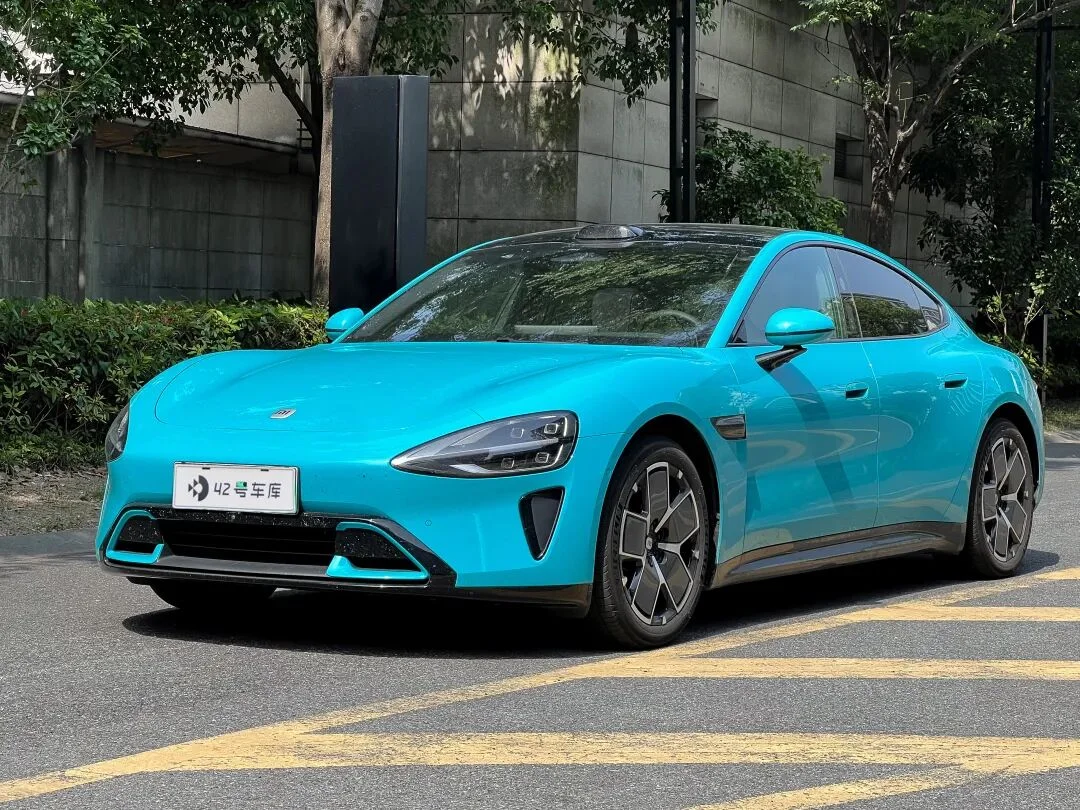
When the Xiaomi SU7 first went on delivery, we conducted a live high-speed range test comparing a SU7 Max Founder’s Edition with a Zeekr 007 equipped with an optional 100 kWh battery. Both performed exceptionally well, easily surpassing 500 km of actual range at an average speed of nearly 100 km/h.
However, for the Xiaomi SU7 lineup, the Max version is not the longest-range model. The Pro variant, priced RMB 54,000 lower, actually offers greater range. The SU7 Pro features a 94.3 kWh lithium iron phosphate (LFP) battery and a 220 kW rear-wheel-drive motor, with an official CLTC range of 830 km—slightly higher than the Max’s 810 km. Furthermore, this test car came fitted with the same 19-inch low-drag wheels as the Standard version, shod in Michelin e·PRIMACY tires designed for quietness and energy efficiency. Consequently, its range performance should significantly outpace that of the previously tested Max version.
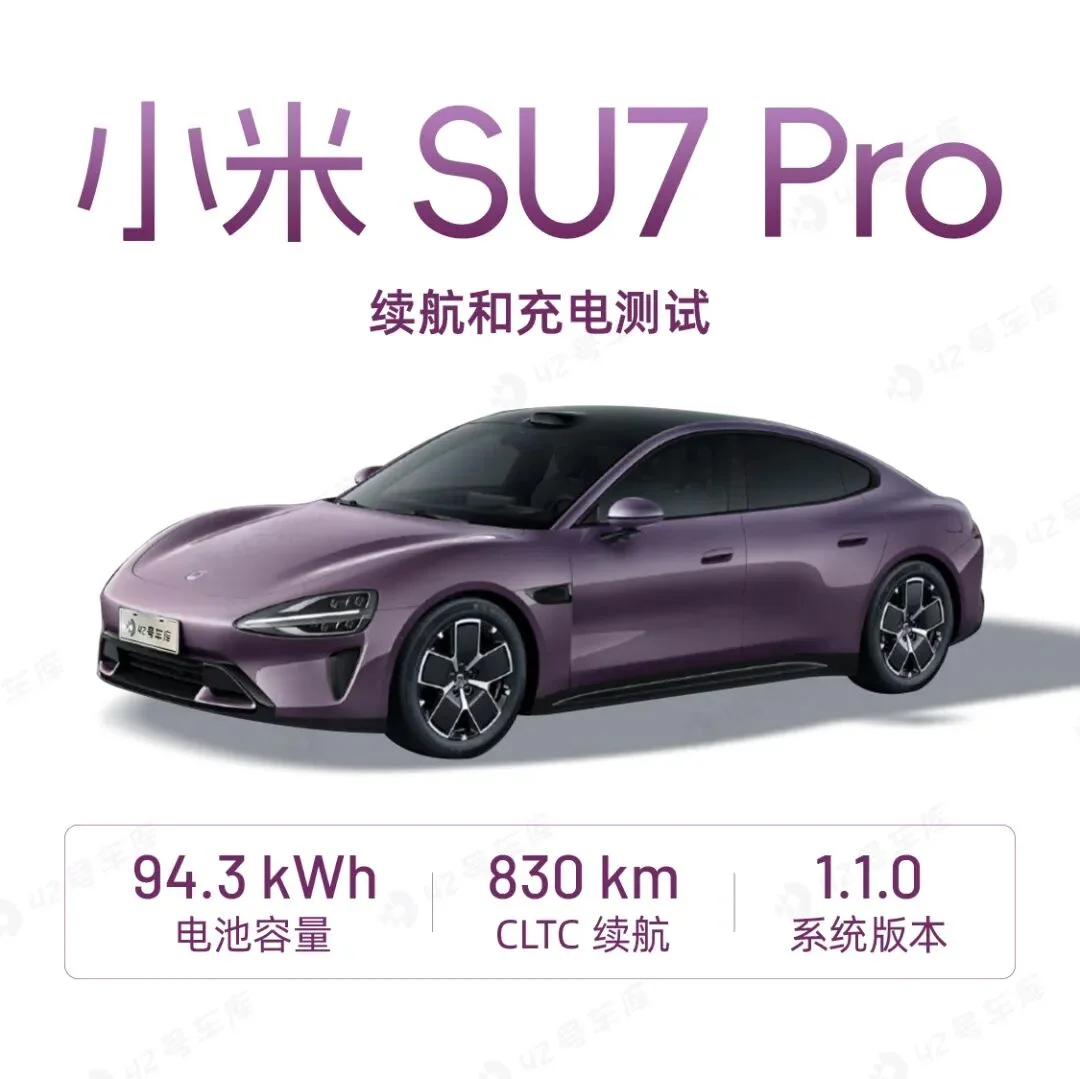
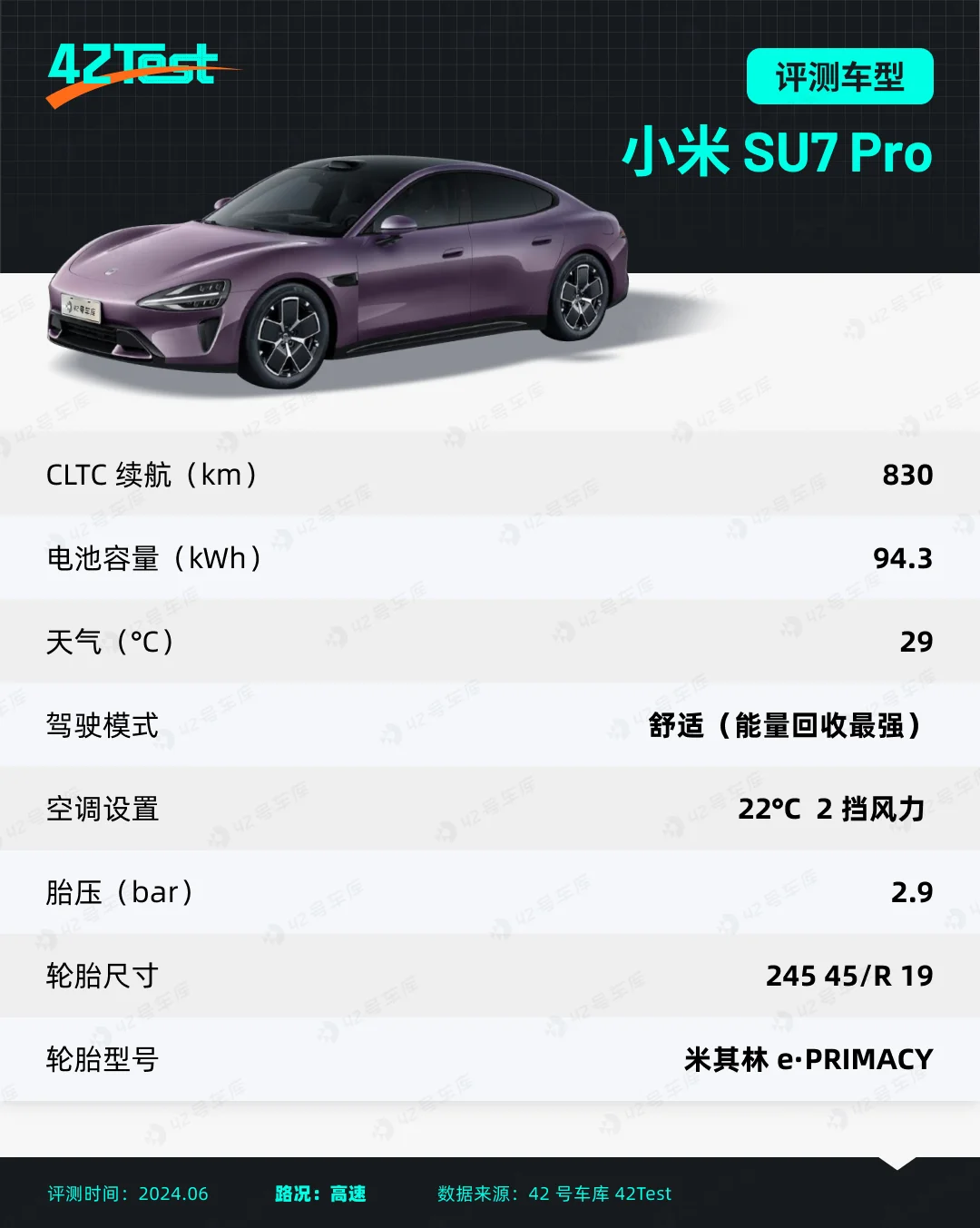
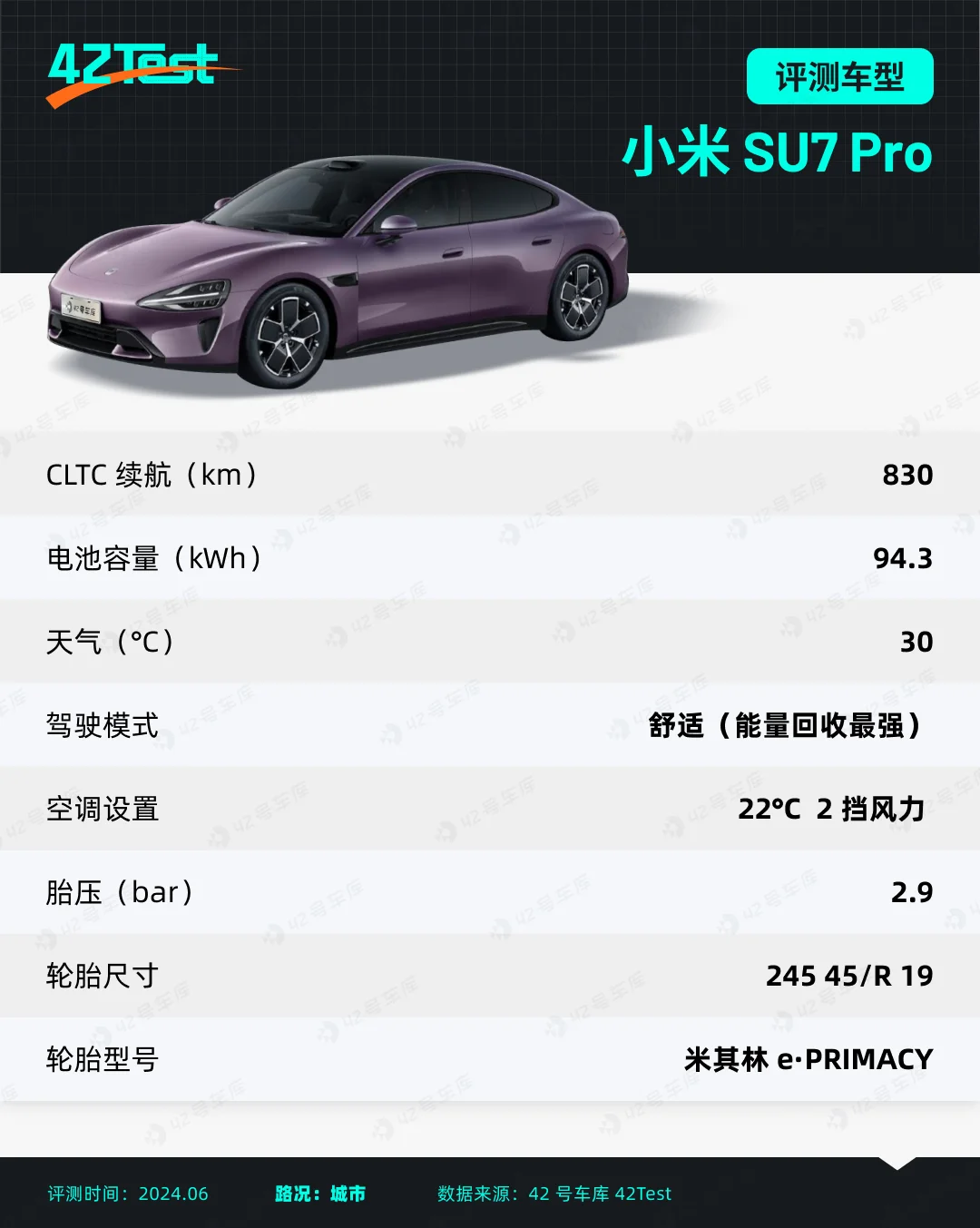
Here are the testing conditions: following 42Test standards, we set the air conditioning to 22 °C at fan level two with A/C enabled. Cold tire pressures were adjusted to the recommended 2.9 Bar as specified on the vehicle placard. Driving mode was set to Comfort, and energy regeneration was customized to its highest setting. After resetting the trip meter, we began the high-speed and urban range tests.
01High-Speed Range
For the highway segment, we selected a route with a uniform speed limit of 120 km/h to maximize average speed. After setting navigation, we relied on NOA as much as possible and increased the ADAS speed offset by 10 km/h to better align with typical highway driving habits.
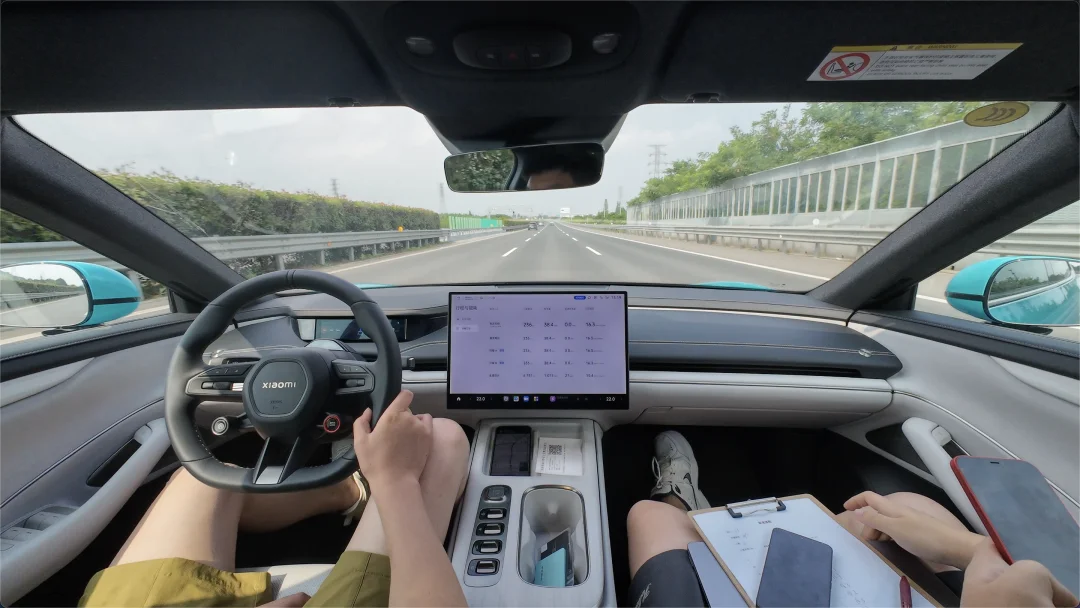
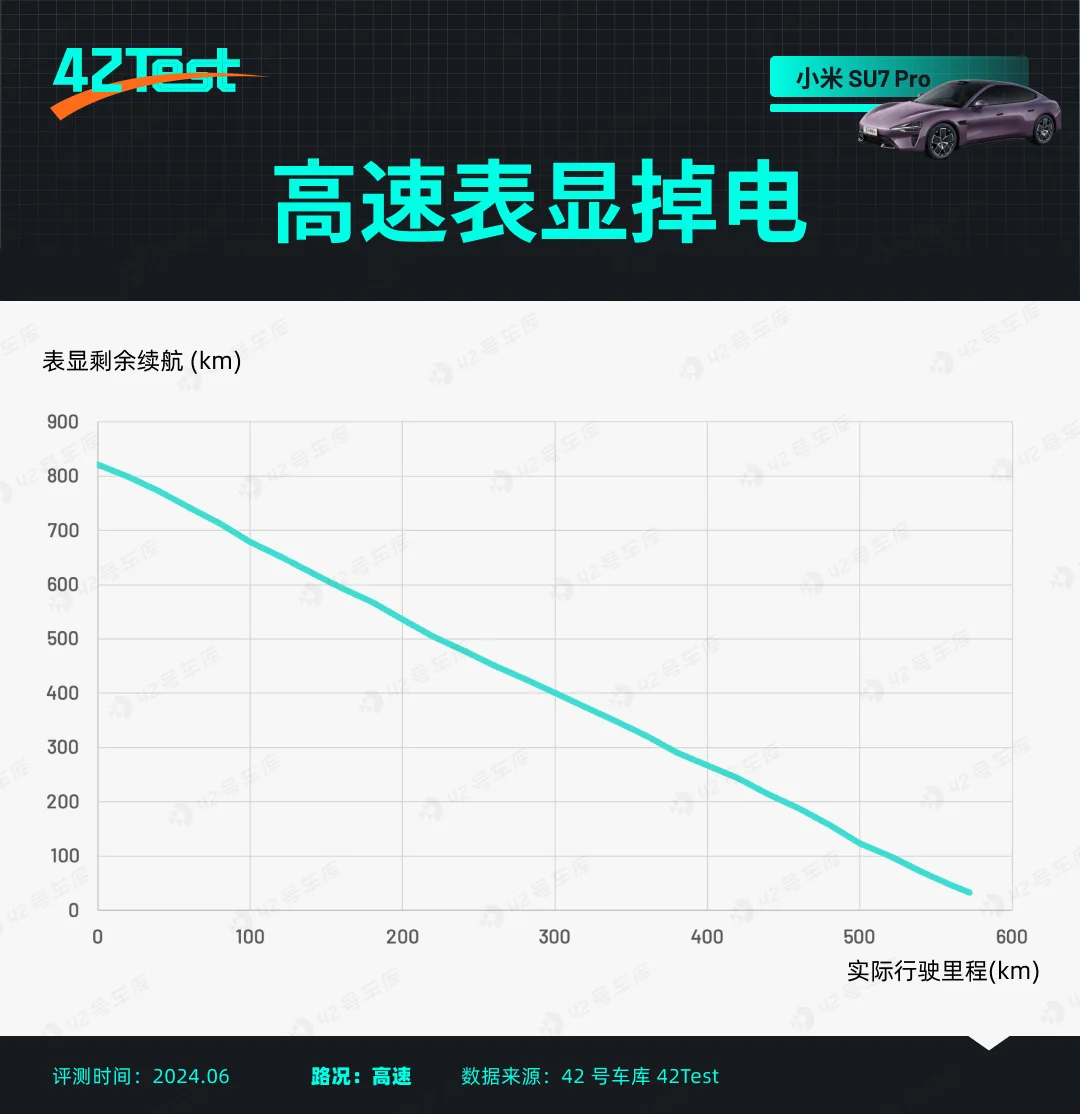
The combination of ultra-low drag, a large battery, small wheels, and energy-efficient tires is a powerhouse setup that ensures robust highway range for the Xiaomi SU7 Pro. The results confirmed this. At 29 °C, with two occupants using NOA throughout and pushing close to the 130 km/h limit, manual intervention was only required when encountering excessive slow traffic to maintain average speed.
After 5.5 hours on the highway, we concluded the test when the display showed just 4% battery remaining and 33 km of CLTC-rated range left. The Xiaomi SU7 Pro covered 572 km in real-world highway driving, consuming 89.4 kWh, with a displayed energy consumption of 15.7 kWh/100 km. This is significantly lower than our previous test of the Max model, demonstrating that the single-motor, low-drag wheel, and energy-efficient tire combination effectively reduces energy consumption.
The final highway range achievement rate for the Xiaomi SU7 Pro was 72%, based on a theoretical highway range of 598 km.

On paper, the SU7 Pro’s highway range may not seem extraordinary, but consider that this was achieved at an average speed of 102.7 km/h—a figure that would likely change one’s perspective. For highway conditions, such an average speed is exceptionally high, and experienced drivers will appreciate the difficulty. Given this average speed, the Xiaomi SU7 Pro’s range and energy consumption performance are excellent, making these test results highly relevant for current and prospective owners.
With this level of efficiency, if driven conservatively on the highway, the Xiaomi SU7 Pro can easily exceed 600 km.
02Urban Range
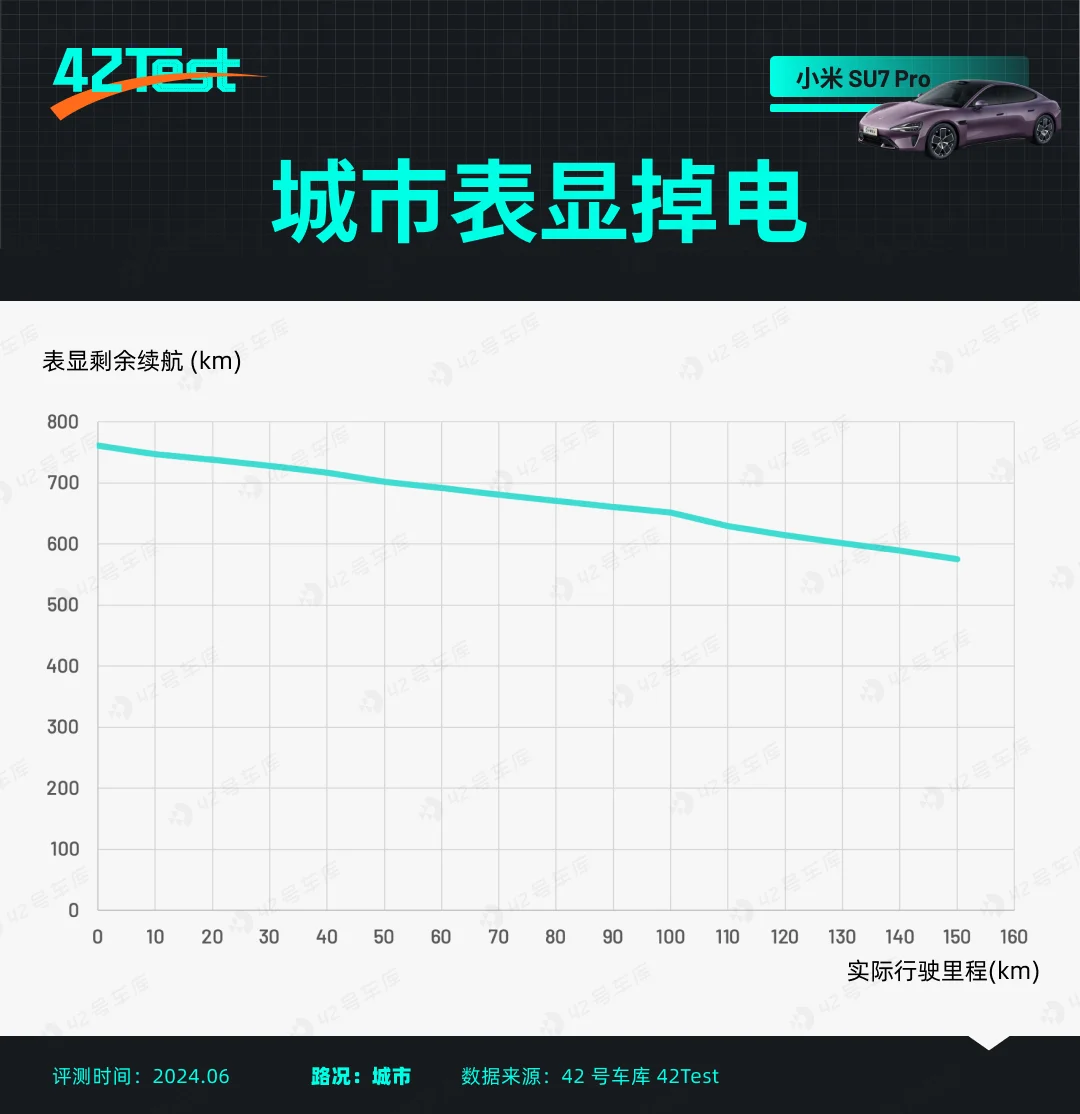
The urban pure-electric range test followed the same vehicle settings as the highway test. The route adhered to 42Test standards: driving 100 km on the Shanghai Outer Ring Expressway, followed by 50 km of congested surface roads, designed to simulate daily urban driving conditions as closely as possible.
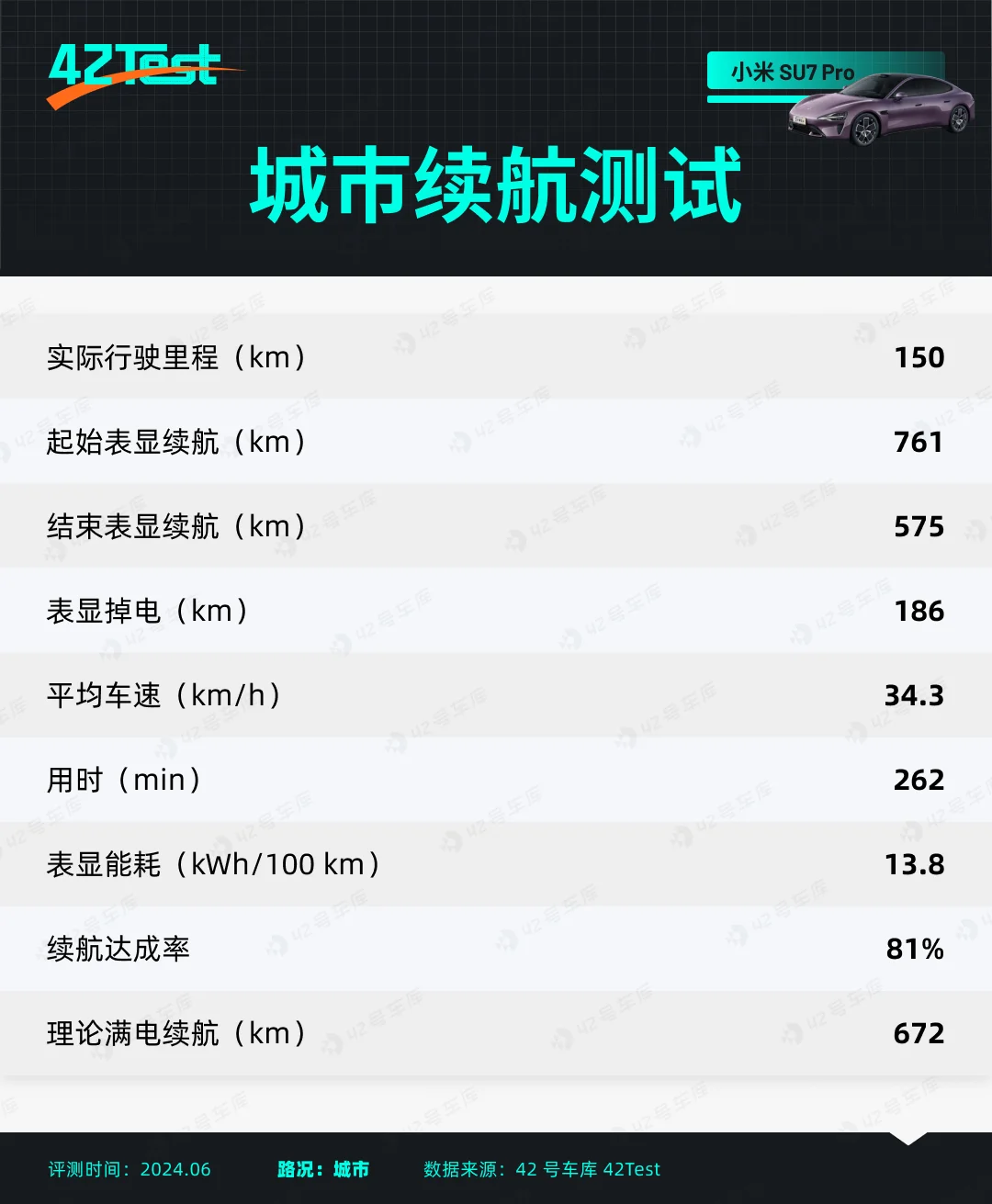
After completing the urban route, the Xiaomi SU7 Pro had traveled 150 km. The displayed CLTC range decreased by 186 km, with an average speed of 34.3 km/h and a displayed average energy consumption of 13.8 kWh/100 km. The urban range achievement rate was 81%, based on a theoretical urban range of 670 km.
This urban range capability exceeds that of most internal combustion engine vehicles. For typical commuting, charging approximately once every two weeks is sufficient. Consequently, range anxiety is largely eliminated for urban use of the Xiaomi SU7 Pro; the primary consideration shifts to how quickly the large-capacity 400 V platform battery can be charged.
03Charging Test
During the charging phase, although the Xiaomi SU7 Pro is based on a 400 V platform, its official peak charging power is not low. Therefore, we took it to a Huawei liquid-cooled 600 kW charger for testing.
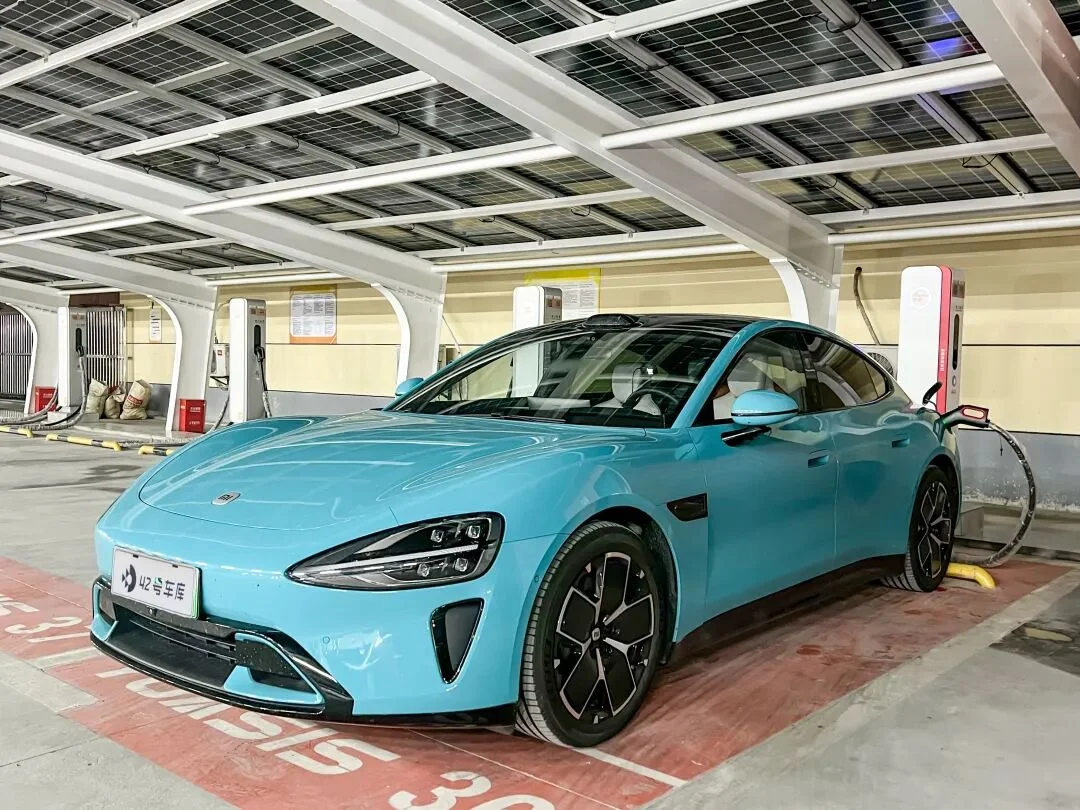
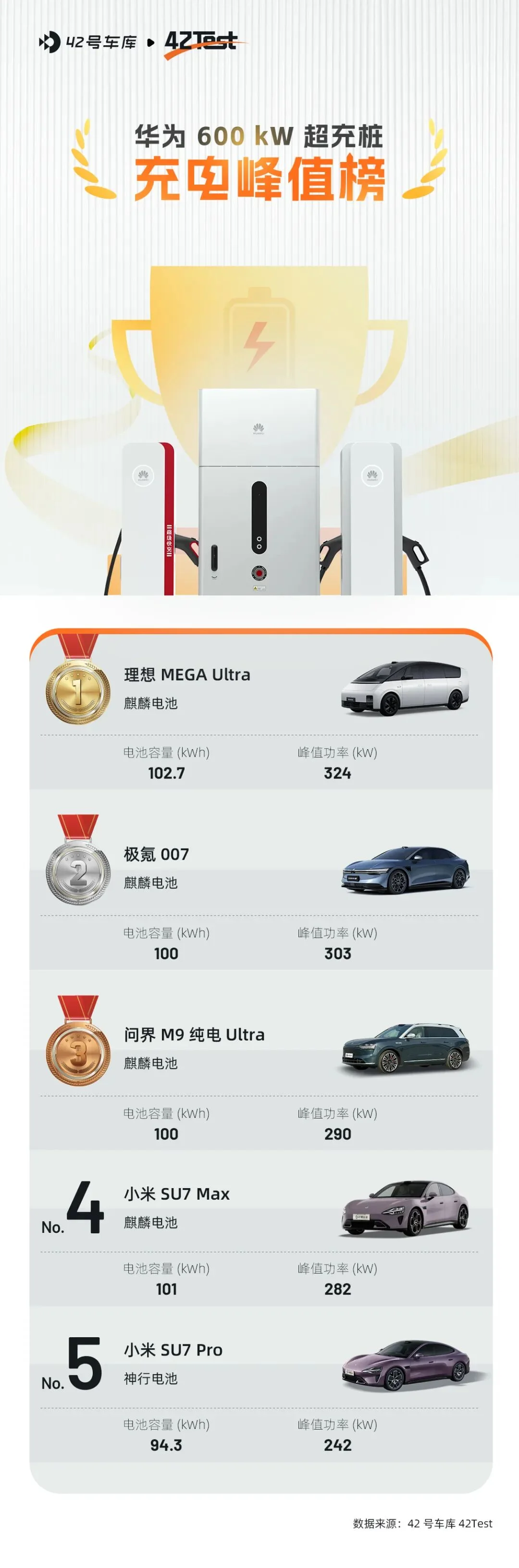
In actual testing, the Xiaomi SU7 Pro delivered considerable surprise with its peak power. On the 600 kW charger, it reached a maximum power of 242 kW, performing comparably to many 800 V platform models we have tested previously and closely matching its larger sibling, the Max variant.
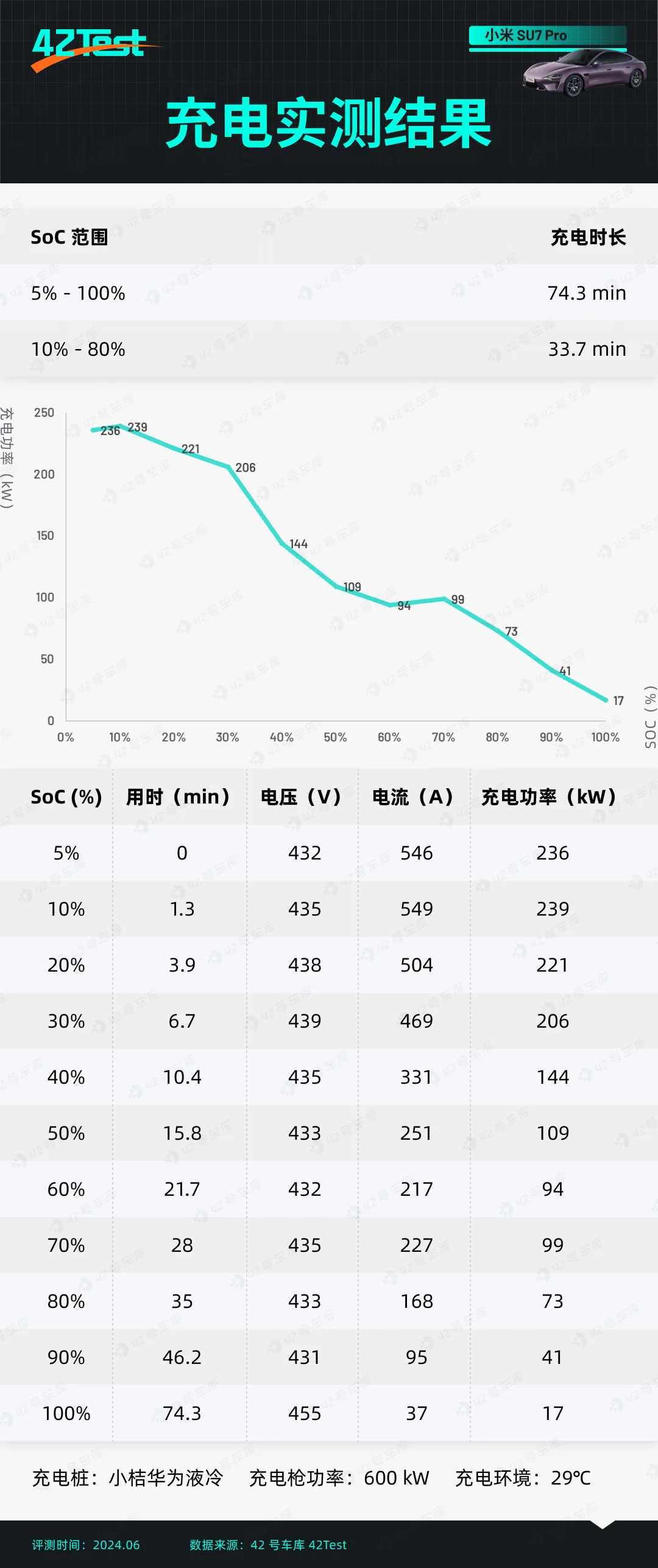
However, the issue with the Pro model is that the peak power duration is too short. Power begins to drop once the battery reaches nearly 20% and continues to decline. Furthermore, limited by the 400 V voltage platform, it cannot maintain power by increasing voltage after current drops. In the final 10%, as the charge enters the trickle phase, power hovers around 20 kW.
Ultimately, the Xiaomi SU7 Pro took 74.3 minutes to charge from 5% to 100%, primarily because the final 10% took more than half an hour. The time from 10% to 80% is significantly shorter, taking only about 33 minutes, which is not slow for a 400 V system. Therefore, unless subsequent charging conditions are poor, stopping at 80% offers better time efficiency.
Regarding charging time at a 120 kW station, we were unable to test it due to time constraints and will make up for this in a future review when we have another vehicle. In fact, for newly released electric vehicles, the actual charging power is influenced more by the charger than the car itself. Even an 800 V platform vehicle is helpless when faced with a low-power charger. Conversely, even a 400 V platform vehicle can charge significantly faster if connected to a 600 kW ultra-fast charger. Therefore, we recommend choosing high-power chargers whenever possible for a better experience.
04Conclusion
As Xiaomi's first model, the SU7 demonstrates impressive energy efficiency management, resulting in excellent range performance in both highway and urban driving scenarios. Particularly on highways, with a battery capacity of less than 100 kWh, it achieves a real-world range of 600 km, comparable to many gasoline cars, which significantly reduces range anxiety during long-distance daily travel.
For those considering purchasing the Xiaomi SU7, if you prioritize range and autonomous driving capabilities, the SU7 Pro is a highly recommended choice. After all, the SU7 Max, priced at nearly RMB 300,000, is beyond the reach of mainstream consumers.
The Pro version, priced RMB 54,000 lower, is undoubtedly a more suitable option. Although it lacks hardware features such as air suspension, CDC dampers, 800 V architecture, and the 2.78-second super performance, other aspects like autonomous driving, cockpit experience, and comfort configurations are identical to the Max. This likely explains why the proportion of Pro orders increased among subsequent Xiaomi SU7 reservations.
Written by: Wentao Edited by: Wentao