


Li Auto VP: 2,000 Supercharger Stations by Year-End Remains KPI Despite Tight Timeline
There are only 2 months left in this year, yet within these 2 months, Li Auto needs to launch 1,000 supercharging stations — a number that has already surpassed the total number of supercharging stations launched by Li Auto over the past 8 months.
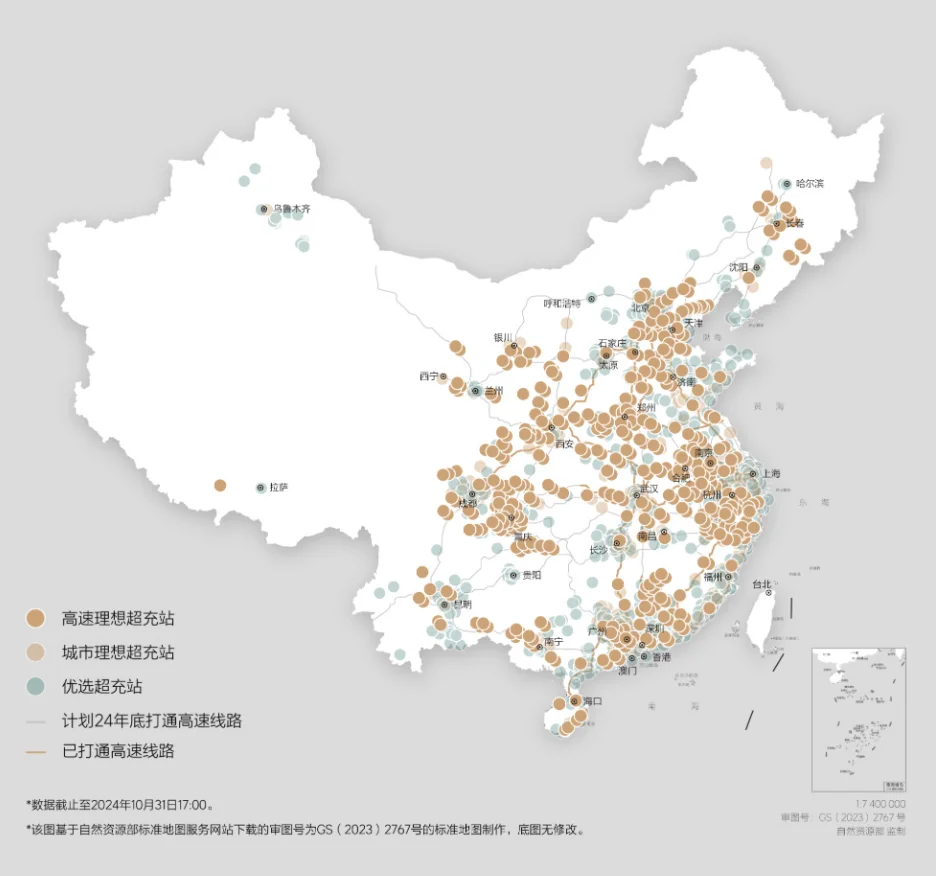
On October 31, marking 561 days since inception, Li Auto officially announced the completion of its 1,000th supercharging station. According to official data, these 1,000 stations now cover 175 cities across 31 provinces in China and connect nine national expressways.
However, it is important to note that on February 26, Li Auto set an annual target to deploy 2,000 supercharging stations by year-end. At that time, only 344 stations were operational. This meant Li Auto needed to add 1,656 new stations over ten months.
Eight months have passed since February 26, and Li Auto’s supercharging network has rapidly expanded to 1,000 stations. Despite this progress, the company still faces the task of deploying another 1,000 stations with only two months remaining—raising questions about whether Li Auto can meet its goal of 2,000 stations this year.
Recently, we interviewed Sun Guangmin, Vice President of Li Auto’s Charging Network, and Tang Huayin, Head of Li Auto’s Vehicle Electrification Products. Sun Guangmin stated that Li Auto has already confirmed more than 2,000 supercharging station projects, with numerous sites currently undergoing site preparation and construction. From late October through the end of the year, Li Auto will experience a peak period for station launches.
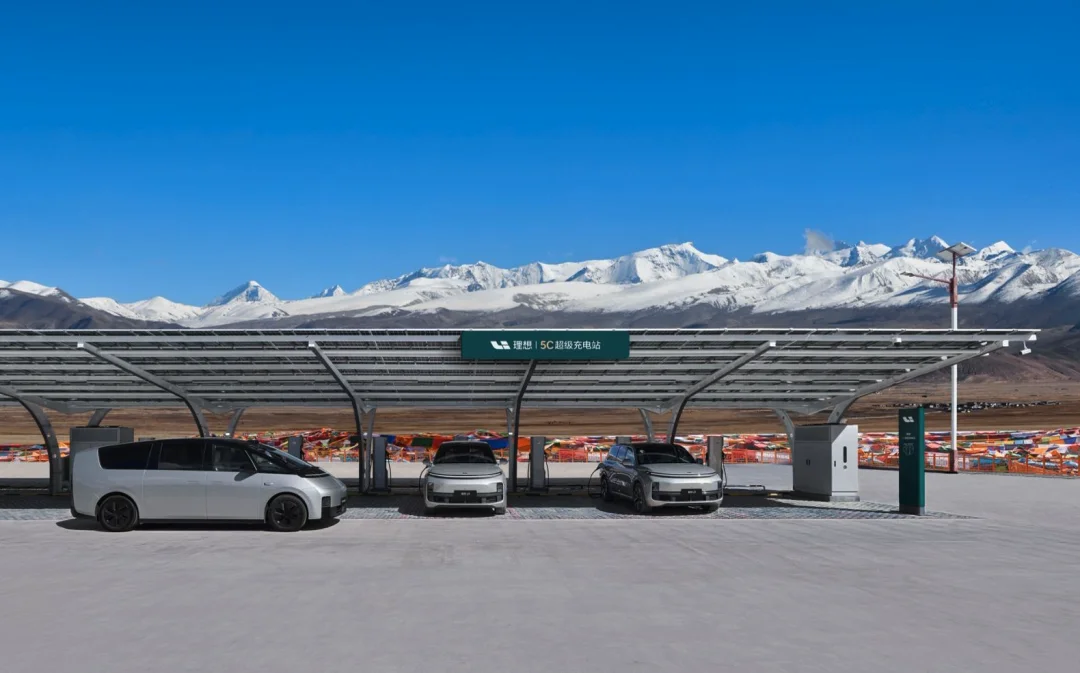
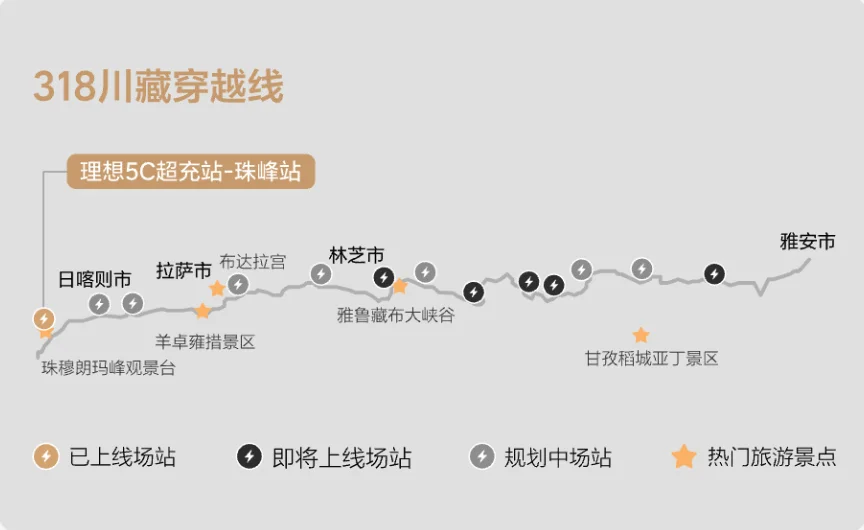
Notably, the location of Li Auto’s 1,000th supercharging station carries significant meaning: the Everest Station. This 5C supercharger is situated at an altitude exceeding 4,200 meters on the plateau, presenting harsh environmental conditions that pose substantial challenges for both initial construction and long-term maintenance operations. By choosing to install its 1,000th station—and specifically a high-performance 5C unit—at this location, Li Auto aims to demonstrate the strength of its energy replenishment technology and its determination to accelerate the development of pure electric vehicles.
Since the beginning of this year, Li Auto has faced significant challenges in its initial entry into the pure-electric vehicle market following the troubled launch of the MEGA. However, this experience has also made Li Auto realize that while the success of its L-series extended-range electric vehicles (EREVs) has provided a solid resource foundation for its pure-electric products, the company must adopt an open-minded approach and start from 0 to 1 to compete effectively in the pure-electric segment.
In the phase from 0 to 1, Li Auto believes that establishing its energy replenishment system is a very critical link. Sun Guangmin stated that supercharging is an important part of Li Auto’s pure-electric product capability; simply selling customers a vehicle with supercharging capability is meaningless without a matching supercharging network. Furthermore, at the Beijing Auto Show in April this year, Li Auto Chairman Xiang Li also discussed with NIO Chairman William Li, saying, "If the energy replenishment network cannot take off, (high-end pure-electric vehicles) really cannot be sold."
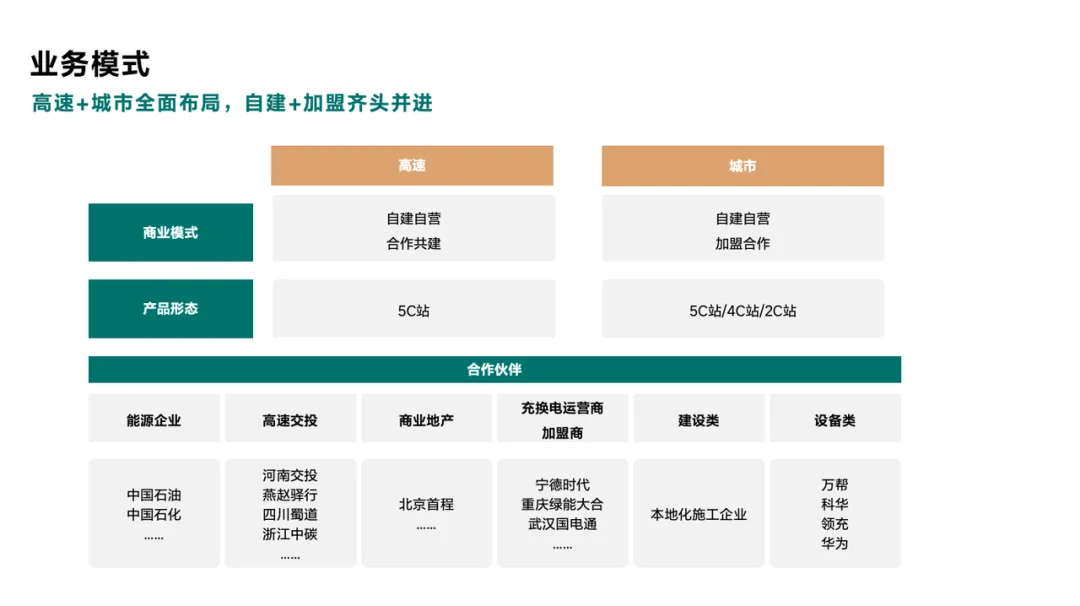
To rapidly expand its layout, Li Auto is pursuing a dual strategy in both highway and urban scenarios: on one hand, it is advancing self-operated supercharging stations to ensure efficiency and quality; on the other hand, it is seeking partners to co-build supercharging stations to more efficiently secure sites, power resources, and other assets.
According to Sun Guangmin, the process of landing a single Li Auto supercharging station generally involves four steps: site selection, contract signing, site access, and online operation. Although the path is clear, execution is not easy.
Sun Guangmin noted that Li Auto faces numerous challenges during this process, including enhancing team capabilities, aligning construction standards with partners, and coordinating supplier resources. Furthermore, increasing the number of supercharging stations from 344 to 2,000 within approximately ten months presents a formidable challenge.
In the interview, Sun Guangmin and Tang Huayin shared with us many of the challenges in Li Auto's construction of supercharging stations, their management of the energy replenishment system, and their overall reflections on the energy replenishment industry. Below is the main content of the interview, which we have edited without altering the original meaning:
01Launching 2,000 Supercharging Stations Does Not Yet Fulfill the KPI
42HOW Auto: Li Auto has recently removed references to its year-end target of 2,000 stations from its promotional copy and posters. Can Li Auto still launch 2,000 supercharging stations this year?
Sun Guangmin: The target for this year remains 2,000 stations. Over the past nearly 10 months, it may appear that Li Auto has only completed 1,000 stations, but in reality, the foundational construction and electrical engineering cycles for Li Auto supercharging stations are all front-loaded.
We divide station construction into four steps: site selection, contract signing, engineering team mobilization, and acceptance/launch. Currently, Li Auto has confirmed more than 2,000 supercharging station projects, with a large number of sites preparing for or undergoing construction. From late October to the end of this year will be the peak period for Li Auto supercharging station launches.
Our goal is set at 700 highway stations and 1,300 urban stations. We are very confident about completing the 700 highway stations, but the difficulty for urban stations is considerably higher.
Urban charging is a new business for us. For our team, advancing this new business is akin to jumping from a standstill. However, based on the current overall progress of construction starts, we remain very confident. There will be challenges, such as management requirements for urban construction after heating begins in northern cities, particularly regarding power grid transmission arrangements.
42HOW Auto: What has been the most difficult aspect of pushing forward with the 2,000-station goal?
Sun Guangmin: Looking at the first half of this year, we can break it down into three stages. In the first stage, the challenge we faced was convincing partners to invest in a project that would not generate profit within two years.
In the second phase, our challenge is to rapidly enhance team capabilities and production capacity to accelerate nationwide expansion.
In the third phase, our primary challenge lies in engineering acceptance. Sometimes partners' projects meet industry standards, yet we deem them unacceptable for handover, requiring item-by-item rectification. This process has been lengthy.
By the second half of this year, our challenge shifts to significantly increasing station construction speed. Building 50 stations a month versus 200 involves entirely different levels of difficulty; backend supplier resources must be fully integrated across the entire chain after capacity increases.
Furthermore, regarding charging operations, launching 2,000 supercharging stations does not constitute completing our KPI. We must also optimize site selection, ensure high-quality construction, and maintain effective post-launch operations and maintenance.
42HOW Auto: What are Li Auto's plans for station construction next year?
Sun Guangmin: Specific numbers for next year's station construction are still under discussion, but we have already formed some preliminary thoughts.
First, before Li Auto's pure electric products launch next year, supercharging infrastructure must be fully prepared. The standard for completion is that users purchasing and using Li Auto's pure electric vehicles will experience no range anxiety whatsoever.
Second, we will work harder next year than this year. On one hand, we see growing user demand for charging; on the other, we are influenced by the current macroeconomic trend of 'making large-scale investments well in advance within short cycles.'
02Not Pursuing Small Victories or Small Profits
42HOW Auto: When is Li Auto’s supercharging network expected to reach break-even?
Sun Guangmin: This is a long-term, large-scale campaign. We do not pursue quick small victories or small profits; instead, we aim for victory in the overall campaign.
We have two criteria for measuring the success of this long-term campaign: one is the large-scale replacement of internal combustion engine vehicles by electric vehicles, and the other is that users’ refueling experience becomes as convenient as refueling with gasoline.
42HOW Auto: What is the current cost per station for Li Auto’s supercharging stations?
Sun Guangmin: The construction costs of Li Auto’s supercharging stations mainly include equipment costs, low-voltage infrastructure construction costs, and high-voltage costs for expanding or increasing capacity at the site. In terms of construction costs, if a high-voltage site needs to be built, our costs are controlled at around RMB 1 million.
However, over the entire lifecycle, the greater cost of supercharging stations lies in the later-stage systematic operation and maintenance.
42HOW Auto: What is the current profitability situation for Li Auto’s supercharging stations?
Sun Guangmin: The profitability of supercharging stations mainly depends on their capacity upper limit and efficiency upper limit. In terms of capacity, we have already conducted some minimum closed-loop validations, and the capacity upper limit of supercharging stations is still relatively high. For example, we recently updated our 4C product; compared to the 2C version, the 4C capacity efficiency can be further improved by about 60%.
Regarding efficiency, it mainly refers to our service capability for users, which serves as the profit source for supercharging stations as infrastructure.
Currently, Li Auto’s supercharging stations have a charging failure rate of less than 0.5%, whereas industry leaders generally see failure rates around 1% to 2%. Furthermore, we will continue to enhance user experience through intelligent deployment and operation based on vehicle-station-cloud systems, while improving overall maintenance efficiency via remote systems and proactive defensive measures.
In the long term, supercharging stations are a project with good profitability. After all, the trend toward new energy vehicles in China is irreversible, and the technical route for high-voltage supercharging of pure electric models is also established. Consequently, tens of millions, or even hundreds of millions, of electric vehicles will have recharging needs in the future.
However, in the short term, supercharging stations are still in the investment phase. We currently need to focus more on foundational work such as site deployment and vehicle-station-cloud system deployment.
42HOW Auto: When will the supply and demand balance point for charging and replenishment be reached?
Sun Guangmin: The charging experience that users currently require, particularly high-quality and fast charging experiences, has constrained the growth in demand for pure electric vehicles. Because this constraint has been identified, companies are accelerating the deployment of supercharging networks. This acceleration will, in turn, help boost sales of new energy vehicles. Therefore, this is a state of double-helix evolution.
42HOW Auto: What is the standard for a Li Auto supercharging station to be considered successfully operational?
Sun Guangmin: Our core focus is whether the daily average charging volume at each station can reach its corresponding break-even point. We have found that some stations with high traffic, as well as during peak traffic periods, have already exceeded expectations and completed their verification targets.
03Building a Product Power Closed Loop for Li Auto’s Pure EVs and Supercharging Stations
42HOW Auto: Xiang Li has mentioned that Li Auto will operate supercharging piles as products or services. At what stage will Li Auto’s supercharging piles primarily serve as a service, and when will they truly become a product?
Sun Guangmin: Supercharging is an important part of Li Auto’s pure electric vehicle product power. It is integrated with the vehicle to form a closed loop of product power.
From the user’s perspective, simply selling a vehicle with supercharging capability to users is meaningless; it must be matched with a corresponding supercharging network. Therefore, internally we treat the vehicle and the supercharging pile as a single, integrated product. Currently, the energy replenishment network is a relatively weak link in our pure electric product power, and we are striving to make up for this gap.
Tang Huayin: From the early stages of design and development, we have treated supercharging stations as products, with subsequent improvements in service levels being a gradual process. This is why we firmly decided to develop the lightest possible supercharging gun cables from the outset, enabling plug-and-charge functionality, to polish the overall user experience to the extreme.
42HOW Auto: As a product or service, what are the quantitative definitions and metrics for a charging station?
Sun Guangmin: 'Service' can be understood as a cost center; you do as much work as your budget allows. The number of stations built and the overall operational level are determined by the budget.
For products, we take a more comprehensive approach, considering factors such as profitability and the closed-loop logic from user experience to business operations. This is the key difference between the two.
42HOW Auto: What is Li Auto’s cooperation model with supercharger station franchisees?
Sun Guangmin: Franchising is a means, not an end. Our goal is to deploy high-quality station resources on a large scale as quickly as possible. From the perspective of acquiring land and power resources, we need to collaborate with partners.
During our discussions with partners, we use specific data to clarify that although supercharger stations are in an investment phase in the short term, they represent a long-term business with sustained profitability. Furthermore, we establish long-term strategic interlocks with our partners.
Franchise stations adhere to Li Auto’s self-built standards for products, engineering, and operation and maintenance. End users cannot distinguish between self-built and franchise stations, much like staying at a branded hotel where service levels remain consistent regardless of the owner. This is what we control, and our team is working closely with partners to refine this process.
42HOW Auto: What is the usage ratio of Li Auto superchargers between Li Auto owners and owners of other brands?
Sun Guangmin: At highway stations, under normal conditions, the ratio of other brands to Li Auto is approximately 8:2. During traffic peaks, such as the National Day holiday, the proportion of Li Auto users increases to about 7:3. At urban stations, the ratio between other brands and Li Auto is 1:1.
42HOW Auto: How do you balance the charging experience between Li Auto owners and owners of other brands?
Tang Huayin: We will introduce operational measures and methods targeting special periods such as holidays, and continue to iterate on them.
Furthermore, we will persistently address and optimize the issue of occupied charging stations, focusing on the following dimensions:
Station Functionality: We will increase the proportion of ground locks and install limiters between some parking spaces to prevent unauthorized occupation. In the future, only Li Auto owners will be able to lower the ground locks at 5C supercharging spots.
Operations: We will assign on-site staff to key stations, with intensified efforts during holidays and other special periods.
Mechanisms: We may impose fees for occupying charging spots. Additionally, if a user repeatedly scans to lower the ground lock but fails to charge, they will be added to a blacklist.
Intelligence: Cameras have been installed at every station. We will use these cameras for intelligent identification and alerts, including automated phone calls to request vehicle relocation, which will be rolled out successively.
42HOW Auto: What are the respective positioning goals for Li Auto’s 2C, 4C, and 5C charging stations?
Tang Huayin: 2C corresponds to a charging current capacity of 250 A per the national standard, and 4C corresponds to a charging current capacity of 400 A, with 400 A being the current highest level under the national standard. After verification next year, we will upgrade the 4C charger via OTA to around 450 A.
5C charging represents a proprietary communication protocol between Li Auto vehicles and chargers, breaking through the current national standard ceiling. This means we are bridging the gap between the average capability of industry charging infrastructure and the leading supercharging capacity of our vehicles, which is our value proposition.
42HOW Auto: If Li Auto's pure electric product sales exceed those of its extended-range products, will there be enough 5C superchargers?
Sun Guangmin: There will definitely be enough. Currently, a single transaction at a 5C charger takes about 12 minutes. Even if usage demand increases to 50 times the current level, each charger would be in use for approximately 5 to 6 hours per day, so the load pressure on the chargers would not be significant.
However, if all users choose to charge at the same time, resulting in queues, we have corresponding measures in place.
First, we are already deploying 8-gun, 12-gun, and even 16-gun stations at some highway service areas, and our station expansion capacity is sufficient. Additionally, we can support one host unit with multiple charging guns and have reserved ample power resources for future capacity upgrades. Second, we are densifying our network in Beijing, Shanghai, Guangzhou, and Shenzhen. In the future, users may find more than one station within a three-kilometer radius. If queues occur, we may further increase density to five stations or continue investing in 8-gun, 12-gun, and other configurations.
Secondly, we will further standardize the order of operations at charging stations. Our order management involves not only managing the stations themselves but also guiding users' charging habits.
Tang Huayin: Some stations already have two 5C chargers, and they will support more flexible power distribution. For example, when two MEGA vehicles charge simultaneously on two 5C chargers, the power will be distributed more flexibly.
Furthermore, the combination of chargers in our stations will change. The most common configuration at Li Auto supercharger stations currently is a mix of 5C and 2C chargers, as well as pure 2C chargers. However, by the end of this year, we will no longer deploy pure 2C stations; we will only add new pure 4C stations. By mid-next year, all new 5C stations will no longer include 2C chargers, shifting to a 5C plus 4C combination.
42HOW Auto: What is Li Auto's site-selection strategy for its supercharging stations?
Sun Guangmin: The logic for urban sites is to cover user demand, while for highways it is to cover user traffic.
For urban site selection, we first focus on the city's economic volume, new energy vehicle penetration rate, and the existing stock of Li Auto owners. We generally rank them in the order of tier-1 cities, new tier-1 cities, tier-2 cities, and strong tier-3 cities.
Next, we layout stations within the city based on the logic that users have a station within three kilometers. Specific locations consider points such as shopping malls and parking lots within that three-kilometer radius.
Finally, we look at exactly where the station is positioned within the shopping mall or parking lot. For example, with parking lots, we need the station to be at a certain distance from the exit but not too far, and it must have an independent area. We also consider the user's parking route and the width of the parking spaces.
42HOW Auto: How does Li Auto secure access to power resources?
Sun Guangmin: In highway scenarios, because power resources for highway stations are relatively scarce, we build a high proportion of our own high-voltage infrastructure, reaching 80–85%.
In urban scenarios, we rely more on partners to obtain power resources. At the same time, we have found that charging stations built by other operators five years ago need iteration. Because their past operational efficiency was low, they need renovation or adjustment to release some corresponding resources; this is an opportunity for us to seize.
04Li Auto’s Charging Network as an Improvement Factor
42HOW Auto: Is Li Auto’s charging network an improvement factor rather than a rigid demand?
Sun Guangmin: In our energy replenishment system, we have self-built supercharging stations and preferred supercharging stations, as well as more official third-party interoperability. This setup is designed to meet the needs of both "essential demand" and "enhanced experience."
In today’s cities, particularly first-tier ones, users can always find a charging station regardless of the process, so the basic "rigid demand" has been met. However, rigid-demand providers cannot address the growing need for better charging experiences among existing and potential electric vehicle (EV) owners.
At any given charging station, users desire faster charging speeds, reliability, and time-efficient navigation for charging planning. We have found that customers who purchase higher-priced vehicles place greater value on their time. Consequently, there is a significant gap in user demand, which is precisely why we are deploying supercharging stations.
From a business perspective, the cost of providing improvement-level services is indeed higher than that of meeting rigid demand. However, looking at the endgame, supercharging capacity and service capabilities are very strong. When more user demand arises, larger capacity can absorb it, and higher volume spreads costs while improving profitability.
42HOW Auto: What will the landscape of China’s future charging network look like? Will state-owned charging piles dominate, or will private operators like Li Auto hold a larger share?
Sun Guangmin: In the endgame, the characteristic of this industry is that charging infrastructure supports the sales and usage of new energy vehicles. Based on this, the charging sector faces two thresholds:
The ability to deploy large-scale infrastructure;
The efficient operation of large-scale infrastructure.
These two thresholds represent a supply-side barrier and a management-side barrier for demand, respectively. Both must be overcome.
From the perspective of deploying large-scale infrastructure, state-owned enterprises have advantages in land resources, power resources, and investment capacity. In this regard, Li Auto's approach is cooperation; for example, Li Auto has already partnered with large state-owned enterprises such as Zhongshihua, Zhongshiyou, Shougang, and Shoucheng.
Li Auto's strengths lie in the efficient operation of large-scale infrastructure. As an automaker, our user-facing services extend beyond charging stations to include overall charging navigation and energy management planning starting from the vehicle's infotainment system. We possess a natural advantage in closed-loop thinking, enabling us to take a holistic view.
42HOW Auto: Is Li Auto considering a layout for integrated solar-storage-charging facilities?
Tang Huayin: There are some pilot projects underway, but this cannot be driven by us alone; it certainly requires co-creation across the industry.
Sun Guangmin: We have actually been accumulating technology in areas such as energy storage and photovoltaics. Energy storage is an excellent product for improving station efficiency and profitability once charging demand scales up. We will also collaborate with the best professional energy storage partners across the industry through cooperative models to better serve users.
42HOW Auto: The buzz around battery swapping is growing louder. What is Li Auto’s current stance on battery swapping?
Sun Guangmin: There isn’t just one path to success. Different approaches have different technology development cycles. For instance, in the past two years, supercharging technology has advanced rapidly, including improvements in vehicles, charging piles, and platforms. Ultimately, both charging and swapping must be evaluated from two perspectives: user experience and operational efficiency.
Written by: Isaiah | Edited by: James