


Chinese Automakers Enter the Large Model Era
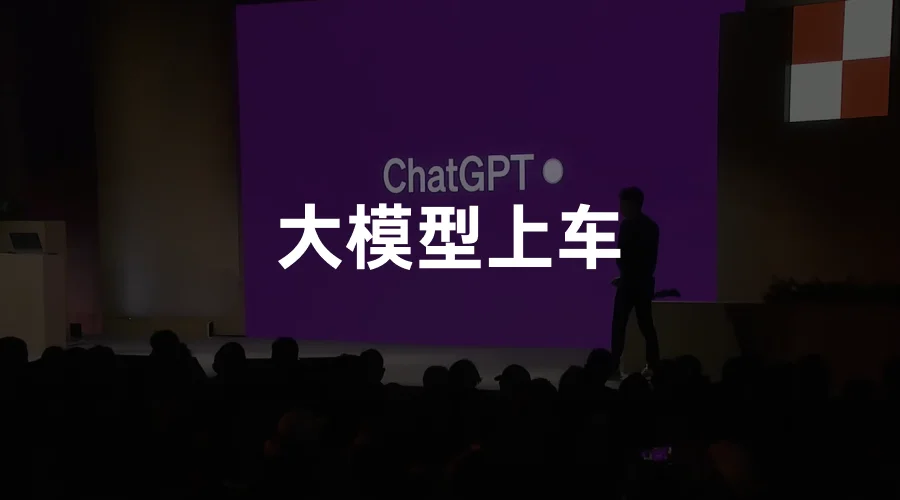
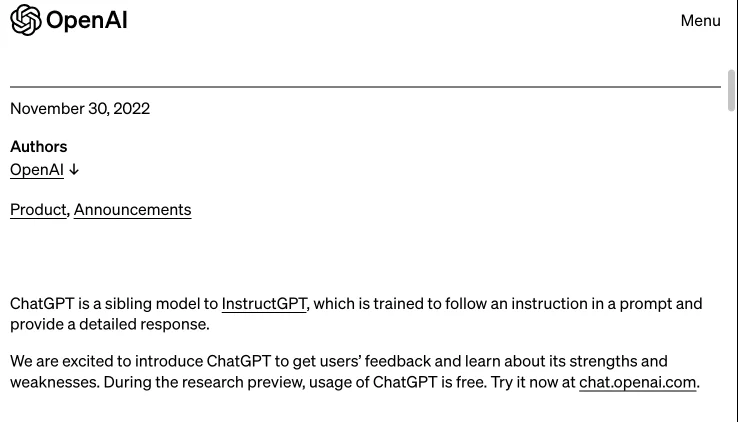
November 30, 2022. When OpenAI launched ChatGPT on its website, no one could have predicted that the app would reach 100 million monthly active users in just two months, becoming the fastest-growing consumer application in history.
Less than a year later, on November 6, 2023, at OpenAI’s first developer day, ChatGPT received a major upgrade. It introduced the "GPT Store" and allowed anyone to customize a GPT with specific skills.
This rapid development and deployment speed has amazed observers and brought large language models back into the spotlight.
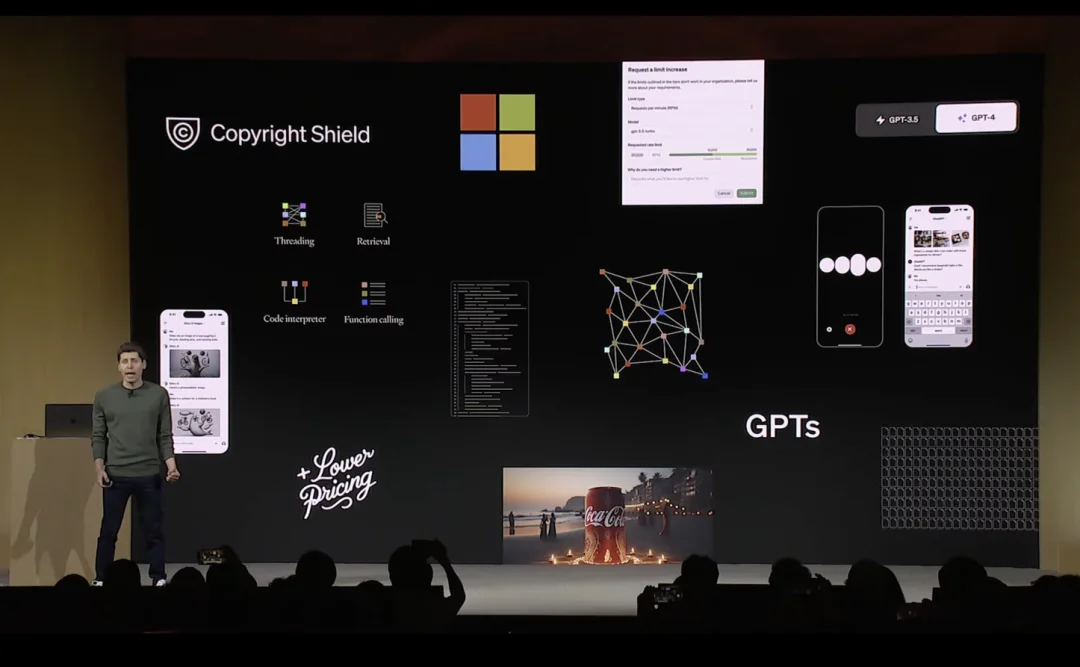
In fact, fueled by ChatGPT’s popularity, the underlying large model technology has spread like a shockwave from the AI field to society at large, beginning to empower various industries from a commercial perspective. The automotive sector, undergoing a significant technological transformation and fully embracing intelligence, is no exception.
Specifically, in the nearly year since ChatGPT’s release, automakers have enthusiastically embraced large language models. They are not only making deep technical investments but also exploring implementation opportunities across user scenarios such as smart cockpits and autonomous driving. These companies hope to leverage the capabilities of large models to improve users’ actual driving experiences.
So, a question worth pondering arises: How should large language models be integrated into vehicles?
Embracing Large Models: A Rapidly Reached Consensus
Before discussing the automotive industry’s adoption of large models, it is essential to clarify a premise. Although industries across the board, including automotive, are talking about ChatGPT and large models—and although large model technology indeed gained widespread attention due to ChatGPT’s popularity—the two are not synonymous.
In fact, ChatGPT is merely one prominent application of OpenAI’s deep learning GPT model. GPT itself is just one of many well-known large models in the industry. For instance, when ChatGPT debuted in late November 2022 and attracted significant industry attention, it was based on a specific version of GPT: the GPT-3.5 series.
However, as a phenomenon-level work in large model technology, ChatGPT did serve as a key entry point for the automotive industry to take notice of these technologies.
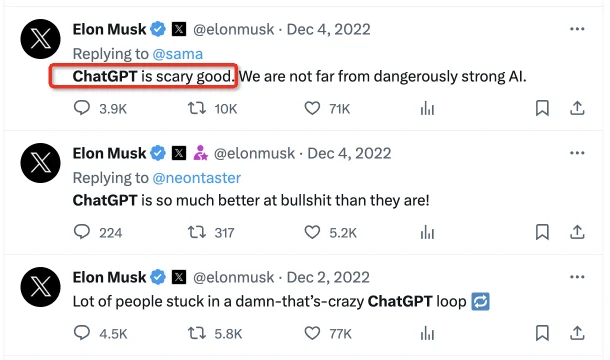
Elon Musk, who spans both the AI field and the electric vehicle industry, was undoubtedly the primary catalyst.
In fact, just two days after ChatGPT’s release, Elon Musk expressed his admiration for it multiple times on social media, stating that 'ChatGPT is so good it gives you chills.' This evaluation immediately drew attention in China and rapidly sparked interest in the underlying 'large model' technology within the automotive sector.
The pivotal moment when Chinese automakers began closely aligning with large language models was Baidu’s Wenxinyiyan.
On February 7, 2023, Baidu officially announced its new large model project, "Wenxinyiyan." This generative conversational product is based on Baidu’s ERNIE Bot and is often described as a "Chinese version of ChatGPT."
In the period that followed, even before Wenxinyiyan had fully launched, companies from various industries announced their participation in the "Wenxinyiyan" ecosystem. In the automotive sector, automakers including VOYAH, Hongqi, Changcheng, Dongfengrichan, Aichi, Leapmotor, Geely, Haima, and Nezha joined the "Wenxinyiyan" circle.
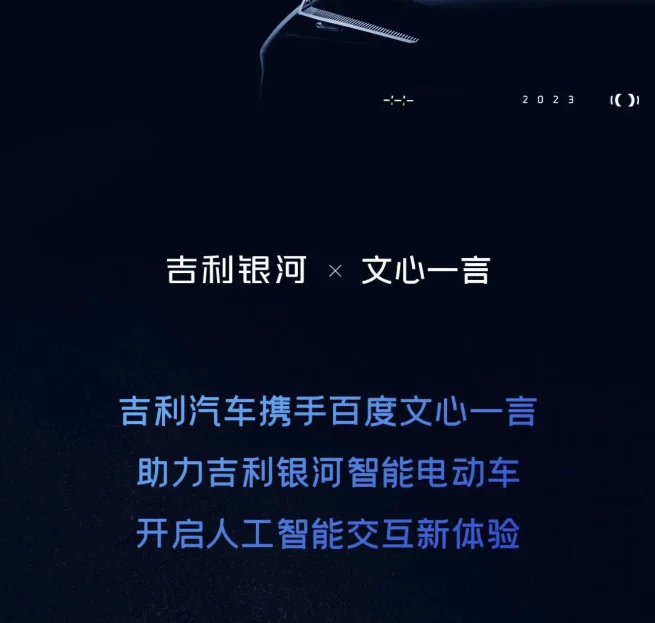
Relatively speaking, these automakers’ embrace of "Wenxinyiyan" was less about adopting large models and more about seizing momentum and demonstrating their resolve to transform toward intelligence.
By March, some leading new-energy vehicle startups began publicly sharing deeper reflections on ChatGPT and large model technology.
For example, in early March 2023, at Li Auto’s spring media briefing, Xiang Li systematically discussed the logic and thinking behind Li Auto’s development.
Xiang Li mentioned that "AI can change the physical world," which led to his views on ChatGPT and large models. Regarding ChatGPT, he stated, "ChatGPT is highly difficult, but I am not afraid of it making mistakes." When discussing large models, Xiang Li emphasized their impact on autonomous driving business development, asserting, "Only large models can achieve the true AI 2.0 that I truly desire."
Next, during XPENG’s Q4 and full-year 2022 earnings call in mid-March 2023, He Xiaopeng also discussed ChatGPT.
He stated that AI applications represented by ChatGPT have allowed hundreds of millions of users to see the enormous potential of generative AI models. This marks a new stage for general-purpose capabilities akin to a machine brain, which can be deployed locally. Such deployment will offer new interpretations of autonomous driving implementation, improve efficiency, and accelerate the transition from L4 to L5 autonomy.
Compared with Li Auto and XPENG, NIO was slower to comment on ChatGPT and large language models. In late May, William Li stated publicly that “the best application scenario for large models is inside the car.” In an interview following the NIO ES6 launch event, he added that NIO is working on integrating large models into its voice interaction system, NOMI.
Notably, among automakers embracing large models, a player cannot be overlooked: tech giant Huawei.
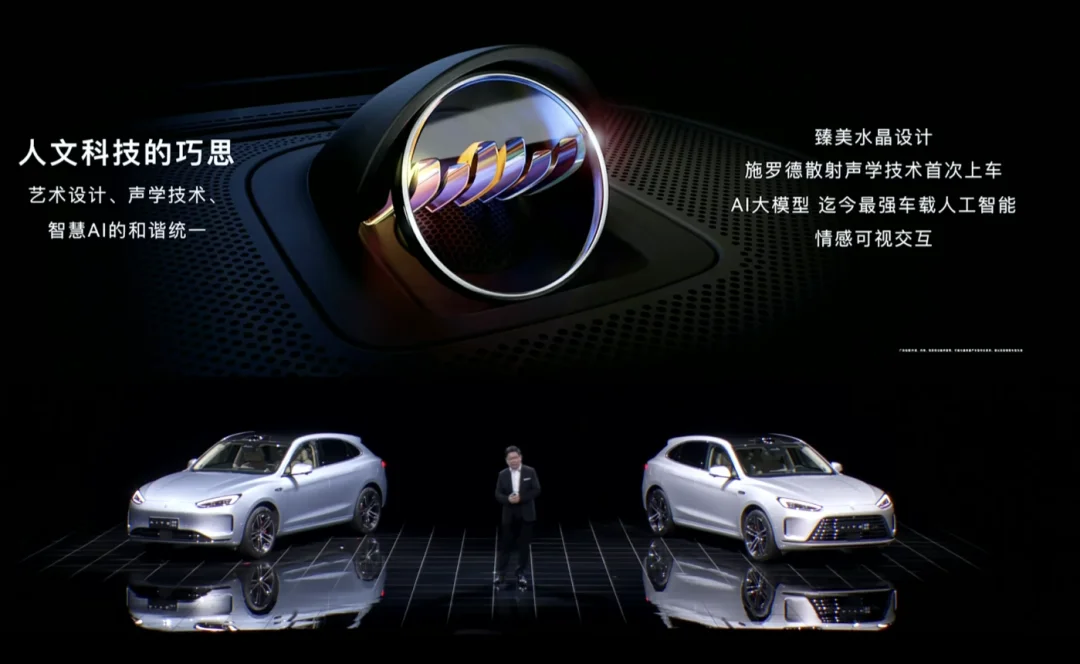
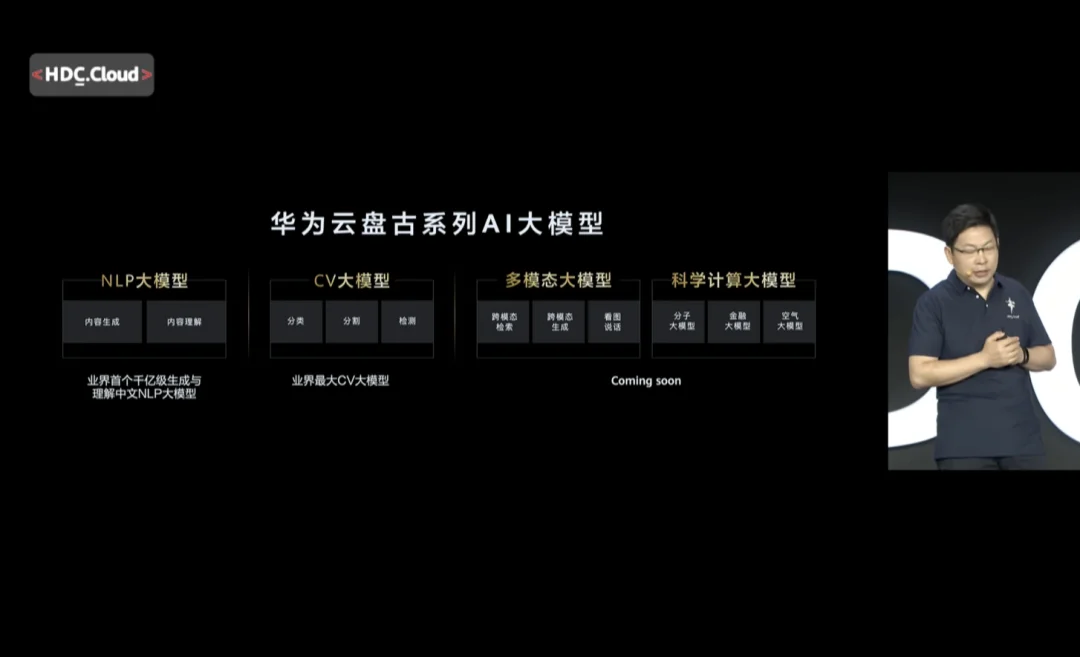
In fact, at an event in April, Richard Yu announced that the AITO M9, scheduled for release later that year, would integrate Pangudamoxing technology via the Hongmeng 4.0 system. Pangudamoxing is expected to elevate AI capabilities on the AITO M9 to a new level. Although no further details have been released, Huawei’s accumulated expertise in large models makes the actual performance on the AITO M9 highly anticipated.
From June onward, nearly all automakers seized opportunities in public forums to discuss their adoption or layout regarding large models.
Having experienced the powerful shockwave of ChatGPT, the widespread support for Wenxinyiyan, and the strategic viewpoints shared by top new-energy automakers such as NIO, XPENG, and Li Auto, the fiercely competitive Chinese automotive industry, collectively seeking intelligent transformation, has quickly reached a consensus within a short period: regardless of the approach, it must rapidly embrace large models.
Amid this momentum, how large language models (LLMs) can be concretely implemented in application scenarios has become a key question for automakers to explore. So far, smart cockpits and autonomous driving have emerged as the two primary focus areas for deploying LLMs in vehicles.
From AI Interaction Entry Points to AI Operating Systems
From an implementation perspective, because ChatGPT’s conversational capabilities and assistant attributes share natural affinities with various AI voice assistants, automakers’ current exploration of LLM deployment scenarios generally focuses on the smart cockpit domain, where user perception is stronger, particularly regarding in-vehicle voice assistants.
Among these, the trio known as "Wei-Xiao-Li"—NIO, XPENG, and Li Auto—has drawn significant attention.
On June 17, during its Li Auto Family Technology Day event, Li Auto unveiled its layout for LLMs, centered on its self-developed cognitive large model, "Mind GPT."
Specifically, Li Auto’s Mind GPT resembles ChatGPT; bolstered by extensive knowledge reserves, its goal is to make "Lixiangtongxue" smarter. Functionally, Mind GPT enhances capabilities such as dialogue generation, language understanding, knowledge Q&A, and logical reasoning, making them safer, more accurate, and more logical. Its built-in memory network also allows users to choose whether Lixiangtongxue should retain personalized preferences and habits based on historical conversations, thereby better understanding the user.
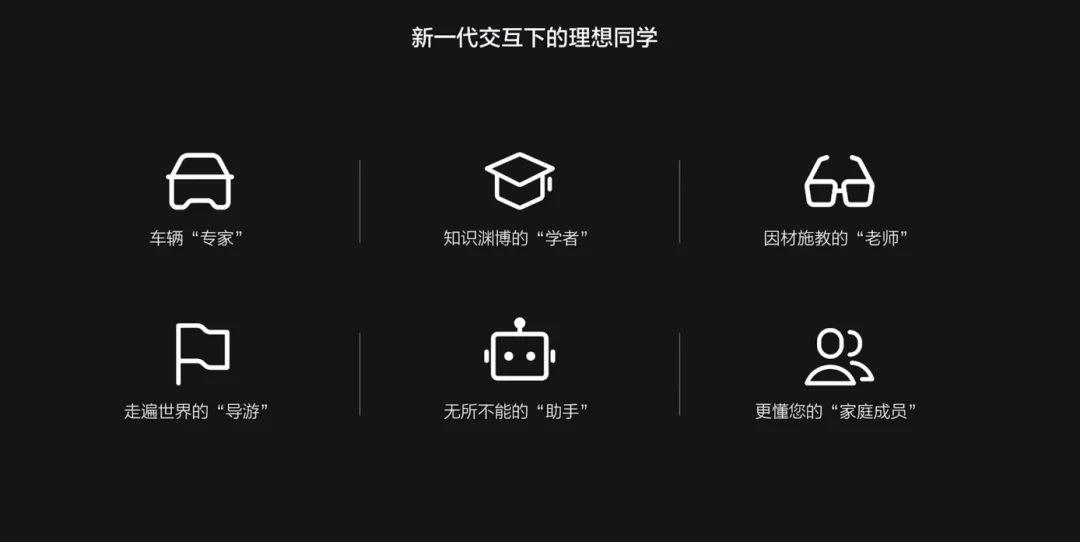
According to official statements, empowered by Mind GPT’s general capabilities, Lixiangtongxue can serve as a knowledgeable companion traveling the world, a professional vehicle steward, or an expert teaching users painting and programming, empowering every user with AI. Overall, through Lixiangtongxue, the capabilities brought by LLMs focus more on enhancements in entertainment and knowledge, aligning well with Li Auto’s positioning for family-oriented vehicles.
However, Mind GPT's actual capabilities are still under development. According to official statements, Lixiangtongxue, powered by large language models, is expected to be pushed to users via OTA before the end of 2023.
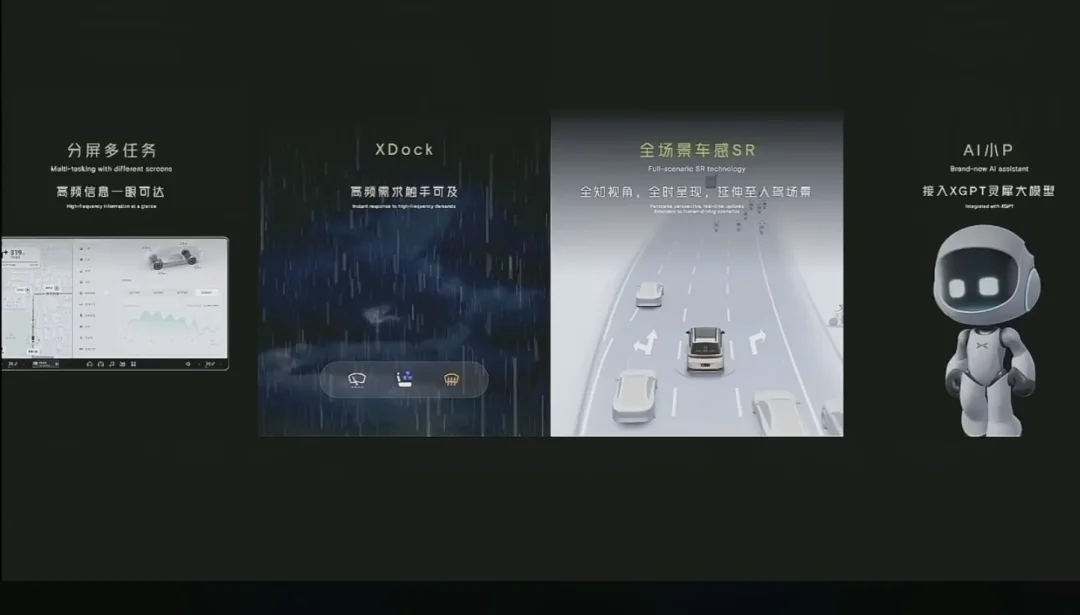
Outside of Li Auto, XPENG, a major player in the smart cockpit sector, also announced at its 1024 Technology Day that its self-developed XGPT large language model has been integrated into its voice system. The new AI Xiao P boasts over eight hundred skills, with significantly enhanced perception, understanding, and reasoning capabilities. According to XPENG, AI Xiao P will be equipped on the XOS Tianji smart cockpit system and will make its mass-production debut on the XPENG X9 MPV.
Additionally, NIO has also applied for trademarks such as "NOMIGPT" and "NIOGPT." At a small-scale communication session held recently, the company announced that NOMI has integrated a self-developed GPT model with up to 100 billion tokens, which will enhance NOMI's understanding and reasoning capabilities. However, the official side has not yet released specific details on how this self-developed GPT model will functionally empower NOMI.
Looking at the situation of the three leading new energy vehicle companies—NIO, XPENG, and Li Auto—they have all chosen to start with in-car voice assistants. By integrating AI large models, they provide capabilities such as dialogue, understanding, and content creation for these assistants. The value offered to users focuses more on knowledge interaction, information provision, and entertainment. Of course, when it comes to building these large models, all three companies emphasize that they are self-developed.
Outside the new-energy vehicle startups, some traditional automakers committed to transformation are also making unremitting efforts to embrace large models. Some have chosen in-house development, while others have opted for partnerships.
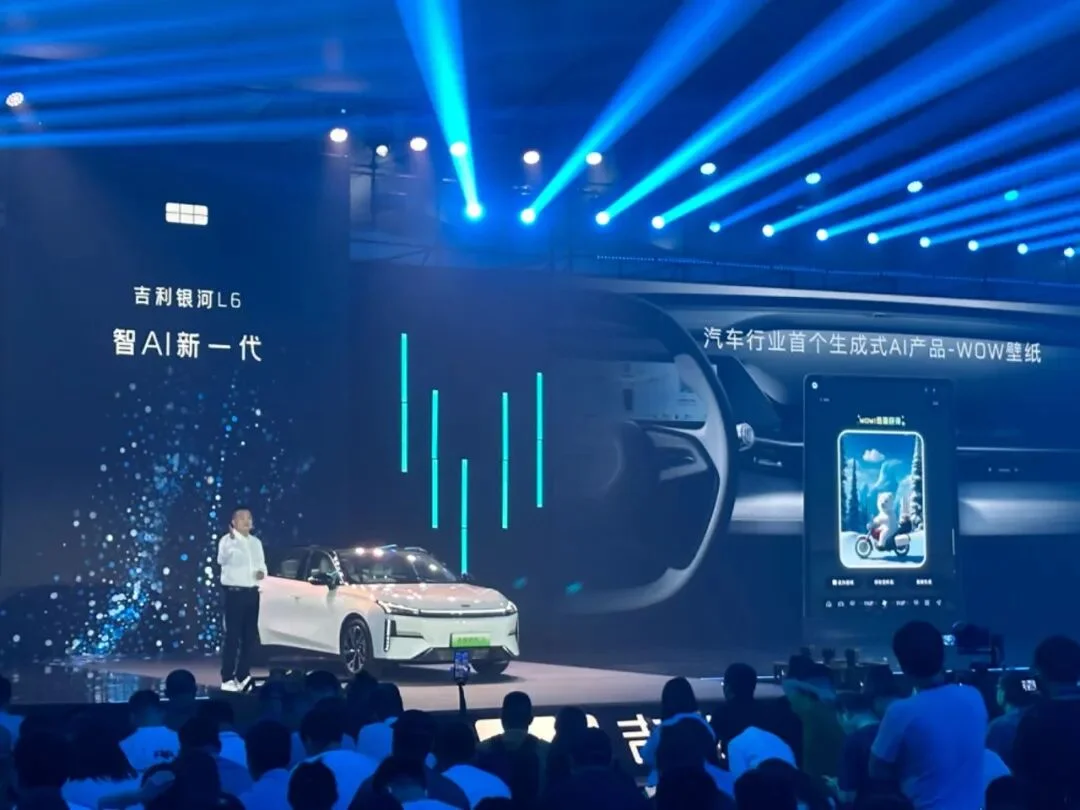
For example, Geely announced in July that it has developed a full-stack self-reliant AI large model technology. According to official statements from Geely, its all-scenario AI large model encompasses painting, music, language, and autonomous driving models, providing features such as AI intelligent interaction, AI music videos, AI children's picture books, and WoW wallpapers.
Furthermore, at the September launch event for the Geely Galaxy L6, Geely announced it had integrated its self-developed global first all-scenario AI large model for the automotive industry into the Galaxy L6. In practice, the feature currently deployed in the Galaxy L6 is the WoW wallpaper function, which offers a stronger user experience perception.
Additionally, in mid-August this year, Chery partnered with Kedaxunfei to announce that the Xinghuorenzhidamoxing would be the first large model to be integrated into the Xingjiyuan ES.
Based on this collaboration, the Xingjiyuan ES aims to create a voice assistant for users that is warm, caring, and considerate. It can plan travel itineraries, recommend favorite movies, and provide health consultation services tailored to individual needs. Its capabilities are oriented toward ChatGPT-like functionality; however, users will need to wait until the Xingjiyuan ES launches on November 30 to experience this more attentive voice assistant.
Of course, beyond the aforementioned manufacturers, many other automakers are also striving to access underlying large model technologies through the entry point of voice assistants.
Overall, within the smart cockpit framework, the implementation of large models in smart cockpits and voice assistants remains in the early exploratory stage. For it to truly reach a broader user base, a disruptive scenario is still required.
Previously, in a conversation with 42HOW Auto, He from XPENG stated that AI Xiao P, empowered by large models, is smarter and more engaging. It can perform highly entertaining functions such as continuous dialogue, drawing, and poetry writing, but these are not core competitive strengths. It addresses minor annoyances rather than major pain points.
Meanwhile, the Li Auto cockpit team told 42HOW Auto that their current exploration of large model implementation focuses on actual user driving experiences, seeking scenarios that align with genuine user needs. These scenarios are still under exploration. Li Ke, Product Director of SenseTime’s Jueying Smart Cockpit, emphasized that for large models to have a significant impact on the user side, they must be closely tied to frequently used user scenarios.
Nevertheless, empowering in-car voice assistants with large models is a direction no automaker dares to miss.
Chen Ye, founder and CEO of Hubokeji, who is currently collaborating with an unnamed automaker on large model integration for smart cockpits, told 42HOW Auto that the automotive industry has reached a high degree of product homogenization. The primary reason all major players are deploying large models in vehicles is to seek product differentiation through enhanced intelligence.
However, he believes that for large models to truly function within vehicles, time is still needed to develop a genuine killer app. This remains the direction in which numerous automakers are striving to explore.
An AI industry insider noted that automakers initially chose vehicle voice assistants as the entry point for large model deployment because this approach is relatively easier to implement and offers higher user visibility. In the long term, however, large models are likely to evolve into the vehicle’s “AI operating system” by tightly integrating AI capabilities with various driving scenarios, thereby unlocking new possibilities.
Smart Driving: The Promised Land for Large Models
Beyond smart cockpits, smart driving—the other key pillar of automotive intelligence—is also seeking breakthroughs and improvements under the technical framework of large models.
It is important to clarify a prerequisite here: The underlying technology supporting large models like GPT is the Transformer algorithm. Since its introduction in the paper Attention Is All You Need, Transformer has been widely applied in natural language processing. However, at Tesla’s AI Day in August 2021, Tesla first introduced Transformer into its autonomous driving algorithm architecture, establishing BEV+Transformer as the new paradigm for mass production in the autonomous driving sector.
Thus, connected via Transformer, there has always been a fundamental technical link between large models and autonomous driving. Consequently, some automakers refer to their BEV+Transformer perception architectures using terms such as “Transformer large model” or “the era of large models.”
This is understandable—but in practice, the current wave of large model integration into autonomous driving primarily occurred in 2023.
With the emergence of ChatGPT and the resulting fervor, the generalization capabilities demonstrated by GPT have prompted new reflections on model architecture in autonomous driving, leading to several experimental approaches.
Currently, Haomozhixing and XPENG are among the most active players in this space.
In April, Haomozhixing, closely associated with GWM, unveiled DriveGPT at its AI Day event—the industry’s first generative large model for autonomous driving. Drawing inspiration from GPT’s underlying principles, DriveGPT differs from ChatGPT in that it takes text sequences derived from fused sensor data as input and outputs text sequences representing autonomous driving scenarios. By tokenizing these scenarios into a "Drive Language," the system completes tasks such as ego-vehicle decision-making and planning, obstacle prediction, and the generation of decision logic chains.
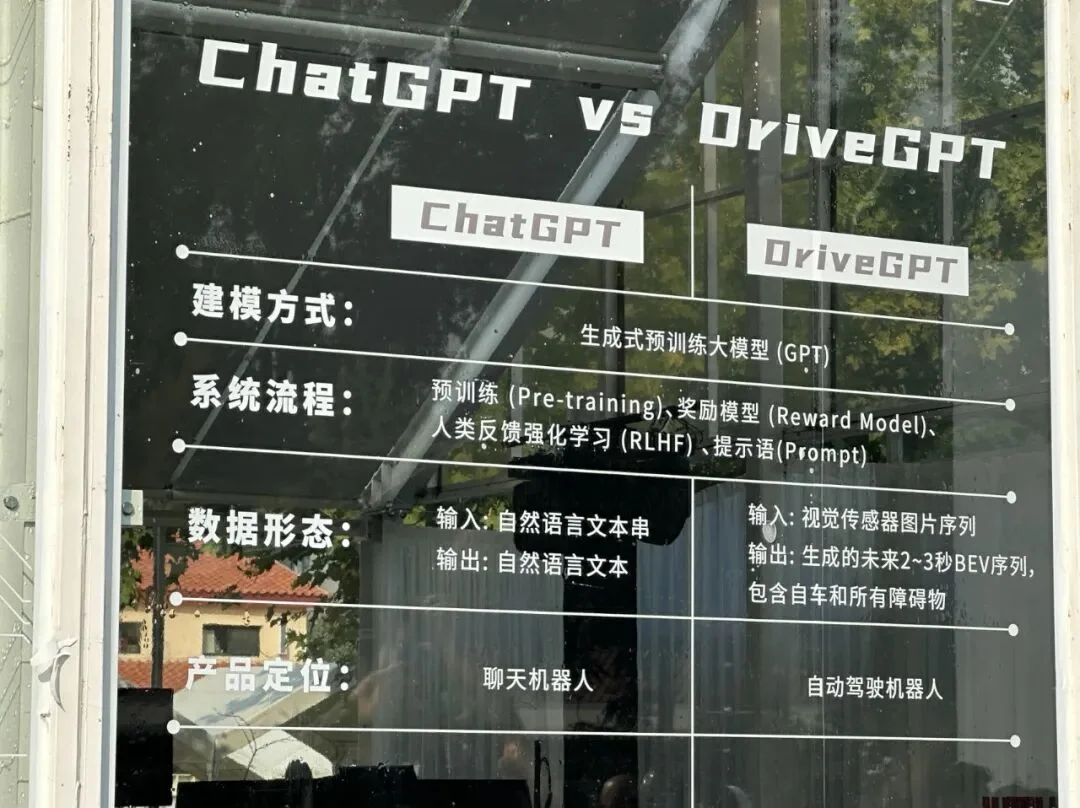
Six months later, Haomozhixing further showcased its exploration and breakthroughs in advancing autonomous driving AI through large models. For instance, in perception, DriveGPT employs a visual perception large model to learn from the real physical world, modeling reality into a three-dimensional space and adding temporal dimensions to create a 4D vector space. Building on this, Haomozhixing integrates open-source image-text multimodal large models to construct more universal semantic perception models, integrating text, image, and video information to align the 4D vector space with semantic space.
Simultaneously, during the cognition phase, DriveGPT uses driving language to describe driving environments and intentions. Combined with navigation guidance and the ego-vehicle’s historical actions, it leverages the vast knowledge base of external Large Language Models (LLMs) to assist in driving decisions—effectively endowing the autonomous system with common sense and reasoning capabilities akin to those found in human society.
Overall, Haomozhixing is introducing large model methodologies across perception, cognition, and decision-making stages. The goal is to enhance the universality and generalization of the autonomous driving system’s processing capabilities, making the overall system smarter.
Similarly, at XPENG’s 1024 Technology Day in October, XPENG incorporated large model capabilities into its newly released XNet 2.0 perception architecture. Specifically, powered by large models, XPENG’s XNet 2.0 can interpret text information on traffic signs, possess a sense of time, and understand the semantics of traffic elements specific to different cities—also aimed at increasing generalization at the perception level.
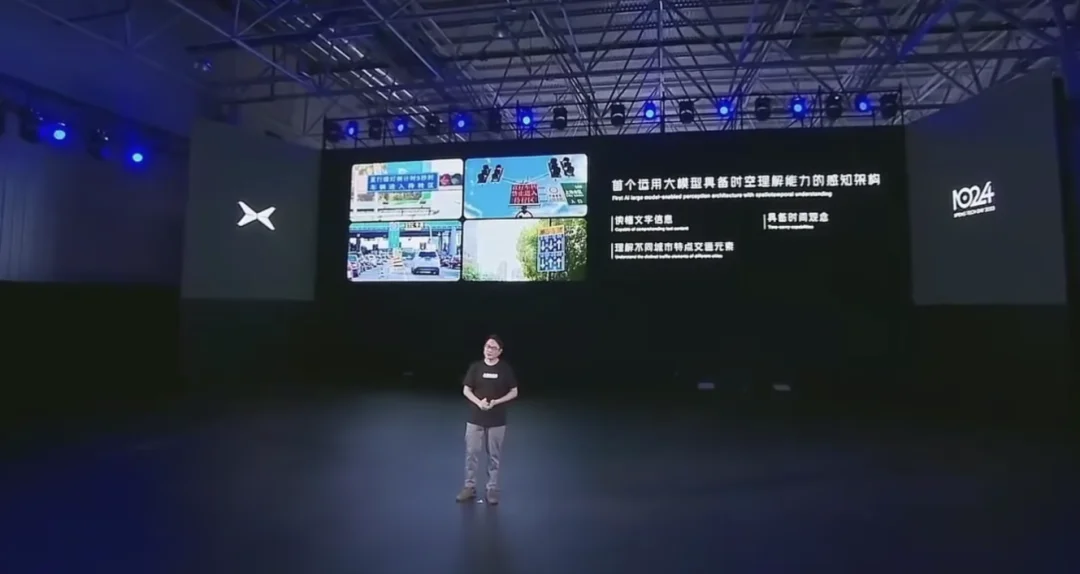
Indeed, the capabilities of large models have become an effective factor in XPENG's efforts to make Urban NGP available in more cities.
Notably, as autonomous driving technology continues to advance, end-to-end systems have emerged as another paradigm for development. Tesla is a typical representative, and some industry practitioners include the concept of end-to-end within the broader category of "large models."
In August this year, Elon Musk live-streamed the first demonstration of Tesla's FSD V12 system on social media. It is the world's first end-to-end AI autonomous driving system. Regarding this, Elon Musk stated that FSD V12 is entirely implemented through AI, with no lines of code written by programmers for road or pedestrian recognition; all processing is handled by neural networks.
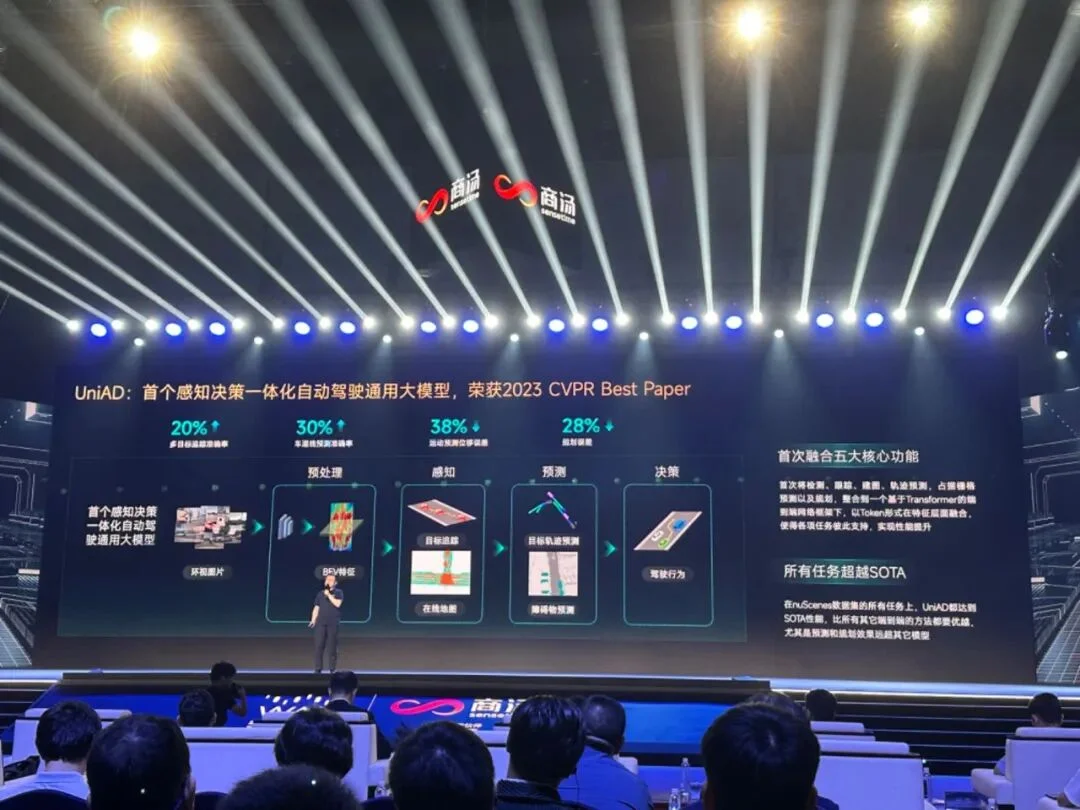
Highly consistent with Tesla's "end-to-end" approach is the paper Planning-oriented Autonomous Driving, which won the Best Paper award at CVPR, the international top conference on computer vision. The paper was jointly published by teams from Shanghairengongzhinengshiyanshi, Wuhandaxue, and SenseTime.
The paper primarily introduces UniAD, an integrated autonomous driving algorithm framework. Specifically, it consolidates various modules in autonomous driving algorithms—such as perception, prediction, and planning—into a single task-oriented end-to-end framework based on Transformer.
Regarding the significance of this paper, some autonomous driving industry insiders have called it "the light of autonomous driving." However, as an academic paper, it is still far from actual implementation. Notably, when introducing UniAD, SenseTime also used the term "autonomous driving general large model."
Yet, despite the varying definitions and implementation strategies for "large models" across automakers, end-to-end systems are emerging as a clear direction in autonomous driving. For instance, Haomozhixing has repeatedly emphasized at its AI Day events that end-to-end autonomous driving is its future goal. Zhang Yaqin, Dean of the Institute for Industry and Intelligence at Tsinghua University, stated that large AI models have ushered in a new technological paradigm shift from discriminative to generative AI. He noted that achieving the final stages of safety and reliability in autonomous driving will necessarily require an end-to-end approach.
However, ordinary users currently find it difficult to intuitively perceive the significant changes large models bring to intelligent driving. They may be waiting for what Elon Musk described as Tesla's "ChatGPT moment": a sudden breakthrough where millions of vehicles achieve full autonomous driving capability.
An industry observer who has long followed large language models told us that the current definition of large models in the industry is very chaotic and unclear.
Nevertheless, one thing is certain: the methodology and approach of large models represent a subversion of previous AI operational modes. Given AI's continuous empowerment of autonomous driving over the past decade, the development of large models is poised to bring revolutionary changes to the field and play a major role in driving the evolution of autonomous driving.
A Process Moving from Quantitative Change to Qualitative Leap Has Just Begun
Whether in intelligent driving or intelligent cockpits, automakers' embrace of large models points to a fundamental reality: in an intensely competitive environment, facing the trend of intelligent transformation, all automakers are highly anxious about falling behind their rivals in the race for AI technology.
The large models that went viral in 2023 have become a crucial lever they must grasp during this transformation process.
An AI researcher specializing in large models told 42HOW Auto that while large models themselves represent a key milestone in AI development with significant importance, the concept has been broadly generalized by the automotive industry. This widespread adoption will inevitably strengthen consumer awareness of the term. On another level, automakers' emphasis on and exploration of large models largely stem from the close integration occurring between the automotive industry and the AI sector—a trend that is unstoppable.
Of course, deploying large models does present certain technical challenges.
From a technical perspective, large models inherently require substantial computing power and vast amounts of data. Their native development and optimization environments are better suited for the cloud, whereas vehicles have severely limited computing resources and data storage capacity. Consequently, integrating large models into vehicles is a high-barrier undertaking from both R&D and deployment standpoints.
In other words, large model technology first requires a sufficiently robust cloud computing hardware infrastructure, followed by effective implementation in specific vehicle scenarios through capabilities such as "edge-cloud deployment."
This poses a significant test for traditional automakers, while companies that have already established computing foundations—such as new-energy startups—find it relatively easier. For enterprises like Huawei, which have strong deployments spanning from cloud to edge, this represents a considerable advantage.
Therefore, as automakers embrace and explore large models, they must not only fully consider user value but also maintain sufficient strategic resolve.
After all, in the long term, as the latest achievement of the AI era, large models are bound to bring a certain degree of certainty and value to the automotive industry.
Chen Ye, founder and CEO of Hubokeji, believes that large models are like a door leading to the future, offering infinite opportunities and possibilities for automotive intelligence, whether in smart cockpits or autonomous driving. This means that automakers must invest in this area to seize potential opportunities; otherwise, they will miss out entirely.
An individual involved in large model R&D at a leading new-energy automaker told us that, beyond the obvious applications, there is a latent motivation for automotive tech departments to actively research large models: the pursuit of artificial general intelligence (AGI), which is a dream long cherished by engineers.
Overall, from the current perspective, although the practical user-experience value delivered by AI large models remains in its early exploratory stages, realizing their true potential on vehicles will likely require automakers to continuously advance through the intersection of technological progress and evolving user needs.
However, looking ahead, the impact of this technology on both automotive products and the broader industry will be profound. It represents an inevitable trend that every automaker must confront. From this viewpoint, empowering cars with large models requires a lengthy process of quantitative accumulation before reaching a qualitative leap—the AGILINK.
So, how long will this process take?
The answer remains uncertain. It could take three to five years, or perhaps as long as ten. But one thing is clear: whether willing or not, automakers have already been drawn into the era of AI large models, either passively or proactively. They must now traverse this long, destination-unknown track. Yet, before they can reach that AGILINK, they must first survive the increasingly brutal competition in the automotive market.
Written by: 308 Edited by: Daji