


Huawei Launches Airport Valet Parking Pilot; Li Auto Opens German R&D Center
01Weekly Index
02Weekly Highlights
Huawei Valet Parking Driver Commercial Pilot Launches at Shenzhenjichang
On January 15, 2025, Huawei launched the Valet Parking Driver (Valet Parking Driver) commercial pilot for valet parking at Shenzhenjichang. Drivers can activate the "one-key parking" feature via a mobile app, and the vehicle will autonomously drive to an empty parking space, independently avoiding obstacles and yielding to pedestrians during the process. After completing the journey, drivers can summon the vehicle through the same app, and it will automatically proceed to the designated pickup point to transport them. This is the global first commercial pilot of Huawei's Qiankun Intelligent Driving Valet Parking Driver VPD at an airport.
Huawei's Qiankun VPD valet parking technology does not require pre-memorization of parking spaces or routes; the vehicle can autonomously navigate to a target space upon its first entry into an unfamiliar parking lot.
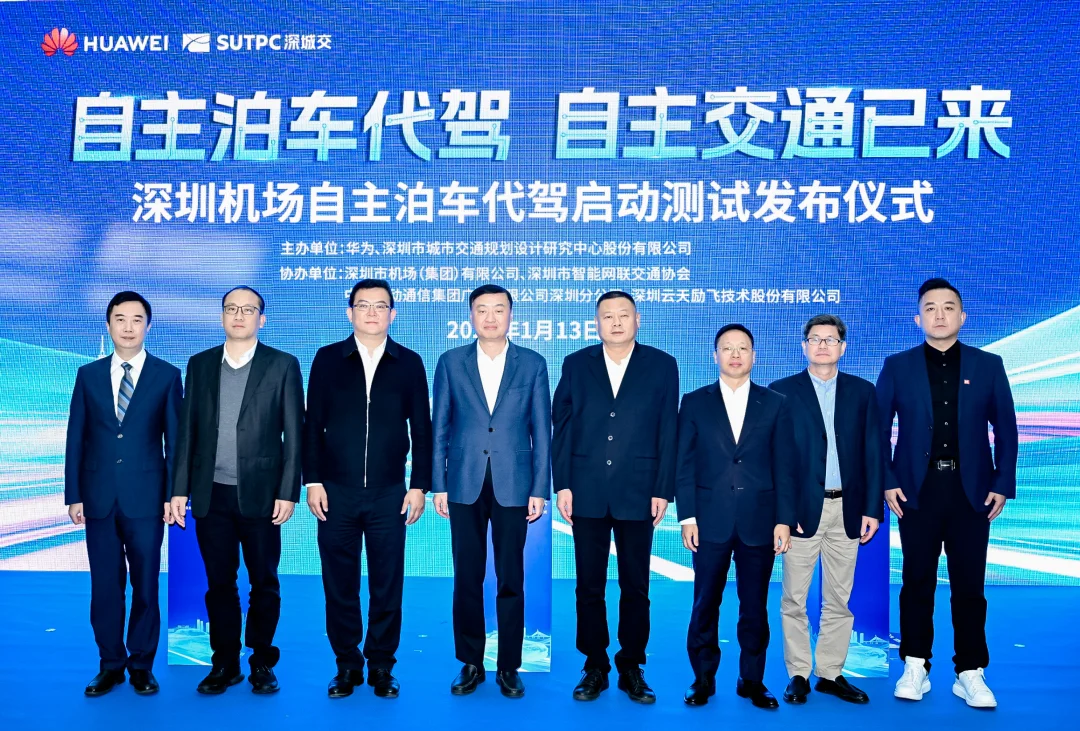
Jin Yuzhi, CEO of Huawei's Intelligent Automotive Solution BU, stated that the VPD valet parking solution is universally applicable and imposes no requirements on the venue. It may be deployed in more scenarios in the future, such as shopping malls, hospitals, and high-speed rail stations, and can also be applied to scenarios like automatic charging and automatic car washing.
The official source has not yet explicitly determined liability for the accident. However, in general practice, responsibility attribution for intelligent driving systems must be established based on the specific causes of each incident and applicable laws and regulations.
Quick Review:
Huawei's launch of the VPD valet parking commercial pilot at Shenzhenjichang marks a significant advancement in intelligent driving technology, particularly with notable advantages in improving travel efficiency and enhancing airport parking experiences. Through intelligent parking, travelers not only save time searching for parking spaces but also increase the space utilization rate of airport parking lots. The promotion of this technology is expected to drive the popularization of smart transportation, with future expansion to more public venues. As consumer demand for intelligence increases, the widespread adoption of high-level intelligent driving systems will promote the automotive industry's development towards greater intelligence and convenience, further transforming travel methods.
Li Auto Establishes German R&D Center
On January 17, 2025, Li Auto held the opening ceremony for its German research and development center in Munihei. This is Li Auto's first R&D center established overseas, marking a significant step in the company's globalization strategy. Government officials including Qiu Xuejun, Consul General of the Chinese Consulate in Munihei, and Markus Wittmann, State Secretary of the Bavarian State Ministry of Economic Affairs, attended the ceremony. Donghui Ma, President of Li Auto, stated that the German R&D center will drive technological innovation, particularly in forward-looking styling design, power semiconductors, intelligent chassis, and electric drive systems, working together with the Chinese R&D team to advance global technological development.
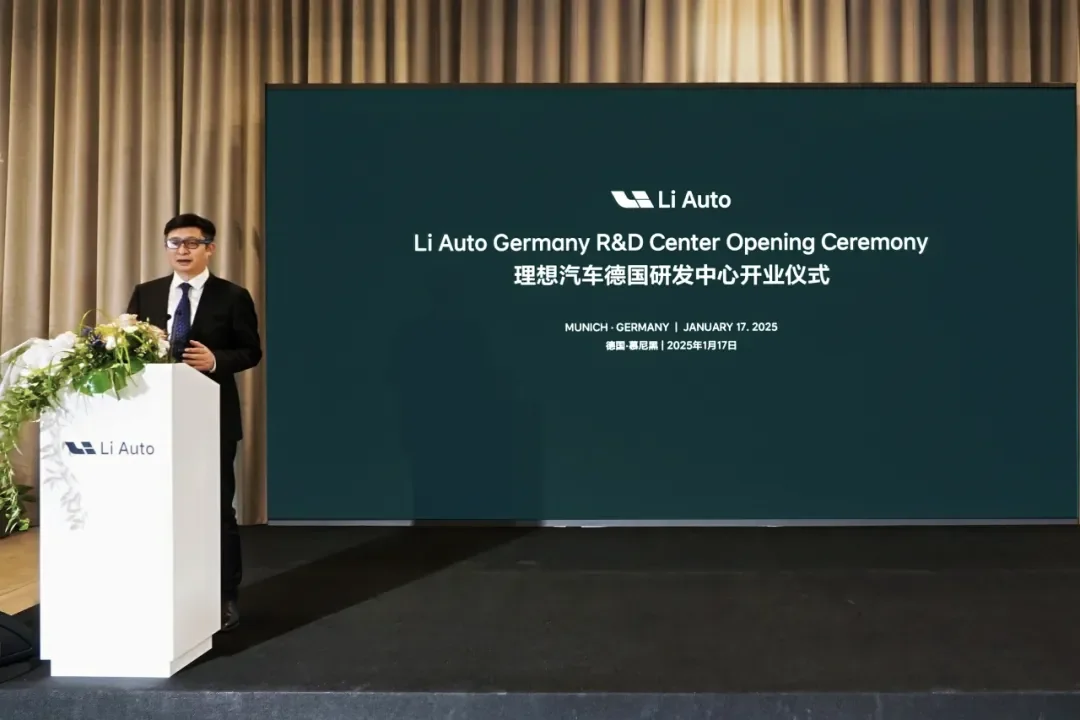
This R&D center will help Li Auto deepen its research and development of intelligent and electrification technologies, while localizing adaptations for the European market to meet diverse user needs. Furthermore, Li Auto has long adhered to a strategy of self-reliance in core technologies, achieving significant progress particularly in autonomous driving and artificial intelligence. By continuously increasing R&D investment, Li Auto aims to drive technological innovation globally, further enhancing its competitiveness in the smart electric vehicle sector.
Quick Review:
Li Auto established its first overseas R&D center in Munihei, Germany, marking a significant step in its globalization strategy. This move not only reflects a firm commitment to technological innovation and a global perspective but also serves as a key strategic placement in Li Auto's global market layout. The German R&D center will focus on four major areas: forward-looking design, power semiconductors, intelligent chassis, and electric drive systems, working closely with domestic teams to advance the development of next-generation technologies. Additionally, the center will help Li Auto gain insights into the European market and establish development and testing capabilities compliant with European regulations to meet local needs. This strategic layout not only enhances Li Auto's global competitiveness but also injects new vitality into Sino-German automotive industry cooperation.
Rumors of "Xiaomi Acquiring NIO" Debunked
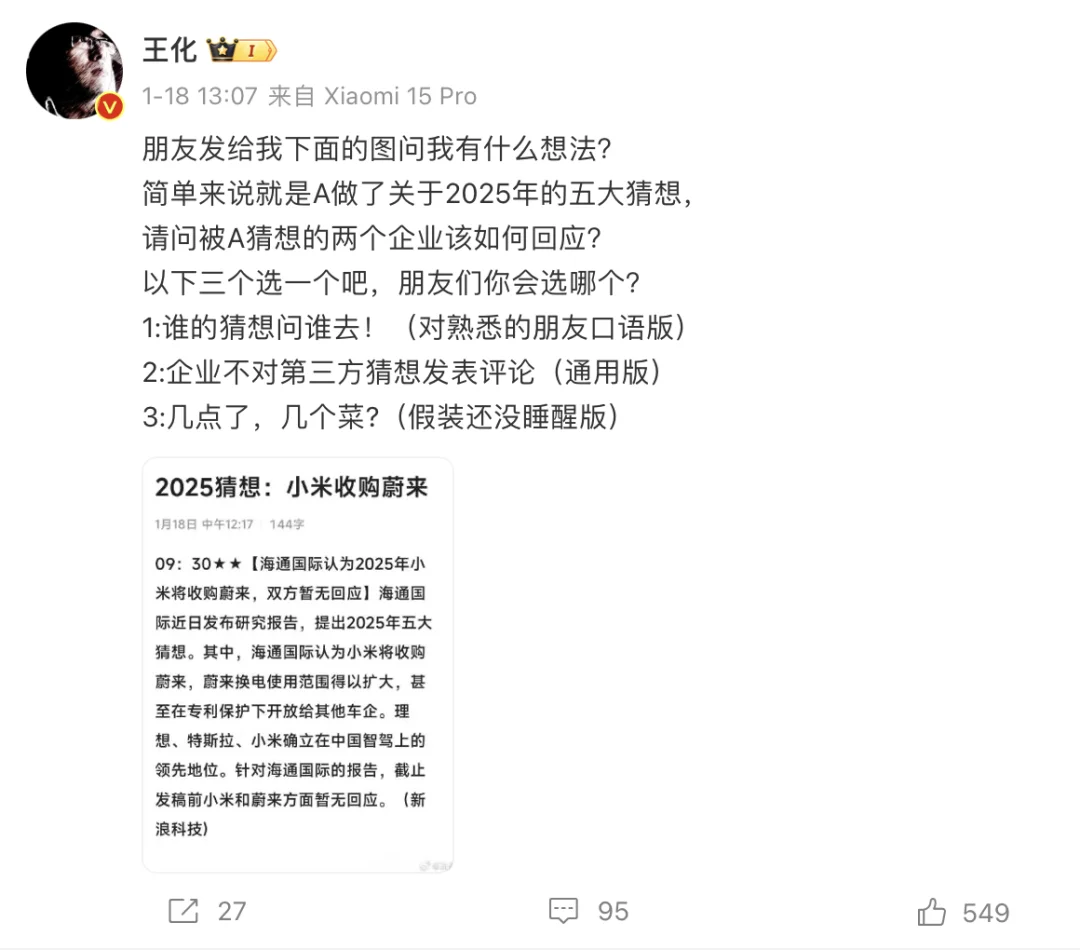
On January 18, Haitongguojizhengquan released a research report outlining five predictions for 2025, with the most attention-grabbing being that Xiaomi would acquire NIO. The report suggested that if such an acquisition occurred, NIO’s battery swap technology could see broader application and be opened to other automakers under patent protection. The news sparked significant interest, prompting executives from both NIO and Xiaomi to quickly debunk the rumors.
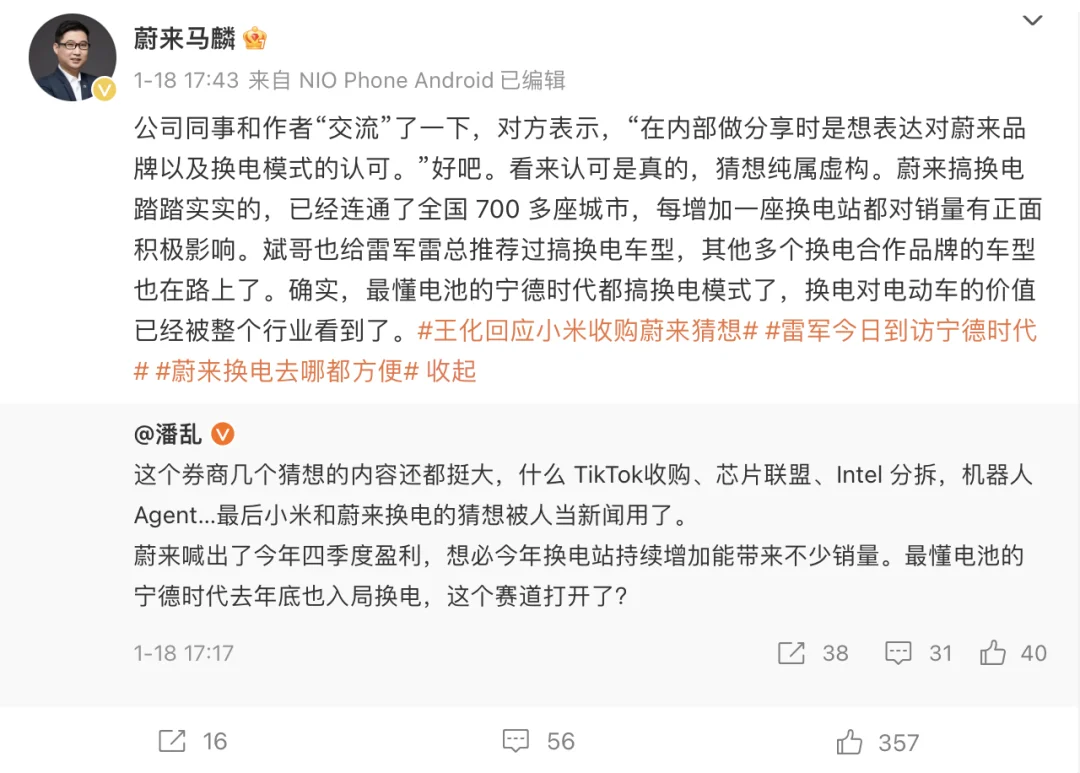
Ma Lin, head of brand communication and marketing at NIO, stated that the speculation is "purely fictional." He pointed out that NIO has made significant progress in battery swapping, with swap stations covering more than 700 cities nationwide, which has had a positive impact on sales. He also mentioned that NIO founder William Li had recommended battery-swapping vehicles to Xiaomi founder Lei Jun, and that NIO is collaborating with other brands to advance battery-swapping technology.
Xiaomi Group Public Relations Director Wang Hua responded with humor, proposing three possible replies: "Ask whoever made the speculation," "Companies do not comment on third-party speculations," and "What time is it? How many dishes are there?" This indirect response signals Xiaomi's lack of endorsement for the unverified rumor.
Commentary:
Both NIO and Xiaomi are at critical stages of development. NIO is working to consolidate its premium brand image through battery-swap technology, while Xiaomi is focused on its goal of delivering 300,000 vehicles in 2025. Their strategic priorities are clear, making the acquisition rumors appear as pure market speculation rather than based on actual strategic layout. NIO's battery-swap network has grown significantly, and CATL's recent high-profile entry serves as strong validation for the swap model; consequently, skepticism toward battery swapping may diminish further.
Hechuangqiche Listed as a Dishonest Judgment Debtor
According to Zhongguozhixingxinxigongkaiwang (China Judicial Execution Information Disclosure Network), on January 16, Hechuangqiche Technology Co., Ltd. was listed as a dishonest judgment debtor by Guangzhoushinanshaqurenminfayuan (Guangzhou Shi Nan Sha District People's Court) for refusing to perform an execution settlement agreement without justified reasons. The case involves a service contract dispute, with the fulfillment status recorded as fully unfulfilled. The effective legal documents stipulate that the debtor must pay the applicant a total amount of RMB 2,120,556.
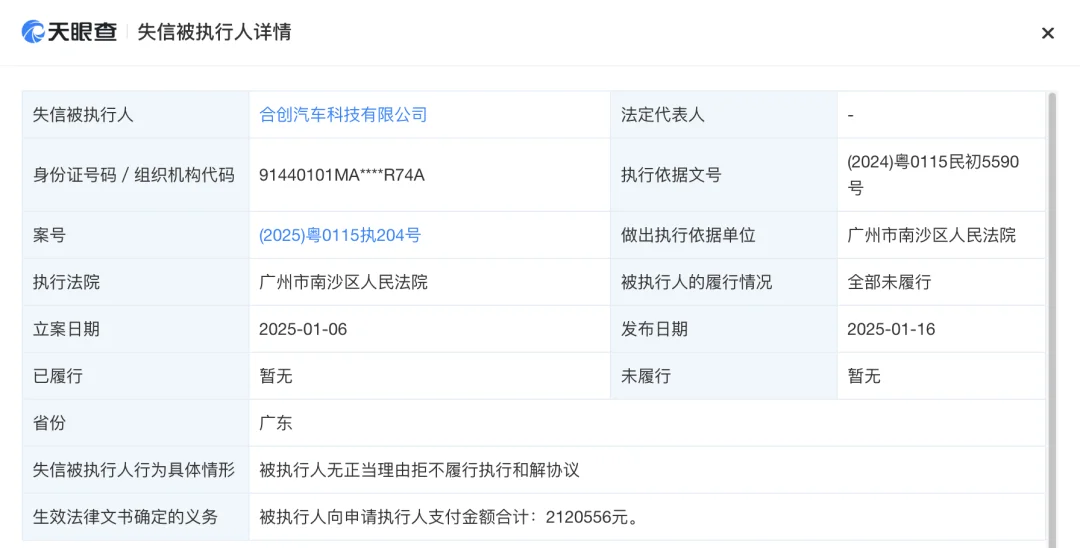
Hechuangqiche is jointly held by Guangdongzhutouzhinengkejitouziyouxiangongsi, Guangqiaianxinnengyuanqichegufenyouxiangongsi, and Guangqijituan. Data shows that as of the end of November 2024, Hechuangqiche's total assets reached RMB 5.299 billion, with total liabilities of RMB 4.925 billion, resulting in a debt-to-asset ratio of 92.94%.
In 2023 and the first 11 months of 2024, Hechuangqiche's operating revenues were RMB 2.441 billion and RMB 618 million, respectively. The company reported net losses of RMB 1.84 billion and RMB 1.13 billion for these periods, accumulating approximately RMB 3 billion in losses over the past two years.
On January 10 this year, Guangqijituan announced it would provide shareholder loans to Hechuangqiche shareholders in proportion to their equity stakes, specifically designated for paying employee wages and economic compensation. Additionally, GAC Aion (Guangqiaianxinnengyuanqichegufenyouxiangongsi) was entrusted to take over Hechuangqiche's product after-sales service business.
Commentary:
Being listed as a dishonest judgment debtor not only negatively impacts Hechuangqiche's market credibility and brand image but may also further restrict its future financing and business expansion capabilities. Although Guangqijituan has decided to provide special loans in proportion to equity stakes to fulfill social responsibilities toward employees and consumers, whether this measure can fundamentally resolve Hechuangqiche's funding issues remains to be seen.
This incident involving Hechuangqiche reflects potential challenges such as broken capital chains and poor management faced by the new energy vehicle industry during its rapid development. It serves as a warning to other automakers: while pursuing scale expansion, they must strengthen internal management and risk control to ensure sustainable development.
Written by: Dayong Edited by: James