How Chinese EV Speed Is Reshaping Qualcomm's Automotive Roadmap
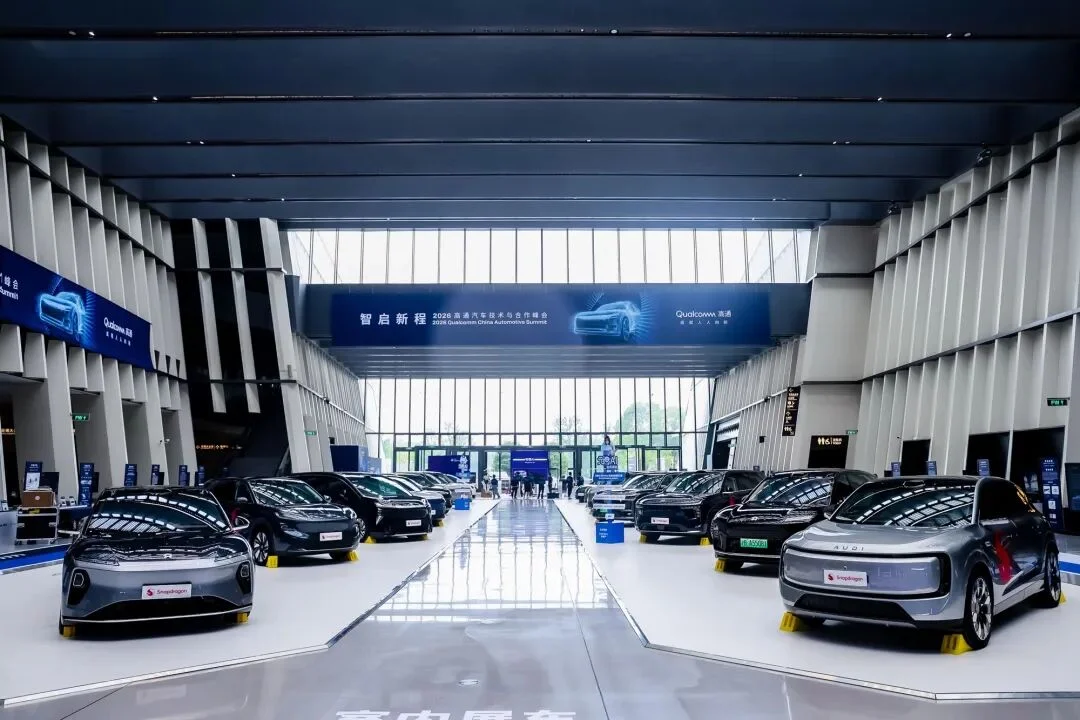
If we rewind ten years, few would have predicted that Qualcomm would one day build its automotive business roadmap around the Chinese market.
In the smartphone era, Qualcomm was the rule-maker. It defined the technological direction, leaving device manufacturers to follow.
But in the smart car era, the situation is changing.
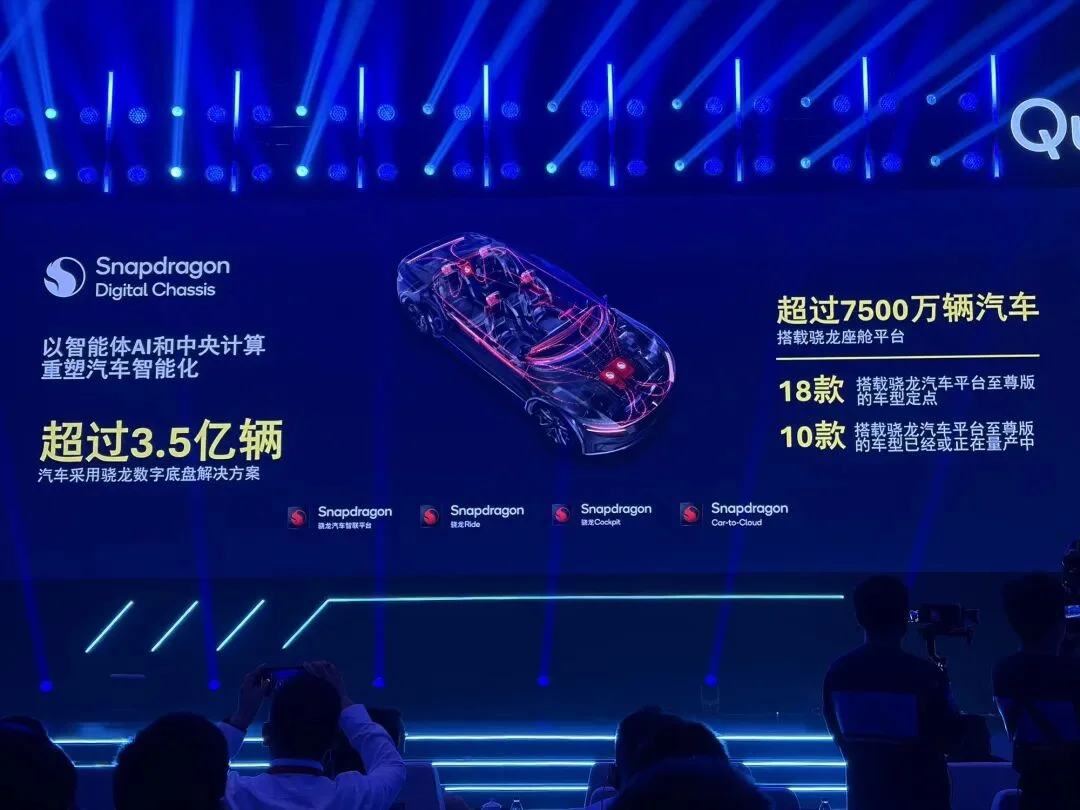
Latest data shows that globally, more than 350 million vehicles have adopted the Snapdragon Digital Chassis solution, with 75 million equipped with the Snapdragon Cockpit Platform. In China alone, since 2021, over 300 intelligent connected vehicles have been built on the Snapdragon Digital Chassis.
As Qualcomm becomes increasingly integrated into China’s automotive supply chain, it is also being influenced by the industry more and more.
At the 2026 Qualcomm Automotive Technology and Partnership Summit, Nakul Duggal, Executive Vice President of Qualcomm Technologies and General Manager of the Automotive, Industrial & Embedded IoT and Robotics Business Unit, repeatedly mentioned a key phrase: 'China speed.'
This statement does more than highlight that Chinese automakers are at the forefront of intelligent vehicle technology; it is also driving overseas manufacturers to advance at a comparable pace.
Over the past few years, during which smart vehicles have seen explosive growth, Qualcomm has focused on several key initiatives:
Making cockpit chips such as the 8155 and 8295 standard across intelligent vehicles, from entry-level models priced around RMB 100,000 to luxury vehicles costing over RMB 1 million, all powered by a single chip.
Pursuing a cost-effective strategy with the 8620 and 8650 chips, even as the high-end market for driver assistance systems has been largely dominated by competitors like NVIDIA and Huawei.
Preparing for the arrival of the AI Agent era by deploying large language models locally through chips such as the 8397, 8787, and 8797, while simultaneously achieving cockpit-driving integration. In Qualcomm’s latest chip lineup, there are no longer separate chips dedicated solely to the cockpit or driver assistance; all support integrated cockpit and driving functions.

It is evident that Qualcomm’s product iteration must outpace the evolution of intelligent vehicles. This implies that rapid iteration in smart cars requires collaboration among automakers, suppliers, and Qualcomm. Because independent Chinese brands’ intelligent vehicles lead the industry, they are now shaping Qualcomm’s automotive roadmap.
During the 2026 Qualcomm Automotive Technology and Partnership Summit, 42HOW Auto and other media outlets jointly interviewed Nakul Duggal, Executive Vice President of Qualcomm Technologies and General Manager of the Automotive, Industrial & Embedded IoT & Robotics Business Group, and Anshuman Saxena, Vice President of Qualcomm Technologies and General Manager of the ADAS and Robotics Business Group. They addressed topics including cockpit-driving integration, the implementation of AI, and price competition in the Chinese market.
01'Chinese Speed' Shapes Qualcomm's Automotive Roadmap
In recent years, Qualcomm's automotive business has experienced rapid growth and a comprehensive transformation, with the Chinese market undoubtedly serving as its largest innovation hub.
Nakul acknowledged a specific timeline during his presentation: when he and his team arrived in China in July 2023, ADAS was in its early explosive growth phase in the country. "I heard them talking about memory driving, 5V5R, highway NOA, and city NOA. At that time, we had not yet collaborated with Chinese ecosystem partners on ADAS," he said.
Today, several years later, Qualcomm has enabled nearly 40 Chinese automakers and tier-1 suppliers to adopt its driving assistance and cockpit-driving integration solutions through its continuously evolving Snapdragon Ride platform. Behind this speed lies the extremely tight deployment cycles demanded by Chinese automakers. Nakul highlighted a real-world example: Leapmotor completed mass production of its solution based on the Snapdragon Ride Elite platform in just approximately six months after receiving it.
To adapt to this 'Chinese speed,' Qualcomm had to reconstruct the underlying logic of its chip development. Nakul revealed that Qualcomm made a key prediction about three years ago: 'Given the pace of AI expansion, separating infotainment systems from ADAS systems is unreasonable.' This is because both require access to sensor data and are processed by AI.
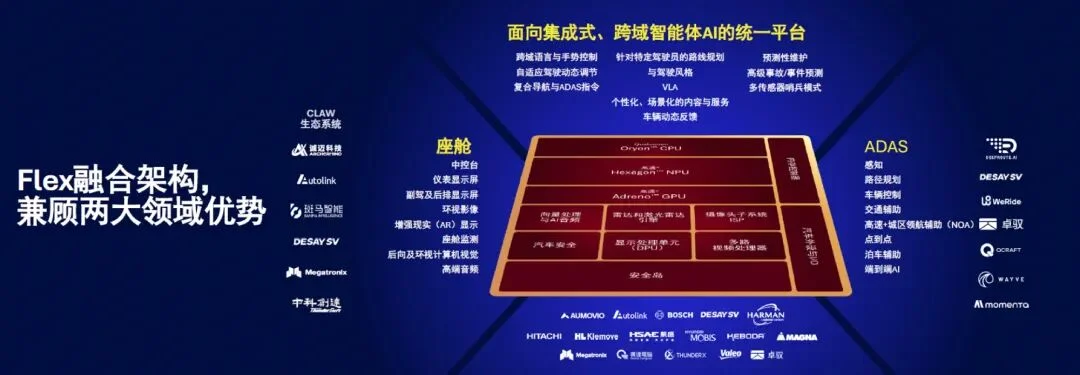
Based on this prediction, Qualcomm developed the Flex cockpit-driving integration platform, which enables the parallel operation of cockpit and ADAS functions on a single chip while achieving binary compatibility, allowing automakers to directly migrate software development efforts from previous generations to next-generation chips.
It is evident that the Chinese market's demand for extreme efficiency, rapid mass production, and cost control has compelled Qualcomm to quickly expand its layout in central computing and cockpit-driving integration.
02Building Platforms, Not Software
In the fiercely competitive automotive computing power arena, players employ diverse strategies. Some tech giants leverage deep algorithmic moats to dominate advanced driver assistance systems (ADAS), while domestic manufacturers secure significant market share by offering highly customized hardware-software integration services. In contrast, Qualcomm’s approach is more restrained and clear: it focuses on foundational infrastructure.
Nakul stated, 'For the Chinese market, we will not develop or provide any ADAS software stacks. Therefore, our primary method for delivering ADAS capabilities relies on the strength of our partners.'
Regarding hardware refinement, Nakul emphasized that Qualcomm decided three years ago to 'over-specify its chips.' To uphold the safety-first nature of automobiles, Qualcomm integrates functional safety into the product design from the outset, provides dedicated acceleration for the Neural Processing Unit (NPU), and runs it on the Oryon CPU.
In terms of ecosystem building, Qualcomm adopts an open stance. Nakul described this attitude with three words: openness, listening, and humility.
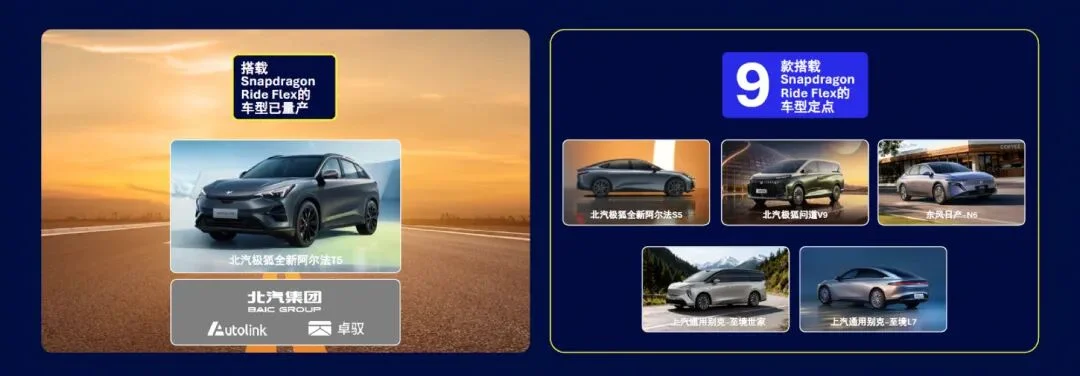
The Arcfox Alpha S5, already on the market, is equipped with the Snapdragon 8775 (Flex platform) chip, marking it as the first mass-produced vehicle to use the 8775. In this project, Qualcomm provided the foundation, while Autolink and Zhuoyu Technology, long-standing partners, leveraged their respective strengths to enable rapid deployment for BAIC.
03Betting on AI
If the past few years have been defined by vehicle connectivity and raw computing power, then as we stand at the 2026 milestone, the industry is rapidly shifting from software-defined vehicles to AI-defined vehicles. Qualcomm’s strategic layout for the next decade was fully unveiled at this summit.
First, AI is making a comprehensive leap from being 'reactive' to becoming 'agents.' With the remarkable advancement of Vision-Language Models (VLMs), vehicles are beginning to 'imagine' and predict their surrounding environments. Nakul believes that the current core challenge is enabling AI agents to proactively solve problems for users by accessing personal knowledge graphs, vehicle hardware, and cloud information, provided they have proper authorization.
To seize this track, Qualcomm jointly announced the 'In-Vehicle AI Claw Ecosystem Initiative' with several Chinese enterprises, including Archermind, Autolink, and Banma Intelligence. Meanwhile, Qualcomm has deepened its cooperation with Banma Intelligence to actively explore new use cases for covering in-vehicle mobile experiences with advanced large models such as Qwen, investigating the synergy between cloud and edge computing.

Secondly, the application boundaries of AI are expanding significantly. The value of applying AI within the vehicle extends far beyond the cabin experience itself, reaching into various scenarios throughout the vehicle's entire lifecycle. For example, by deploying the machine learning operations platform Edge Impulse inside the car, vehicles can run models locally to provide real-time insights, thereby optimizing predictive maintenance and reducing warranty costs.
Finally, Qualcomm has not overlooked cutting-edge connection technologies such as satellite communications, viewing them as essential means for vehicles to stay connected in areas with poor signal coverage. The company continues to drive the development of in-vehicle connectivity modules.
Five years ago, when Qualcomm began contemplating the ecosystem of China’s intelligent connected vehicle industry, it was still a process of step-by-step exploration. Today, the immense energy gathered from the long-term focus of China’s automotive industry on electrification, intelligence, and AI evolution has triggered a deep chemical reaction with Qualcomm’s underlying computing power. Chinese automobiles are using their own speed and ambition to reverse-define Qualcomm’s future course; meanwhile, Qualcomm is using this continuously evolving computing foundation to support the next decade of rapid advancement in automotive intelligence.


By James Edited by Daji