


Chinese EV Makers Battle for 'Parking-to-Parking' Autonomous Driving Experience
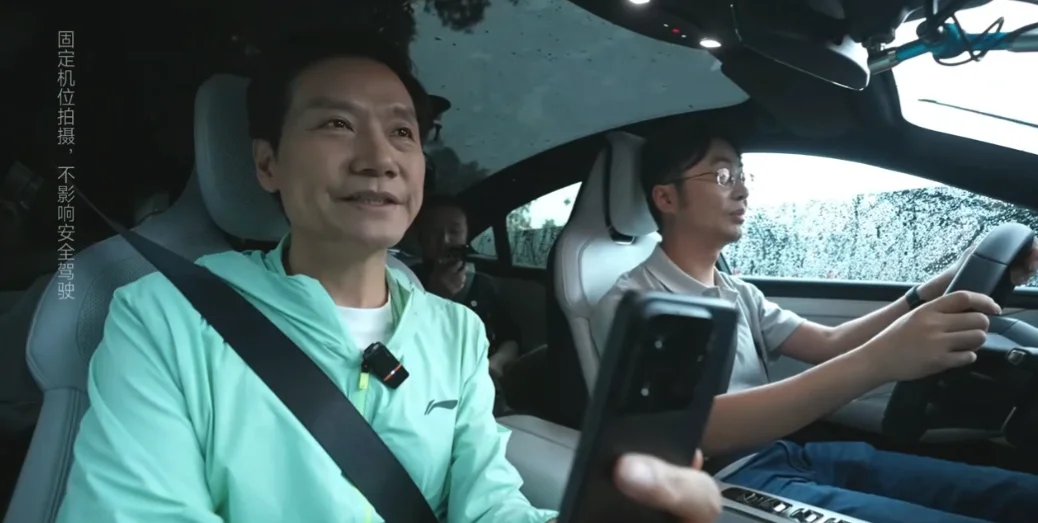
On the afternoon of November 14, the day before the start of the Guangzhou Auto Show, this traffic feast in the automotive circle, Xiaomi Chairman Lei Jun personally went live, driving a Xiaomi SU7 out of its parking space, through the gate, onto the road, and into the garage... demonstrating the high-level intelligent driving capability from parking space to parking space developed by Xiaomi based on an end-to-end solution.
Ten minutes into the broadcast, more than 70,000 viewers had already tuned in to Lei Jun’s WeChat Channels account alone. As this traffic-driven livestream continued its relentless pace, a fierce battle for autonomous driving supremacy—fought within the octagon of the Guangzhou Auto Show and erupting among automakers—officially began.
In this head-to-head competition, following Huawei's release of its parking-to-parking intelligent driving system in August this year, Li Auto, XPENG, Xiaomi and others at the Guangzhou Auto Show all pointed to parking-to-parking as the key milestone for deploying advanced intelligent driving.
Notably, in addition to the top-tier intelligent driving companies such as Huawei, Li Auto, and XPENG, Changcheng and Xingtu have also released their own end-to-end intelligent driving systems that can operate nationwide.
Reviewing the information released by various automakers at the Guangzhou Auto Show, "end-to-end" has basically shifted from a debate over technical routes earlier this year to a competition in practical experience. Judging by the moves of leading autonomous driving companies, the core of this practical experience competition is parking-space-to-parking-space capability.
Identical Application Scenarios, It's All About Experience Value
Unlike previous auto shows, this time automakers have placed significant emphasis not only on technical routes and capabilities but also on the practicality and experiential value of intelligent driving.
First, let’s look at Huawei. At this year’s Guangzhou Auto Show, Huawei did not disclose extensive details about its intelligent driving technology. However, during the press conference, Huawei emphasized the value of its intelligent driving systems in reducing driver fatigue and enhancing safety.
Richard Yu, Chairman of Huawei’s Intelligent Automotive Solution BU, shared a story about one of his classmates. According to Richard Yu, the classmate owns a BMW 7 Series but drove a Stelato S9 for an entire day during the National Day holiday to visit his mother-in-law. After the trip, the classmate remarked that driving the BMW 7 Series for a full day would have been exhausting.
Additionally, the host at the press conference presented a statistic: HarmonyOS Intelligent Driving has accumulated 930 million kilometers of autonomous driving mileage in just one year, equivalent to circling the Earth’s equator more than 23,000 times.
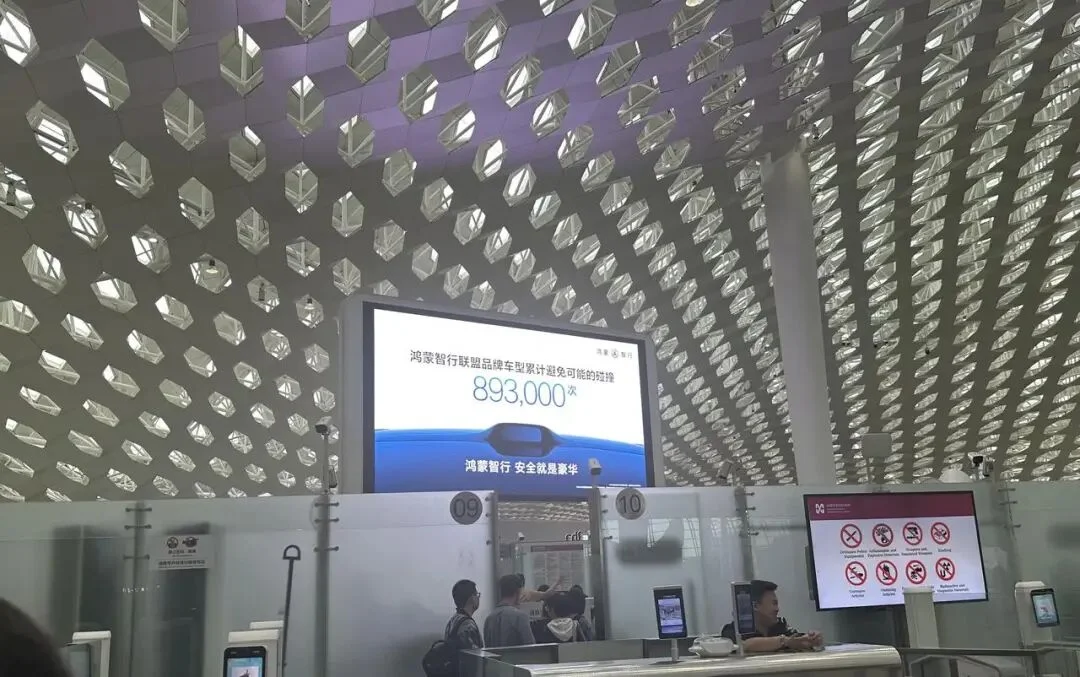
Furthermore, if you have recently visited Shanghai Hongqiao International Airport or Shenzhen Bao’an International Airport, you may have noticed billboards for the HarmonyOS Intelligent Driving Alliance brands. The ads stated that these brands have cumulatively avoided 893,000 potential collisions.
During the Guangzhou Auto Show press conference, Richard Yu also cited the figure of 893,000, noting that it increases daily. This helped concretize the safety value brought by Huawei’s intelligent driving systems.
Li Auto mentioned similar data.
According to official figures from Li Auto, its active safety system has cumulatively avoided over 3.6 million potential hazards. Following the full rollout of its end-to-end plus VLM (Vision-Language Model) intelligent driving system on October 23, Li Auto announced at the Guangzhou Auto Show the launch of a 10,000-person beta program and the distribution of test vehicles for its “parking spot to parking spot” intelligent driving feature.
In terms of specific capabilities, Li Auto’s parking-to-parking autonomous driving allows users to activate the system with a single tap while parked. It supports autonomous entry and exit from residential communities and industrial parks, automatic recognition of barrier gates to lift them, navigation through roundabouts, U-turns, and autonomous ETC passage at toll stations nationwide.
According to Li Auto’s plan, this feature will be pushed to all AD Max users by the end of November.
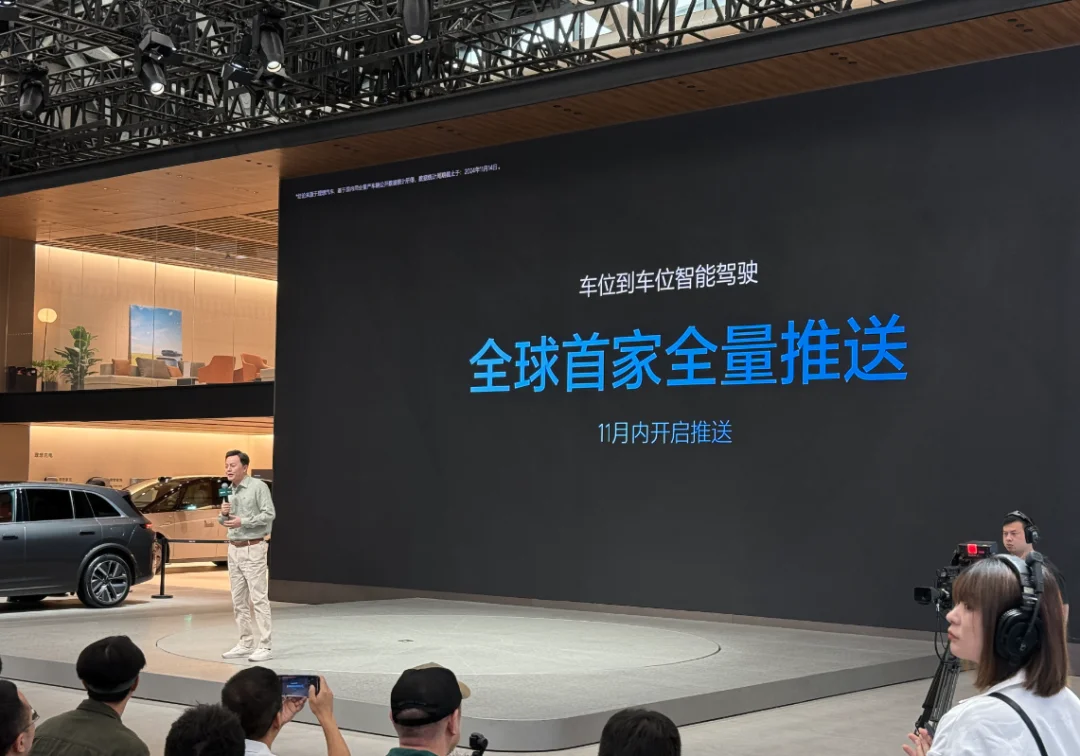
Compared with Huawei and Li Auto, Xiaomi, as a latecomer, made bolder moves in promoting its autonomous driving technology at the Guangzhou Auto Show, with a denser and more compact schedule.
The day before the show, Xiaomi livestreamed demonstrations of its parking-to-parking autonomous driving capabilities for users to see. Then, on the day of the show, Lei Jun formally unveiled the feature in a manner resembling a comprehensive report.
Regarding specific capabilities, Xiaomi’s parking-to-parking autonomous driving supports starting and stopping at parking spots, automatic passage through ETC lanes and barrier gates, navigation through narrow roads, and automated valet parking in parking lots.
According to Xiaomi’s plan, targeted beta testing for this feature will begin on November 16, followed by a push to the Pioneer Edition users by the end of December.
Interestingly, Xiaomi has also renamed its intelligent driving system from Xiaomi Pilot to Xiaomi Hyper Autonomous Driving (Xiaomi HAD). This aligns with its Hyper OS ecosystem, giving Xiaomi’s entire human-vehicle-home integration a more unified feel.
XPENG also unveiled its parking-to-parking autonomous driving system, stating that it connects scenarios including underground garages, toll gates, and urban roads, with a nationwide first test launch scheduled for November 15.
Zeekr similarly announced its parking-to-parking autonomous driving capability. Zeekr Vice President Chen Qi stated that Zeekr’s system currently offers the most comprehensive scenario coverage and optimal user experience in the industry, with plans to roll out the feature in batches across the country starting in January next year.
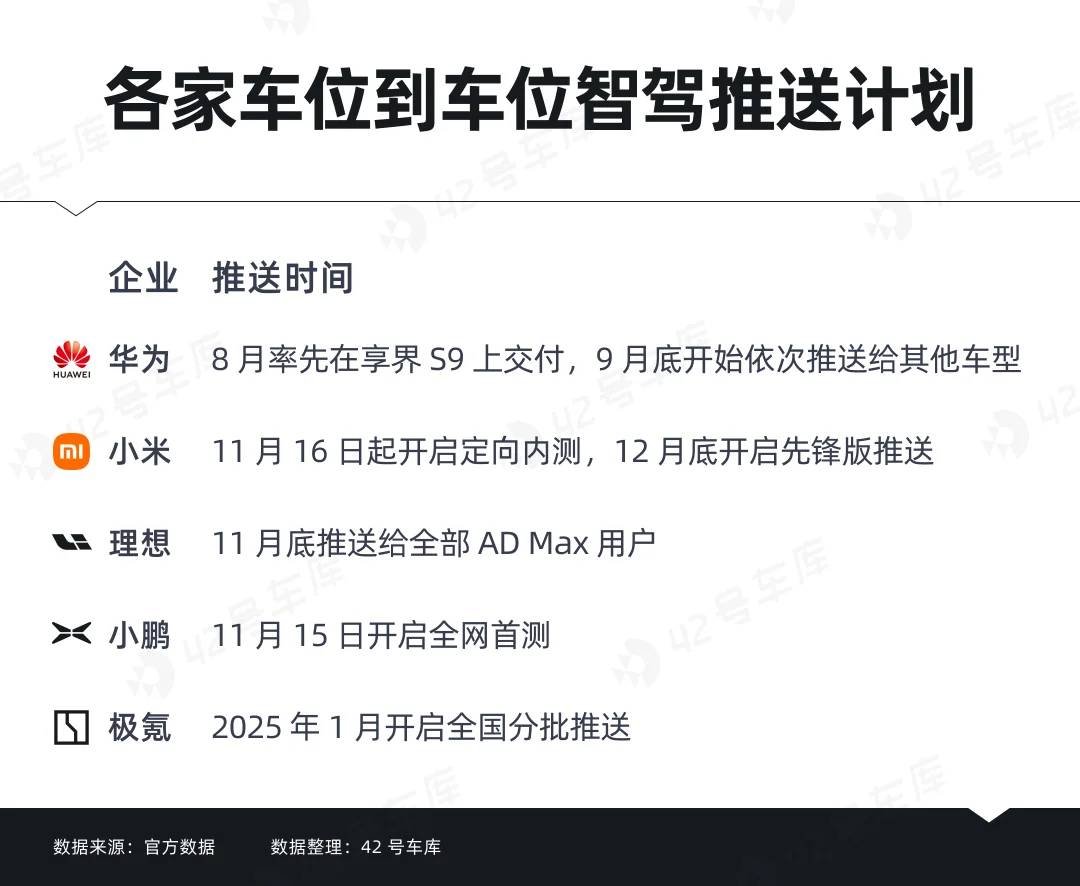
Overall, achieving parking-to-parking autonomous driving has led China’s key players in the intelligent driving sector to adopt end-to-end technology as their foundation. The drivable scenarios they can currently handle are remarkably similar. Therefore, which company will deliver the superior user experience in this specific capability is a key point of interest moving forward.
Intelligent Driving Commercialization Takes Bolder Steps
Behind the push to elevate the value of intelligent driving through parking-to-parking capabilities lies automakers’ effort to better meet user needs and accelerate the commercial adoption of these technologies.
A noteworthy detail emerged two days before the Guangzhou Auto Show began.
On November 13, Huawei launched a trial season promotion for ADS 3.0. According to official information, the promotion runs from November 11 to November 30. During this period, all users who have not previously activated the one-time purchase high-level function package can buy the ADS high-level function package at a discounted rate of RMB 199 per month (down from the original price of RMB 720 per month), with a limit of three orders per vehicle.
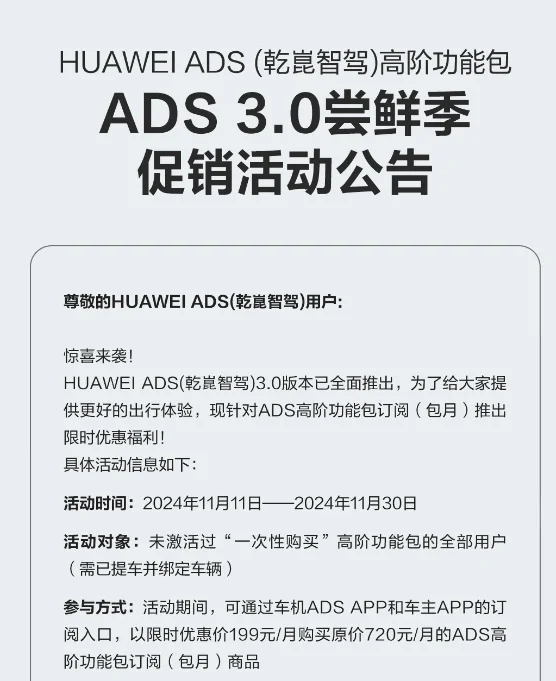
Clearly, Huawei’s promotional campaign aims to enable more users to experience ADS 3.0 at a lower cost, thereby driving sales of ADS 3.0 and converting its substantial investments in autonomous driving technology into significant commercial returns.
This approach mirrors Tesla’s strategy earlier this year, when it lowered the FSD subscription price from USD 199 per month to USD 99 to attract U.S. buyers.
Autonomous driving is a capital-intensive industry; companies such as Huawei, Tesla, Li Auto, XPENG, and Xiaomi incur massive R&D costs to develop these systems.
For instance, according to Huawei’s 2023 annual report, cumulative R&D investment since the establishment of its Smart Car Solution BU has exceeded RMB 30 billion. Elon Musk has also stated that Tesla’s cumulative investment in autonomous driving this year will exceed RMB 10 billion.
Furthermore, while end-to-end autonomous driving does not rely on stacking human resources, it heavily depends on high cloud computing power for data training. Consequently, end-to-end systems significantly increase automakers’ R&D expenditures. Lang Xianpeng, Vice President of Intelligent Driving R&D at Li Auto, told us that Li Auto will require tens of exaFLOPS of computing power in the future, with annual spending on computing clusters potentially reaching around USD 1 billion (approximately RMB 7.2 billion).
To achieve sustainable positive development, these R&D investments must gradually translate into substantial commercial returns through product sales.
In fact, since the inception of autonomous driving, determining how to achieve commercialization has remained a long and arduous challenge for enterprises.
The good news is that, based on the information released at this Guangzhou Auto Show, the commercial value that intelligent driving brings to automakers is becoming increasingly significant.
For example, Li Auto released data related to the commercialization of intelligent driving: the proportion of NOA test drives in stores is 65 percent, the proportion of AD Max in models priced at 300,000 yuan and above exceeds 70 percent, and the proportion of AD Max in models priced at 400,000 yuan and above exceeds 80 percent. In response, Li Auto officially stated that intelligent driving has become one of the most important reasons for purchasing a vehicle.
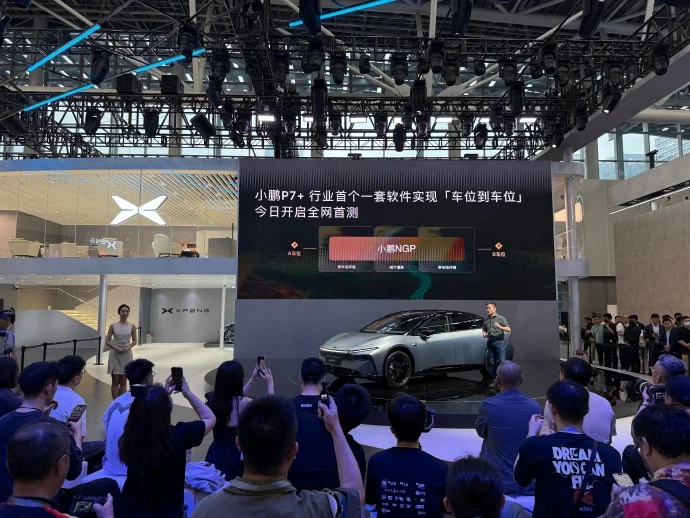
In addition, XPENG Automobile Chairman He Xiaopeng also revealed at the Guangzhou Auto Show that NGP is the primary reason users choose to buy the XPENG P7+. On this matter, He Xiaopeng expressed even greater excitement:
We all know that intelligent driving is important, but it has always been just one of the reasons users consider when purchasing a car. Its ranking in purchase considerations has gradually moved from the top ten to the top five, and then to the top three. However, with the P7+, we actually achieved the number one spot.
Notably, even for autonomous driving companies that are not at the very top of the market, the commercial value brought by these technologies is beginning to stand out. Liu Peng, Product Director for the Weipinpai Lanshan, told us that more than 60% of new Lanshan buyers chose to purchase the vehicle specifically because of its autonomous driving capabilities.
From this perspective, while intelligent driving remains a key topic for automakers to attract market attention, it is increasingly becoming a crucial selling point for boosting product sales and capturing market share.
Final Thoughts
After the end-to-end autonomous driving technology race earlier this year, the industry has now shifted to a phase centered on "parking spot to parking spot" functionality, where the competition focuses on real-world user experience.
In less than a year, Chinese automakers have fully leveraged high efficiency and technical application capabilities, while Chinese consumers' attention to and demand for autonomous driving continue to grow.
Driven by increasing consumer interest and demand, the commercial value of autonomous driving for automakers is rising steadily.
This indicates that China's autonomous driving sector is currently pursuing a dual strategy: advancing technological evolution based on end-to-end solutions while simultaneously optimizing user experience to address driving pain points and enhance practical utility. The goal is to convert autonomous driving technology into commercial value, thereby fostering a positive feedback loop for the business.
Meanwhile, Tesla remains keenly interested in the Chinese autonomous driving market. It remains unclear whether FSD will prove to be a formidable force or a paper tiger when navigating China's unique road environments, which often feature irregular traffic behavior.
From this perspective, the current competition centered on "parking spot to parking spot" is not only an internal contest among Chinese autonomous driving players but also a practical rehearsal to prepare for potential disruptions from Tesla FSD before its entry into China.
Written by: Isaiah; Edited by: James