


Huawei and Changan Sign Investment MOU; NIO Partners with Changan for Battery Swapping; Leapmotor Completes Equity Transfer to Stellantis
01Weekly Index
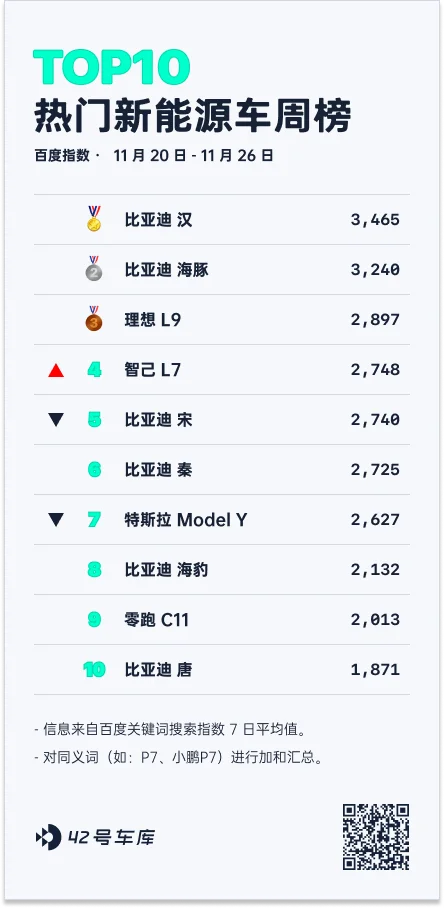
02Weekly News
Huawei and Changan Sign Investment Cooperation Memorandum of Understanding
On November 25, Huawei and Changan signed a Memorandum of Investment Cooperation in Shenzhen. Following negotiations, Huawei plans to establish a new company focused on the research, development, production, sales, and service of intelligent driving systems and incremental components for smart connected vehicles. Attendees included Zhu Huarong, chairman and party secretary of Changan; Wang Jun, president of Changan; Tan Benhong, deputy party secretary of Changan; Pu Xingchuan, secretary of the disciplinary committee of Changan; Wang Hui, vice president of Changan; Xu Zhijun, rotating chairman of Huawei; and Richard Yu, executive director of Huawei and chairman of its Intelligent Automotive Solution Business Unit.
According to the memorandum, Huawei intends to integrate the core technologies and resources of its Intelligent Automotive Solution business into the new company. Changan and its affiliates will invest in the company and jointly support its future development. The new company aims to become a world-leading provider of automotive intelligent driving systems and components. It will serve as an open platform for the automotive industry, offering equity stakes to existing strategic partner automakers and other investors with strategic value, thereby becoming a company with diversified ownership. The new entity will continue to provide high-quality services to customers and collaborate with partners to drive technological innovation and leadership in smart vehicles, promoting prosperity in the automotive industry.
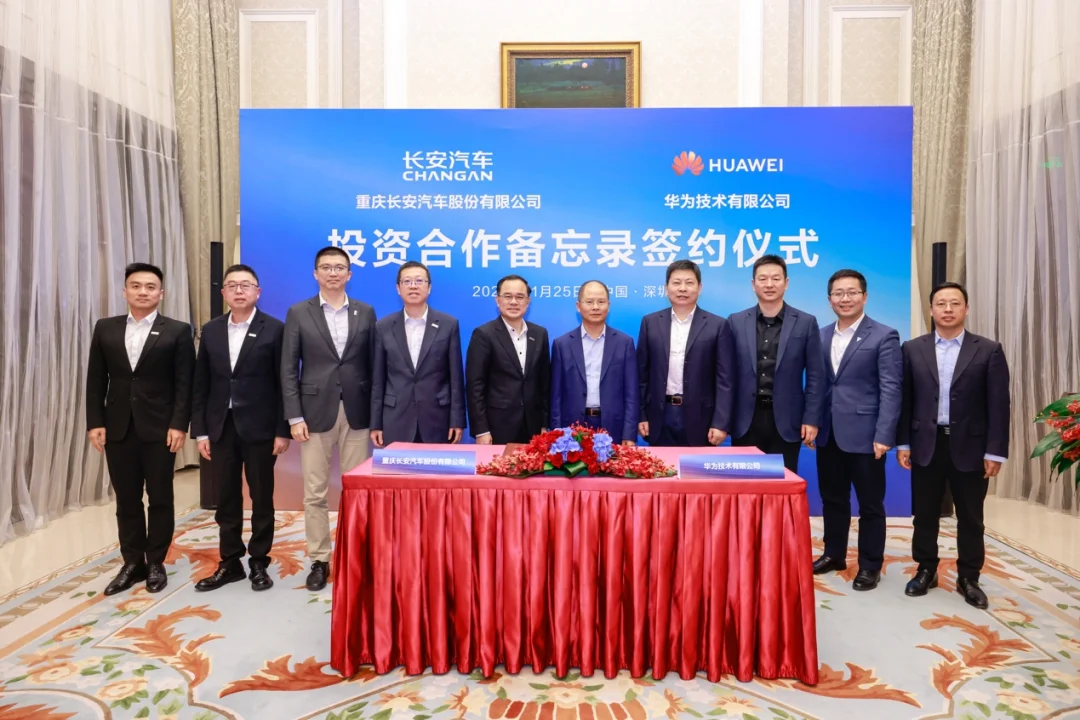
Zhu Huarong, chairman and party secretary of Changan, stated: "By leveraging their respective advantageous resources and collaborating closely with strategic partner automakers, Changan and Huawei will accelerate the large-scale commercialization of intelligent technologies. This will enable global users to enjoy first-class intelligent experiences, promote the scaled, intensive, and shared development of China's smart vehicle industry, enhance the resilience of the automotive industrial and supply chains, drive high-quality development of China's automotive sector, lead breakthroughs in core technologies, and propel Chinese automotive brands toward world-class status."
Xu Zhijun, rotating chairman of Huawei, said: "Huawei adheres to not manufacturing cars itself. Instead, we leverage our ICT technology advantages and marketing capabilities to help automakers build and sell better vehicles. We will continuously fulfill our commitments to customers and partners, jointly advancing the rise of the automotive industry." Richard Yu, executive director of Huawei and chairman of its Intelligent Automotive Solution Business Unit, added: "We have always believed that China needs to build an open platform for electrification and intelligence participation by the entire automotive industry—an open platform with a 'locomotive.' By deepening cooperation with Changan and partnering with more strategic automakers, we will explore new models of openness and win-win outcomes, seize the opportunities presented by the industry's transition to electrification and intelligence, and realize the dream of rising China's automotive industry."
Quick Review:
Changan and Huawei previously collaborated to launch the AVATR brand. This signing of a Memorandum of Investment Cooperation undoubtedly pushes their deep collaboration further. Changan possesses profound expertise in vehicle manufacturing, while Huawei leads in intelligence. Their strong combination can significantly accelerate the intelligent upgrade of Changan's products, giving them stronger competitiveness in China's rapidly changing automotive market, where developments are measured in days.
NIO Battery Swap Technology: Approaching the 'iPhone Moment'?
On November 21, NIO announced a battery swap cooperation with Changan.
For Changan, joining NIO’s battery swap network enhances the charging efficiency of its models, adding to an already rich resource portfolio.
For NIO, welcoming Changan into its swap ecosystem is not only a significant return on investment through long-term value accumulation via swap infrastructure, but also a revitalization of the company’s overall vitality.
At the same time, this collaboration marks a milestone victory for battery swapping itself.
More than just a swap partnership
Centered on battery swapping, Changan and NIO have established a broad scope of cooperation.
According to reports, the collaboration between Changan and NIO will focus primarily on the following four areas:
Construction and sharing of battery swap networks;
Research and development of battery-swap models;
Promoting the establishment of standardized battery specifications for swapping;
Establishing an efficient battery asset management mechanism.
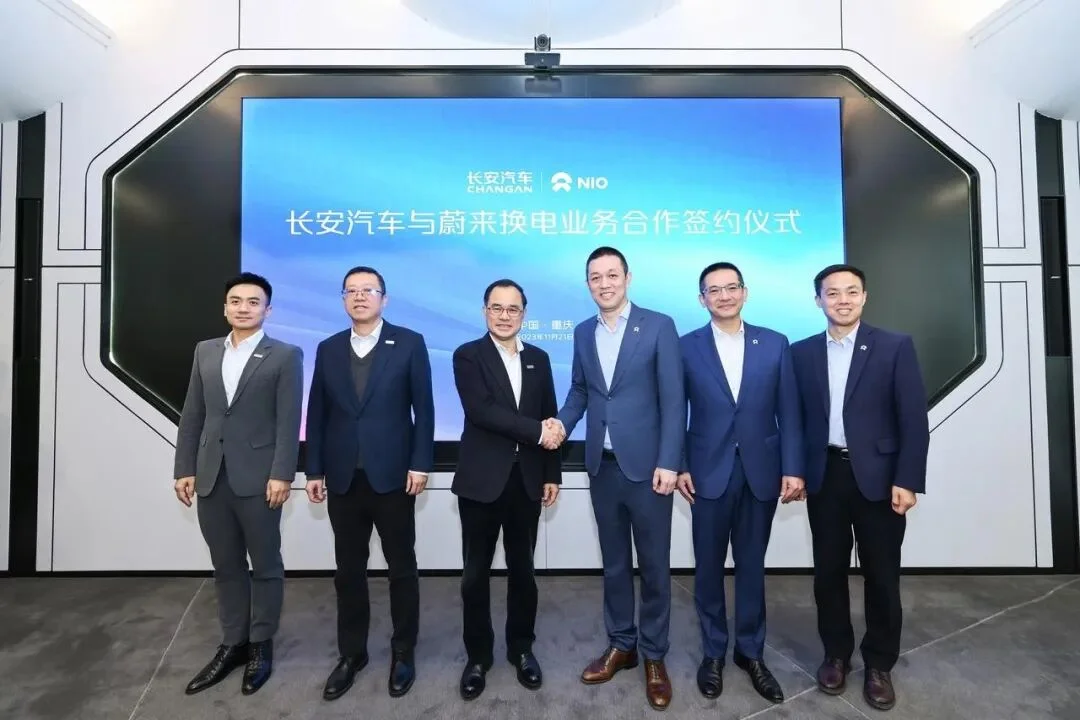
From the perspective of cooperation content, this agreement is not merely a superposition of advantageous resources between Changan and NIO, but also encompasses a pursuit of industry and social value.
Changan Chairman Zhu Huarong places great importance on this cooperation between Changan and NIO. He stated that the swap business collaboration is of significant significance and expressed hope that Changan would not only cooperate with NIO in the battery-swap sector but also continuously strengthen ties across other platform-based and foundational areas, including energy, charging and swapping, vehicles, and ecosystem.
It is evident that using battery swapping as a connection point, Changan is leveraging NIO to seek new momentum for its transformation.
In the current critical period when the entire automotive market is transitioning toward new energy, Changan has been keenly aware of avoiding falling behind in its transformation efforts. Currently, in the new energy vehicle market, Changan has laid out three major brands: AVATR, DEEPAL, and Qiyuan, entered both pure electric and extended-range lines, and simultaneously launched in-depth collaborations with industry giants such as Huawei and CATL.
However, these transformation efforts are more product-oriented. Changan still has shortcomings in its energy replenishment infrastructure, which is precisely NIO's strength.
According to the latest official data, NIO currently operates over 2,100 battery swap stations and more than 20,000 charging piles. This scale of energy infrastructure is rarely matched in the new energy vehicle industry, particularly regarding swap stations.
For Changan to strengthen its energy replenishment system, NIO is almost the only logical partner.
Regarding the collaboration between Changan and NIO, William Li stated:
This collaboration marks NIO’s first battery-swap partnership with an automaker, a move of significant importance for both NIO and the intelligent electric vehicle industry. I believe that through this cooperation, NIO and Changan will jointly promote high-quality development in the new energy vehicle sector and drive the automotive industry toward low-carbon transition.
NIO’s Future Gets Another Refill
Why did Changan and NIO choose battery swapping as their entry point? The answer is simple: swapping offers substantial practical value.
At this year’s NIO Power Day, NIO officially summarized nine key values of battery swapping:
Battery swapping is as fast as refueling: three minutes for a swap.
Eliminates range anxiety, making travel convenient everywhere.
Fully automatic without the need to exit the vehicle, offering greater comfort than charging.
Flexible upgrades: small batteries for city driving, large batteries for long trips.
Separation of vehicle and battery: buyers do not need to purchase the battery, lowering the entry threshold for car ownership.
Each swap serves as a health check, ensuring safer batteries.
Optimizes charging current, extending battery life compared to ultra-fast charging.
Allows flexible removal of batteries, facilitating recycling and reuse.
Vehicle-to-grid interaction helps flatten peak loads and reduce energy waste.
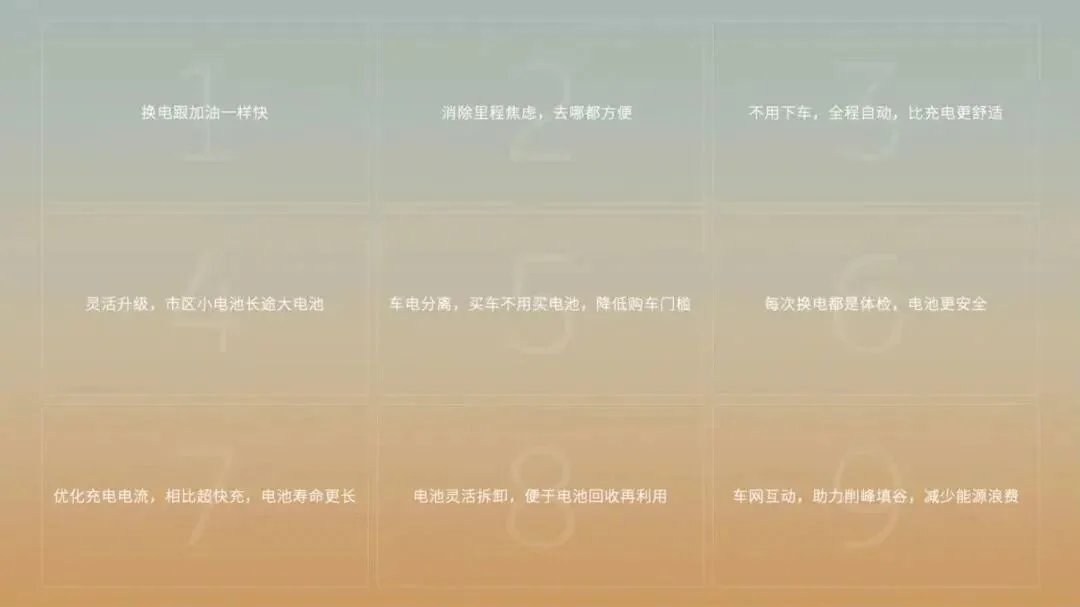
Among these nine value dimensions, there are both user benefits and social benefits. In practical implementation, this is a massive undertaking that would be difficult for NIO, as a private enterprise, to shoulder alone.
Starting with the construction of its first battery swap station in Shenzhen’s Nanshan Science and Technology Park on May 20, 2018, NIO has accelerated its expansion of swap stations.
According to official data, it took NIO 1,508 days to build the first 1,000 swap stations, and 477 days to go from the 1,000th to the 2,000th.
To date, NIO has built more than 2,100 swap stations, including 646 highway swap stations, establishing a highway swap network across nine major urban clusters arranged in six vertical and four horizontal corridors.
Meanwhile, according to NIO’s most recent official data, cumulative user swap events have exceeded 32 million, averaging 60,000 swaps per day.
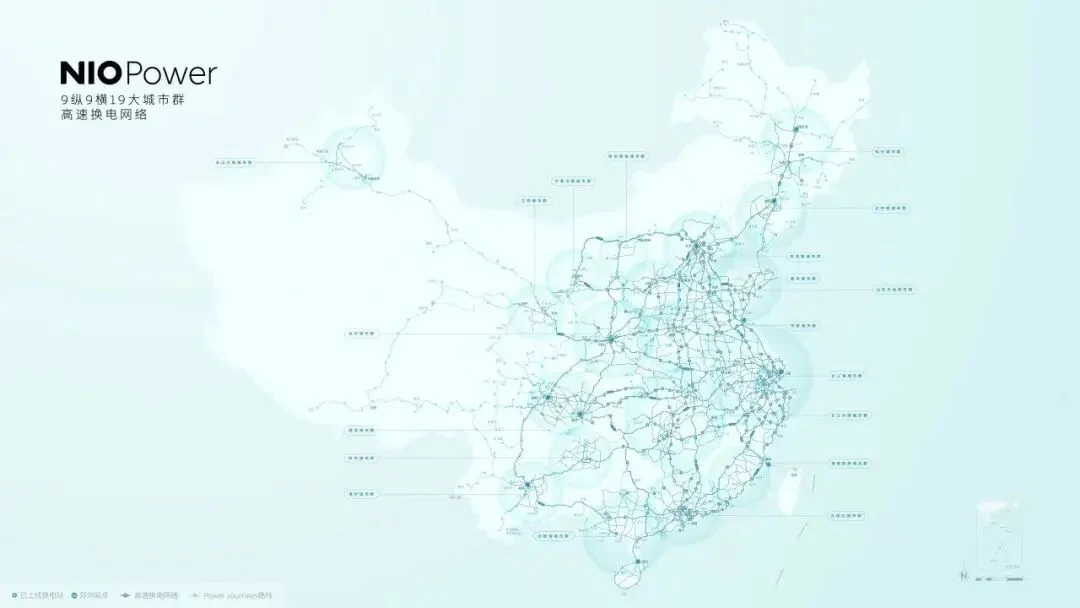
As charging and swapping station technologies advance, operational experience accumulates, and Changan joins the network, NIO's expansion of its battery swap stations is expected to accelerate further, along with a significant rise in utilization rates.
It is evident that NIO's battery swap business has reached a considerable level of maturity, both in terms of the number of stations and usage rates, with its application value steadily increasing. As William Li stated:
The time has come to open this service to the entire industry.
Notably, national policy is also driving the development of battery swapping.
Since 2020, multiple documents—including the New Energy Vehicle Industry Development Plan (2021–2035), the Implementation Opinions on Further Enhancing the Service and Guarantee Capabilities of Charging and Swapping Infrastructure, and the Notice on Launching Pilot Programs for New Energy Vehicle Battery Swap Mode Application—have been issued to promote battery swapping from a macro perspective.
In fact, William Li noted that the collaboration between Changan and NIO is a concrete implementation of these policies, and more automakers are expected to join battery swap partnerships in the near future.
With the expansion of swap stations and the growing "circle of friends" for battery swapping, NIO's "iPhone moment" for its swap business may not be far off.
Quick Review:
In an industry where cost reduction and efficiency gains are the norm, NIO's massive investment in expanding its battery swap station network appears to be a counter-trend move.
From NIO’s perspective, however, this strategy aligns with national policy support and reflects a commitment to long-term value.
As NIO’s swap station network grows, its brand identity becomes increasingly tied to battery swapping, and both user and social values continue to rise; consequently, it is nearly impossible for NIO to abandon its swap business in favor of a lighter competitive posture.
For current and potential NIO owners alike, battery swapping has become an integral part of the vehicle’s product appeal.
Although NIO sees no way out, it had already mapped its path forward from the start. William Li stated:
NIO prepared its charging and swapping operations for full industry openness from day one.
Facts prove that NIO's preparations for battery swapping were not in vain. The entry of Changan and more automakers to come into the swap ecosystem is telling NIO that even if the road ahead has some bumps, the path still exists.
With NIO’s swap partner network expanding, a new challenge has emerged: battery swapping was originally an exclusive benefit for NIO owners. Now that vehicles from other brands are joining, how will NIO balance the experience between its own customers and those of partner brands?
Leapmotor and Stellantis Complete Equity Transfer on November 20
According to the announcement, 194,260,030 new H shares have been issued to Stellantis, and two members of Stellantis have joined the Leapmotor board.
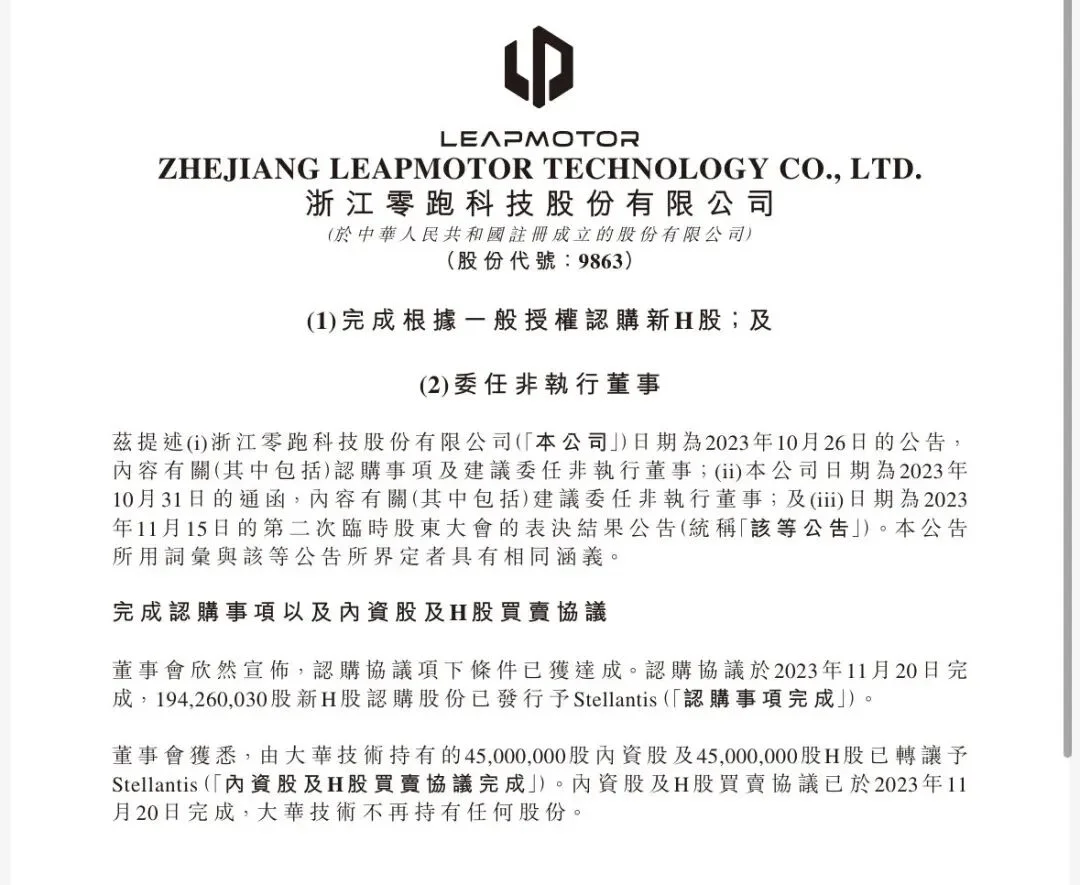
Notably, with the completion of the equity transfer between Leapmotor and Stellantis, Dahua has officially exited Leapmotor. Dahua no longer holds any shares in Leapmotor.
The completion of the equity transfer confirms the partnership between Leapmotor and Stellantis, allowing both parties to make substantive progress in business cooperation.
Wu Qiang, Co-President of Leapmotor, stated that Leapmotor's journey into overseas markets is like a siege where the ladder has reached the wall, but significant challenges remain ahead.
During today's media briefing, Wu Qiang discussed several aspects of the collaboration between Leapmotor and Stellantis.
Below are the main points from the Q&A session, edited for clarity without altering the original meaning:
How fast will Leapmotor expand internationally?
The cooperation with Stellantis has essentially built the ladder for our overseas business, but there is still a long and arduous task ahead.
Our plan is to start with the European market. We expect deliveries to begin in the third quarter of next year, selling our cars as exports. This is the general outlook. Before that, we will push forward with various tasks according to our schedule.
Does Leapmotor have sufficient funds?
Because this industry is highly competitive and the company is developing, funding is always a topic.
At the beginning of the year, Leapmotor had over ten billion yuan in cash on hand. By the end of September, the company’s cash balance was RMB 11.6 billion. With the cooperation with Stellantis, we also received HKD 8.5 billion.
However, Leapmotor does not view issues from the perspective of how much cash or funding we have. We will raise financing when needed and conduct business as usual.
Are there any plans for overseas sales channels?
In key European markets, we will start with more developed countries such as Germany, France, Italy, and Spain, while simultaneously expanding into other nations.
Selling channel construction and selection, as well as the choice of after-sales service channels, will employ a combined strategy, comprehensively built based on our brand positioning in Europe. We will not simply become hands-off owners at Leapmotor just because Stellantis has its channels available.
Our teams held very detailed discussions yesterday and the day before. The plan is to leverage their existing channel resources while also applying our effective strategies developed in China, including how to secure customer orders and manage customer resource information.
What does completing the equity transfer with Stellantis actually mean?
It means that the funds have entered our company's accounts and two of their directors are now seated on our board of directors; it signifies that we have established a commercial partnership with them.
In short: the relationship is solidified, and work begins.
Chinese companies currently face barriers such as European anti-dumping and countervailing duties when going global. How does Leapmotor proactively address these challenges?
These regulatory challenges face the entire industry rather than targeting any single company. We have made some appropriate plans for this, specifically by structuring and laying out our cooperation framework with Stellantis.
First is the establishment of "Leapmotor International." This is a joint venture based in the Netherlands, with Stellantis holding 51% of the shares and us holding 49%. Because Stellantis holds 51% of the shares, it should possess the capacity to alleviate or resolve certain issues. Additionally, we will provide Stellantis with sufficient incentives to exercise its initiative, mobilize resources, and drive sales growth.
Secondly, on an operational level, our main challenge lies in entering a completely new market. Although this collaboration offers significant potential and numerous possibilities, there are many challenges involved.
How has Stellantis's entry into the board of directors affected Leapmotor's management and decision-making mechanisms?
Stellantis's investment and entry into the board as a shareholder does not alter Leapmotor Technology's equity structure, shareholder composition, or daily business operations and management.
As Leapmotor begins exporting vehicles, what changes will occur in product development?
Different countries naturally have different product requirements, such as infotainment software, maps, and languages. We will seek cooperation with suppliers like Guge to adapt to the needs of different countries.
At the same time, our LEAP 3.0 third-generation centralized integrated electronic architecture features three tiers—high, medium, and low solutions—that can be applied across vehicle models of different price points and sizes. Therefore, this architecture allows us to flexibly respond to diverse demands.
Consequently, there is no question of whether we develop specifically for the European market or the Chinese market. Ultimately, the vehicles produced within our R&D system can be freely switched between the European and Chinese markets.
Will this new joint-venture model become a trend?
We don’t think it will. Every company has its own business development needs. Our cooperation with Stellantis, for instance, is based on our own circumstances and our thoughts on overseas strategy.
I believe that each company should develop its business according to its actual situation. That’s how I view this matter.
Stellantis also has its own cars to sell. How can you motivate them to actively sell Leapmotor vehicles?
First, Stellantis does not have products like those offered by Leapmotor.
Second, the various brands under Stellantis have different positioning and internal competition, requiring a balance among them.
Third, Stellantis holds a 51% stake in the joint venture. If Leapmotor sells well, Stellantis is also a financial winner.
Can China’s production capacity cover the demand of overseas markets?
If Leapmotor fully utilizes its current production capacity at its factories in China, it can support the sales of 700,000 vehicles. Additionally, if future demand exceeds 700,000 units, Leapmotor will not plan further heavy-asset investments in building new factories, but instead leverage existing capacity from Stellantis or other third parties.
Quick Review:
Based on the Q&A above, Leapmotor appears well-prepared for the brutal elimination round in the new energy vehicle market, with preparations spanning overseas growth, production capacity, and technical architecture.
As Leapmotor’s monthly sales continue to grow, brand awareness and recognition are bound to strengthen, helping the company maintain its footing in the elimination race and extend its long-term trajectory.
However, significant uncertainty remains in the domestic market. As Wu Qiang noted, the overseas market has only just begun to climb the ladder of conquest and faces substantial challenges.
Yet behind the uncertainties and challenges lie abundant opportunities. Leapmotor has undoubtedly achieved phased success in sales, and its future development still holds considerable room for imagination.
Written by: Wentao Edited by: Wentao