


Leapmotor Unveils 'Four-Leaf Clover' Architecture, Signals Shift to Technology Supplier
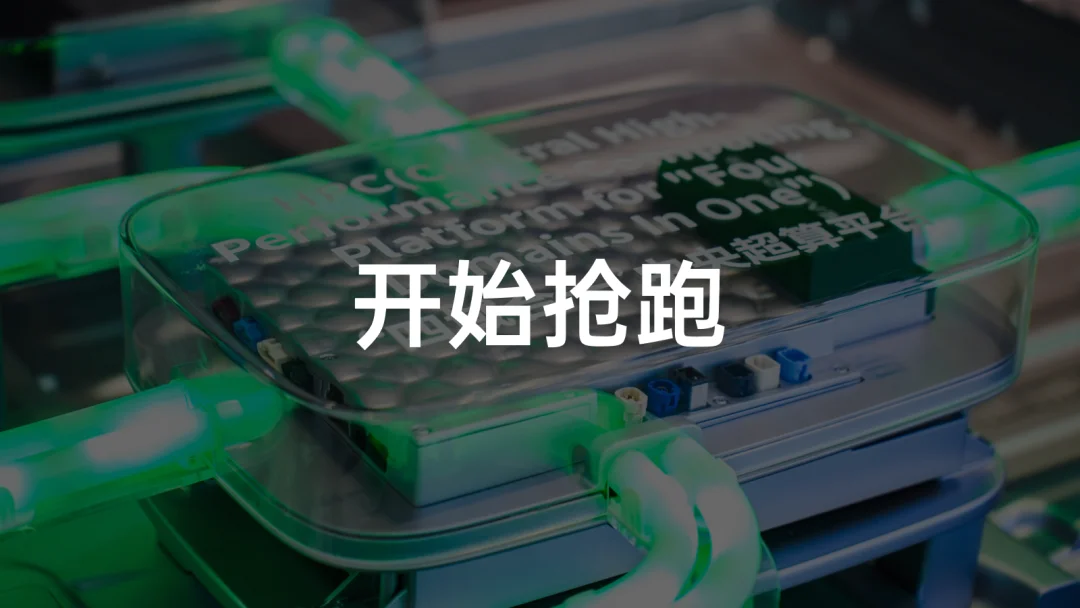
Leapmotor is no longer content with being merely an automaker.
On July 31, Leapmotor unveiled its all-new generation central integrated electronic and electrical architecture, named "Four-Leaf Clover." According to the official introduction, the core electronic components of the Four-Leaf Clover architecture are fully self-developed by Leapmotor. The system is now nearing mass production readiness, and the first vehicle equipped with it will make its debut at the Munich Motor Show in September.
Notably, with the release of the Four-Leaf Clover architecture, Leapmotor no longer limits its positioning to that of an automotive OEM; it also aims to serve as a provider of complete smart electric vehicle solutions.
In response, Leapmotor Chairman Zhu Jiangming stated:
Leapmotor is willing to license its technology and has already granted authorization to two vehicle manufacturers.
01Integration of Four Domains to Enhance Intelligent Experience
As Leapmotor's next-generation "Central Integrated Electrical and Electronic Architecture" developed for its vehicles, the Four-Leaf Clover architecture aims to deliver a smart electric vehicle experience that is frequently updated and of a higher tier.
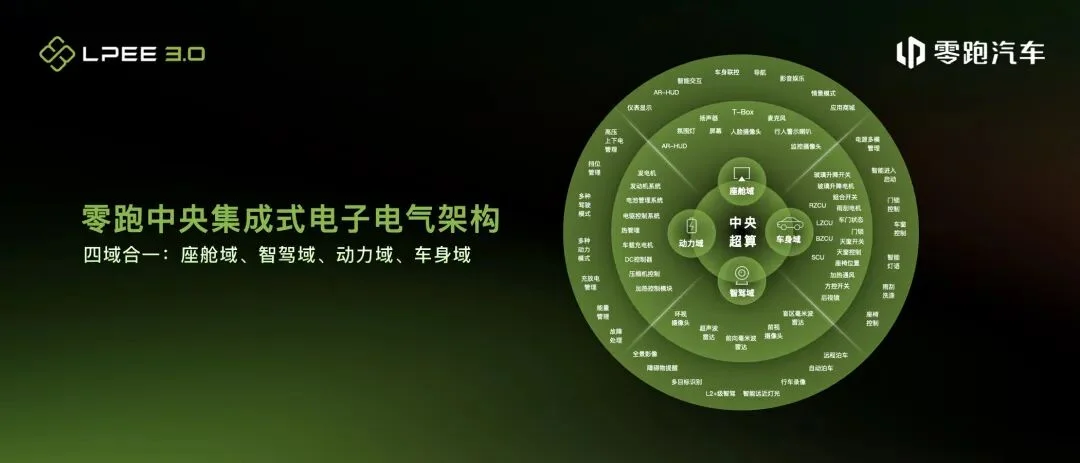
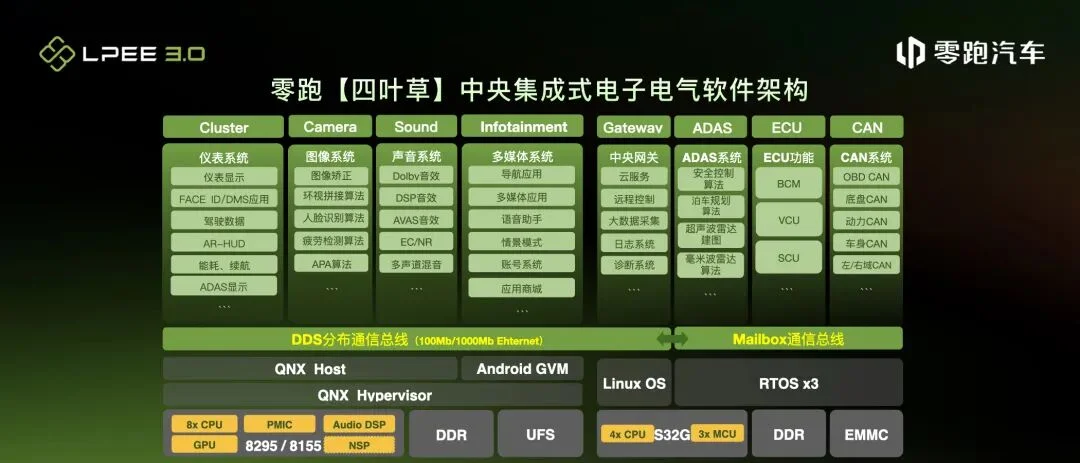
According to Leapmotor, the Four-Leaf Clover architecture integrates the cockpit domain, intelligent driving domain, powertrain domain, and body domain into a single unit to achieve high-level central supercomputing. This design enables efficient coordination of core components in smart electric vehicles, making it the only electronic and electrical architecture that has truly realized central integration.
Specifically, it features four key technical characteristics.
High Degree of Cockpit-Driving Integration
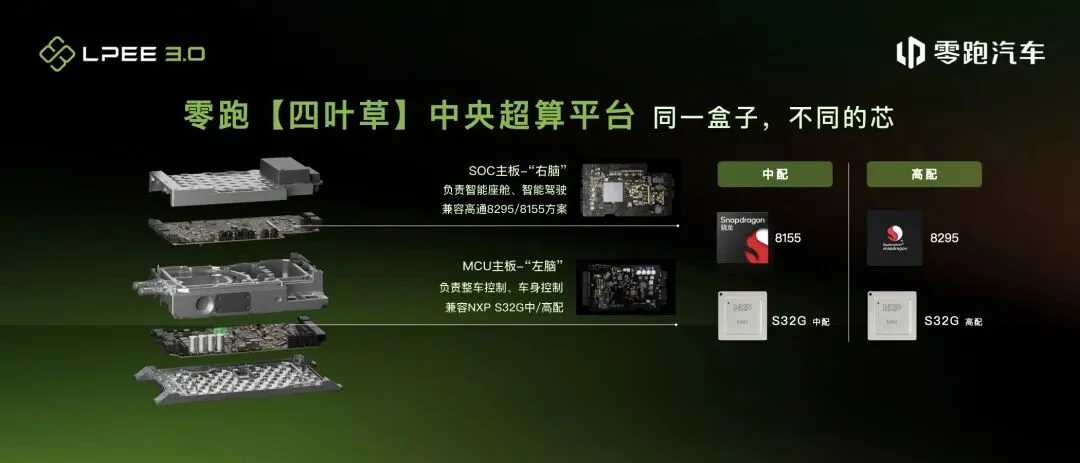
The Four-Leaf Clover architecture is equipped with one System on Chip (SoC) — either the Qualcomm Snapdragon 8295 or 8155 — and one Microcontroller Unit (MCU) chip, the NXP S32G.
The Qualcomm Snapdragon 8295 delivers 30 TOPS of computing power, laying the computational foundation for efficient collaboration among internal vehicle modules. The NXP S32G offers robust security and communication capabilities, supporting top-tier vehicle information processing and high-speed response to massive data streams.
Together, these two chips form the vehicle’s “central supercomputer,” functioning like its “left and right brains.” The SoC serves as the “right brain,” handling the smart cockpit and intelligent driving functions, while the MCU acts as the “left brain,” managing overall vehicle control and body control. Through this coordinated effort, Leapmotor achieves more powerful intelligent driving and a smoother smart cockpit experience.
ECU Control Unit Integration
Leapmotor has fully developed 15 modules in-house, including vehicle control, body control, gateway management, thermal management, instrument cluster information systems, infotainment systems, 360° surround-view monitoring, APA parking, fatigue monitoring, life monitoring, dashcams, sentinel mode, sound alerts, DSP amplifiers, and video conferencing. These are highly integrated into a central supercomputing module, solving the problem of excessive ECUs found in previous distributed and domain-controlled electronic/electrical architectures.
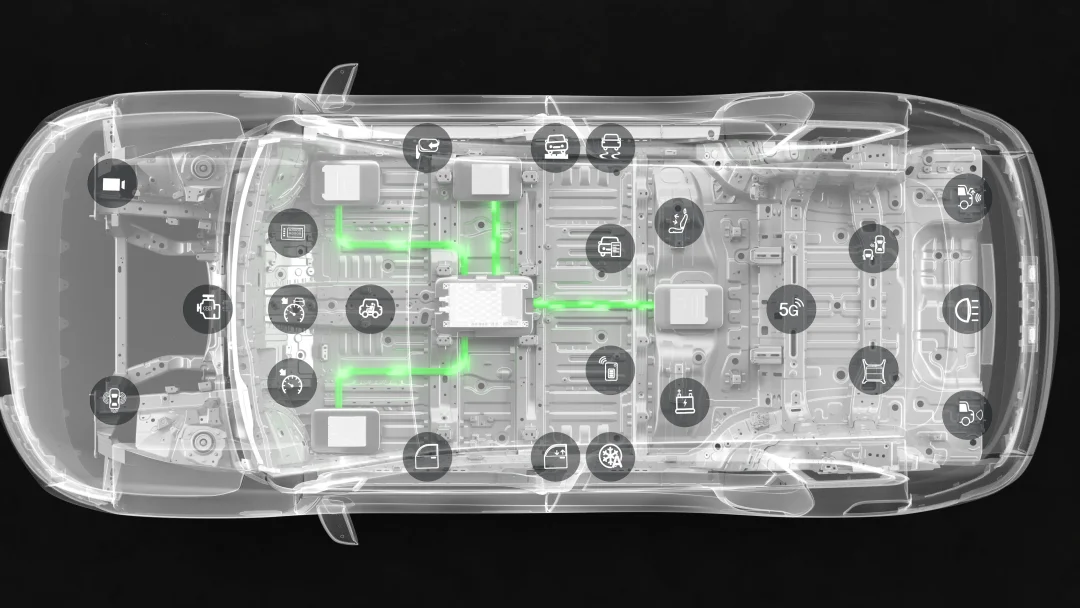
To ensure the central supercomputing module operates within its optimal temperature range for peak performance and longevity, Leapmotor employs liquid cooling to maintain the chips in their best working state, thereby enhancing the vehicle's intelligent interaction capabilities and autonomous driving response speed.
With a significant reduction in ECUs, the vehicle's wiring harness has been shortened to under 1.5 km and reduced in weight to 23 kg. This promotes body weight reduction, leading to more favorable energy consumption. Additionally, shorter wiring harnesses improve the transmission rate of interactive information.
Creating a Personalized Ownership Experience
The Four-Leaf Clover architecture reserves over 500 interfaces, enabling functional combinations across cabin, autonomous driving, powertrain, and body domains, giving users greater customization options.

At the software level, the Clover architecture features a unified SOC codebase and an MCU codebase configuration. This resolves the traditional challenges of domain controllers operating in silos, difficulty in standardizing communication protocols, and the inability to ensure efficient system operation, ultimately resulting in stronger compatibility across all systems.
Seamless Online OTA
Based on the high degree of central integration in the Clover architecture, Leapmotor can evolve the entire vehicle by updating the software of a single supercomputing platform. The upgrade process supports automatic background updates. Upon completion, the vehicle prompts the user to switch to the latest system; if desired, the user can switch immediately, making the OTA experience more timely and intuitive.
Overall, the emergence of the Clover architecture is an inevitable outcome of Leapmotor's pursuit of automotive intelligence.
As vehicles become increasingly intelligent, drivers inevitably demand higher efficiency in data transmission, processing, and decision-making. However, previous distributed and domain-controller-based electronic/electrical architectures could no longer provide significant breakthroughs for advancing automotive intelligence.
Centralized electronic/electrical architectures, characterized by greater central integration, wire harness consolidation, and concentrated computing power, achieve unified decision-making through a central supercomputer while regional nodes handle execution only. Their high computing power, strong synergy, and low latency better meet the current requirements for intelligent vehicles. Leapmotor’s 'Clover' architecture aligns well with this trend.
02Three Solutions, Two-Year Iteration Cycle
From a product implementation perspective, the Clover architecture will be applied to Leapmotor’s full lineup of models, supported by three distinct solutions. Specifically:
Standard solution: Qualcomm 8155 + NXP S32G (3-core)
Supports 6 to 12 speakers, four screens, and an AR-HUD;
Supports four surround-view cameras, one face-detection camera, and 12 ultrasonic radars.
Mid-tier Solution: Qualcomm 8295 + NXP S32G (7-core), with 30 TOPS of computing power
Supports up to 20+ speakers (with external power amplifiers), four 2.5K-resolution streams, one 1080P stream, and two 720P streams;
Supports 4 surround-view cameras to enable L2 / L2+ intelligent driver assistance.
High-end solution: Qualcomm 8295 + NXP S32G (7-core) + NVIDIA Orin X, providing the vehicle with 284 TOPS of computing power
Supports up to 20-plus speakers (with external power amplifiers), four 2.5K-resolution streams, one 1080P stream, and two 720P streams;
Supporting LiDAR, high-definition maps, four surround-view cameras, four blind-spot cameras, and four blind-spot corner radars to achieve L2++-level advanced driver assistance.
It is evident that even with a standard configuration, products under the Four-Leaf Clover architecture do not skimp on delivering intelligent experiences.
In the second half of the new energy vehicle era, dominated by intelligence, the electronic and electrical architecture often determines the upper limit of an electric vehicle's smart capabilities. This suggests that through its Four-Leaf Clover architecture layout, Leapmotor aims to comprehensively enhance the intelligent experience across its product lines, thereby elevating the competitiveness of its vehicles.
Of course, as time progresses, the Four-Leaf Clover architecture will continue to iterate. Regarding the iteration cycle, Zhu Jiangming has set it at two years. He stated:
I believe that by 2025, we will definitely see iterations in high-voltage platforms, intelligent driving chip capabilities, and cockpit capabilities. This is certain, following a rhythm of essentially one iteration every two years.
03Seeking a Second Growth Curve Through Technology Export
The intense competition in intelligent driving has caused many automakers to consume massive amounts of capital. Although Leapmotor’s R&D spending is far lower than that of companies like NIO, XPeng, and Li Auto, Zhu Jiangming believes that while Leapmotor invests less, it operates with higher efficiency.
The 'Four-Leaf Clover' architecture offers a glimpse into Leapmotor's high efficiency.
According to Leapmotor, the Four-Leaf Clover architecture reduces the number of vehicle controllers from 42 to 28. The total wiring harness length is under 1.5 km, with a weight of just 23 kg. It provides three solution tiers—standard, mid-range, and high-end—to cover a broader user base, while achieving a platform commonality rate of more than 90%.
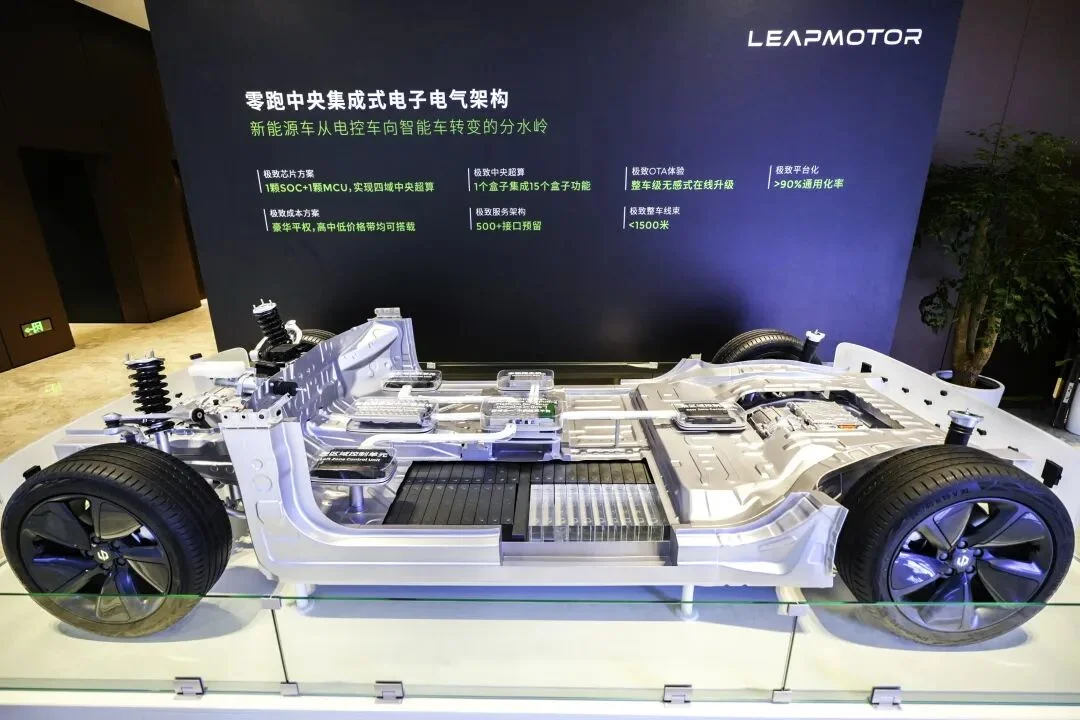
This means that, compared to the previous A, B, and C physical platforms, production costs for the Four-Leaf Clover architecture will be significantly reduced.
Zhou Hongtao, Senior Vice President of Automotive Electronics at Leapmotor, stated:
We aim to maximize the potential of existing features to deliver products with the highest price-to-performance ratio. This is our direction of effort.
From a commercial perspective, the Four-Leaf Clover architecture possesses the capability for technology export. It not only meets Leapmotor's own production needs but also enables technology sharing with partners.
Currently, Leapmotor has established four commercial cooperation models for technology export:
Model 1: Technology sharing based on the Four-Leaf Clover electronic and electrical architecture and peripheral controllers (including headlights, cameras, radars, etc.);
Model 2: Technology sharing based on the Four-Leaf Clover electronic and electrical architecture, peripheral controllers, batteries, and electric drive systems;
Model 3: Technology sharing based on the complete delivery of the lower vehicle body (including the electronic and electrical architecture, batteries, and electric drive systems);
Model 4: Cooperation and sharing at the complete vehicle level.
Therefore, from this perspective, Leapmotor is not only hoping to be merely an original equipment manufacturer (OEM) but also aims to play the role of a provider of full sets of solutions for smart electric vehicles.
Regarding this, Zhu Jiangming stated:
"Through eight years of comprehensive in-house research and development, Leapmotor has already developed the capability for individual core components, as well as the ability to integrate entire architectures, ranging from the electronic and electrical architecture to the complete vehicle architecture. We are now very willing to export these capabilities externally, aiming to establish a new business model for Leapmotor in the future."
Thus, it is evident that with the launch of the Four-Leaf Clover architecture, Leapmotor hopes to demonstrate its technical strength while seeking new business growth points and finding a "second growth curve" through innovation in its business model.
04Conclusion
The reshuffling of the new energy vehicle market is intensifying. Under the relentless pressure of price wars, Leapmotor’s current situation is far from ideal.
In terms of market performance, Leapmotor’s total sales for the first half of the year reached 44,000 units, a year-over-year decline of 14.4 percent, completing only 22 percent of its annual target. The pressure to boost sales in the second half of the year is significant. Regarding this result, Zhu Jiangming stated in an interview that he could give himself a score of sixty to seventy.
When discussing the second half of the year, Zhu Jiangming indicated that Leapmotor aims to achieve monthly sales of 20,000 units. In the current volatile and hyper-competitive market environment, this is not an easy goal to reach.
During the interview, Zhu Jiangming made it clear that starting in August, Leapmotor will adjust prices across its C-series high-end models. The strategy is to allow customers to upgrade to higher-trim versions with only a modest increase in cost compared to standard models. Clearly, through these price cuts, Leapmotor hopes to further drive sales growth.
This indicates that Leapmotor is currently facing immense market pressure.
Given this context, Leapmotor’s launch of the Four-Leaf Clover architecture serves purposes beyond mere technological advancement.
On one hand, Leapmotor aims to amplify the cost advantages gained from its previous full-stack in-house R&D efforts, thereby expanding profit margins. On the other hand, by engaging in technology export, Leapmotor hopes to diversify revenue streams beyond complete vehicle business, thus broadening its survival space. From a market perspective, Leapmotor also intends to demonstrate its capabilities to release greater confidence to the external market.
However, from the launch of the Tetra Architecture to its actual contribution to Leapmotor’s revenue, a considerable amount of time remains.
Therefore, against a backdrop of persistent and intensifying market uncertainty, it is crucial for new-entrant automakers like Leapmotor to plan for the future while prioritizing immediate actions to boost sales across their model lineup. Achieving a monthly sales target of 20,000 units or more is essential — after all, survival is the prerequisite for long-term development.
Written by: Isaiah Edited by: 308