


China's H1 EV Market: Growth Slows as Price Wars and Tech Race Intensify

The first half of the year saw China's new energy vehicle (NEV) market reach a new level of intense competition.
On one hand, the price war triggered by Tesla's price cuts left many NEV automakers scrambling to respond with various measures.
On the other hand, as electrification and intelligence become key drivers of the market, NEV makers are racing to implement technologies such as highway and urban NOA (Navigate on Autopilot) and 800V architectures, leaving observers overwhelmed.
This degree of internal competition is world-class.
Despite this unprecedented intensity, China's NEV market has maintained an overall upward trajectory, revealing clearer emerging trends beneath the surface.
01Overview of China's NEV Market in the First Half of the Year
In the first half of the year, NEV sales continued to grow, but the growth rate has slowed.
Data from Zhongqixie shows that the overall new energy vehicle (NEV) sales in the first half of the year reached 3.747 million units, a year-on-year increase of 44.1%. Compared to the 120% year-on-year growth in the first half of 2022, this year's growth shows signs of fatigue.
A similar situation occurred with market penetration. The NEV penetration rate in the first half of the year was 28.3%, an increase of only 2.7 percentage points from 25.6% at the end of 2022. In the past two years, the penetration rate grew by approximately 5.1 percentage points every six months on average. This year, however, the pace of growth has slowed.
It is clear that while the Chinese NEV market continues to grow overall, its momentum is becoming insufficient.
After reviewing the overall picture, let us look at the specific performance of automakers.
Data from Chenglianhui shows that BYD achieved sales of 1.154 million units in the first half of the year, a year-on-year increase of 82.2%, ranking first in the Chinese NEV market with a market share exceeding one-third. Tesla China ranked second with sales of 294,000 units, a year-on-year increase of 48.9%.
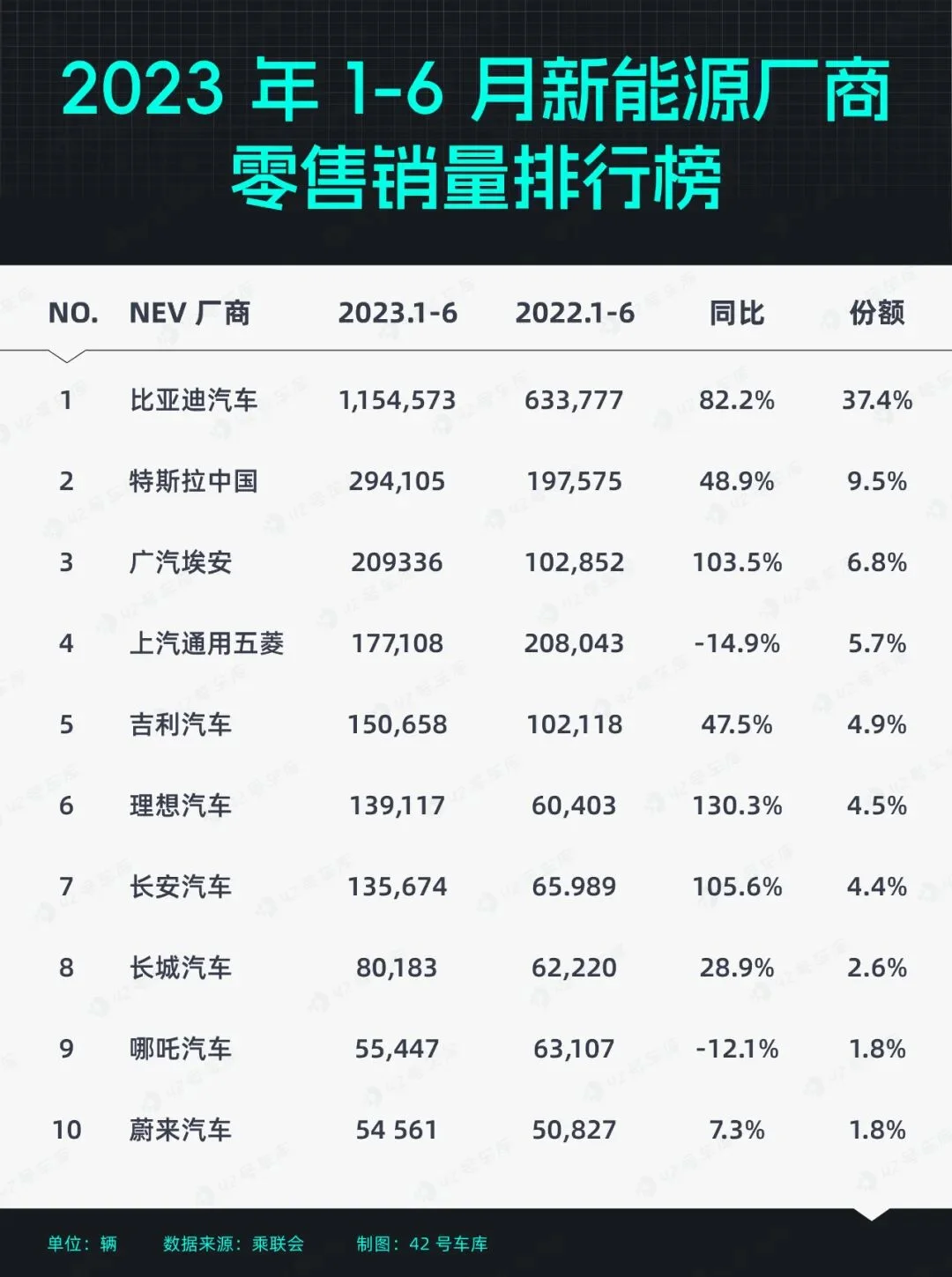
Aian achieved sales of 209,000 units, a year-on-year increase of 103.5%, making a strong comeback and living up to the ambition expressed last April by Feng Xingya, general manager of Guangqijituan, when he called for replacing 'Wei Xiao Li' with 'Ai Xiao Wei'.
But regardless of whether 'Wei Xiao Li' will become 'Ai Xiao Wei', the internal landscape of 'Wei Xiao Li' itself has indeed changed again based on the sales data for the first half of the year.
Among the "Wei-Xiao-Li" trio, Li Auto is undoubtedly the biggest winner.
In the first half of the year, Li Auto achieved sales of 139,000 units, representing a year-on-year growth of 130.3%. Coupled with an average selling price exceeding RMB 300,000, the company has enjoyed a robust performance.
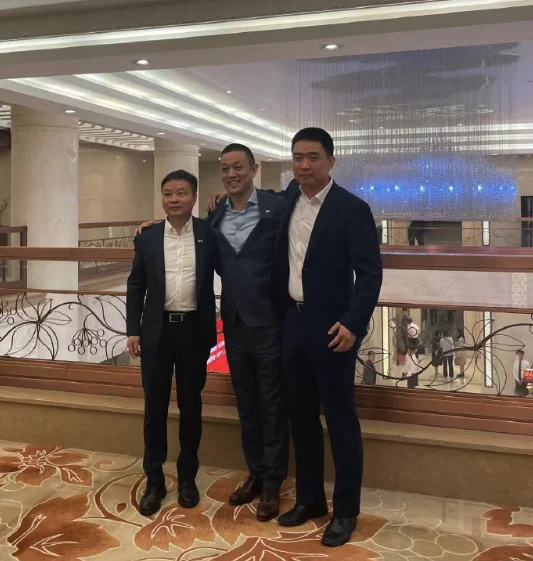
NIO recorded sales of 55,000 units in the first half of the year, up 7.4% year on year. Although this figure may not appear spectacular, it maintained growth regardless of scale. In contrast, XPENG saw its sales plummet by 39.9% year on year to 41,000 units.
Notably, while automakers reported varying sales figures in the first half of the year, they shared a common characteristic: most were still some distance away from achieving 50% of their annual sales targets.
This implies that the first half was difficult due to fierce competition in the price war, and the second half will also be challenging as automakers face pressure to sprint toward their sales goals.
It is worth mentioning that while overall new energy vehicle (NEV) sales growth slowed in the first half of the year, plug-in hybrid (including extended-range) models experienced rapid growth.
Data from Zhongqixie shows that plug-in hybrid sales reached 1.025 million units in the first half of the year, a year-on-year increase of 91.1%. Although this volume is significantly lower than the 2.719 million units sold for pure electric vehicles, the growth rate far exceeded the pure electric segment's 31.9% increase.
The growth in plug-in hybrid vehicle sales is largely due to the steady introduction of new models in the first half of the year and their downward price adjustments.
Plug-in hybrid models launched in the first half of the year include the Geely Yinhe L7, HAVAL Xiaolong, WEY Lanshan, and Qin PLUS DM-i 2023 Guanjunban, among many others. The Qin PLUS DM-i 2023 Guanjunban has pushed the starting price for plug-in hybrids below RMB 100,000, while the official guide price for the Geely Yinhe L7 starts at RMB 138,700. This downward shift in pricing is making plug-in hybrid models particularly poised for growth.
Against the backdrop of China's auto market entering a stock era, any emerging vehicle category inevitably squeezes existing ones. With more plug-in hybrid models entering the fray, pure electric vehicles are bound to face greater competitive pressure in an already uncertain new energy vehicle market, further exacerbating market uncertainty.
02The Open and Hidden Struggles Triggered by a Price War
The sales results for the new energy vehicle market in the first half of the year were partly driven by the price war.
On January 6, Tesla announced that the starting price of the Model 3 has been reduced to RMB 229,900, while the Model Y's starting price has been lowered to RMB 259,900. Although Elon Musk has stated multiple times that Tesla's price cuts are not targeted at competitors, how could rivals remain indifferent to such moves?
Thus, as soon as Tesla started the price cuts, the domino effect immediately kicked in.
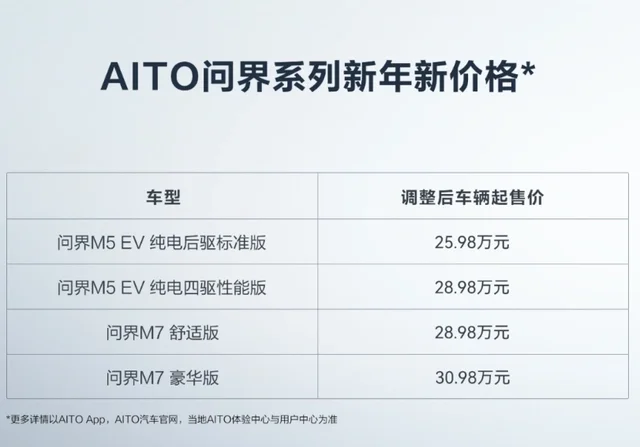
AITO was the first to follow suit, lowering the starting price of its entire model lineup by approximately RMB 30,000. Three days later, XPENG officially announced price cuts of up to RMB 36,000, followed by Leapmotor, BYD and others joining the fray.
This, however, was merely a 'localized hot battle' in the new energy vehicle (NEV) market. The event that truly pushed the price war into 'full-scale outbreak' was Dongfengxuetielong's announcement in March of subsidies reaching up to RMB 90,000, initiating a 'table-flipping' style price cut.
In China's auto market, which has entered a stock era, the total market share is fixed; if some players take a larger slice, others must take less. With its stunning price cuts, the once-overlooked Xuetielong C6—a model priced at RMB 200,000 described as 'old-fashioned,' and another at RMB 120,000 described as 'dignified and steady'—suddenly became highly sought after. This meant that certain NEVs were left to sit on the cold bench.
Thus, fueled by Dongfengxuetielong, the price war across the entire automotive market erupted fully, squeezing the NEV sector once again.
Interestingly, this price war featured not only blatant 'open competition' through direct price cuts but also 'covert struggles' involving indirect price reductions.
On February 8, Li L8 Air launched. Li Auto lowered product prices by introducing lower-priced versions of existing models. However, BYD took this approach to its fullest extent.
On February 10, Qin Plus DM-i Guanjunban launched with a starting price of just RMB 99,800. Subsequently, BYD sequentially released Champion Editions for Han EV Guanjunban, Tang DM-i Guanjunban, and other models, covering eight variants across Haiyangwang and Wangchaowang.
Following Li Auto and BYD, more 'Champion Edition' models emerged, such as Aian's AION Y Younger, AVATR 11 Single Motor Version, and ZhijiLS7 Urban Fit Ban.
Beyond launching 'Champion Edition' models, NIO and Zeekr have each developed their own distinct strategies in the shadow war for market share.
On June 12, NIO announced a price cut of RMB 30,000 across its entire lineup, engaging directly in the price battlefield. At the same time, NIO did not advance recklessly but kept a backup plan in reserve.
NIO stipulated that users who purchase vehicles after the price reduction will no longer enjoy benefits such as four lifetime free battery swaps per month. If they wish to retain these perks, they can repurchase them for RMB 30,000 before July 31.
Zeekr avoids mentioning the price war altogether, referring instead to a 'value war.' Its core strategy is not to lower product prices but to offer greater value for the same amount of money.
Consequently, Zeekr introduced a limited-time free product enhancement package. As long as users place a deposit, they can receive a free upgrade worth up to RMB 80,000, including options such as Extreme Blue exterior paint, air suspension, and a three-year zero-interest financing plan valued at RMB 200,000.
Even though automakers engaged in open and covert struggles throughout the first half of the year, exhausting themselves to sell cars—even being pushed by Li Auto to compete on sales volume on a weekly basis—the overall data revealed that the growth rate of sales and penetration declined. The tangible returns did not match the efforts made by each company.
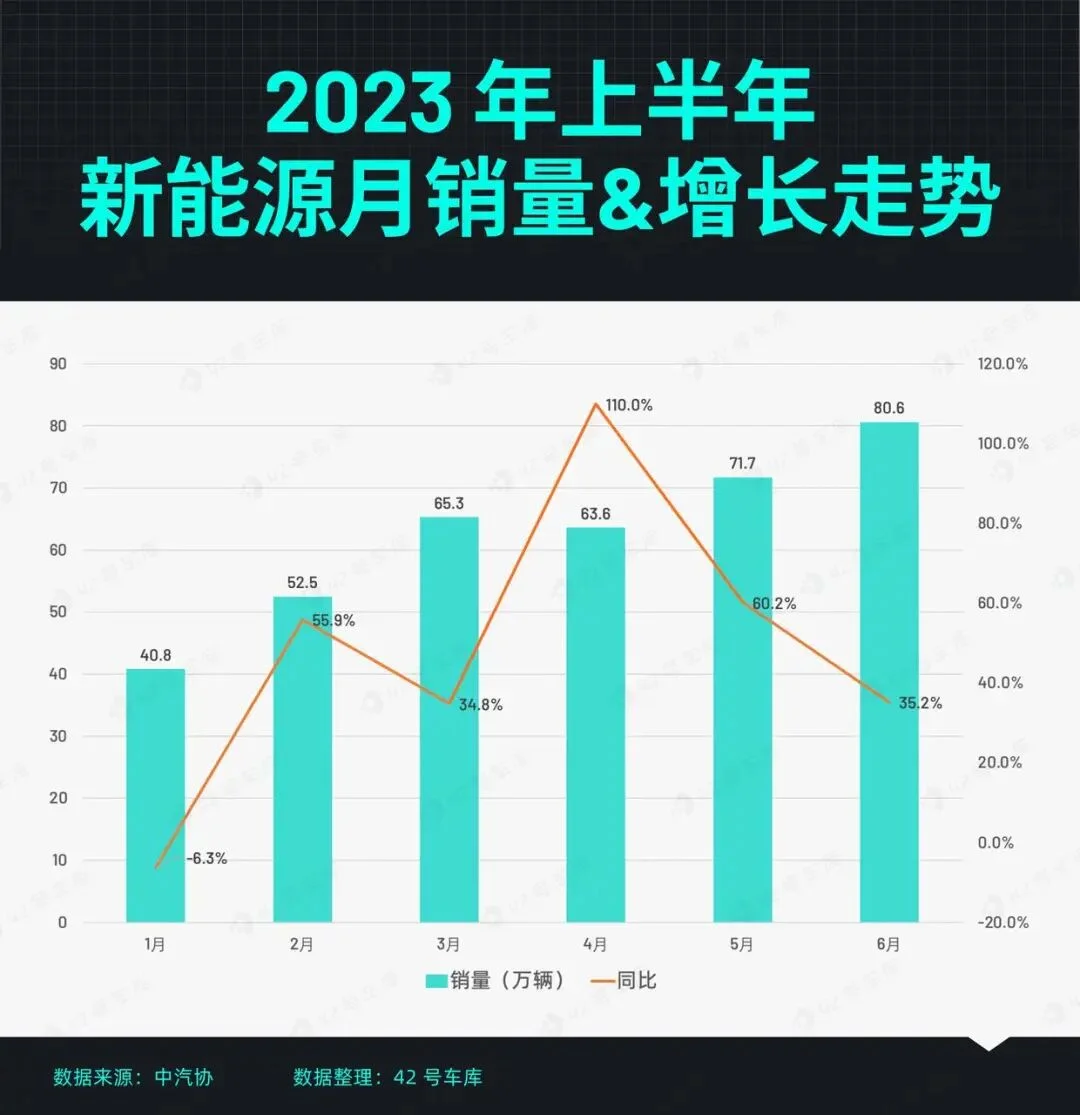
In December last year, due to factors such as the impending phase-out of policies and holiday effects, consumer demand for new energy vehicles was overdrawn in advance. This led to an unfavorable start in January this year, with sales dropping 48.3% month-on-month and falling 6.3% year-on-year.
Although new energy vehicle sales have generally increased month by month since January, the year-on-year growth rate has shown insufficient momentum after two concentrated bursts of price wars in January and March.
By the end of the first half of the year, although the price war continued, it had begun to ease.
However, with the launch of the XPENG G6 as a turning point, the price war underwent new changes, potentially generating fresh momentum for growth.
On June 29, XPENG launched the G6 with a starting price of RMB 209,900. Equipped with standard 800V architecture and XNGP, the model offered every available feature as standard equipment rather than optional extras, adopting a pricing strategy described as 'explosive.' Subsequent results showed that the XPENG G6 sold more than 3,900 units in its first month of delivery. This strong market feedback helped clear the gloom accumulated over the past year for XPENG, but it cast a shadow over competitors.
After all, a product priced at around RMB 200,000 already incorporated the most cutting-edge charging technology (800V) and intelligent driver assistance (XNGP). Consequently, competitors must consider how to price their own products. It is likely that they will be influenced by the XPENG G6, aiming to make prices attractive and provide value-driven competitiveness.
Driven by both price and value, growth in the new energy vehicle market may gain new momentum. However, for automakers, this represents a brutal, naked combat of systemic competitiveness involving comprehensive technology, production and sales capabilities, and supply chain management.
03Some Deterministic Trends 'Rolled' Out
Although the growth rate of the new energy vehicle market slowed down during the fierce price war in the first half of the year, some deterministic development trends are already very clear when looking at the long-term development of China's new energy vehicle market.
Urban NOA Rollout and BYD’s Entry: A Turning Point for Intelligence
On March 31, XPENG was the first to announce that its XNGP system, based on China’s first and only mass-produced BEV perception technology—XNet, a deep visual perception neural network—has eliminated reliance on high-definition maps. The company opened access to the first phase of XNGP capabilities for users in Guangzhou, Shenzhen, and Shanghai.
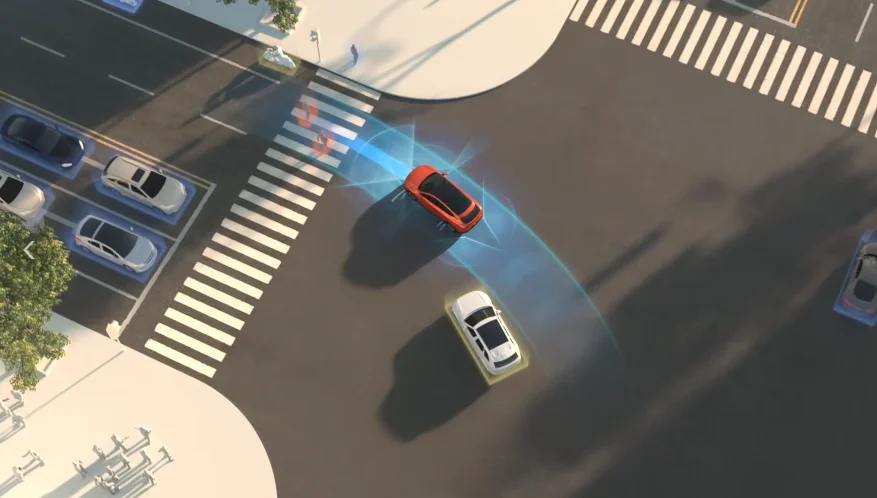
Within a month, Changchenghaomozhixing, Zhiji, AVATR, and Li Auto all announced their respective plans for urban NOA deployment. Specifically:
Changchenghaomozhixing announced it will implement the Chengshi NOH function in the third quarter of this year, with coverage expanding to 100 cities by 2024;
Zhiji released its urban NOA feature, which is expected to begin public beta testing by the end of this year;
AVATR stated that its NCA system will be deployed in 45 map-free cities within the current year;
Li Auto’s urban NOA will be pushed to 100 domestic cities by the end of this year.
Meanwhile, Tesla FSD has reached a new stage. By the end of Q2, Tesla’s FSD testing mileage had exceeded 300 million miles, with the testing distance growing at an exponential rate. Additionally, in July, the Dojo supercomputer began mass production. With all preparations complete, Tesla’s pursuit of full autonomous driving is advancing step by step.
Under the fierce competition among various players, the landscape for intelligent driver assistance systems to enter urban environments has opened up, significantly propelling the wave of new energy vehicle intelligence forward with sustained momentum.
First, from a technical perspective, based on the BEV + Transformer solution, intelligent driver assistance is no longer limited to single-use scenarios such as automatic parking and highway navigation assist. It is gradually capable of handling more complex and rapidly changing urban road driving scenarios, further stimulating demand through technology.
Second, from a commercial perspective, the business model of using smart driving to drive scale, accumulating data through scale, iterating smart driving with data, and finally attracting user payments through smart driving has taken another major step toward profitability.
Meanwhile, this also means that automakers have just emerged from the phase of competing on hardware and must now immediately shift their focus to competing on software.
The advancement of urban NOA into city streets pushes the wave of intelligence forward, but another force is pushing this wave to a new height: BYD.
On July 3, BYD released its self-developed high-end intelligent driver assistance system, Tianshenzhiyan, unveiling the second half of BYD’s intelligence strategy. This indicates that BYD’s recognition of the trend has overcome Wang Chuanfu’s previous view that 'autonomous driving is nonsense.'
BYD’s formal entry will undoubtedly drive more traditional automakers to recognize and invest in intelligence. The situation where intelligence was previously driven almost exclusively by companies like Tesla and new forces is changing, moving toward joint advancement across the entire industry.
Once the entire industry unites its efforts, the development of intelligent technologies will also reach an upward inflection point.
Notably, amid increasingly fierce industry competition, automakers’ progress in autonomous driving is facing new variables beyond technical and commercial dimensions. A recent typical case confirms that Wu Xinzhou, head of XPENG’s autonomous driving division, will be leaving his post—this personnel change is clearly set to deliver a fresh shockwave across the autonomous driving sector.
Yet it remains certain that automakers’ embrace of intelligentization has become an irreversible trend.
800V Is No Longer 'Exclusive'
Although vehicle electrification is the prevailing trend, charging infrastructure for pure electric vehicles remains a major obstacle to this journey.
As early as 2019, the Porsche Taycan led the industry by being the first to feature an 800V architecture, supporting peak charging power of up to 350 kW and enabling a charge from 5% to 80% in just 30 minutes under ideal conditions.
However, with a starting price of RMB 898,000, the Porsche Taycan restricted 800V technology to a privileged few.
In the subsequent period, automakers such as NIO, AVATR, BYD, and XPENG successively unveiled their own 800V technologies, with some already launching mass-produced models. Nevertheless, the price threshold for ordinary consumers to experience 800V remains high.
Consequently, the market performance of 800V systems has not yet achieved a true breakthrough.
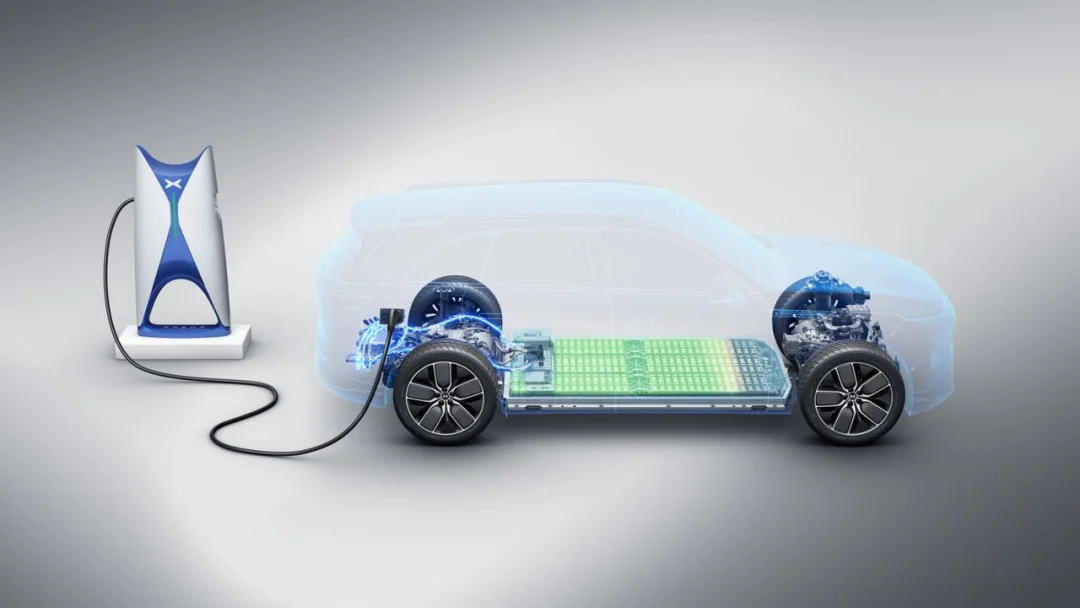
It is important to note that 800V technology represents only a partial aspect of product competitiveness. To achieve genuine market advancement, a product with comprehensive competitive strength is needed to drive growth. That product was precisely the XPENG G6 launched in the first half of the year.
The other aspects of the XPENG G6's comprehensive competitiveness are not reiterated here; readers can refer to our previous article, '209,900 RMB: The Desperate and Fatal Strike for XPENG G6'.
Regarding the 800V architecture, thanks to its 800V high-voltage silicon carbide (SiC) platform and standard 3C battery cells across all trims, the XPENG G6 achieves a charging efficiency of adding 300 km of range in just 10 minutes at S3/S4 supercharging stations. Furthermore, compared to 400V models, it charges more than one time faster even on national standard fast-charging piles.
Meanwhile, the XPENG G6 also adopts the 800V XPower Sanheyidianqudongxitong. By improving electric drive efficiency, it delivers excellent acceleration and braking performance.
More explosively, the XPENG G6 starts at a price of only 209,900 RMB. This means that in the first half of this year, the price threshold for 800V technology was further lowered by the XPENG G6 to 209,900 RMB.
For the entire market, 800V is no longer an unattainable feature.
Notably, in addition to the 800V models already launched in the first half of the year, such as the XPENG G6, automakers including Li Auto, Chery, Shangqi, NIO, and Leapmotor are also scheduled to introduce 800V vehicles in the future.
Although most products equipped with 800V technology currently remain concentrated in the mid-to-high-end market, continuous technological iteration, maturation, and reduced manufacturing costs will inevitably drive prices down. This will allow 800V-equipped products to cover the high, mid, and low-end markets comprehensively, delivering a qualitative improvement in the overall charging speed of pure electric vehicles.
Of course, the ultimate solution for high-efficiency energy replenishment is certainly not 800V. However, the shift from Porsche to XPENG reflects the industry's ongoing thinking and exploration regarding charging methods for pure electric vehicles.
This thinking and exploration are not confined solely to 800V.
For instance, beyond 800V, BYD’s dual-gun fast charging offers new ideas for pure electric vehicle energy replenishment. Meanwhile, the battery swapping model, once heavily criticized, is increasingly becoming a direction encouraged by policy makers.
In the future, more energy replenishment technologies will emerge. Their path to popularization may repeatedly resemble the journey from Porsche to XPENG, but regardless, the electrification of automobiles will become increasingly unstoppable.
Plug-in Hybrids and Pure Electrics: All-Around Competition in New Energy
Previously, driven by popular pure electric automakers like Tesla, companies flooded into the pure electric track.
However, the reality is that not all automakers can currently generate substantial profits from pure electric vehicles. Rushing into the BEV segment carries two risks: it easily leads to homogenized competition, and for traditional brands known for internal combustion engines, the cost of transitioning to electrification in a short time is prohibitively high.
Although plug-in hybrid (PHEV) models have long been labeled as 'transitional products,' they remain practical while offering economic benefits that still meet user needs, making them more viable than pure EVs in many scenarios.
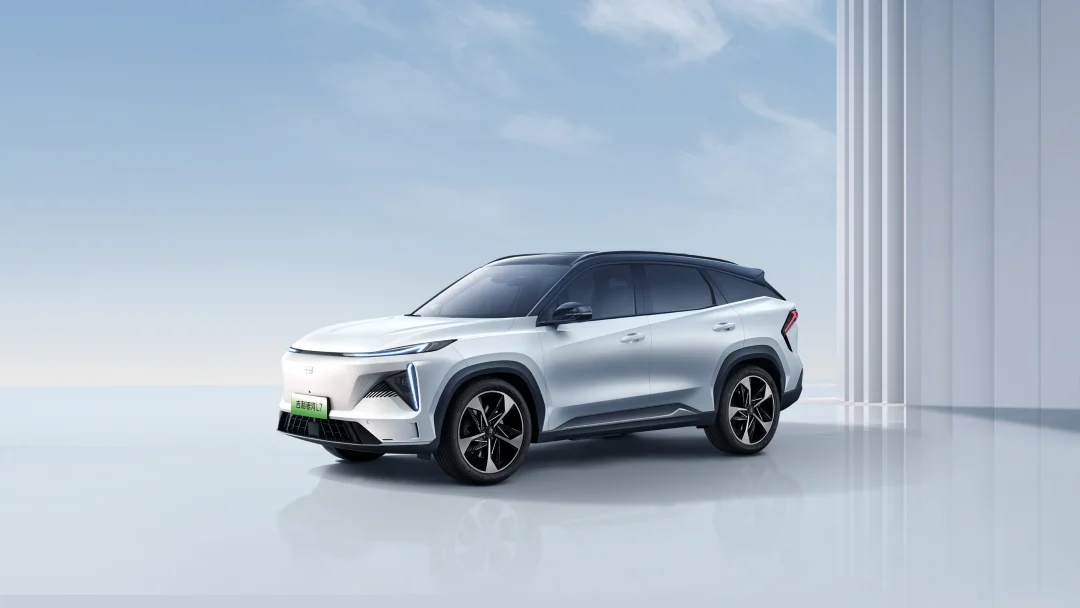
Whether a product is transitional or ultimate, the best ones are those that align with user demands. In this regard, BYD and Li Auto have already reaped significant rewards.
Consequently, new-generation NEVs such as Nezha and Leapmotor, alongside traditional brands like Geely and Changcheng, are all launching their own PHEV models.
As noted earlier, as the number of PHEV models increases, prices continue to drop. Highly competitive PHEVs such as the Geely Yinhe L7 and HAVAL Xiaolong are increasingly clustering in the mid-range market.
The mid-range segment represents the area with the greatest consumption potential; its users constitute the mainstream of the automotive market. For the NEV sector to grow sufficiently strong and evolve into a more mature, stable market structure, it must fully capture this segment and its users.
While PHEVs are indeed growing, electrification remains the overarching trend. To gauge preferences, we conducted a survey on Weibo asking, 'Between a PHEV and a BEV at the same price point, which would you choose?' The results showed 56% chose PHEVs, while 44% chose BEVs.
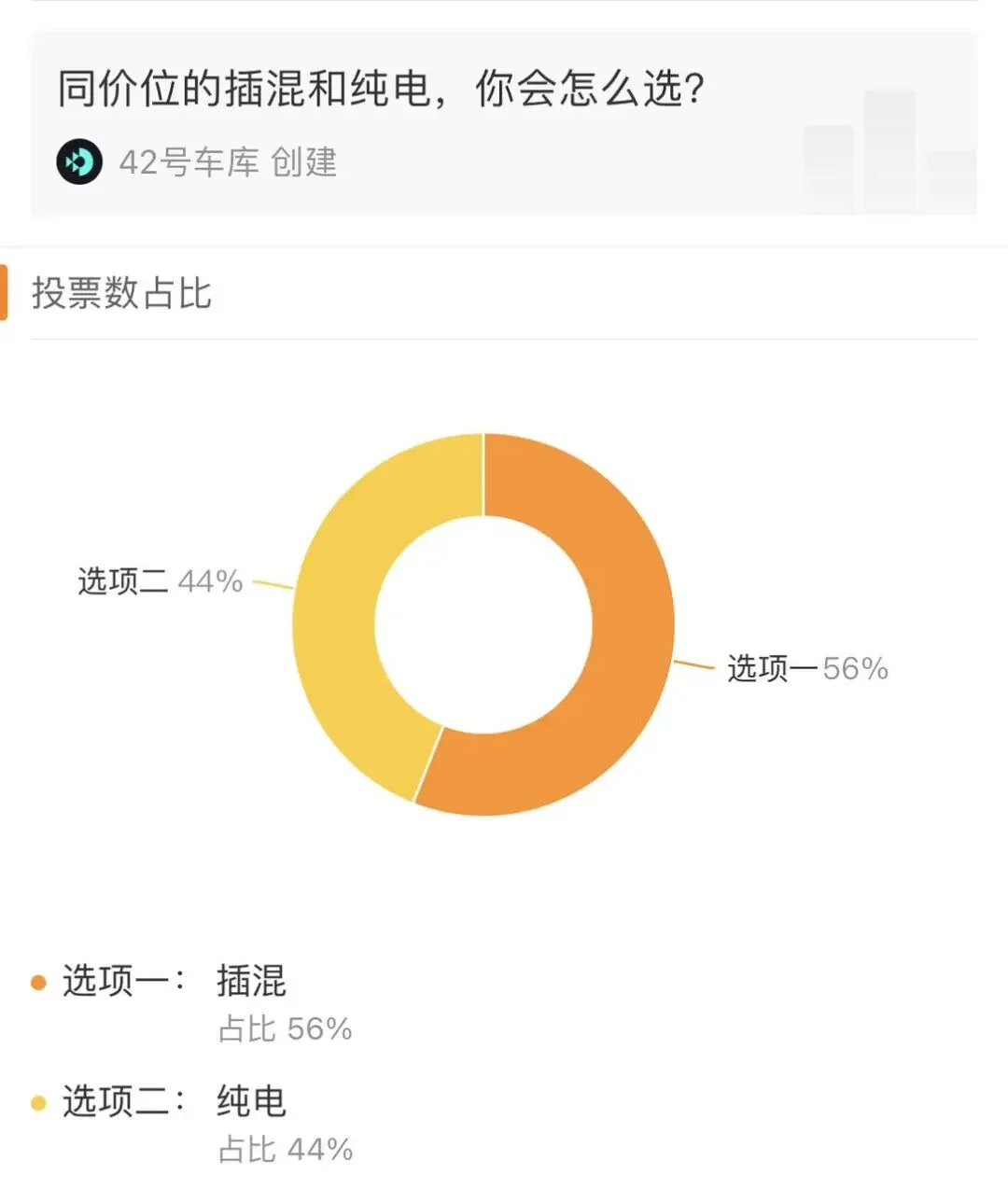
Although more people chose plug-in hybrids, the gap with those choosing pure electric vehicles is not significant; the two are almost evenly matched.
This means that although pure electric models may not match plug-in hybrids in terms of range and refueling convenience, they remain highly competitive, and this competitiveness continues to grow.
Compared to plug-in hybrid models, pure electric vehicles have already taken the lead in capturing the mid-range market. As more plug-in hybrids and pure EVs expand their coverage of this segment, a wave of intense competition—far fiercer than the past focus on micro cars and premium models priced above RMB 200,000—is bound to erupt. This will directly trigger comprehensive price wars across all price tiers in the new energy vehicle market.
In this situation, both the scale that new forces have been longing for and the new energy transition that traditional automakers are deeply committed to must now accelerate.
04Final Thoughts
Whether it is a price war or intense competition, these are inevitable means for the new energy vehicle market to eliminate the bad and retain the good, and also an unavoidable path for the market to reach maturity and stability.
Currently, there are too many players on the road and competition is too fierce. With market space limited, each automaker's survival space is being squeezed by others.
Compounding the difficulty, as growth in the new energy vehicle market has slowed, electrification has moved past its initial phase of rapid expansion and conquest, entering a more arduous and protracted battle. Meanwhile, the curtain has fully risen on intelligent driving; unwilling to fall behind, automakers have begun launching a comprehensive war across multiple dimensions—including technology, products, cost, and user experience—with the goal of mass-producing high-speed NOA (Navigate on Autopilot) and urban NOA capabilities.
Under these circumstances, automakers' room for survival will become even more constrained, with some already facing existential pressure.
Thus, driven by survival pressures, automakers are actively seeking change and new ways to survive.
Traditional automakers like Geely and Changcheng have opted to establish new brands or series, such as Yinhe and Xiaolong, to find a fresh starting point. Volkswagen's collaboration with XPENG represents a more pragmatic choice, shedding the so-called pride of industry giants; in turn, XPENG has gained breathing room in terms of financial and technical reputation. Interestingly, new force automakers like Leapmotor are also beginning to seek technology exports amid immense market pressure.
In short, amid the rapidly changing and harsh market environment, "seeking change" has also become a collective move for new energy vehicle makers.
As the saying goes, "When things reach an impasse, they must change; through change, they find a way." The market is changing, and automakers are striving to adapt. In this game of "change versus continuity," some automakers have fallen by the wayside, while others struggle on. There is no precise arrival time for dawn in the new energy vehicle market. Before that dawn arrives, survival is the top priority for automakers, even if it means living "like beasts of burden."
Written by: Isaiah Edited by: 308