


Li Auto Reports Record Q2 Revenue and Deliveries; Baojun Cloud Debuts; Tesla Cuts Prices
01Weekly Indices
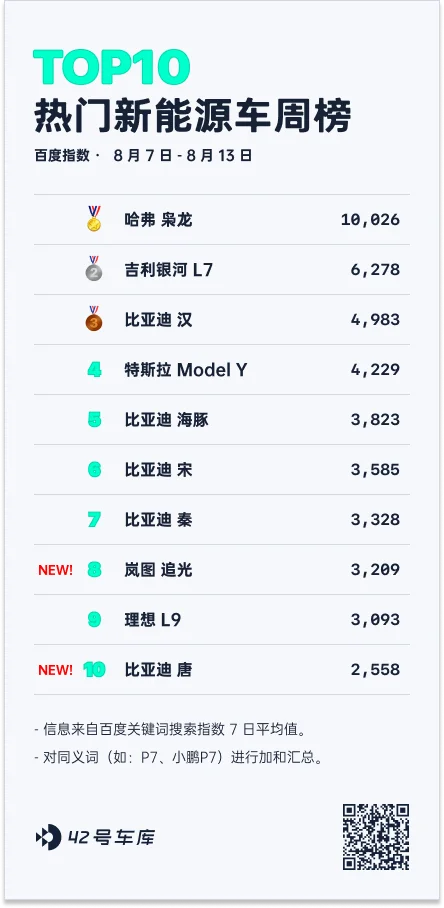
02Weekly News
Li Auto Releases Q2 2023 Financial Results
2023Q2 Financial Data
Total revenue was RMB 28.65 billion, up 228% year over year and 52% quarter over quarter;
Automotive business revenue was RMB 27.97 billion, up 230% year-over-year and 53% quarter-over-quarter;
Total gross profit reached RMB 6.24 billion, a year-over-year increase of 232% and a quarter-over-quarter increase of 63%;
The overall gross margin was 22%, compared to 22% in the same period last year and 20% in the previous quarter;
Gross margin per vehicle was 21%, up from 20% in the previous quarter;
Cost of sales was RMB 22.42 billion, up 227% year-over-year and 50% quarter-over-quarter;
Net profit was RMB 2.31 billion, compared to RMB 934 million in the previous quarter;
The company’s cash reserves (cash and cash equivalents, restricted cash, time deposits, and short-term investments) stood at RMB 73.77 billion, compared to RMB 65 billion in the previous quarter.
R&D expenses for Li Auto’s second quarter reached RMB 2.43 billion, a 31% increase from the prior quarter, accounting for 8% of total quarterly revenue.
Sales and administrative expenses amounted to RMB 2.31 billion, representing a 74% year-over-year increase and a 40% quarter-over-quarter increase.
2023 Q3 Business Outlook
Vehicle deliveries are projected to be between 100,000 and 103,000 units, an increase of approximately 277% to 288% compared to 2022 Q3.
Total revenue is expected to fall between RMB 32.33 billion and RMB 33.3 billion, reflecting growth of approximately 246% to 257% over 2022 Q3.
After breaking through the monthly sales milestone of 30,000 units, the company is now targeting 40,000.
From the perspective of its business performance in the second quarter, Li Auto has unquestionably become a 'dark horse' among Chinese automakers.
Specifically:
In April, Li Auto delivered 25,681 vehicles, a year-over-year increase of approximately fivefold. The L8 Air began deliveries that month, while the L7 Xilie saw its first delivery month, with over ten thousand units delivered.
In May, Li Auto deliveries reached a new high of 28,277 units, with the Li L7 delivering over 10,000 units again. Notably, Li Auto’s revenue in that month exceeded RMB 10 billion, marking the first time the company’s monthly revenue surpassed RMB 10 billion.
In June, despite the complete withdrawal of the Li ONE from the market and only a modest increase in factory capacity, Li Auto’s monthly deliveries broke the 30,000-unit mark for the first time, reaching 32,575 units—a year-over-year increase of 150.1%. This made Li Auto the only Chinese luxury brand to achieve monthly deliveries exceeding 30,000 units.
Beyond these figures, Li Auto’s delivery performance in the second quarter featured several other highlights.
For instance, in the price segment ranging from RMB 319,800 to RMB 459,800, Li Auto not only achieved monthly deliveries exceeding 25,000 every month but also showed a month-on-month upward trend, breaking the 30,000-unit threshold in June. This successfully met the expectations previously stated by Xiang Li during the earnings call for the previous quarter.
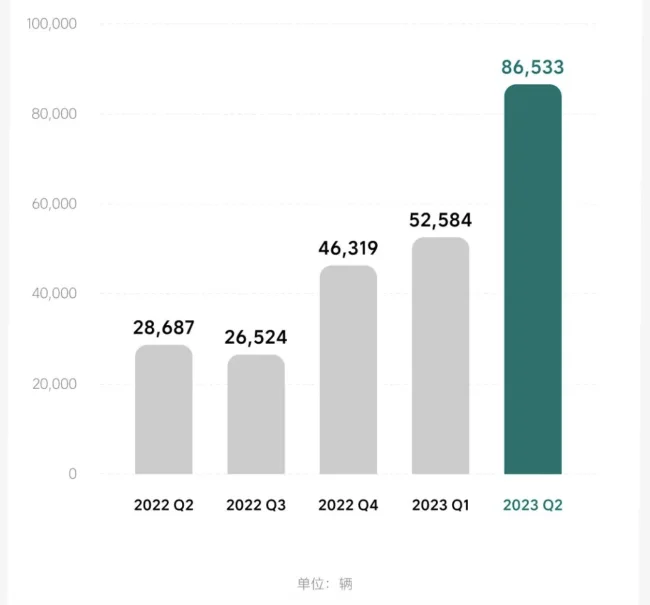
Overall, Li Auto’s cumulative deliveries for the second quarter reached 86,533 units, up 201.6% from the 28,687 units delivered in the same period last year. By comparison, XPENG’s deliveries fell 32.6% year-over-year in Q2, while NIO’s deliveries declined by 6.1%. In fact, Li Auto’s total deliveries alone surpassed the combined totals of XPENG and NIO.
Such performance is hard not to make rivals envious.
Not only that, with this achievement, Li Auto's delivery volume in the first half of 2023 has already surpassed its full-year delivery volume in 2022. At the same time, this sales figure far exceeded the delivery expectations Li Auto had set in its previous quarter's financial report (76,000 to 81,000 units).
In response, Xiang Li, Chairman and CEO of Li Auto, stated:
We crossed the important milestone of monthly deliveries exceeding 30,000 units in June. The second-quarter delivery volume reached a historical high, and all three models in the Li L series maintained sales leadership in their respective market segments. These achievements have consolidated Li Auto's market position as the preferred luxury brand for families and laid a solid foundation for breaking through the RMB 100 billion annual revenue target in 2023.
It is worth noting that in the July sales data already released, Li Auto's delivery volume hit another new high at 34,134 units, surpassing 30,000 units for two consecutive months, a year-on-year increase of 227.5%. Among them, on July 5, Li Auto also achieved cumulative deliveries exceeding 400,000 units.
Such delivery performance stands out not only among new energy vehicle brands but also shines exceptionally in the entire Chinese new energy vehicle market.
It is also worth mentioning that based on existing results, Xiang Li, Chairman and CEO of Li Auto, stated that the goal for the Li L8 and Li L9 in the third quarter is to exceed 10,000 units per month, while the Li L7 aims for a monthly delivery target of 15,000 units. In the fourth quarter of this year, they will challenge a monthly delivery target of 40,000 units.
Additionally, according to the performance guidance provided by Li Auto in its financial report, Li Auto expects to achieve a delivery volume target of 100,000 to 103,000 units in the third quarter, representing a year-on-year increase of 277% to 288.3%. Considering that July's delivery figures are already available, this means Li Auto is prepared to maintain delivery volumes above 30,000 units in both August and September.
This also underscores the confidence of Xiang Li and Li Auto.
Quick Commentary:
For Li Auto, the first half of this year has indeed been a period of rapid growth.
This growth is reflected not only in its product lineup, delivery figures, and financial statements, but more importantly, Li Auto, as a new-entrant automaker, has successfully built an organization, processes, and systems capable of sustaining a positive commercial cycle. Moreover, these organizational structures and systems are themselves continuously evolving.
This is what has drawn the industry's attention to Li Auto.
In fact, "growth" has become Li Auto's core corporate identity. In the earnings report, Xiang Li himself stated: As a growth-driven enterprise, Li Auto will continue to learn, train, and grow, consistently delivering products and services that exceed user expectations.
Viewing this from the perspective of growth, we can see that Li Auto has already completed one phase of growth during the initial stage from 0 to 1, though this process was relatively lengthy. Now, in the stage from 1 to 10, Li Auto's growth pace has accelerated significantly. Furthermore, through its "Dual-Energy Strategy," Li Auto is already laying the groundwork for its next phase of development.
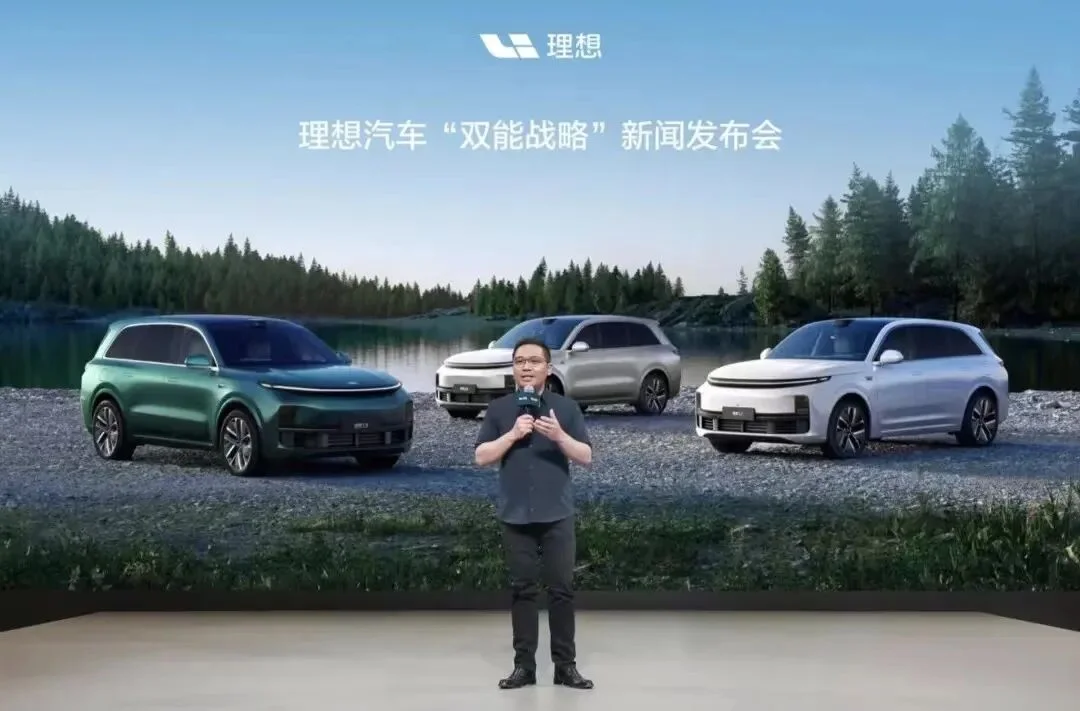
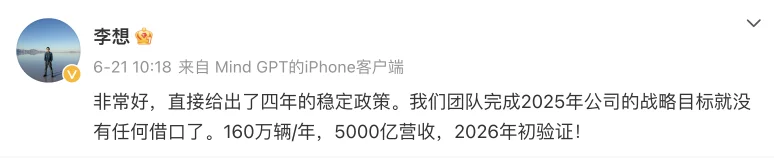
Notably, in stages 1 through 10, Li Auto set a goal to achieve annual revenue of RMB 100 billion this year. In the first half of the year, Li Auto’s revenue reached RMB 47.44 billion; for the third quarter, Li Auto forecasts revenue between RMB 32.33 billion and RMB 33.3 billion. Therefore, based on current revenue performance, achieving the RMB 100 billion annual revenue target is no longer distant.
However, from a longer-term perspective, Li Auto still has room for continued growth.
Baojunyunduo Officially Launched
With the launch of Baojunyunduo, Baojun demonstrated its determination to create an "epic" product.
On August 10, Baojunyunduo was officially launched.
Baojunyunduo includes 5 versions in total, namely:
Baojunyunduo 360 Plus, priced at RMB 95,800;
Baojunyunduo 360 Pro, priced at RMB 103,800;
Baojunyunduo 460 Pro, priced at RMB 115,800;
Baojunyunduo 460 Max, priced at RMB 123,800.
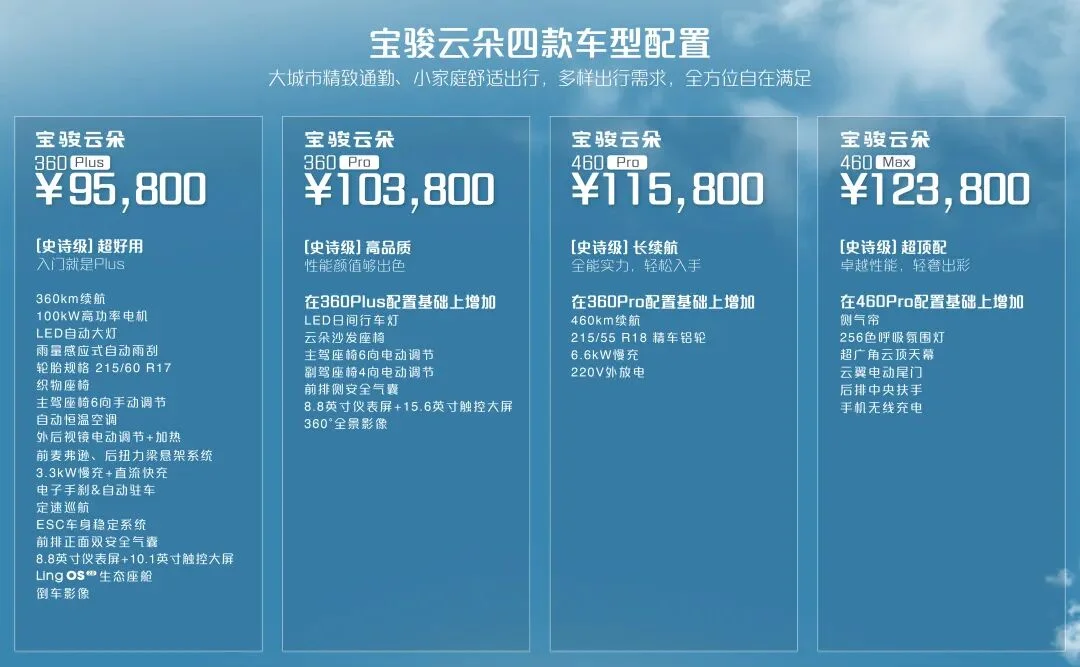
Additionally, users who place a reservation deposit of RMB 1,000 between August 11 and September 30 will receive benefits such as a free charging pile and financial interest subsidies.
Additionally, Baojunyunduo offers a 460 Lingxi variant equipped with DJI’s intelligent system, which will be launched separately at a later date and is currently open for blind reservations.
Compared to competitors in the same class, a core feature of Baojunyunduo is its size—surprisingly large.
In terms of body dimensions, the Baojunyunduo measures 4,295 mm in length, 1,850 mm in width, and 1,652 mm in height, with a wheelbase of 2,700 mm, giving it a significant advantage in overall size over competing models.
Meanwhile, although Baojunyunduo is a standard A-segment car in terms of exterior dimensions, stepping inside reveals that its interior space feels nothing like an A-segment vehicle.
In our real-world test (with a tester who is 1.8 m tall), there was approximately one fist's width of knee room in the front seat and about one fist plus three fingers of headroom. In the rear seat, with the front seats moved almost to the B-pillar position, there was still roughly three fists' worth of knee room.
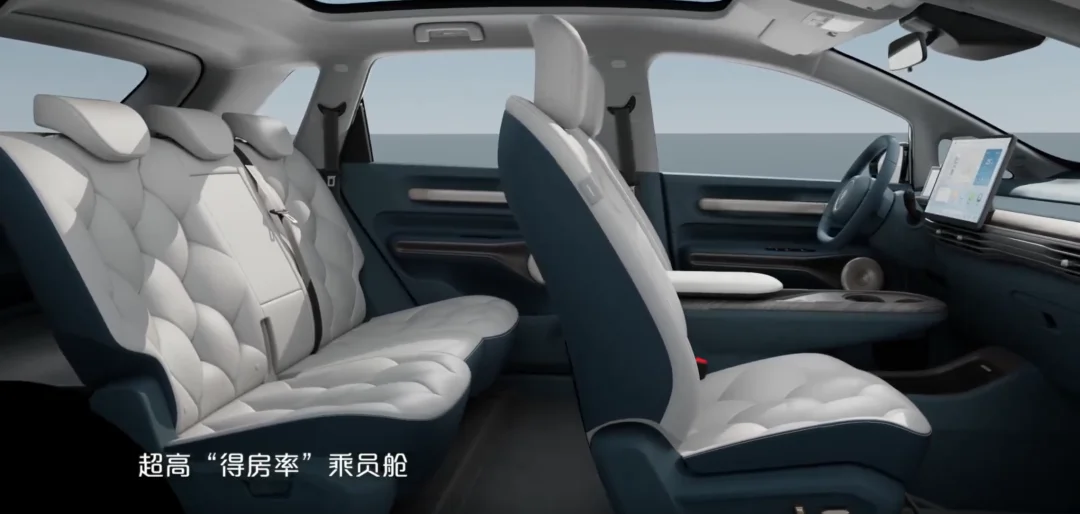
The trunk space is particularly impressive. With the rear seats in the upright position, the Baojunyunduo's trunk can accommodate ten 20-inch suitcases. Removing the cargo cover further increases the volume to 600 liters, comparable to that of a mid-size SUV.
Quick Commentary:
Despite repeatedly emphasizing that Baojunyunduo is an "epic" product, Zhou Xing still has significant concerns. He said:
"To be honest, I'm a bit worried about the traffic for the Yun Duo launch event at 7 p.m. tonight. Everyone's online attention span is limited, and after a major traffic surge, it's difficult to generate another big excitement point due to fatigue."
Indeed, in an era where traffic is king, new hot topics constantly replace old ones. However, as automobiles are products with exceptionally long usage cycles, sufficiently high sales volumes can bring sustained attention to the product.
According to official data, since the blind reservation for Baojunyunduo began on July 28, orders have exceeded 10,000 units within 10 days. Among them, the proportion of large reservations with a deposit of 1,000 yuan accounts for more than 70%, and family users in first- and second-tier cities account for over 80%.
Based on this data, Baojunyunduo has significant potential to convert sales volume into traffic, thereby establishing a positive feedback mechanism between the two that drives continuous growth in both.
However, in China's fiercely competitive new energy vehicle market, where every manufacturer is aggressively vying for both sales and attention, sustaining this momentum is extremely difficult.
This challenge tests not only whether a model's product strength is sufficient but also evaluates automakers' comprehensive capabilities across production capacity, distribution channels, and other areas.
In the sub-RMB 100,000 new energy vehicle market, Baojunyunduo has taken the lead in this intense competition, but more and more difficult challenges await it ahead.
Tesla Limited-Time Price Cuts
Tesla has introduced a new wave of purchasing incentives.
Specifically:
——From now until the end of September, buyers of the Model 3 Rear-Wheel Drive version can receive a RMB 8,000 vehicle purchase subsidy.
——Effective immediately, the price of the Model Y Long Range version has been reduced to RMB 299,900, and the Performance version to RMB 349,900. The reduction amounts to RMB 14,000.
This round of price cuts is quite interesting. Elon Musk previously made strong statements that 'Tesla can sell cars at zero profit' and that 'further price reductions are possible,' and he has indeed followed through.
However, it is important to note the context: the facelifted versions of the Model 3 and Model Y are likely not far off, making pricing a critical factor.
Quick Commentary:
Rumors have circulated since last year regarding an upcoming facelift for the Tesla Model 3 and Model Y. For vehicles that have been on the market for over five years, this timing aligns with a reasonable cycle for a major update. Considering this factor, Tesla's price reduction to some extent increases the credibility of information suggesting that the new models are imminent.
I wonder whether consumers would prefer the new model or the discounted older version?
Written by: Yisong Edited by: JOJO