


Li Auto, the Dark Horse, Races Toward RMB 500 Billion in Revenue
Li Auto has once again set a new record.
In its latest financial report for the second quarter of 2023, Li Auto delivered its best quarterly performance since going public: revenue reached a new high, building on Q1 figures; gross margin saw steady growth, even surpassing Tesla’s; and net profit was substantial, showing a significant improvement over the previous quarter.
It is clear that Li Auto is currently in a strong upward trend.
In fact, given the business results from the second quarter, Li Auto’s financial performance was not surprising to the outside world—after all, Li Auto’s L-series has indeed formed a highly competitive product lineup. Behind this product lineup, Li Auto has repeatedly proven itself in terms of organization, systems, and processes.
Based on this foundation, Li Auto is also laying solid groundwork for its long-term strategy combining pure electric and extended-range vehicles.
Record-Breaking Performance: Gross Margin Surpasses Tesla
No surprises: Li Auto delivered a stellar financial report, marking its "best ever."
Overall, in the second quarter of this year, Li Auto's revenue reached RMB 28.65 billion, representing a year-over-year increase of 228.1% compared to RMB 8.73 billion in the same period last year, and a quarter-on-quarter growth of 52.5% compared to the first quarter.
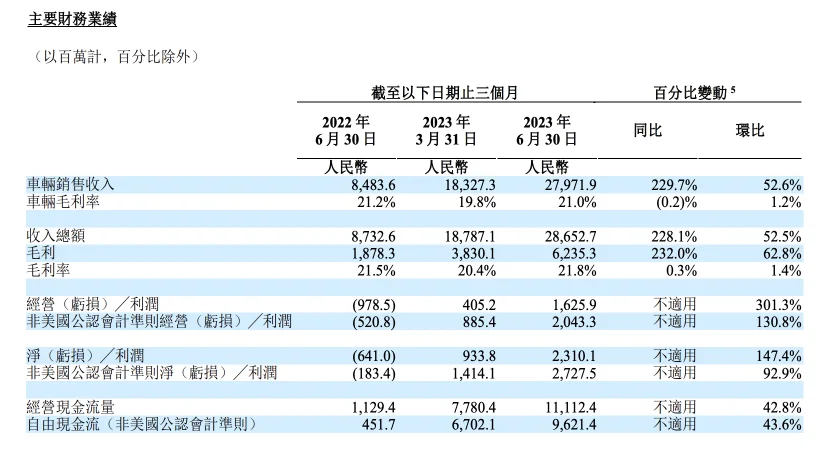
Revenue from vehicle sales amounted to RMB 27.97 billion, up 229.7% year-over-year and 52.6% quarter-on-quarter. This significant year-over-year growth was driven not only by a 201.6% increase in vehicle deliveries but also by a slight rise in the average selling price of delivered models.
Turning to gross margin performance.
Li Auto's gross profit for the second quarter was RMB 6.24 billion, a 232% year-over-year increase from RMB 1.88 billion in the same period last year, and a 62.8% quarter-on-quarter increase.
From a gross margin perspective, Li Auto's gross margin rate in the second quarter stood at 21.8%, showing a clear improvement from 20.4% in the first quarter. This rate exceeded Tesla's gross margin of 18.2% during the same period.
Regarding vehicle-specific gross margins, Li Auto achieved 21% in Q2, a substantial increase from 19.8% in the first quarter, compared to 21.2% in the same period last year. Li Auto stated that excluding the impact of the Li ONE, the gross margin for the Li L series remained stable compared to the first quarter of 2023.
In terms of profitability:
Operating profit in Q2 reached RMB 1.63 billion, a quarter-on-quarter increase of 301.3% compared to the first quarter, reversing a loss of RMB 978.5 million in the same period last year.
Net profit for Q2 was RMB 2.31 billion, up 147.4% from the previous quarter. With this result, Li Auto has achieved profitability for three consecutive quarters.
Additionally, operating cash flow for Li Auto in the second quarter stood at RMB 11.11 billion, a 42.8% increase quarter-on-quarter; this compares to RMB 1.13 billion in the same period last year and RMB 7.78 billion in the first quarter of this year.
Overall, whether measured by revenue scale or profit generation, Li Auto’s performance in the second quarter represents its best state since going public, reflecting continuous self-breakthrough.
Notably, as of the end of the second quarter, Li Auto’s cash and cash equivalents, restricted cash, time deposits, and short-term investments (i.e., cash reserves) totaled RMB 73.77 billion. Such a cash reserve provides a foundation for enhancing risk resistance, ensuring long-term stable development, and deepening investment in research and development.
Regarding these financial results, Li Auto Chief Financial Officer Li Tie stated:
"Our performance in the second quarter was strong, with revenue, net profit, and free cash flow all hitting record highs. Specifically, driven by a significant increase in vehicle deliveries, our revenue grew 228.1% year-on-year to RMB 28.65 billion; our net profit increased to RMB 2.31 billion, and free cash flow reached RMB 9.62 billion."
Our strong financial performance will support deeper R&D investment, accelerate business development, and enable us to create greater value for users, shareholders, and society.
After Breaking the Monthly Sales Milestone of 30,000 Units, Aiming for 40,000
Based on its second-quarter performance, Li Auto has emerged as a well-deserved "dark horse" among Chinese automakers.
Specifically:
In April, Li Auto delivered 25,681 vehicles, representing year-over-year growth of approximately five times. The L8 Air began deliveries that month, while the L7 series saw its first delivery month, with over 10,000 units delivered in that same period.
In May, Li Auto’s deliveries reached a new high of 28,277 units, with the L7 again exceeding 10,000 deliveries. Notably, the company’s revenue surpassed RMB 10 billion that month, marking the first time Li Auto achieved single-month revenue of over RMB 10 billion.
In June, despite the complete withdrawal of the Li ONE from the market and only a modest increase in factory capacity, Li Auto’s monthly deliveries exceeded 30,000 units for the first time, reaching 32,575 units, a year-over-year increase of 150.1%. This made Li Auto the only Chinese luxury brand to exceed 30,000 monthly deliveries.
Beyond these figures, Li Auto’s delivery performance in the second quarter featured several other highlights.
Take the price segment of RMB 319,800 to RMB 459,800 as an example. Li Auto not only achieved monthly deliveries exceeding 25,000 units every month but also showed a month-on-month increase. In June, it broke through the 30,000-unit monthly delivery milestone, successfully meeting the expectations set by Xiang Li during the previous quarter's earnings call.
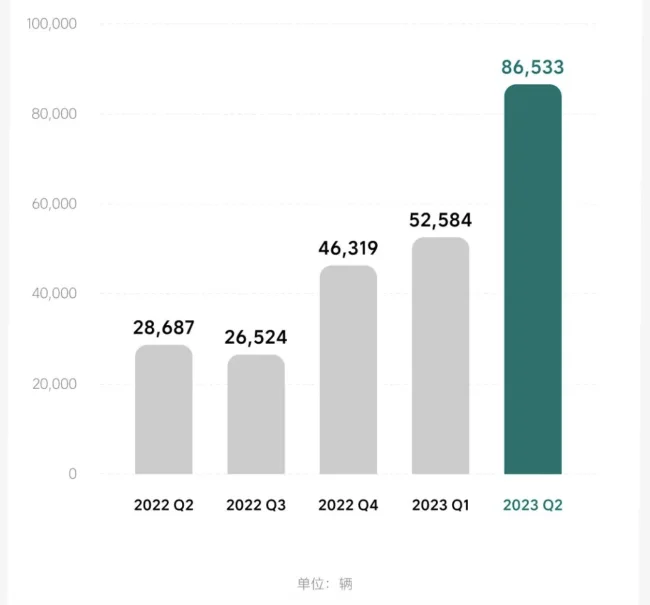
On a broader scale, Li Auto’s cumulative deliveries in the second quarter reached 86,533 units, representing a year-over-year growth of 201.6% compared to 28,687 units in the same period last year. By contrast, XPENG’s deliveries in Q2 fell by 32.6% year over year, while NIO’s deliveries declined by 6.1%. Notably, Li Auto’s single-company delivery volume even surpassed the combined total of XPENG and NIO.
It is hard not to envy such performance from competitors.
Furthermore, with this achievement, Li Auto’s first-half 2023 delivery volume has already exceeded its full-year delivery volume in 2022. This sales figure also significantly surpassed the delivery expectations Li Auto had provided in its previous quarterly earnings report (76,000 to 81,000 units).
In response, Xiang Li, Chairman and CEO of Li Auto, stated:
We crossed the important milestone of 30,000 monthly deliveries in June. The second-quarter delivery volume reached a historical high, and all three models in the Li L series maintained sales leadership in their respective market segments. These achievements have consolidated Li Auto’s position as the preferred luxury brand for families and laid a solid foundation for achieving the 2023 revenue target of RMB 100 billion.
It is worth mentioning that in the July sales data already released, Li Auto’s deliveries hit another record high at 34,134 units, breaking the 30,000-unit mark for two consecutive months, up 227.5% year over year. On July 5, Li Auto also announced that its cumulative deliveries had surpassed 400,000 units.
This delivery performance stands out not only among new-energy vehicle startups but also across the entire Chinese NEV market.
Notably, building on these results, Li Auto Chairman and CEO Xiang Li stated that the company aims for monthly deliveries exceeding 10,000 units each for the Li L8 and Li L9 in the third quarter. The Li L7 targets a monthly delivery goal of 15,000 units, with an ambition to reach 40,000 units per month by the fourth quarter of this year.
Furthermore, based on the guidance provided in its earnings report, Li Auto expects third-quarter deliveries to range between 100,000 and 103,000 units, representing a year-over-year increase of 277% to 288.3%. Given that July’s delivery figures have already been released, this implies that Li Auto is positioned to maintain monthly deliveries above 30,000 units in both August and September.
This clearly reflects the confidence held by both Xiang Li and Li Auto.
Increased R&D Investment: Li Auto’s Early Layout for Pure Electric Vehicles
While the current achievements are impressive, Li Auto remains vigilant.
In terms of research and development spending, Li Auto’s R&D expenses reached RMB 2.43 billion in the second quarter, up 58.1% from RMB 1.53 billion in the same period last year and 31% higher than in the first quarter. The company attributed this increase to higher employee compensation due to a growing workforce, as well as rising costs associated with expanding its product organization and technology capabilities.
Addressing this, Xiang Li noted in the earnings report that amid intensifying competition in China’s new-energy vehicle market, Li Auto will further strengthen its competitive advantage through sustained R&D investment, rapid business expansion, and improvements in organizational processes and operational capabilities.
In fact, Li Auto has already begun laying out its business strategy for the future.
For instance, in terms of product lineup, on August 3 this year, building on the existing L-series models, Li Auto introduced the L9 Pro priced at RMB 429,800 based on the L9. Its main difference from the L9 Max lies in intelligent driving: specifically, it no longer includes the AD Max system that supports urban NOA (Navigation on Autopilot), but still supports highway NOA.
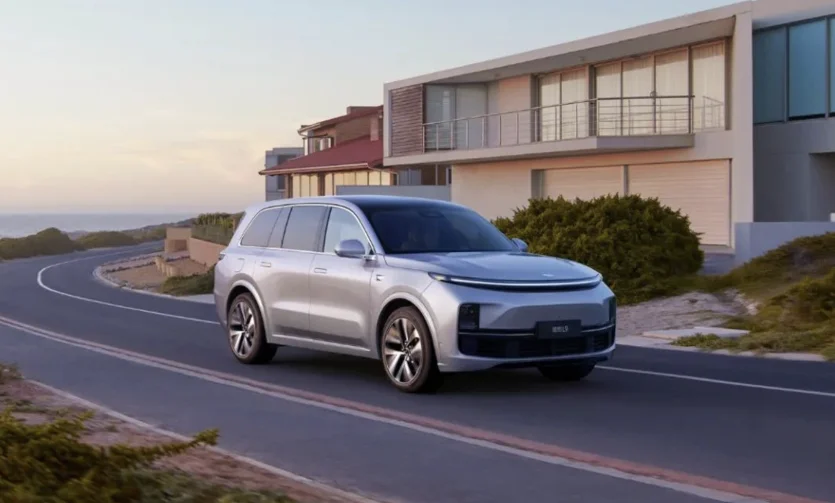
Clearly, this model supplements the entire L-series product line, helping Li Auto capture market share in the RMB 400,000 to RMB 450,000 segment and supporting higher sales targets—the vehicle is currently being delivered.
Meanwhile, to support sales growth, Li Auto is actively expanding its sales channels, penetrating deeper into third- and fourth-tier cities. According to data released by Li Auto, as of July 31, 2023, the company operated 337 retail centers covering 128 cities, and ran 323 after-sales service centers and authorized body-paint centers across 222 cities.
Notably, while expanding its sales channels, Li Auto upgraded its commercial system organizational processes. A significant change was shifting from a regional management structure to a refined provincial management model, with provinces directly managing individual stores.
In this way, under the new management framework, both the resource allocation for customer acquisition and the resource allocation for conversion have shifted from being handled centrally by the head office to being managed autonomously by each province and each store. The significant benefit brought about is that the output per Li Auto store and the output per product specialist have both increased substantially, and the conversion rate from leads to orders has also seen a very significant improvement.
In intelligent driving, Li Auto held its first Family Technology Day in June, showcasing technological progress in smart spaces and autonomous driving, as well as plans for opening urban NOA and commute NOA. Test drives for these features began in June 2023. Li Auto stated that urban NOA and commute NOA are expected to roll out to 100 cities nationwide by the end of 2023.
More importantly, the market is watching Li Auto’s first pure-electric model.
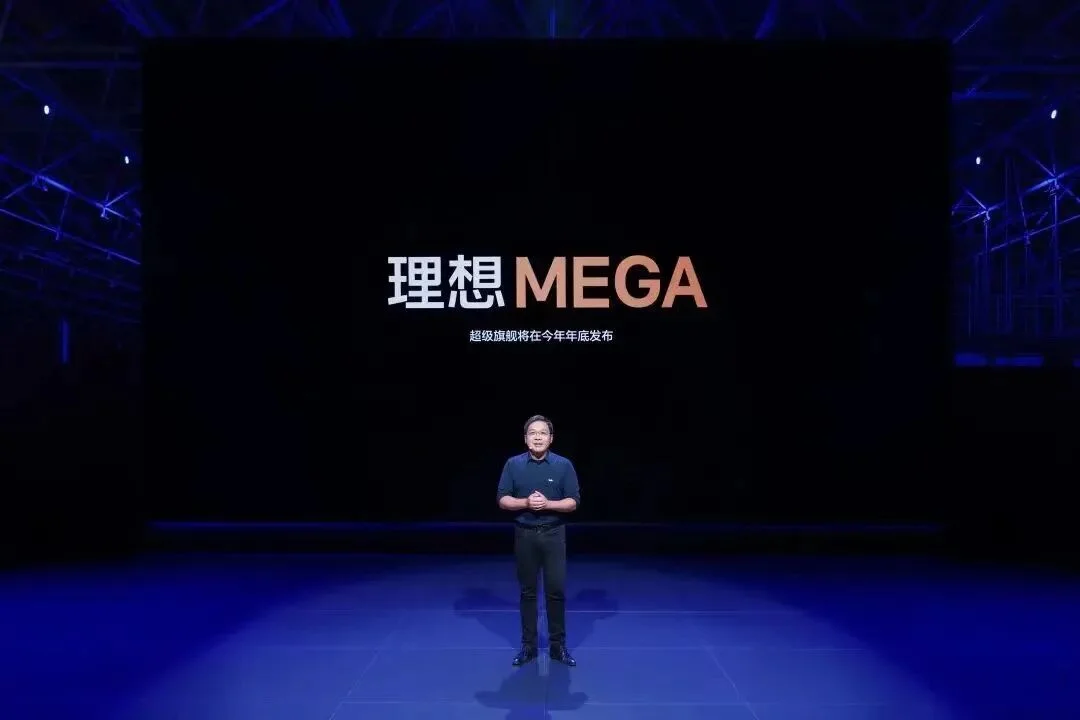
Earlier, at the Li Auto Family Technology Day, Li Auto announced its upcoming 5C pure-electric super flagship model, named Li MEGA, which is scheduled for release in 2023. The vehicle's key feature is its focus on achieving 5C charging, leading to optimizations in both the battery and the battery thermal management system.
At the same time, Li Auto is rapidly expanding its supercharging network for its pure-electric models. The company stated that it has already built 37 supercharging stations, plans to build more than 300 by the end of this year, and aims to exceed 3,000 stations by the end of 2025.
Xiang Li also places high hopes on the Li MEGA. In the earnings report, he said:
Our first 5C pure-electric super flagship, Li MEGA, will be launched in the fourth quarter of this year. We are confident that Li MEGA, which embodies the latest technological achievements of our “Dual-Energy Strategy,” will become a new blockbuster with sales ranking first in the segment above RMB 500,000.
Conclusion
For Li Auto, the first half of this year has indeed been a period of rapid growth.
This growth is evident not only in its product lineup, delivery figures, and financial statements, but more importantly in Li Auto’s successful establishment of the organizational structure, processes, and systems that sustain a positive commercial cycle. These elements are also continuously evolving.
This is also what has made Li Auto stand out in the eyes of the entire industry.
Indeed, "growth" has become a core corporate identity for Li Auto. In its earnings report, Xiang Li stated: As a company driven by growth, Li Auto will continue to learn, train, and evolve, consistently delivering products and services that exceed user expectations.
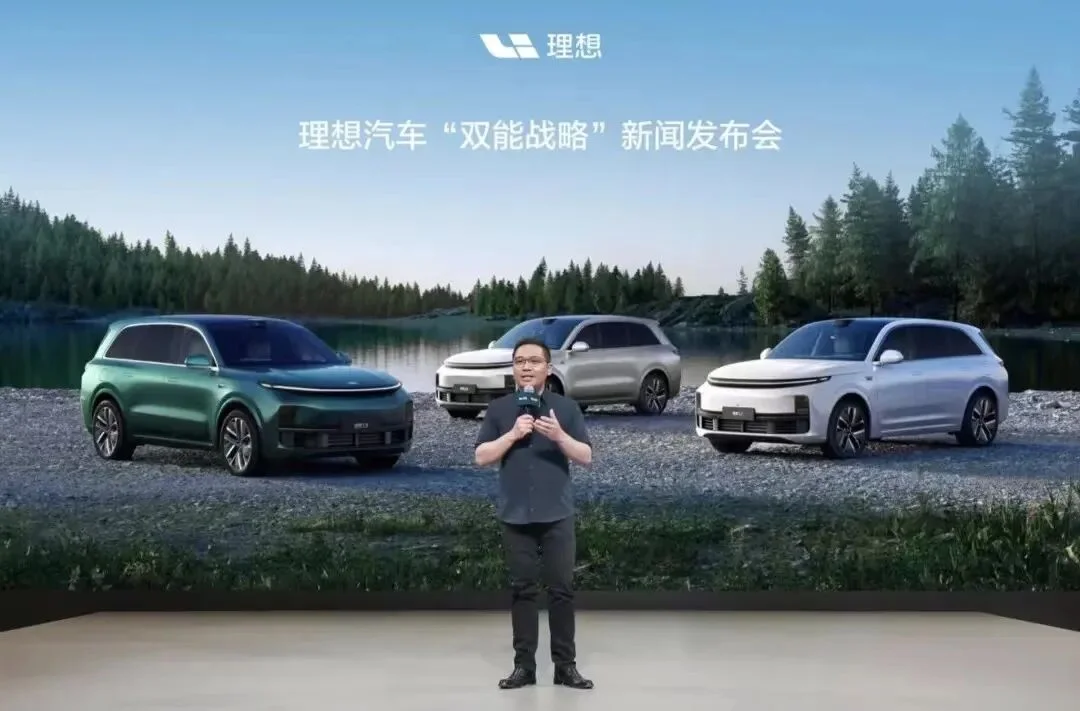
Viewed through the lens of growth, Li Auto has already completed its initial phase—from 0 to 1—a process that was relatively lengthy. It is now accelerating through the 1-to-10 stage, with its next-phase strategy already taking shape under its "Dual-Energy Strategy."
Notably, during this 1-to-10 phase, Li Auto set a goal to achieve RMB 100 billion in annual revenue. The company reported H1 revenue of RMB 47.44 billion and projected Q3 revenue between RMB 32.33 billion and RMB 33.3 billion. Based on current performance, reaching the RMB 100 billion milestone is no longer distant.
Looking further ahead, however, Li Auto must continue to grow.
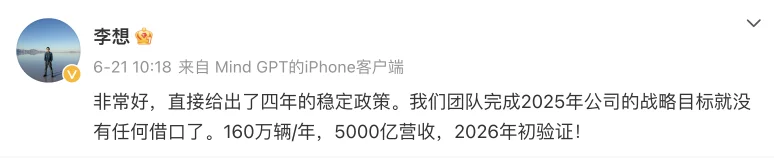
By 2025, Li Auto’s product lineup will be locked in as “one super flagship plus five extended-range electric vehicles (EREVs) and five high-voltage pure electric models.” Xiang Li has also announced the company’s overall strategic goals for 2025: annual sales of 1.6 million units and revenue of RMB 500 billion. At present, this target remains distant.
Furthermore, from 2023 to 2025, Li Auto will undergo what Xiang Li defines as the “three-year elimination race for smart electric vehicles.” Amidst this competitive landscape, which is fraught with uncertainty and complexity, Li Auto must maintain a posture of continuous growth, constantly iterating and moving forward.
The following summarizes key points discussed by Li Auto management during the earnings call, edited for clarity without altering the original meaning.
Q: What caused bottlenecks in Li Auto’s deliveries? Can monthly deliveries reach 40,000 units in the fourth quarter?
A: Currently, Li Auto’s Changzhou manufacturing base operates two production lines. With double shifts, the vehicle capacity can reach 50,000 units. The primary bottleneck lies in component supply. Because sales exceeded expectations, parts supply could not keep pace; these components are currently undergoing debugging and validation. However, capacity will ramp up over time. We are confident in raising our sales targets and have made preparations for next year and the year after.
Q: What is the latest progress on Li Auto’s organizational restructuring? How do you assess the pace of change?
A: We have invested significant resources and manpower into upgrading to a matrix organization. We believe the most critical aspect of organizational change is culture—for example, prioritizing customers and choosing the right path rather than the easy one. Organizational processes are indeed the most important product we offer to our internal employees. In summary, product upgrades drive profitability, while organizational upgrades drive efficiency.
Q: What is the projected trend for gross margins?
A: We expect gross margins to continue improving, and we are already seeing positive factors.
Q: What is Li Auto's plan for autonomous driving?
A: Li Auto's urban NOA and commute NOA features will be enabled according to the previous logic. This mainly refers to the local Li Auto ownership volume; if the ownership volume in a place is higher, there will be more data. As for the comprehensive implementation of large model-based NOA, we are confident in fully opening it up on urban roads and highways next year. Currently, development and testing are underway.
Q: How was the sales guidance for the third quarter determined? What are the subsequent sales targets?
A: Sales guidance represents the limit of production capacity. After increasing capacity in the fourth quarter, achieving a delivery target of 40,000 units is no problem at all. In 2024, we are confident in adjusting to challenge BBA's sales in China, and we aim to become the best-selling luxury brand in 2024.
Q: What is the progress of Mind GPT?
A: Regarding Mind GPT, we possess full-stack self-developed capabilities, mainly divided into four sectors: data, algorithms, evaluation, and delivery. We have also added search and recommendation capabilities. The current Mind GPT has 16 billion parameters. We hope it can better align with our users to achieve the effect of an ideal classmate conversational interaction.
Ultimately, it will become a series of products, including making Li Xiang Tongxue a family member or an automotive expert. We will share more progress in September. Currently, internal testing has already begun within the company, and it will be released to early users via OTA updates.
Q: What are the production readiness and sales expectations for the Li MEGA, and what is the subsequent plan for pure electric vehicles?
A: The sales target for the Li MEGA is to rank first with over 500,000 units sold, regardless of energy type or vehicle form. Next year, we will launch four new models: one range-extended SUV and three pure electric vehicles.
Q: Li Auto does not pursue official exports but faces some parallel export activity. Does Li Auto consider supporting this?
A: No.
Q: Is Li Auto’s rollout target for urban NOA (Navigation on Autopilot) too aggressive?
A: We will still roll out features in batches rather than releasing everything at once, but our goal for this year remains coverage in 100 cities. Compared to competitors, we hold advantages in perception and planning, including our NPN and TIN networks. Additionally, we operate the largest autonomous driving fleet, which provides the most training mileage data domestically, enabling continuous iteration of our algorithms. This is our greatest advantage.
Q: How can Li Auto further improve its dealership operational efficiency?
A: High-quality products and effective distribution channels complement each other and are indispensable. Our internal metric requires each store to achieve a monthly sales volume of 100 units within six months. Therefore, while we prioritize store efficiency, we do not focus solely on short-term results.
Over the next two years, we will launch multiple new models and open more stores. There is no secret to this strategy; BBA has already validated it clearly, so we will follow their logic to support our sales volume.
Q: What is the rationale behind Li Auto’s construction of charging stations?
A: Our goal is to build 300 supercharging stations on highways by 2023, and by 2025, to cover 90% of highway mileage and major cities. The financial pressure involved is entirely manageable. We will self-build and operate fast-charging stations on highways, while adopting an agency model for urban locations.
Q: Will Li Auto increase its R&D investment in the future?
A: We will invest more R&D funds, both in autonomous driving and other areas.
Q: How will Li Auto maintain competitiveness if it enters the RMB 200,000 to 300,000 price range?
A: We are very confident in the product strength of the L6; it will become the highest monthly seller within the L series. The key is to maintain our competitiveness, ensuring it remains the top choice for family users at that price point.
Written by: 308 Edited by: 308