


7,000 RMB for Urban Navigation: DJI Automotive’s Offering Has a Strong Xiaomi Vibe
What is the hardware cost for urban navigation? The answer can be 7,000 yuan.
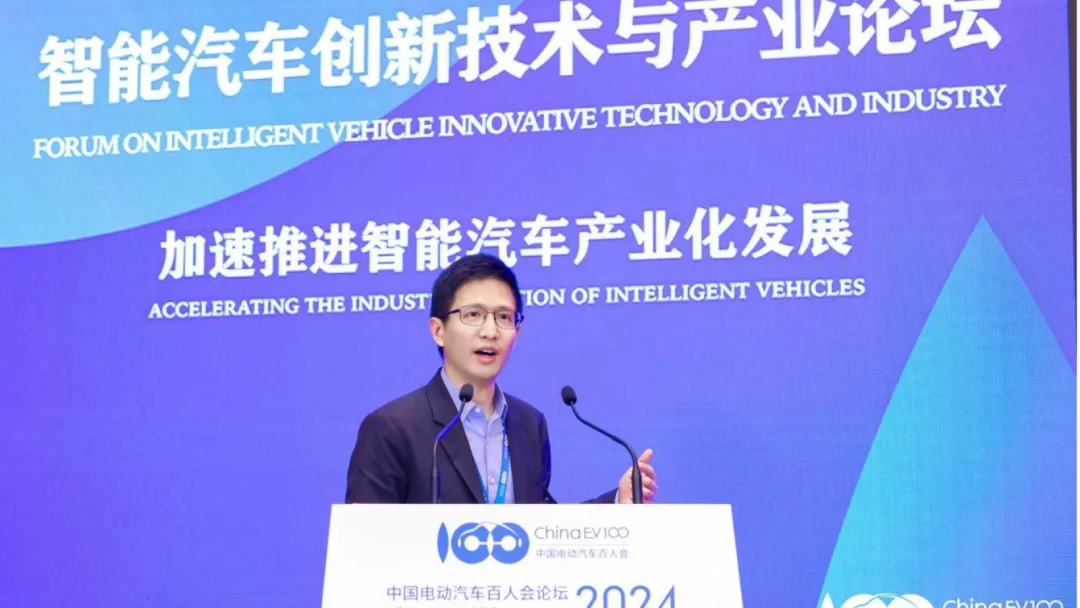
At the Zhongguodiandongqichebairenhuiluntan on March 17, DJI Automotive head Shen Shaojie stated that DJI Automotive can achieve urban navigation without maps using a 7V + 100 TOPS solution. This solution will be equipped in vehicles at the 150,000 price level this year, with hardware costs provided to OEMs as low as RMB 7,000.
This means that, with costs coming down, urban NOA will no longer be a 'special offering' for vehicles priced above RMB 200,000. Users of vehicles under RMB 200,000 can also become users of urban NOA, and at an even lower cost.
However, this is far from the end of the line for DJI Automotive. For DJI Automotive, making intelligent driving a standard feature is what truly deserves pursuit. At the same time, DJI Automotive no longer wishes to be limited to the mid-to-low-end market; instead, it is expanding its vision, looking from the 80,000 RMB segment up to the 300,000 RMB segment.
01"Carving a Forest on a Watermelon"
What does a 7,000 RMB solution with 7 V + 100 TOPS mean?
First, let's look at this 7,000 yuan. Since DJI's hardware cost to OEMs is 7,000 yuan, the price offered to users by OEMs will not be a figure that is particularly difficult for buyers of 150,000-yuan-level vehicles to accept; it is even possible that some OEMs are currently proactively offering discounts to users in order to boost sales.
For comparison, if a user chooses a model above RMB 200,000 that supports urban navigation, they must pay at least RMB 20,000 more than the standard version. For brands like AITO and XPENG, opting for the intelligent driving version costs over RMB 20,000 extra, while Tesla’s option price for Full Self-Driving capability has reached RMB 64,000. The price difference between the 7V + 100 TOPS solution and these options is therefore significant.
Next, let’s look at the 7V + 100 TOPS solution itself. According to Shen Shaojie, '7V' refers to seven cameras: a pair of front-facing 8-megapixel inertial-guidance binoculars, a rear-facing 3-megapixel monocular camera, and four 3-megapixel surround-view cameras; '100 TOPS' refers to the computing power of the Gaotongxiaolong 8650 chip.
In terms of algorithms, the 7V + 100 TOPS solution employs a Transformer-based road topology perception model and a joint prediction and decision-making model, along with 4D scene flow based on binocular and omnidirectional fisheye lenses.
Furthermore, the 7V + 100 TOPS solution can be used with or without millimeter-wave radar and ultrasonic radar. It does not rely on high-definition maps and is independent of powertrain type, supporting both electric and fuel vehicles, demonstrating high flexibility.
Clearly, DJI Automotive’s 7V + 100 TOPS solution serves as a versatile option for models in the RMB 150,000 price range.
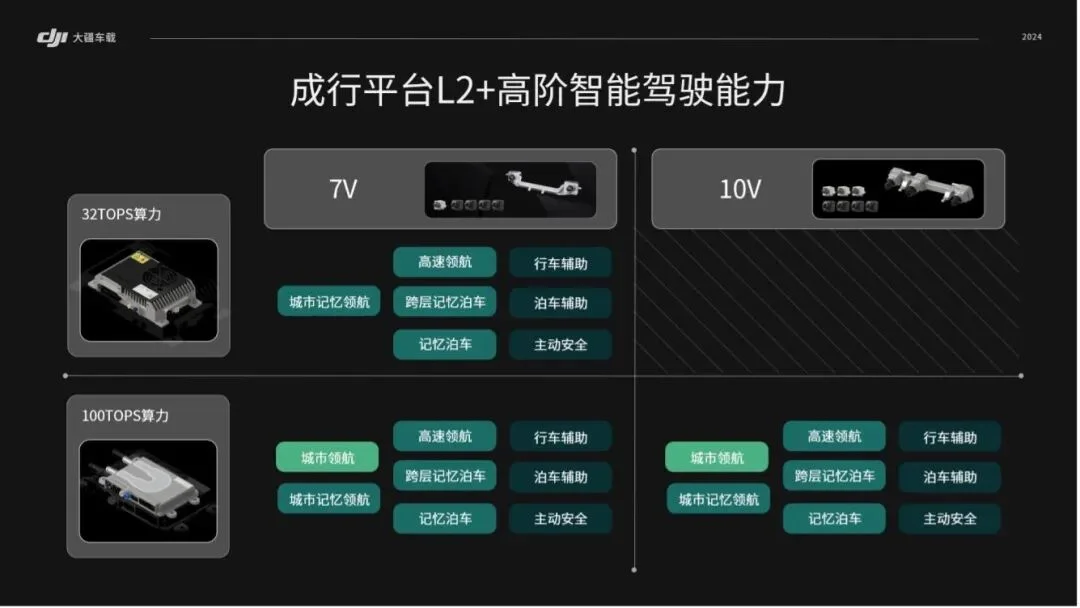
In fact, the 7V + 100 TOPS solution originates from Chengxingpingtai, which DJI Automotive officially announced during the Hundred People Conference last year. Chengxingpingtai encompasses DJI Automotive’s full-stack hardware and software design and delivery solutions, serving as its core product for providing intelligent driving solutions to automakers.
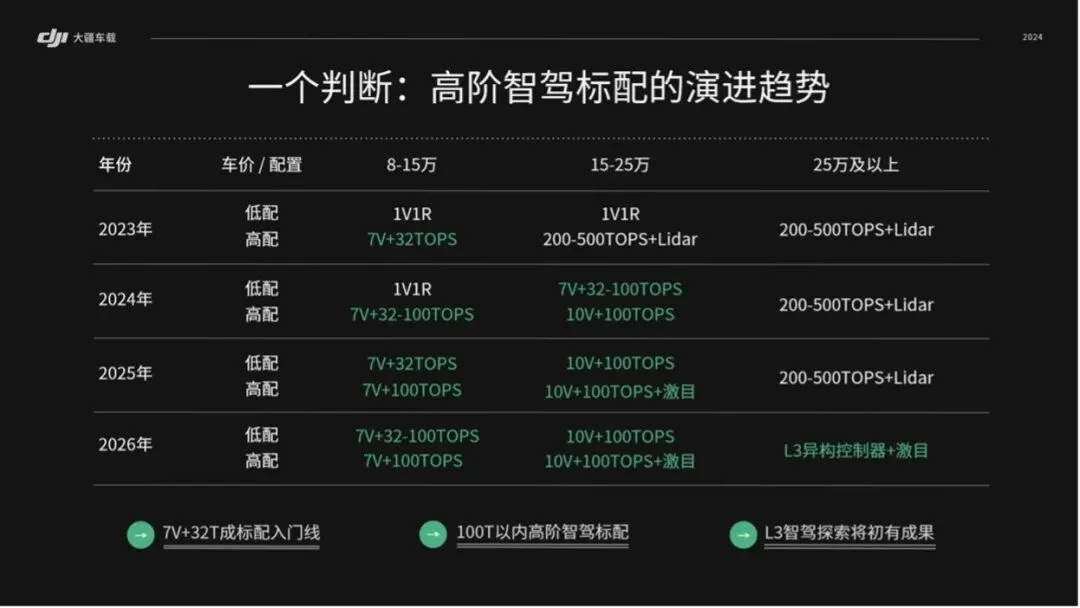
By this year’s Hundred People Conference, Chengxingpingtai had evolved into three versions, including:
Base version: 7 V + 32 TOPS;
Upgraded 7 V + 100 TOPS;
The high-spec version features 10 V + 100 TOPS.
It is reported that the basic version of the solution, which supports intelligent driving features such as highway navigation assist and memory parking, has already been mass-produced. This version is equipped on the Yunduolingxiban, iCAR 03, and Yueye Plus.
Starting this year, DJI Automotive will gradually make the basic version of its solution standard equipment on models priced between RMB 80,000 and RMB 150,000.
Compared to the base version, the upgraded version's perception hardware has not changed; it is merely that the chip has been replaced from Dezhouyiqi TDA4-VH to Gaotongxiaolong 8650, with computing power increased to 100 TOPS, thereby enabling higher-order urban navigation, suitable for models priced above 150,000 yuan.
The upgraded solution will be implemented in new mass-produced vehicles this year. DJI Automotive plans to promote the standard configuration of the upgraded solution on models priced at 150,000 RMB within the next two years.
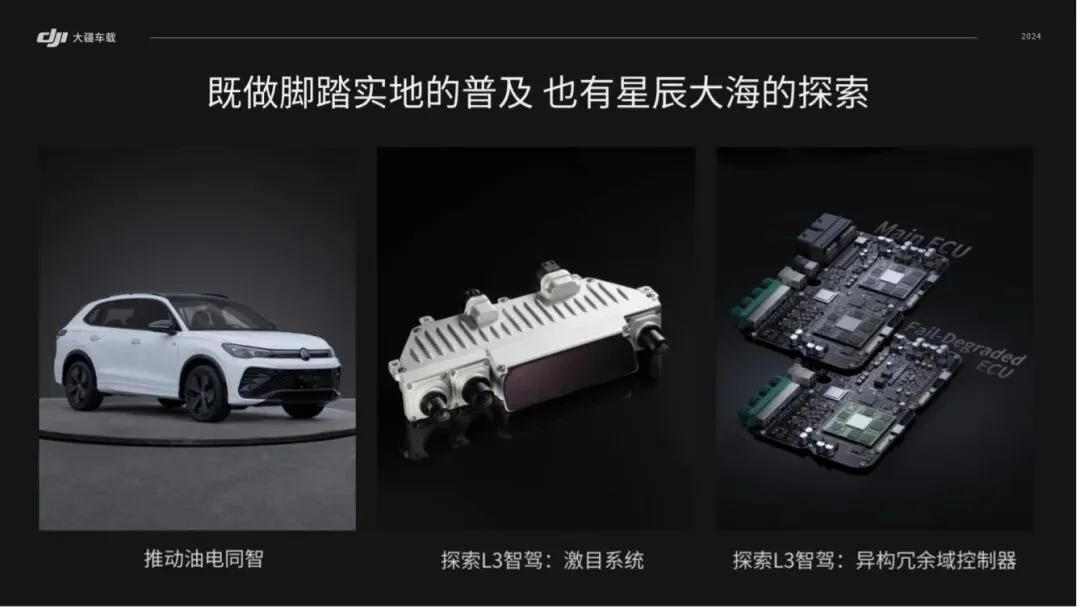
Compared with the upgraded version, the high-specification version keeps the Gaotongxiaolong 8650 chip unchanged and upgrades the perception hardware from 7 units to 10 units. This involves replacing the front-view inertial-guidance binocular camera in the 7-unit setup with an 'inertial-guidance tri-eye and LiDAR assembly'—consisting of a pair of inertial-guided stereo binocular cameras, one telephoto monocular camera, and one LiDAR unit—to achieve L3-level autonomous driving.
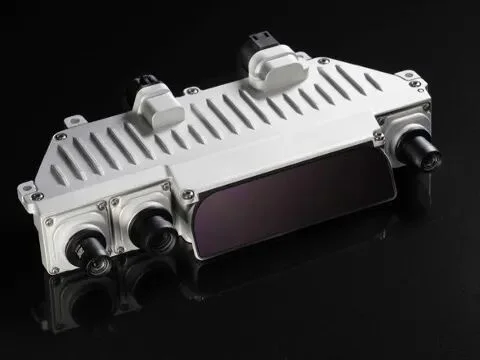
DJI Automotive expects to apply its high-specification solution to models priced around RMB 250,000 by 2026, and within three years, to make the high-specification solution standard on models in the RMB 200,000 price tier.
Notably, because the perception hardware for the basic version and the upgraded version is identical, the basic version can be swapped to the upgraded version via a pin-to-pin chip replacement.
Overall, DJI Automotive’s intelligent driving solutions focus on low cost and high volume, allowing OEMs to choose according to their needs. Regarding DJI Automotive’s intelligent driving solutions, Shen Shaojie stated at the Zhongguodiandongqichebairenhuiluntan:
"Some people say that DJI Automotive is best at 'carving flowers on sesame seeds.' I think this evaluation is half right. Sesame seeds are too small; what we have actually achieved is not carving flowers on sesame seeds, but carving forests on watermelons."
02A cat that catches mice is a good cat
Why can DJI Automotive achieve urban navigation with so little perception hardware and computing power, while keeping hardware costs as low as RMB 7,000? The following words from Shen Shaojie may help explain the issue:
"Is DJI a pure vision camp? We just want to make a good product, and we don't dwell on this label. However, for products where costs are relatively constrained, we might use vision, and possibly use it extremely, directly adopting a pure vision approach that eliminates millimeter-wave radar and ultrasonic radar... But we are not resistant to LiDAR at all."
"I just want to make a good product." With no hesitation on the intelligent driving R&D path, this translates to DJI Automotive having clear and focused product goals, while adhering to pragmatism in action: regardless of whether it is a black cat or a white cat, as long as it catches mice, it is a good cat.
Of course, producing a high cost-performance solution is not easy. In an interview with the Zhongguodiandongqichebairenhuiluntan (China Electric Vehicle 100 Forum), Shen Shaojie stated, "To be honest, developing a high cost-performance solution is very difficult. It is not just about which chip I chose or what sensors I selected."
However, according to Shen Shaojie, two key traits of DJI Automotive enable it to produce high cost-performance intelligent driving solutions: engineering capability and the corporate culture that supports that engineering capability.
In terms of engineering capability, DJI Automotive has the engineering DNA of DJI flowing through its veins, possessing innate advantages in both software and hardware development, as well as supply chain management and engineering manufacturing.
Regarding corporate culture, Shen Shaojie introduced that DJI Automotive has a strong engineer-centric culture. Engineers believe that creating high cost-performance solutions aligns with the company's mission and vision, and are therefore willing to invest effort in continuously optimizing algorithms and pushing hardware performance to the extreme.
Precisely because of the full utilization of hardware, as well as capabilities in supply chain management and engineering manufacturing, DJI Automotive has effectively ensured the implementation efficiency of its intelligent driving solutions.
Shen Shaojie stated at the Zhongguodiandongqichebairenhuiluntan forum that the current time required for DJI Automotive's intelligent driving solution to adapt to existing vehicle models is three months, while for new models it is six to nine months. This will greatly help original equipment manufacturers (OEMs) keep up with the market's relentless pace in intelligent driving.
With its low cost, high efficiency, and proven effectiveness, DJI Automotive’s solutions have gained popularity among many OEMs. DJI Automotive continues to maintain a pragmatic approach, welcoming both new energy vehicle manufacturers and traditional internal combustion engine (ICE) automakers.
According to reports, DJI Automotive’s current clients include Chery and Wuling. At the Zhongguodiandongqichebairenhuiluntan, Shen Shaojie announced a new client: SAIC Volkswagen. The system will be featured in the Tuguan L Pro. Shen Shaojie stated:
The penetration rate of high-level autonomous driving in ICE vehicles is close to zero. We are attempting to break through that zero limit... It can be said that the Tuguan L Pro equipped with DJI Automotive’s high-level autonomous driving system may be one of the smartest ICE cars on the market. This should also be considered an effort to promote intelligent parity between electric and fuel vehicles.
Meanwhile, according to information obtained from official personnel at DJI Automotive, even more significant clients have already reached cooperation agreements with DJI Automotive.
A diverse client base means the mass production scale of DJI Automotive’s autonomous driving solutions will further expand, while simultaneously driving down costs. This will gradually create a richer ecosystem for DJI Automotive’s own survival and growth.
Is Urban Intelligent Driving Competition Heating Up at the 3.15 Million RMB Price Point?
User demand for autonomous driving has risen, but the supply remains uneven.
Shen Shaojie released data at the Zhongguodiandongqichebairenhuiluntan:
In 2021, smart driving-related features ranked only 14th in users' car purchase decision-making rankings, but by last year, they had risen to fifth place;
In the new energy vehicle market, the sales share of models priced below RMB 200,000 lags far behind that of models priced above RMB 200,000 in the adoption of L2+ intelligent driving;
In the ICE vehicle market, usage of L2+ intelligent driving is extremely low across all price segments.
For DJI Automotive, securing a leading position in the new energy vehicle and internal combustion engine markets below the RMB 200,000 price point has already provided a first-mover advantage, especially given that DJI Automotive faces few competitors.
But the competitive pressure that the market is placing on DJI Automotive is about to arrive.
The day before Shen Shaojie announced urban navigation for the 150,000 yuan price segment, He Xiaopeng made an announcement at Zhongguodiandongqichebairenhuiluntan that XPENG would launch a new brand in the 100,000 to 150,000 yuan range, dedicated to creating 'the first AI smart driving car for young people.'
It is evident that in the 100,000 to 150,000 RMB market segment, DJI's automotive intelligent driving capabilities will compete directly with XPENG's.
It is still difficult to predict which solution will prove superior, but it is clear that in the 100,000–150,000 RMB new energy vehicle segment, XPENG’s entry and DJI Automotive’s growing momentum will convert many potential autonomous driving users into actual adopters. At the same time, users who previously showed little interest in autonomous driving will begin to pay attention to, learn about, and experience these systems, eventually becoming users as well.
In the near future, the path that autonomous driving once paved in the 200,000+ RMB market may need to be retraced in the 100,000–150,000 RMB segment.
Written by: Isaiah Edited by: 308