


Chery Pledges 'All In' on New Energy as Fengyun Concept Cars Debut
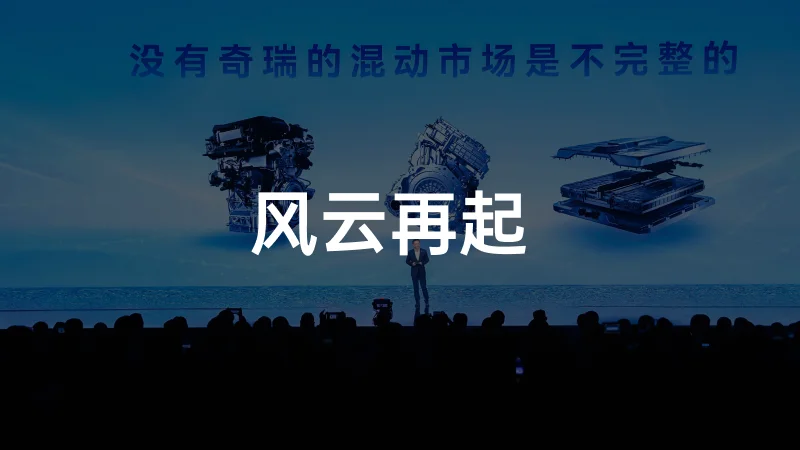
From January to October this year, Chery Group sold 1.454 million vehicles, a year-on-year increase of 41.6%. The Chery brand alone accounted for nearly 1.05 million units, marking its first time breaking the one-million-vehicle mark.
Meanwhile, the new energy vehicle (NEV) market is also expanding rapidly. Data released by Zhongguoqichegongyexiehui shows that domestic NEV sales reached 7.28 million units from January to October, up 37.8% year on year. NEVs now account for 30.4% of all new car sales.
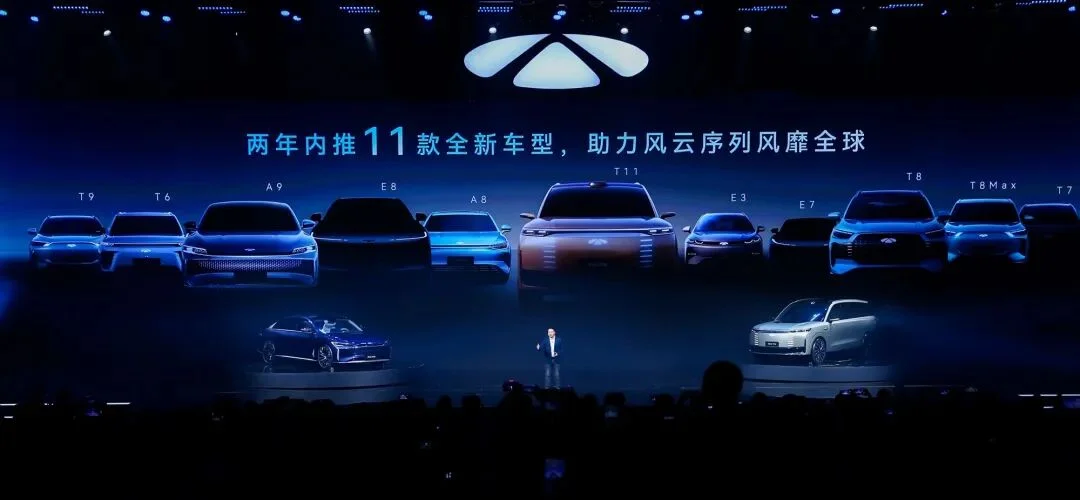
In response to the transformation of the automotive market, Chery’s Fengyun lineup has returned with a global debut of two concept models: the Fengyun A9 and the Fengyun T11. According to the company’s plan, Chery Fengyun will launch 11 new models over the next two years.
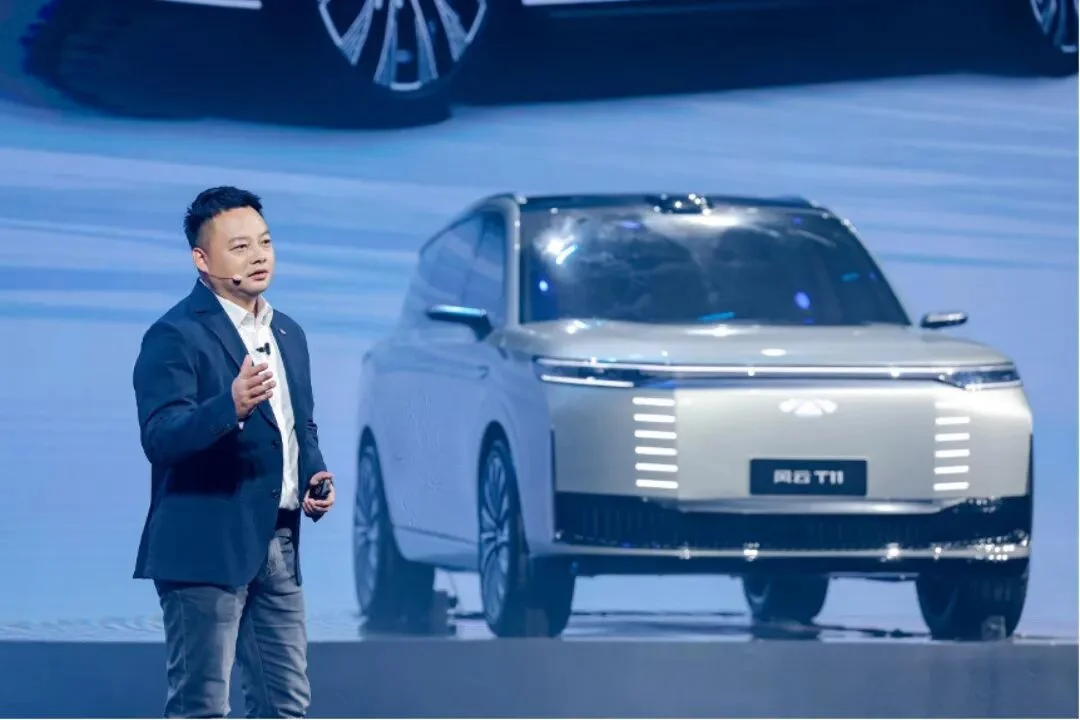
Li Xueyong, vice president of Chery Automobile Co., Ltd., general manager of Chery Marketing, and general manager of Jietuqiche, stated, “Chery will go all-in to compete decisively in the new energy market.”
For any new energy vehicle, an advanced powertrain is critical. With its reputation as a “science and engineering” brand, can Chery deliver a compelling solution? To understand this, we must look at Chery Group’s global layout.
01Focusing on Global User Pain Points
Today, Chery owners are spread across more than 80 countries and regions worldwide. The starting point for the development of the Chery Fengyun series is to meet vehicle usage needs in various complex operating conditions.
There are several countries and regions with particularly typical vehicle usage demands:
Brazil: Some mountain roads are steep, so users demand strong power.
Indonesia: High humidity and frequent rainfall make waterproofing performance crucial for new energy vehicles (NEVs).
Middle East: Consistently high temperatures and user demand for high-speed cruising pose significant challenges for stable operation across different temperature ranges.
Germany: With its unrestricted speed highways, users expect superior acceleration and top speed.
China: Range anxiety and energy consumption concerns persist, yet current products struggle to balance both efficiency and performance.
After identifying user needs across different countries and regions, the requirement can be summarized in one sentence: users demand powertrains that offer lower energy consumption, higher performance, and reliable safety. This is especially true for domestic users, who will not compromise on energy efficiency, performance, or safety.
In response to these user demands, Chery’s answer is the Kunpengchaonenghundong C-DM. This plug-in hybrid system consists of Chery’s fifth-generation ACTECO 1.5TGDI high-efficiency dedicated hybrid engine, a Sandangchaojidianhun DHT (three-speed super electric hybrid DHT), a Wujichaojidianhun DHT (continuously variable super electric hybrid DHT), and dedicated hybrid batteries with a battery management system.
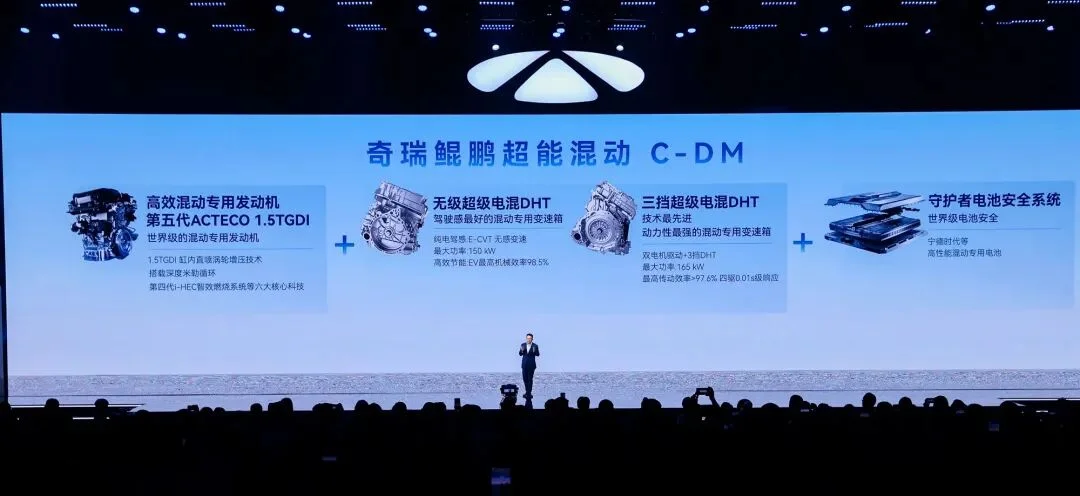
The newly unveiled Chery Fengyun lineup features this system. Structurally, the Kunpengchaonenghundong C-DM is a mainstream series-parallel plug-in hybrid system. But how does it meet such diverse global user requirements?
02What Level Is a Thermal Efficiency Above 44.5%?
For plug-in hybrid vehicles, achieving low energy consumption requires first breaking through engine efficiency limits. Two key indicators must be considered: peak thermal efficiency and the engine’s high-efficiency operating range.
This is an engine map showing the relationship between torque and rotational speed. The area closer to the center of the graph represents higher engine efficiency.
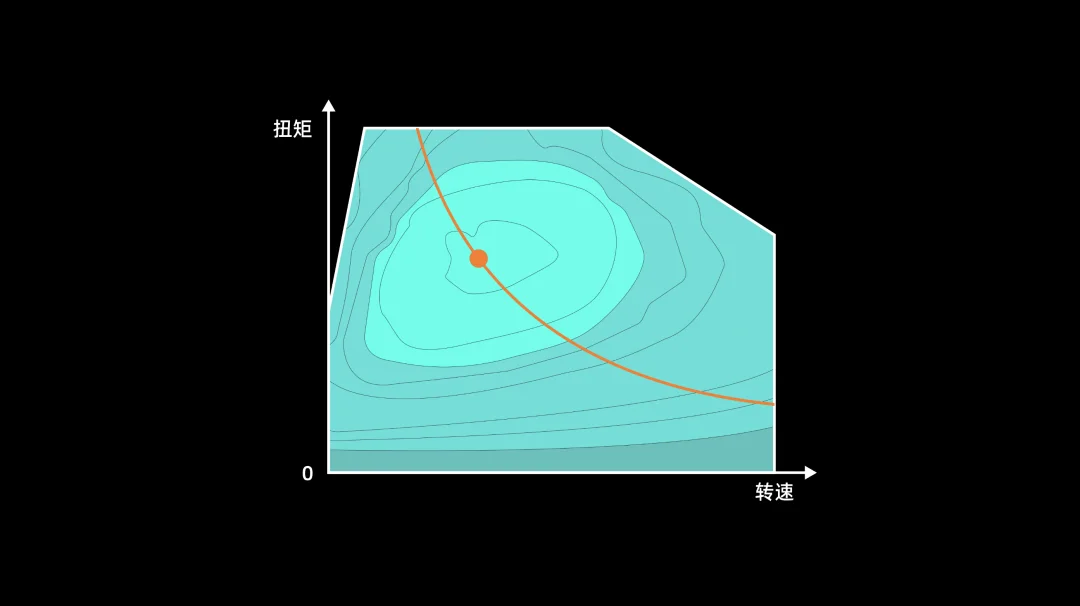
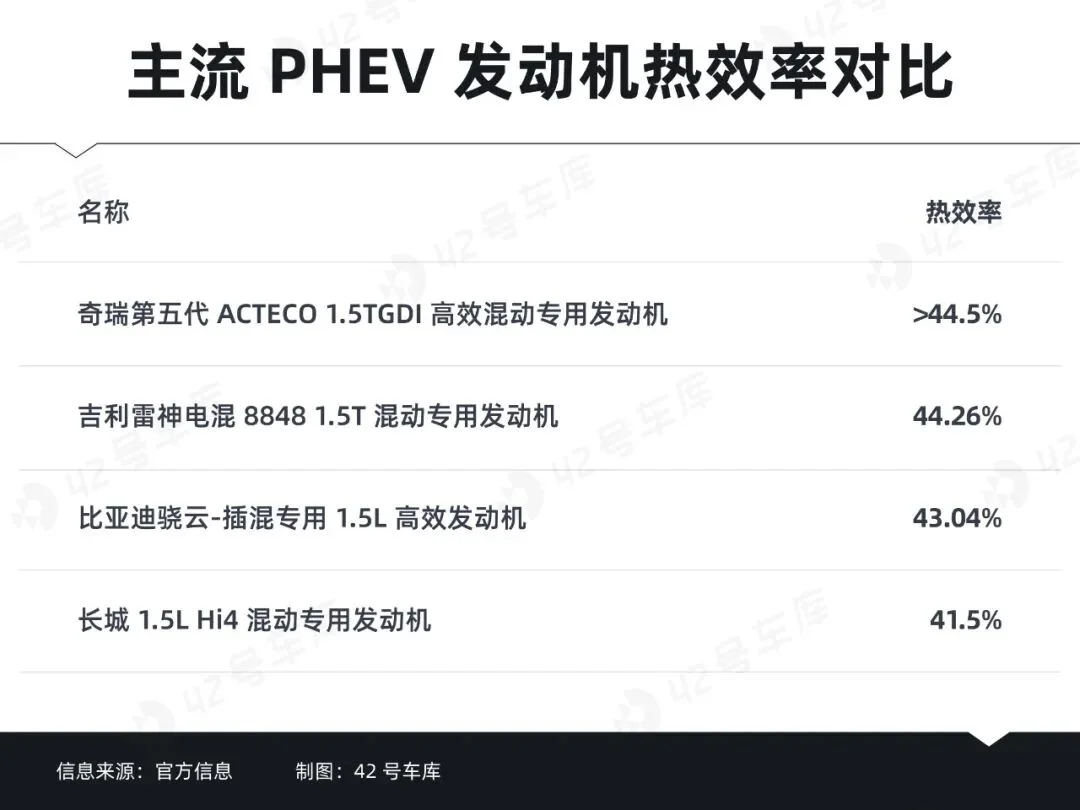
The red dot in the center of the image represents the peak engine efficiency. The Chery Fifth-Generation ACTECO 1.5TGDI High-Efficiency Dedicated Hybrid Engine achieves a maximum thermal efficiency exceeding 44.5%.
Compared to current mainstream dual-motor series-parallel hybrid systems, a simple comparison reveals that Chery offers higher thermal efficiency.
However, peak thermal efficiency alone is insufficient because it only represents a single combination of speed, torque, and output power. Vehicles have different power demands under various operating conditions. True high efficiency means the engine maintains optimal performance across diverse combinations of speed, torque, and output power.
The Fifth-Generation ACTECO 1.5TGDI High-Efficiency Dedicated Hybrid Engine operates within this efficient range from 1,000 rpm to 5,500 rpm. On the engine's universal characteristic map, this wide efficient speed band allows for more varied torque and output power combinations, truly meeting a broader range of driving conditions.
Under WLTC conditions, Chery Fengyun series models achieve a fuel consumption of 4.2 L/100 km when battery-depleted. This compares favorably to the BYD Qin PLUS DM-i 2023 Champion Edition, which records 4.6 L/100 km under WLTC comprehensive depleted-fuel conditions. Given the strong interest in the Chery Fengyun series, we will conduct real-world energy consumption tests after the new cars launch to verify their actual savings.
Additionally, while some plug-in hybrids that require 95-octane gasoline are described as "fuel-efficient but expensive," Chery Fengyun series models that run on 92-octane gasoline achieve both fuel economy and cost savings.
Lower energy consumption enables Chery Fengyun series models to deliver longer ranges on a full tank of fuel and full charge. Their WLTC comprehensive range exceeds 1,400 km. Official claims state that a trip from Beijing to Shanghai requires no refueling or recharging, while a journey from Beijing to Lhasa requires only two stops for energy replenishment.
03Low Energy Consumption Can Also Deliver High Performance
As the analysis above shows, achieving higher efficiency and lower energy consumption requires a highly efficient hybrid engine. Meanwhile, competitive products in the industry can achieve fuel consumption levels as low as 4 L/100 km under battery-depleted (feed-in) conditions.
However, discussing energy consumption without addressing performance is unrealistic. While pursuing lower energy consumption, some owners have reported issues such as loss of power at high speeds and sluggish acceleration after taking delivery of their vehicles. These cars may suffice for daily city commuting or errands, but they struggle when driven on highways where performance is demanded.
It is well known that high performance typically comes with high energy consumption. However, better balance can be achieved through other technical means. If the engine achieves higher efficiency, it can deliver superior performance within the same fuel consumption limits.
This is an capability already realized by Kunpengchaonenghundong C-DM.
The fifth-generation ACTECO 1.5TGDI efficient hybrid dedicated engine delivers a maximum power of 115 kW and a peak torque of 220 N·m.
For different vehicle models and user needs, Chery offers two distinct electric drive solutions.
One solution pairs a 3DHT transmission with dual-motor drive. The 3DHT transmission allows the vehicle to adapt to a wider range of operating conditions, while the dual-motor setup enables stronger performance output.
At low speeds, the system uses first gear to deliver stronger power and acceleration; during high-speed cruising, it shifts to third gear for lower energy consumption; and when overtaking, it downshifts to second gear.
This means that once the engine is running, the system maintains higher efficiency across the entire speed range, resulting in better fuel economy for owners under various driving conditions.
In terms of performance, the electric motor has a maximum power output of 165 kW and a peak wheel-end torque of 4,000 N·m. With assistance from the internal combustion engine, the Kunpengchaonenghundong C-DM powertrain achieves an official 0–100 km/h acceleration time of as fast as 4.26 seconds, with a top speed of 240 km/h.
To address sluggish acceleration, this powertrain can accelerate from 30 to 70 km/h in 2.9 seconds and from 90 to 120 km/h in 3.6 seconds, representing urban and highway overtaking scenarios respectively. According to Chery’s official data, these acceleration times are one second faster than those of competing models.
The system also boasts a maximum transmission efficiency exceeding 97.6% and an average electric drive efficiency above 90%, minimizing energy loss during power transfer.
Another available option is the continuously variable super hybrid DHT, which pairs an E-CVT transmission with an electric motor to achieve even higher efficiency.
The advantage of this powertrain lies in its smoother and quieter operation. The E-CVT shift process is nearly imperceptible, and because electric drive dominates, the driving experience closely resembles that of a pure electric vehicle.
This single-motor configuration features a maximum power output of 150 kW and a peak wheel-end torque of 3,750 N·m. Although less powerful than the four-wheel-drive variant, the specifications are still sufficient for daily family use.
Analysis of these two powertrain systems reveals that Chery achieves high efficiency through an excellent engine, combined with two different electric drive systems to deliver even lower energy consumption. For consumers, this means no longer having to compromise performance in pursuit of low energy usage.
04Global-Standard Battery Safety
For a new energy vehicle, the power battery has become one of the "new three major components." However, battery safety remains a challenge the industry wants to solve but finds difficult to address.
According to Chery's research, more than 66% of power battery fire incidents are caused by thermal runaway following physical damage to the cells or high-voltage systems.
Therefore, a robust and reliable battery pack is the development goal.
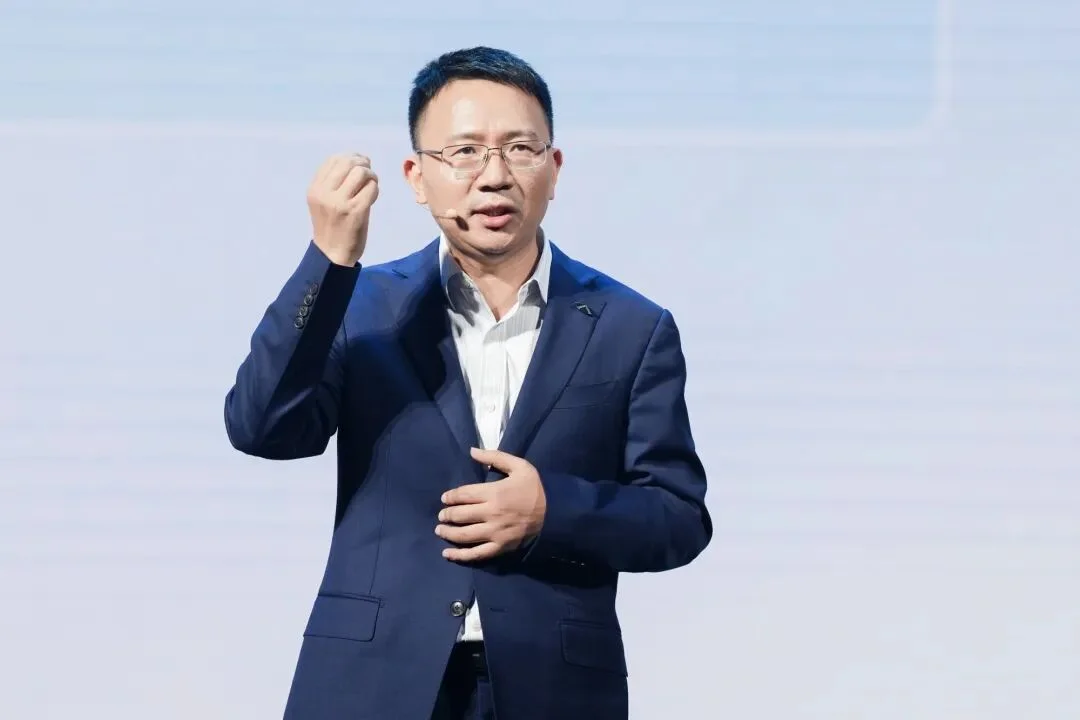
In his speech, Dr. Xu Youzhong, Assistant General Manager of Chery Automobile Co., Ltd. and Deputy Dean of the Main Institute of the Automotive Engineering Research Institute, noted that to control stress and deformation, Chery developed dozens of solutions and hundreds of optimizations for even a single small fixing bolt.
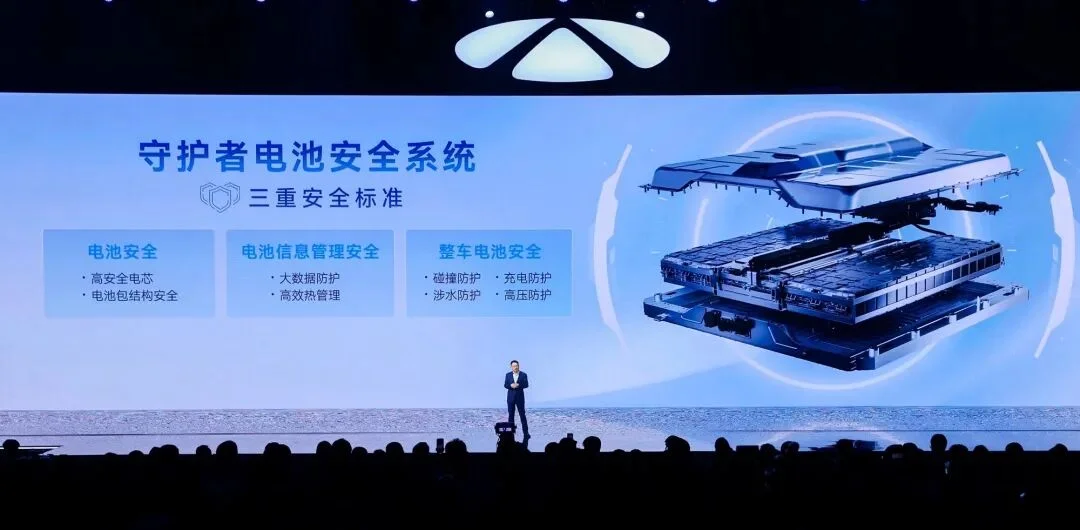
Chery has established a triple safety standard system called Shouhuzhedianchianquanxitong. The first is battery safety, encompassing high-safety cells and structural safety of the battery pack; the second is battery information management safety, including big data protection and efficient thermal management; the third is whole-vehicle battery safety, covering crash protection, water immersion protection, charging protection, and high-voltage protection.
In terms of safety performance, Chery provided the following data:
The vehicle's waterproofing meets three times the national standard, and the battery pack's waterproofing meets 48 times the national standard.
The battery pack's crashworthiness meets 50 times the national standard.
In the event of a collision during driving or charging, high voltage is disconnected within 2 ms.
It is precisely because these multiple indicators exceed national standards that the Guardian Battery System can adapt to different global markets, achieving superior safety quality.
Additionally, the Guardian Battery System equipped in Chery's Fengyun series models can achieve an all-electric range of more than 200 km, meeting urban commuting needs.
05Final Thoughts
Low energy consumption without high performance might have described plug-in hybrid vehicles in a previous era. In 2023, technological advancements enabled a better balance between low energy consumption and high performance, a shift exemplified by the launch of Chery’s Fengyun lineup.
Do users not seek performance? Not necessarily. For the broader driving public, energy efficiency has simply been prioritized higher. As technology evolves and consumption upgrades, pursuing better performance has naturally become another core metric for vehicle ownership.
The first models to debut in the Chery Fengyun lineup are the Fengyun A9 and Fengyun T11, which will also be among the first to hit the market. A total of 11 models, including these two, will be launched successively in the future.
Leveraging Huoxingjiagou, Kunpengdongli, Xiongshizhicang, Dazhuozhijia, and Yinheshengtai, the Chery Fengyun lineup boasts strong advantages in both powertrain and intelligent technologies, meeting users’ growing needs and addressing the industry’s competitive landscape in intelligence and electrification.
Built upon 18 years of self-developed hybrid technology and Chery’s ‘science-and-engineering nerd’ spirit that permeates its entire R&D system, Chery has established unique technical advantages in hybrid technology, with improved hybrid systems now on the horizon for consumers.
Written by: James Edited by: Ameng