


Xiaomi SU7 Deliveries Begin as Tesla Posts First Quarterly Delivery Decline in Four Years
01 Weekly Index
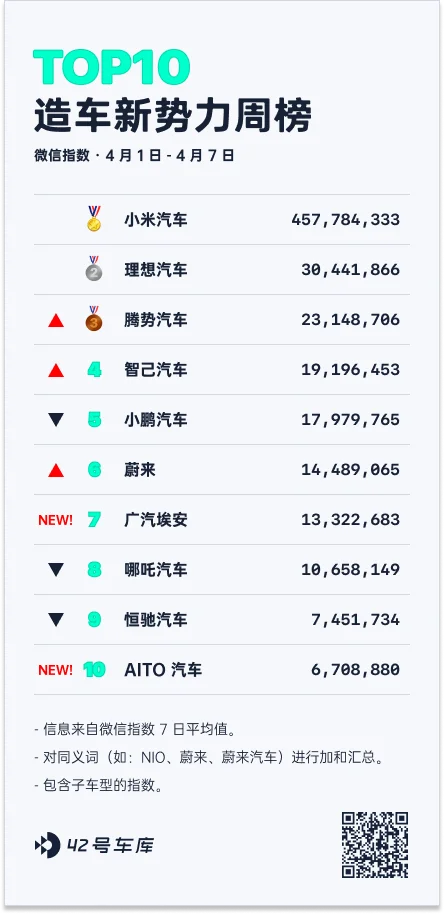
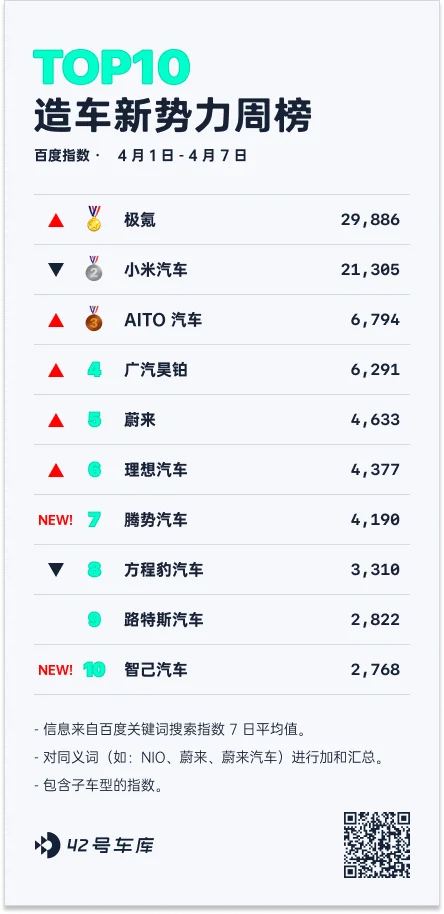
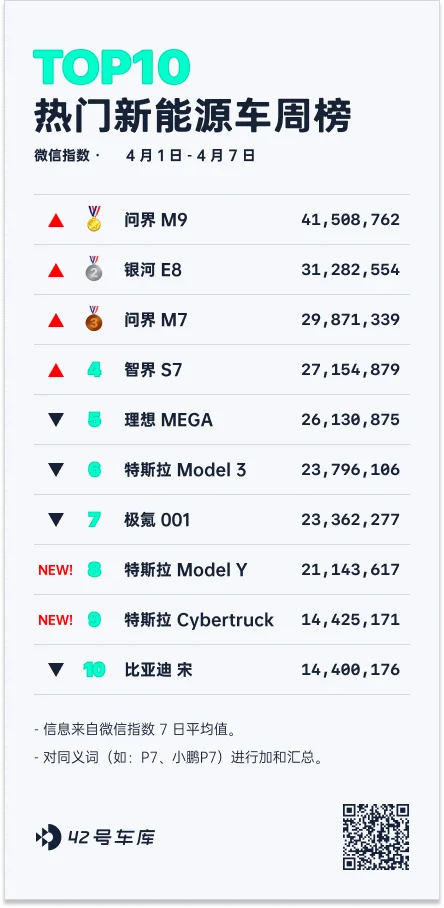
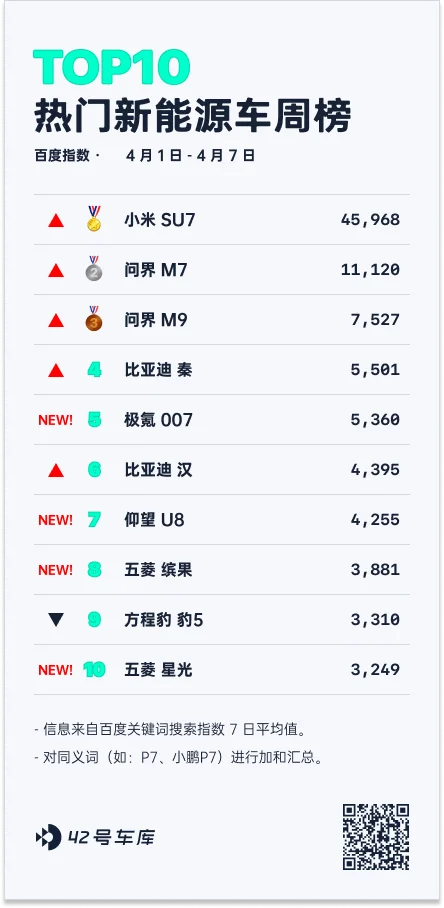
02Weekly Highlights
Xiaomi SU7 Deliveries Begin, Lei Jun Personally Hands Over Vehicles
Early on April 3, Lei Jun posted on his personal Weibo: 'The bold promise made three years ago has become reality today. I will personally hand over brand-new Xiaomi SU7 vehicles to the first batch of owners.'
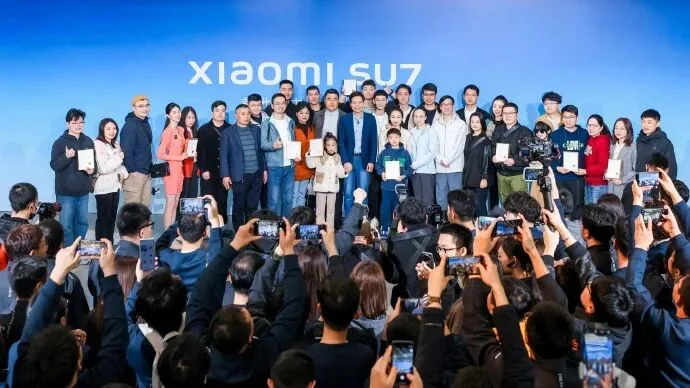
At the Xiaomi Auto factory that day, Lei Jun handed over the keys to the first batch of owners. Netizens also captured a detail: Lei Jun personally opened the car door for them.
Commentary:
The Xiaomi SU7 is generating significant buzz. On the Xiaomi Auto app, the entry-level model currently has the shortest delivery wait time, but it still requires 24–27 weeks. The high-spec SU7 Max has a delivery cycle of 29–32 weeks. Production queues are now extending six months out, underscoring the model's popularity.
Meanwhile, we strongly recommend that all users test-drive before locking in their order to ensure it meets their needs.
Tesla’s Week: Price Hikes, Discounts, Interest-Free Installments, and First Quarterly Delivery Decline in Four Years
Amidst fluctuations in the automotive market, Tesla has continuously adjusted its strategy within a single week: raising prices, announcing optional equipment discounts, and introducing interest-free installment plans. At the same time, Tesla reported its first quarterly delivery decline in four years.
In fact, Tesla had already previewed this week’s price increase on March 20. On April 1, Tesla raised prices across the entire Model Y lineup by RMB 5,000. The rear-wheel-drive version is now priced at RMB 263,900; the long-range version at RMB 304,900; and the performance version at RMB 368,900.
Following a price increase announced early on April 1, Tesla’s official WeChat account announced free options for the Starry Gray paint on Model 3 and Model Y, which previously cost RMB 12,000. However, the previously complimentary "Pure Black" paint is now an optional extra priced at RMB 8,000.
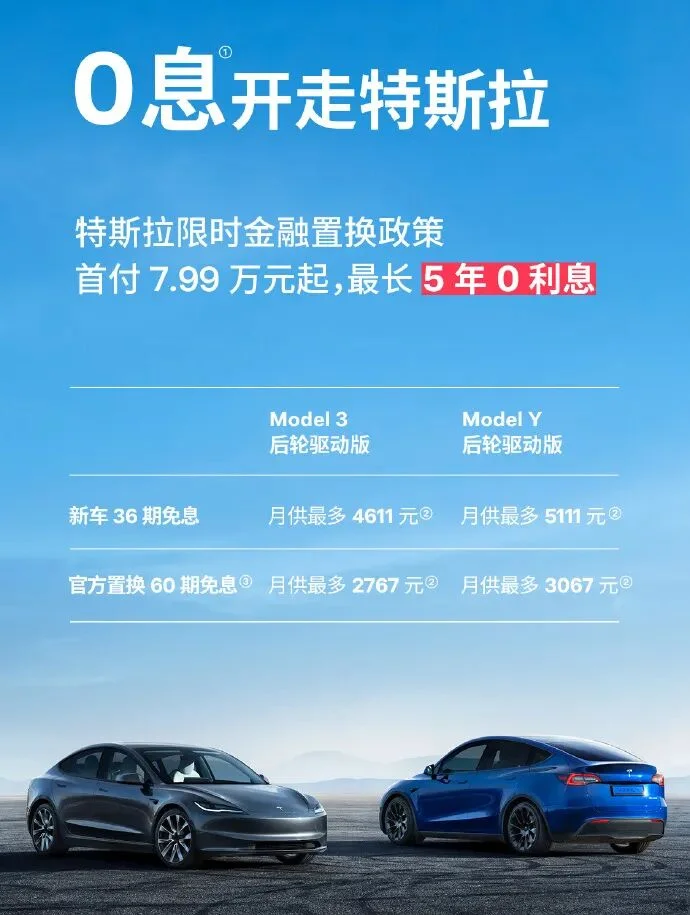
On April 3, Tesla officially launched an interest-free policy. A down payment of RMB 79,900 allows buyers to enjoy three years of interest-free financing, while the official trade-in special offer provides five years of interest-free financing. Choosing the three-year option can save up to RMB 27,000.
In its Q1 2024 delivery report released that day, Tesla reported global deliveries of 387,000 vehicles, representing a year-over-year decline of 8.3% and a quarter-over-quarter drop of 20.1%. This marks the first quarterly delivery decline in four years. Tesla attributed the impact on production and deliveries to the ramp-up phase of the refreshed Model 3 production at its Fremont factory in California, logistics disruptions caused by the Red Sea conflict, and plant shutdowns resulting from an arson incident at its Berlin Gigafactory.
As a result, Tesla shares fell 4.9% on April 2. Year-to-date, Tesla’s stock has dropped nearly one-third, erasing more than USD 260 billion from its market capitalization.
Commentary:
The Chinese automotive market is evolving rapidly, with Tesla adjusting its pricing and promotional policies frequently. Despite the decline in delivery volumes, Tesla remains the dominant player in the new energy vehicle segment above RMB 200,000.
Meanwhile, according to foreign media reports, analysts at Deyizhiyinhang stated that inventory data confirms that, beyond known production bottlenecks, Tesla may also be facing significant demand issues.
With a wave of new models from automakers both domestic and overseas in 2024, is Tesla still competitive?
Some New Energy Vehicle Brands Continue to Lower Prices or Add Features
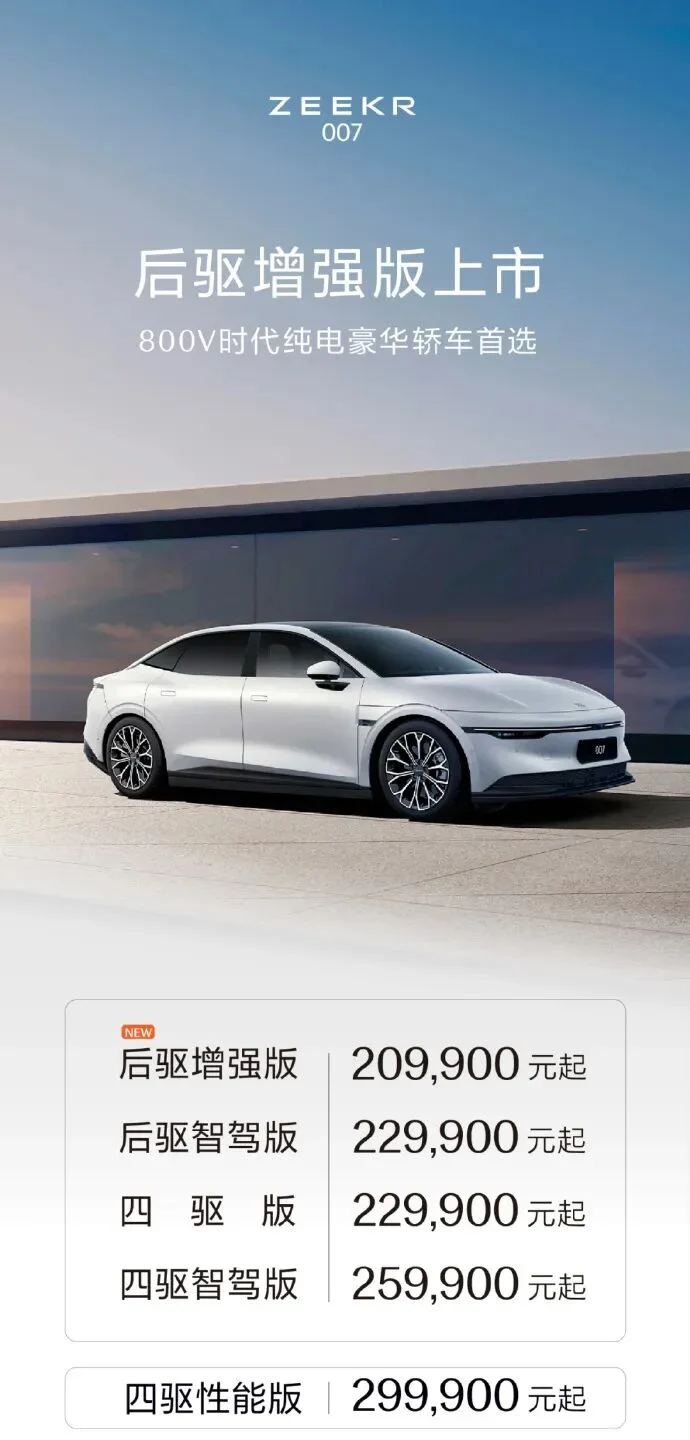
On April 1, Zeekr announced the launch of the all-new Zeekr 007 Rear-Wheel Drive Enhanced Edition, which serves as the entry-level model for the Zeekr 007 lineup. Priced at RMB 209,900, the enhanced edition maintains the same price as the original rear-wheel-drive version but upgrades the configuration by adding a Technology Full-Sense Package valued at RMB 12,000.
This package integrates a suite of luxurious smart features, including the self-developed ZEEKR Sound premium audio system with 21 speakers, a 35.5-inch AR-HUD head-up display, a 15.05-inch 2.5K OLED sunflower central control screen, dynamic flowing Ice Block crystal ambient lighting, and an intelligent fragrance system.
The current price range for the Zeekr 007 is RMB 209,900 to RMB 299,900.
Also on April 1, AITO launched a limited-time offer of RMB 20,000 off the total vehicle price for the new M7 Plus five-seat rear-wheel-drive model. The Hongmengzhixing App indicates that customers who pay a deposit before April 30 are eligible for this discount.
XPENG also introduced a vehicle-wide discount for the G9 this month, which includes subsidies for intelligent driving. Limited-time stock vehicles receive a reduction of RMB 20,000, bringing the starting price for available XPENG G9 units down to RMB 243,900 after subsidies. The promotion runs from April 1 to April 30.
Additionally, XPENG offered several optional discounts, including a five-fold discount for the Interstellar Green and Starview Gray paint colors, and an eight-fold discount on the intelligent dual-chamber air suspension system.
Commentary:
Just last week, the hype surrounding the Xiaomi SU7 overshadowed almost all other models in its segment. This intense competition prompted competitors across various body styles and price points to roll out promotional offers.
As April arrives with the Beijing Auto Show approaching, a wave of new vehicles is set to debut. The competition in the New Energy Vehicle (NEV) market is expected to intensify as we head into the middle of the year. Do you think the price war will continue? And is it really only consumers who benefit from these price cuts?
March Sales Data Released; AITO Takes Lead Among New Forces
On April 1, domestic automakers began releasing their March sales figures. AITO continued to surpass Li Auto, securing the title of the top-selling brand among China's "new forces" (emerging EV brands).
Specifically, AITO delivered 31,727 vehicles in March, marking its third consecutive month as the best-selling brand among Chinese new forces. Within this total, the AITO New M7 accounted for 24,598 units, ranking first among new force models, while the AITO M9 delivered 6,243 units, leading the 500,000 RMB+ segment among new force brands.
Li Auto delivered 28,984 vehicles in March, representing a 39.2% year-over-year increase compared to 20,823 units in March of the previous year. Additionally, Li Auto’s total deliveries for the first quarter of 2024 reached 80,400 units, up 52.9% year over year.
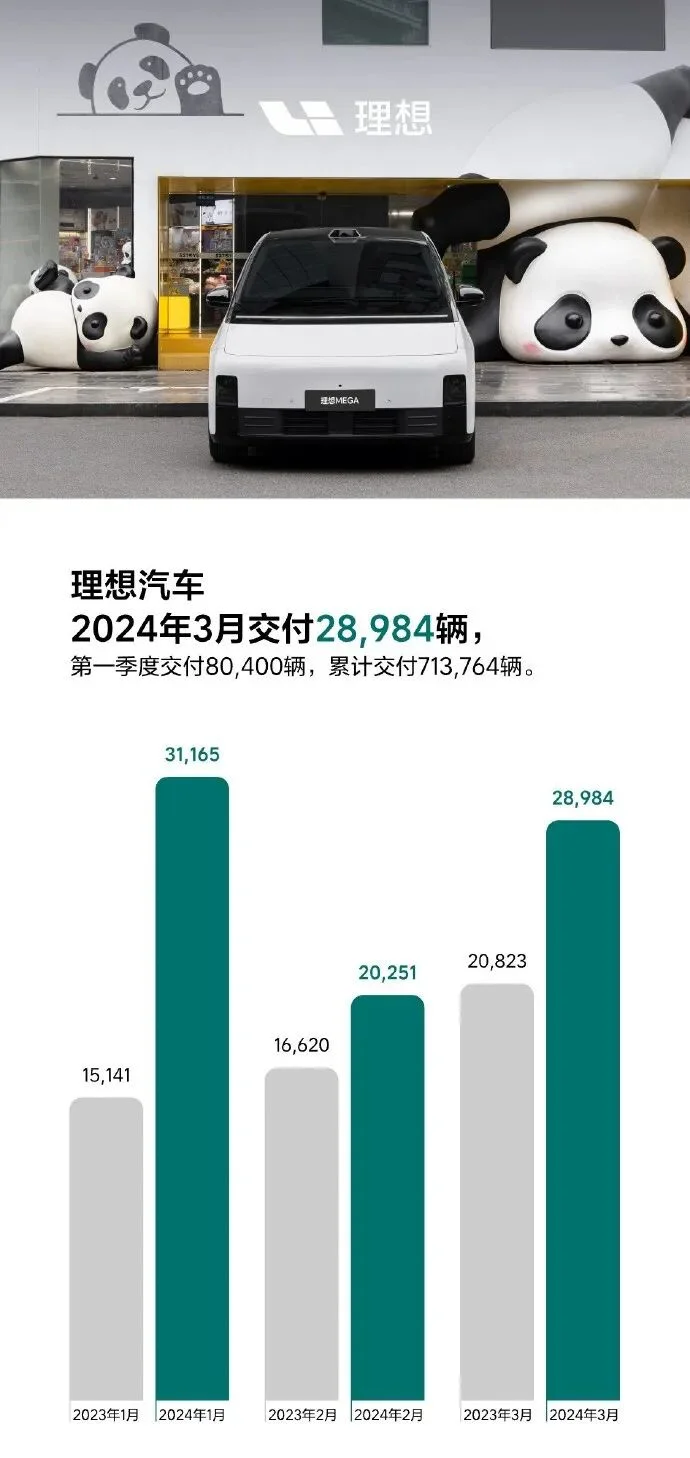
By March 31, 2024, Li Auto had cumulatively delivered 713,764 vehicles, becoming the first Chinese new-energy vehicle startup to reach the milestone of 700,000 cumulative deliveries.
NIO delivered 11,866 new vehicles in March, a year-over-year increase of 14.3% and a month-over-month increase of 45.9%. For the first quarter of 2024, NIO delivered a total of 30,053 new vehicles. To date, NIO has cumulatively delivered 479,647 new vehicles.
According to official announcements, the transition to NIO’s 2024 model lineup is largely complete, with new vehicles now available at dealerships. In April, NIO’s smart cockpit and autonomous driving systems will receive major upgrades.
XPENG delivered 9,026 vehicles in March, representing a 99% month-over-month increase from February’s 4,545 units, and a 29% year-over-year increase compared to 7,002 units in March 2023.
From January to March this year, XPENG’s delivery volume reached 21,821 units, a 20% year-over-year increase from the 18,230 units delivered in the first quarter of 2023. However, this figure remains below the cumulative delivery volume of 34,561 units recorded in the first quarter of 2022.
Additionally, Leapmotor delivered 14,567 vehicles in March, marking a year-over-year increase of more than 136%, while Zeekr delivered 13,012 units, showing significant growth both year-over-year and month-over-month.
Commentary:
Since the beginning of the year, AITO has consistently outperformed Li Auto in monthly sales for three consecutive months.
In light of this, on March 21, Xiang Li issued an internal letter reflecting on Li Auto's misjudgment regarding the pace of its pure-electric strategy and its excessive focus on sales volume and competition. On the afternoon of April 3, Li Auto released an all-staff announcement declaring the launch of a matrix-style organizational upgrade (Version 2.0), alongside structural adjustments across multiple departments.
As we enter April, with the rollout of various 2024 model lineups, competition remains fierce. Which of the leading new energy vehicle manufacturers do you think will continue to strengthen its position? Is Xiaomi also poised to make the list?
Written by: James Edited by: Yisong