


FSD May Enter China by Year-End: Is Tesla on the Eve of an AI Breakthrough?
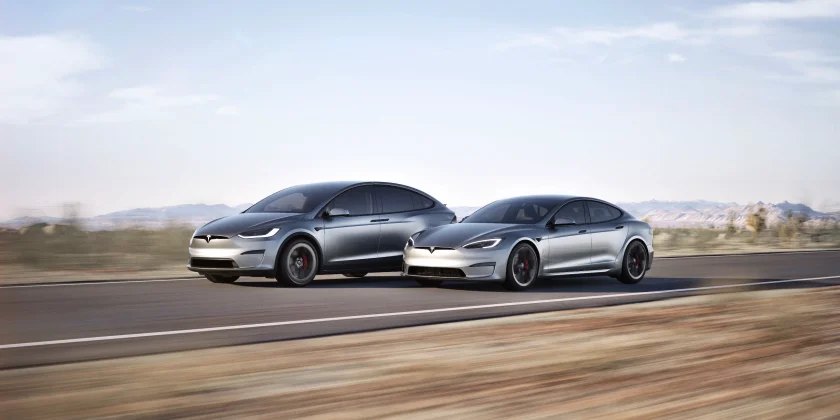
Tesla is increasingly decoupling from its automotive business, charging ahead into the AI sector with an "AI in" strategy.
On July 24, Tesla released its financial results for the second quarter of this year. Despite facing significant pressure on sales growth, Tesla delivered a Q2 report that was relatively strong by its own standards.
The reason lies in the fact that Tesla’s revenue growth no longer relies solely on vehicle sales, and is becoming less dependent on them. Instead, it is increasingly driven by energy storage businesses and AI-centric operations, with the latter being particularly critical.
In the AI sector, Tesla has invested heavily in autonomous driving, Robotaxi, and humanoid robots. However, to date, it has not yet produced standout achievements in these areas that have gained widespread market recognition.
Nevertheless, although Tesla is currently in a phase of accumulating strength in AI, when its potential finally erupts, the sheer force of its impact could drastically reshape the market. Due to its massive investments in AI, Tesla’s future appears both shrouded in uncertainty and exceptionally intriguing.
01Frenzied Accumulation: Tesla’s Massive Bet on AI
Autonomous driving and Optimus are Tesla’s core AI products. Elon Musk stated during the earnings call that Tesla will focus exclusively on developing these two areas and will not easily venture into other AI products.
Currently, Tesla has made massive investments in autonomous driving and Optimus, with computing power at the core of these efforts.
It is reported that Tesla has already purchased approximately 35,000 NVIDIA H100 chips from NVIDIA. By the end of this year, it plans to increase its purchases to approximately 90,000 units. In its earnings report, Tesla also noted that the expansion of its Texas factory is nearing completion, which will house the largest H100 cluster to date.
According to Elon Musk, who stated on X in June, the data center and cooling facilities for this H100 cluster will reach a scale of 130 megawatts this year, and expand to 500 megawatts within the next eighteen months.
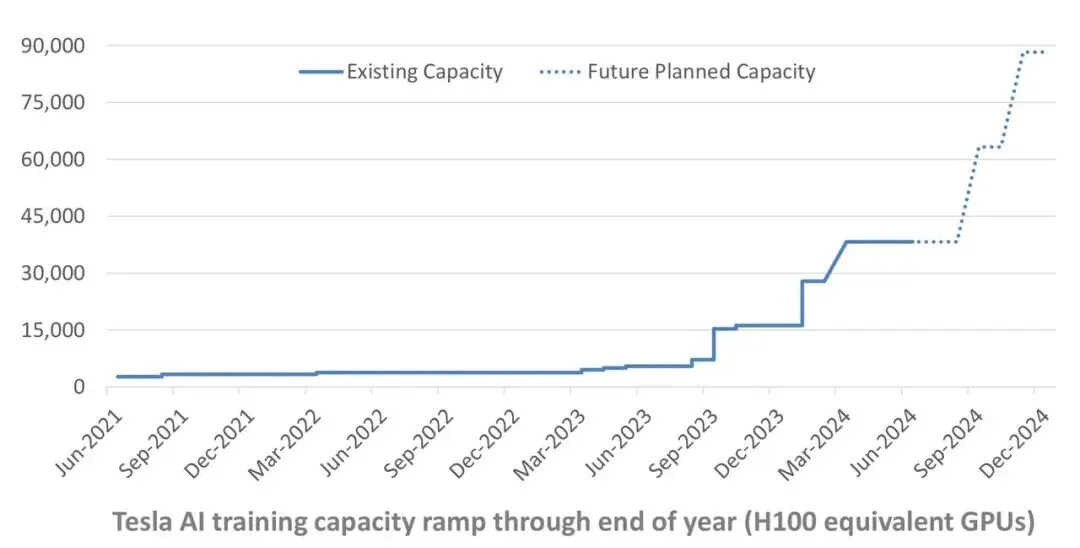
In addition to purchasing computing power from NVIDIA, Tesla is also advancing the evolution of Dojo.
Dojo is an important tool specially developed by Tesla to process video data. According to Elon Musk, by the end of this year, Dojo 1, which is the first generation version of Dojo, will have computing power equivalent to the sum of 8,000 H100 chips.
Also due to the massive investment in computing power, Tesla's corporate operating expenses are rising continuously. Financial reports show that Tesla's Q2 operating expenses were USD 2.973 billion, a year-over-year increase of 39% and a quarter-over-quarter increase of approximately 18%.
However, to boost computing power, Tesla will continue its investment regardless. That said, Tesla will not invest blindly. Under Elon Musk's guidance, Tesla may collaborate and coordinate with xAI, the company Musk founded last July, in the field of AI. During the earnings call, Musk also stated that he would consider how to achieve better synergy between xAI and Tesla.
xAI’s current computing power infrastructure is equally formidable. Recently, the supercomputing cluster xAI has deployed in Memphis, Tennessee, officially entered operations. The cluster comprises 100,000 H100 chips, delivering robust large-scale training capabilities.
Musk recently launched a poll on X asking whether users support Tesla investing USD 5 billion in xAI. The results showed that 72.5% of respondents supported the investment plan. However, this was merely Musk’s gauge of public sentiment; finalizing the investment still requires board approval. Nevertheless, it underscores Musk’s strong intent to integrate Tesla and xAI.
It is not just xAI and Tesla that can be integrated; xAI, Tesla, and SpaceX could also be interconnected. If successful, unifying the capabilities of these three entities would grant Musk’s AI empire particularly dominant control.
With substantial investment, Tesla has achieved certain phased results in autonomous driving and Optimus.
In autonomous driving, financial reports indicate that Tesla FSD has accumulated over 1.6 billion miles of total driving distance, with figures continuing to grow rapidly.
Tesla also noted that in Q2, it will focus on reducing driver interventions in FSD, increasing the mileage driven between interventions, and enhancing driving comfort.
In the financial report, Tesla specifically emphasized that FSD launched a feature using eye tracking to judge driver attention. However, this function was criticized on X a few days ago for not being able to work with sunglasses. Elon Musk stated that this issue would be fixed in the FSD 12.5 version.
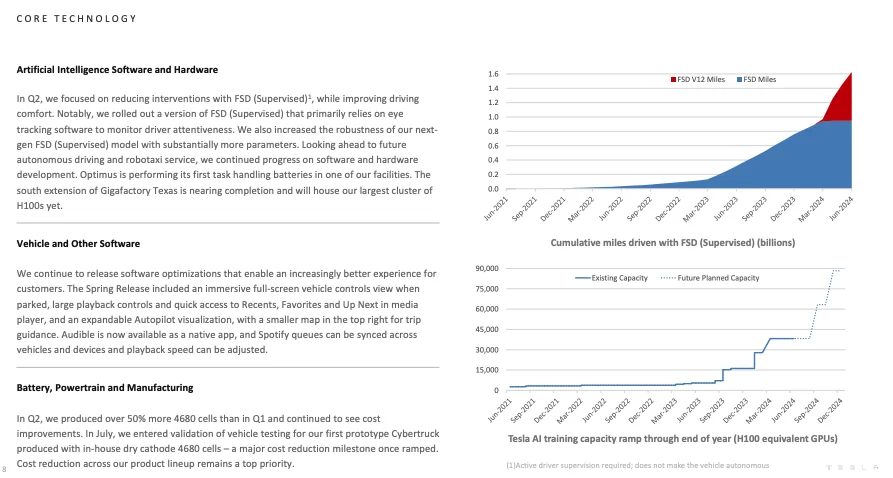
Regarding FSD 12.5, Elon Musk stated during the earnings call that the model parameters for FSD 12.5 are five times those of 12.4, and that it merges the software stack for highway and other driving scenarios.
Currently, FSD 12.5 is beginning to be rolled out. According to Elon Musk, FSD 12.5 will initially only be pushed to Model Y vehicles with HW 4.0; after ensuring stable operation, the rollout will expand further. Additionally, HW 3.0 will run the same model parameters, though the code requires optimization.
Tesla has invested heavily in autonomous driving. The company's CFO noted that penetration rates are rising following FSD price adjustments. However, Elon Musk expressed the view that many people do not yet realize how capable Tesla's system truly is.
From this perspective, Robotaxi serves as a key product demonstrating Tesla's FSD capabilities and will play a pivotal role.
The Robotaxi launch has been delayed from August to October. Elon Musk stated that Tesla is continuously improving the vehicle, aiming to deliver something impressive to users, with plans to have it on the road next year.
Meanwhile, Elon Musk indicated that FSD might receive approval to enter the Chinese and European markets by the end of this year. In China, applications for intelligent driving are becoming increasingly widespread, and user demand and attention are growing. Recently, Luobokuaipao sparked significant public discussion regarding the impact of autonomous driving on technology and employment.
If FSD indeed enters the Chinese market by year-end as Elon Musk suggests, it could pose a major challenge for automakers emphasizing intelligent driving and for Robotaxi companies like Luobokuaipao.
As for whether FSD can handle the complex environment of the Chinese market, many people are currently quite skeptical. In the earnings call, Elon Musk stated that FSD trained by Tesla in the United States possesses general driving capabilities and can be applied in markets outside the United States.
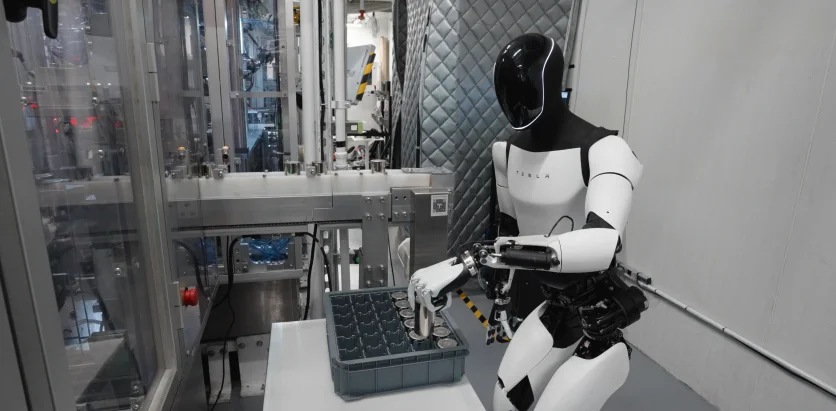
Regarding Optimus, the robot has already begun performing simple battery production tasks. According to Tesla’s plan, it will mass-produce approximately 1,000 Optimus units by the end of next year to take on more complex production duties, with deliveries to customers expected to begin in 2026.
On the future of humanoid robotics, represented by Optimus, Elon Musk stated that there could eventually be over 20 billion humanoid robots capable of executing general-purpose tasks. This would not only significantly boost production efficiency but also form a massive distributed computing network.
02Financial Results Return to Expected Levels
Next, let’s look at Tesla’s Q2 financial results:
Total revenue reached USD 25.5 billion, up approximately 2% year-over-year and approximately 20% quarter-over-quarter;
Gross profit totaled USD 4.578 billion, up approximately 1% year-over-year and approximately 19% quarter-over-quarter;
The gross margin was 18%, compared to 18.2% in the same period last year and 17.4% in the first quarter of this year;
Total automotive revenue of USD 19.878 billion, down approximately 7% year-over-year and up approximately 14% quarter-over-quarter;
Operating income of USD 1.605 billion, down approximately 33% year-over-year and up approximately 37% quarter-over-quarter;
An operating profit margin of 6.3%, compared to 9.6% in the same period last year and 5.5% in the first quarter of this year;
Free cash flow of USD 1.342 billion at the end of the second quarter.
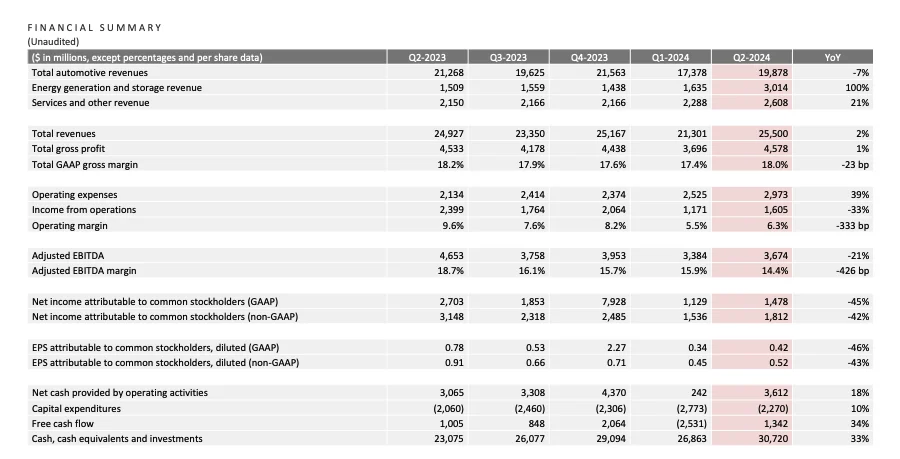
From these figures, Tesla’s performance in Q2 was not particularly strong compared to the same period last year. Total revenue and gross profit remained largely flat year-over-year, while automotive business revenue and operating profit margins both saw significant declines.
However, compared to Q1 of this year, Tesla achieved substantial growth across all metrics, returning to its typical performance level.
Notably, Tesla’s non-automotive businesses demonstrated especially robust growth in Q2, particularly in its energy storage segment.
According to official information, Tesla’s energy storage business generated $3.014 billion in revenue in Q2, representing a year-over-year increase of 100% and a quarter-over-quarter increase of 84%. Meanwhile, revenue from services and other businesses reached $2.608 billion, up 21% year-over-year and approximately 14% quarter-over-quarter.
This growth in energy storage and services-and-other revenues drove the notable increase in Tesla’s overall Q2 revenue. In its earnings report, Tesla predicted that the growth rate for its energy storage business this year may exceed that of its automotive business. The company also stated that it signed strong contracts in Q2, with significant backlog orders expected to be processed through 2025 and 2026.
Meanwhile, the rising delivery volume of the Cybertruck was a key driver of Tesla’s Q2 revenue growth. Tesla noted in its earnings report that Cybertruck production tripled quarter-over-quarter in Q2, with hopes that the entire project could become profitable by the end of this year.
Looking ahead, Tesla stated in its Q2 earnings report that its current focus remains on reducing costs across the company and accelerating the development of AI-enabled products. Tesla is managing its product portfolio with a long-term orientation to promote sales growth, thereby generating sufficient cash flow to invest in future growth.
Continued Sales Expansion
Tesla’s operating revenue for the second quarter was USD 1.605 billion, a decrease of approximately 33% year-over-year and an increase of about 37% quarter-over-quarter. Looking back at Tesla’s quarterly operating revenue since the second quarter of last year, USD 1.605 billion is clearly a low figure. This change is closely tied to sales performance within Tesla’s S3XY product lineup.
According to official data, total production of Tesla’s S3XY lineup in Q2 was 410,831 units, down 14% year-over-year and 5% quarter-over-quarter; total deliveries were 443,956 units, down 5% year-over-year but up 15% quarter-over-quarter.
As Tesla’s main-selling products, Model 3 and Model Y had a combined production of 386,576 units in Q2, down 16% year-over-year and 6% quarter-over-quarter; deliveries totaled 422,405 units, down 5% year-over-year but up 14% quarter-over-quarter.
Tesla did not provide a clear explanation for the decline in production in its earnings report or during the conference call, but it expects Q3 production to increase sequentially following the drop in Q2. In the second half of this year, Tesla will focus on increasing production volumes for the Cybertruck and Model 3.
The growth in deliveries during Q2 was significantly driven by Tesla’s frequent use of price cuts; however, this strategy also lowered the average selling price across the S3XY lineup, ultimately impacting revenue growth.
To sustain sales momentum, Tesla’s strategy outlined in the earnings report centers primarily on product updates.
In the earnings report, Tesla stated it would continue to refresh its global vehicle lineup, including introducing new interior designs for the Model 3 and Model Y, as well as offering new paint options for the entire S3XY series.
During the earnings conference call, Elon Musk indicated that Tesla plans to introduce and begin production of a new model in the first half of next year, with the Roadster also expected to move toward production by then.
Meanwhile, Tesla’s expanding market reach is helping boost delivery volumes. According to official information, the Berlin Gigafactory has begun producing right-hand-drive vehicles and has already delivered the first batch to the UK. Deliveries to Qatar have also started, while shipments to Israel and Taiwan (China) are increasing.
Notably, during the conference call, Elon Musk mentioned that Tesla would dynamically adjust its advertising strategy as needed to support sales, engaging in moderate advertising efforts.
Furthermore, in the Chinese market, Tesla faces significant competitive pressure. In its earnings report, Tesla noted that China’s automotive market is one of the most fiercely competitive globally, but the company aims to position itself favorably for long-term growth. Beyond the autonomous driving capabilities it prioritizes, cost structure serves as another key driver.
Regarding cost structure, Tesla has consistently focused on reducing expenses. The earnings report specifically highlighted that the company will continue to prioritize cost reduction.
According to official information, excluding the Cybertruck, Tesla’s average vehicle costs have been declining steadily. This trend is evident in Tesla’s strong gross margin performance, even amid frequent price cuts.
03Conclusion
Tesla has not delivered anything particularly exciting in a long time.
The current state stems from Tesla’s view that it is positioned between two major growth waves. The first wave was the global expansion initiated by the Model 3 and Model Y; the next wave centers on the advancement of Tesla’s autonomous driving technology and the launch of related new products.
When situated between these two growth waves, Tesla naturally enters a relatively flat development phase. However, because the first wave created such a substantial impact on the market, it raised user expectations significantly. Consequently, despite retaining considerable overall strength, Tesla currently appears somewhat lackluster.
However, based on Tesla’s emphasis on, investment in, and progress regarding its AI business, the practical application of Full Self-Driving (FSD), Robotaxi, and humanoid robots seems imminent. Many changes that will ultimately affect our lives may already be unfolding unnoticed.
We can certainly wait and see how these developments unfold. However, companies such as Huawei, Xiaomi, NIO, Lixiang, and XPENG need to prepare for battle in advance. With the entry of FSD into China—potentially as early as the end of this year—another fierce war over autonomous driving may be about to begin.
Written by: Isaiah Edited by: James