


Xiaomi Unveils SU7 Ultra Prototype; Zeekr Launches New 009 in Hong Kong; Volkswagen ID. Yuzhong Goes on Sale
01 Weekly Index
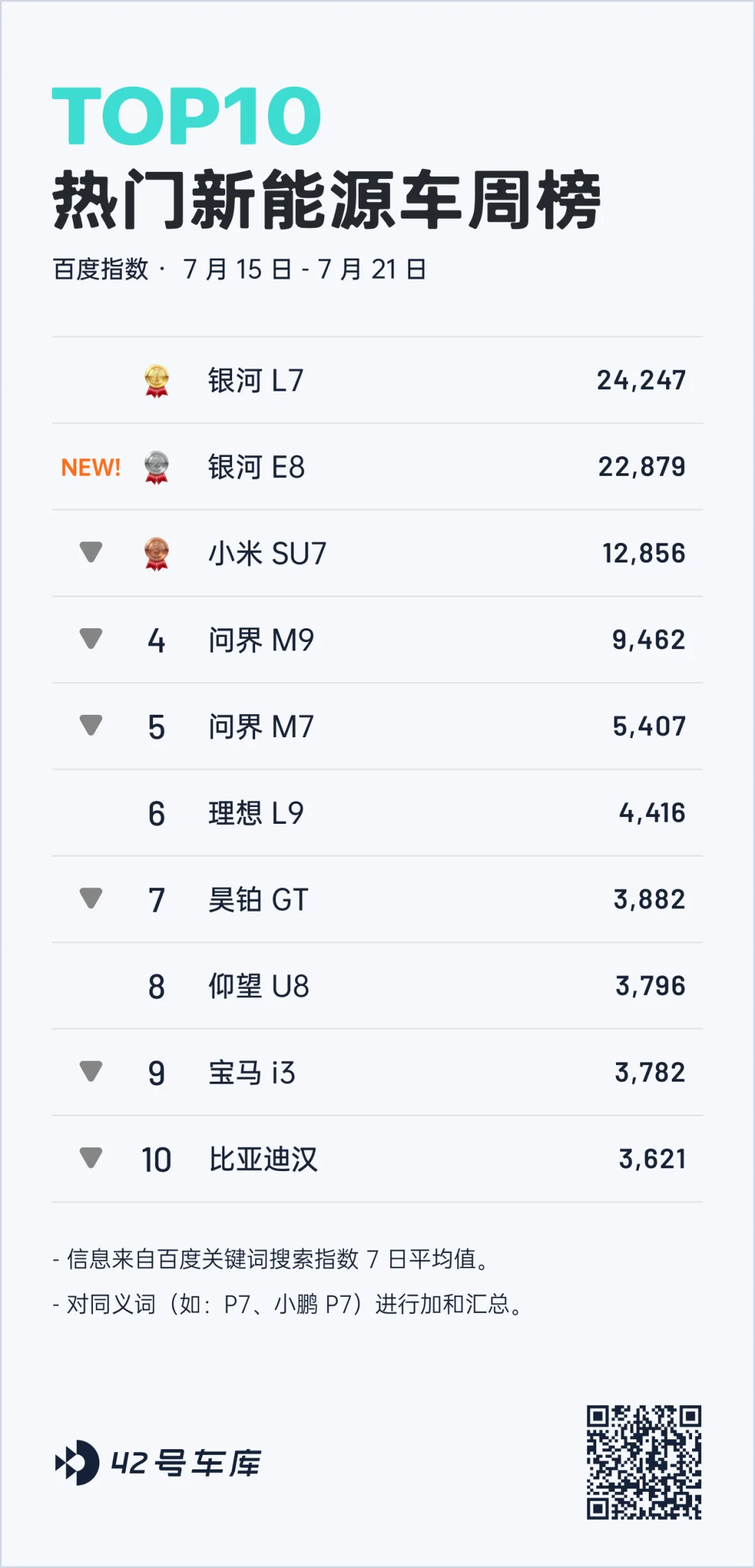
02Weekly News
Xiaomi SU7 Ultra Yuanxingche Launch
On the evening of July 19, Lei Jun delivered his fifth annual speech. Starting with the United States sanctions, Lei Jun shared Xiaomi's three-year journey in building cars. At the same event, the Xiaomi SU7 Ultra Yuanxingche was also unveiled.
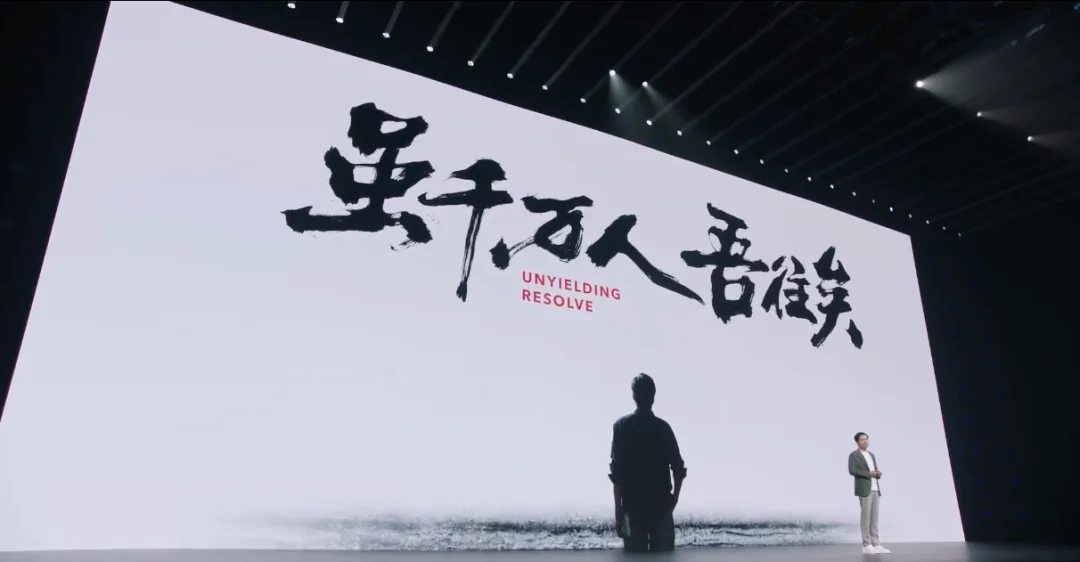
At 7:00 a.m. on January 15, 2021, Lei Jun received a phone call. The caller said, "Mr. Lei, you have been sanctioned by the United States."
It turned out that in January 2021, during the final stage of his term, Te Langpu issued an executive order adding Xiaomi to a "blacklist," specifically the list of "Chinese military companies." Chinese enterprises on this list were restricted from purchasing United States goods, software, technologies, and other services.
The chokehold imposed by the United States caused Xiaomi’s stock price to plummet, and operations in its core mobile phone business became fraught with uncertainty.
That same day, Xiaomi convened a board meeting to discuss how to respond to the United States' sanctions. According to Lei Jun, a Xiaomi director asked at the time, "If Xiaomi phones fail, what will happen to the company’s thirty thousand to forty thousand employees?" This question deeply concerned Lei Jun. Shortly after, another director proposed entering the automobile manufacturing industry.
By 2021, Tesla was thriving in China, and new EV startups were gaining significant traction. With intelligence and electrification as core focuses, new automakers and innovative models continued to emerge. The entire new energy vehicle market was a battleground where numerous players vied for dominance.
For Xiaomi at that time, beyond the issue of sanctions, there was another pressing challenge: upgrading its brand to the premium segment.
Because Xiaomi’s reputation for cost-effectiveness is so deeply ingrained, establishing a premium brand image has always been a challenge. Lei Jun has expressed significant anxiety about this. He has noted that if the company cannot continuously drive capability improvements through performance in the high-end market, it will inevitably drift toward mediocrity or decline in the long run. Entering the automotive sector serves as an efficient pathway to elevate Xiaomi’s brand value.
Thus, when a board director proposed entering the vehicle manufacturing business, Lei Jun was indeed intrigued. He promptly initiated research into the new energy vehicle (NEV) market.
After extensive research, Lei Jun observed that automobiles and consumer electronics were increasingly converging, and the trend toward smart electric vehicles was unstoppable.
At the same time, Lei Jun recognized that the NEV sector was highly crowded. He believed the market would likely undergo severe consolidation, similar to the smartphone industry, eventually leaving only five to eight surviving companies. In his view, if Xiaomi Auto failed to rank among the top five, it might not survive.
Ultimately, after 70 days of conducting 85 research sessions and interviewing more than 200 individuals, under Lei Jun's leadership, Xiaomi decided to manufacture cars and committed USD 10 billion to the venture.
On March 30, 2021, Lei Jun formally responded to the Xiaomi Board, stating that if car manufacturing was a must-do endeavor and he was deemed the most suitable person to lead it, he was willing to step forward.
It was on that same day, March 30, that Lei Jun held the now-famous press conference announcing the entry into car manufacturing. During the event, he declared, "This is my last entrepreneurial venture; I am fighting for Xiaomi Auto," a slogan filled with romanticism.
Xiaomi’s motivation to enter the auto industry was driven by necessity. However, once the decision was made, the company moved forward with boldness and courage, never looking back. By holding the March 30 press conference, Lei Jun had effectively cut off any retreat.
If we examine the advantages Xiaomi holds in vehicle manufacturing, Lei Jun’s personal influence is undeniable.
At 5:00 a.m. on March 31, 2021, Liu Anyu, Xiaomi’s 37th employee, sent Lei Jun a message stating that he would do anything to participate in Xiaomi’s car-making project.
Liu Anyu’s decisive choice to join Xiaomi’s automotive efforts stemmed from two factors: he is an avid car enthusiast, and he was moved by Lei Jun’s romanticized presentation the previous night.
In fact, it was not just Liu Anyu who was swayed by that launch event; Lei Jun also persuaded BMW designer Li Tianyuan to return from Europe to China with his family to join Xiaomi. He further attracted Shunweiziben partner and former Geely Research Institute President Hu Zhengnan to join Xiaomi for vehicle development work.
According to Lei Jun, the presentation attracted numerous individuals to join Xiaomi Auto. He further noted that over the three-year period of Xiaomi’s vehicle development, the company received more than 380,000 resumes.
Interestingly, those seeking to join Xiaomi’s automotive team were not the only ones; significant capital was also available. Lei Jun stated that if Xiaomi Auto were to operate independently from the broader Xiaomi ecosystem, its market valuation could reach USD 10 billion.
However, Lei Jun remained unmoved by this potential funding. In his view, vehicle manufacturing is a long-cycle endeavor, and accepting outside capital would make it difficult to maintain independent decision-making and stay true to the original vision.
Consequently, Lei Jun ultimately decided to proceed along his own path, leveraging the entire Xiaomi ecosystem for vehicle development rather than adopting a light-asset contract manufacturing model. Starting from core technologies, they are building their automotive capabilities step by step.
During the early R&D phase, although China’s automotive supply chain was already relatively mature, Xiaomi Auto was building its first vehicle and essentially had to learn by doing. In just over ten months, the team developed more than a dozen battery pack prototypes, incurring costs of tens of millions of yuan.
At Xiaomi Auto’s first review meeting before the 2022 Spring Festival, fierce debates erupted within the team. On some issues, arguments lasted from 9 a.m. to 9 p.m.
Faced with such a stalemate, Lei Jun decided that meetings would continue until clarity was reached, regardless of how long it took. This particular review session lasted 21 days, resulting in all proposals being scrapped and redone.
After 21 days of debate, the Xiaomi Auto team reached an important consensus at this review: simply getting Xiaomi onto the playing field successfully was the greatest victory.
Consequently, Xiaomi Auto established the principle of “staying true to fundamentals while seeking innovation.” The company adopted a methodical approach to vehicle development, avoiding ambitions to disrupt or overturn the industry from the outset.
Lei Jun also underwent significant personal changes during the vehicle development process. After deciding to enter the auto business, he set a modest goal for himself: to become one of the best-driving CEOs among Chinese automakers.
To achieve this, Lei Jun began driving himself. He noted that prior to entering the auto industry, he always had a dedicated driver, which caused him to lose his driving skills. Therefore, after deciding to build cars, he instructed his driver to sit in the passenger seat while he took the wheel.
Meanwhile, to drive more cars and gain deeper insights, Lei Jun borrowed vehicles from friends and colleagues, visiting various brand 4S dealerships for test drives.
Additionally, when Lei Jun had free time, he would explore Xiaomi’s underground parking garage to identify cars he hadn’t yet driven. If a car was untested by him, he would borrow it for a drive. He also proactively asked owners about their experiences with their vehicles, inquiring about what they liked, what they disliked, and how they would choose their next car.
In short, Lei Jun utilized every available channel to understand and learn about automobiles. According to Lei Jun, he has test-driven more than 170 vehicles and accumulated over 200,000 words of notes.
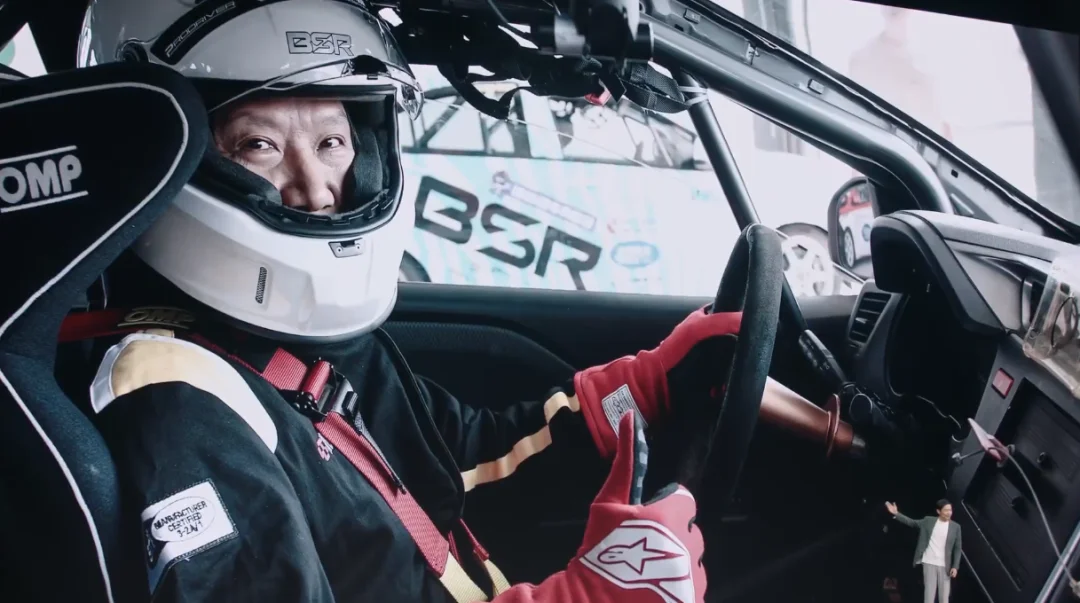
After extensive study, Lei Jun considered himself proficient in driving. During his annual speech, he even shared a video of himself performing drifts.
More importantly, Lei Jun applied his automotive knowledge to vehicle development. He personally participated in the winter and summer testing of the Xiaomi SU7, drove the Xiaomi SU7 for 5,000 kilometers himself, and led Xiaomi executives to collectively test-drive the Xiaomi SU7 for 100,000 kilometers.
Under Lei Jun’s leadership, Xiaomi spent three years developing the Xiaomi SU7. However, just before the official launch of the Xiaomi SU7, Lei Jun fell into a state of deep frustration.
Lei Jun stated that prior to the Xiaomi SU7’s official launch, Xiaomi consulted many industry insiders. Many of those consulted noted that Tesla’s fan base is strong and that buyers of C-class sedans (34C segment) prioritize brand loyalty when changing vehicles. Additionally, Xiaomi internally produced a report spanning dozens of pages, which indicated that female car owners are generally unlikely to prefer performance-oriented vehicles. Lei Jun also engaged with media outlets, whose prevailing view was that achieving monthly sales of 3,000 units for a pure electric sedan would be cause for celebration.
All this information sent the same signal to Lei Jun: the Xiaomi SU7 might not sell well. Nevertheless, Lei Jun remained convinced that the Xiaomi SU7 would achieve massive sales.
When Xiaomi placed orders with suppliers in February to determine its annual production capacity, many believed that securing a capacity of 30,000 units would suffice. However, Lei Jun opted for 76,000 units. This meant that to utilize the full annual capacity of 76,000 units, the Xiaomi SU7 needed to achieve average monthly deliveries exceeding 10,000 units.
Beyond capacity, pricing posed another thorny issue. As is well known, there was intense public discussion regarding the pricing of the Xiaomi SU7 at the time, with rumors ranging from RMB 99,000 to RMB 149,000 and RMB 199,000.
Lei Jun believed that reasonable pricing ensures long-term success, whereas low prices are merely drinking poison to quench thirst. It was not until a meeting the day before the launch event that he finalized the price at RMB 215,900. According to Lei Jun, an executive at the meeting stated that Xiaomi would accept whatever sales volume resulted.
Subsequent events proved Lei Jun’s confidence well-founded. The Xiaomi SU7 became a phenomenal bestseller, and Xiaomi Auto successfully secured its place on the automotive stage.
Regarding the success of the Xiaomi SU7, Lei Jun said during his annual speech: "Behind the success of the Xiaomi SU7 lies immense courage. This is not the courage of a single individual, but the courage of more than 40,000 people across the Xiaomi Group."
At the conclusion of his annual speech, Lei Jun once again reiterated Xiaomi's goal to become one of the top five global automakers within 15 to 20 years. To achieve this status as a top-five global automaker, Xiaomi Auto must have the courage to engage in head-on competition with the world's leading automakers on the pinnacle racing tracks.
Therefore, Xiaomi has decided to officially compete at Niubei this October, with the weapon for this campaign being the Xiaomi SU7 Ultra Yuanxingche, which made its grand finale appearance at the annual speech.
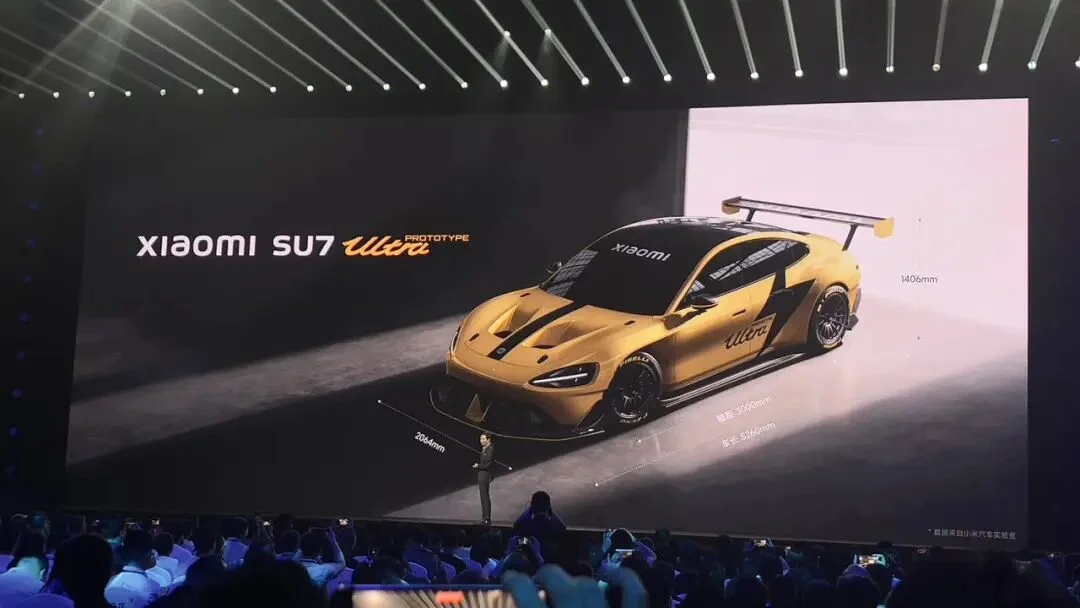
The Xiaomi SU7 Ultra Yuanxingche prototype is equipped with two Xiaomi-developed V8s motors spinning at 27,200 rpm, along with a single V6s motor. With this three-motor configuration, the vehicle produces 1,548 horsepower, achieves a zero-to-100 km/h acceleration time of 1.97 seconds (including launch time), and reaches a top speed exceeding 350 km/h.
Additionally, the Xiaomi SU7 Ultra Yuanxingche also adopts an all-carbon design, with its body panels made 100 percent from carbon fiber material, bringing the total vehicle weight to just 1,900 kg.
According to official information, the core hardware and body structure of the SU7 Ultra Yuanxingche were independently designed and developed by Xiaomi Auto. The V8s motor was entirely self-developed by Xiaomi, while the vehicle’s thermal management system, electric drive controller, and battery control strategy were also independently designed and developed by Xiaomi Auto. The battery pack is a joint development result between Xiaomi Auto and CATL.
Interestingly, while discussing the Xiaomi SU7 Ultra Yuanxingche, Lei Jun also noted that the car is very expensive—so expensive that he cannot afford to buy one himself.
Editorial Comment:
The market response and sales performance of the Xiaomi SU7 undoubtedly serve as the best rebuttal to those who previously questioned Xiaomi’s ability to manufacture automobiles. The success of the SU7 stems from Xiaomi’s deep accumulation in intelligent technology and its precise grasp of market trends. Facing sanctions from the United States and shifting market dynamics, Xiaomi chose self-innovation rather than passive waiting—a decision-making courage and execution capability worthy of emulation by all enterprises.
All-New Zeekr 009 Launches
On July 19, the all-new Zeekr 009 launched.
At the start of the launch event, Zeekr presented sales data for the 009 Guanghui: orders placed within three months of its release exceeded the original annual production plan. Among 009 Guanghui owners, listed company CEOs, corporate executives, and public figures accounted for 75%.
This indicates that the 009 Guanghui has achieved significant market success.
The newly launched Zeekr 009 is available in three variants:
Seven-seat aisle version starting at RMB 439,000;
Seven-seat all-wheel-drive aisle version starting at RMB 459,000;
Six-seat executive all-wheel-drive version starting at RMB 469,000;
According to official information, deliveries of the new Zeekr 009 will begin on July 22.
Additionally, as the new Zeekr 009 launched in Hong Kong, Zeekr simultaneously introduced the new Zeekr 009 to the Hong Kong market. The right-hand-drive version starts at HKD 755,000 (approximately RMB 703,000) and will be delivered in the fourth quarter of this year.
Let's look at the product information for the all-new Zeekr 009.
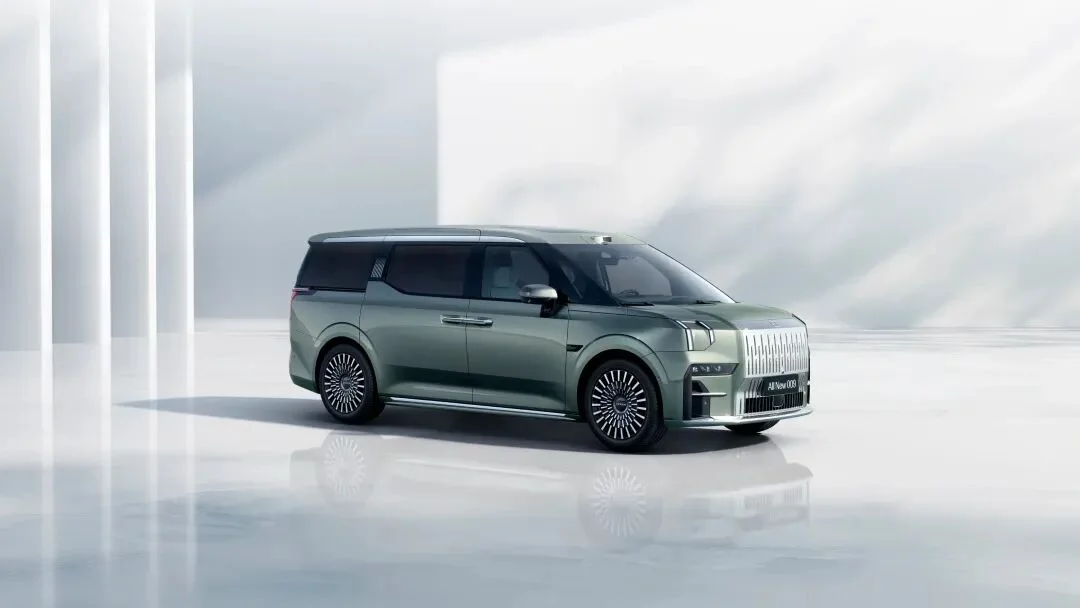
In terms of the three-electric systems, the all-new Zeekr 009 is available in two versions: an 800 V and a 400 V variant. The 800 V version is equipped with a CATL 5C Qilin battery with a capacity of 108 kWh, supporting a maximum charging power of 560 kW. According to official information, the 800 V Zeekr 009 can charge from 10% to 80% state of charge in 11.5 minutes, with a maximum CLTC range of 740 km. The 400 V version features a 140 kWh Qilin battery, offering a maximum CLTC range of 900 km.
In terms of driving dynamics, the all-new Zeekr 009 is equipped with a high-performance silicon carbide electric drive system and dual-chamber air suspension. It delivers a maximum output of 788 horsepower, achieves a zero-to-100 km/h acceleration time of as fast as 3.9 seconds, has a braking distance from 100 to 0 km/h of 36.6 meters, and scores 76 km/h in the moose test.
In terms of comfort features, the all-new Zeekr 009 comes equipped with the standard "refrigerator, color TV, and large sofa" setup. It features an 8.6-liter refrigerator with a temperature range of -6°C to 50°C, supporting constant-temperature mode and ultraviolet sterilization. Both front and rear rows are standardly equipped with dual-layer OLED screens identical to those on the iPad Pro, offering 1.07 billion colors, a 2,000,000:1 contrast ratio, and an 87% screen-to-body ratio. The seats are Safaro first-class aviation seats. Additionally, for audio, the all-new Zeekr 009 uses a YAMAHA surround sound premium audio system that supports 7.1.9 Dolby Atmos, featuring nine overhead channels and panoramic sound across all three rows.
In terms of intelligent driving, the all-new Zeekr 009 comes standard with LiDAR across all trims. It is equipped with a Mobileye EyeQ5H high-performance 7 nm chip, seven 8-megapixel long-range HD cameras, one millimeter-wave radar with 250-meter perception range, four long-range ultrasonic radars, eight short-range ultrasonic radars, four short-range surround-view cameras, and one interior monitoring camera.
Quick Review:
The Zeekr 009 is a key product for shaping Zeekr's brand value and stature. Since its official launch on November 1, 2022, driven by strong product capabilities and high cost-effectiveness, the market reception of the Zeekr 009 has continued to grow. Recently, the Zeekr 009 Guanghui even experienced a phenomenon where it could only be purchased at a premium price. However, according to Conghui An, in response to this situation, Zeekr immediately convened a meeting with the team to strictly prohibit such markups.
Launching this MPV in Hong Kong, a hot market for such vehicles, demonstrates Zeekr's confidence in the product and brand strength of the all-new Zeekr 009. It also shows that Zeekr's market presence is expanding. As Conghui An stated, as a global brand, Zeekr must internationalize; its products will enter various global market segments. From this perspective, the Zeekr 009 serves as a vanguard for Zeekr's entry into the global market.
ID. Yuzhong Launches
On July 17, Volkswagen launched the all-electric coupe SUV ID. Yuzhong, with prices ranging from RMB 209,900 to RMB 249,900.
The ID. Yuzhong precisely targets the all-electric coupe SUV segment. After a redesign, it stands out as highly distinctive among other Volkswagen models.
The ID. Yuzhong features a new Coupe SUV design. Its dimensions are 4,663 mm in length, 1,860 mm in width, and 1,610 mm in height, with a wheelbase of 2,766 mm.
Exteriorly, the ID. Yuzhong adopts Volkswagen's latest design language, with details tailored to appeal to younger users.
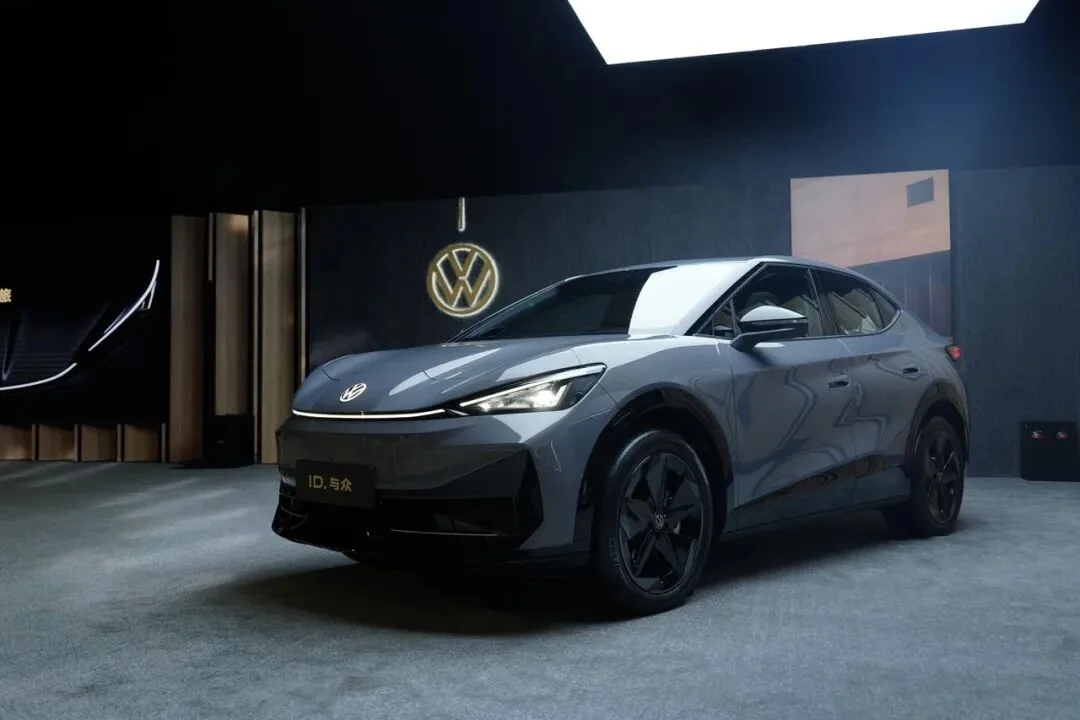
The front end of the ID. Yuzhong features a diving posture. The full-width lighting design, which is lower in the center and higher on the sides, adds dynamism to the front face. Paired with a muscular hood, it immediately conveys the aura of a sporty model.
Moving to the side profile, the sloping A-pillar and fastback coupe silhouette create a graceful overall stance. The ID. Yuzhong also features a floating roof design inspired by the ID. R concept supercar; the high-gloss black A-pillars connect the windshield to the side glass, producing an effect similar to a racing car's visor.
The optional 21-inch low-drag mecha-style wheels further elevate the visual impact of the ID. Yuzhong. Indeed, large wheels simply look impressive.
Two details make the ID. Yuzhong even more striking: the gold Volkswagen badge and gold accents throughout the vehicle, along with the IQ. Light intelligent matrix LED headlights.
The ID. Yuzhong is the first model to feature a gold Volkswagen badge, which appears on the front grille, rear, and center caps of all four wheels. Gold accents are also integrated into the lighting elements and body trim, making it unique among Volkswagen models globally.
Regarding lighting, the IQ. Light intelligent matrix LED headlights have a sharp, distinctive gaze. This high recognizability has already received significant praise from users of other ID. family models.
Stepping inside the ID. Yuzhong, the familiar feel immediately stands out, reflecting the interior design language shared across the ID. family.
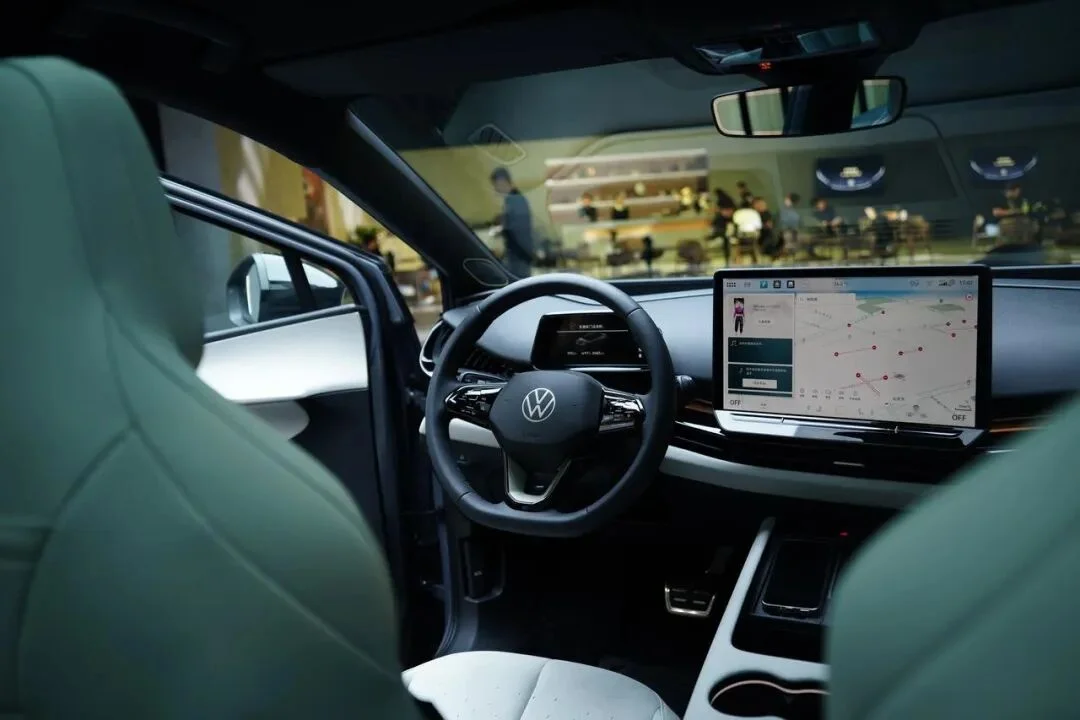
A 5.3-inch instrument cluster, the largest 15-inch 2K central touchscreen in the ID. family, and a 70-inch AR HUD contribute to the car’s strong tech credentials. The infotainment system differs from previous models; the ID. Yuzhong is equipped with ID.S 5.0 software running on the UNYX.OS operating system.
Compared with the already launched ID.3 and ID.4 models, the central control screen of the ID. Yuzhong is significantly larger, matching that of the ID.7 model. The larger screen creates a completely different first impression. So how is the user experience?
Previously, we briefly tested this infotainment system and were impressed by its AI smart companion. By customizing the companion's appearance through face sculpting, outfit selection, and pose adjustments, users can engage in more realistic conversations with the system. The infotainment unit can also clone real human voices, making the AI feel even more lifelike.
Volkswagen also collaborated with Kedaxunfei on a new generation of cognitive intelligent large language models. With natural language understanding and stronger AI technology, "Hello Volkswagen" is no longer just about helping you roll down the windows or play music; it can also answer more complex questions.
In addition, the in-car app store supports third-party applications and includes more than 50 car-specific mini-programs, such as Youku video and local life services, which can be launched directly without downloading. This application ecosystem essentially covers all vehicle usage scenarios.
These points also represent the upgrades in intelligent cockpit features relative to the ID.4 model. After upgrading to UNYX.OS, the infotainment system's functionality has become significantly richer.
Regarding smartphone-to-vehicle connectivity, the ID. Yuzhong supports wireless CarPlay and CarLife, as well as a wired connection to Huawei HiCar. This means the ID. Yuzhong is compatible with almost all mainstream smartphones on the market, making core functions like navigation and music intuitive and easy to use.
If you prefer a straightforward infotainment system and don't seek a geeky experience, or if you are already a deep user of systems like CarPlay or HiCar, I believe the ID. Yuzhong's infotainment system will certainly meet your daily needs.
Another aspect of intelligence is autonomous driving. The ID. Yuzhong comes standard across the entire lineup with an L2+ level driver assistance system and active safety features. Officially, these are referred to as the Travel Assist 3.0 full-journey driving assistance system and the Emergency Assist 3.0 emergency assistance system.
Travel Assist 3.0, the full-journey driver assistance system, offers L2+ level capabilities. Once activated, it controls the distance to the vehicle ahead and steers along the current lane markings. When the driver signals a lane change, the system assesses the surrounding environment to assist in executing the maneuver.
Emergency Assist 3.0 is a comprehensive suite of nine active safety functions, comprising three lateral, five forward, and one rearward safety feature.
An examination of the current A-segment pure electric SUV market reveals that most models offer a low-priced 'entry-level' variant. This typically involves stripping features; given the significant hardware costs associated with active safety and driver assistance systems, these are often the first items removed.
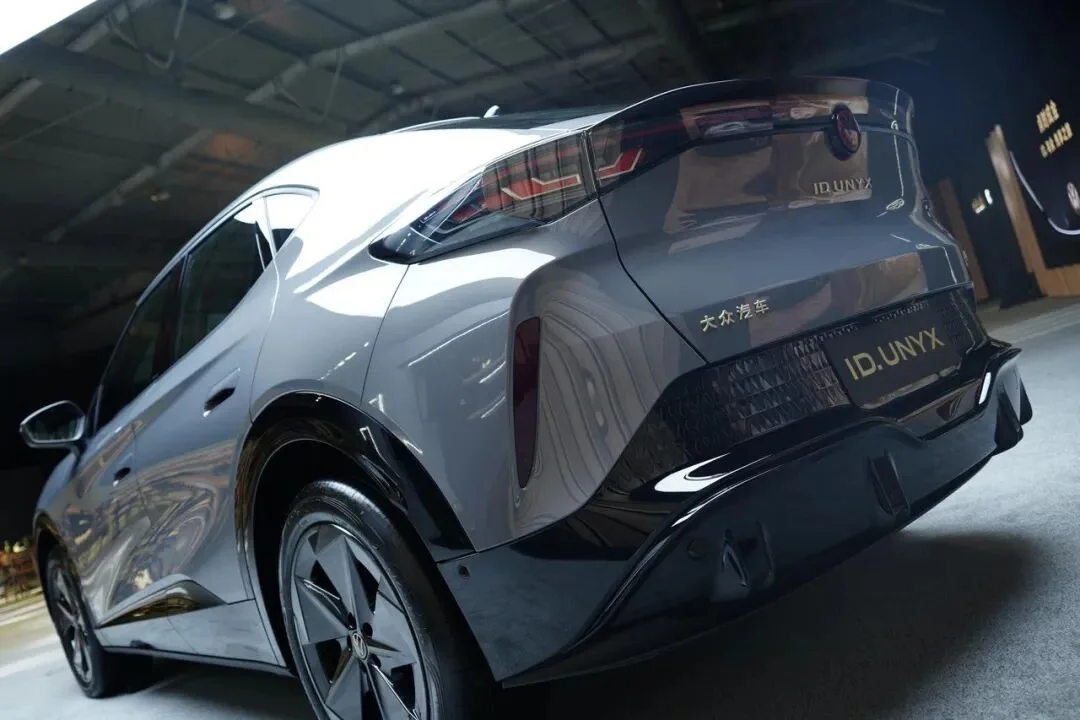
It is also evident that entry-level A-segment pure electric SUVs usually come equipped only with Adaptive Cruise Control (ACC) or outdated standard cruise control.
ID. Yuzhong avoids this trend by making both Travel Assist 3.0 and Emergency Assist 3.0 standard across all trims.
Additionally, an automatic parking package is available. Utilizing 12 ultrasonic radars and a Top View 360° panoramic camera, ID. Yuzhong can perform functions such as parallel parking and reverse parking into bays.
The realization of these intelligent features relies on Volkswagen’s MEB pure electric platform. The MEB platform ensures that ID. Yuzhong delivers excellence in battery, motor, electronic control systems, range, and driving dynamics.
The ID. Yuzhong is equipped with an 82.4 kWh battery pack. The rear-wheel-drive version achieves a CLTC range of 621 km, while the dual-motor all-wheel-drive variant delivers a combined output of 250 kW and peak torque of 472 N·m, with a 0–100 km/h acceleration time of just 5.6 seconds.
In China’s A-segment pure electric SUV market, this performance and range are highly competitive.
The ID. Yuzhong features Volkswagen’s latest high-performance chassis system, including the DCC adaptive damping control system and the MEB two-stage flexible vibration isolation system. Using real-time road data from sensors, the system dynamically adjusts shock absorber stiffness. Whether in comfort or sport mode, it enhances both ride quality and handling precision.
Additionally, the ID. Yuzhong features a 50:50 front-to-rear weight distribution and asymmetric tire widths—235 mm at the front and 255 mm at the rear—which enhance the vehicle's overall handling.
A standout advantage of already-launched ID. family models is their exceptionally small turning radius, a trait immediately noticeable to first-time drivers. In tight U-turn scenarios where other vehicles might require multiple forward-and-back maneuvers, ID. models can complete the turn in one smooth motion. Leveraging the MEB platform’s advantages, the ID. Yuzhong inherits this capability with a minimum turning radius of just 4.7 meters.
For the rear-wheel-drive model, the front wheels achieve inner and outer steering angles of 48.83° and 40.17°, respectively. This large wheel articulation enables agile steering—a feature uncommon in this price segment.
Built on the MEB pure-electric platform, the ID. Yuzhong excels in powertrain efficiency, range, driving dynamics, and smart features. As of 2024, it remains a compelling A-segment pure electric SUV with strong product competitiveness.
Quick Review:
In 2024, automakers widely perceived the Chinese automotive market as intensely competitive. For consumers, this environment has yielded a surge of models offering superior value. This trend extends beyond domestic brands; many joint-venture manufacturers are now launching vehicles with enhanced product capabilities at lower price points to defend their market share.
Consequently, the new energy vehicle (NEV) market is experiencing unprecedented activity.
Among joint-venture brands operating in China, Volkswagen stands out as one of the most proactive players in its NEV transition. As Volkswagen expands its model lineup and introduces additional vehicles such as the ID. Yuzhong to meet diverse user needs, its transformation into an intelligent connected electric vehicle provider continues to accelerate.
Written by: Isaiah Edited by: Isaiah