


SenseTime Unveils R-UniAD: End-to-End Autonomous Driving with World Model Synergy
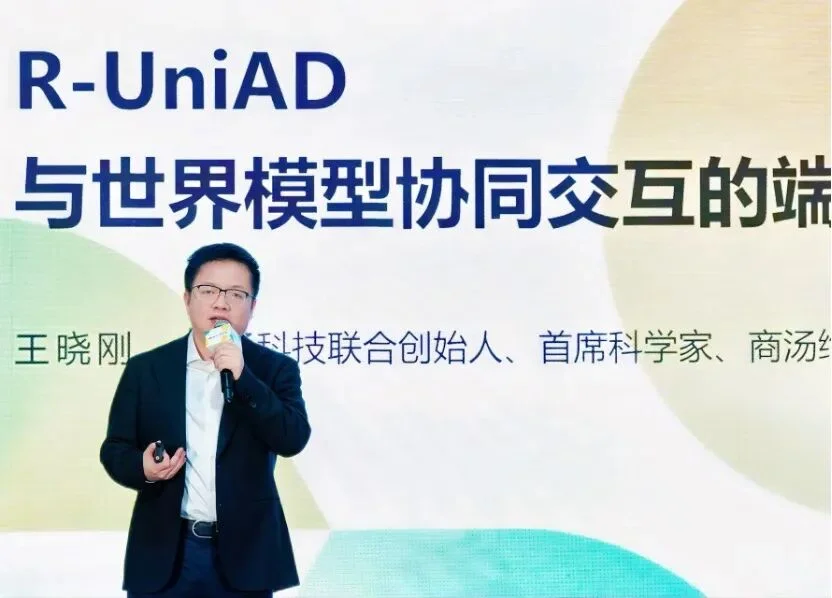
At the 2025GDC Quanqiukaifazhexianfengdahui, SenseTime unveiled the industry’s first "end-to-end autonomous driving route R-UniAD that collaboratively interacts with world models." By constructing a world model to generate online interactive simulation environments, it enables reinforcement learning training for end-to-end models.
This approach closely mirrors the technical philosophy behind DeepSeek, which has gained widespread popularity since the Spring Festival. Shangtangjueying believes that the evolution from imitation learning to reinforcement learning positions end-to-end autonomous driving to potentially surpass human driving performance.
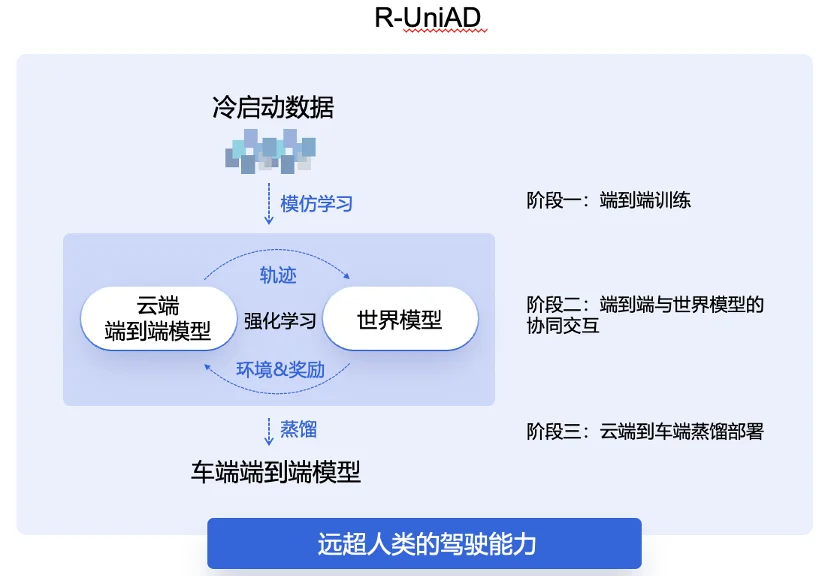
Xiaogang Wang, CEO of Shangtangjueying and co-founder and chief scientist at SenseTime, detailed in his speech that training R-UniAD involves three stages. First, cloud-based end-to-end autonomous driving large models are trained via imitation learning using cold-start data. Next, based on reinforcement learning, the cloud-based large model interacts collaboratively with the world model to continuously enhance end-to-end model performance. Finally, the cloud large model is deployed to vehicles as a high-performance end-to-end autonomous driving small model through efficient distillation.
According to its plan, Shangtangjueying will demonstrate the real-vehicle deployment of its "end-to-end autonomous driving solution that collaboratively interacts with world models" at the Shanghai Auto Show this April.
Based on Shangtangjueying’s description, China’s intelligent driving development has arguably reached its "DeepSeek moment."
Following the presentation, 42HOW Auto and several other industry media outlets jointly interviewed Xiaogang Wang. He shared detailed insights into the technical core of R-UniAD, the simulation capabilities of the "Kaiwu" world model, and responded to recent hot topics such as DeepSeek and the official rollout of FSD. Through this in-depth dialogue, we sought to explore SenseTime’s early layout in the field of intelligent driving and the cutting edge of intelligent driving research and development.
01Data Demand Drops by One Order of Magnitude
The end-to-end autonomous driving technical route is now widely accepted across the industry. Its essence lies in using massive amounts of high-quality human driving data to achieve optimal "imitation" driving performance. However, while this imitation-learning paradigm can approach human-level capabilities, it struggles to break through the human ceiling. Meanwhile, the scarcity of high-quality data and uneven data quality make it difficult for end-to-end solutions to reach the peak of human driving ability. The resulting need for tens of millions of clips of high-quality data feedback creates a significant scale barrier.
This has turned the competition in end-to-end autonomous driving levels, to some extent, into a contest of computing power.
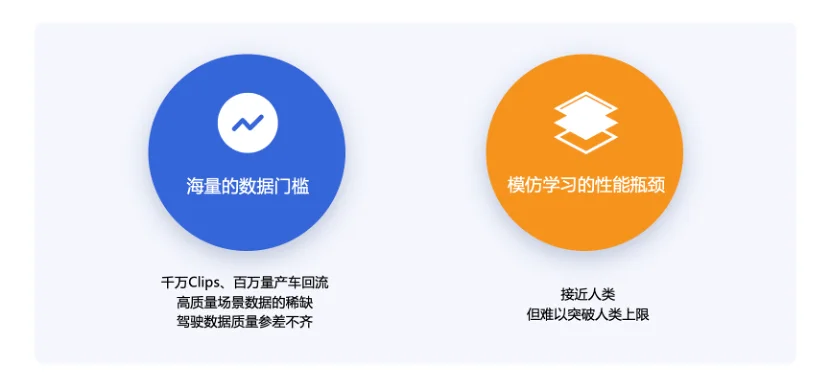
During this year's Spring Festival, DeepSeek-R1 sparked global attention with its innovation based on pure reinforcement learning. By starting with a small amount of high-quality data, the model undergoes multi-stage reinforcement learning training, thereby lowering the data scale threshold for large model training. More importantly, reinforcement learning enables large models to spontaneously develop long chain-of-thought capabilities, improving reasoning effects and potentially even achieving thinking abilities that surpass humans.
The large model technology route based on reinforcement learning can be transferred to the training and development of end-to-end autonomous driving algorithms. This is the technical approach behind Shangtangjueying R-UniAD.
According to SenseTime's calculations, the few-shot multi-stage learning technical route can reduce the data demand for end-to-end autonomous driving by one order of magnitude. How is this achieved?
Xiaogang Wang provided a practical example: In a difficult traffic scenario, only 10% of high-quality human driving data may pass. Collecting and training data for such scenarios is challenging. However, for reinforcement learning, it can repeatedly attempt simulations until it successfully navigates the scene. It can then generate different driving behaviors and paths to solve complex scenario problems.
"In this scenario, it could achieve a 10x to 100x improvement in data utilization efficiency," Xiaogang Wang said.
The key to future autonomous driving training lies not in finding high-quality human driving data, but in identifying complex scenarios to drive the next cycle of evolution and iteration.
However, multi-stage reinforcement learning does not mean that data is unnecessary; rather, the definition of high-quality data has fundamentally changed. Previously, full-length recordings of skilled drivers were required, but now only a single scene image or a short video clip is needed, as reinforcement learning can handle the rest.
Data remains critical, but the methods for acquiring it have become more efficient.
Xiaogang Wang did not provide an exact figure for how much data demand will decrease, stating that further practical validation is still needed.
02'Kaiwu' World Model: The Foundation of Simulation-Driven Autonomous Driving
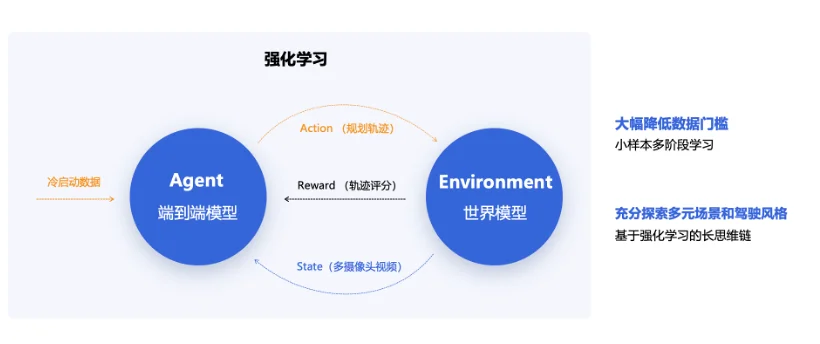
After cloud-based end-to-end autonomous driving large model training, R-UniAD enters its second phase, where reinforcement learning enables the cloud-based end-to-end large model to interact with the world model, continuously improving the performance of the end-to-end model. How are the technical challenges in this process addressed?
Xiaogang Wang believes that the world model provides more realistic simulation, diverse predictive generation, and evaluates driving behavior through reward functions.
He stated, 'We have accumulated considerable experience in simulating world models. The resulting models must accurately adhere to physical laws and traffic regulations. Furthermore, the generated videos must not only be visually appealing but also precise—areas where we have done substantial work.'
The second challenge lies in generating diverse predictions. When driving through a specific traffic scenario, there are often multiple valid ways to navigate it. Additionally, surrounding vehicles and pedestrians may behave differently at various moments. Therefore, the simulated trajectories and video sequences generated must exhibit greater diversity.
The third challenge involves using reward functions to evaluate driving behavior. During the interaction process, the system dynamically assesses whether the simulation results represent good or bad outcomes.
Through end-to-end autonomous driving large model training on the cloud and collaborative interaction with world models, the final cloud-based large model will be deployed to the vehicle via efficient distillation, resulting in a high-performance end-to-end autonomous driving small model.
High-quality data for this process is derived almost entirely from simulation. Currently, simulation data accounts for approximately 20% of Shangtangjueying’s dataset, with a future target of reaching 50–80%.
However, how can the reasoning capabilities of the model be preserved during the transition from cloud-based distillation to vehicle-side deployment?
Xiaogang Wang acknowledged that model capabilities would inevitably degrade, but emphasized that the edge-side model must ensure basic functionality given its limited computing power.
He identified two key factors: "One is to generate high-quality data from cloud-based models for data distillation, and the other is to design Mixture of Experts (MoE) model architectures based on the characteristics of edge-side chip architectures."
SenseTime has already run a series of such models on the edge side in smart cockpits.
03Changes in the Cost Structure of Autonomous Driving
According to SenseTime's mass-production rollout plan, Shangtangjueying showcased real-vehicle road test results of UniAD at the 2024 Beijing Auto Show, with its mass-produced end-to-end autonomous driving solution expected to be delivered and implemented by the end of this year. The newly released R-UniAD will feature a real-vehicle deployment scheme to be exhibited at the Shanghai Auto Show in April this year.
In terms of mass-production implementation timelines, SenseTime still lags behind industry leaders.
Xiaogang Wang stated: "The so-called end-to-end mass production actually relies on significant technical differences. For example, some two-stage end-to-end approaches vary in their integration ratios with rule-based systems."
SenseTime's introduction of a new technical route implies changes across its entire R&D system. Requirements for data simulation capabilities and cloud infrastructure will be significantly strengthened. For the autonomous driving industry, this presents an opportunity.
In fact, R-UniAD is quietly reshaping the cost structure of autonomous driving.
SenseTime's autonomous driving solution relies on vision-based perception, with no LiDAR components involved. Xiaogang Wang believes that this choice of perception hardware is driven by cost considerations and the fact that, as training data scales up, vision-based solutions have a higher potential ceiling and can compensate for the shortcomings of other sensors.
He said, "When visual capabilities are weak, LiDAR must be used as an auxiliary sensor."
Today, the price of vehicles equipped with intelligent driving systems has dropped below RMB 100,000, making universal intelligent driving an unstoppable industry trend. Xiaogang Wang believes this places further demands on reducing hardware costs and improving robustness.
04Final Thoughts
The R-UniAD technology roadmap released by SenseTime at the 2025GDC Quanqiukaifazhexianfengdahui marks another significant breakthrough in its autonomous driving field. By interacting synergistically with the "Kaiwu" world model, this end-to-end autonomous driving approach not only reduces data requirements by an order of magnitude but also, through enhancements in reinforcement learning and simulation capabilities, makes it possible for intelligent driving to surpass human driving levels.
From Xiaogang Wang's sharing, we see how R-UniAD is quietly changing the cost structure of the intelligent driving industry through few-shot learning and diverse simulation. The debut of R-UniAD may well be a sign that the intelligent driving industry is moving toward its "DeepSeek moment." We believe that after many automakers have called for the democratization of intelligent driving, Shangtangjueying will also be able to carve out its own place in urban intelligent driving.
Written by: James Edited by: Daji