Behind NIO's World Model Upgrade: Autonomous Driving Competition Shifts From Algorithms to Infrastructure
Today, many NIO and ONVO owners have likely received a major update: the full rollout of NWM 2.5.
On the surface, this appears to be a routine OTA for NIO’s world model. However, examining the scope of this deployment reveals a broader reach: it spans both the NIO and ONVO brands and maintains backward compatibility with all NT2 models, including the initial ET7 units delivered in 2022.
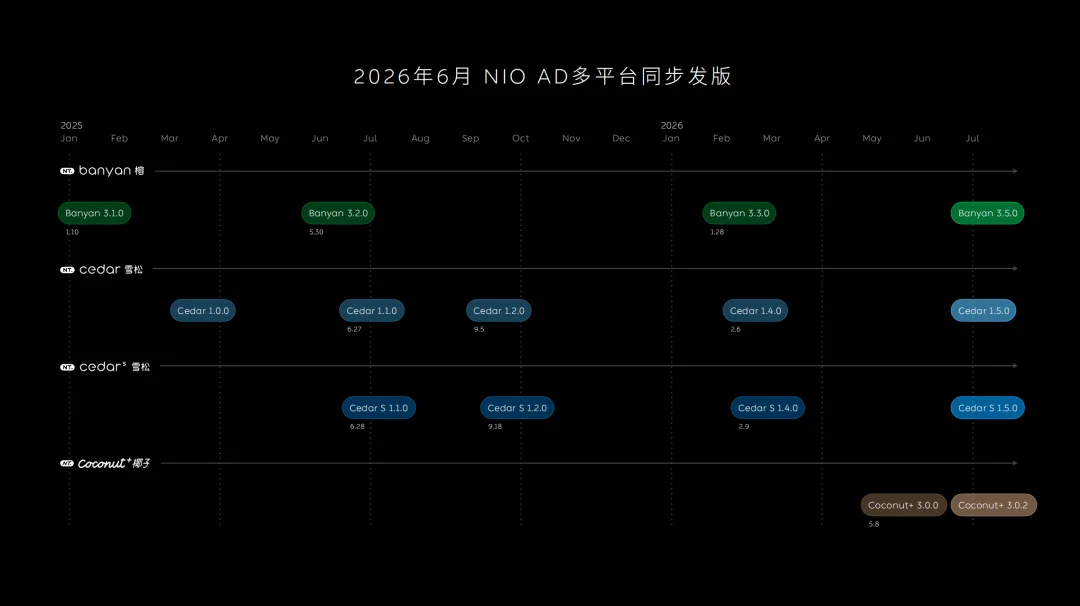
This means that hundreds of thousands of vehicles—spanning three to four years of production and featuring vastly different hardware foundations, from high-end platforms equipped with four Orin chips to entry-level platforms with a single Orin, and even the latest NT3 platform running on the self-developed Shenji chip—must connect to the same latest large-model algorithm at the same time while maintaining a consistent core experience.
How difficult is this? At a recent NIO intelligent driving briefing, Ren Shaoqing, Senior Vice President of Intelligent Driving R&D at NIO, made a rare public appearance. He spent nearly half the session explaining how his team tackled this formidable challenge.
What lies behind this development is a new phase in the competition for intelligent driving: as end-to-end systems and world models become industry consensus, algorithms themselves are no longer the sole, or even the most robust, barrier between companies.
The second half of the intelligent driving race is no longer about who can post a stunning zero-intervention demo video on social media; it is about which company can build a massive infrastructure encompassing engineering, data, computing power, and verification at the foundational level.
01The Shift in Autonomous Driving: Insights from OTA Updates
In recent years, the industry has focused on who expands city coverage first, who debuts end-to-end models, and who abandons high-definition maps. The competition centers on specific features: whether lane changes are decisive, intersection throughput is high, and parking functionality is user-friendly.
However, with the rollout of NWM 2.5, NIO aims to demonstrate not that it possesses a superior new algorithm, but that it has built an infrastructure capable of deploying new algorithms across brands, vehicle models, and platforms.
The iteration of autonomous driving technology follows a discernible pattern: from early rule-based systems to BEV perception, and now to world models and unified multimodal networks. Each technological upgrade represents a surge in model complexity.
As models grow larger, they can no longer be developed in isolation by algorithm teams. They have become extremely rigorous and capital-intensive engineering projects.
They require consistent sensor inputs, highly efficient inference deployment toolchains, automated data filtering systems, and vast verification frameworks to cover long-tail risks. This explains why the logic of autonomous driving competition is shifting entirely from comparing individual algorithmic models to competing on underlying AI infrastructure systems.
02Infrastructure Takes Precedence Over Algorithms
Why is infrastructure becoming more critical than algorithms? Because the era of 'burning data' has arrived.
At a communication meeting, NIO stated that linear growth in model performance requires an exponential surge in data volume. To improve performance by 3 percentage points, 10 times the data may be needed; for a 6-point improvement, 100 times the data is required.
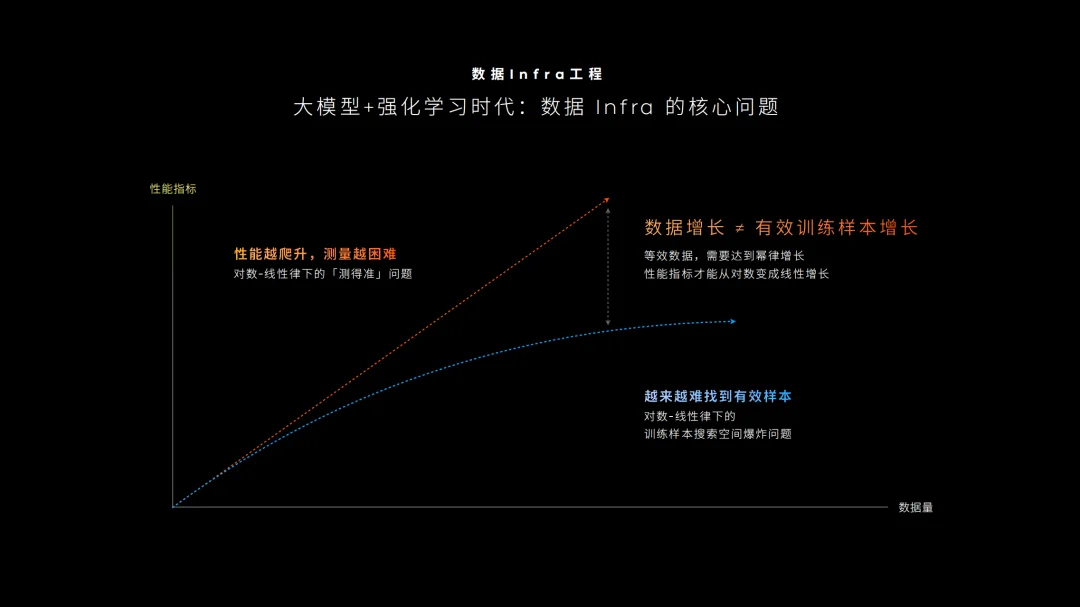
In this phase, relying solely on a smart algorithmic 'brain' without a vascular system to deliver nutrients will cause the model to quickly hit a ceiling.
Implementing an advanced world model carries extremely high barriers. It requires:
Hardware consistency: Sensor layouts cannot vary wildly, or the model cannot be generalized;
Compute and bandwidth: Chips must offer not only high compute power but also sufficient memory bandwidth to handle the throughput demands of large models;
Software engineering capability: An efficient deployment framework is essential; otherwise, updated algorithms cannot run on vehicles;
Data and validation: A systematic fleet of mass-produced vehicles is needed to encounter rare corner cases on the road.
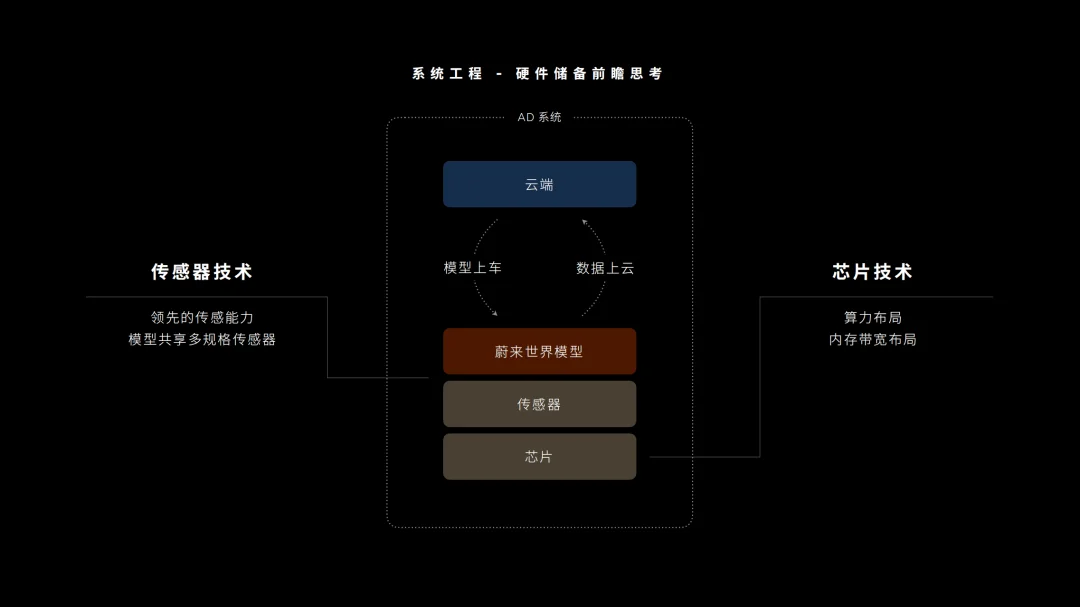
The second half of autonomous driving has shifted the focus of competition. It is no longer about which automaker announces a new concept first, but rather which company’s chips, toolchains, and software architecture can truly support the continuous iteration of large models.
03The First Layer of Infrastructure: Early Hardware Redundancy
NIO’s first layer of infrastructure lies in the hardware redundancy it installed years ago.
In early 2021, NIO launched the ET7, insisting on using roof-mounted LiDAR and seven 8-megapixel cameras. At the time, this approach was criticized by many as being too costly and wasting computing power.
However, several years later, this unified and high-specification sensor layout has become the foundation for ongoing upgrades to older vehicles. Looking back today, the true value of what was once mocked as "hardware redundancy" is finally beginning to show.
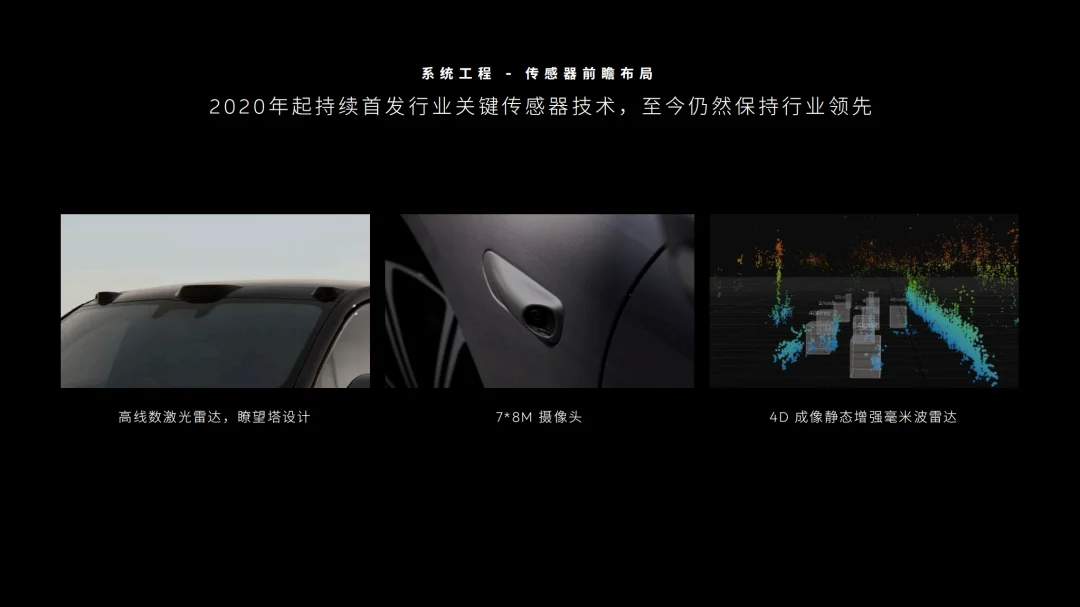
During a communication meeting, NIO presented an extremely critical business logic—the deployment of autonomous driving hardware must be capable of supporting more than two generations of software iterations.
This reveals a fundamental industry rule: hardware redundancy in smart vehicles is not inherently correct. Redundancy becomes an asset only when subsequent software, algorithms, and data systems can continuously leverage that hardware; otherwise, it is merely a cost.
NIO’s ability to deploy the latest world model to older owners today is the realization of its earlier investment in sensor uniformity.
Of course, physical hardware limitations remain. For instance, with this NWM 2.5 update, ONVO vehicles equipped with a single Orin chip will receive the push slightly later, and their subsequent update frequency will be relatively lower. This indicates that while model compression and pruning can achieve consistent core experiences, there is an objective gap between single-chip and four-chip configurations in terms of deployment efficiency and peak capabilities. Hardware capacity remains the critical foundation determining how quickly models reach production vehicles.
04Layer Two Infrastructure: AI Infra and Toolchains
Deploying cloud-based large models onto vehicle-side chips is an extremely challenging engineering task. This constitutes NIO’s second layer of infrastructure and the most technically rigorous part of the presentation.
As early as 2020, NIO decided to abandon NVIDIA’s official full-stack toolchain (retaining only the underlying CUDA layer) and began developing its own inference engine, deployment framework, and AI compiler.
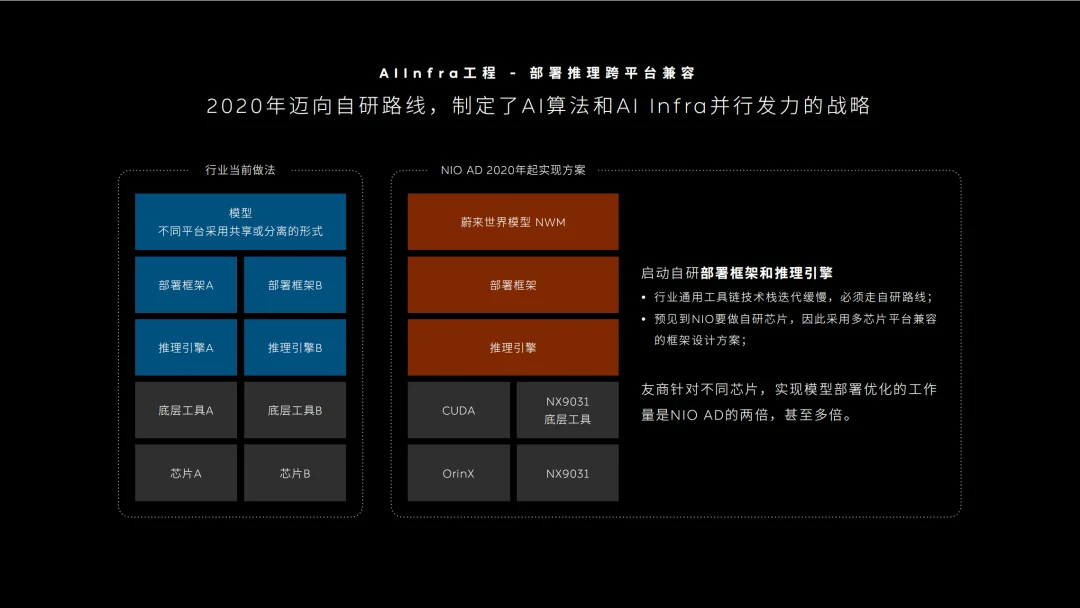
The reason is straightforward: whether self-developed chips deliver value depends not just on the silicon itself, but crucially on the availability of supporting software toolchains. Without a powerful compiler, a self-developed chip is nothing more than an expensive piece of silicon.
Traditional model deployment is like an old master hand-polishing parts: slow and heavily reliant on individual experience. When algorithm iterations accelerate, this approach simply cannot keep up. NIO’s self-developed AI compiler achieves automatic operator optimization and automatic graph optimization. When algorithm engineers modify the model architecture, the compiler runs automatically, generating most of the underlying adaptations without manual intervention, while boosting inference efficiency by more than 20% compared to general-purpose toolchains. Combined with an automated workflow driven by AI Agents, NIO has compressed the time required to deploy models into vehicles from several days down to under two hours. This explains how NIO can simultaneously handle multi-platform adaptation.
When discussing the self-developed Shenji NX9031 chip, a particularly interesting detail emerges. As early as late 2020 to early 2021, the NIO team repeatedly simulated a question internally: Will next-generation neural networks evolve into pure Transformer architectures?
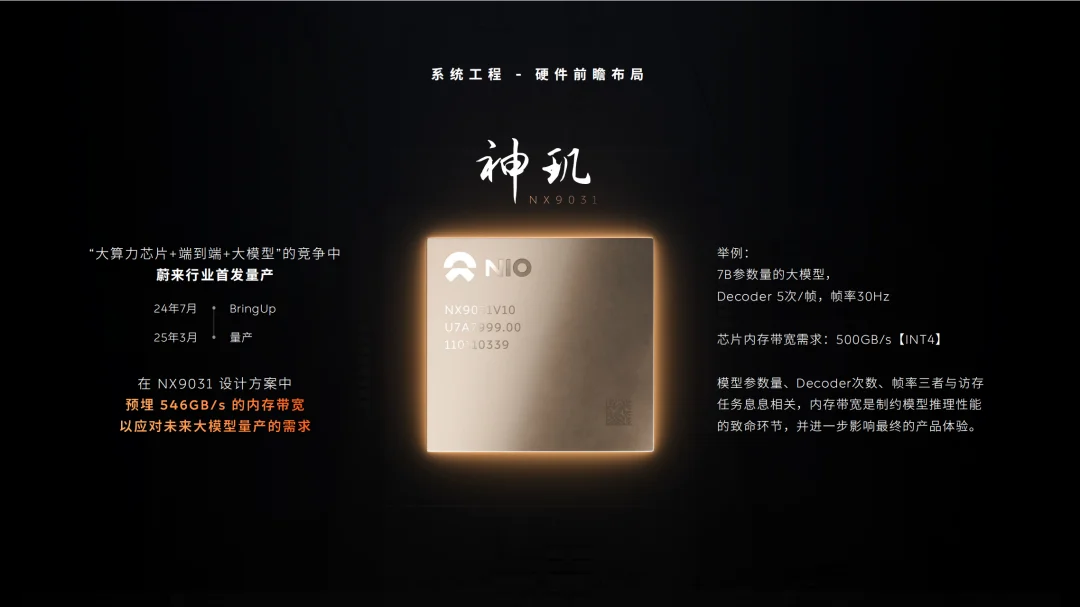
At that time, the mainstream approach still relied on CNNs (Convolutional Neural Networks), with many believing that Transformers were not yet versatile enough. However, NIO ultimately decided that given their chips would be in use for years, the future would inevitably trend toward pure Transformer architectures.
This prediction directly determined the core design metrics of the Shenji chip. Rather than blindly stacking TOPS compute power, the chip achieved a memory bandwidth of over 500 GB/s per chip.
This also illustrates how the competitive standards for autonomous driving chips are constantly evolving. With Transformers and world models entering vehicles, memory bandwidth, toolchain efficiency, and the ability to deploy models across platforms are far more critical than raw compute figures alone.
05The Third Layer: Data Closed-Loop and Verification Systems
This layer can be described as the core of the entire infrastructure system.
The traditional understanding of a "data closed loop" involved dispatching test fleets to collect data on the streets and then uploading it to the cloud for training. However, this approach is already outdated in the face of true AI large models.
NIO views data not as zero-cost copies; rather, its essence is computing power. To identify data that exposes the flaws of a new model, you must run that model through massive volumes of real-world scenarios.
Where do you get these scenarios? Relying on hundreds of test cars to drive blindly on the streets? A tester might drive all day without encountering a single bizarre scenario worth recording. If you spend money to purchase large-scale data, the exponentially growing costs could bankrupt any automaker.
NIO's solution is to weave hundreds of thousands of already-sold production vehicles into a vast "computing power scheduling pool."
In simple terms, NIO silently deploys new models under verification to real users' cars. You drive your car while the existing driver assistance system operates as usual, but in the background, a shadow model runs silently alongside. If it detects a discrepancy between its own judgment and the actions of an experienced human driver, it flags this rare, high-value case and uploads it to the cloud.
This constitutes a non-disruptive, large-scale live simulation. Both older NT2 models and newer NT3 models contribute computing power to this pool in the background.
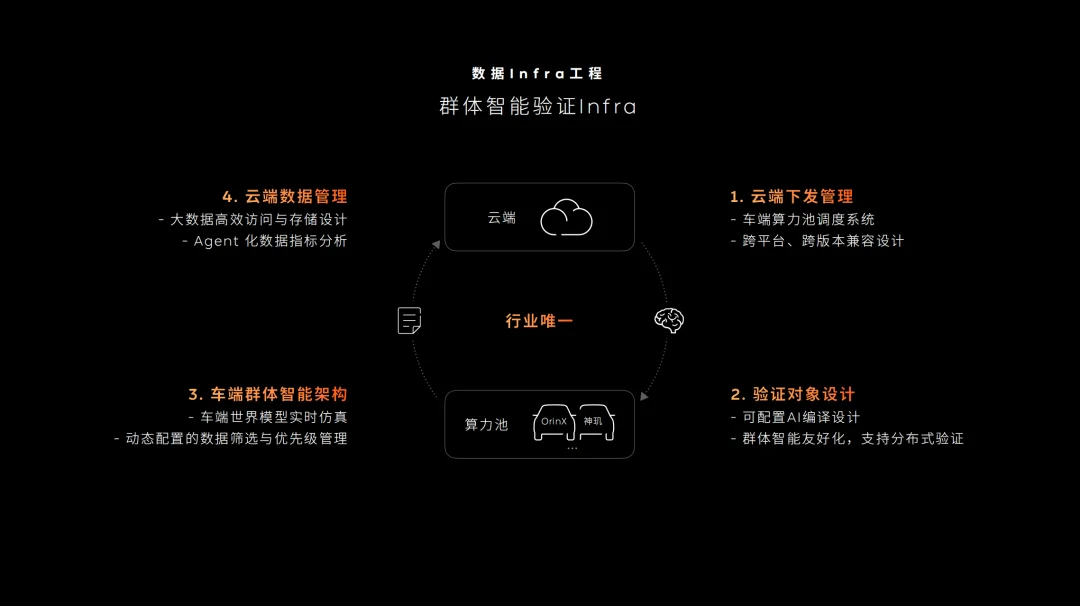
As driver assistance capabilities advance, testing and validation become as critical as training. A truly effective driver assistance system is not defined by how impressively a model performs on a fixed test route, but by its ability to avoid errors in complex urban environments, adverse weather conditions, and various long-tail scenarios.
The same applies to the validation phase. Testing a new version today no longer relies on driving a few hundred kilometers to draw qualitative conclusions. NIO’s baseline is now to run over 40 million kilometers of companion test mileage per week in the background, using more than 1,000 granular metrics within its swarm intelligence verification system.
It is precisely because of this data and verification infrastructure that NIO feels confident publishing those hard-core safety figures: the mileage covered by active safety defenses under human-driven conditions has reached nearly 7 million kilometers, with targets set for 8 million and 10 million kilometers this year.
06The Real Rules of the Second Half
The autonomous driving industry never lacks new terminology. Technologies such as end-to-end models, world models, and closed-loop reinforcement learning continue to emerge, and Tesla’s FSD will eventually enter China, a complex testing ground.
The rules of the second half are already clear: new algorithms will be caught up by competitors increasingly quickly. What truly widens the gap is the infrastructure capability behind the algorithms.
This infrastructure includes unified hardware planning, the integration of high-bandwidth chips with AI compilers, the ability to dispatch mass-production fleets into verification networks, and cross-brand, cross-platform OTA engineering implementation capabilities.
The competition in intelligent driving is shifting from 'whose algorithm is more advanced' to 'who can faster, safer, and more stably turn advanced algorithms into the confidence that hundreds of thousands of users rely on every day.' This is the true trump card revealed at NIO’s recent autonomous driving briefing.
07Appendix: Q&A Transcript
We have also compiled a selection of key Q&A points from the briefing.
Q: Competitors are also developing high-compute self-research chips. Why was NIO able to deploy them across multiple platforms first?
A: We have done a great deal of work over the past few years, especially during the process of bringing our self-developed chip into mass production last year, in 2025. We started in 2024, and by 2025 the tape-out had come back—after the tape-out came back in 2024, we moved to mass production in March 2025. We did a great deal of work throughout that process.
At the AI infrastructure level, we began laying the groundwork as early as 2020. This included substantial development of our inference engine, deployment framework, and AI compiler. Leveraging the accumulation from our initial efforts starting in 2020, once our self-developed chip was ready, engineering efficiency had already reached a certain maturity. Following the tape-out return, we quickly achieved cross-chip compatibility.
Q: Regarding physical-world AI algorithm routes such as VIO and world models, is there now a clear direction?
A: The path is gradually converging. Looking back at the evolution of autonomous driving, progress in physical-world AI algorithms from 2016 to 2022 was relatively slow, primarily relying on BEV combined with OCC. The entire industry was in a pipeline engineering phase characterized by competition in manpower and test vehicles.
However, starting in 2022, the industry experienced a surge. Technical routes shifted from highly deterministic to uncertain but full of opportunities. In the second half of 2023, NIO decisively restructured its organization, breaking away from the previous pipeline model and shifting resources toward pre-research and innovation. We firmly chose the 'world model' route, driven by two core intentions: first, to train using unsupervised/self-supervised methods to reduce dependence on massive manual annotation; and second, to build a unified multimodal hybrid network. Fortunately, we aligned well with this technological cycle.
Q: What are the plans for NIO's next-generation self-developed chip?
A: What you see today is NIO’s first-generation self-developed chip, the Shenji NX9031. Undoubtedly, we will continue to develop a second-generation chip. We are currently in the internal stage of discussing and finalizing the design, so specific parameters and details cannot be disclosed publicly at this time.
Q: For NIO NT3 platform models like the ET9, which have added side-facing LiDAR, what specific improvements does this bring to the actual driving experience?
A: NIO uses the best side-facing LiDAR available in the industry, with a detection range of 70–80 meters. When combined with front-facing LiDAR, it enables high-precision observation across a 350-degree field of view.
In everyday driving, users may not notice its presence. However, it acts like an 'airbag,' designed specifically to handle extremely rare corner cases. For example, on a highway at night during rain, if a dark-colored vehicle or small object without lights approaches rapidly from the rear side, pure vision systems can easily fail. In such situations, the side-facing LiDAR plays a life-saving role, significantly enhancing safety during high-speed lane changes and urban driving.
Q: Under the World Model framework, is there a significant performance difference between versions equipped with LiDAR and those relying solely on vision?
A: In terms of daily user perception and experience, the difference caused by having one more or one less sensor is very small. If drivers could clearly feel a difference during routine driving, it would indicate that the perception fusion of this generation of platforms is poorly executed. The real distinction lies primarily in the fallback capability for extreme weather conditions and rare scenarios.
Q: ONVO’s first generation relies on pure vision plus a single NVIDIA Orin chip. Can it receive updates for the World Model version simultaneously? Why is its progress slightly behind?
A: ONVO will push the new version soon. In recent internal blind tests, the new version showed a qualitative leap compared to the current version.
The reason for the relatively late progress has nothing to do with pure vision sensors; it is entirely due to a computing power gap. Multi-compute platforms primarily address cross-chip engineering compatibility issues. However, on a single Orin platform, we need to invest significant R&D resources in model compression to fit the massive world model onto chips with limited compute, while also thoroughly eliminating potential safety hazards introduced by model compression.
Q: To fit the model onto smaller compute chips, did NIO choose to retrain a small model using filtered data, or use 'distillation' from a large model?
A: Both technical approaches are highly mature within NIO. The specific choice depends on which yields better actual results.
However, in the current iteration of autonomous driving models, 'distillation' is more likely to be used. When we develop new architectures, such as more end-to-end modeling and advanced lateral and longitudinal vehicle control methods, we want to bring these new features to the single Orin platform. Compared to training from scratch, distilling a small model from an existing large model allows for the most cost-effective migration of architectural features.
Q: Where does NIO's current NWM 2.5 autonomous driving capability stand in the industry? Has it been compared to Tesla FSD?
A: We have experienced Tesla FSD internally. Objectively speaking, Tesla leads the world in data volume and training compute resources, with computational demands exceeding those of domestic companies by at least one order of magnitude.
However, at the algorithmic architecture level, NIO's 'world model + closed-loop reinforcement learning' system launched in the first half of this year is absolutely not inferior to Tesla's, and even holds a leading position domestically. NIO's current challenge is: how to achieve similar or even better results through superior architecture despite having less compute than Tesla.
Q: Why do people suddenly feel that NIO's autonomous driving capabilities have made a qualitative leap at this juncture? What does NIO consider the next milestone for autonomous driving?
A: The capability leap is the result of three layers of factors superimposed: underlying hardware pre-installation, years of solid foundation building in the data system, and capitalizing on the algorithmic dividends of "world models + closed-loop reinforcement learning" in 2023. The combination of these three elements allows us to achieve better results with lower computing power costs.
The next milestone: We are not bound by the labels of L3 or L4; our core expectation is to significantly extend users' 'zero-intervention time.' The ultimate goal is to reduce the current safety accident rate by another order of magnitude, making autonomous driving ten to one hundred times safer than human driving.
Q: Tesla FSD is expected to enter China soon. What impact does NIO believe this will have on the domestic autonomous driving industry?
A: It is a huge benefit for China's autonomous driving industry. First, at the technical level, it provides a fair competitive stage. Although Tesla has massive computing power, we are confident in being able to 'go head-to-head' with them in terms of architecture and user experience. This can prove to the market that the autonomous driving capabilities of Chinese local enterprises are world-class.
Second, at the commercial level, Tesla insists on a software subscription model. The entry of FSD into China will greatly educate the domestic market and improve the business environment for autonomous driving in China. Only a healthy business model can support automakers in providing continuous autonomous driving updates for users three to five years after purchase, which is best for users' long-term interests.
Q: Since competitors have already launched city NOA fallback strategies approaching L3, what is NIO's timeline for the implementation of L3 and L4?
A: At the policy and regulatory level, NIO is among the first batch of automakers on the Ministry of Industry and Information Technology's L3/L4 access list and has been cooperating with the government on core verification work.
At the technical level, based on the data-driven world model architecture, our safety is improving rapidly. As long as we solve the issues of system-level latency and redundancy design through deep cross-domain integration, we will be technically ready. Once national regulations are lifted, NIO's L3/L4 features will definitely be among the first to go online in the industry.
By Qiran | Edited by Daji