


XPENG 1024 Tech Day: XNGP Expansion and the Battle for Autonomous Driving Leadership
In early 2023, the new energy vehicle market was sluggish. XPENG's sales fell below 10,000 units for several consecutive months. The flagship G9 model recorded fewer than four-digit monthly sales in some months. Online chatter about "XPENG being doomed" spread across social media platforms.
During that period, the G9 was the most frequently used vehicle within our company. Its 800-volt high-voltage architecture, advanced driver assistance features, and convenient wake-word-free voice system represented the industry's cutting-edge technological direction. These were also the focal points of our content production. Although XNGP, a key highlight of the G9, significantly outperformed most competitors at the time, it had not yet garnered the widespread attention it enjoys today.
At roughly the same time, GPT went viral. Andrej Kapathy, Tesla's AI director, announced his departure to return to Open AI. Large models briefly became the new darling of the tech world, attracting a number of top talents from the AI field. But before this, their mainstream choice had been to work on autonomous driving.
This shift made urban intelligent driving solutions like FSD Beta—which had failed to achieve large-scale, wide-area deployment for years—appear outdated and uncertain.
At that time, rumors circulated in China's intelligent driving community that Wu Xinzhou, XPENG's head of intelligent driving, was planning to leave. Consequently, both XPENG and its intelligent driving division gave off an air of impending danger.
I discussed this situation with a friend in the intelligent driving industry. He said:
"I believe XPENG must not collapse. It needs to keep running ahead to pressure others. Without XPENG as a benchmark, there would be no motivation for comparison. If an industry leader like XPENG falls, few companies will remain dedicated to intelligent driving. People will conclude that developing such technology is pointless."
"As technology developers, we are not afraid of benchmarking or fighting; what we fear is discovering that the battlefield has disappeared, ending up in the same predicament as those L4 autonomous driving companies."
Half a year has passed. XPENG has pulled itself out of the mire with the G6 and G9. The battlefield for intelligent driving has not vanished; instead, the conflict has escalated to unprecedented intensity, making this year's XPENG 1024 event a focal point amidst the turmoil.
01This Year's 1024 Is Bound to Be Turbulent
The Battle for the 'Strongest Intelligent Driving' Label
The one who truly ignited this intelligent driving fire was Huawei, which broke through chip and 5G baseband blockades this year and released the Mate Xilieshouji early as a 'grand gift' on the occasion of the U.S. Secretary of Commerce's visit to China.
Huawei's triumphant return garnered phenomenon-level attention and widespread public recognition, far beyond what most peers could achieve. Consequently, its offline stores have been swarming with customers.
As a direct beneficiary of this surge in popularity, the AITO M7, equipped with Huawei's ADS 2.0 intelligent driving system, went viral both as a vehicle and for its tech. In less than a month since its launch, it secured 60,000 confirmed orders. While sales figures frequently dominated various platforms, another statistic regarding the M7 was equally startling: orders for the high-end intelligent driving package accounted for 70% of the five-seat model's total sales.
In an era where intelligent driving is still in the 'early adopter' phase, achieving such a high option rate for advanced driver assistance systems was previously only seen with XPENG.
This outcome is indeed attributable to the formidable autonomous driving capabilities of Huawei ADS, but it also owes much to effective communication strategies. In this year's race to roll out urban autonomous driving in new cities, it seems that every company announcing its plans later aims to be more aggressive than those who announced earlier, striving to outshine competitors in public messaging. When it came to Huawei, Richard Yu directly announced at the AITO M7 launch event that urban autonomous driving for AITO models equipped with advanced driver assistance systems would be available nationwide by the end of the year.
Prior to this, various video clips of Huawei ADS high-level autonomous driving vehicles had already gained some traction online; even a friend of mine who never follows the automotive industry recently asked me, 'Are those videos of Huawei autonomous driving on the internet real?'
All signs point to Huawei rapidly seizing the intelligent driving label in the minds of consumers.
XPENG, which has positioned intelligent driving as its core brand identity, would naturally not remain indifferent to this.
XPENG's Response
"We don't really like to use short videos from the public to say where our features are, where our performance is, and then claim we're 'far ahead.' XPENG prefers to focus on reality, firmly advance technology, and ensure solid implementation!"
The above passage is a speech delivered by He XPENG himself during the opening segment of 1024. Before saying this, He XPENG also stated that XPENG Auto has achieved mass production of XNGP full-scenario assisted driving and is currently the only manufacturer to have officially launched urban intelligent driving in five cities: Beijing, Shanghai, Guangzhou, Shenzhen, and Foshan.
To briefly translate what He from XPENG said: "For urban autonomous driving, don't look at the marketing; look at the actual results."
Of course, with 1024 serving as XPENG's Technology Day, the main focus after the warm-up was the showcase of intelligent driving achievements. This segment, previously handled by Wu Xinzhou, was taken over this year at 1024 by Li Liyun, Senior Director of Autonomous Driving at XPENG.
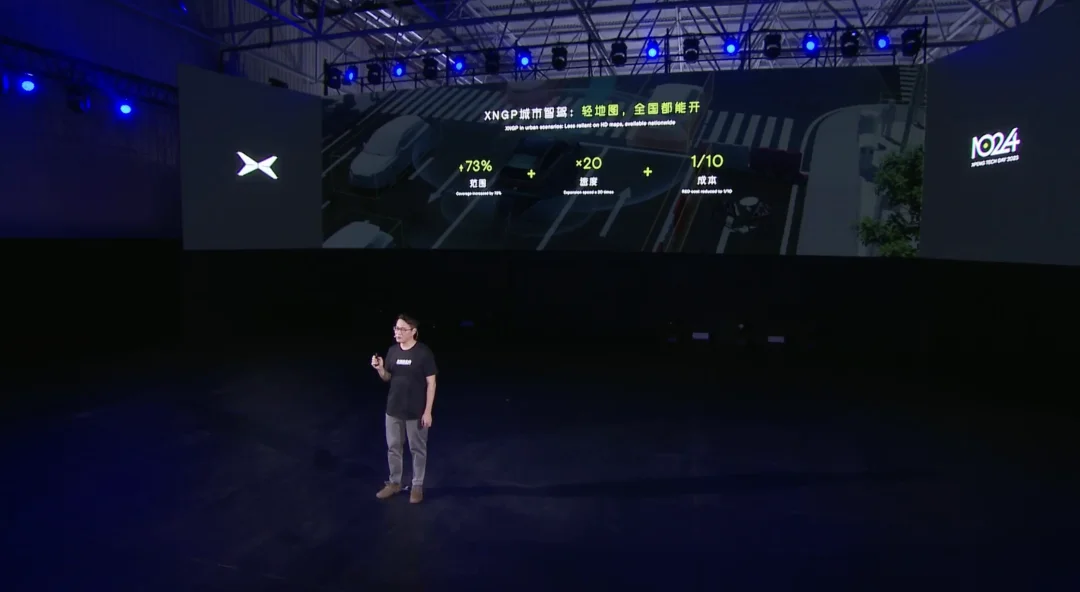
The technical presentation on XPENG XNGP during the launch event was dense and detailed. The key messages revolved around three points: broader coverage, faster city expansion, and lower costs.
XNGP now covers 73% of China’s road network. Dependence on high-definition maps has decreased significantly; the speed of adding new cities is 20 times faster than in the HD map era, and costs have dropped to one-tenth of what they were.
During this process, XPENG uses shadow mode to accelerate city rollouts, collecting features, training scenarios, and deploying functions via the cloud.
XPENG’s AI Chauffeur mode will be available nationwide, regardless of the city. It requires only a single learning session to activate, and the learned routes continue to iterate on the cloud. Li Liyun summarized this as 'drivable nationwide, effective throughout.'
With accelerated city expansion on one side and nationwide availability of AI Chauffeur on the other—where route learning is activated in one go—XPENG’s dual-track strategy is clear: not only do they aim to launch urban smart driving in major cities ahead of competitors, but they also want smaller counties to adopt route-level navigation-assisted driving before rivals. Want to cover the whole country? Coincidentally, so do I.
02XNGP is Technically Strong, But Not Just Technically Strong
"When we first entered the urban autonomous driving scenario, our total code volume multiplied by 4 times, especially the prediction and planning code, which multiplied by 66 times." Li Liyun walked us through the difficulties XPENG faced in the early stages of urban autonomous driving during the technical session, then shifted tone: "But as the saying goes, books get thinner the more you read them. As we gained experience and accumulated technology in urban autonomous driving, our technological progress will lead to a gradual simplification of the architecture."
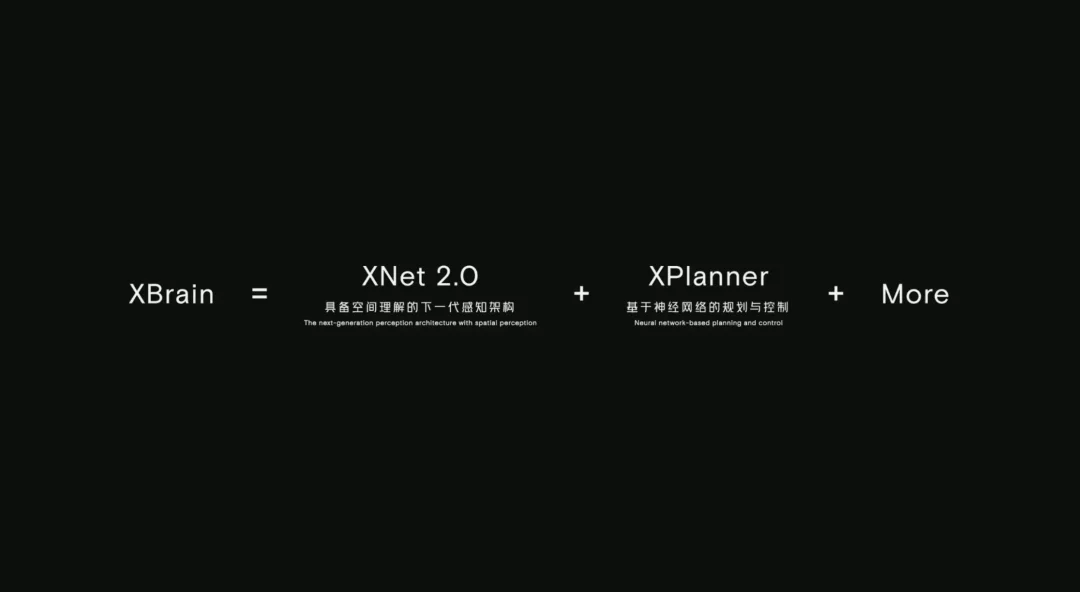
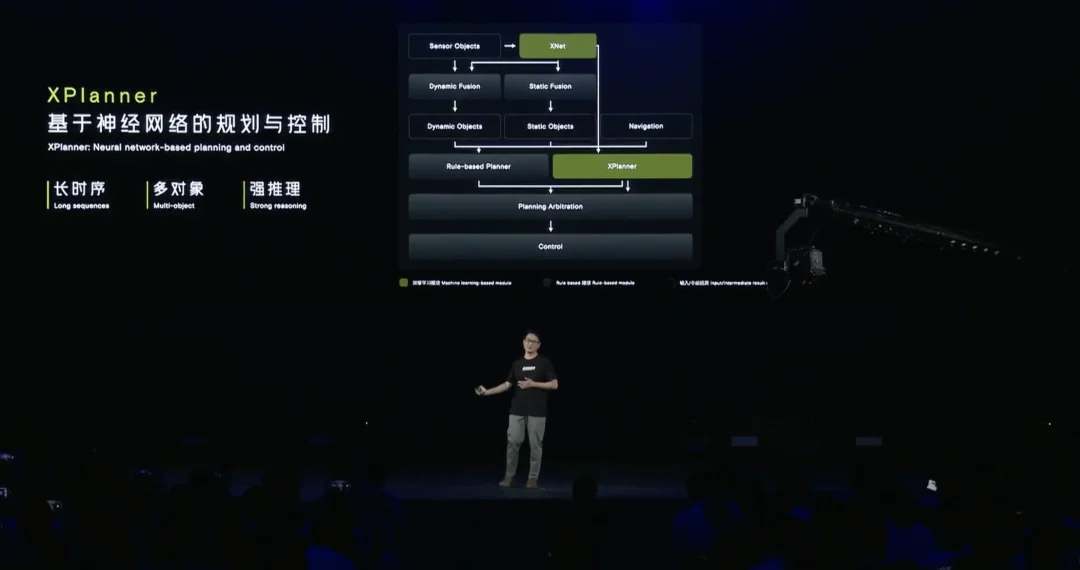
Next, XPENG presented the ultimate architecture for full-scenario intelligent driving, XBrain. The core components of this architecture are the XNet 2.0 perception framework, which features spatial understanding, and the XPlanner, which handles planning and control based on neural networks.
Opening with Eyes: XNet 2.0
Regarding XNet 2.0, XPENG officially mentioned a concept called "three-network integration." Under the new architecture, it combines a dynamic BEV network with a static BEV network. This improvement significantly enhances the system's ability to infer missing information, allowing it to better handle scenarios where objective perception data is missing or unstable due to object occlusion, unclear features, or poor lighting conditions. This is of great significance for reducing reliance on high-definition maps in perception-assisted driving.
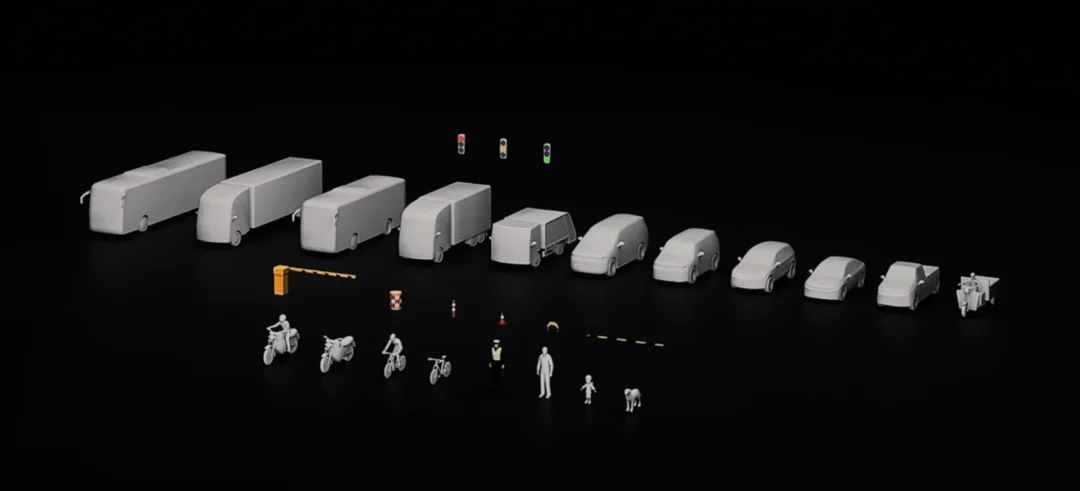
The types of recognizable features in XNet have also been expanded to 11, including animals, children, two-wheeled vehicles with or without riders, parking lot barriers, and more.
The third network is the Visual Occupancy Network, which refers to the system's ability to perceive 3D entities in the environment using pure vision. This capability forms the foundation for the system's path planning and obstacle avoidance functions. XPENG stated that the accuracy of Xnet 2.0's pure visual occupancy network has already reached twice the highest precision currently achieved in the industry.
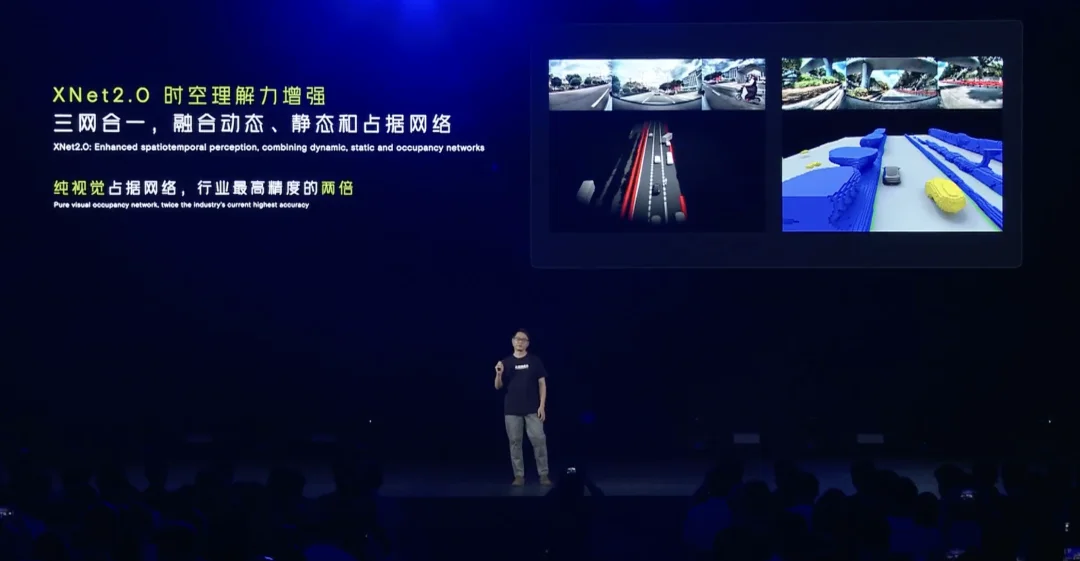
Another key evolution is the enhanced understanding capability of XNet 2.0, which now incorporates text recognition. This gives it the potential to interpret road signs across various cities, meaning scenarios like variable lanes will no longer hinder enabling service in new cities.
Comprehensive Planning and Control: XPlanner
As the planning and control brain, XPlanner is another critical component of the system. After accumulating experience with rule-based urban intelligent driving across different cities, XPENG’s planning and control logic is gradually shifting toward model- and data-driven approaches.
XPlanner not only possesses minute-level long-horizon planning capabilities but also makes compound considerations based on its own state and the traffic environment, resulting in better game-theoretic performance.
Based on our practical testing, this capability translates to better timing selection in specific scenarios, as well as enhanced ability to handle cut-ins and prevent being cut in.
A Preview of Next Year
Although the presentation slide stated "covering most cities nationwide," Li Liyun’s exact words when introducing XPENG’s 2024 intelligent driving plan were: "In 2024, we will use map-light XNGP to cover all of China, making it drivable nationwide. Furthermore, we will go global, usable anywhere."
Under the expansion of full-scenario capabilities, XNGP will further integrate highway and urban driving, enabling autonomous passage through toll stations without manual intervention. It can even start from within a residential community and automatically merge onto external roads.
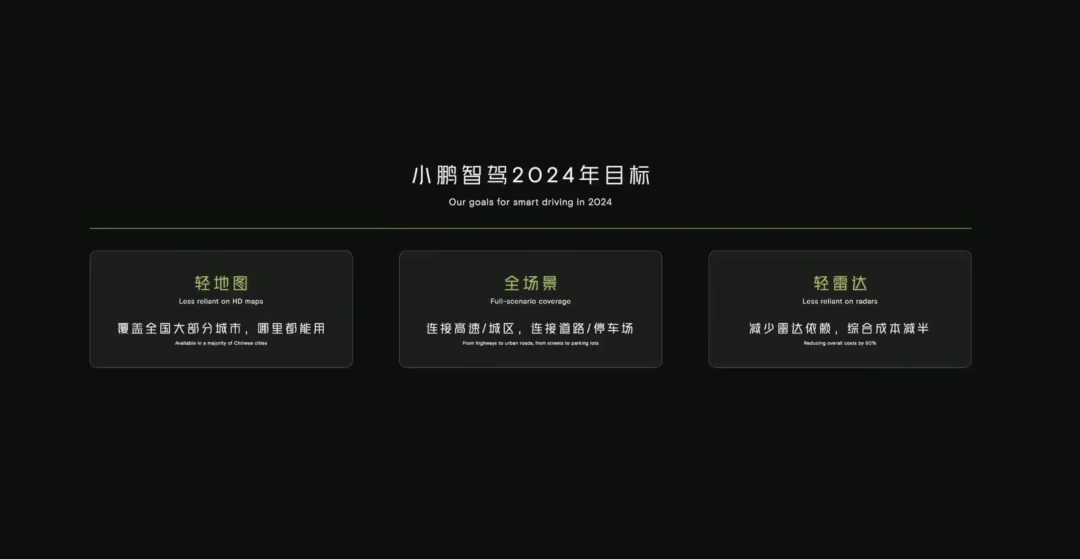
Following map-light is radar-light, with the underlying rationale being cost reduction. For example, on the new X9 model, XPENG removed two corner millimeter-wave radars. Whether subsequent models will retain LiDAR remains unclear, but under the trend of cost reduction, the decision to remove LiDAR depends on both perception improvements and the speed at which LiDAR costs themselves decrease.
The Powerful Backend Behind XNGP
The iteration of high-level intelligent driving is ultimately driven by data-closed-loop iterations; the capability of the data-closed-loop system is ultimately reflected in its ability and speed to process data. Li Liyun stated that last year XPENG could handle around 1,000 Corner Cases. Through improvements across various links this year, the efficiency of the full closed-loop increased by 150%, allowing them to resolve over 2,500 Corner Cases.
For strategy issues and map problems that can be handled in the cloud, XPENG can resolve them in as little as 24 hours. The practical feedback from this improvement is a 38% reduction in passive interventions in XPENG’s urban intelligent driving this year.
Simulation capability is another manifestation of XPENG’s backend strength. Li Liyun emphasized here that XPENG’s data simulation does not test just a few modules, but evaluates the full-link capability of the system by running all modules together.
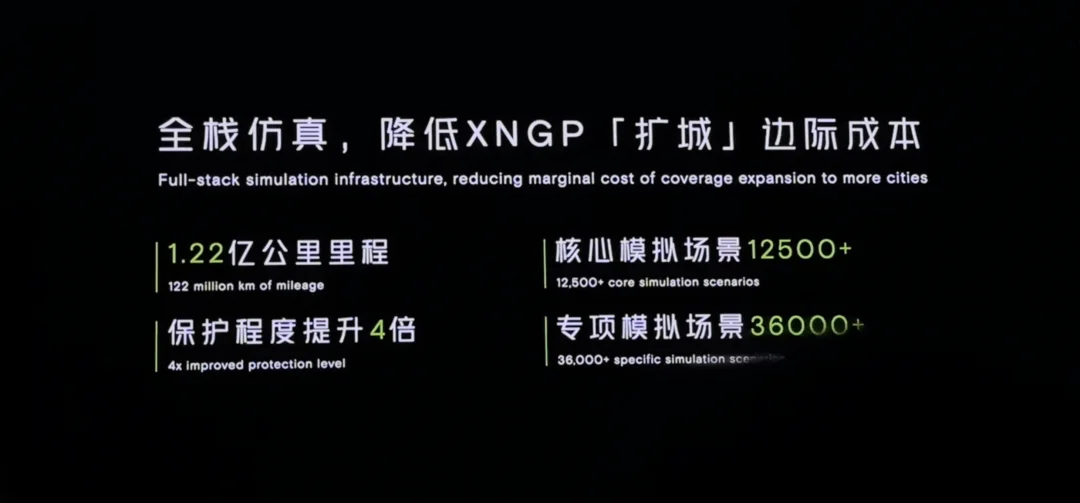
In 2022, XPENG conducted 50 million kilometers of simulation; by the 1024 event in 2023, it had completed 122 million kilometers.
Simulations covering more than 12,500 core scenarios ensure that system capabilities do not regress after updates, while simulations of over 36,000 specialized scenarios continuously enhance performance in complex situations.
The final evolutionary effect is very obvious: today, more than 80% of issues at XPENG are resolved during the simulation phase. Real-vehicle testing currently focuses on refining the experience and collecting scenarios that have not yet appeared in the scenario library.

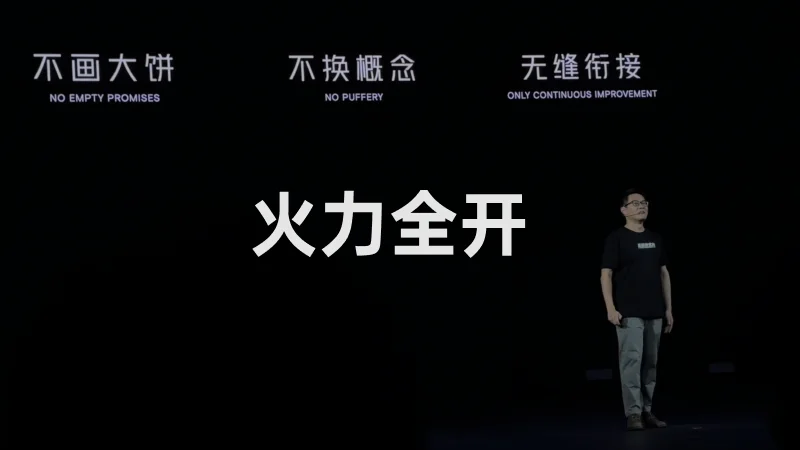
"We are not good at drawing pies with PPTs; we are truly focused on technology," concluded Li Liyun, marking the most compelling segment of the 1024 event.
During this ten-plus-minute presentation, XPENG's intelligent driving team conveyed several key messages through a restrained narrative:
Regardless of competitors' claims, XPENG currently holds the number one position in mass-produced urban intelligent driving capabilities.
XNGP is now equipped with the tools necessary for its next phase of nationwide and global rollout: XNet 2.0 and XPlanner.
XPENG is confident in accelerating the adoption of urban autonomous driving, a confidence built on extensive preparation across backend data systems, algorithmic architecture, and cost control.
Moving forward, XPENG will back its claims in the intelligent driving arena with tangible results, intensifying efforts across all key areas.
03Reflections on This Year’s 1024
Can Intelligent Driving Actually Drive Sales?
In recent years, the automotive industry has been plagued by a peculiar logic of disdain: when a product’s overall performance is lacking, its standout features often become targets for criticism.
For instance, a vehicle with excellent design and performance may suffer from low sales due to high pricing or lagging intelligence and configuration, leading critics to dismiss it as having "unmarketable performance" or "designs that fail to align with mainstream tastes."
Similarly, past failures of several XPENG models have led some to mistakenly conclude that "intelligent driving does little to boost sales."
I would go so far as to say that without intelligent driving, XPENG would be selling even worse and being forgotten by the world. The high option rates for the Max versions of the G6 and G9 this year also show that consumers are willing to pay for XPENG's intelligent driving.
The "wooden bucket theory" has been overused. In a systematic engineering project, the shortest plank is what limits overall capability.
The issue with XPENG has never been about autonomous driving, but rather lies elsewhere. For a considerable period in the past, XPENG's core strength—autonomous driving—failed to deliver its full potential due to two main reasons.
First, past autonomous driving systems had not yet reached today's levels in terms of coverage, usability, and purchase price, making their value proposition a lower priority for consumers.
But you can imagine that the first issue applies to contemporaneous competitors as well; XPENG's intelligent driving remains an advantage in comparison, albeit with slightly less significance. Therefore, the second reason is more critical—the ball simply cannot reach Yao Ming.
Cars are complex, high-value consumer goods. For most consumers, the purchase decision for a vehicle involves numerous stages, including early-stage marketing and brand building, as well as product attributes such as drivability, design, interior space, smart features, word-of-mouth reputation, pricing, and post-purchase delivery and after-sales service. No single factor alone can guarantee success.
Intelligent driving is the "Yao Ming" of XPENG's product strength. Although it possesses the team's strongest matchup and scoring ability, the reality is that in games, the ball is often interfered with and stolen by opponents before it even reaches Yao Ming. When guards are forced into a situation where they struggle to dribble past half-court, no matter how hard Yao Ming tries, he cannot win.
Of course, advanced driver assistance systems can help boost sales, but only if your other aspects are roughly on par with competitors'.
This is precisely why the G6 and G9 have managed to turn things around.
04The Unsung Heroes Behind the Scenes
In my view, at XPENG’s 1024 event this year, autonomous driving was the sole protagonist; the cockpit, flying cars, humanoid robots, and the X9 were supporting roles. This is because autonomous driving represents XPENG’s most critical, unique, and widely acknowledged strength among industry peers—a long-term advantage and brand identity that allows it to compete head-on with all rivals.
This is also why the atmosphere at this year’s 1024 event carried an unusually strong sense of rivalry.
If there is one major difference defining XPENG this year, it must be “addressing weaknesses.”
Starting with the P7i, XPENG drastically reduced its new vehicle SKUs and adopted more intuitive naming conventions. It no longer releases entry-level models designed solely to lower prices, nor does it offer premium versions created merely to symbolize brand status.
The facelifted G6 and G9 delivered extreme pricing in a single step. Their rollout strategy aimed for seamless progression: from launch to availability, from availability to test drives, and from launch to delivery.
On the product front, XPENG began implementing features users had been expecting: reducing the use of piano-black plastic, standardizing seat ventilation, and improving practicality through better space utilization and seat comfort.
Deeper systemic optimizations, such as channel reform and anti-corruption measures within the supply chain, are not elaborated on here.
All these changes have ultimately enhanced XPENG's competitiveness in vehicle-related areas, gradually allowing its autonomous driving capabilities to find their footing.
It is precisely these changes that give XPENG the confidence and resolve to fully commit to autonomous driving at this year's 1024 event.
Final Thoughts
During the group interview following the 1024 press conference, He XPENG was asked when the inflection point for autonomous driving would arrive and what the quantifiable metrics would be.
He Xiaopeng stated that the timing is approximately 2025, with three key indicators: availability across all scenarios, reasonable pricing, and standard inclusion across all vehicles. When XPENG launched Gaosu NGP more than two years ago, many were skeptical. However, after over two years of iteration, the combined improvements in cost, coverage, and capability have elevated Gaosu NGP to another dimension. The same trajectory is expected for urban high-level autonomous driving by 2025.
I strongly agree with this assessment. I believe that as more strong players enter the autonomous driving arena, the industry's iteration and competition will enter a virtuous cycle. If I had any other expectation for XPENG, it would be to continue focusing on its core business and launch more products like the G6 and G9 before 2025.
Written by: Reinhardt Edited by: Reinhardt