


How Far Has Li Auto's Urban NOA Evolved? | 42Talk Vol.21 Transcript
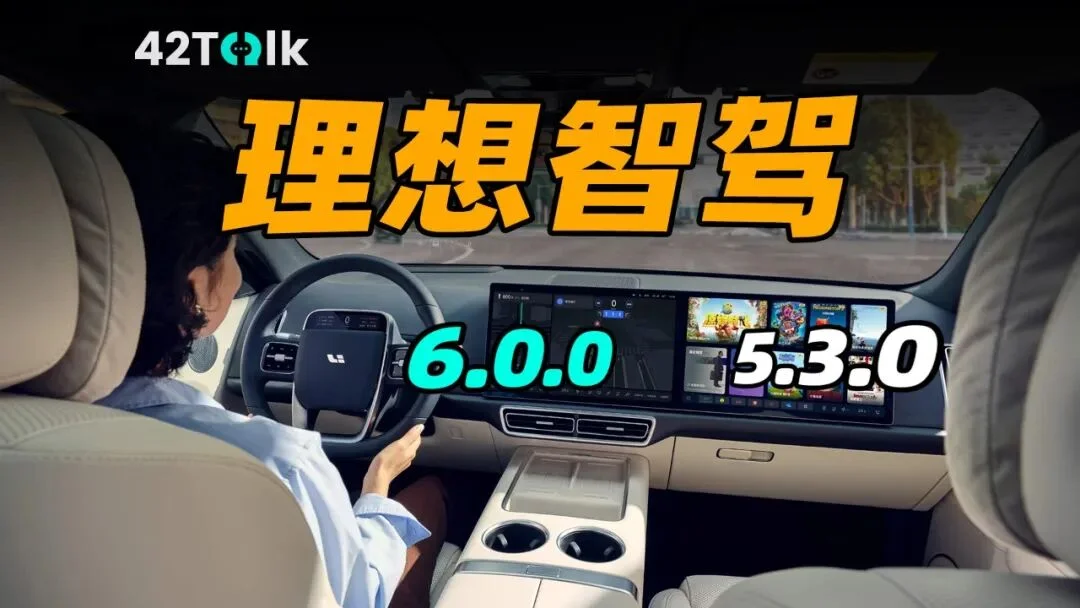
"42Talk" is an online chat show produced by 42HOW Auto for new energy vehicle owners, aiming to help you find the most suitable EV through authentic owner feedback.
42Talk: Discovering the most genuine voices of car owners.
Hello everyone, welcome to 42Talk.
In early June, Lixiang AD Max launched an internal beta test for its mapless NOA experience, opening 9,000 spots. This followed a batch of 1,000 spots released in May. By late June, the OTA 6.6.0 experience version opened recruitment with no limit on the number of participants.
From thousands to tens of thousands, and now to unlimited participation, Li Auto’s recent OTA update efficiency has delighted owners. But does the actual user experience deliver surprises?
This episode invites two Li Auto OTA beta testers to share their experiences.
Guests for this episode:
Ding Xiaogou: Hangzhou, Zhejiang, 27 years old, 2023 Li L8 Max, OTA 5.3.0 beta tester
Yong Bin: Fuzhou, Fujian, 40 years old, 2022 Li L9 Max, OTA 6.0.0 beta tester
(For the podcast version, please click 'Read Original' at the end of the article to access the '42Talk Channel' on the Xiaoyuzhou APP)
01Basic Information
Laven:
Do you currently own any other cars?
Ding Xiaogou:
I also have a BMW Series 2.
Yong Bin:
I currently drive a Xiaomi SU7 Standard Edition Founders Edition and a Zeekr 001 in addition to the Li L9 Max.
I am an early adopter of new energy vehicles and one of the first owners of the Li ONE. I placed my order for the Li ONE when it was announced at Li Auto’s launch event in 2018.
Laven:
How frequently do you use intelligent driving features in daily life?
Yong Bin:
The frequency is quite high. My Li L9 has now accumulated approximately 67,000 kilometers, with official data showing that over 33,000 kilometers were driven using intelligent driving—accounting for roughly 49%, nearly 50%.
My Li ONE has also logged around 40,000 kilometers of intelligent driving usage. Although its capabilities are quite basic, it is genuinely very user-friendly.
Ding Xiaogou:
My usage frequency for intelligent driving isn't as high as Teacher Wang's; my total mileage is less than 25,000 kilometers, and the software shows that intelligent driving accounts for only 13% of that distance.
Is Intelligent Driving a Key Factor When Buying a Car?
Yong Bin:
For me, it is a relatively important consideration.
When I first bought the Li ONE, there were no Li Auto stores or delivery centers in Fuzhou. I picked up the car in Hangzhou and drove it directly back to Fuzhou. On that trip, I used the intelligent driving features for the first time. Although they were still in a very basic stage—just a combination of ACC and lane keeping—their performance surprised me greatly.
That six- or seven-hour drive felt incredibly relaxing. Even with such basic technology, I could already feel a world of difference compared to before.
From then on, I gradually started exploring and learning about intelligent driving, which eventually became something I enjoy researching.
I started using urban autonomous driving in earnest last November as an internal tester. The beta version covered about five kilometers in Fuzhou.
I accidentally activated NOA and was thrilled when the car turned automatically after the light turned green. I remember it clearly: either November 21 or 24. Li Auto sales staff even contacted me to ask how I had enabled the feature.
That was my first time using the function in city traffic, and the excitement remains unforgettable.
Ding Xiaogou:
Initially, I wasn’t very interested because early Tesla models brought basic driver-assistance features to China. I tried a friend’s car but found the experience unsatisfactory.
It was only after getting the Li L8 Max that I seriously considered upgrading my ADAS capabilities. However, since most of my driving is in cities, many advanced features weren’t frequently useful for me.
After buying the Li L8, I used the system out of curiosity, but I wasn’t particularly enthusiastic about high-level autonomous driving. Instead, I urgently wanted practical basic assistance like Lane Centering Control (LCC), which felt more necessary.
02User Experience
Yong Bin:
For areas with navigation, intelligent driving is now basically available everywhere, with a coverage rate of more than 99%.
There may be a small section of the road where it cannot be used, or on narrower roads, it might temporarily disengage when you first turn into them. However, after turning in, you can reactivate it and use it again.
Ding Xiaogou:
Hangzhou, I feel like the coverage is probably quite comprehensive now. I'm currently just on RC 1 of version 5.3.0.
Version Improvement Status
Yong Bin:
After more than half a year of testing, I found that the system is overly sensitive to surrounding vehicles. When nearby vehicles show even slight signs of approaching, the system takes measures to decelerate or brake. This handling initially gave me a less-than-ideal impression, but with continuous system upgrades, the current experience is quite good. Nevertheless, I believe there is still room for improvement; further optimization could achieve a smoother driving experience.
Traffic light recognition used to have some misjudgments in the early stages, but with technological advancements, accuracy is now quite high. Although occasional interference from other lights—such as traffic signals or pedestrian crossings from different directions—can still occur, overall recognition capability remains strong.
The overall evolution of the version has been quite good; areas that needed optimization have been addressed. This process resembles a game of balance, where developers must find a midpoint between safety and efficiency. In some cases, the system may adopt more conservative strategies for safety reasons; in others, users may prefer the system to respond more aggressively.
This likely requires gradually finding that balance point.
When driving my Li, I tend to keep my driving style conservative and comfortable, though I do enjoy driving and sometimes take my Xiaomi out on mountain roads.
Ding Xiaogou:
From my experience, there are several areas that have been optimized.
First, regarding car-following functionality: previously, if I was driving in the center lane of a three-lane road and a vehicle appeared in an adjacent lane, the system’s reaction was akin to that of a novice driver with only six months of experience—it would brake frantically, resulting in an uncomfortable ride feel. Now, however, the system handles such situations more calmly and is less overly sensitive.
Second, braking strategies at traffic light intersections and acceleration/deceleration logic have improved significantly compared to before.
The current system feels like that of a driver who has been behind the wheel for one or two years, transitioning from novice to experienced.
Ding Xiaogou:
Brother Wang, I have a question: can its NOA handle roundabouts now?
Yong Bin:
Not yet. U-turns and roundabouts remain problematic; they haven't been enabled. However, regarding U-turns, I've seen some videos online suggesting internal testing may already be underway. An update adding U-turn functionality is expected next month. As for roundabouts, I haven't heard any news yet, but I believe it will likely be enabled soon.
'Surprise Moments' and 'Bug Moments'
Laven:
Have you encountered any moments during use where you were pleasantly surprised? Perhaps you didn't expect much from how it handled a specific stretch of road, but it performed exceptionally well.
Yong Bin:
Actually, this sense of surprise is part of an evolutionary process. For instance, in the early days, when I experienced the vehicle smoothly merging from a slip road onto the main highway, that seamless transition felt like a genuine surprise. But later on, it became something taken for granted, and those moments of surprise faded into the past.
But last night, I encountered a particularly surprising moment. I was making a left turn under an overpass, where the bridge piers partially obstructed my view. After turning, I noticed a pile of what looked like white foam dropped by a preceding vehicle on the ground. The intelligent driving system handled it very smoothly, navigating around the obstacle without any issue.
The feeling was excellent; the experience was truly impressive. This feature may have been present in previous software versions, but because I hadn’t encountered such a scenario before, finding it yesterday still felt quite surprising.
Ding Xiaogou:
My usage has been relatively limited, so I haven’t had many surprises. Perhaps my threshold for being impressed is simply higher.
There are quite a few bugs, such as driving against traffic, crossing lane lines, inexplicable deceleration, abrupt braking, failure to recognize tidal lanes, inability to navigate roundabouts, and unnecessary overtaking on the right.
For example, there was one instance at an intersection where it directly drove into the opposing lane’s left-turn lane.
Laven:
Yong Bin, have you encountered this situation in this version?
Yong Bin:
This version is significantly better than before. It is now mapless, but it still needs to interpret intersections at junctions. Occasionally, it may still take a wrong turn or encounter a vehicle suddenly crossing a solid line to change lanes.
The inexplicable braking mentioned by Teacher Ding earlier was likely caused by the system being overly sensitive to vehicles on the side that were actually quite far away.
It is unclear whether these issues are bugs or signs that the capability has not fully evolved.
However, lane recognition accuracy is already quite good; even when markings are blurred or missing, the system can identify and 'infer' lane lines. But the logic for lane selection still needs improvement. For example, among three straight-ahead lanes, if one lane already has five or six cars queued while others have only two, the system currently does not seem to proactively judge and change to the less congested lane.
The 'Most Usable' and the 'Most Wanted'
Yong Bin:
The feature I enjoy most is the urban NOA’s ability to navigate around obstacles. It occasionally surprises me and proves very convenient.
Previously, if a slow vehicle was ahead, I had to take over immediately. Now, the overtaking capability feels much more satisfying psychologically and saves considerable effort. Before, after taking over, re-engaging the intelligent driving system required some hassle; now, the entire overtaking process is seamless.
Ding Xiaogou:
I find following traffic the most useful. It performs well in light-to-moderate congestion. However, in heavy traffic, it cannot drive itself because it is easily cut off by other vehicles.
When using NOA in the city, the blue indicator light turns on. Everyone knows that a blue light means the car is driving, not the human. This leads many drivers to try to intimidate or cut in front of you.
Laven:
Speaking of the blue light, do you think there should be such an indicator to alert others when the vehicle’s intelligent driving system is active?
Ding Xiaogou:
Yes.
Yong Bin:
I think it's very necessary. One is for safety reminders, and the other is that if there are some aggressive driving behaviors, people will see the small blue light and understand that you're not driving yourself but rather using intelligent driving.
Laven:
Do you have a specific feature you really want for intelligent driving?
Ding Xiaogou:
What I want most is a smart summon feature like Tesla's, similar to reverse valet parking: I summon the car from its parking spot at Point A to come pick me up.
Yong Bin:
This feature is definitely something I’d love to have. I hadn’t even considered it until Teacher Ding mentioned it just now.
In southern regions with frequent rainy seasons, this function would be extremely useful. If available, it would be fantastic. Technically, there shouldn’t be much difficulty, but it may involve regulatory and legal considerations.
If regulations permit, a reverse valet parking function would allow the car to drive up to you from an indoor garage without you needing to go out to retrieve it from an open-air lot. That would be excellent.
03Has intelligent driving reduced driving pressure?
Ding Xiaogou:
It depends on the road conditions.
Yong Bin:
Actually, in urban areas, I wouldn't say it completely relieves stress yet; it's more of a compromise.
Although driving myself isn't exhausting, the system does reduce stress at certain times. However, there are moments when you need to pay closer attention to its performance, which can be more tiring.
Currently, in city driving, it hasn't reached the point where it fully alleviates stress, but I feel the process is gradually moving in that direction.
This is also closely related to the driving environment. My typical usage scenario is rush hour in downtown Fuzhou, so traffic is relatively congested. But if I drive to slightly suburban areas, it significantly reduces fatigue.
Laven:
Since domestic autonomous driving levels are currently only open to L2, and automakers' technologies in this area are still developing, I see many users spending considerable effort monitoring road conditions while using the system.
Ding Xiaogou:
Basically, what Teacher Wang said aligns with what I had envisioned.
Highway NOA is highly addictive; once you use it, you can't go back. However, activating NOA in urban areas, especially under complex traffic conditions, often leads to unpredictable situations. In such scenarios, engaging NOA places greater mental strain on the driver, as I must not only observe how other road users behave but also anticipate how the vehicle will react.
04Are You Willing to Pay for Intelligent Driving?
Yong Bin:
I would be willing to pay for certain features, such as the experience on highways. But given the current development level of urban intelligent driving, which largely caters to my personal interest, I am not inclined to pay for it.
If it further evolves to genuinely reduce driving fatigue in city environments, I believe I would be willing to pay.
Ding Xiaogou:
Yes, I agree with Teacher Wang's perspective. Moreover, I think it is unfair to subscribers if a vehicle comes equipped with the necessary hardware for intelligent driving, yet requires users to subscribe to unlock these features.
For instance, we know Tesla employs a 'shadow mode,' utilizing the vehicle's hardware to learn from the owner's driving behavior and compare it against its own models.
The pre-installation of all its hardware is standard across all vehicles. I'm not sure if this learning process applies only to users who have already paid. If the system uses data from all users to improve itself, and then later requires payment for those features, I consider that an unfair model.
I'm not absolutely opposed to paying for it; the key lies in whether the capability and pricing meet my expectations and fulfill my aspirations.
05How do you view automakers' 'empty promises'?
Laven:
When Tesla first entered the Chinese market, many people purchased FSD, but the feature has still not been rolled out to everyone to this day.
Nowadays, people joke that automakers are building cars with PPTs, frequently 'painting pies' at launch events by promising what features will be delivered and when.
Last year, many automakers claimed they would push out 'mapless NOA available nationwide by [time].' What are your views on this phenomenon? Did these claims influence your purchasing decisions at the time?
Yong Bin:
It does have an impact. Whether it’s a promise or early promotion, I’d be quite interested.
If I hadn’t bought a car yet, this kind of news would likely influence my future purchase decision.
Because the long-term development trend is always positive, and smart cars with OTA capabilities evolve quickly and effectively, I’m quite optimistic about it.
It’s completely different from traditional ICE vehicles. In the past, when companies like Toyota or Audi announced new features, older owners couldn’t use them. Now, these companies’ promises give both existing and new owners some anticipation for the future.
Laven:
You currently own three NEVs. Compared to what was said at their launch events, how much of those features do you feel has actually been realized?
Yong Bin:
Li Auto’s realization rate is very high. Xiaomi, having been on the market for only two or three months, needs to implement its capabilities step by step, which is understandable. However, Zeekr is indeed relatively slower in rolling out infotainment features, which we have to admit.
Li Auto's promise and its actual realization are quite high, likely exceeding 80% or even 90%.
Ding Xiaogou:
I believe the importance of 'drawing a pie' (making grand promises) lies not in the 'pie' itself but in the act of 'drawing.' Similarly, the essence of 'involution' (intense competition) lies not in the 'rolling' but in the 'internal' nature. For any so-called 'pie,' if it can actually be realized, I am willing to accept it; that is fine. But if it is merely talk, then the situation changes entirely.
Automakers exchange their capabilities and time for owners' money and value recognition. I think this is fair. As long as we clearly understand what we want, we have the capacity to accept it and the freedom to ignore it.
Since I work in advertising, I have experienced many such situations, so I remain somewhat insulated from them and tend to stay rational. I am less inclined to be an early adopter; I prefer to wait for others to try first. If they find it good, then I will join in.
Laven:
I also want to ask Yong Bin: since you own both a Zeekr and a Xiaomi, have you tested the intelligent driving features of the other two vehicles?
Yong Bin:
My experience with Zeekr’s intelligent driving is limited; it has only just opened up highway NOA, and I haven’t used it much. As one of the earliest owners of the Zeekr 001, my vehicle lacks a LiDAR sensor, so there is still a considerable gap compared to Li Auto.
Xiaomi and Zeekr are likely in a similar position now. My Xiaomi is the standard version without LiDAR and features lower computing power, so I haven’t been able to fully experience this functionality. Vehicles that have just launched typically require time to refine their intelligent driving systems. Currently, I don’t feel it is a complete product; it needs further evolution and more time.
066.0.0 vs 5.3.0
Ding Xiaogou:
I am quite curious about the difference between the new internal test version 6.0 and the 5.X versions. I recently saw that it pushed RC 1 of 6.0.0 to me.
Teacher Wang, what differences have you noticed in your usage?
Yong Bin:
I’m not sure if our software versions are the same; I am on Beta 2.
I just started using it today, and I feel it’s actually not as good as Beta 1. Sometimes the upgrades bring regressions or compromises in certain aspects.
In terms of user experience, I feel this update is a step backward, but that’s just my impression after using it for a day.
Unnecessary braking and deceleration seem to be increasing again. Since I’ve only experienced it for one day, I’m not sure if my perception is biased or if these issues are indeed present.
I think version 5.3 was really good to use; compared to 6.0.0 Beta 1, I even found 5.3 slightly better, though this may depend on individual preferences.
I think being willing to try new things is a positive thing. The experience depends partly on the vehicle itself and partly on the driver.
Some users who are less familiar with driver assistance systems tend to take over control early in certain scenarios because they feel the car won’t make it through. However, due to my extensive usage and deeper understanding, I know it can handle these situations appropriately without issues.
Even when the system can navigate through, the experience might not be perfect, as it still makes some drivers feel tense.
The goal of ‘driving well nationwide’ should be reaching a stage where everyone feels at ease while enjoying efficient and smooth driving experiences.
Ding Xiaogou:
There is still a significant difference between "usable" and "user-friendly."
Laven:
Yes, we released a video the other day titled "Does Zero Takeovers Equal User-Friendly?"
Because when promoting intelligent driving now, everyone says "zero takeovers throughout the journey," which sounds particularly impressive.
Yong Bin:
Indeed, there's no need to excessively pursue this. I believe it's more important to find a balance between a sense of security and efficiency.
If one pursues a sense of security too much, it may cause the vehicle to maintain an overly large safety distance from the car ahead. This not only reduces road traffic efficiency but may also increase the risk of being cut off by other vehicles, affecting the driving experience. Conversely, if one pursues efficiency too much, it may lead to more aggressive driving strategies, which could reduce the driver's sense of security.
How should this balance be coordinated? I believe it is a significant research direction.
Regardless, I am very much looking forward to the further development of intelligent driving by automakers.
Laven:
That concludes today's episode. Thank you for your time.
If there are any topics you'd like to hear about, feel free to leave a comment in the section below.
This content is compiled from the podcast program '42Talk'.
Click 'Read Original Text' below to unlock more past episodes.