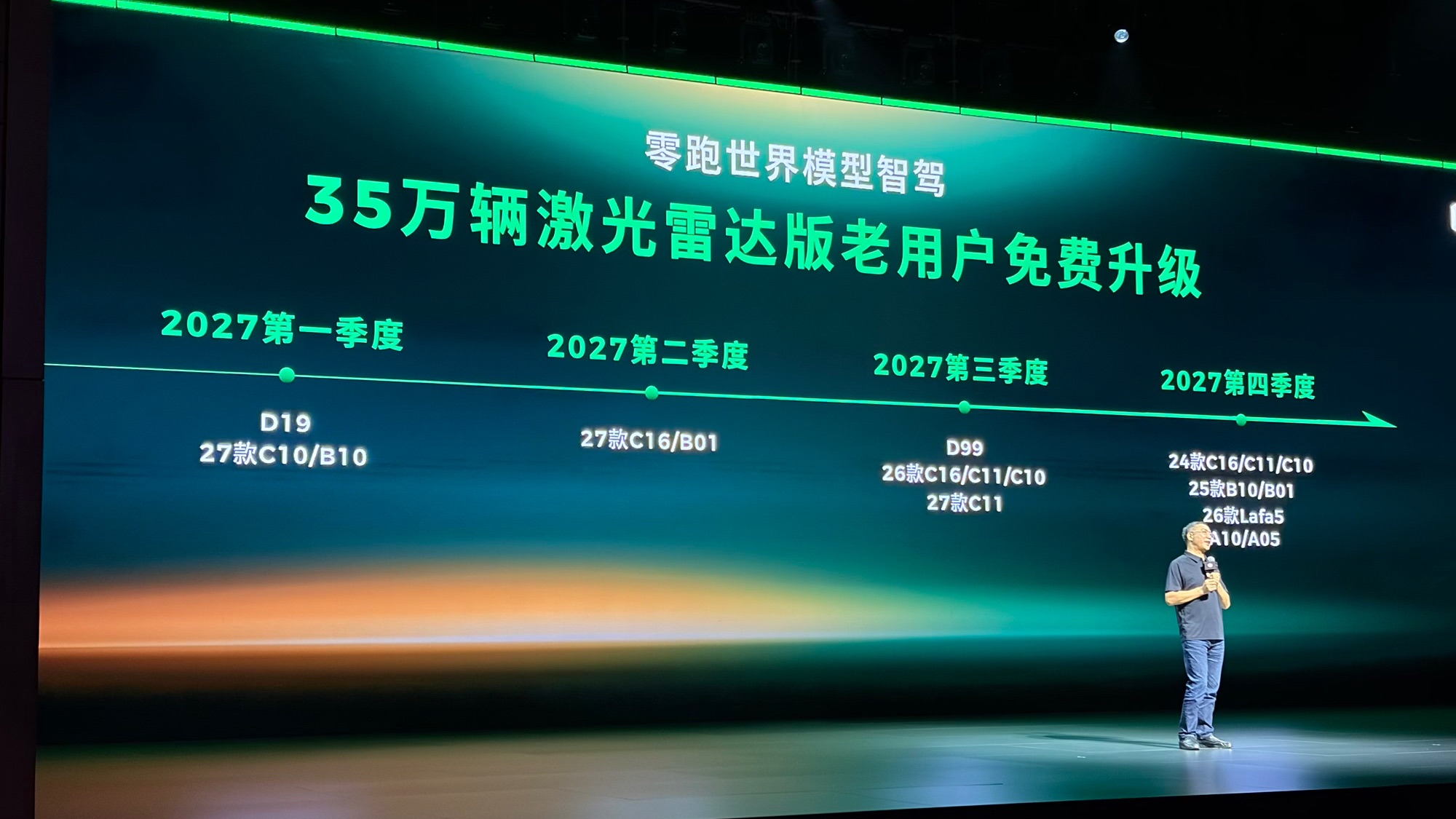
As of the end of August this year, LEAPMOTOR has delivered 350,000 vehicles equipped with lidar technology. During the LEAPMOTOR Technology Day on September 16, 2026, the company’s Founder, Chairman, and CEO Zhu Jiangming announced that all 350,000 existing users would receive a free upgrade to the latest World Model Assisted Driving version, with lifelong free access.
According to the plan, in the first quarter of 2027, LEAPMOTOR D19, and models from 2027 like C10 and B10, will take the lead in using the World Model. By the second quarter of 2027, the World Model will be implemented in 2027 models like C16 and B01. By the third quarter of the next year, LEAPMOTOR D99 and 2026 models such as C16, C10, and C11, as well as 2027 C11, will also receive the World Model assisted driving. By the fourth quarter of next year, 2024 models like C16, C10, and C11, along with 2025 models B10 and B01, 2026 model Lafa5, as well as A10 and A05, will also be equipped with the World Model’s assisted driving.
Additionally, the World Model Assisted Driving is not exclusive to high-end cars; models priced under 100,000 yuan can also be equipped with this feature.
For existing car owners, the World Model Assisted Driving capability is an additional feature, not promised during the purchase.
This free upgrade promise for existing users represents an attitude—LEAPMOTOR does not betray its customers. Zhu Jiangming revealed that for over 10,000 early lidar version users, due to hardware platform discrepancies, algorithm transfer and reconstruction would cost at least 50 million yuan, yet LEAPMOTOR will still offer a free upgrade for these users.
Zhou Hongtao, Head of LEAPMOTOR’s Electronics Product Line, stated: “The World Model is not a technical paradigm but a goal.” This goal is to enable the model to understand the surrounding world and predict what will happen next.
Previously, LEAPMOTOR has implemented a two-stage architecture for parking-to-parking city pilot, but encountered three significant pain points: information loss during module transmission, compounded delays with multiple modules in series, and difficulty comprehensively covering special scenarios relying on rule processing. The advent of LWM World Model Assisted Driving, with its end-to-end architecture, integrates environmental understanding and driving decisions more closely.
The training system for World Model Assisted Driving is divided into cloud and in-car operations. The cloud first trains the base World Model, learning the structure and dynamics of scenarios through tasks like video prediction, pixel reconstruction, semantic understanding, and 3D physical occupancy. The in-car model reuses the cloud base’s understanding capabilities, incorporating navigation, real-time vehicle status, and combining driving data for end-to-end training to form a real-time operational driving model. Another pathway involves using the cloud model to generate rare scenarios for closed-loop simulations, helping the in-car model address issues inadequately covered by real vehicle data.
The term “cloud-edge integration” here refers to the division of labor in training, simulation, and capability reuse: the cloud expands the world seen by the model, while the in-car system completes real-time driving decisions.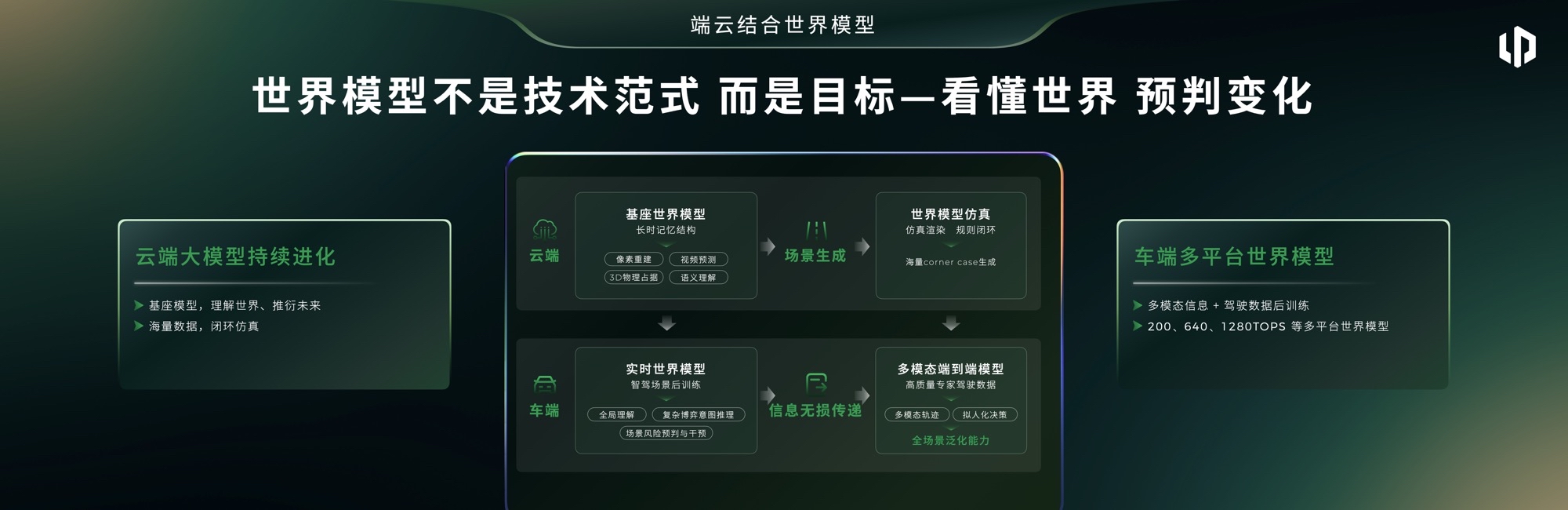
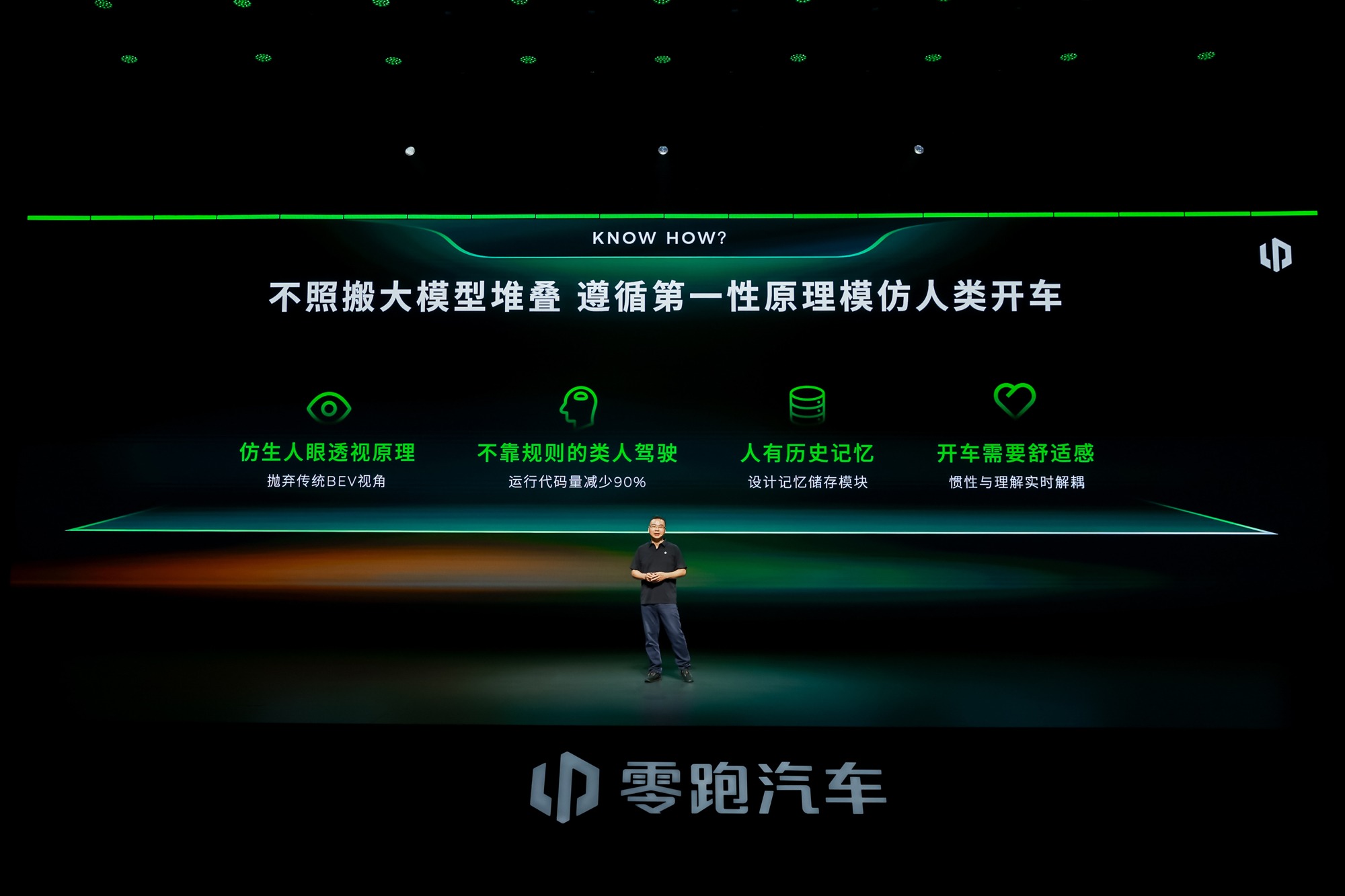
In terms of model design, Zhou Hongtao introduced three compromises made by LEAPMOTOR: retaining the image’s original perspective relationship to reduce computational load by skipping the BEV (bird’s-eye view) conversion; designing a memory storage module for utilizing historical information; and decoupling inertia from real-time understanding to enhance driving comfort.
Additionally, the new architecture reduced code volume by 90% while still retaining fallback rules like traffic lights as safety protocols, with LiDAR used as a safety redundancy. More driving strategies are entrusted to model learning, though necessary constraints remain.
Just days before the 2026 LEAPMOTOR Technology Day, Garage No.42 conducted an in-depth conversation with Feng Mingyue, the person in charge of world model intelligent driving at LEAPMOTOR. Beginning with hardware adaptation and experience differences that users care about most, he further elaborated on model design trade-offs and how the team gradually increased investment as solutions were validated.
Feng Mingyue clarified that LEAPMOTOR vehicles equipped with Qualcomm 8650 and 8797 chips, along with LiDAR, would be compatible with the world’s model-assisted driving. For the 200 TOPS 8650 platform, LEAPMOTOR aims to meet daily commuting needs; meanwhile, platforms with higher computing power will perform better overall, with differences primarily in extreme scenarios and feature richness. For example, the 640 TOPS 8797 platform plans to support voice-activated car control, which the 8650 chip platform does not.
Therefore, reducing the on-board computing power for 8650 chip vehicles is a critical step.
In terms of perception, LEAPMOTOR abandoned BEV and adopted the principle of human eye perspective, simply put as “near-large, far-small.”
Feng Mingyue shared an example where a car cuts in from the front-side; changes in its heading angle and position may be minor, but it occupies significant space in the camera image. Retaining the original image perspective allows the model to directly use these changes to output trajectories, leveraging driving cues without the need for BEV conversion.
From early validation of the world model-assisted driving to now, it’s been only 9 months. Feng Mingyue recalls that the world model project started at the end of last year with fewer than 20 people, 6 or 7 of whom were responsible for the model, and others for control and vehicle integration. Engineers even placed an industrial computer equipped with a 3090 chip in the test vehicle’s trunk for early testing and validation to quickly ascertain the model’s limits.
In March 2026, the LEAPMOTOR world model-assisted driving team presented its first demo. Although there were issues with scenarios like high-curvature bends, the model’s demonstrated capability for strategic interaction convinced LEAPMOTOR to continue investing. By June of this year, the project team had grown to 60-70 people, with algorithms transitioning from industrial computers to the 8797 chip.
Currently, the algorithm team for LEAPMOTOR’s world model-assisted driving exceeds 400 members, and the entire intelligent driving team surpasses 800. Clearly, in recent months, the world model team’s scale rapidly expanded, with the goal of mass production installation by the first quarter of next year.Below is the full edited conversation between Garage No. 42 and Feng Mingyue.
Only Took 9 Months
Garage No. 42: How long has it been since the inception of the world model assisted driving project?
Feng Mingyue: It has been about nine months since the project surfaced. The initial point was last November and December. Before that, the team conducted some research and felt the solution was feasible, so they reported to the boss to propose this project. Initially, not many people were involved, about ten to twenty. Six or seven colleagues worked on the model, while others focused on control and vehicle integration to establish in-car connections.
Initially, we were very concerned that after resolving all deployment issues, the results might not meet expectations, leading us down the wrong path. So, we aimed to quickly validate the solution and allow room for swift trial and error.
Garage No. 42: Why was the validation of the world model so fast?
Feng Mingyue: We directly moved a 3090 industrial computer into the car, placing it in the trunk. It was quite large, and we even had to remove part of the seat. The car would jolt during driving, so we built a frame to secure the industrial computer there. This approach saved time on early engineering tasks.
From November/December to March, our primary aim was to prove the solution’s effectiveness and assess its potential. If its potential fell short of our requirements, it might indicate that the chosen technical paradigm was flawed.
Garage No. 42: By March, was the first version already very capable?
Feng Mingyue: That version still had many issues, for instance, handling high curvature turns poorly. However, we observed its abilities in game-theory interactions and its understanding of the physical world.
For example, during tests in very narrow spaces, when faced with traversable low curbs, the model chose to drive over them; if the curb was slightly higher, even with oncoming vehicles squeezing past, it preferred to stop rather than take abrupt action. We hadn’t specifically coded rules for this behavior.
From these scenarios and interaction capabilities, we felt the solution was feasible with high potential. Thus, starting in March, we committed more resources.
Garage No. 42: During the early verification phase, why focus more on the model’s potential?
Feng Mingyue: Although there were still experience issues, the overall result exceeded expectations. Everyone was more interested in the maximum potential this solution could achieve.
Some lower-limit issues can be addressed through engineering work or very simple fallback logic. The hardest part is assessing the potential. Seeing that this solution had potential, we decisively committed resources.
Garage No. 42: After March, what advancements have been made in LEAPMOTOR’s world model-assisted driving?
Feng Mingyue: The first priority is enhancing the performance; second, removing the industrial computer and migrating the entire algorithm to the 8797 chip. We needed to verify two main aspects: whether the performance improved as expected and if it met mass production requirements. During this phase, more colleagues working on mass production, control, and smooth processing joined the effort.
By June, the project involved around 60 to 70 people.The demo in June showed significant changes compared to March. When President Zhu took the ride, he didn’t use the route we recommended but navigated himself to West Lake. After his experience, he was very satisfied, and we essentially met our expectations for the June results set in March.
Garage 42: So what happens after June, is the focus now on mass production?
Feng Mingyue: Our previous generation of assisted driving, internally called Project 2.0, has mostly completed the necessary OTA updates. After June, more manpower began to be invested in new projects. You can now consider that the intelligent driving team is primarily focused on this project, with over 400 algorithm colleagues. From June to September, we have been continuously refining this product.
Abandoning BEV
Garage 42: Why did LEAPMOTOR not choose to modify the multimodal large language model into the VLA path?
Feng Mingyue: From the start, we were not very inclined towards this path. The multimodal large language model has already proven effective in the digital world, but we think that bringing it into the physical world as a solid solution needs further verification. The resources it requires, as well as the difficulty and cycle of verification, are also relatively high.
We focus more on how humans drive. You can think of the multimodal large language model as a top student with a lot of internet knowledge, but a university student, graduate student, or Ph.D. student learning to drive with a middle school student doesn’t necessarily learn faster.
We’re learning how to drive in the physical world with intelligent driving, so we prefer to start from things related to driving itself and make specific technical choices.
Garage 42: Speaking of technical choices, is the abandonment of BEV perspective transformation one of them?
Feng Mingyue: BEV is a very mature perception framework that solves some problems in perception. In an image, objects closer appear larger, and the same pixel difference in different positions can represent completely different distances. BEV eliminates these disparities.
However, our thinking is: when people drive, they don’t do so from a bird’s-eye, omniscient perspective. The phenomenon of closer objects appearing larger is inherently useful.
For example, at high speed, when a vehicle cuts into the current lane, the change in its yaw angle and position may be very slight, and the signal provided to the model is also minimal. But in the image, when a vehicle enters from the right into the front view, the pixel change is very noticeable.
This example shows that perspective relationships are useful when driving. So we retain the image perspective and output trajectories directly from the images, bypassing intermediate viewpoint transformations. This is one specific technical decision.
Additionally, BEV transformation itself is quite computationally intensive. Skipping this step saves computing power, allowing the world model to be deployed on the 8650 chip platform.
Q: Previously, LEAPMOTOR used a two-stage architecture. Is it now a single-stage one?
Feng Mingyue: In the previous two-stage solution, it first performed perception and then moved on to planning and control. We encountered issues like awkward stops, point braking, and jerks, partly because of perception errors, where planning and control were not confident enough about the perception.
For instance, the perception error could be within 10 centimeters left or right, and planning and control didn’t know whether the current scene was accurate, so boundaries had to be set according to this margin of error. Some boundaries were hard boundaries, meaning when that distance was reached, no further movement was allowed.If you observe the images directly, the panoramic camera assesses whether there are any gaps between the car and adjacent objects. In a one-step, world model-based end-to-end solution, this imagery directly informs subsequent decisions. We observe that it chooses to pass through very narrow areas, similarly to how humans perceive gaps.
Q: The differences between the new and old architectures are substantial. Can past experiences still be utilized?
Feng Mingyue: Anything new doesn’t arise from thin air; it’s about addressing shortcomings of previous solutions. We don’t pursue VLA for VLA’s sake, nor do we forcibly adopt multi-modal large language models just because they perform well in other fields.
From the rules era, to perception modeling, to a two-step approach where planning is also modeled, we are very aware of the challenges at each stage. In designing the current scheme, we considered past issues and how a new plan could resolve them.
Even if the current approach is vastly different from the two-step method, our motivations and judgments still stem from previously identified problems.
A Thousand-Card, H20-Level Computing Power, But People Matter More
42 Garage: What computing power does LEAPMOTOR use for training its world model?
Feng Mingyue: We use a thousand-card, H20-level computing power.
There’s a correlation between computing power and people. To evaluate an algorithm peer, we look at their model judgment. In AI development, making mistakes must be allowed; nobody designs an architecture and gets it right the first time.
Someone with good judgment might find the right path in five attempts; someone else might miss it in a hundred. Certainly, having more cards is better for algorithm engineers.
However, if the desired effect is fixed, more resources mean more trial-and-error opportunities. With fewer cards, higher demands are placed on people, given the limited trial-and-error space.
During the transition from the two-step approach, we built a practical, problem-solving team. Now, in creating the one-step world model solution, those who excelled in the two-step method have made significant contributions again.
42 Garage: LEAPMOTOR builds cars that are “good and affordable,” while many industry players rely on “premium and costly” radars and sensors. What are your thoughts on the capabilities of LEAPMOTOR’s current hardware?
Feng Mingyue: Adding sensors is like an addition, enhancing blind spot coverage could theoretically surpass human safety levels.
Yet, I believe the potential of the current sensor scheme hasn’t been fully realized. Humans look forward while driving and check mirrors for lane changes, but panoramic cameras on cars already cover many of these perspectives.
The current cameras capture a wide range, but have we made it good enough to surpass humans? I’m not so sure. Thus, the current hardware still has untapped potential.
42 Garage: With LEAPMOTOR’s development of a world model-assisted driving system, what changes do you and your team hope this system will bring to users?
Feng Mingyue: Most importantly, safety. We aim to change user mindsets, making them confident in using it.In the past, during two-stage testing, there were challenging scenarios where the outcomes were less than ideal. Some testers, after reporting an issue, would add, “In such situations, I wouldn’t use the smart drive, and users likely wouldn’t either.” In a previous phase, this might have served as an excuse. However, we aim to continue perfecting these scenarios, giving users the confidence to enable smart driving.
Between safety and efficiency, I would choose safety first. Once safety is adequately ensured without compromise, we can then strive to maximize efficiency. There are still many aspects to improve. We hope that when it ultimately reaches users’ hands, the experience will exceed what is available today.
This article is a translation by AI of a Chinese report from 42HOW. If you have any questions about it, please email bd@42how.com.