
“I was happy for two seconds, then I moved on.”
This was Yu Kai’s reaction when discussing Horizon’s milestone of reaching 15 million shipments of intelligent driving chips.
Reflecting on the early days of chip development and the uncertainty it brought: the team was young, unsure of the success of a chip, and the entire core team once went to Lingyin Temple to pray. In Yu Kai’s memory, the journey was mostly muddy, with few bright moments that were also fleeting.
On the afternoon of September 15, at the Horizon Building in Lingang, Shanghai, we witnessed this milestone shipment ceremony. Horizon’s 15 millionth chip was installed in a FAW-Volkswagen ID. AURA T6, making Yu Kai, the founder and CEO of Horizon, the car owner.

In subsequent conversations with 42Garage and other media, Dr. Yu Kai provided an industry endgame prediction: ultimately, there might only be two to three global core technology suppliers for autonomous driving; approximately 80% of car manufacturers may choose to partner with suppliers, while 20% insist on vertical self-development. He joked, “Every OEM now thinks they are in that 20%.”
Horizon prepares different collaboration methods for these two types of car manufacturers: selling chips and software while also offering technology licenses to self-developing companies. Yu Kai hopes Horizon can become an open computing platform for the smart car era.
Yu Kai shared market share data for the advanced driving-assistance chip sector: in the domestic brand ADAS market, Horizon’s share rose from 3.7% in 2022 to 50.0% in the first half of 2026, roughly double that of the second-place Mobileye. Meanwhile, Mobileye’s share only slightly decreased from 26.1% to 25.1%, with noticeable contractions for Renesas, Xilinx, and Texas Instruments.
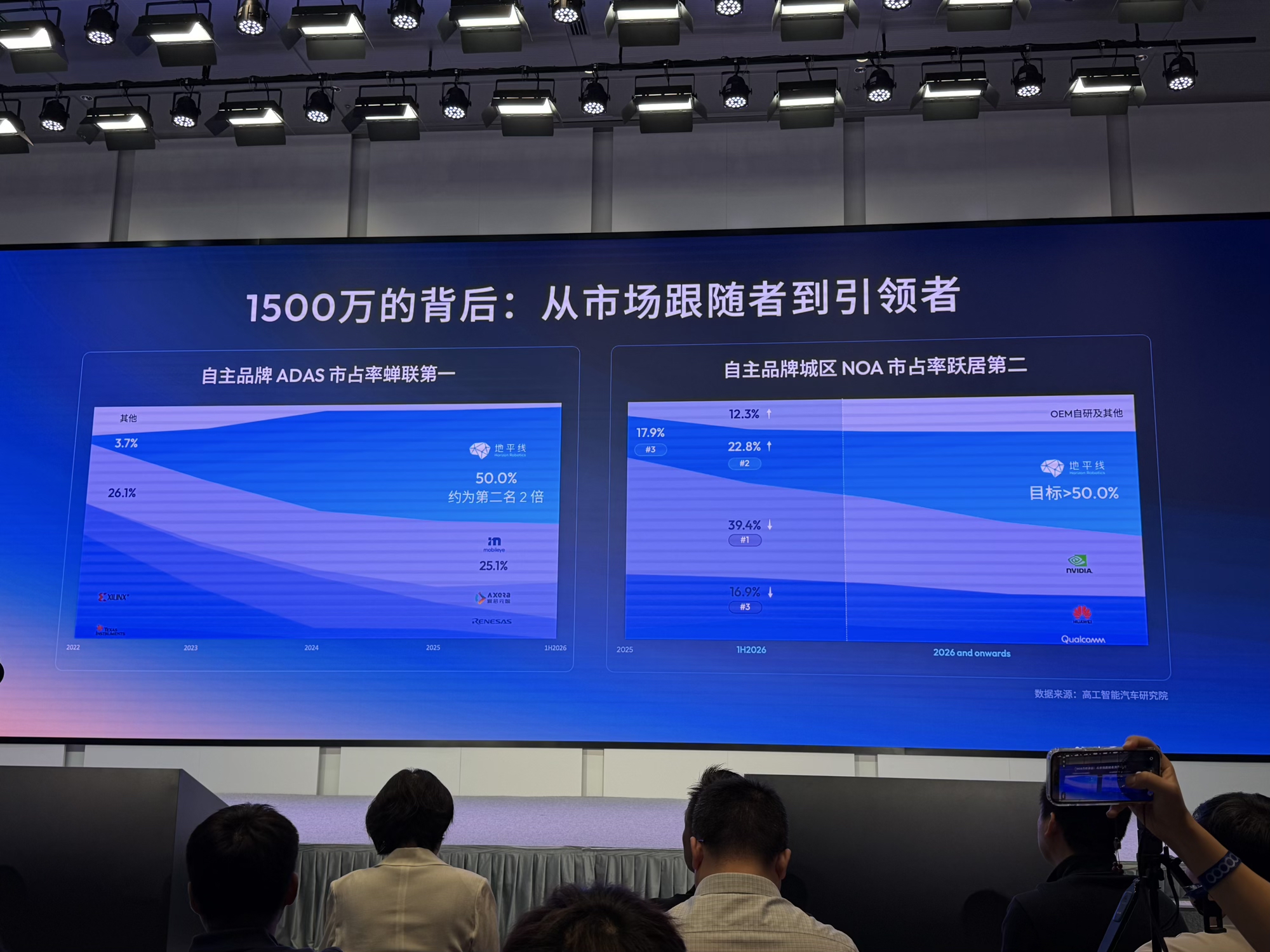
In the domestic brand urban NOA market, Horizon’s share increased from 17.9% in 2025 to 22.8% this year, ranking second, behind Nvidia’s 39.4%. Yu Kai’s goal for next year is to attain the top position in this market.
Horizon’s most important product this year, HSD, also has new developments. Yu Kai revealed that HSD 2.1 is soon to be launched, including new features such as full-scene reversing, allowing vehicles stuck in dead-ends to reverse out.
Additionally, HSD will be mounted for mass production by a leading new energy manufacturer within the year, which Yu Kai describes as “the world’s largest new energy car manufacturer.” It can be inferred that HSD will soon be installed in BYD vehicles.
Discussing the driving-assistance experience, Yu Kai is confident: “Feel free to test-drive any HSD model, and its capabilities are on par with luxury cars over 300,000 yuan.”However, when discussing whether subscription fees can be charged to consumers, he provided another metric: the assisted driving system hasn’t fully guaranteed safety for drivers. At this stage, purchasing assisted driving still means purchasing a configuration outright. In his view, to ensure users would continue to subscribe, technology must advance to the point where it can truly drive the car autonomously, reaching L4 capabilities.
Below are the main points from the conversation between Garage No. 42, several industry media outlets, and Yu Kai, founder and CEO of Horizon Robotics, edited for clarity.
1. How to Implement Better Assisted Driving in Models Costing 100K?
Q: What will be the relationship between supplier solutions and self-developed solutions by auto manufacturers in the future?
Yu Kai: I have always believed that the endgame of the industry will reach a convergence. Possibly 80% of the major manufacturers will collaborate with suppliers, while the top 20% will choose vertical self-development.
By saying this, I don’t offend any major manufacturer because each one believes it’s part of that 20%. Every manufacturer should have its own dream and hope to master core technologies, and I think this is worth encouraging.
From the perspective of industry trends, initially, there wasn’t a mature supplier system; the division of labor was neither professional nor efficient. At this time, vertical self-development might give an early advantage. However, as the industry progresses to the mid-to-late stage, a division of labor among suppliers begins to appear, with more specialized and efficient players. At this point, open and cooperative division of labor is often more efficient.
The mobile era is similar; eventually, we had the ARM plus Android model. Look at Apple; its chip instruction set is also ARM’s. So I believe that open division of labor will be mainstream, while vertical self-development will be something only a very few top-tier manufacturers will insist on.
Q: How can NOA capabilities extend to 100K fuel SUVs while ensuring performance under cost pressures?
Yu Kai: Through technology. Horizon Robotics doesn’t compromise on quality to reduce costs; we aim to provide customers with a more cost-competitive overall solution.
For example, the Journey 6M has a computational power of 128 TOPS, which is moderate. We don’t downgrade our chips into low-price products just to reduce costs for customers. What we do is combined optimization of software and hardware to achieve performance at a competitive cost structure that others can only achieve with several hundred TOPS.
What I refer to as internal competition is homogenized competition within boundaries, relying on low-quality price cuts. What we aim to do is expand the boundaries through technology, allowing customers to gain higher value and a more competitive cost structure, while Horizon Robotics can also profit.
The fuel model I just mentioned is about to be released; I won’t disclose much now, but you can experience it. I believe its NOA capabilities in urban areas are better than many models costing over 300K, yet it allows people who can only afford an 11K model to experience it. This is the purpose of our work – through technological advancements, allowing the best technology to be accessible to everyone.
Q: What is your vision of “intelligent driving equality” eventually?
Yu Kai: I’ll use the development of mobile communications as an analogy again. In the past, mobile phones varied greatly in communication capabilities across different price points. With 4G, videos became smooth, and both entry-level and high-end phones started using 4G, leading to the emergence of various applications later on.I believe that the current state of intelligent driving is somewhat akin to that stage. High-end models have urban NOA, while lower-end models may lack even assisted driving, with various levels in between, such as forward-looking integrated units and highway NOA.
If at some point autonomous driving suddenly becomes very good and very smooth, I think even entry-level models will come standard with it. That would be a turning point.
We must continue to strive and push forward. I believe that when people no longer need to focus on driving and can do other things instead, it will be challenging to resist such a feature.
Q: Will consumers be willing to pay for subscriptions during the assisted driving stage?
Yu Kai: I think the technology needs to be good enough.
We are still in the assisted driving stage, and there is no true fallback for drivers. This is essentially a car configuration. Whether standard or optional, you pay for this feature by buying the configuration.
In the future, if a robot drives you, you would pay for rideshare services. Thus, paying by the month or mileage feels natural. I believe there will eventually be subscription fees, but autonomous driving must first be done well enough.
Q: What have you learned from working with Volkswagen?
Yu Kai: We’ve learned a great deal about the German industrial system’s demands for quality and safety through our collaboration. This includes the testing, version iteration, software releases, and strict testing systems for hardware quality.
We’ve never seen ourselves as disruptors of the automotive industry, but rather as collaborators. We have our strengths, and others have theirs, so we should naturally approach with open cooperation and a bilateral commitment.
Through our collaboration, we also discovered Volkswagen’s prowess in areas like chassis tuning, stability, and latency. This is reflected in the experience of autonomous driving.
Latency is crucial. A slight delay may result in unsafe handling, and harsh braking as compensation compromises user experience. I think comfort in driving and handling unexpected situations is tied to the integration of the intelligent systems and the vehicle as a whole.
(2) From Selling Chips to Entering Automakers’ Self-Research Systems
Q: Compared to suppliers like Nvidia, what gives Horizon an edge?
Yu Kai: I think we need to downplay the notion of surpassing others and focus more on who we want to become. Horizon aims to be an open computing platform for the automotive era.
Over the years, we have been establishing two business models. One is akin to Wintel—the PC-era model of Windows and Intel, providing both hardware and software platforms, supporting numerous PC manufacturers.
The other is the ARM plus Android model of the mobile era. ARM defines open hardware standards, while Android defines open software standards. We call it the AA model.
For Horizon, one model is directly selling chips and software; the other is providing IP licensing for chips and software. This open licensing approach suits car manufacturers eager to maintain core technical prowess and pursue in-house development.Providing chips and software directly is suitable for 80% of OEMs. Their core capability is integrating components and supplier technologies to launch comprehensive vehicle products.
Q: How will technology licensing change Horizon’s market space?
Yu Kai: The delivery of 15 million chip solutions we discussed today primarily comes from the first model. We are also developing a second IP licensing model.
The first model offers direct market share; the second model places us behind OEMs with self-research capabilities, offering expanded market share.
I hope to combine these parts so that Horizon can become the defining computing platform of the future automotive era, like Microsoft, ARM, or Android. This aims at not just the Chinese market but the global automotive industry.
We’ve followed a “rural encircles the city” strategy, starting from low computing power to medium and then high. If we look at the high computing power market share, we are about second this year; I hope to be first next year with continued effort.
Q: This time you mentioned leading new energy vehicle manufacturers who emphasize self-research. How did HSD reach a partnership with them?
Yu Kai: Our partnerships with these leading players are very long-term. Horizon adopts an open collaboration model, whether the car manufacturers have a supplier strategy or a self-research strategy, we can collaborate.
We aim to develop the hardest technology with the softest flexibility, maintaining long-term relationships with various manufacturers. Further details can be discussed privately.
Q: With more clients and projects, will increasing engineering investment lead to diseconomies of scale?
Yu Kai: Our revenue is sourced from two main areas: directly selling chips and software, and technology licensing. The proportion from manpower services is very low.
How does “softest flexibility” support clients? Through the IP authorization of technology. We collaborate with many partners in the hardware and software fields; direct manpower engineering services are conducted via partners, while Horizon focuses on the underlying technology platform.
I’ve mentioned this year that 95% of Horizon’s deliveries are through partners. For example, in our collaboration with Volkswagen, partners are involved in between.
We’ve secured global orders, sometimes for markets we’ve never even visited, and achieved this through partnerships.
III. With increasingly similar functionalities, why do suppliers continue to converge?
Q: If consumers find it harder to discern differences in driver assistance, what do core technology suppliers rely on to compete?
Yu Kai: There’s a category of technology that is highly converged, difficult to differentiate, but extremely challenging to develop. Autonomous driving and mobile phone basebands share these characteristics.
Mobile communications work in an open world without a script. In sparsely populated rural areas, in the skyscraper-dense Lujiazui, or in the subway, different interferences occur. Ensuring smooth and uninterrupted communication at different times and places is very challenging.Autonomous driving also operates in an open world, completely unscripted. It aims to navigate a vehicle from point A to B smoothly, safely, and without interruption, which is quite challenging.
I estimate that in the end, there may be no more than two or three global suppliers of core autonomous driving technology, resulting in a high degree of convergence.
Q: Many smart driving talents are moving to embodied intelligence. What are your thoughts?
Kai Yu: On one hand, it’s natural. Horizon Robotics, the name of our company, reflects our belief that the first stop in the robot era is mastering intelligent driving. Talents thoroughly trained in intelligent driving naturally move on to embodied intelligence.
On the other hand, it also indicates that the intelligent driving industry has already highly converged. In the early stages, many new companies emerge, but now it is starting to consolidate. In the future, whether by OEMs or third-party tech companies, there will be fewer players, and talents will move to the next stage.
I believe Horizon is in a favorable position. The industry is reaching a turning point, moving towards natural, healthy growth. We focus on our work, perfecting each generation of products and delivering each model without spinning new stories.
Some years ago, the intelligent driving sector was similarly seeing new companies emerge, both in the U.S. and China. Now, it has largely converged.
Q: Horizon has already collaborated with global major automakers. What defines truly entering the global automotive industry?
Kai Yu: We have collaborated with global automotive groups like Volkswagen and Toyota, proving our capability to mass-produce with world-leading automakers.
In these collaborations, there is mutual influence; we learn from them, and they learn from us. It’s not a one-way output process; we’ve become part of the global ecosystem.
Our strategic positioning and business model enable us to find partners in many areas. As long as we adhere to long-term win-win and altruism, I believe we will be respected in the global market in the future.
Many people are concerned with whether a company appears flashy in its success. We care more about whether Horizon is perceived as valuable and altruistic over the long term. A company’s lasting health is far more important than flashy success. This way, partners won’t see you as aggressive but as a company they can collaborate with over the long term.
4. Overseas Orders Exist, But Urban NOA Requires Patience
Q: What stage is the overseas assisted driving market in?
Kai Yu: In the long run, expansion overseas is significant, but in the short term, overseas consumer demand is mainly for basic assisted driving. For the advanced market, our strategy is proactive positioning.
We have received over 20 million overseas orders so far. On the other hand, global automakers will also invest in R&D for future advanced assisted driving, which we can support through a licensing model during the R&D phase; and in the mass production phase, we can gain revenue through direct shipment.
At different stages, we have different business models and strategies to adapt to different automakers’ progress.In China, this year, if a car doesn’t have the urban NOA, it’s almost embarrassing to sell. I think it might take another five years to reach this state overseas. So, we need to actively plan and also have long-term patience.
Question: As the whole vehicle industry continues to consolidate domestically, do you prefer a scattered or concentrated pattern?
Yu Kai: Of course, the more scattered, the better for me. But thinking about it is useless; whatever happens, happens. The only thing I can control is what I do and how well I do it.
I don’t think Chinese automakers will consolidate so quickly. There are many local investments involved, as well as jobs and industrial output. The automotive industry is too important.
Question: How will cabin-driving integration change Horizon’s products?
Yu Kai: I think cabin-driving integration is inevitable. In-car computing will move toward central computing, making all calculations more centralized. Galaxy is expected to start mass production in October this year, with a larger volume next year. It also has the advantage of saving DDR memory. Integrating two sets of DDR into one can save money for car companies.
V. Moments of Glory are Rare and Fleeting
Question: From the first chip to 15 million, what does this journey look like in hindsight?
Yu Kai: We’ve been established for 11 years now, founded in 2015. I mentioned nine years earlier on stage, because that was when I first came to Lingang. Back then, it was just a barren land, with no buildings around. From the first chip to shipping 15 million chip solutions, we’ve faced many challenges. Most of the time wasn’t glorious—most of the time was mired in difficulties.
In the beginning, the chip team was also very young. Getting through those days was definitely a rocky road, sometimes making a chip with apprehension, the core team even went to Lingyin Temple to pray without knowing if it would succeed.
Journey 5 later successfully went into mass production, but it was also criticized for not having enough CPU power. I was adamant outwardly, saying because it’s end-to-end, we don’t need that much CPU power in the future. In truth, I was just being stubborn because we couldn’t afford ARM’s IP at that time.
Moments of glory are rare and fleeting. Recently, someone asked me, with 15 million chips mass-produced and delivered, was I happy? I said I was happy, happy for two seconds, then moved on.
Greater challenges certainly lie ahead, and tougher things continually arise. After all, we’re climbing such a steep slope.
Question: AI is very hot right now, and there’s a lot of talk about bubbles. Will Horizon be affected by these changes?
Yu Kai: We can’t have the delusion that Horizon can pull back the entire AI wave or bubble. Just getting our own work right is hard enough.
Horizon’s values are eight words: accomplish customers, endure loneliness. In our strategic choices, we often take the road less traveled. When AI first boomed, everyone was doing facial recognition, we did chips; when automated driving was hottest, focusing on Robotaxi, we did assisted driving.We are not the brightest or the most prominent today, but we embrace this state. It keeps us clear-headed, allowing us to ponder our product pace and core strategy. In the whirlwind of the era, maintaining clarity is indeed challenging.
Every day we open our eyes to a flood of AI news, feeling swept along and anxious about missing out on the trend. Moments like these have been a constant over the past two decades.
However, I believe that nothing remains perpetually hot; everything has its cycle. Some fields may be cold today and hot tomorrow, and vice versa. We can’t cover all our bases; with so many opportunities, it’s impossible to grasp everything on the horizon.
We are fortunate that what we do is valuable to humanity. Instead of merely envying the fish in deep waters, it is better to weave the net ourselves. Perfecting our assignments and embracing what the horizon offers suffices.
Q: What role does Horizon aspire to play in the field of embodied intelligence?
Yu Kai: We did not name ourselves Horizon Robotics because Robotics is hot right now. The company was founded with this name eleven years ago, embodying its original ambition: to create the computing platform of the robotics era.
What is a computing platform? It is the maker of hardware and software standards, enabling global robotics development on these standards.
Our first step is to create a computing platform for the automotive industry. Apart from chips, Horizon through direct shipments and IP licensing seeks to become a software standard. We’ve moved from intelligent driving to the cockpit, launching the Galaxy.
Once we become the standards-setter for automotive computing, we’ll proceed to robotics. We believe that automotive computing is a necessary pathway to future robotics computing.
I often compare the automotive industry to the mobile phone industry. Mobile phones achieved large-scale, low-cost miniaturization of computing, mobile communication, and sensors, driving the widespread development of IoT. I believe automobiles will lead to a future where ubiquitous robotics is common.
At least by the time I retire, I hope Horizon will be the global standards-setter for robotics computing, both in hardware and software.
This article is a translation by AI of a Chinese report from 42HOW. If you have any questions about it, please email bd@42how.com.