At the 2003 North American International Auto Show, the Audi Pikes Peak Quattro Concept was unveiled, stunning the world.
By 2005, the production version, evolved from the Pikes Peak Quattro, was introduced as the Q7, featuring a length exceeding 5 meters, a wheelbase over 3 meters, three-row seating for seven, and air suspension. Such specs made the Q7 a benchmark for C-segment SUVs 22 years ago; today, it is the progenitor of the “Fridge-TV-Grand Sofa” vehicles in the Chinese market.

Back in the early 2000s, Audi Q7’s Technical Director Dietrich Engelhart defined the Q7 as the world’s first third-generation SUV.
At that time, the SUV market was just emerging. Mounting a sleek body on an off-road vehicle’s chassis marked the first generation of SUVs; raised road vehicles with a focus on sporty attributes became the second generation; whereas the Q7 aimed to incorporate traits like sportiness, off-road capability, comfort, and multi-functionality into one vehicle.
Today, 22 years later, the global automotive market has undergone immense changes. Yet, the one constant is that the most popular models in the Chinese market bear a striking similarity in product definition to the original Q7. This forward-thinking vision has ensured the continued success of the Q7 model.
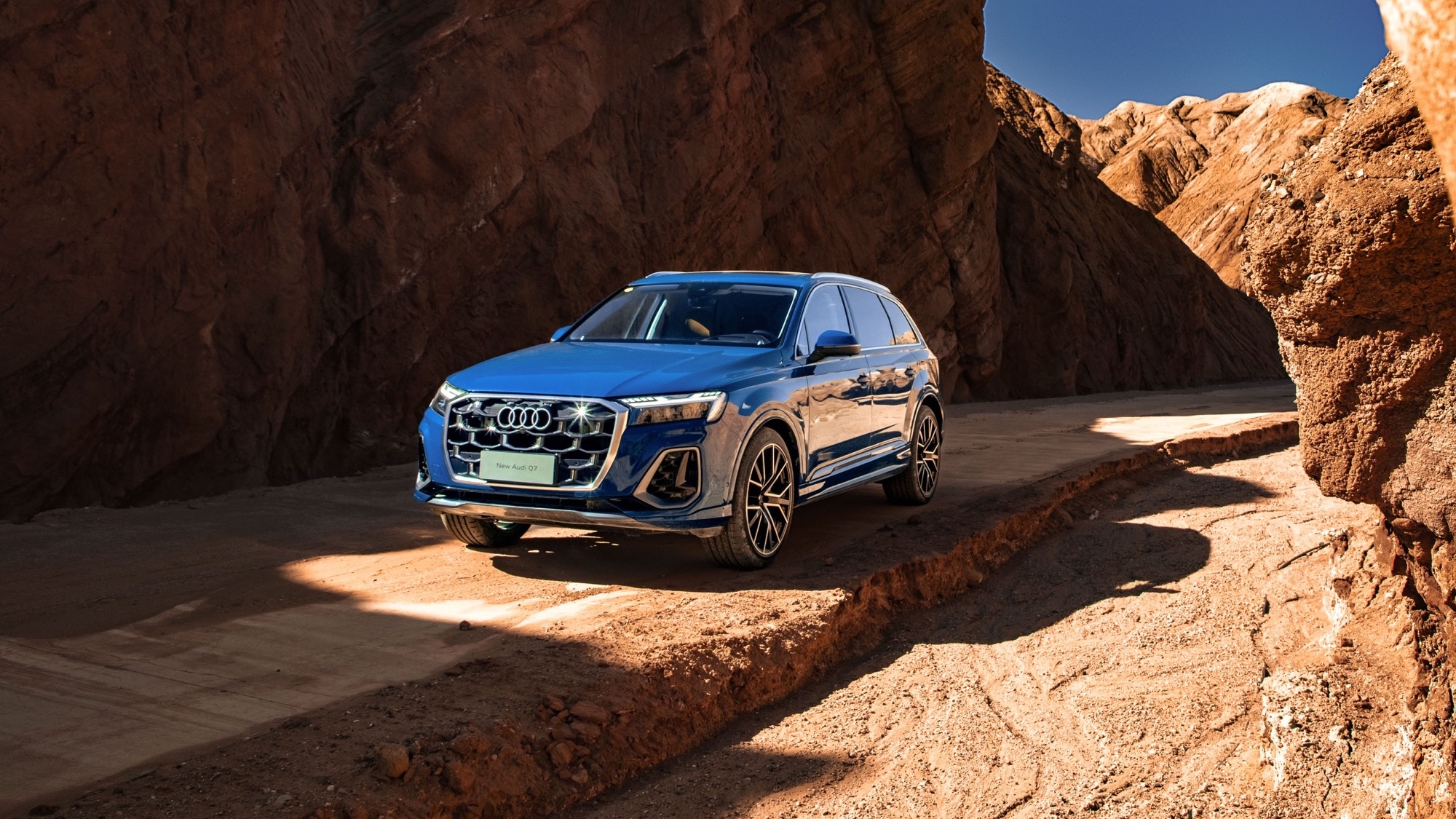
Staying true to the third-generation SUV’s product definition, the 2025 Audi Q7 remains a standard in the family SUV market. Recently, we drove the 2025 Audi Q7 to tackle the “Land Ladder” of the Qinghai-Tibet Circuit, where we could truly appreciate the meaning and value of a Q7.
Commanding Presence of the Flagship SUV
At first glance, the 2025 Audi Q7 may seem like it follows Audi’s family design language, but its presence and distinctiveness unmistakably mark it as a flagship SUV.
The 2025 Audi Q7’s front end features an octagonal integrated grille with an internal structure of a large honeycomb mesh design, reminiscent of the RS family aesthetics. Additionally, the bumper has two large air intakes on either side, further enhancing the aggressive and recognizable nature of the 2025 Q7.

From the side, you can see traces of the original Q7, with its dual waistlines and door sills—classic designs that have been carried forward to date, providing a sense of substantiality. When standing beside a Q7, it’s undeniable that you are in the presence of a large vehicle.
The wheels significantly influence the body’s aesthetics. The 2025 Audi Q7 starts with 21-inch wheels, while the top-tier 55TFSI model comes with 22-inch wheels, ample enough to exude its sporty character.
 Arriving at the rear, a continuous chrome trim combined with flat tail lights echoes the design of the first-generation Q7.

Known as the “light factory” among enthusiasts, the 2025 Audi Q7 is equipped with cutting-edge headlight technology throughout the vehicle.
During daytime driving, the daytime running lights illuminate, with both horizontal and vertical light strips making the Q7 appear sharp. At night, the headlights truly take the stage. The standard 2025 Audi Q7 comes with matrix LED headlights, and the top-tier models boast high-definition matrix LED headlights with Audi laser lights.
High-definition matrix LED headlights offer higher resolution, providing drivers with more precise illumination. The high beams feature laser lights, with an illumination range reaching up to 600 meters, ensuring peace of mind while driving at night.

For the first time, the 2025 Q7 rear features digital OLED tail lights. These lights consist of ultra-thin lighting elements, each composed of numerous independently controllable components. Thanks to this technology, the 2025 Q7’s tail lights can form different patterns, adding a touch of individuality and serving as a symbol of the owner’s identity.
Additionally, the digital OLED tail lights work closely with the driver assistance system. Unlike the “little blue light” preferred by autonomous driving enthusiasts, it is a safety configuration. When the vehicle is stationary and there are road participants within two meters at the rear, the OLED tail lights automatically activate quickly, providing extra warning to other road users and reducing collision risk.
Evidently, the 2025 Audi Q7 features sophisticated design and brand recognition, exuding the powerful aura of a flagship SUV. Whether for family trips or business receptions, the Q7 delivers substantial emotional value.
Take You to “Poetry and Distance”
While the Audi Q7’s exterior design has much to commend, some may question why buy a new car that isn’t a new energy vehicle in this day and age.
According to data from the China Association of Automobile Manufacturers, the penetration rate of new energy vehicles reached 44% in the first half of this year. This indicates that pure fuel vehicles still hold a significant market share and are not merely a “choice for the minority.”
In 2025, choosing a purely fuel-powered Audi Q7 means opting for hassle-free refueling and the stability and reliability of a traditional fuel car.

Today, with ongoing infrastructure improvements, the convenience of refueling fuel vehicles is very close to that of new energy vehicles in urban commuting scenarios, though there is still a gap in refueling efficiency.Certainly, here’s the translated text:
Moreover, Q7 owners are certainly not confined to urban areas; during holidays, family trips are a must. Like our journey with the Q7 on the Qinghai-Tibet ring road, the convenience of recharging new energy vehicles still lags behind the infrastructure available in cities. However, with fuel vehicles, you have no such worries. Its 85 L fuel tank provides enough range for an exhilarating adventure on the Qinghai-Tibet Plateau.
Additionally, if the Q7 serves as a business reception vehicle, its ideal use is to provide excellent service to the onboard VIPs. The most awkward scenario for new energy vehicles—where the boss waits for you to charge—won’t occur with a fuel vehicle.

In terms of performance, the 2025 Audi Q7 features a 3.0 TFSI V6 engine on the 55 TFSI model, delivering a top power of 250 kW and a maximum torque of 500 N·m, allowing you to experience enhanced driving pleasure.
The V6 engine achieves a multidimensional balance of performance, smoothness, and sophistication. On one hand, the V6 engine runs more smoothly, providing a quieter cabin environment and driving quality during daily drives. On the other, when more power is required, the V6 engine delivers a continuous power output, symbolizing a sense of sophistication.
In the transmission department, the 2025 Audi Q7 uses the same 8-speed Tiptronic automatic transmission as the Porsche Cayenne, ensuring efficient and smooth power output while maintaining high-speed cruising efficiency.
Power is only one aspect; the entire 2025 Audi Q7 range is equipped with the mechanical quattro all-wheel drive system, which stands as a technological emblem of Audi.
By default, the pure mechanical torque self-locking center differential quattro all-wheel-drive system distributes 40% of torque to the front axle and 60% to the rear, providing a rear-drive-like driving characteristic with better handling for everyday driving. In extreme conditions, the system can channel up to 70% of torque to the front axle or up to 85% to the rear, enhancing traction.

The essence of this mechanical full-time all-wheel-drive system is to offer drivers a safer and more controllable driving experience.
Regarding the chassis, the 2025 Audi Q7 is robust, featuring aluminum front and rear five-link suspension. Moreover, it comes standard with air suspension across the range, offering a 90 mm adjustment range to accommodate various driving scenarios, from off-road to city streets.
Clearly, whether it’s the convenience of refueling, power, drivetrain, or chassis, the 2025 Audi Q7 possesses strong foundational qualities, remaining a worthy choice for consumers.
Luxury Sensation Remains OnlineNowadays, Chinese families tend to prefer “all-rounders,” combining both features and luxury. As a result, many brands offer heavily equipped models. The Q7 stands apart with not only a wealth of features but also a sense of luxurious quality.
Stepping inside the 2025 Audi Q7, the front seats come standard with ventilation and heating functions. Higher-end models are equipped with Wagner leather and Kreyche leather perforated fabric, as well as seat massage.
Moreover, the main dashboard area of the core 2025 Audi Q7 model is crafted from NAPPA leather. The door armrests and central console trim also use synthetic leather materials. On the top-tier models, a premium extended leather package is available, further increasing the interior leather coverage when selected.

The optional wood trim further enhances the sense of luxury. The 2025 Audi Q7 comes standard with a Lava Brown Eucalyptus wood trim. Optional trims include gray-brown wood, natural silver ash wood fine-grain trim, and high-gloss gray oak trim. The top-end model features standard Audi Exclusive Natural Amber Eucalyptus wood trim. The presence of wood trim significantly elevates the car’s overall luxury feel.
In details not immediately apparent to users, the 2025 Audi Q7 is equally refined. The top-tier model features a four-zone climate control system with an ionizer and allergen filter, ensuring fresh air at all times.
Inside, the standard Bang & Olufsen Luxury 3D sound system with a maximum output of 730 watts can be upgraded to the Bang & Olufsen Supreme 3D sound system with 1,920 watts and 23 speakers. This sound system offers an impressive audio experience, with acoustic prisms rising elegantly as the vehicle starts, combined with active noise cancellation and sound insulation, creating a concert hall-like atmosphere. Additionally, the 2025 Audi Q7’s top-tier model includes standard power-assisted doors, further enhancing its luxury appeal.
Regarding seating and space, the 2025 Audi Q7 provides a 5-seat and a 7-seat configuration, allowing for versatile space arrangements. For instance, in the 7-seat model, the third row features two seats, and the second row has three seats, all foldable. The second-row seats can even fold forward. In the 2025 Audi Q7, passenger and cargo space coexist harmoniously.
Furthermore, folding the rear two rows of seats creates a flat space, suitable for large luggage or as an entertainment and leisure area during family outings.
In terms of technology, the 2025 Audi Q7’s front row is equipped with four screens, including three displays and a HUD. Level 2 assisted driving is also standard.
 In today’s automotive industry, the speed of new vehicle iterations has noticeably increased, with some automakers able to update models three times a year. However, there is no shortcut to luxury.
In Audi’s new car development process, there is the PEP, which spans from project kickoff to mass production delivery over 48 months (4 years). This process focuses not on speed, but on comprehensive quality assurance. Detailing PEP reveals Audi’s commitment to extensive testing across a range of conditions, “two winters, two summers” extreme climate verifications, the stringent evaluation of dedicated systems, and corrosion and durability testing.
Clearly, this represents Audi’s commitment as a leading luxury brand to “long-termism” and “quality first,” as well as its standard of ease across all terrains and enjoyable driving. Thus, upon exploring the interior of the 2025 Audi Q7 in depth, it offers not only visible luxury but also a significant amount of “hidden” luxurious quality.
Conclusion
In 2025, China’s fuel vehicle market remains a market with annual sales in the millions, alongside a substantial user base, making fuel vehicles a worthy choice for users.
As a top luxury brand, the 2025 Audi Q7 is crafted under the “third-generation SUV” concept, merging sportiness, off-road capability, comfort, and versatility in one car. Coincidentally, this “third-generation SUV” concept closely aligns with the blockbuster SUV trend in the Chinese market, showcasing Audi’s foresight in the SUV arena.

Looking forward, the form of energy might not be the key criterion for users when choosing a car, who should simply select what best suits their travel needs. More importantly, the principle of car selection lies in how users understand all-round capability and luxury; merely adding materials doesn’t equate to luxury, and being able to traverse unpaved roads doesn’t define all-round capabilities.
In this era, the 2025 Audi Q7 better defines what all-around capability and luxury are, just as 22 years ago, the “third-generation SUV” concept allowed the Q7 series to continue gaining considerable user approval.
This article is a translation by AI of a Chinese report from 42HOW. If you have any questions about it, please email bd@42how.com.