


Why Tesla's Robotaxi Doesn't Have to Be a Taxi
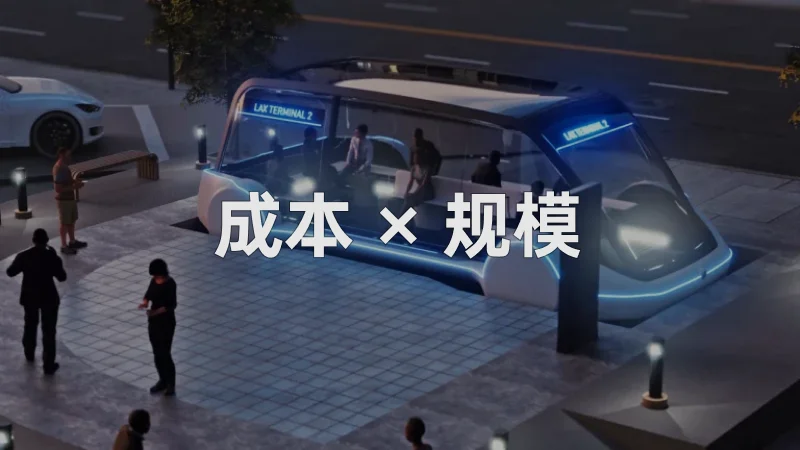
In early April 2022, Elon Musk hinted at Tesla’s development of a vehicle specifically designed for Robotaxi service during the opening ceremony of its Texas factory. Less than two weeks later, during Tesla’s first-quarter earnings call, Musk confirmed that this Robotaxi would feature a design with no steering wheel or pedals, with mass production expected in 2024.
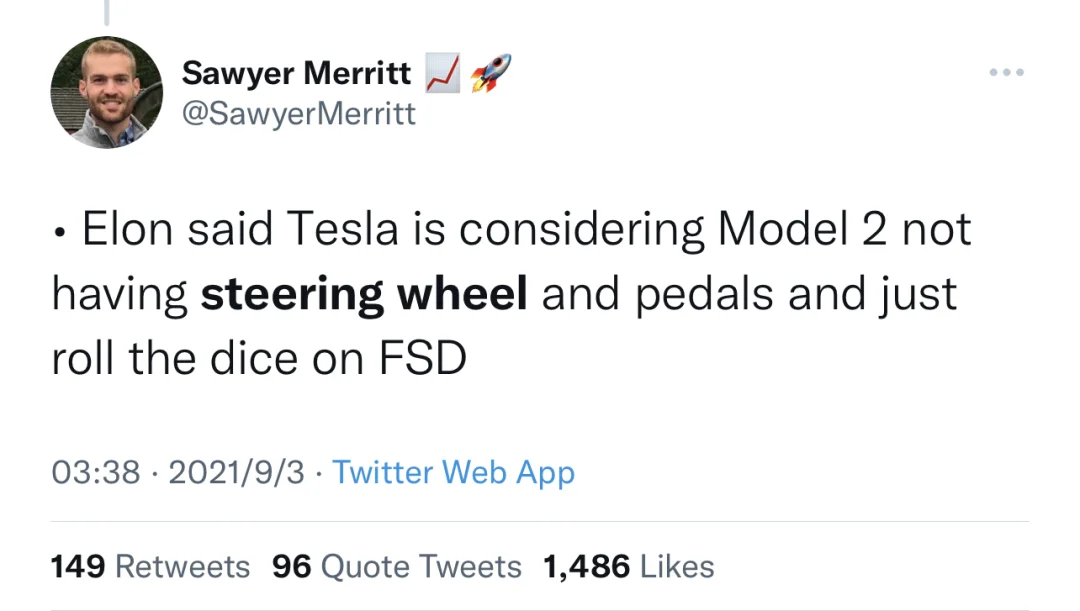
This recalls a September 2021 leak by prominent Tesla insider Sawyer Merritt on Twitter, who reported that Tesla’s planned $25,000 model might also omit a steering wheel and pedals, relying entirely on Full Self-Driving (FSD) for operation. The concept of this affordable vehicle traces back to Tesla’s Battery Day in 2020, where the company expressed its intention to launch a lower-priced $25,000 model once battery costs decreased significantly.
However, closer examination reveals nuance. During Tesla’s full-year 2021 earnings call, Elon Musk explicitly stated that the company is not rushing to bring the $25,000 model to market. This suggests two possibilities: first, the $25,000 vehicle and the Robotaxi may be two distinct models; second, Tesla likely began developing the dedicated Robotaxi platform earlier than previously assumed.
01Why Is Tesla Entering the Robotaxi Business?
According to reports from McKinsey & Company and research data from CICC, the global market potential for autonomous taxi (Robotaxi) services is projected to exceed USD 2 trillion by 2030.
Waymo One, under Google, launched its Robotaxi service in Phoenix, Arizona, in 2018. Cruise, backed by investments from Tongyongqiche, Bentiangongsi and Microsoft, began its operations in 2020. Domestic autonomous driving companies such as Baidu, Pony.ai, Wenyuanzhixing and Didi have also deployed Robotaxi testing programs across multiple cities. Last year, XPENG announced plans to launch its own Robotaxi service in the second half of 2022. As a leading commercial player in autonomous driving, Tesla is unlikely to miss this opportunity, especially given its unmatched cost advantages compared to any other competitor.
Su Jing, chief architect of Huawei’s former BU, stated in a media interview: “I would never do Robotaxi. Companies pursuing Robotaxi at this stage are doomed. Robotaxi is an outcome, not a commercial objective. The ride-hailing experience in China is already excellent, and autonomous driving will not improve it.” This sentiment underscores that the Robotaxi industry faces not only urgent technical challenges in autonomous driving but, more critically, the problem of viable commercialization. For instance, how can high-investment Robotaxi operations escape the trap of exorbitant vehicle and operating costs?
Tesla has consistently adhered to its pure vision-based autonomous driving solution. Compared with other Robotaxi companies’ approaches, Tesla’s pure vision system holds an unparalleled cost advantage. Even the cheapest LiDAR units remain significantly more expensive than multi-megapixel cameras. Retrofitting existing vehicles for Robotaxi service incurs both equipment and modification costs that ultimately result in figures several times higher than Tesla’s approach, which adapts mass-produced vehicles into “Robotaxis.”
Furthermore, Tesla’s autonomous driving ecosystem boasts strong generalization capabilities. Data from its FSD production fleet can be shared with Robotaxi operations. With over one million vehicles equipped with HW3.0 already on the road, once FSD Beta rolls out officially across various regions, no other company worldwide can match Tesla in accumulating real-world driving data or collecting special corner cases efficiently. This positions Tesla to lead competitors in Robotaxi capability iteration, potentially delivering safer, broader-coverage, and more comfortable autonomous driving experiences for users.
Additionally, the Robotaxi business model extends beyond dedicated ride-hailing vehicles to include private cars. Tesla considers allowing owners to rent out their personal vehicles—equipped with Robotaxi capabilities—during idle periods such as work hours, effectively turning them into shared mobility assets. This strategy significantly boosts vehicle utilization efficiency, transforming idle cars into income-generating assets. According to Tesla’s plans, its Robotaxis will also achieve higher energy efficiency, maximizing the value generated per kilowatt-hour and aligning with its mission to accelerate the world’s transition to sustainable energy.
02Why Does Tesla Want to Develop a Dedicated Robotaxi Model?
If you speak with drivers on platforms like Didi about their primary concerns during daily operations, vehicle damage and routine energy costs rank at the top.
The nature of commercial operation vehicles, such as taxis, dictates that they may accumulate annual mileage exceeding that of private cars over five years. The taxi business model essentially relies on capturing the margin between energy consumption and revenue. If vehicle damage costs are high and energy expenses cannot be reduced, such an operational model becomes unsustainable.
During its 2019 Autonomy Day event, Tesla explicitly stated that to extend vehicle lifespan, it would optimize battery systems, electric drive systems, and even tires, aiming for a Robotaxi-ready vehicle life of up to one million miles. Regarding energy efficiency, Model 3 currently achieves 4.5 miles per kWh; Elon Musk hopes the dedicated Robotaxi model will reach at least 5 miles per kWh.
As a vehicle designed purely for operation, the Robotaxi aims to maximize profitability over its entire lifecycle. These modifications reflect a different value orientation compared to consumer vehicles, which is why Tesla has decided to develop a dedicated model for Robotaxi service.
Currently, existing models still fall short of targets in terms of cost and energy efficiency. Furthermore, space utilization is compromised by design principles centered on driving dynamics; this results in unnecessary components such as steering wheels, pedals, instrument clusters, center consoles, and at least four doors occupying cabin space.
Compared to Tesla’s current lineup, the upcoming Robotaxi—confirmed to lack a steering wheel or pedals—will shift its design core from driving to riding. As described in Tesla’s recent '2021 Impact Report,' the Robotaxi will prioritize maximizing energy efficiency, making features like door handles, acceleration performance, and top speed less critical.
Based on this, I offer some predictions regarding Tesla’s yet-to-be-revealed Robotaxi.
Question 1: Will Lidar Be Included?
When observing Robotaxis, whether they are retrofitted vehicles from ride-hailing companies like Waymo, Cruise, and Pony.ai, pre-installed systems from Zoox and Baidu Apollo Moon, or planned models from automaker XPENG, all have adopted lidar. So, should Tesla’s Robotaxi include lidar, or perhaps provide perceptual redundancy for safety?
This point may find some reference in Elon Musk's explanation of Robotaxi at Tesla's 2019 Autonomy Day event. According to Tesla's plan, all models produced after October 2016 are equipped with hardware capable of full self-driving. In the presentation, Elon Musk also explicitly stated that they would recall some Model 3 vehicles and deploy them into the Robotaxi fleet. Of course, owners can also choose to join the Tesla Network platform, allowing their vehicles to be used as Robotaxis when idle.
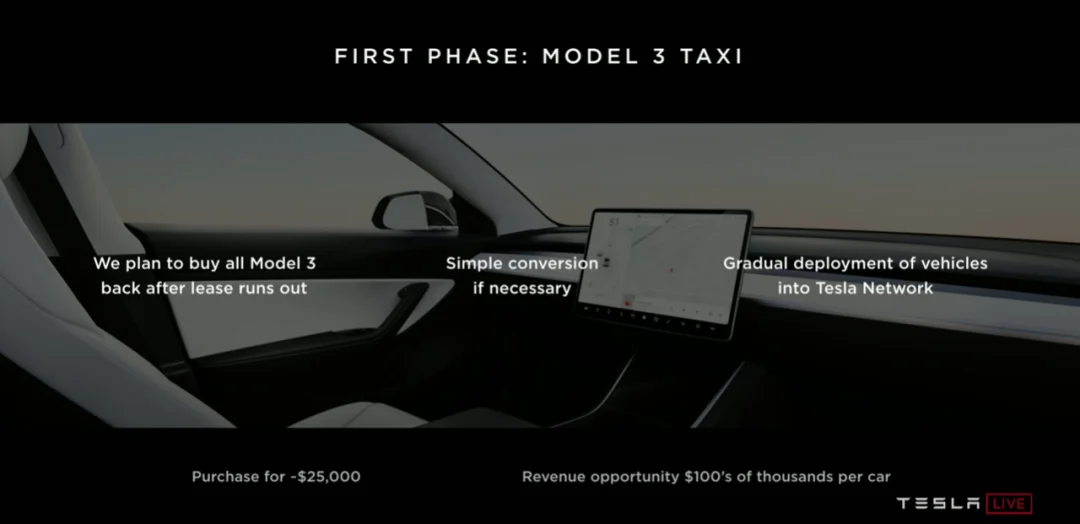
Image source: Screenshot from Tesla’s Autonomy Day video. In other words, Tesla is bound to define this Robotaxi product based on its current pure-vision autonomous driving solution. The still-expensive LiDAR will certainly not be included. As for so-called sensor redundancy, Tesla’s decision to eliminate millimeter-wave radar in the North American market has already made its stance clear.
It must be said that Tesla’s FSD is still some distance away from true Robotaxi capability. Although many test users in the U.S. have shared on social media that their trips have achieved full "zero intervention," the reality is that FSD still legally requires drivers to be ready to take over at any time. The ultimate requirement for a Robotaxi is fully unmanned operation; only when this level is reached can one truly feel confident removing the steering wheel or pedals.
Elon Musk stated at the 2022 earnings call that FSD’s safety would surpass human driving levels this year. Continuous small-version iterations have already enabled FSD to handle more extreme scenarios, which is evident from its coverage expanding to all U.S. states and parts of Canada. Analyzing Tesla’s increased mention frequency of the Robotaxi model over the past six months suggests Elon Musk’s confidence in achieving full autonomy with FSD is growing. The Robotaxi is expected to enter mass production in 2024, leaving Tesla two years. Starting this year, FSD Beta will use this period for rapid iteration and refinement.
Question 2: Will it be sold to consumers?
First, ask yourself a question: If Robotaxis truly arrive, would you be willing to own your own autonomous vehicle?
During the first-quarter earnings call this year, an analyst asked whether the Robotaxi would target the consumer market or if Tesla would use it for its own mobility services. Elon Musk did not answer directly; instead, he employed a delaying tactic, stating that more details would be announced at a future product launch event.
Robotaxi services have long been part of our daily lives. Whether Tesla’s Robotaxi is intended for individual consumers or for commercial mobility service providers is an issue that Tesla must clarify from the outset, as it directly shapes the design philosophy of this autonomous vehicle.
From a business perspective, mobility giants such as Uber, Didi, and Lyft do not directly own vehicles; instead, they shift these costs onto tens of thousands of drivers. Otherwise, any mobility company would easily be burdened by such massive fixed assets.
In its 2016 "Master Plan Part Deux," Tesla outlined in the "Sharing" section that while owners add their vehicles to a shared fleet, Tesla would also deploy its own fleets in areas with high travel demand to enhance user experience.
Additionally, at its 2019 Autonomy Day event, Tesla stated that owners could choose to join their cars in a Robotaxi network, similar to the business models of ride-hailing company Uber or short-term rental platform Airbnb. Tesla would take a commission of approximately 25% to 30% from each order.
From these perspectives, it is highly likely that Tesla's Robotaxis will continue to be sold to individual consumers, with Tesla establishing a shared mobility platform to connect all Robotaxis. This approach would not only boost automotive sales revenue but also generate substantial service fees akin to those earned by ride-hailing platforms.
Whether early horse-drawn carriages, initial steam-powered automobiles, or modern internal combustion and electric vehicles, their fundamental purpose has always been to transport people or goods geographically. However, as autonomous driving becomes a reality, the demand for cars extends beyond simply moving us from point A to point B. Technological advancements are transforming vehicles into extensions of our work and living spaces; people desire to watch movies, play games, and handle work tasks inside the car—a trend already visible in today's smart cockpits.
Furthermore, if the price is reasonable and I can truly trust the vehicle to drive autonomously, I would be very willing to own my own Robotaxi.
Question Three: What Will Cars Without Steering Wheels or Pedals Look Like?
Looking at the global automotive and mobility markets, among models designed from the outset without steering wheels or pedals, the most widely discussed unveiled concept is undoubtedly Zoox.
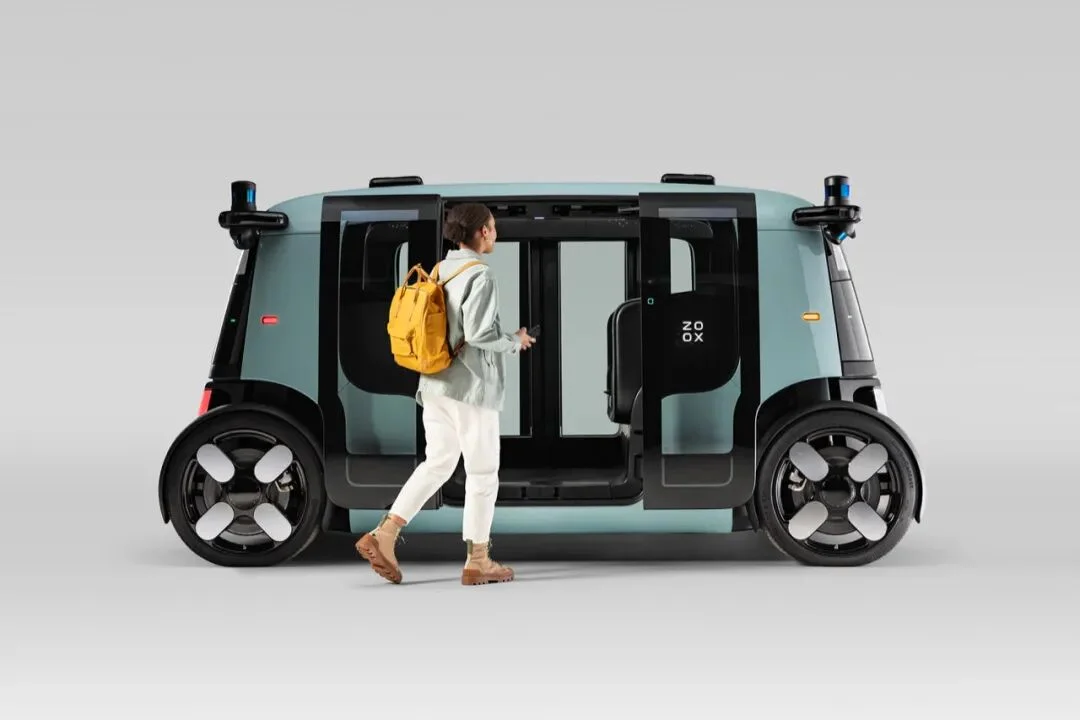
Image source: Zoox official With its mini-bus-like appearance, a design with no distinct front or rear, bus-style side-opening doors, a compact body length of 3,630 mm, an unusually tall height of 1,936 mm, and a four-seat layout with facing seats, this is Zoox’s vision for Robotaxi design. The company was founded in 2014.
True to Zoox’s positioning of this Robotaxi, it is designed for passengers, not drivers. CEO Aicha Evans even emphasized in an interview that it is not a car but a transportation tool, and that Zoox is not an automotive company but a mobility service provider. This Robotaxi will not be sold to the consumer market.
So what kind of design will Tesla’s Robotaxi, which targets the general consumer market, adopt?
At the end of 2020, Tesla Chief Designer Franz was asked by Chinese media whether SUVs, MPVs, and sports cars would become obsolete once Full Self-Driving (FSD) achieved fully autonomous capabilities from a design perspective. Franz replied, "I think history has proven that we hope to have more attractive products. We want to maintain some personalized elements, which is something Tesla has always done. What we least want is for every car to look exactly like a bubble car. We want our products to be attractive and provide you with a fantastic experience."
This is evident from the design philosophy of the Cybertruck. Tesla does not blindly adhere to a fixed design language, whether for exterior or interior. Regarding the design of this Robotaxi, Elon Musk used only one word to describe it: futuristic.
If a Robotaxi does not need to focus too much on door handles, acceleration, or top speed, but instead prioritizes comfort for different groups of people, how should it be designed? How should the interior be arranged if the steering wheel and pedals are removed? Perhaps we can find some answers in Tesla’s existing vehicle features.
Starting with the Model 3, Tesla has been continuously experimenting with how cars should be designed when autonomy arrives. For example, it eliminated the instrument cluster because, during assisted or autonomous driving, occupants do not need to pay close attention to information such as speed. It adopted a horizontal central control screen to facilitate watching videos and playing in-car games. It removed adjustable regenerative braking options to reduce interaction between the driver and the vehicle in terms of control. It added millimeter-wave radar inside the cabin to monitor vital signs and passenger movements. It also added speakers outside the vehicle to enable communication with the outside world through sound.
Furthermore, the automatic gear-shifting feature in the refreshed Model S is further training the vehicle’s ability to reverse and move forward independently. The integration of AMD Ryzen chips makes the in-car gaming experience comparable to a Sony PS5. Moreover, the recently refreshed Model S added the ability to tilt the central control screen left and right, further indicating Tesla’s gradual strengthening of its concept of enhancing the in-car entertainment experience.
For years, Elon Musk has emphasized features such as the Cybertruck’s door-handle-free design with automatic door opening upon recognizing occupants, and its initial lack of side mirrors. Aren’t these preparations for the arrival of autonomous driving?
Based on the above, we can predict that Tesla’s Robotaxi will feature the following:
At least one large horizontal screen. Elon Musk has consistently stressed that in-vehicle entertainment systems will become crucial once autonomous driving arrives, whether for gaming or streaming video. Notably, early this year, reports emerged that Tesla would partner with the gaming platform Steam to introduce a richer selection of games.
A more compact body. Removing the steering wheel and pedals allows designers to maximize interior space. As a Robotaxi is rarely occupied by more than four people, it can be shorter than current models while providing equivalent interior room. This reduction in size also helps lower curb weight and improve energy efficiency.
Longer range. Elon Musk has explicitly stated his hope that the Robotaxi achieves an energy consumption rate of 5 miles per kWh under EPA standards. For a vehicle that is more compact and has fewer components, this target may not be out of reach. Assuming a 75 kWh battery pack, the Robotaxi’s range would exceed 375 miles (600 kilometers). At an average speed of 60 km/h, the vehicle could operate continuously for up to 10 hours.
Single motor. Tesla already possesses the technical capability for automatic shifting, so it does not need to adopt the dual-motor setup used by Zoox, which enables all-wheel drive at any cost. Given its extreme sensitivity to costs, the Tesla Robotaxi does not pursue peak performance; therefore, it will avoid the added expense and unnecessary weight of a second motor.
Reconfigurable interior seating. Franz has noted that interior design after the advent of autonomous driving should reflect what passengers do when they are not driving. Beyond entertainment, rest may be a common desire. Current vehicles are not particularly friendly to those seeking rest, unless they are spacious MPVs. When the Robotaxi is not fully loaded, allowing passengers to take a nap through reconfigurable seat arrangements seems like a viable option.
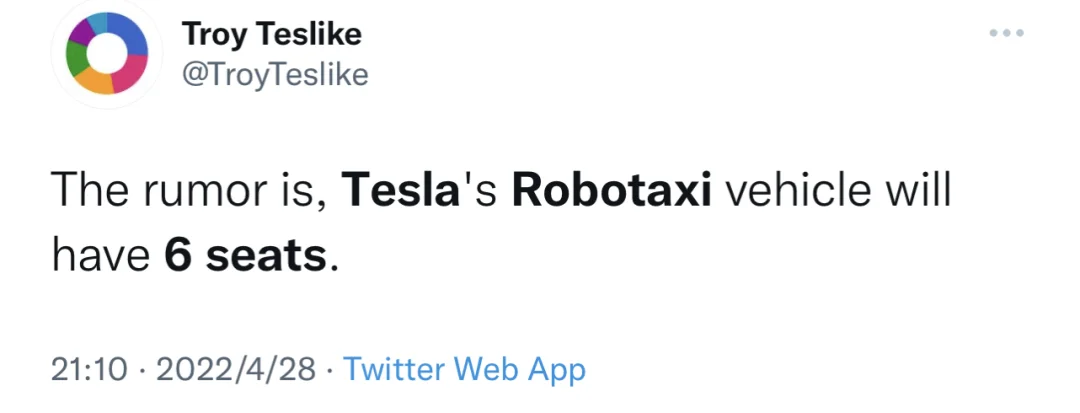
More than one version has emerged. After Elon Musk confirmed the Robotaxi, U.S. analysts leaked that Tesla’s Robotaxi will feature six seats. But does a Robotaxi really need so many seats? This remains questionable.
03Conclusion
After Elon Musk confirmed the launch timeline for the Robotaxi during an earnings call, I revisited his presentation on the Robotaxi at Tesla’s 2019 Autonomy Day. At that time, he had already clearly stated their goal to create a vehicle without a steering wheel or pedals. If they wanted to achieve this quickly, they could simply remove unnecessary components like the steering wheel from existing models. Elon Musk even mentioned that around 2022, the price of such a component-free Robotaxi would not exceed USD 25,000.
Perhaps in 2019, few believed that Tesla—a company struggling to deliver its promised Full Self-Driving (FSD) features on time—would design and develop a dedicated Robotaxi model. However, it now appears that Tesla started early on the Robotaxi path and has never stopped.
Tesla’s Robotaxi: See you in 2024!
Written by: Five-Spoke Wheels Edited by: Reinhardt