


How Can Your Car Do So Much With Just a Voice Command?
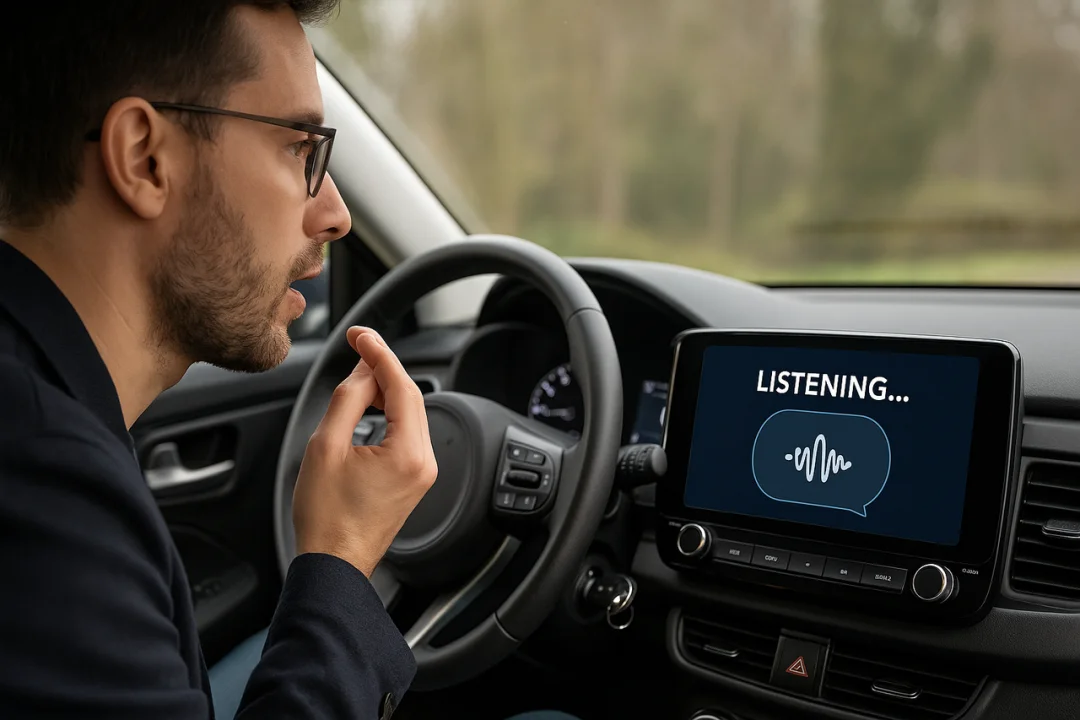
Have you ever considered this: with a smartphone, you can use your hands and eyes to precisely touch and input commands. But in a car, your hands must hold the steering wheel and your eyes must watch the road ahead. So what do you do? The current best solution is intelligent voice interaction, which can replace your touch operations while driving.
According to statistics from Gaishiqiche, by April this year, Sibichi had successfully entered the top two of the voice supplier market installation volume rankings. At the beginning of last year, Sibichi's ranking was fifth; within one year, its market share grew to 15.9%, entering the ranks of leading players.
In 2025, when discussing in-vehicle voice assistants again, the expectations of automakers and users can be summarized with two words: intelligence and deep integration. With the arrival of the AI large model era, what meaningful tasks vehicle voice assistants can perform for occupants remains a topic worthy of in-depth exploration, and Sibichi happens to be a pioneer in the technological implementation of this field.
Recently, we had an in-depth conversation with Zeng Chunhua, Deputy General Manager of Sibichi's Intelligent Automotive Division, to uncover the secrets behind Sibichi's rapid growth over the past year. Riding the wave of AI, Sibichi is making intelligent voice assistants truly reliable partners inside the car.
01Full-Link Voice Solution, Flexible Configuration for Automakers
When we return to the starting point of voice interaction, we can see that early voice interaction was more like a "walkie-talkie." Press the button to wake it up, finish speaking a sentence, and only then will the other side reply. At this stage, there were only single-turn commands, and it could only handle simple instructions.
Today, intelligent voice assistants have evolved to resemble face-to-face human conversation: they operate without a wake word, support continuous interaction, understand context, and can process complex and ambiguous commands in spoken language.
As a core supplier of automotive voice systems in the industry, Sibichi possesses full-chain voice interaction technology.
From basic signal processing, speech recognition, and speech synthesis to advanced multimodal perception and natural language processing, as well as rare full-duplex dialogue and end-to-end large models, Sibichi offers a complete suite of solutions. This means automakers can leverage Sibichi’s capabilities to quickly enhance their intelligent voice experience.
Public information indicates that Sibichi’s intelligent voice solution is currently deeply integrated into more than 200 mass-produced models from over 60 automotive brands, including Mercedes-Benz, Audi, Jaguar Land Rover, BYD, and Shangqitongyongwuling.
However, with so many automakers and models, product definitions will inevitably vary. For Sibichi, this means it can provide automakers with a complete suite of voice interaction capabilities, offer partial capabilities based on specific needs, or customize solutions as required.
Before developing its voice features, Sibichi had two starting points: convenience and safety. According to Zeng Chunhua, the needs of both automakers and users were also fully considered.
For example, if an automaker wants its voice assistant to stand out, Sibichi can co-develop certain capabilities with them.
Uncovering user needs is actually quite difficult. For instance, the "what you see is what you say" feature, which smart car users are already familiar with, originated when automakers noticed that many users were speaking directly to the text displayed on the infotainment screen. According to Zeng Chunhua, Sibichi collaborates with automakers to jointly define product requirements based on such user-driven insights. After determining these requirements, the company first validates a preliminary concept version internally, followed by a gray-scale test, before finally integrating it into mass-produced vehicles.
02Transformation in the AI Era
Now that AI has permeated every corner of our work and daily lives, it has also entered the automotive sector. As voice remains a key interface for smart cockpit interaction, it has naturally become a primary vehicle for deploying large AI models in cars, driving a new wave of upgrades in in-vehicle voice interaction.
Sibichi released DFM-2 Dongfengdamoxing in July 2023, a model with tens of billions of parameters. According to Zeng Chunhua, Tianqinyuyinzhushou, which is based on DFM-2, is already integrated into vehicles from Shangqitongyongwuling, Beiqi, Changcheng, and Yiqibenteng, with more models set for mass production in the future.
The Dongfengdamoxing developed by Sibichi possesses both general capabilities and domain-specific expertise as an industry language model with general intelligence. It enables flexible customization for artificial general intelligence, facilitating large-scale, high-quality, and personalized AI system development.
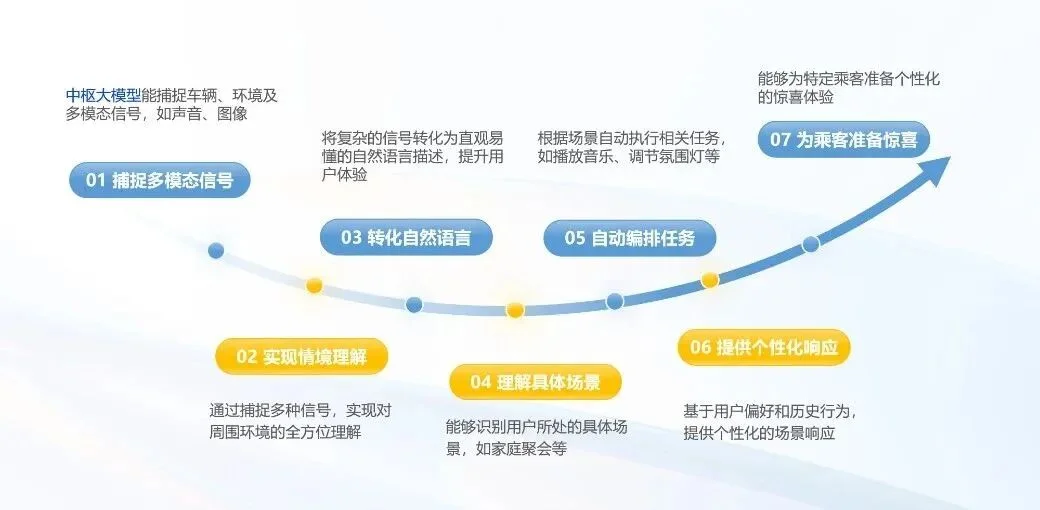
How should large models integrate with smart cockpits? Sibichi has pioneered six core capabilities to answer this question.
Planning and Customization: Provides time-based or sequential planning suggestions for users’ journeys or daily activities.
Content Creation: Delivers emotional and personalized content creation experiences, including games and interactive content designed for children.
Knowledgeable Assistant: Offers rich information across general knowledge and encyclopedic facts through the in-vehicle assistant.
Multi-dimensional Data Integration: The in-vehicle assistant can provide urban traffic restrictions, news, restaurant recommendations, and map navigation, while also accessing closed-domain data such as vehicle control systems and owner’s manuals.
Advanced Semantic Parsing: The in-vehicle assistant features multi-intent, multi-turn dialogue capabilities across diverse scenarios and domains. It supports advanced functions such as task tracking, task interleaving, and generalized parsing.
Document and Knowledge Management: The in-vehicle assistant can summarize, categorize, and synthesize knowledge. It provides information on vehicle usage, fault detection, and maintenance.
To build a more comprehensive in-vehicle assistant, Sibichi proposes the "1 + N Central Large Model" solution. The "1" component leverages various external resources, including large models, while the "N" component consists of N domain-specific "experts" designed to handle highly specialized tasks.
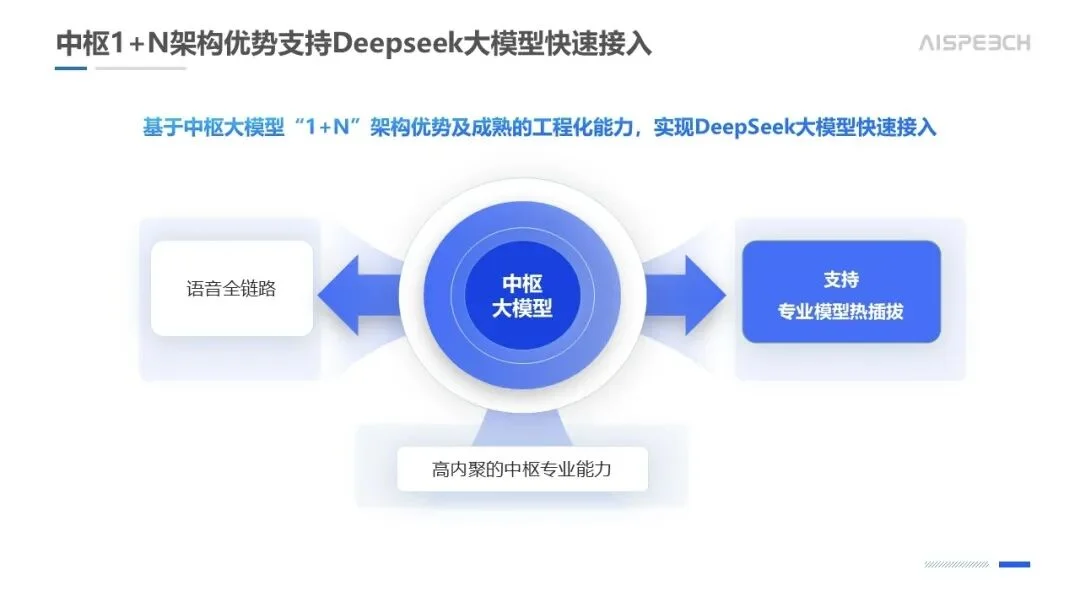
In 2024, Sibichi launched DFM-3, a large model with hundreds of billions of parameters. Zeng Chunhua noted that with iterative technological advancements, DFM-3 has seen significant improvements in deep reasoning capabilities. It can integrate Agent-related functionalities, even combining multiple Agents for joint reasoning and scheduling. This represents a substantial upgrade in capability.
Large models are not limited to intelligent assistant services; Sibichi also possesses end-to-end large model capabilities, which are more efficient than traditional intelligent voice processing chains.
A traditional speech recognition chain involves multiple steps: Automatic Speech Recognition (ASR), Natural Language Understanding (NLU), Dialogue Management, and finally Text-to-Speech (TTS).
However, each step in this process is lossy. Consequently, contextual information, age indicators, emotional cues, and other nuances inherent in human language may be difficult to identify.
End-to-end text-to-speech (TTS) shifts from a multi-segment approach to a single-segment one. When this end-to-end model receives human voice input, it processes everything within a unified model, technically achieving an "audio in, TTS out" capability. In terms of performance, voice assistants can integrate more diverse signals, providing more immediate and emotionally nuanced feedback.
The recent surge in large AI models has nearly transformed every industry, and AI happens to be Sibichi's core competency. Regarding the rapid growth in market share over the past year, Zeng Chunhua said: "We have laid out our presence in the AI industry for many years. While continuously digging deeper into AI scenarios, we are also exploring application scenarios in vertical fields. In the smart vehicle sector, we are working with automakers to drive product implementation."
In Zeng Chunhua's view, the development of AI in future cars will mainly unfold across three levels. First is the technical level, encompassing multimodal interaction, end-to-end voice technology, and cloud-edge collaboration for large models. Second is the user experience level, where voice interaction will gradually shift from a utilitarian tool to an emotional companion or even a life manager, achieving deep integration between people, vehicles, and their environment. Third, given the current abundance of AI tools, the AI ecosystem itself will move toward convergence, enabling more operable and engaging features inside the vehicle.
03A New Engine for Growth: In-Car Solutions Are Going Global
Meanwhile, Sibichi is actively advancing its overseas expansion strategy.
Currently, Sibichi Tianqinyuyinzhushou has integrated its self-developed AI multilingual voice interaction system, supporting more than 20 languages including English, Thai, French, German, Japanese, Korean, Vietnamese, Russian, Spanish, and Norwegian, adapted to the dialects and cultural habits of different regions. At the ICASPP 2023 Guojiduoshuohuarenduoyuzhongyuyinhechengtiaozhansai, Sibichi won championships in two tracks, achieving a MOS score of 4.77.
According to Zeng Chunhua, Sibichi's intelligent automotive business expansion into overseas markets will follow a three-dimensional strategy.
First, Sibichi will support the global expansion of Chinese-branded vehicles by integrating its intelligent voice solutions into export models.
Second, Sibichi is collaborating with overseas and joint-venture brands. On one hand, it is implementing intelligent voice technology in the Chinese market, with progress already made with brands such as Mercedes-Benz and Porsche. On the other hand, leveraging these partnerships in China, it is gradually expanding its intelligent voice technology to overseas markets.
Third, it is partnering with automakers focused solely on overseas markets to expand its presence globally from a worldwide perspective.
Zeng Chunhua stated: 'We currently have many models in development for the first two steps, which are planned and may see a large volume of exports land in the second half of this year. The third point will be a key focus for planning and action from this year through next year.'
04Conclusion
Sibichi’s rapid rise in the highly competitive in-vehicle voice market, supported by comprehensive technical implementation and a global layout, relies on three core capabilities.
On one hand lies the 'hard power' spanning the entire R&D chain—deep accumulation in full-stack self-research and excellent engineering implementation capabilities. This ensures that key technologies, from underlying algorithms to upper-layer applications, remain autonomous and controllable, translating into stable products that meet automotive smart cockpit requirements. On the other hand is the 'soft power' derived from Sibichi’s deep understanding and fulfillment of automakers’ and users’ needs—product support for customization. Whether providing full-link solutions or modular services, it can flexibly adapt to the differentiated positioning and functional requirements of different brands and models. Third is the 'openness' oriented toward the future intelligent ecosystem—the high openness of the product architecture. This is reflected not only in the '1 + N' multi-model integration but also in how the intelligent voice solution can connect to and empower broader intelligent scenarios. It is the organic combination of these three elements that drives Sibichi to remain at the forefront of the industry.
Therefore, when exploring the mystery behind 'simply speaking allows cars to complete complex tasks,' Sibichi’s hard-core full-stack self-research technology, deeply customized product strategy, and open, integrated ecosystem architecture together form the most compelling answer. These three core capabilities not only define Sibichi’s present but will also steer it toward a broader future of intelligent voice interaction, making the voice assistant an indispensable smart companion for every driver and passenger.
Written by James Edited by James