


Can the Single-Motor AVATR 11 Become the Brand's Sales Pillar in the Second Half of the Year?

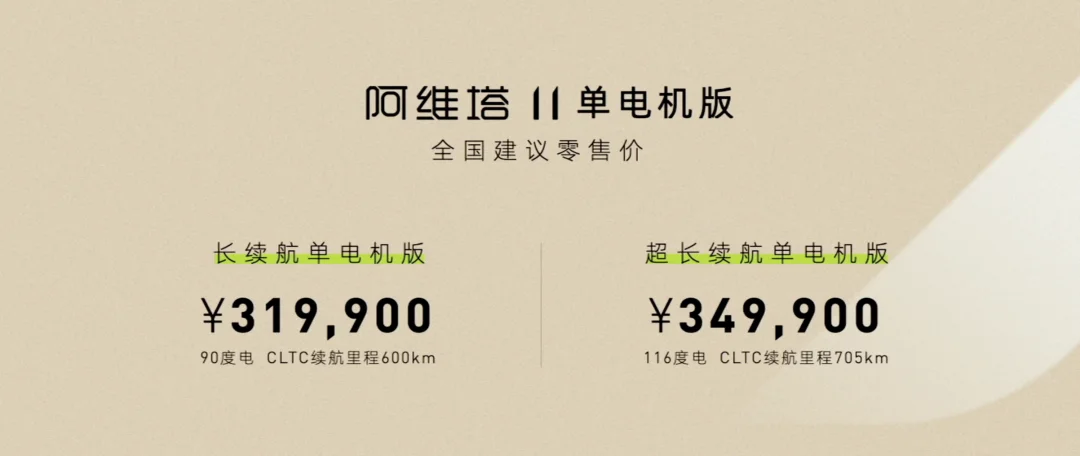
On March 24, AVATR released the single-motor version of the AVATR 11. The single-motor lineup consists of two trims: a 90 kWh variant starting at RMB 319,900 and a 116 kWh variant starting at RMB 349,900.
For AVATR, the single-motor models represent the brand’s most critical strategic move this year.
01Why is this model so crucial for AVATR?
The AVATR 11 was officially launched in August last year with a starting price of RMB 349,900. Because only the dual-motor version was available at launch, the pricing did not create a striking impression on consumers.
Additionally, the benefits offered at launch were limited to a free lifetime upgrade to the advanced autonomous driving package and either free installation of a charging pile or a one-time conversion into 3,000 kWh of free charging.
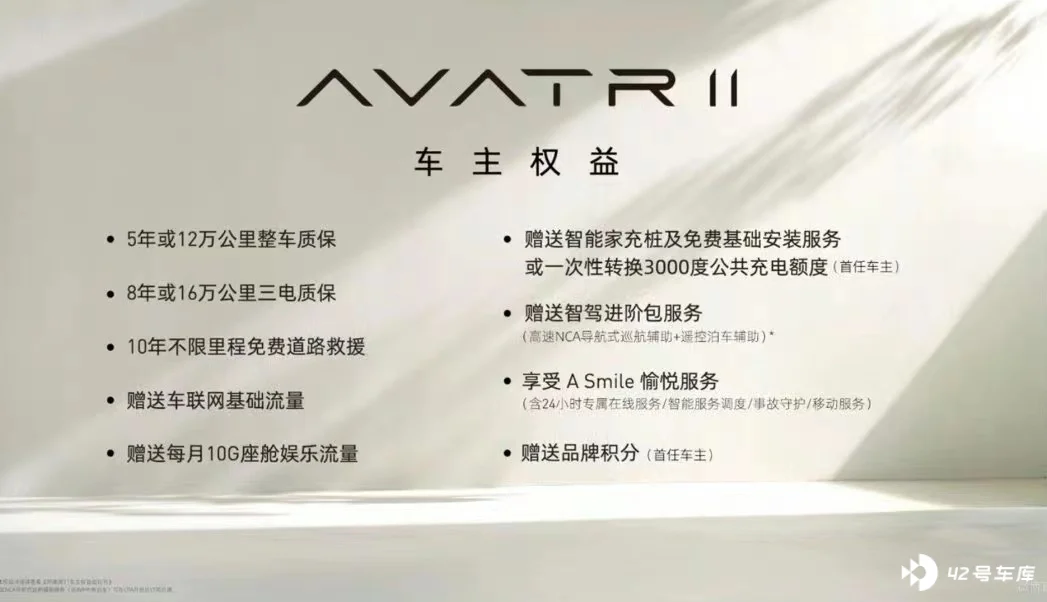
From AVATR's configuration parameters, the price of RMB 349,900 is not expensive. The free lifetime upgrade to the advanced autonomous driving package is also a practical feature. However, for users who have already experienced the Zeekr 001 launch event, their expectations have been raised; they hope to see a price and benefits package that exceed expectations.
The current pricing and benefits for AVATR can at best be described as meeting expectations, or even falling short of them. Therefore, AVATR's initial launch did not generate earth-shattering results.
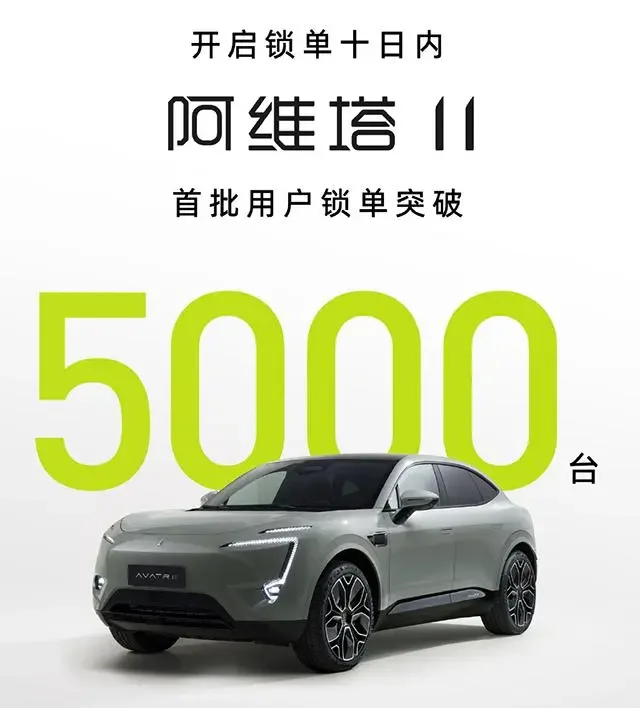
After receiving user feedback, AVATR adjusted the benefits. In November 2022, it secured 5,000 locked orders. To date, AVATR's cumulative delivery volume over three months has reached approximately 6,000 units.
Based on March delivery figures, the AVATR 11 ranked first on the list of China's high-end pure electric SUVs, ahead of the upcoming facelifted NIO ES6 and XPENG's newly launched G9. From this perspective, the AVATR 11 delivered a solid performance.
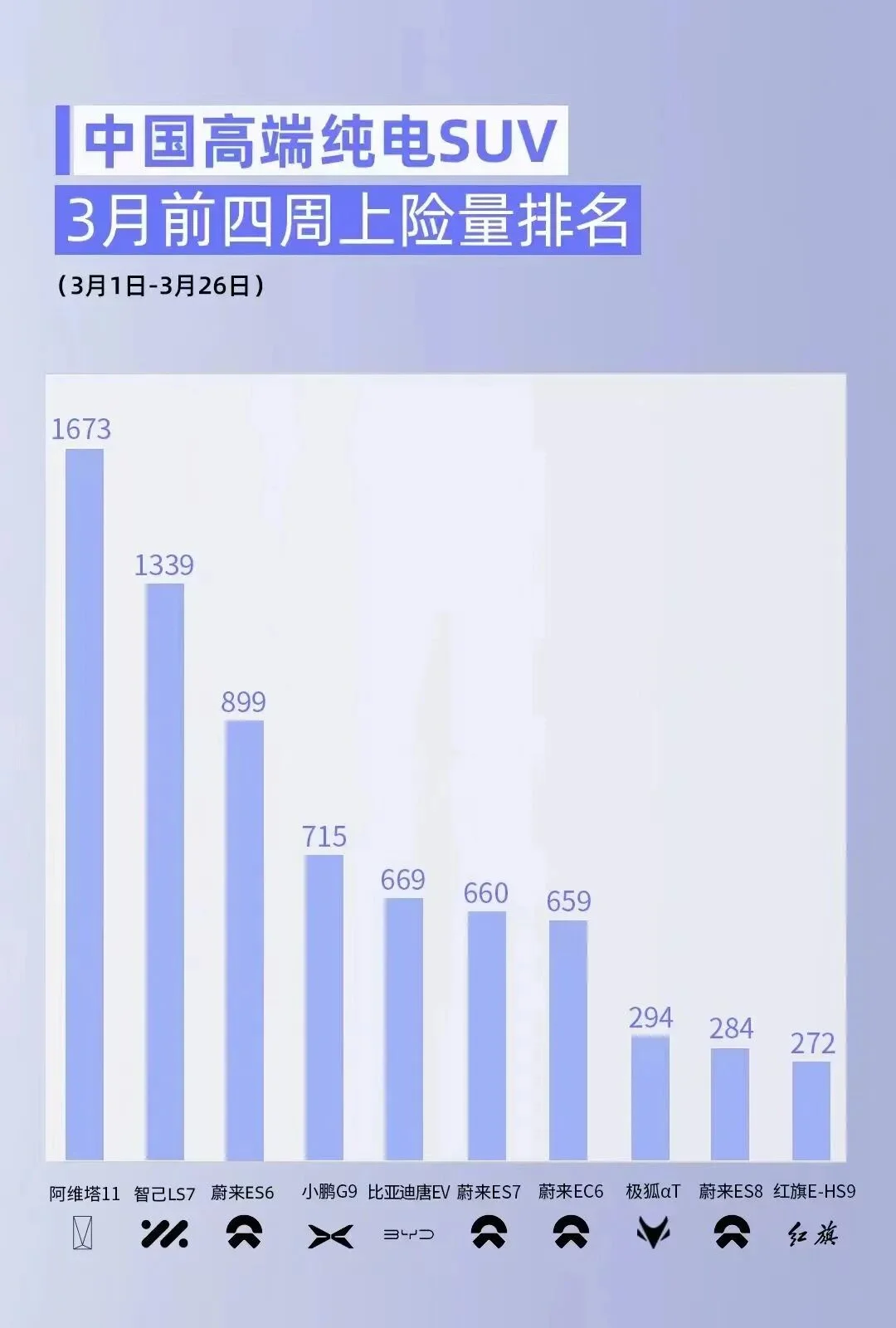
However, looking closely at the "China high-end pure electric SUV" segment, even the top 10 models combined account for only 7,500 units—a volume lower than BMW X5L sells in a single month.
Clearly, such sales figures are far from sufficient for a newly established brand.
AVATR was officially launched in late 2021, backed by Changan, Huawei, and CATL. This alliance aims to secure a competitive position during the new energy and intelligent driving reshuffling of the automotive industry, while achieving upward brand breakthrough for Chinese automakers.
To gain that advantage, strong sales are essential. In today’s market, sales figures act as a magnifying glass and serve as the most direct performance report for any emerging automaker.
For consumers, high sales provide the most immediate validation for a new brand. Greater sales volume signals broader recognition, reducing hesitation when choosing a vehicle.
For automakers, a larger user base translates to higher visibility and lower marketing costs.
Higher sales also reduce per-unit production costs, improving gross margins, while strengthening bargaining power with suppliers. For automakers, this creates a positive feedback loop.
Thus, sales act as a catalyst for an automaker’s growth. In an intensely competitive environment focused on efficiency, such a catalyst becomes increasingly vital.
Furthermore, in the era of intelligence, manufacturers require extensive real-world usage data and feedback from a large user base to continue iterating and enhancing both smart cockpit and autonomous driving capabilities.
Clearly, AVATR executives recognize this necessity.
However, constrained by product development timelines, AVATR's next model, the E12, will not begin deliveries until as early as year-end. Therefore, sales for this period must rely on the 11, making the introduction of a more affordable variant crucial to boost volume.
The card AVATR is playing is the single-motor version of the 11.
This strategy closely mirrors Tesla's approach when the Model 3 first entered the Chinese market: launching a higher-priced dual-motor variant first, then introducing a more affordable long-range single-motor model once market demand softened, to stimulate sales further.
So the new question is: how capable is the AVATR 11 single-motor version, and can it effectively drive sales?
02How capable is the AVATR 11 single-motor version?
First, there is a reasonable price point and a sincere benefits policy.
Regarding pricing, the AVATR 11 single-motor lineup consists of only two trims: a 90 kWh version priced at RMB 319,900, and an 116 kWh version at RMB 349,900. Features such as Nappa leather interior, power doors, fragrance systems, and wheel designs are available only as optional extras.
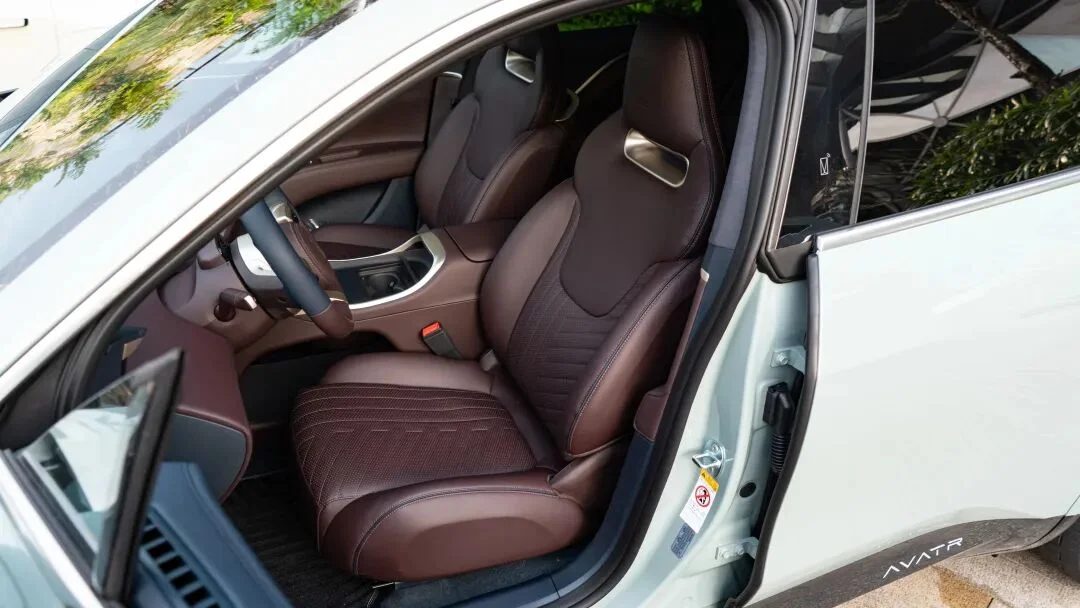
Although the RMB 319,900 price is not as striking as the expected RMB 299,900, the single-motor version differs from the dual-motor version by only one front-mounted 195 kW permanent magnet synchronous motor and an electric rear wing. From a bill-of-materials perspective, the cost savings from these hardware exclusions are far less than RMB 30,000, yet AVATR has priced the new single-motor variant RMB 30,000 lower than the previous dual-motor baseline.
This pricing strategy indicates that AVATR not only deducted basic material costs but also absorbed additional expenses, demonstrating significant sincerity.
Beyond the price reduction, AVATR offers the following incentives:
A RMB 5,000 deposit deducts RMB 10,000 from the purchase price
A complimentary RMB 6,000 insurance subsidy
Interest-free financing for 36 months or a direct RMB 10,000 price reduction for full-payment purchases
A RMB 2,000 discount for existing owners who refer new buyers
An RMB 8,000 upgrade package for seats and cabin features

For buyers ready to purchase outright, a cash discount of RMB 23,000 brings the listed prices of RMB 319,900 and RMB 349,900 down to RMB 296,900 and RMB 326,900, respectively.
AVATR has cleverly delivered this price surprise while maintaining its positioning as a premium brand above RMB 300,000.
The AVATR 11 at RMB 296,900 comes standard with Huawei’s most advanced driver-assistance system, while the RMB 326,900 version features an 116 kWh battery offering over 700 km of range and supports 240 kW ultra-fast charging.
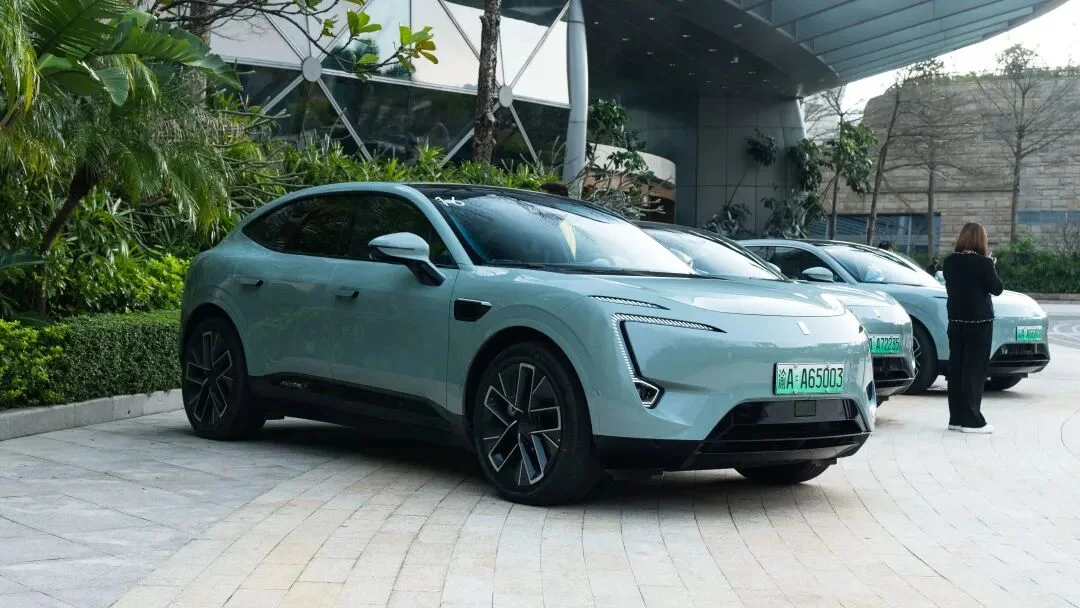
Compared to the XPENG G9 in the same segment, specifically the Max trim with equivalent autonomous driving capabilities, the AVATR 11 boasts a more striking and distinctive design. Its 90 kWh and 116 kWh battery options significantly exceed the G9’s 78 kWh and 98 kWh capacities, all at a lower price point.
However, XPENG’s self-developed voice assistant and Xmart OS infotainment system provide the G9 with a superior smart cabin experience, leaving AVATR with considerable room for improvement in this area.
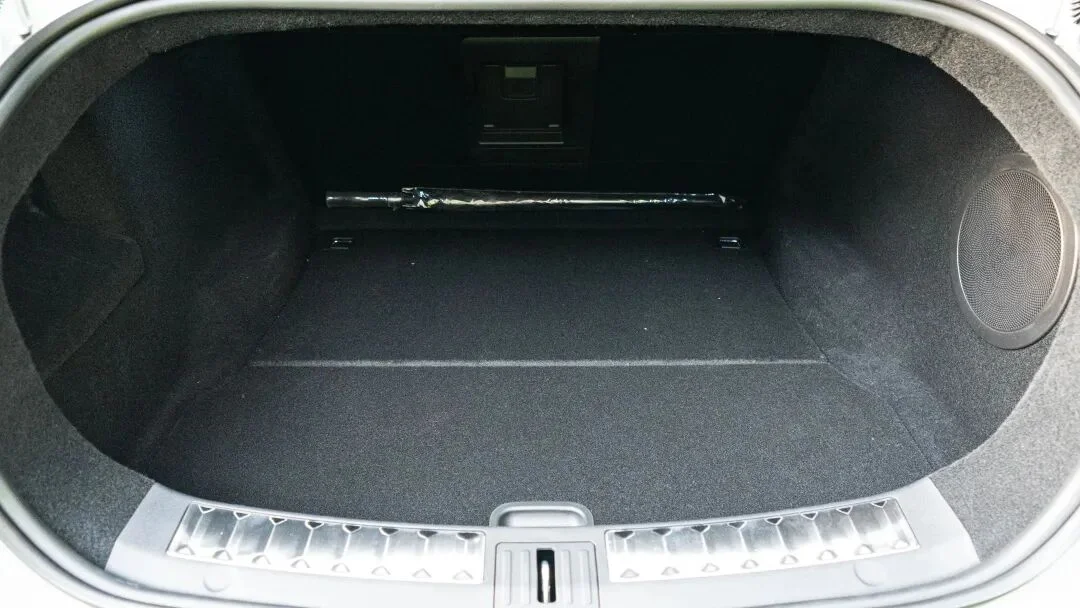
Additionally, due to this styling, the trunk space is only 394 liters, far less than the G9’s 660 liters. The rear seats also lack practicality as they do not fold down.
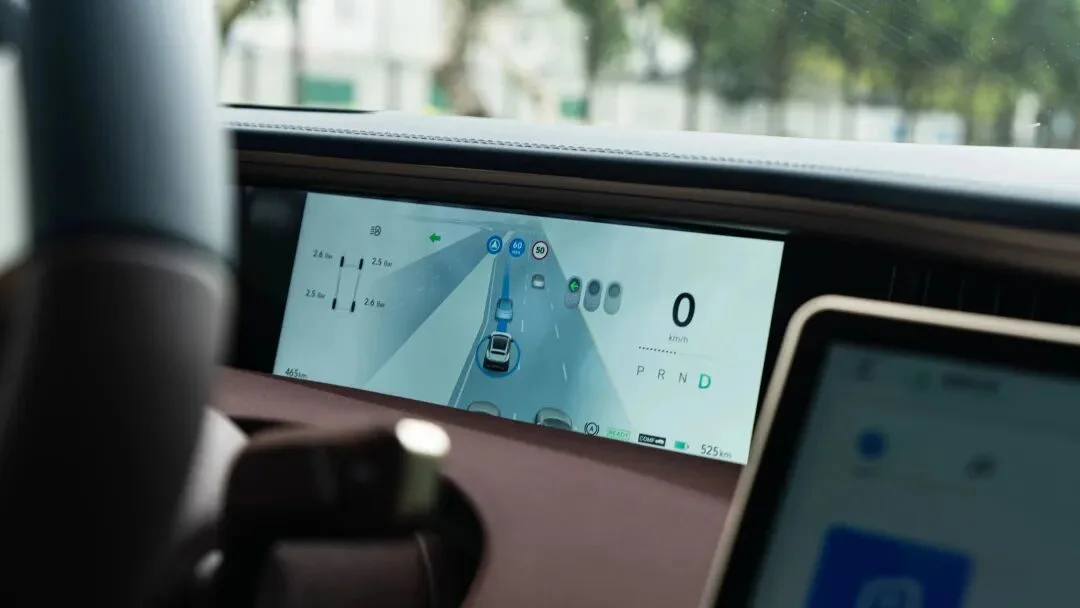
Compared with the Tesla Model Y, the AVATR 11’s 750V electrical architecture enables faster charging. With urban navigation-assisted driving now available in Shanghai, Shenzhen, and Guangzhou, the AVATR 11’s intelligent driving experience significantly surpasses that of the Tesla Model Y.
The Model Y holds a price advantage over the 11.
In the segment where AVATR operates, the 11 boasts clear strengths in four areas: design, range, charging speed, and intelligent driving, securing a solid sales ranking within its category.
The introduction of the single-motor variant carries another significant implication: a lower starting price brings the AVATR 11 into more buyers’ consideration lists, shifting potential customers from “out of budget” to “worth looking at.”
According to the store visit data compiled by Sun Shaojun, the launch of the single-motor AVATR 11 increased orders per store by 15 to 20, representing a doubling in month-on-month growth.
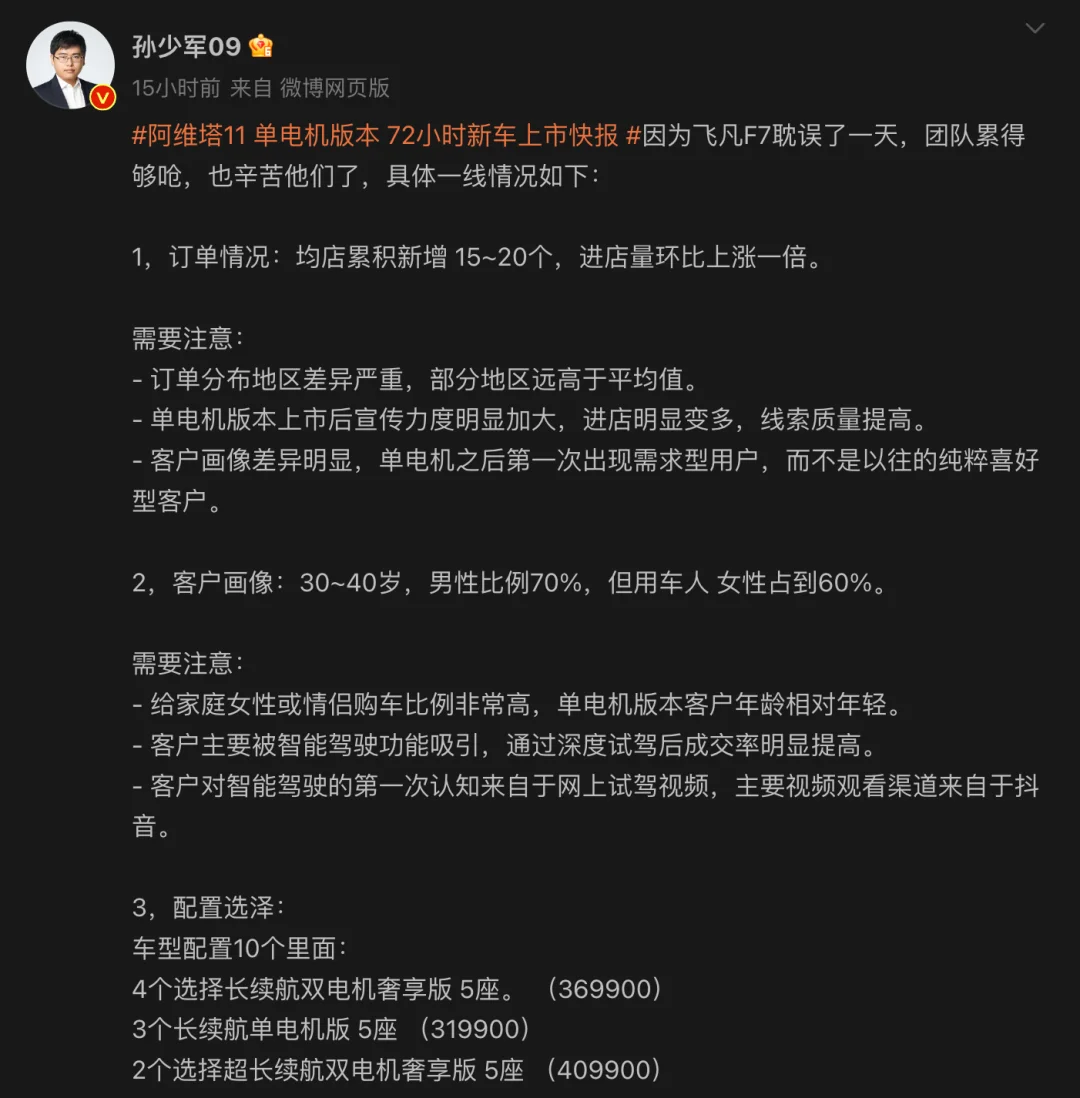
More interestingly, among every 10 new orders, 4 are for the dual-motor version at RMB 369,900, 3 are for the long-range single-motor version at RMB 319,900, and 2 are for the ultra-long-range dual-motor luxury version at RMB 409,900.
Although this data was collected after the launch of the single-motor model, the proportion of dual-motor orders is actually higher. This indicates that the introduction of the single-motor variant helped many users become aware of the AVATR brand; upon visiting showrooms to learn more, they ultimately chose the dual-motor models.
Whether in terms of product capability or marketing impact, the launch of the single-motor version will certainly drive AVATR 11 sales to a new height.
03Conclusion
The launch of the single-motor model was a brief victory in AVATR's campaign, but the strength of a single model is certainly limited. Competing models from NIO, XPENG, and Lixiang ranged from as few as 3 to as many as 6, while traditional brands' new energy vehicle models also entered a phase of rapid proliferation. Lixiang and NIO both set their sales targets for this year at 250,000 units.
China’s automotive market has passed its high-growth phase and has even entered a stage of volume contraction. Although the new energy sector remains vibrant, the entry of new players and the transformation of established ones have intensified competition within the industry.
Therefore, for AVATR, it is necessary not only to address weaknesses such as the poor infotainment experience in the current 11 model to eliminate obvious shortcomings and create a hit vehicle with higher sales, but also to accelerate the pace of launching new models to expand its product matrix.
In this reshuffling phase, only those with strength can remain at the table.
Written by Liu San Edited by Liu San