


XPENG Leads March Deliveries as NIO and Li Auto Navigate Product Cycles
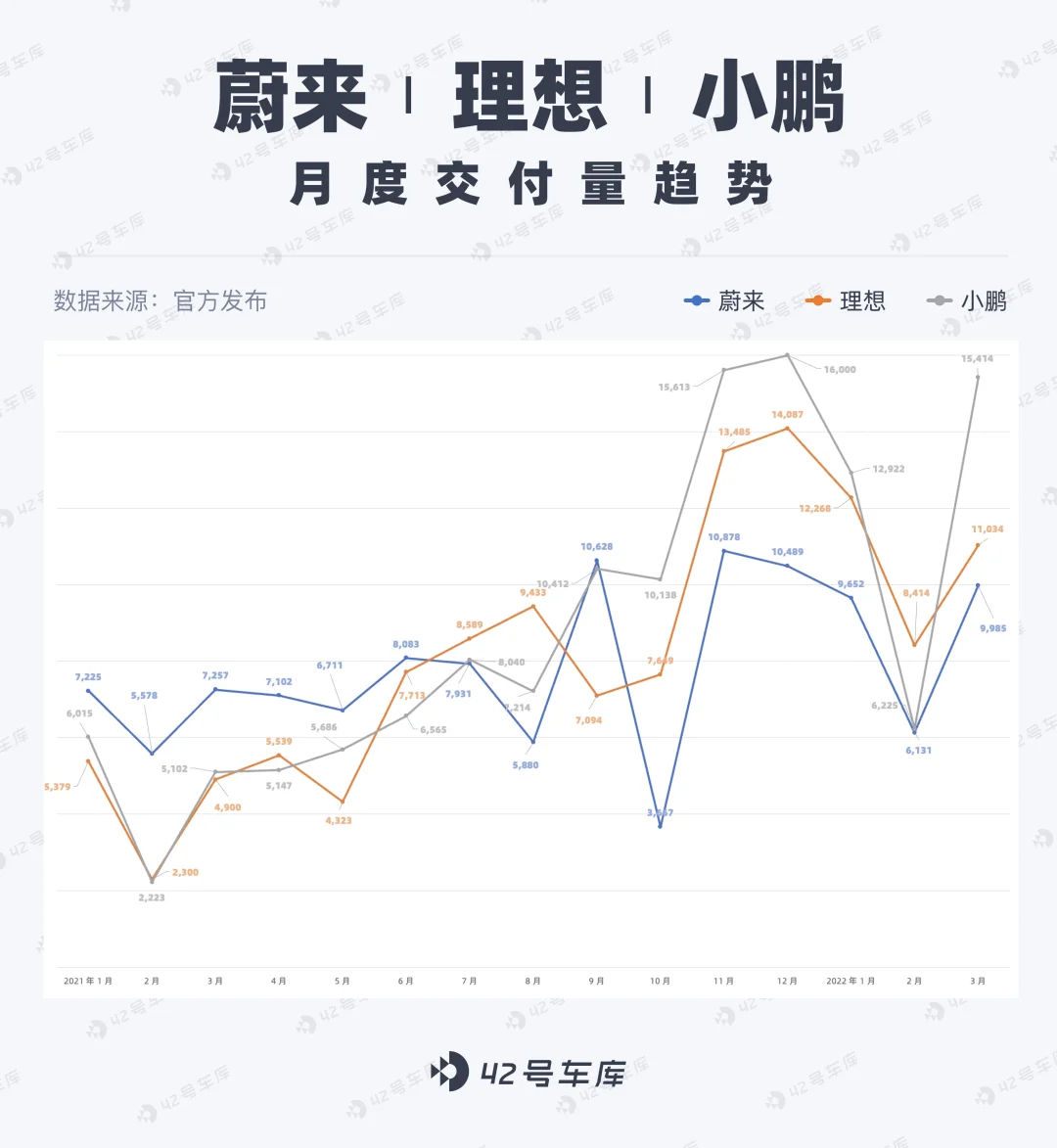
On April 1, Lixiang, NIO, and XPENG successively released their March delivery figures. The results were somewhat surprising:
XPENG delivered 15,414 units, reclaiming the top spot.
Lixiang delivered 11,034 units, ranking second.
NIO delivered 9,985 units, ranking third.
However, looking at the sales trends of these three companies over the past two quarters, it is clear that this situation has persisted for some time.
Why are XPENG’s sales so high? How has Lixiang managed to break the 10,000-unit mark with only one model? And what exactly has happened to NIO’s sales? In the following content, we will briefly analyze these questions.
01Behind the Shift in Rankings
XPENG: A Comeback and a Risky Gamble
XPENG’s March sales, once again exceeding 15,000 units, were strikingly impressive—a leap forward year-over-year.
After reclaiming the top spot in March, XPENG has ranked first among the top three new energy vehicle startups four times in the six months from last October to this month. Five of those months saw monthly deliveries surpass 10,000 units, with a single-month peak of 16,000 units.
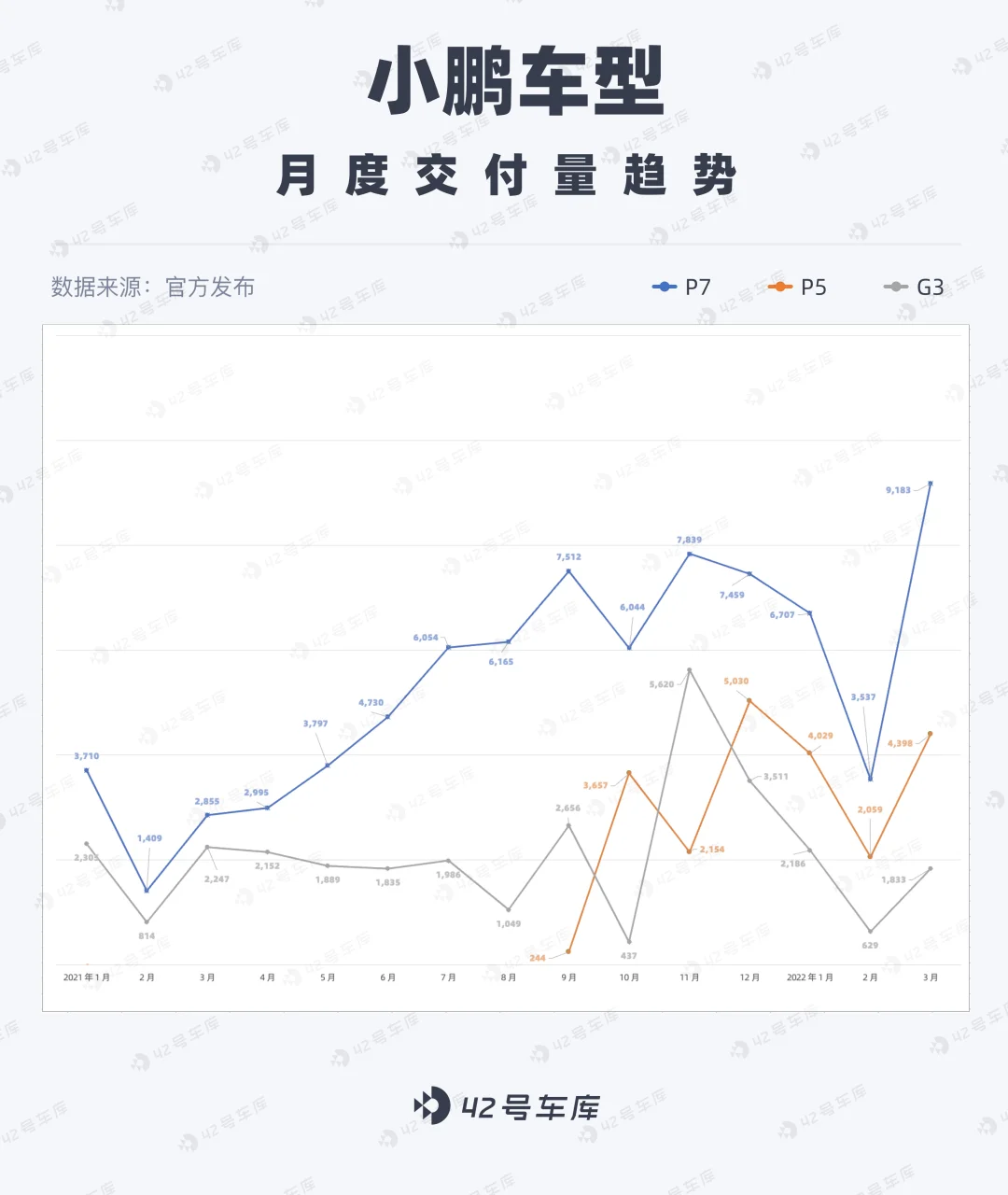
To visualize this trend more clearly, we have compiled a chart showing XPENG’s model-level sales from January 2021 to March 2022. Combined with XPENG’s actions over the past year, we can identify several key drivers behind this growth.
The first reason is the sustained increase in P7 deliveries.
The XPENG P7 officially began deliveries on June 28, 2020, at which time the market's expectations for this vehicle were not particularly high. The primary competing product at that time was the Tesla Model 3, which was still in its "price reduction period." In terms of driving dynamics, brand recognition, and popularity, the XPENG P7 could not compete with the latter. Moreover, XPENG's intelligent technology label was not as prominent then as it is today, so the P7 gave the impression of being a more cost-effective "larger Model 3." In short, the competition was formidable, and the product positioning was somewhat awkward.
After a period of production ramp-up, the P7’s sales stabilized at around 3,000 units per month. This level fluctuated for approximately six months. Starting in April 2021, however, the P7 entered a second growth phase, achieving consecutive month-on-month increases for six months. Monthly sales rose from the 3,000-unit range to the 7,000-unit range, contributing significantly to XPENG’s delivery volume during that period. Subsequently, the P7 returned to a stable phase, with sales hovering around 7,000 units.
In the most recent March, the P7’s sales surged again, reaching a record high of 9,183 units. Breaking the 10,000-unit threshold appeared imminent.
Analyzing the internal drivers behind the P7’s sales growth reveals two primary factors:
XPENG conducted multiple over-the-air (OTA) updates last year. In January, it rolled out NGP (Navigation-guided Pilot), an highway navigation-assisted driving feature, which delivered a standout intelligent driving experience.
In March of last year, XPENG launched a lithium iron phosphate (LFP) battery variant of the P7. The new model came standard with XPLIOT 2.5 and saw its starting price drop by RMB 20,000. Upgrading to XPLIOT 3.0 required only an additional payment of RMB 10,000.
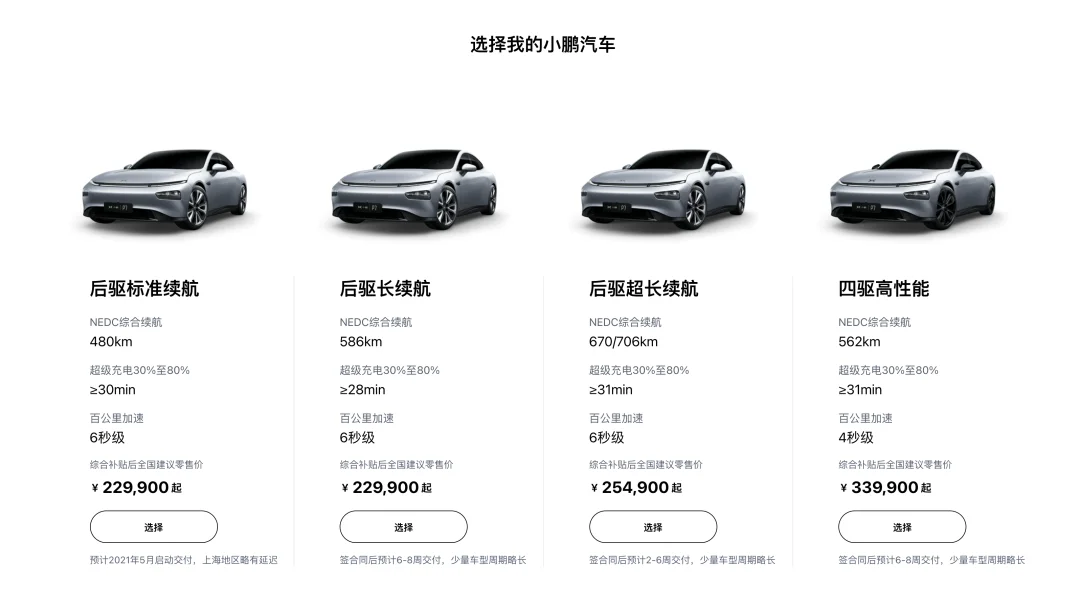
These two internal factors, combined with the overall growth trend of the new energy vehicle market throughout last year, helped the XPENG P7 emerge as the model with the strongest intelligent features in this highly competitive price segment.
Beyond these factors, another reason for XPENG’s rising deliveries was the expansion of its model lineup.
Last year, XPENG released three new models: the G3i, P5, and G9. The G3i and P5 had already achieved deliveries last year. The arrival of these new products brought XPENG another part of growth beyond the P7.
However, aside from a noticeable sales increase in the first few months after the G3i's facelift was delivered, volumes subsequently fell back to the pre-facelift level of 2,000 units per month. Therefore, the genuine sales growth that followed actually came from the P5.
The P5 can be described as XPENG's attempt with a "death wish" spirit. Previously, no independent brand had ever sold a large compact sedan for 200,000 yuan, a price point sufficient to purchase a mid-size sedan from a top-tier joint-venture brand.
Another point to note is that although the P5 offers more overall space and higher specifications, it shares the same platform as the G3i. Within this shared-platform lineup, sedans commanding a higher price than SUVs defies market conventions. Therefore, the P5's market performance will largely indicate whether consumers are willing to pay for intelligent features.
Sales data since the P5 deliveries began suggest XPENG has once again made a winning bet. Over the past four months, the P5, which is priced higher than the G3i, has sold nearly twice as many units. This has created a rare phenomenon in XPENG's current lineup: the more expensive models are selling better, while the cheaper ones are performing worse.
This situation indicates that competition in the current pure electric vehicle market is not a case where "low price solves everything." There are plenty of consumers willing to pay a premium, and among the factors affecting sales volume, comprehensive product strength has begun to outweigh absolute price. The positive correlation between the sales volumes of the P7, P5, and G3i and the product strength of these three vehicles precisely reflects this trend.
Lixiang: The Advantage Lies in Precision
Lixiang's March sales performance was normal. The figure of 11,034 units marks the fourth consecutive month that Lixiang has exceeded ten thousand in sales. As the only enterprise among the top three new energy vehicle makers to rely on a single model for sales over this period, Lixiang's delivery volume has not fallen behind.
The key inflection point for Lixiang's sales growth in 2021 was the delivery of the 2021 Li ONE. Starting in June, monthly deliveries began to climb significantly, setting a new single-month record in its first month post-upgrade. By December, it achieved a record single-month sales volume of 14,087 units, demonstrating the substantial impact of the facelift on sales.
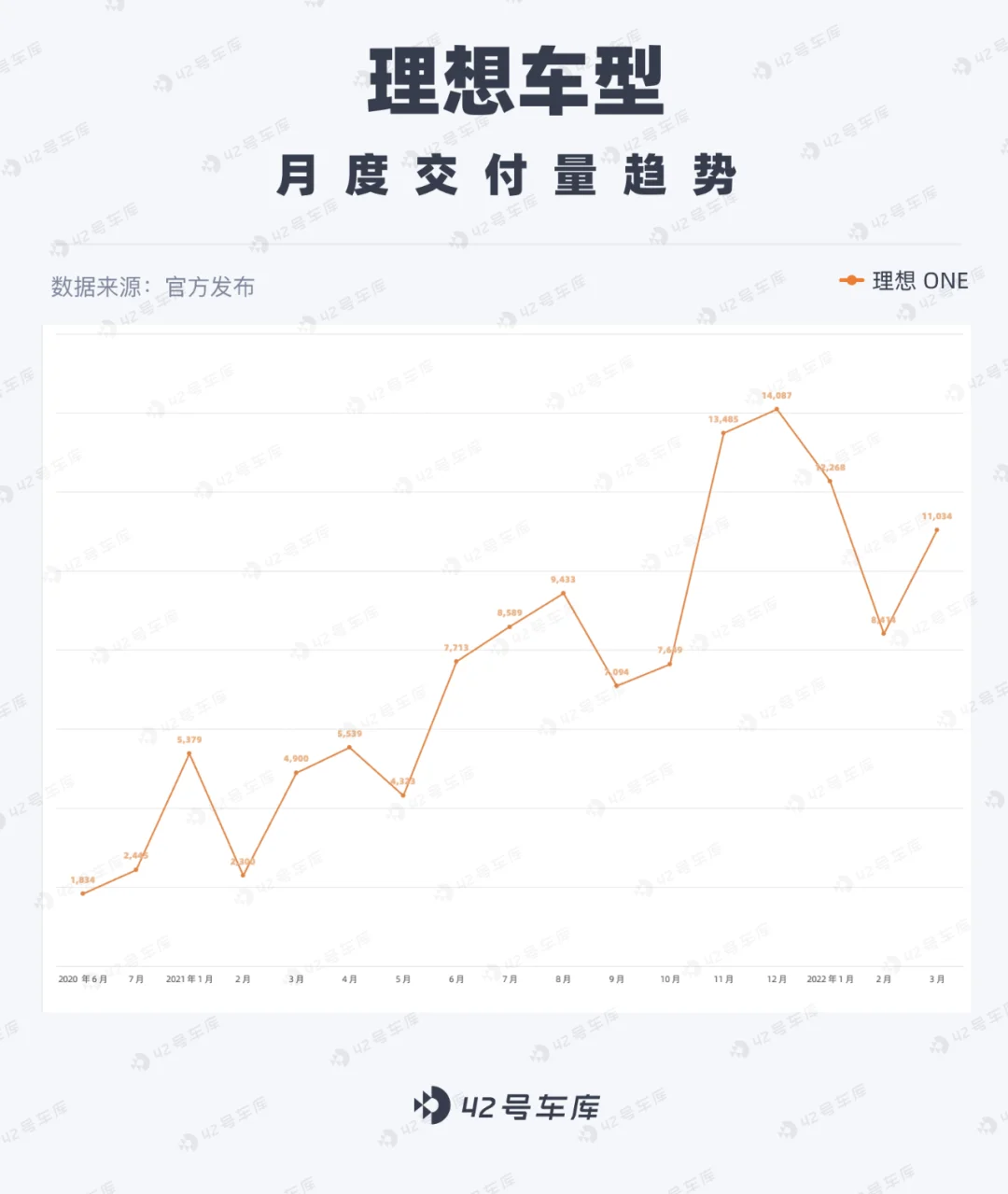
More notably, the 2021 market saw the introduction of several SUVs with similar pricing or positioning, including the Hanlanda, Lufang, Lynk & Co 09, and VOYAH FREE. Despite this crowded competitive landscape, the Li ONE still managed to grow. The direct reason closely tied to this outcome is Lixiang’s highly precise positioning as a vehicle for families with children. This product strategy helped the Li ONE identify key growth drivers by addressing market demand directly, allowing it to withstand various differentiated product competitions.
Additionally, as a large SUV that can run on gasoline, the Li ONE showed strong penetration in lower-tier markets. Its share of sales in non-license-plate-restricted cities increased from approximately 65% in 2020 to about 80% in 2021.
However, it must be acknowledged that the outdated overall architecture also resulted in average performance for the Li ONE in specific areas such as advanced driver assistance and mechanical quality. Comparisons with recently launched models are becoming increasingly challenging, and growth momentum may slow down before the arrival of the new L9.
Overall, the hit-product strategy for the Li ONE yielded solid practical results over the past period. While XPENG pursued victory through intelligence in areas like ADAS and voice interaction, Lixiang’s growth followed more conventional logic, yet remains difficult to fully understand.
NIO: Growing Pains During New-Old Iteration
NIO’s March sales fell just 15 units short of breaking 10,000 for the third time, reflecting an overall performance that was good and within expectations.
Compared with XPENG and Lixiang, NIO delivered 91,429 vehicles in all of 2021, a year-over-year increase of 109.1%. It had the lowest growth rate among the three. In Q1 2022, NIO’s delivery growth was only 28.5%, while XPENG and Lixiang reached 159% and 152.1%, respectively.
The sales chart for individual models also shows that over the past year or so, NIO’s overall trend has been relatively flat despite some monthly fluctuations. The ES6 saw a slight uptick in monthly sales, while the EC6 and ES8 showed almost no significant growth.
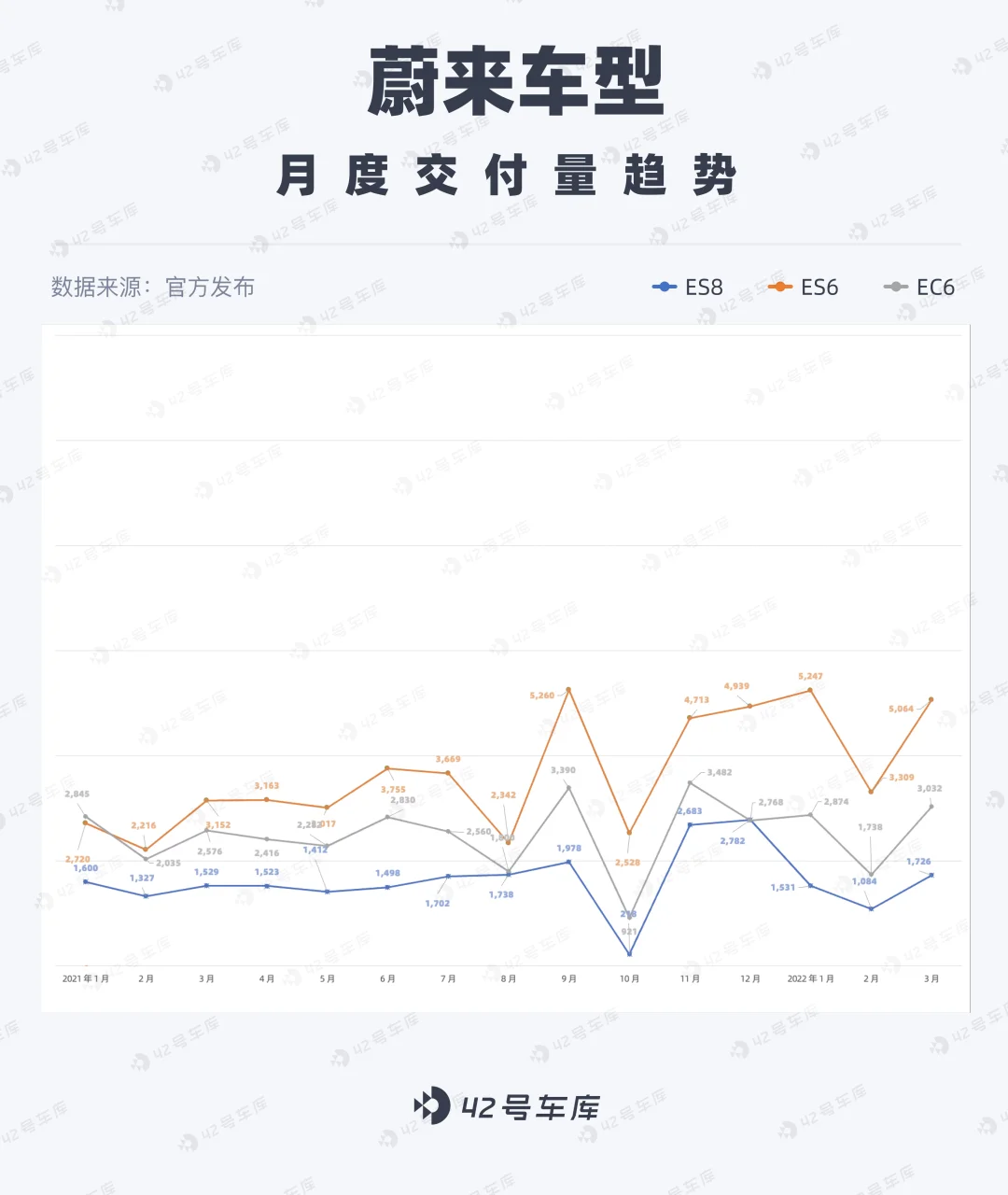
If looking strictly at actual results, NIO’s sales growth has slowed significantly compared to the other two companies. However, behind these results, we must recognize that NIO’s situation involves multiple special factors, primarily including:
NIO’s sales performance in 2020 and Q1 2021 was the best among the top three new-energy automakers, making its year-over-year comparison data the most unfavorable;
Among the top three new-energy brands, only NIO did not update its product lineup in 2021;
NIO’s models have the highest average selling price.
In addition, another very critical external factor limiting NIO’s growth in 2021 was the domestic production of the Tesla Model Y. The arrival of this strong direct competitor greatly increased the substitutability of NIO’s main-selling models, the ES6 and EC6, in the market.
Under the combined effect of these factors, NIO’s growth slowdown is hardly surprising. Looking at it from another angle, in such a challenging market environment, NIO managed to achieve triple-digit growth in 2021 with just three older models—including its sister brand lineup—which is quite an achievement.
NIO made considerable efforts in 2021 to address this. The Battery-as-a-Service (BaaS) model, strategically laid out in 2020, helped lower the purchase threshold for all NIO products—a crucial move. According to NIO’s most recent official data, BaaS penetration has reached 55%. In terms of intelligent driving, Navigation Guided Pilot (NOP) also achieved unexpected success on the older vehicle platforms.
Another equally significant development is NIO’s accelerated construction of its energy infrastructure in 2021. The number of battery swap stations grew from just over 100 at the beginning of the year to more than 700 by year-end. Most of the newly built stations are second-generation swaps, which offer higher efficiency. Coupled with the launch of 100 kWh and 75 kWh batteries, these moves have laid a solid foundation and provided assurance for improved charging experiences.
After all, the 866 model currently on sale has not seen core updates or generational changes for too long, and an objective decline in market competitiveness exists. Therefore, the issue of stagnant growth will only see real improvement after the delivery ramp-up of new vehicles.
Ultimately, the root cause of NIO’s growth slowdown from 2021 to the present lies in the aftermath of 2019. The EC6, released in 2020, was a cost-driven product born out of NIO’s financial crisis, whereas the original plan had been to build a sedan factory in Shanghai. It was precisely the forced pace adjustment in 2019 that created NIO’s product vacuum period in 2021.
But as models like the ET5, ET7, and ES7 roll out this year, NIO is about to end the painful transition period between its old and new product lines.
Summary
As the top three new EV forces have grown stronger over the past few years, each has begun to develop distinct advantages. XPENG targets the mid-to-high-end market with its focus on intelligence, Lixiang wins over family users through precise product definition, and NIO attacks the mainstream luxury market with its premium image and service offerings.
The comparison of sales figures among the three companies has evolved beyond simple numerical contrasts. Evaluation metrics have become increasingly multidimensional, encompassing total volume, incremental growth, average selling price (ASP), model-specific sales, and rankings within sub-segments, each with its own rationale and focus. There is no need to expect that current sales data can definitively predict long-term outcomes ('see a three-year-old in their infancy'). Instead, what truly matters are the differentiated variables and market logic underlying each company's sales performance. With this perspective, we can take a forward-looking look at the 2022 sales projections for the top three new energy vehicle startups.
022022 Forecast: Alternating Leadership Amid Multiple Challenges
Shared Challenges: Subsidy Phase-Out, Pandemic, and Supply Shortages
EV price hikes were a hot topic in the new energy vehicle market during Q1 this year, primarily driven by the phase-out of new energy subsidies and rising battery raw material costs. Among the top three startups, Lixiang has never been eligible for new energy subsidies, while XPENG and NIO have both been affected by these two factors.
Lixiang and XPENG have already announced price increases for their models. The price hike for the Li ONE, combined with demand diversion to the L9, may pose challenges to the Li ONE's growth in the coming months. However, users who purchase before the official price increase takes effect in March will provide some buffer.
Compared to Lixiang, XPENG’s product lineup is more significantly impacted by rising battery raw material costs due to larger battery capacities. Additionally, with a lower ASP relative to the other two brands, the negative impact of price increases on sales volume is theoretically greater, which may be reflected in the sales performance of the P5 and G3i.
NIO has not officially announced any price increases but has recently signaled an intention to adjust its pricing strategy based on market conditions. If battery pack costs continue to rise, it is unlikely that NIO will sustain its current pricing indefinitely.
Equally significant are parts supply constraints and pandemic-related disruptions. Shortages of automotive-grade MCU chips, battery packs, and other components, coupled with the latest wave of infections, pose greater challenges to sales volumes amid the current price increases.
Industry estimates suggest the automotive chip shortage will persist, potentially covering the entire year. In the second half of last year, all three new energy vehicle startups faced supply shortages, and this unfavorable condition will continue to impact growth this year.
The Shanghai epidemic became severe starting in March, and a citywide lockdown began on April 1. Based on insurance registration data from the past few months, the top three new energy vehicle makers are likely to lose approximately 1,000 units of deliveries in Shanghai during March and April, with other regions similarly affected by the epidemic. Fortunately, none of the three new energy vehicle manufacturers have halted production due to the epidemic. If overall capacity is currently insufficient to meet demand, orders from epidemic-affected areas may be partially converted to other regions. However, this is contingent upon effective control of this round of the epidemic, preventing larger-scale lockdowns.
Following a recent shortage of power batteries, XPENG has been the subject of rumors regarding friction with CATL. Currently, XPENG's power battery supply includes SKI, officially announced last year, and Xinwangda, which is rumored to be involved. In anticipation of potential battery shortages during this year's growth phase, XPENG has already taken action. Although NIO and Lixiang have not made major moves, their supply chains are likely making active preparations.
In short, the new energy vehicle market this year offers fewer tailwinds. Industry supply shortages will persist, and the pandemic has injected greater uncertainty into the market. These uncontrollable external variables are highly likely to dictate the growth trajectory of the top three emerging automakers.
Sales Forecast: Alternating Leaders
XPENG's sales leadership, based on our previous analysis, mainly stems from the growth of the P7 and P5. This growth momentum is relatively clear to confirm will continue for at least the P5 in the near future. Comparing NIO with the 866 + ET7 and Lixiang with only one car, if XPENG's P7 sales can stabilize above 8,000 in the short term, then XPENG's chance to defend its title continues.
Next up are the new models from various brands. XPENG is launching the G9 and a facelifted P7. The information regarding the G9 and the facelifted P7 is already known to everyone. As an upgraded model, the facelifted P7 should not see significant price changes; after addressing pain points through optimization and improvements, there is still room for sales growth. The current price of the G9 is unknown, but based on the announced specifications, it can be predicted that it will be a large five-seater in the RMB 300,000 to 400,000 range. This creates some overlap with NIO and Tesla's product lines.
I think the sales volume of G9 is still as hard to predict as previous XPENG models. The actual capabilities of XPILOT 4.0 and the 800 V electrical platform will be quite important for potential customers of this car. XPENG officially announced deliveries in Q3, and the facelifted P7 and G9 this year should bring a combined incremental increase of 30,000 to 50,000 units.
Then there is NIO. The ET7 has already been delivered, and monthly sales are expected to ramp up to 5,000 units in the coming months. With the May facelifted 866 model, NIO will see modest growth before Q3, making it possible to surpass Lixiang or XPENG. Meanwhile, the ET5 has the potential to achieve over 10,000 monthly sales, and NIO's growth will accelerate further once the ES7 is delivered around the same time.
Lixiang's major move this year is the L9. Although its price may exceed RMB 450,000, given the product positioning of this car, its sales volume is likely to surpass that of the 2021 Li ONE. However, before the L9 is delivered in Q3, relying solely on the incremental growth of the 2021 Li ONE, Lixiang’s outlook will not be very optimistic; compared to the other two brands, Lixiang is basically in a defensive stage.
03Conclusion
The first quarter of 2022 has officially concluded. The Beijing Auto Show in Q2 promises a surge of new vehicle launches. The flagship products of the top three new energy automakers will debut simultaneously in Q2 and begin deliveries concurrently in Q3. Before that milestone, sales trends among these three brands are likely to continue patterns established in 2021. Given the rapid evolution of the market and product landscape, this comparison at the tail end of the industry's '1.0 phase' holds limited significance.
The real competition begins in Q3. Against a backdrop of industry-wide supply shortages, fluctuating local pandemic conditions, and rising raw material costs, sales figures will better reflect each manufacturer’s factory capacity and supply chain management capabilities.
From a product perspective, while the top three new energy brands appear to be pursuing different strategies, they face direct competition due to converging intelligent driving routes and overlapping price points. Their growth strategies from the '1.0 phase' must inevitably adapt to this new environment.
The strategy of 'more children make for stronger fighters' requires comparable individual combat skills. The premise that 'lower prices drive sales' assumes product strength exceeds the average for that price segment. The prerequisite for sustained hit models is that product lines do not cannibalize each other.
In my view, all three top new energy brands have the opportunity to reach 200,000 annual sales in 2022. Each currently has distinct advantages and shortcomings. While their strategies and pacing have diverged, their overall capability levels remain within the same tier.
Sales figures, unlike literary criticism, offer clear-cut rankings that are easy to interpret. Delivery volumes will remain a key metric for evaluating the top three new energy vehicle startups. We will continue to monitor each brand’s trajectory and hope that XPENG, Lixiang, and NIO can sustain this healthy competition with even stronger results.
Written by: Reinhardt Edited by: Reinhardt