


WEY Gaoshan 7 Launches at RMB 285,800 as Family-Focused Plug-in Hybrid MPV
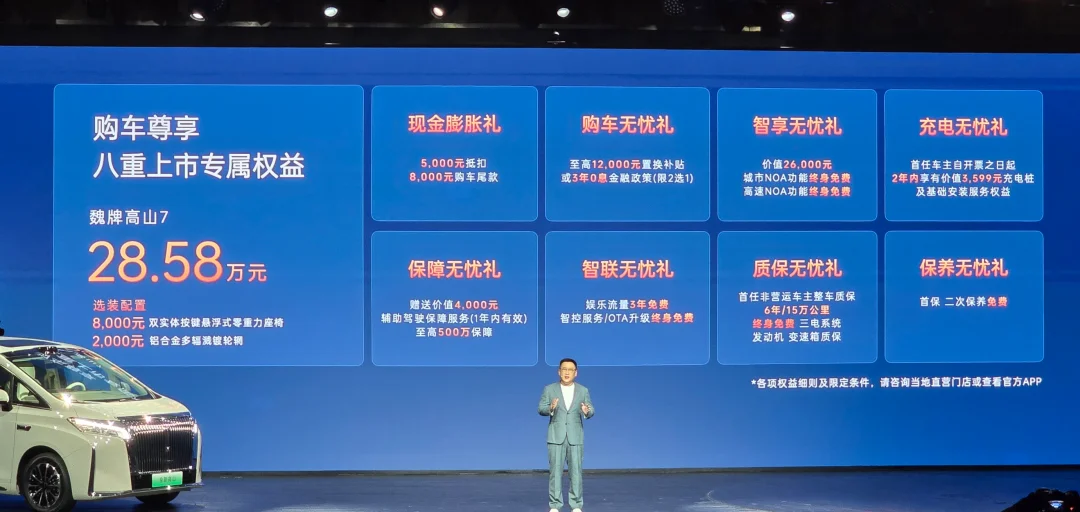
Today, the WEY Gaoshan 7 officially launched with a single trim priced at RMB 285,800. Optional equipment includes dual physical-button floating zero-gravity seats for RMB 8,000 and multi-spoke aluminum alloy wheels with sputtered finish for RMB 2,000.
This is a mid-to-large plug-in hybrid MPV and the smallest model in the new Gaoshan family by price and size.
The vehicle was originally scheduled to debut alongside the Gaoshan 8 and Gaoshan 9 in May this year. However, due to configuration adjustments and other factors, the Gaoshan 7 launch was delayed until today. Compared to the two already-launched models that lean toward business use, the Gaoshan 7 appears tailored more specifically for family users.
According to recent data released by CCRT (China Consumer Research & Evaluation), total MPV sales in China reached approximately 500,000 units in the first half of 2025, representing a year-on-year growth of about 13%. Within this total, the penetration rate of new energy MPVs has exceeded 66.5%. This indicates that in the MPV sub-segment, new energy vehicles are no longer rare; they are becoming one of the mainstream options.
At the same time, consumer demands for MPVs are evolving. As lifestyles diversify, many users expect new energy MPVs to handle mixed scenarios involving commuting, holiday travel, and daily urban passenger and cargo transport.
These shifts present new challenges: range anxiety must be eliminated, power delivery must keep pace, smart cockpits must be user-friendly, and driver assistance systems must be reliable. If an MPV fails to deliver adequate experiences in these core areas, it will struggle to stand out in a market where product differentiation is increasingly difficult.
After years of refinement, the Gaoshan 7 has finally stepped into the spotlight. Can it meet these ever-escalating expectations?
01A Mobile Grand Living Room Where Everyone Has a Good Seat
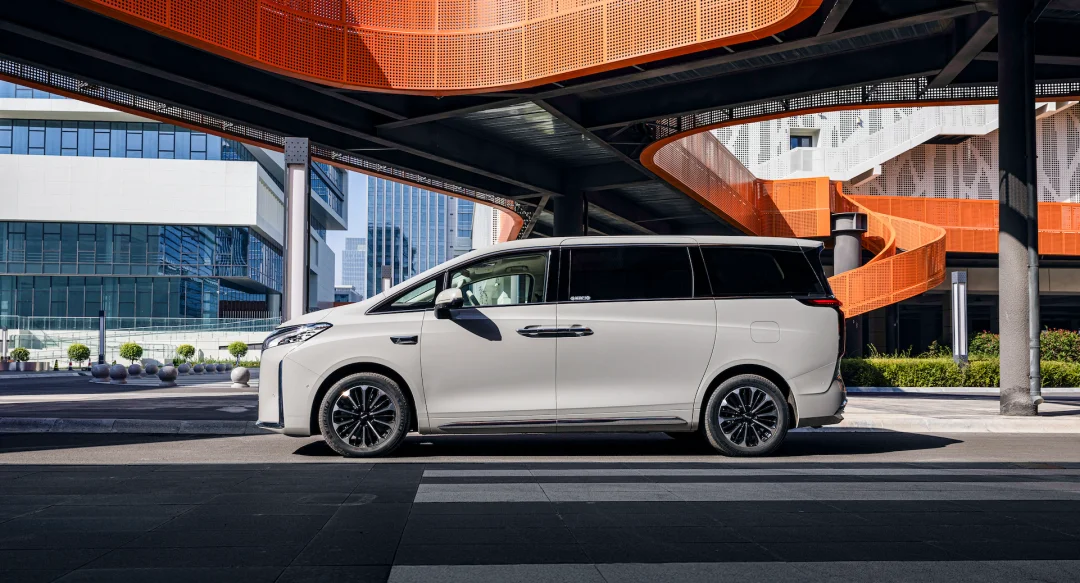
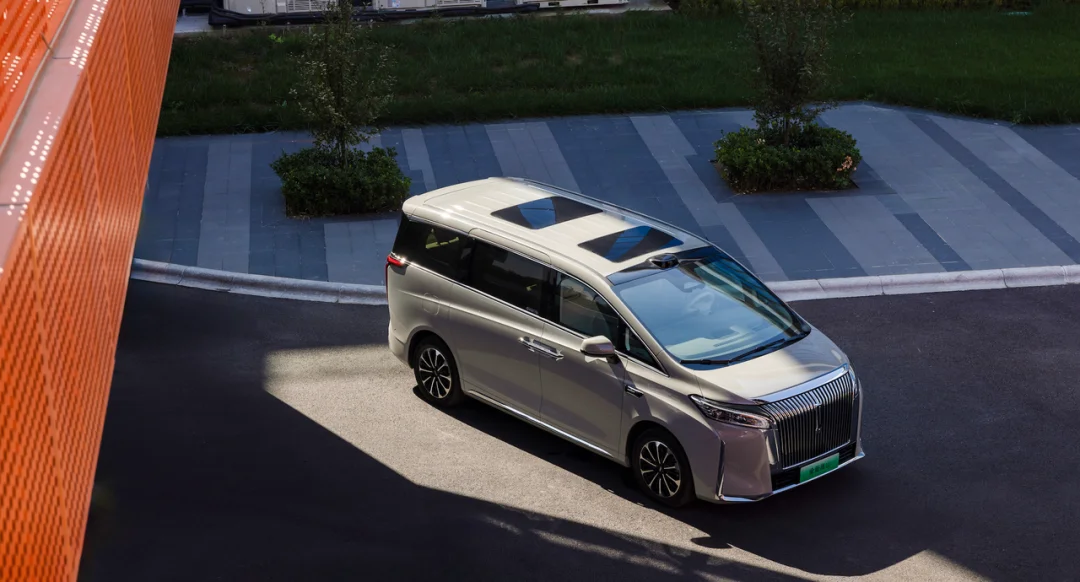
The exterior design of the Gaoshan 7 continues the signature language of the Gaoshan family, featuring a large vertical-slat chrome grille and straight roof lines, ensuring high recognizability. However, it is not merely a downsized version of the Gaoshan 9; rather, through adjusted proportions and refined details, it clarifies its positioning as a vehicle for families.
At today's launch event, WEY CEO Feng Fuzhi outlined the distinctions among the three Gaoshan models: the Gaoshan 9 serves as a flagship suitable for both business and family use, the Gaoshan 8 is designed for larger families, and the newly launched Gaoshan 7 targets younger families. "The relationship between the Gaoshan 7 and 8 is like that between the iPhone Pro and Max; their core functions are similar, but the sizes differ," he said.
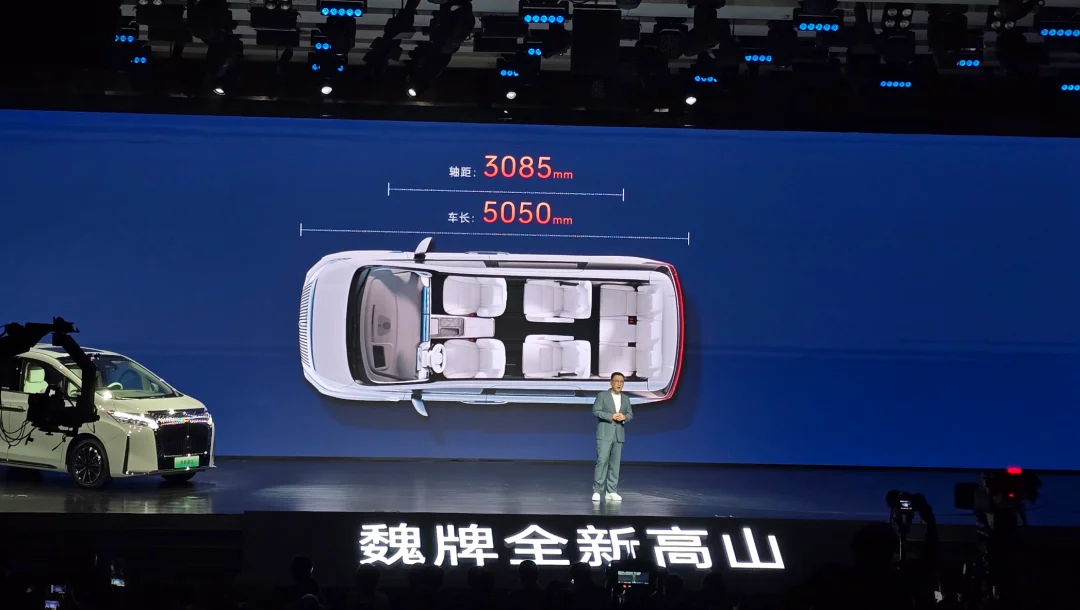
In terms of dimensions, the Gaoshan 7 measures 5,045 mm in length, 1,960 mm in width, and 1,900 mm in height, with a wheelbase of 3,085 mm. It adopts a 2+2+3 seven-seat layout. Compared to the Gaoshan 8, the Gaoshan 7 is 230 mm shorter in length, while the wheelbase has decreased by only 60 mm. This balance preserves spacious interior room while enhancing flexibility for urban commuting scenarios.
Targeting young families, the Gaoshan 7 aims to create a 'mobile grand living room where everyone has a good seat,' investing significant effort into spatial comfort.
First, in terms of space, the Gaoshan 7 achieves a wheelbase-to-length ratio of 61.1%. The flat floor combined with a front-and-rear shared rail design allows the second- and third-row seats to slide flexibly, with a rail length of 1.84 meters. When the third row is not in use, it can be folded down with one button to expand trunk space. The maximum legroom in the third row reaches 1,285 mm, offering a seating posture closer to that of the front rows and avoiding the awkwardness of knees pressing against the seatback. The second row features dual independent seats, supporting electric leg rests, ventilation, heating, and optional zero-gravity massage seats, along with adjustable double armrests that offer both angle and length customization.
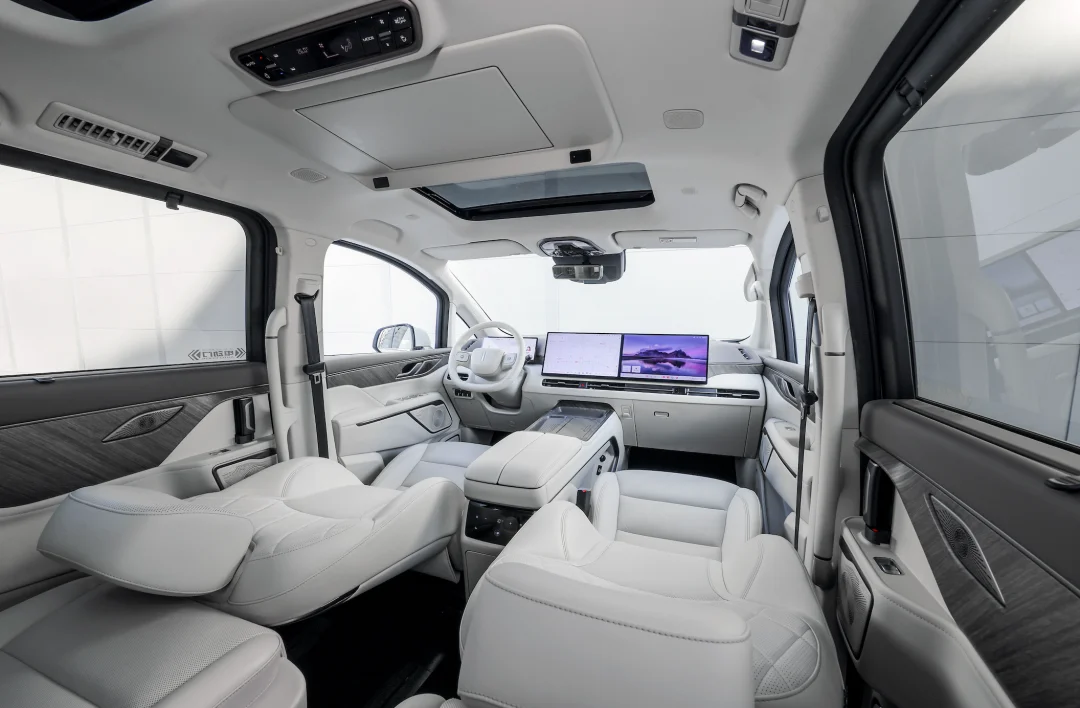
Another detail is that the third row features large side windows, which are uncommon in this class. Each window has an area of 0.365 square meters, improving visibility and reducing the sense of confinement for rear passengers.
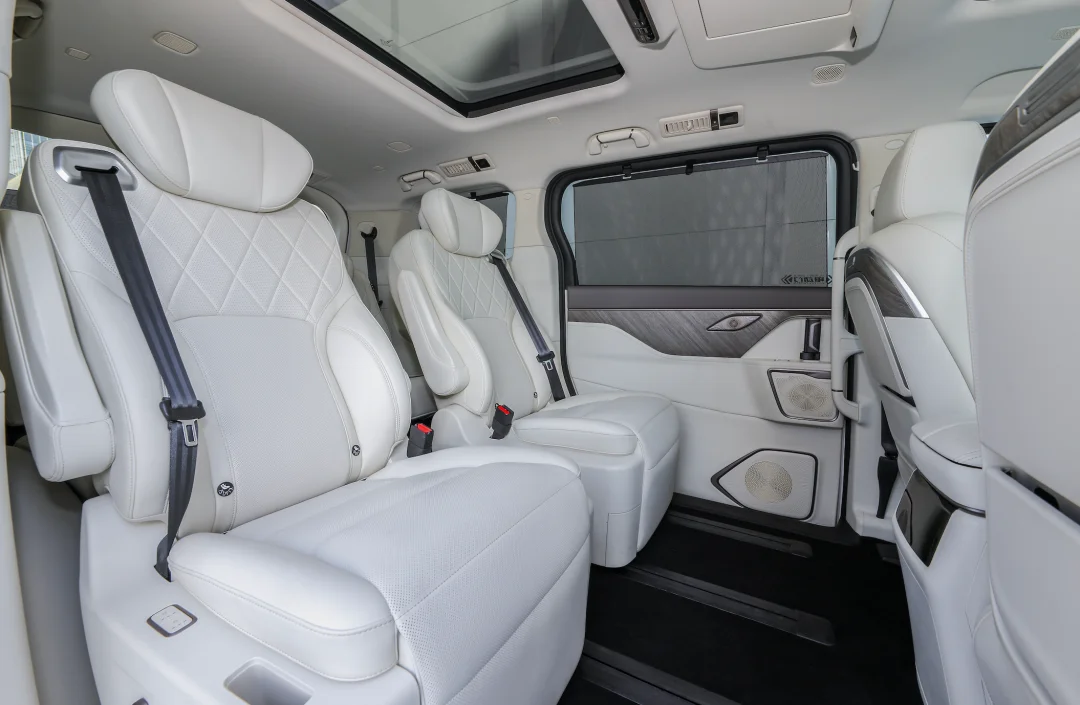
In terms of comfort features, the Gaoshan 7 maintains a high standard: it comes standard with 23 speakers (including driver's seat headrest audio), a 12.5 L onboard compressor refrigerator (adjustable range 0-50℃), second and third-row sunshades, three-zone automatic air conditioning, negative ion air purification, and more. The refrigerator features a two-tier design capable of holding over ten bottles of beverages, meeting the needs of all occupants during long trips; all speakers use rare-earth strong magnetic magnets, with a peak power of 2,440 W, consistent with the Gaoshan 8 and Gaoshan 9.
02Can MPVs Be Maneuverable Too?
The stereotype of MPVs is often that they are bulky, turn slowly, and are difficult to park. Especially in the eyes of urban commuters, drivers on narrow roads, or novice drivers, these vehicles are hard to associate with agility. But the Gaoshan 7 aims to make agility no longer a shortcoming of MPVs through a complete chassis and three-electric system configuration.
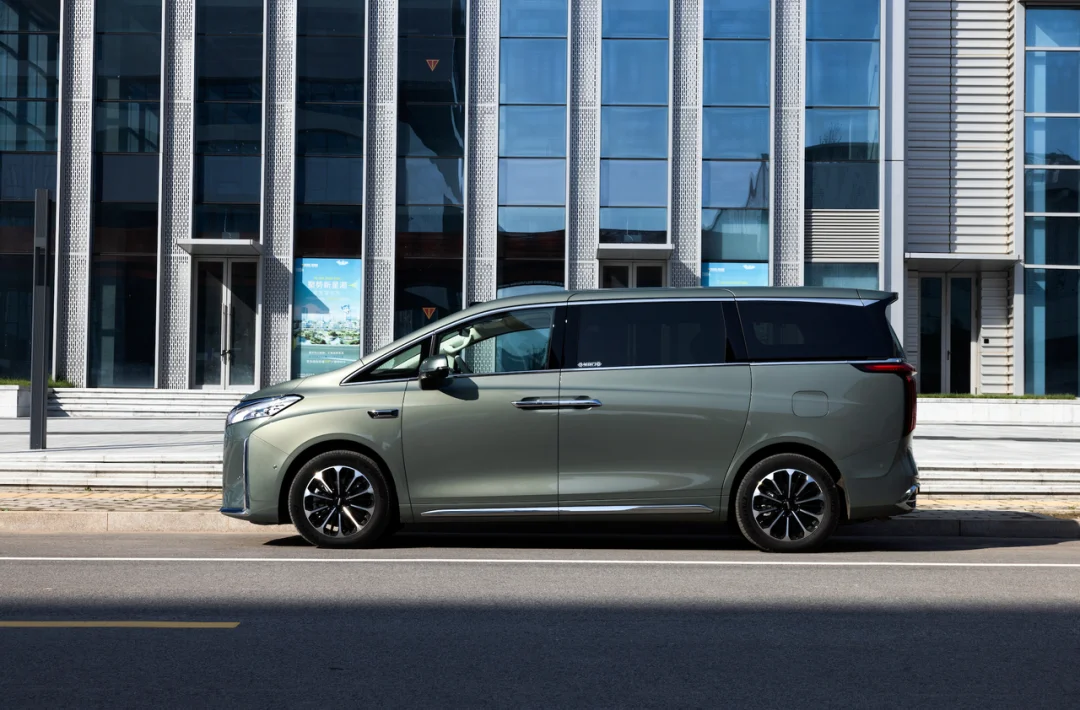
First, in terms of the three-electric architecture, the Gaoshan 7 is equipped with the Chaoji Hi4 four-wheel-drive electric hybrid technology. The powertrain delivers a maximum power of 337 kW and a peak torque of 644 N·m, matching the performance parameters of a V8 engine in a conventional fuel vehicle. The zero-to-100 km/h acceleration time is 5.7 seconds with a full charge, and remains at 5.8 seconds even under depleted battery conditions, which is already a high level for MPV models.
This power delivery translates to brisk starts and decisive lane changes in real-world driving. Even when fully loaded, the vehicle responds instantly on undulating roads and during high-speed overtaking.
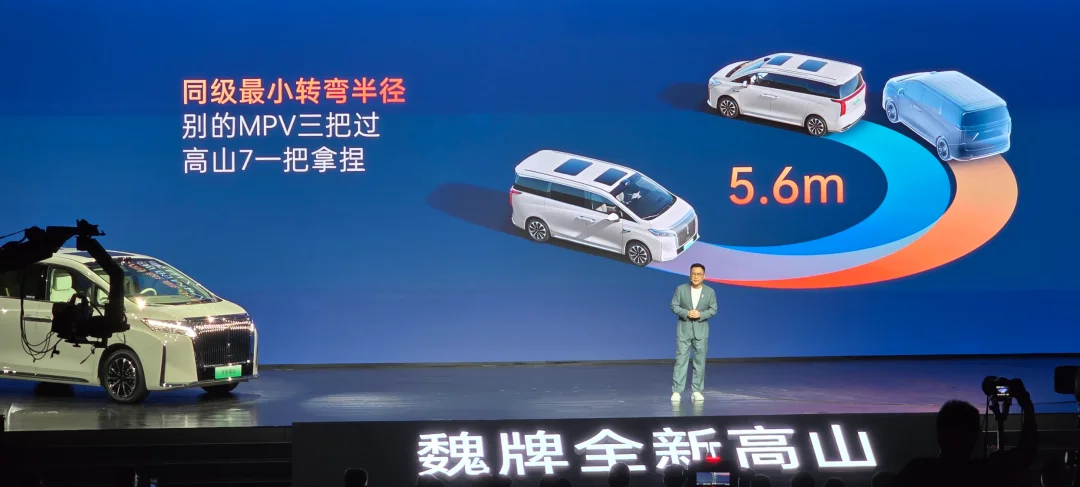
To make this vehicle, which exceeds 5 meters in length, easier to handle, the Gaoshan 7 is equipped with a lighter and more corrosion-resistant all-aluminum suspension. Additionally, control of the turning radius is a key highlight. The Gaoshan 7 has a turning radius of only 5.6 m and a steering angle of 34.6°. Furthermore, the Gaoshan 7 features an agile steering function; Feng Fuzhi introduced at the launch event that this function is equivalent to gently applying the brakes to the inner wheels.
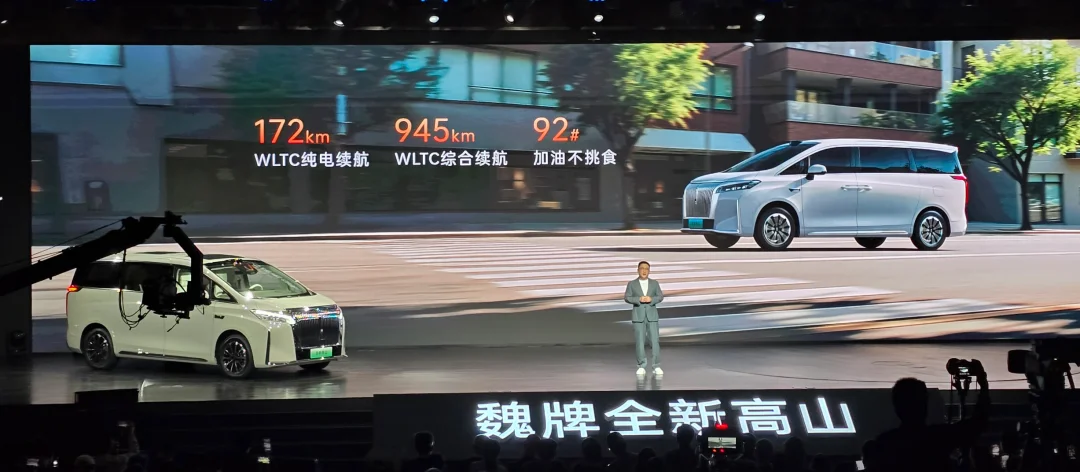
In terms of range, it aims to address both pure-electric commuting and long-distance travel. Equipped with a 44.28 kWh battery, it offers a WLTC pure-electric range of 172 km, which is sufficient for a week of commuting without recharging. With a full tank and full charge, the WLTC combined range reaches 945 km, covering scenarios from city commuting and client meetings to family road trips.
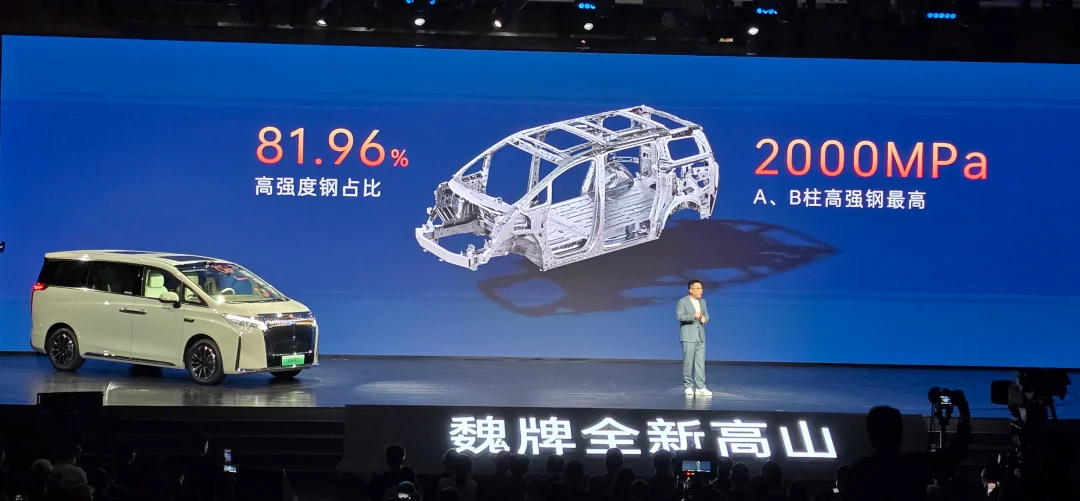
In terms of safety, the WEY Gaoshan 7 features a body with an 81.96% proportion of high-strength steel. The A and B pillars integrate 2,000 MPa high-strength steel, and the roof can withstand a pressure of 12 tons, providing better protection for occupants in the passenger compartment during rollovers. The Gaoshan 7's battery pack has passed 89 tests, including compression, impact, vibration, bottom spherical impact, thermal runaway, overcharge, and over-discharge, meeting the new national standard to be implemented in 2026 ahead of schedule.
Additionally, the Gaoshan 7 features side curtain airbags with a length of 3,107 mm and an inflation volume exceeding 110 liters, capable of maintaining pressure for six seconds to provide extended protection for passengers.
Overall, the product positioning of the all-new Gaoshan 7 is straightforward: it offers strong power, long range, agile handling, and an SUV-like driving feel, complemented by a comprehensive suite of all-scenario safety configurations. Its target audience clearly extends beyond traditional family MPV users to include households and corporate clients who demand a high-quality driving experience and require versatile vehicles.
03Enhanced by LiDAR, Intelligence Without Compromise
The intelligent configuration of the Gaoshan 7 continues the style of the Gaoshan family, addressing many shortcomings in the smart experience previously seen in MPVs.
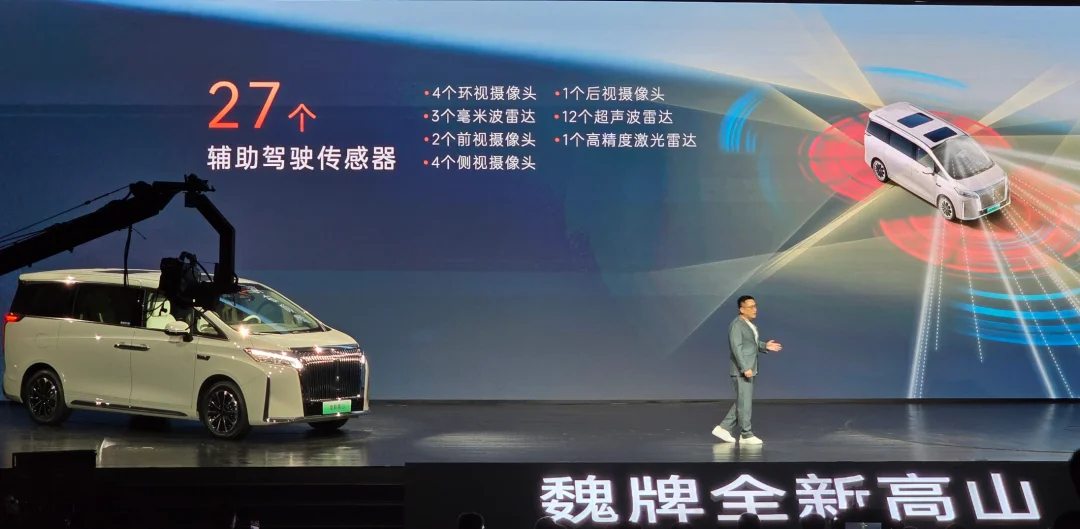
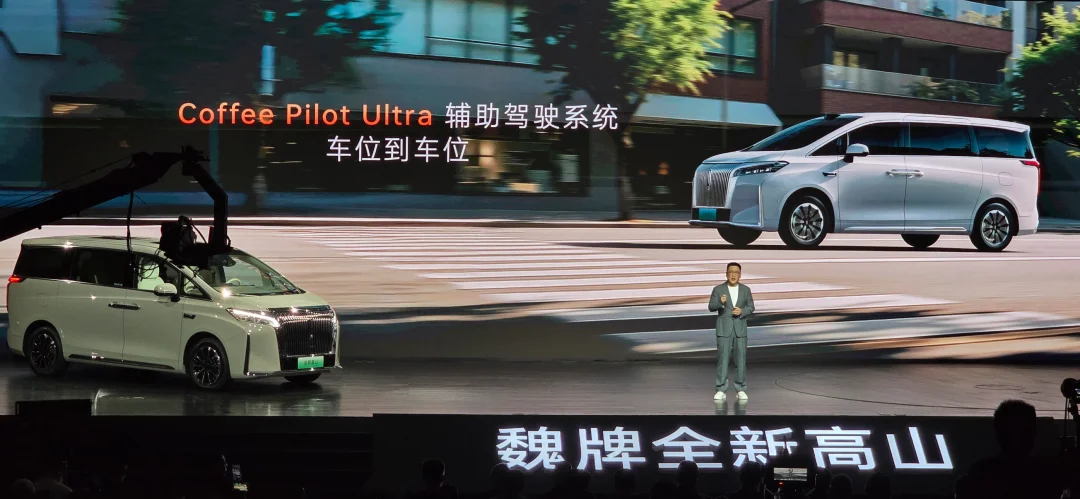
For intelligent driving, the Gaoshan 7 comes standard with 27 driver-assistance sensors, including LiDAR, enabling point-to-point assisted driving from parking space to parking space. Coupled with its agile steering function, it significantly improves the driving convenience of MPVs.
Furthermore, the WEY New Energy all-new Gaoshan 7’s parking assistance supports over 200 parking space types and allows for custom parking. The parking space recognition success rate reaches 96 percent, and the assisted parking success rate hits 95 percent. For an MPV with a length exceeding five meters and a wheelbase close to 3.1 meters, this largely resolves the pain point of difficult parking.
Compared with traditional MPVs, the Gaoshan 7’s voice control and parking systems have advanced significantly in user experience, offering substantial practicality rather than merely being a token feature.
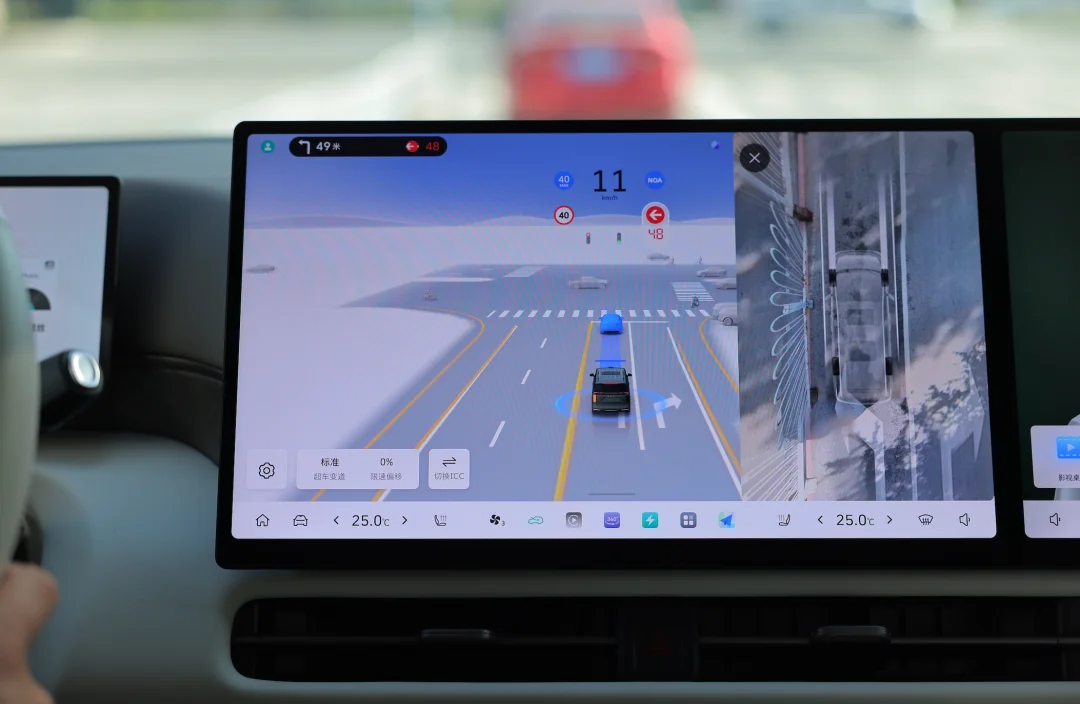
The interior interaction logic of the Gaoshan has also been refined. The Gaoshan 7 features dual 15.6-inch 2.5K screens for the center console and front passenger, while a 17.3-inch 3K resolution screen is standard equipment for the rear row—a configuration rarely seen in MPVs priced around RMB 300,000.
In terms of driving information display, the Gaoshan 7 continues WEY’s tradition of meticulous design. The digital instrument cluster is a 12.3-inch 2K screen with a reflectivity of only 2%, ensuring that critical information remains clearly visible even under direct sunlight.
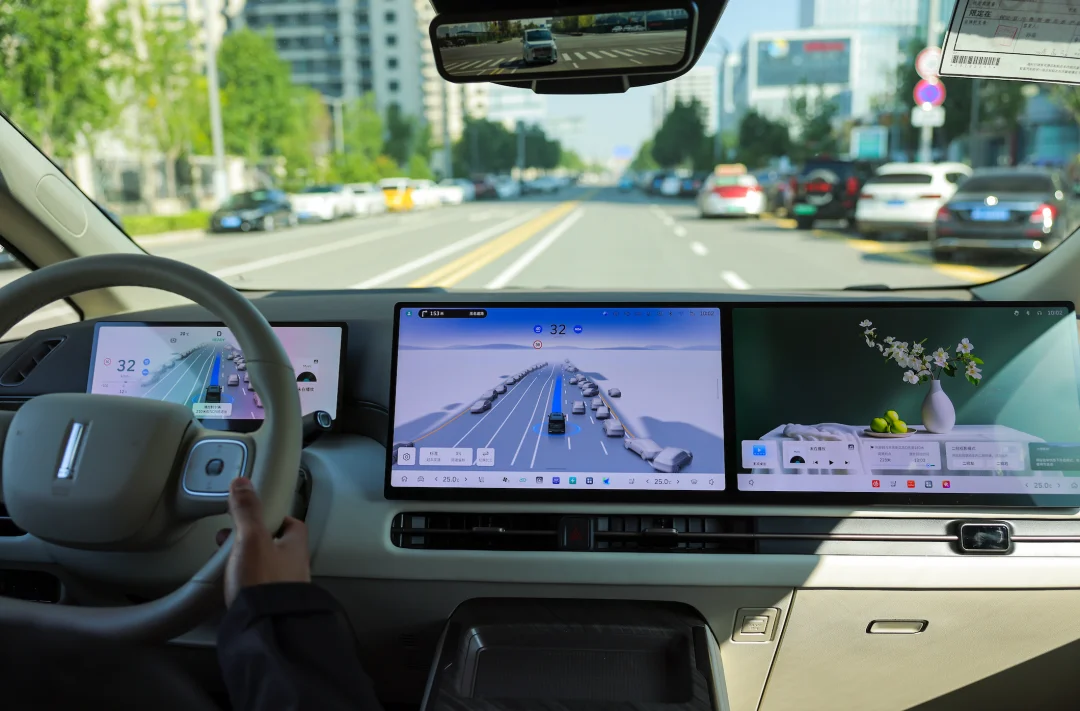
The HUD utilizes Changcheng’s self-developed Coffee SR-HUD technology, featuring a 26-inch image size and a projection distance of 4 meters, with a resolution of 1,440 × 480. Beyond standard information such as navigation, vehicle speed, and ADAS status, it supports multiple display modes including minimalist, map, environmental, and full-information views, allowing drivers to switch according to personal preference. Outside of driving, the system offers cinema mode and lyrics mode, seamlessly integrating daily driving with entertainment and relaxation scenarios on a single screen.
Overall, addressing shortcomings from the user’s perspective represents the most significant shift in product definition for the new Gaoshan family.
As the smallest and most affordable model in the Gaoshan lineup, the Gaoshan 7 has not compromised on core configurations; instead, it achieves class-leading levels in intelligence, comfort, and safety. Whether for family users, commuting scenarios, or younger consumers seeking intelligent MPV capabilities, the Gaoshan 7 demonstrates strong adaptability.
In addition, since Changcheng raised the slogan "Change for users" in May, WEY has made considerable efforts to improve its service system, in addition to core configurations. For instance, in May, WEY committed to establishing a western service guarantee line. To date, WEY has established 35 escort stations along the Qinghai-Tibet route, Sichuan-Tibet route, and Qinghai-Gansu loop, serving 3,135 users and providing 617 road rescue services.
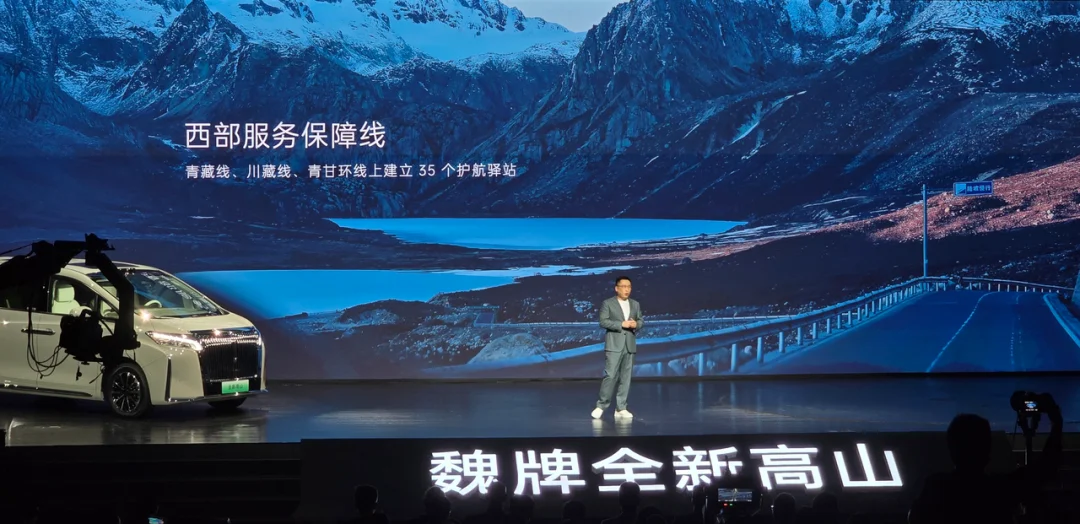
WEY also pledged a two-hour response time on urban main roads and a guaranteed six-hour arrival even in remote areas.
The effectiveness of these moves—spanning pricing structure, user experience, and service network coverage—remains to be validated by the market. However, they demonstrate WEY’s strategy to refine its MPV positioning through closer user engagement and gradual trust-building.
Written by: Da Yong | Edited by: James