


Li Auto Appoints Donghui Ma as President, Xie Yan as CTO in Leadership Overhaul

This afternoon, Li Auto announced a significant personnel change:
Chief Engineer Donghui Ma will succeed Shen Yanan as President of Li Auto and join the board, taking overall responsibility for the R&D and Supply Chain groups.
Senior Vice President Xie Yan will serve as Li Auto’s CTO, with full authority over the Systems and Computing group.

Before joining Li Auto, Xie Yan served as Vice President of Software Engineering for Huawei’s Consumer Business Group and Head of the OS Department, leading the R&D of operating system technologies including HarmonyOS. From 2014 to 2019, he was Chief Architect and Rotating General Manager of Alibaba’s AliOS Business Group, responsible for the technical architecture design and R&D management of mobile operating systems.
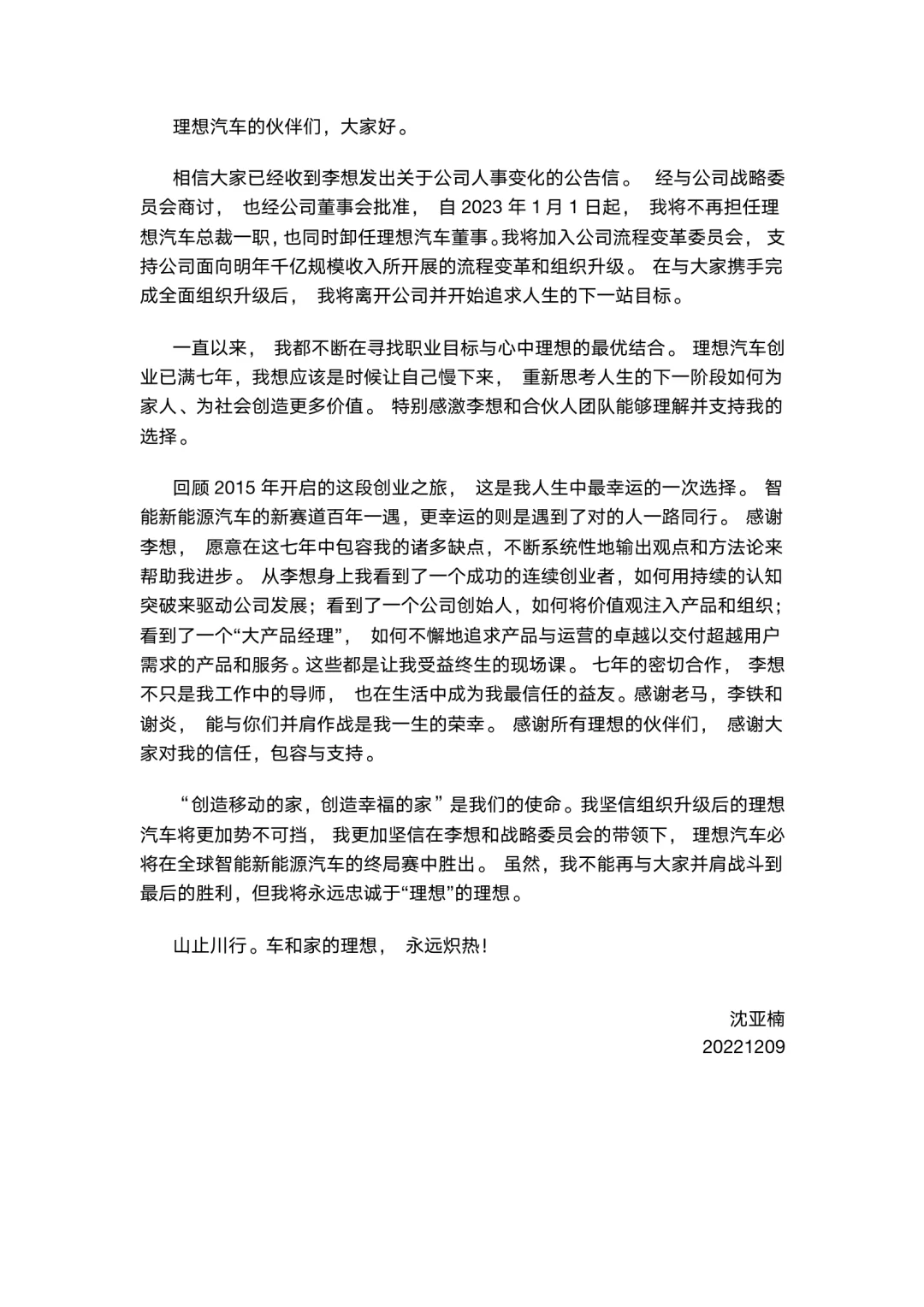
Executive Director and President Shen Yanan will step down from the board and join the 'Li Auto Process Transformation Committee'.

The supply team managed by Shen Yanan, which includes supply chain, manufacturing, and quality functions, will be transferred to President Donghui Ma. The commercial team, encompassing sales, service, and the charging network, will be managed directly by CEO Xiang Li.
Li Auto stated that these appointments take effect on January 1, 2023.
42HOW Auto received internal letters from Xiang Li and Shen Yanan addressed to all Li Auto employees regarding this change. The letters are as follows:
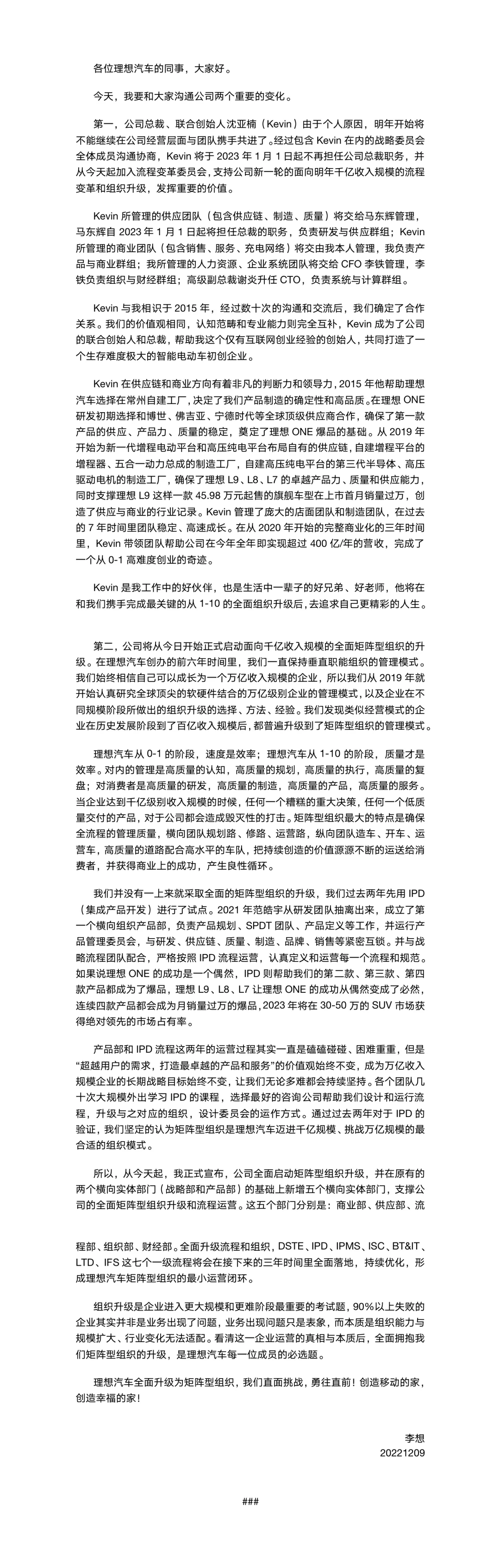
- Internal Letter from Xiang Li to All Li Auto Employees
- Internal Letter from Shen Yanan to All Li Auto Employees
Li Auto announced that future investments in research and development will cover product R&D, platform R&D, and system R&D.
In the future, Li Auto will launch multiple electric vehicles under development. This includes REV models such as the Li L9, Li L8, and Li L7, as well as several MEV models.
Li Auto also stated that it will persist in full-stack self-research of core technologies. Through three years of accumulation and billions of yuan in technology R&D investment, Li Auto has established a complete closed-loop cycle in technology R&D, covering preliminary research at the laboratory stage, technology implementation, and final support for product development.
Li Auto said it will deepen its self-research efforts in the future, focusing on two underlying technologies: electric drive and artificial intelligence, to build four major technology platforms: range-extended electric platform, high-voltage pure electric platform, intelligent space platform, and intelligent driving platform.
Furthermore, at the top-level technology tier, Li Auto will gradually achieve deep self-research of four systems: AI operating system, AI chips, AI cloud services, and AI electronic and electrical architecture. To further strengthen strategic reserves of scientific and technological talent, Li Auto recently established a joint academic co-construction platform with Tsinghua University, where the first batch of seven postdoctoral researchers has begun work.
Investment in capabilities encompasses commercial capability, supply capability, and organizational capability.
Between 2021 and 2022, Li Auto attracted several business architecture talents with top-level design capabilities across multiple business modules, including R&D, supply chain, charging network, and sales services.
At the same time, Li Auto stated that it has adhered to the path of building its own factories since its inception and will continue to consolidate procurement, supply, and manufacturing capabilities. In the second half of 2022, Li Auto’s Changzhou smart manufacturing plant completed capacity expansion to support production of the Li L9 and Li L8; the green smart manufacturing base located in Beijing is planned to officially commence operations by the end of 2023, supporting the production of pure electric models.
Additionally, Sichuan Li Auto Xincheng Technology Co., Ltd., a joint venture between Li Auto and Xincheng Power, officially commenced operations in 2022, fully producing Li Auto’s self-developed range extenders.
In an open letter to all employees, Xiang Li stated that during the 0-to-1 phase of a company's development, speed is efficiency. The vertical organizational model helped Li Auto achieve revenue in the billions.
Over these seven years, Li Auto successfully built complete capabilities in products, R&D, supply chain, manufacturing, sales, service, and organizational collaboration, achieving initial success in both product and business.
In the 1-to-10 phase, quality becomes efficiency. Organizational upgrades are needed to break through to revenue in the hundreds of billions and challenge the trillion-yuan scale.
Therefore, adjustments to the organizational structure aim to help the enterprise better adapt to an increasingly competitive environment. It also hopes that new force automakers, which have overcome hardships along the way, can surmount difficulties in this wave and create better products. Written by: Mingming Edited by: Liu San