


Zunjie S800 Exterior Revealed; Xiaomi's Second Car May Launch in Q1 Next Year; NIO, XPENG Release Q3 Earnings | Weekly Highlights
01Weekly Index
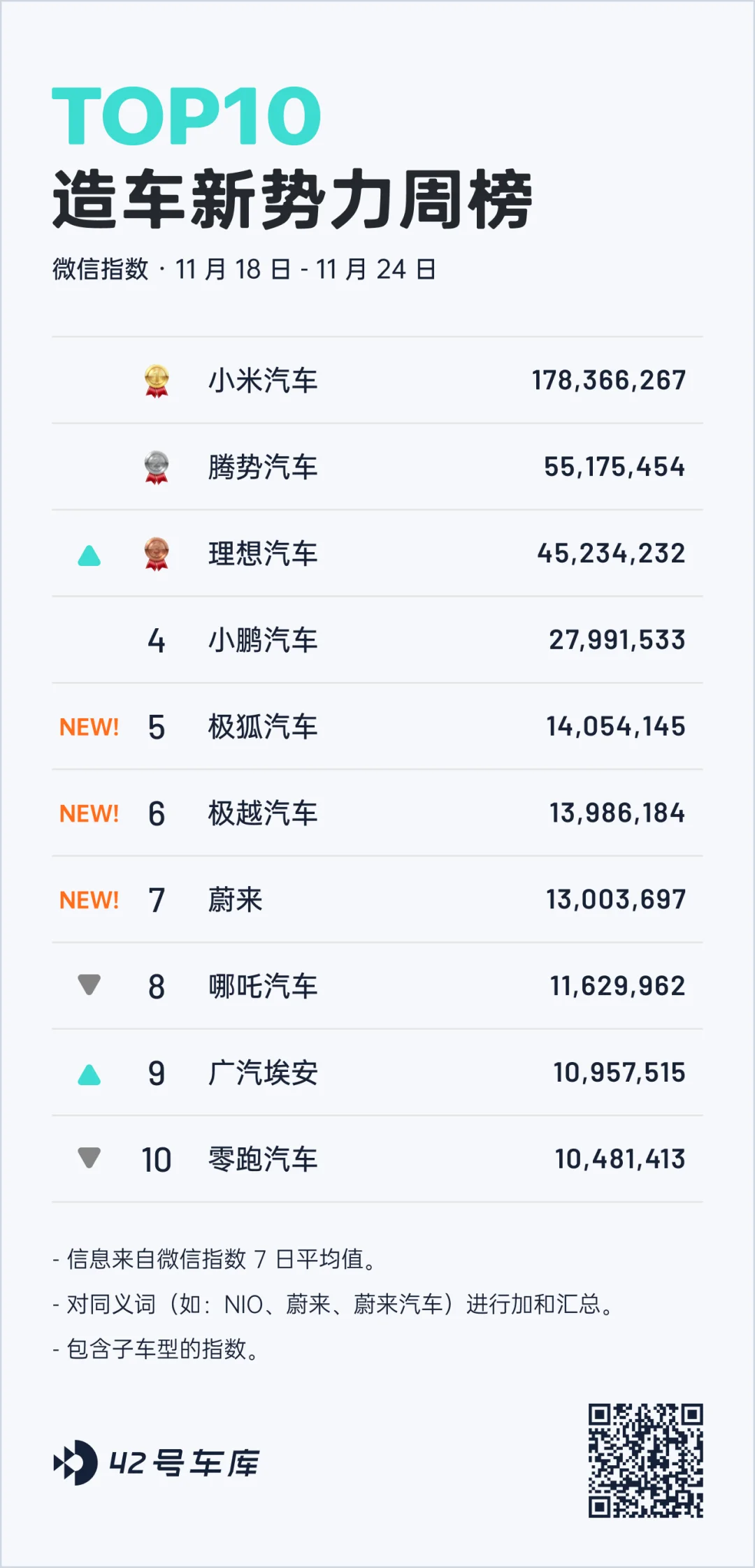
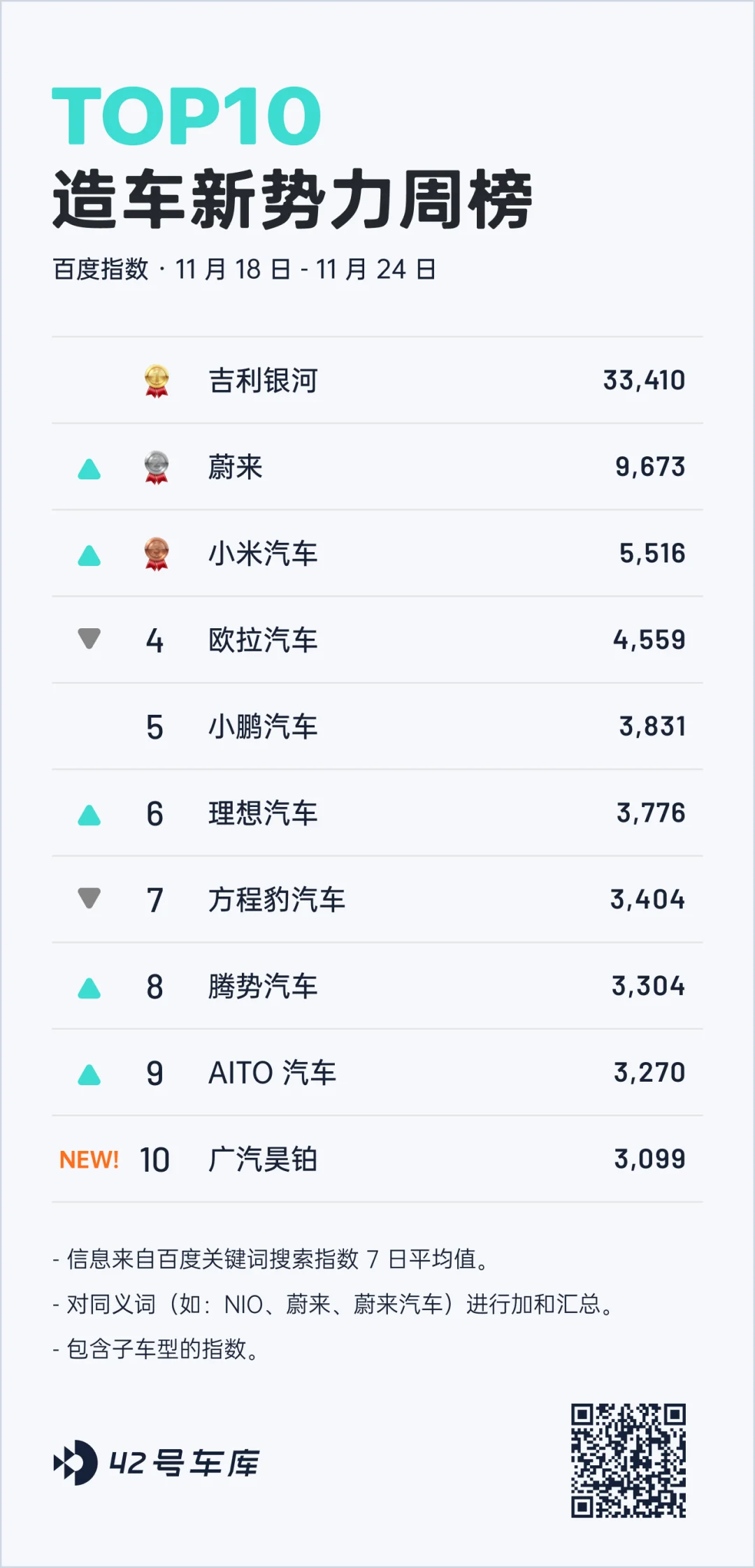
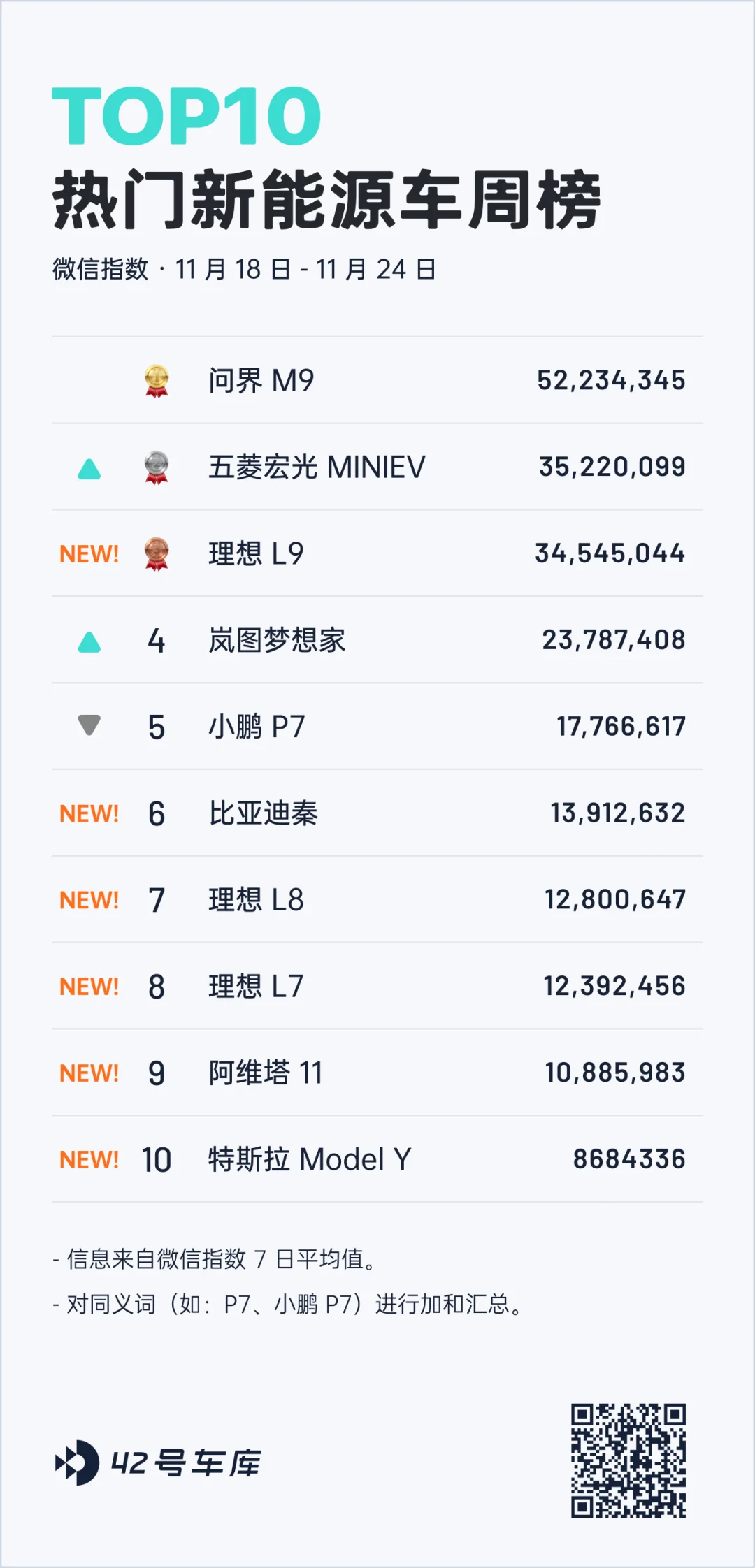
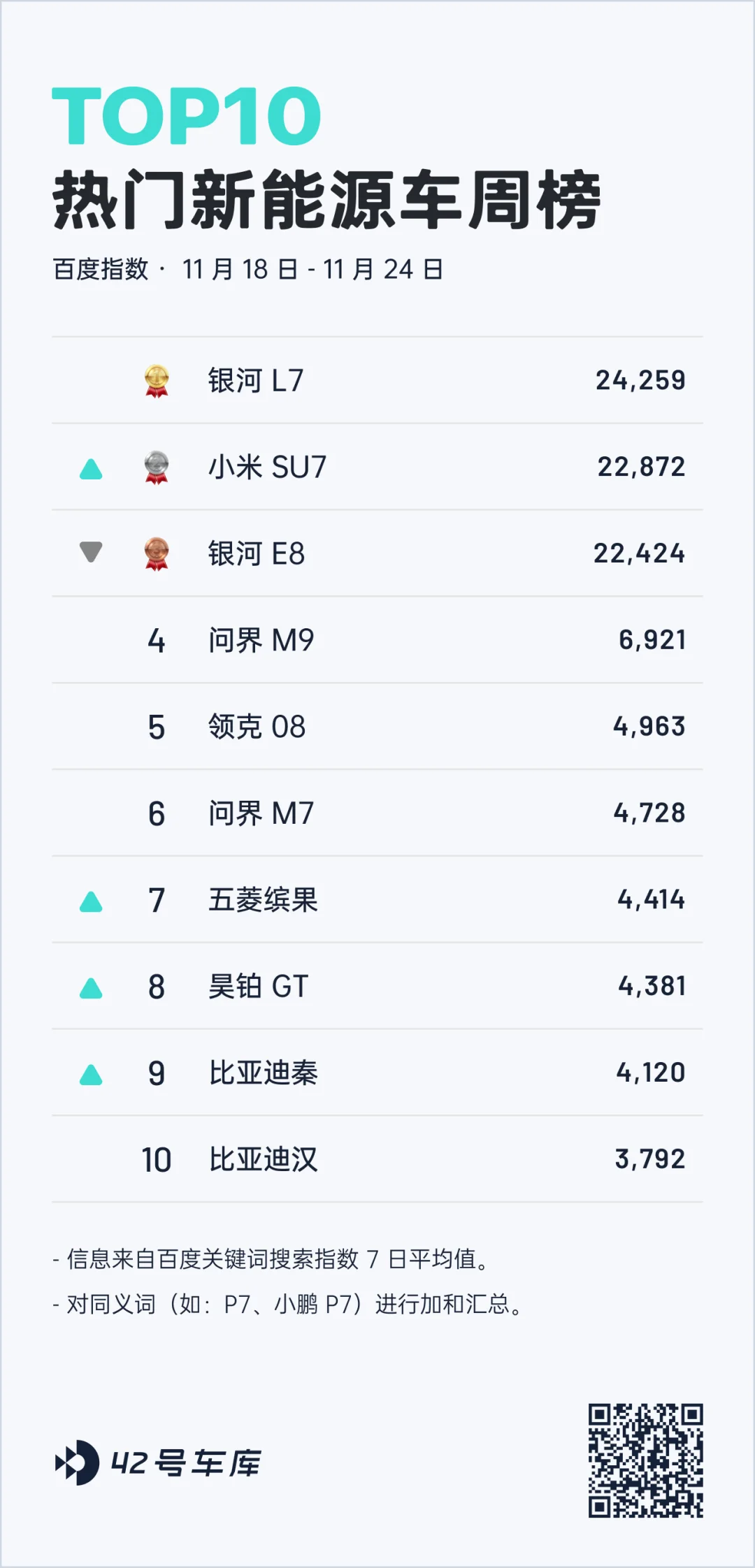
02E-Week Highlights
Zunjie S800 Exterior Revealed
The only car at the Guangzhou Auto Show that is present but not on public display is the Zunjie S800. Carrying the strongest halo effect, it is positioned as the top-tier product in terms of brand, model, and pricing among the four 'Jie' (boundary) brands under Hongmengzhixing. Consequently, during the period before its official reveal, various hand-drawn sketches and renderings were circulating widely.
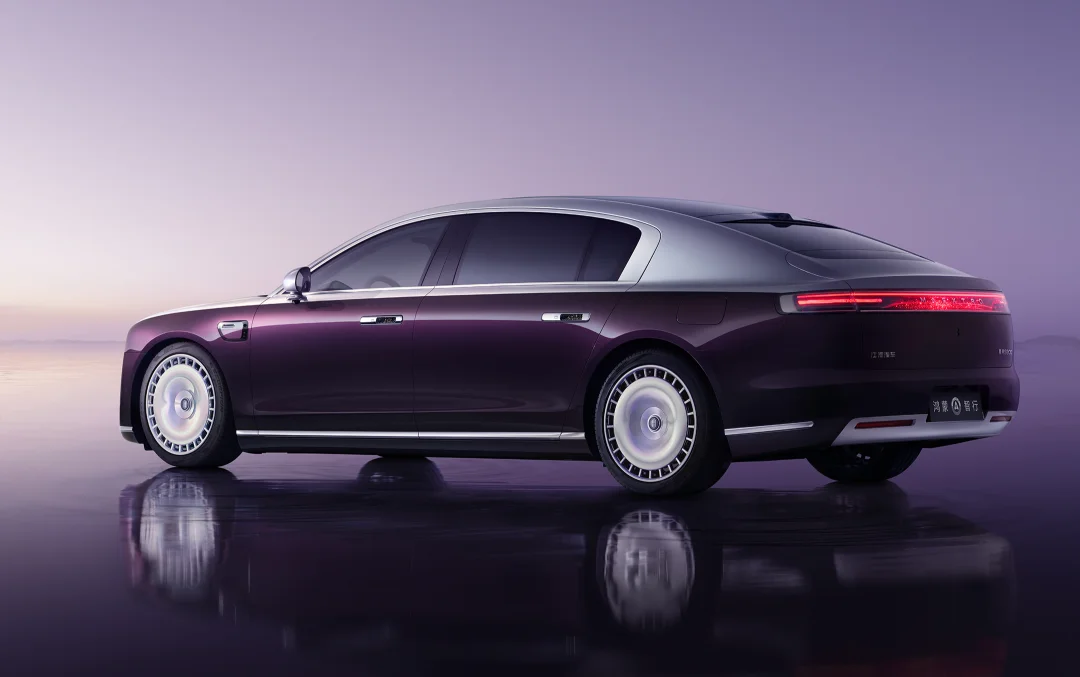
The mystery surrounding the rear of the Zunjie S800 was finally unveiled this Saturday. The Zunjie S800 adopts a sedan design with a length of approximately 5.5 meters, giving it a larger 'footprint' than most sedans currently on the market. Despite its massive dimensions, the Zunjie S800 does not appear bulky; instead, its body is sleek and elongated.
Additionally, the Zunjie S800 features 'pie-pan' style wheels, which give the vehicle's stance a commanding presence.
On November 26, the Huawei Mate Brand Gala will take place, where the Zunjie S800 will also make its debut. Bosses, we trust your wallets are ready?
Editorial Comment:
Hongmengzhixing pushes higher again, this time directly entering the million-yuan price segment. In the past, products in this tier were exclusively from overseas brands. However, with the entry of brands such as Zunjie and Yangwang, the million-yuan luxury car market is quietly changing.
Unlike Yangwang, which first entered the off-road vehicle market, Zunjie's first model is positioned as an executive sedan. Competition in this market is fierce, with traditional luxury brands including Mercedes-Benz, BMW, and Audi all having models in the lineup. However, the true sales leader remains the Mercedes-Benz S-Class. The reason behind this is straightforward: the Mercedes-Benz brand halo is a significant factor boosting S-Class sales. According to data released by Yiche, the domestic sales of the Mercedes-Benz S-Class reached nearly 12,000 units in the first three quarters of this year, averaging more than 1,300 units per month.
So, here’s the question: Now that Zunjie has entered the million-yuan luxury sedan market, what monthly sales volume would you consider a success?
Xiaomi's Second Model May Launch in Q1 2025
According to exclusive reports from Caijingqiche, an insider at Xiaomi Auto revealed that the company's second model is scheduled for launch in February or March of next year. It is confirmed that this second vehicle will be a pure electric SUV with the internal code name MX11.
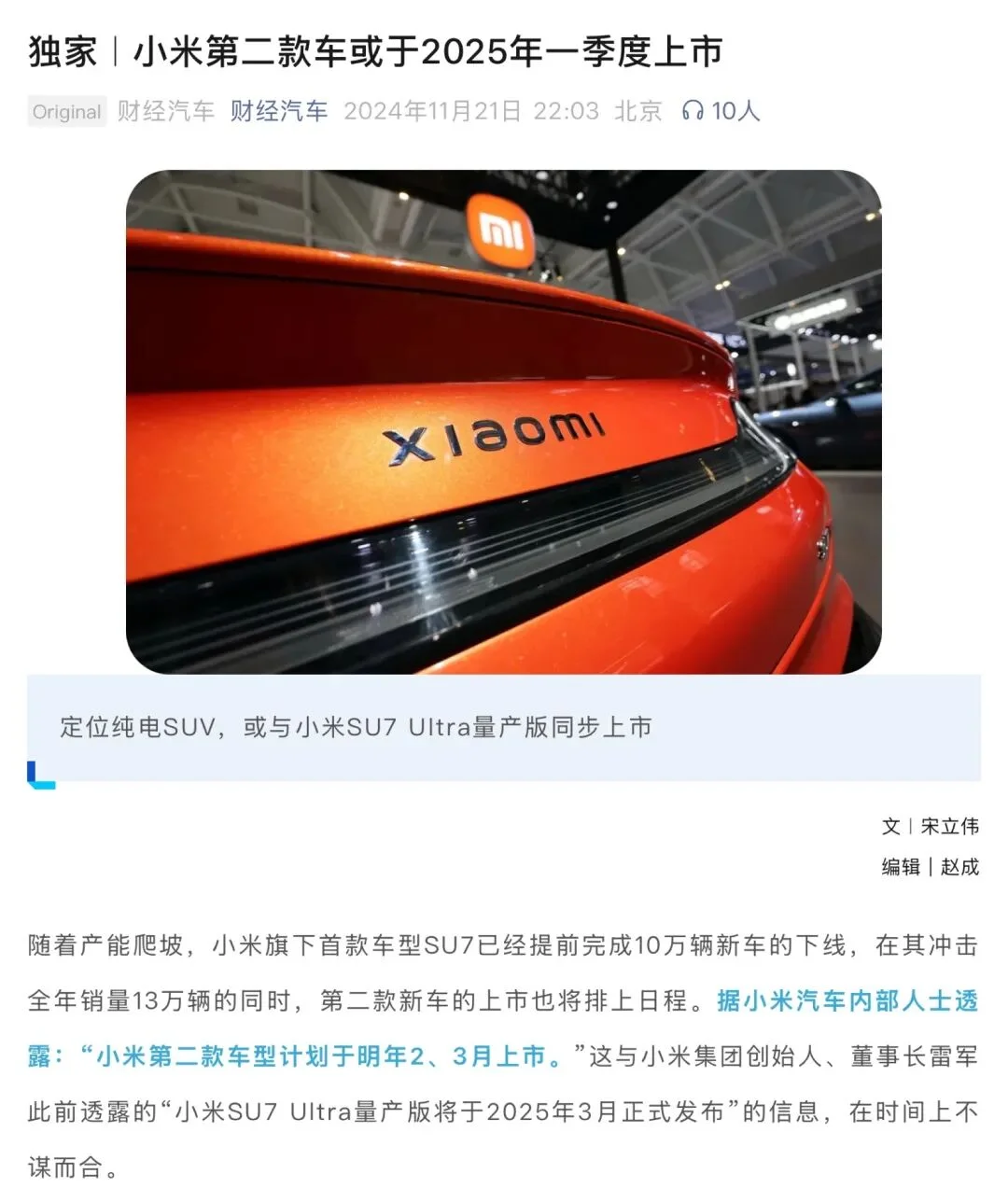
Another source close to Xiaomi Auto stated that the launch schedule for the new model will follow the same rhythm as the SU7. The SU7 was launched on March 28 this year.
This timeline aligns closely with the planned release of the mass-production version of the SU7 Ultra, which is also set for March next year.
When Caijingqiche confirmed these details with a Xiaomi Group executive, the response was that "the questions go beyond the scope," and no further comments could be provided.
Additionally, Caijingqiche learned that Phase II of the Xiaomi Auto factory is in intense preparation. Construction has shifted to two shifts (day and night) and is scheduled to be completed by June 2025. Following corporate acceptance verification and filing with the local Housing and Urban-Rural Development Bureau, production is expected to begin as early as July 2025 and no later than August. Once operational, Xiaomi's two factories will provide a combined rated annual capacity of 300,000 units.
Editorial Comment:
As of now, the delivery cycle for the Xiaomi SU7 Max listed on the Xiaomi App is 19 to 22 weeks, placing expected deliveries around April next year. This timing coincides with the anticipated launch of Xiaomi’s second model. Customers who have already placed orders are faced with a choice: stick with the Xiaomi SU7 or wait for the debut of the Xiaomi SUV.
Pure-Electric 'Lixiang' ONVO Takes Shape as NIO Enters the NT3 Era
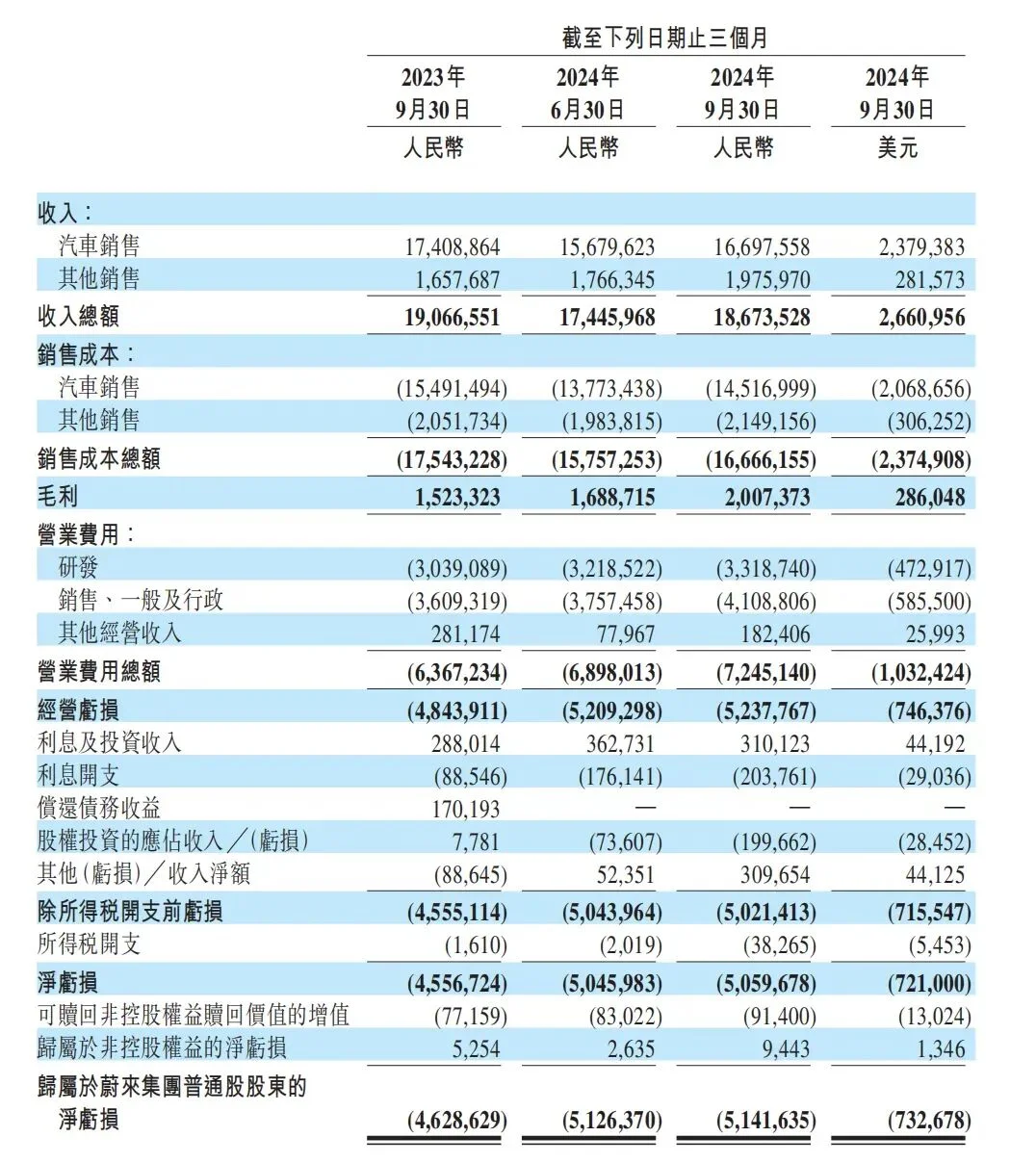
On November 20, NIO released its financial results for the third quarter of 2024. Key financial data includes:
Vehicle sales revenue reached RMB 16.6976 billion, a year-over-year decrease of 4.1% and a quarter-over-quarter increase of 6.5%;
The automotive gross margin stood at 13.1%, compared to 11% in the same period last year and 12.2% in the second quarter of this year;
Total revenue was RMB 18.6735 billion, down 2.1% year-over-year but up 7% quarter-over-quarter;
Gross profit amounted to RMB 2.0074 billion, representing a year-over-year growth of 31.8% and a quarter-over-quarter increase of 18.9%;
Gross margin of 10.7%, compared with 8% in the third quarter of last year and 9.7% in the second quarter of this year;
Operating loss of RMB 5.2378 billion, up 8.1% year-over-year and 0.5% quarter-over-quarter;
Net loss of RMB 5.0597 billion, up 11.1% year-over-year and 0.3% quarter-over-quarter;
Cash and cash equivalents, restricted funds, short-term investments, and long-term time deposits totaling RMB 42.2 billion.
In terms of sales, NIO delivered 61,855 vehicles in the third quarter, setting a new quarterly delivery record. Monthly deliveries from July to September all exceeded 20,000 units.
By contrast, the more compelling segment was the post-earnings conference call, where William Li outlined plans for multiple new models across NIO’s three brands—NIO, ONVO, and Yinghuochong—for next year.
Among these, ONVO will launch two family SUVs: one mid-to-large six- or seven-seater SUV and one large five-seater SUV. William Li noted that these two models are comparable to Lixiang’s L7 and L8. He also hinted at pricing strategy: "The L60 is priced RMB 40,000 lower than Lixiang’s L6, and the two new products will offer strong price competitiveness against the L7 and L8."
NIO will gradually transition its lineup to the NT3 platform. The ET9, the first model on this architecture, is in pre-production preparation and is scheduled for delivery in March next year. Other NIO models will also receive updates based on the NT3 platform, with the upgrade cycle completing over the next two years.
NIO’s third brand has been named Yinghuochong. Its debut model will be unveiled at NIO Day 2024, with deliveries expected in the first half of next year.
Additionally, William Li outlined sales targets for next year, aiming for 100% growth. He also set a profitability goal: achieving full-year profit by 2026.
Editorial Comment:
November 25 marks the tenth anniversary of NIO. Looking ahead to 2025, NIO’s ambitions in financial performance, sales volume, and product development are substantial. However, amid intense market competition, the company faces significant pressure.
For NIO today, persistent losses remain the most glaring challenge. To what extent can ONVO help mitigate these high losses? Will the series of new products launching next year serve as a turning point or an additional burden for NIO’s profitability? Achieving profitability sooner rather than later is crucial to maintaining investor confidence.
XPENG Reports Strongest Quarterly Results in Company History
On November 19, XPENG released its third-quarter 2024 financial report, marking the strongest quarterly performance in the company’s history.
Key financial figures are as follows:
Total revenue reached RMB 10.1 billion, up 18.4% year-over-year and 24.5% quarter-over-quarter, with vehicle deliveries of 46,533 units;
Gross margin stood at 15.3%, an 18 percentage-point increase year-over-year;
XPENG expects Q4 total revenue to be between RMB 15.3 billion and RMB 16.2 billion, representing a year-over-year growth of 17.2% to 24.1%;
XPENG anticipates Q4 vehicle deliveries of 87,000 to 91,000 units, up 44.6% to 51.3% year-over-year.
Overseas sales grew 70% quarter-over-quarter in Q3, accounting for 15% of total company sales;
The company operates 639 retail stores across 206 cities nationwide. XPENG’s self-operated charging network comprises 1,577 stations, including 259 newly added self-operated sites in the third quarter and six new liquid-cooled S5 ultra-fast charging stations.
Editorial Comment:
Over the past two years, XPENG has navigated a challenging period marked by executive turnover, product line iterations, and its partnership with Volkswagen. By this quarter, however, the company’s financial performance reached an all-time high. Meanwhile, He Xiaopeng predicted that 2025 to 2027 will constitute a "survival-of-the-fittest" phase for China’s automotive industry. This outlook is driven by two factors: the unstoppable rise of new energy vehicle penetration rates to over 85%, and the transformative impact of artificial intelligence on the entire market.
The key focus for the foreseeable future will be to further strengthen XPENG’s competitive advantages while addressing its weaknesses.
Written by James Edited by James