


Huawei Reveals HarmonyOS Vehicle Interface and AR-HUD at HDC 2021
On October 18, a few days before I departed for HDC 2021, Huawei signed what is thus far the world’s largest energy storage project—the Red Sea New City Energy Storage Project in Saudi Arabia, with a capacity of 1,300 MWh.
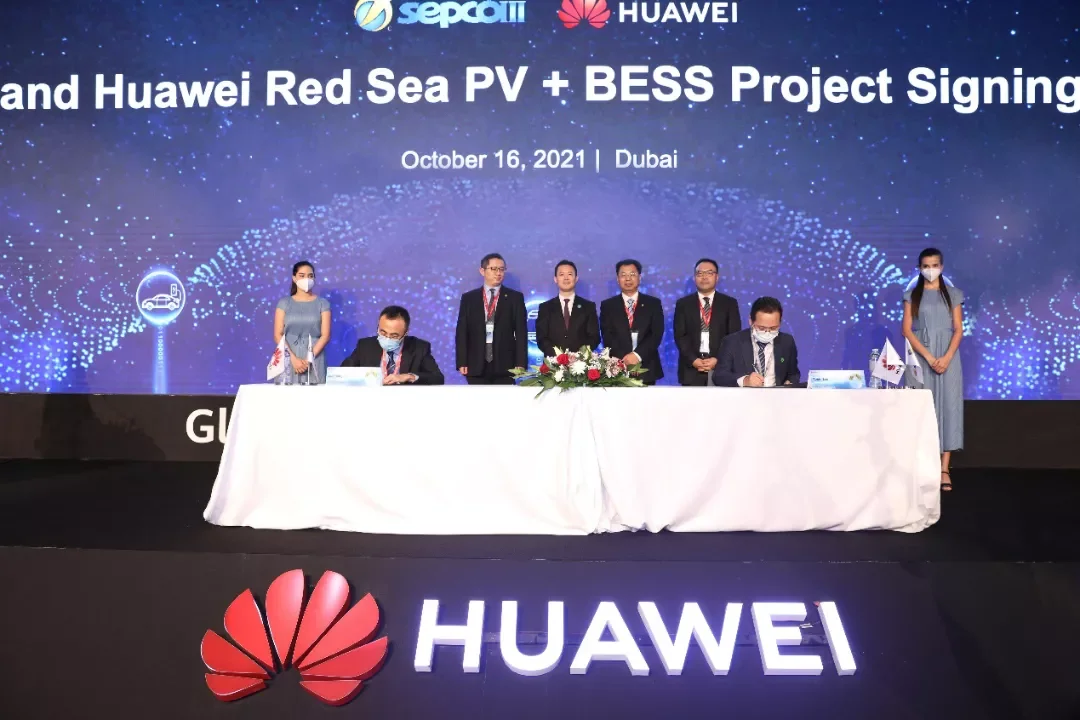
Aside from Huawei concept stocks on the stock market paying tribute the following day, I was actually quite puzzled: Huawei? Energy storage?
I immediately checked related news. Huawei Digital Power has actually had over 10 years of R&D in energy storage systems and more than 8 GWh of project application experience; it had simply remained low-key until now. For photovoltaic inverters, which are crucial to this solar-storage project, Huawei formed the relevant team in 2010. In Wood Mackenzie's "2020 Global Photovoltaic Inverter Supplier Market Ranking," Huawei became the leader with a 23% share.
With my initial surprise gradually giving way to clarity, I attended a tech company’s press conference in my capacity as an automotive media representative. The developer conference ran from October 22 to 24. Having participated in the first two days’ events and deepening my understanding of Huawei, I began to see the “facade” of this towering tree.
01How is HarmonyOS Progressing?
Because this was my first time exhibiting and the HDC conference is not aimed at C-end consumers, I have compiled historical information here. By simply listing key points, readers can quickly understand HarmonyOS’s history, features, and current progress.
HarmonyOS Timeline
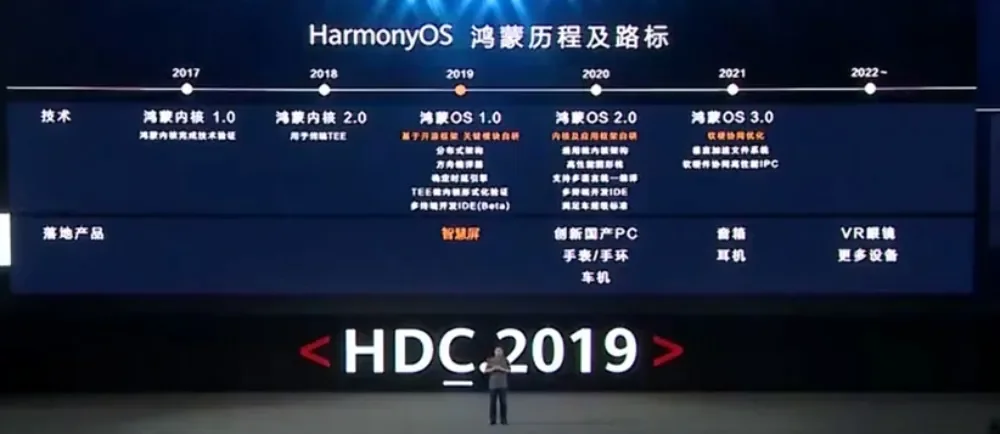
At the 2019 Huawei Developer Conference, we first saw the roadmap for Huawei HarmonyOS. Based on actual developments, I have compiled the following timeline for HarmonyOS:
Starting in 2012, planning for its own operating system, "HarmonyOS";
In 2019, at the Huawei Developer Conference, HarmonyOS 1.0 was officially unveiled and initially adapted for Huawei Smart Screen products. Richard Yu stated that HarmonyOS would be open source;
In September 2020, the HarmonyOS 2.0 version was upgraded, along with the release of beta test versions for large screens, smartphones, and automotive systems;
On December 16, 2020, the mobile phone version of the HarmonyOS 2.0 Beta was officially released;
On June 2, 2021, the official version of HarmonyOS 2.0 began to be pushed out;
On October 22, 2021, Huawei released the HarmonyOS 3 Developer Preview and HMS Core 6.
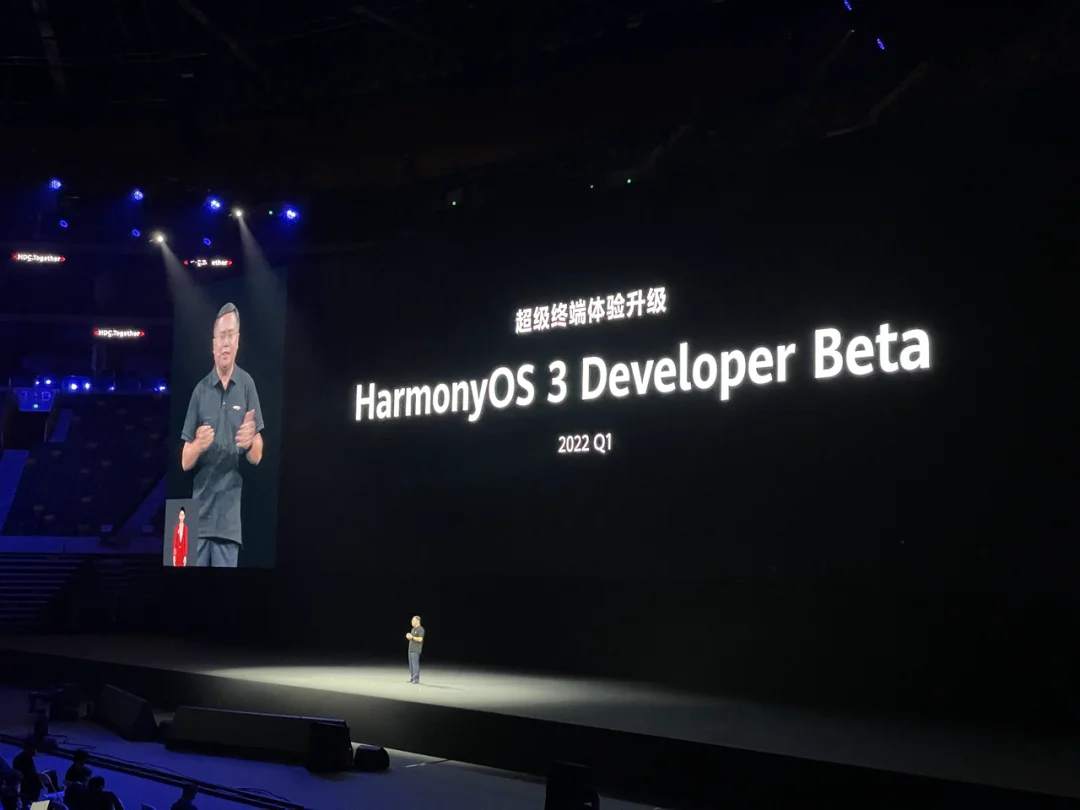
Huawei announced that the HarmonyOS 3 Developer Beta is expected to launch in the first quarter of 2022.
Features of Huawei HarmonyOS
HarmonyOS aims not to replace Android, but to achieve the Internet of Everything. Its advantages include a microkernel, distributed architecture, and shared ecosystem:
The primary function of the microkernel is to simplify kernel operations by providing only the most basic services, such as thread scheduling and inter-process communication (IPC). This design grants the microkernel high flexibility, allowing it to operate across various device terminals while maintaining strong security and low latency through IPC;
The distributed architecture enables rapid connectivity between different devices, hardware capability sharing, and cross-device data synchronization and task scheduling;
The shared ecosystem simplifies development for programmers. By creating a single version of an app, developers can deploy it across multiple terminals via HarmonyOS, achieving cross-device ecosystem integration.
Current Progress
This section excludes the more obscure details of development software progress. Instead, we look directly at the data to assess the current status of the entire project.
As of now, HarmonyOS has been activated on over 150 million devices, including smartphones, tablets, smartwatches, and smart screens;
Currently, HarmonyOS Connect has more than 1,800 partners and 4,000 products, with shipments of new ecosystem devices exceeding 60 million units in 2021;
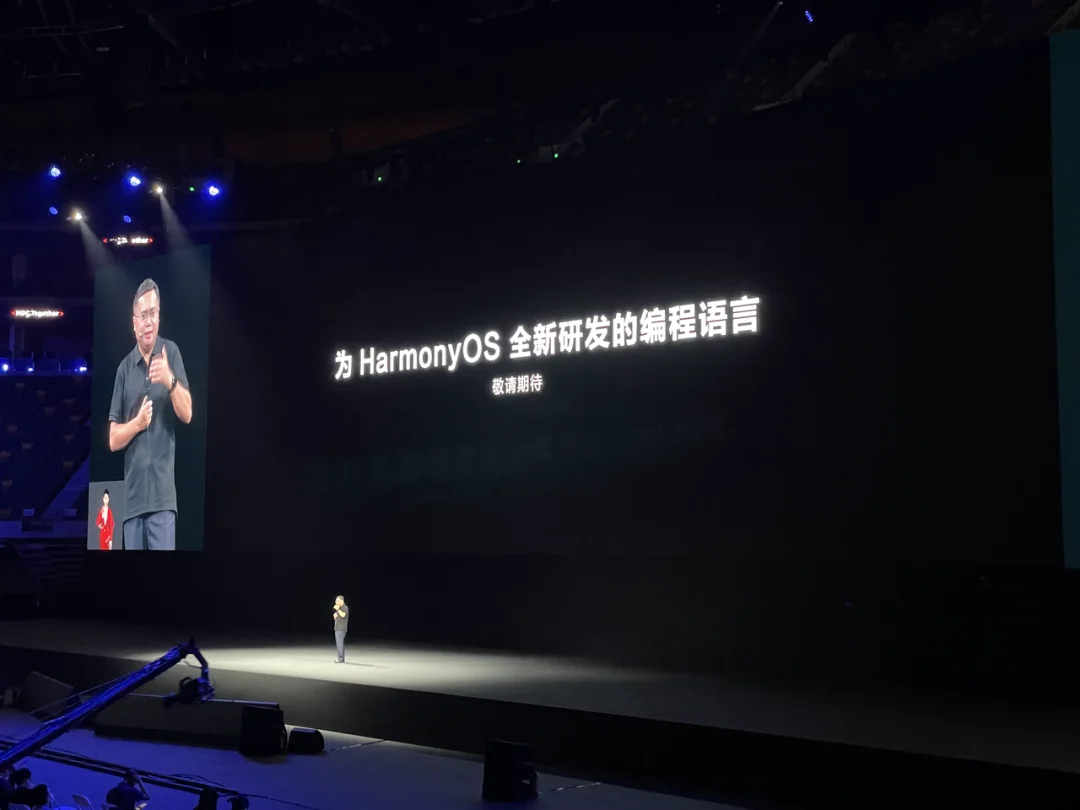
Huawei announced it will release a newly developed programming language for HarmonyOS, which is expected to launch as early as next year;
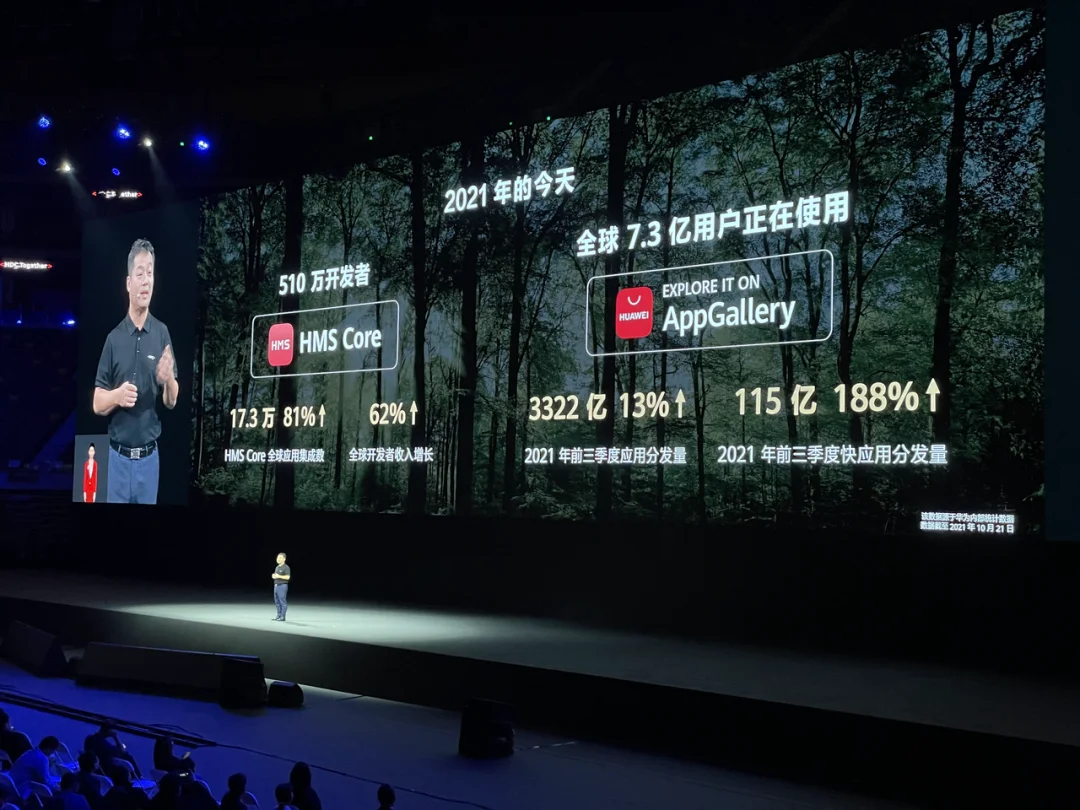
With the support of 5.1 million developers worldwide, the Huawei Mobile Services (HMS) ecosystem continues to grow rapidly: more than 173,000 apps have integrated HMS Core; in the first three quarters of 2021, app distribution via Huawei’s AppGallery reached 332.2 billion, and developer revenue shares grew by 62%;
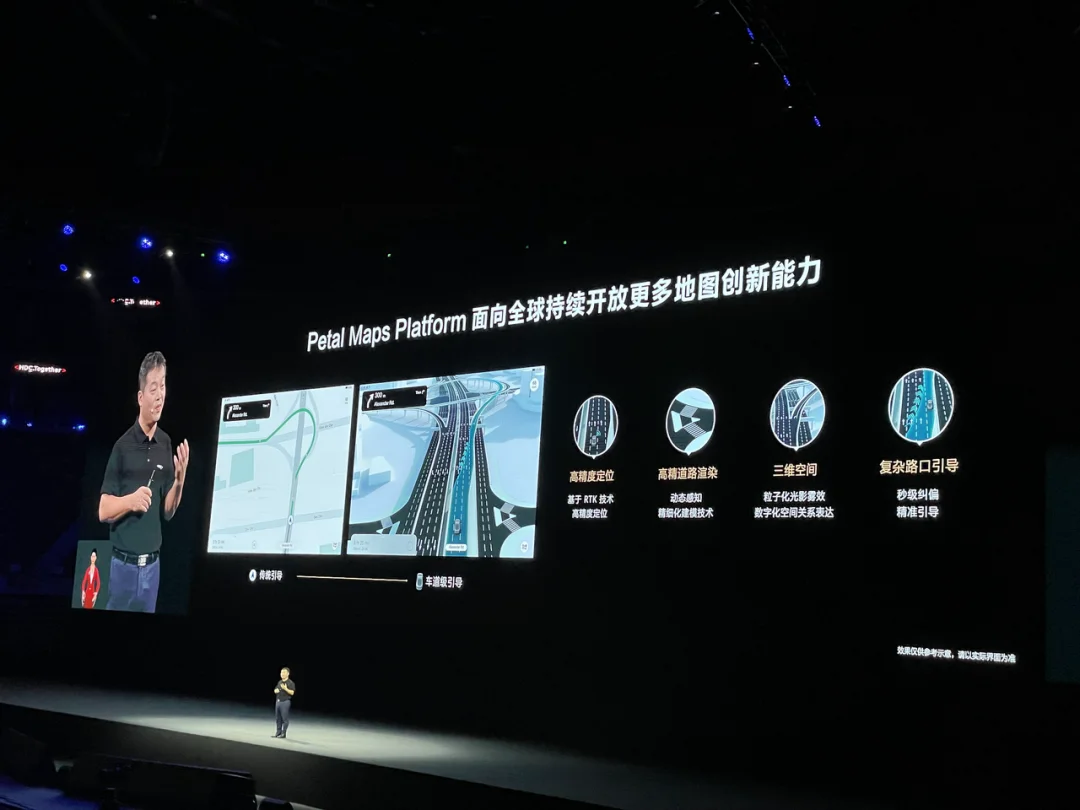
Huawei has launched Petal Maps in 22 countries.
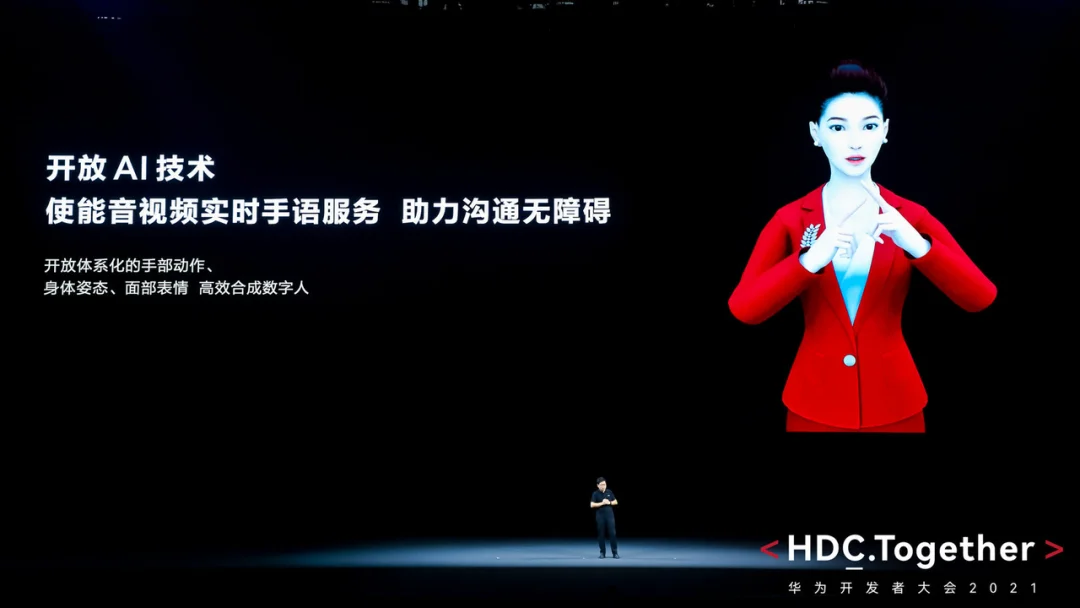
During the conference, there was a small surprise: a digital human provided real-time sign language translation for the live broadcast, displayed in the bottom-right corner of the screen.
Many viewers felt that the signing speed was incredibly fast. Driven by strong curiosity, I verified this with staff the following day. Typically, sign language translation lags behind the speaker, concluding only after the speech ends. In this broadcast, however, the digital human accelerated its movements to achieve full real-time translation. Notably, terms like 'HarmonyOS' were not present in the existing Chinese sign language database and had to be specially recorded.
02About Cars
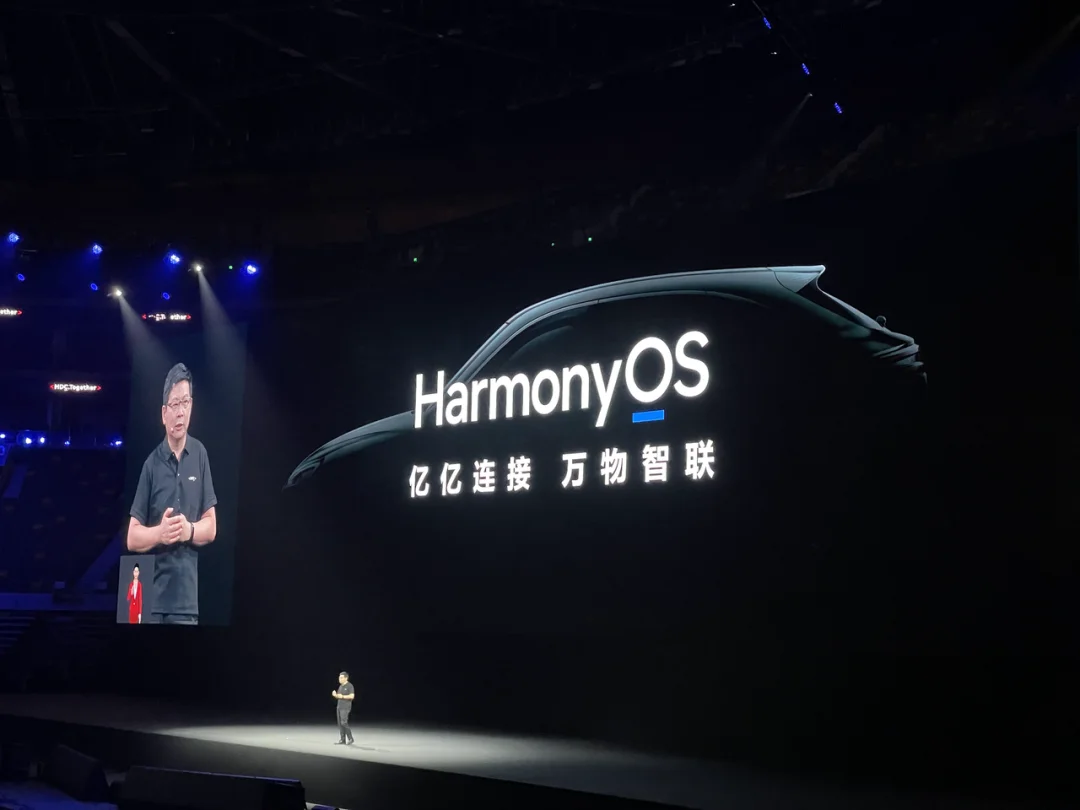
Finally, we arrive at our familiar ground! After watching the entire HDC keynote, you will notice that Jihu was never mentioned by any of the executives throughout the presentation. This makes the upcoming year-end delivery of the Jihu Alpha S HI version seem somewhat peculiar. SERES, on the other hand, appeared frequently—in posters and speeches—and even announced that its next model developed in cooperation with SERES would feature the HarmonyOS smart cockpit.
Latest HarmonyOS Smart Cockpit Interface Images Revealed
Gong Ti, President of Huawei Consumer Business Group Software Department, stated at the Huawei Developer Conference that Huawei's smart cockpit would be unveiled soon and would offer a significantly elevated experience compared to traditional in-vehicle infotainment systems. The advantages of Huawei's smart cockpit lie in its strong interconnectivity capabilities and broad ecosystem of applications.
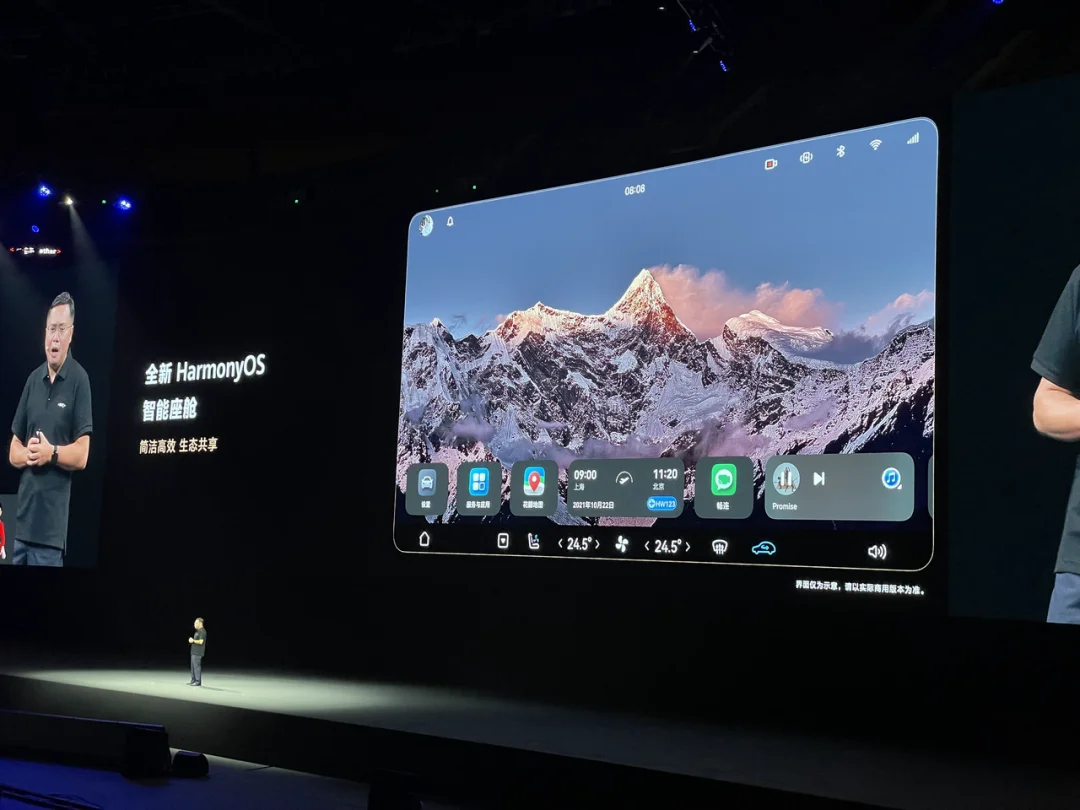
At the conference, Huawei displayed an previously unreleased image of the vehicle interface. We can see a horizontally oriented screen with rounded corners, closely resembling the design of a tablet.
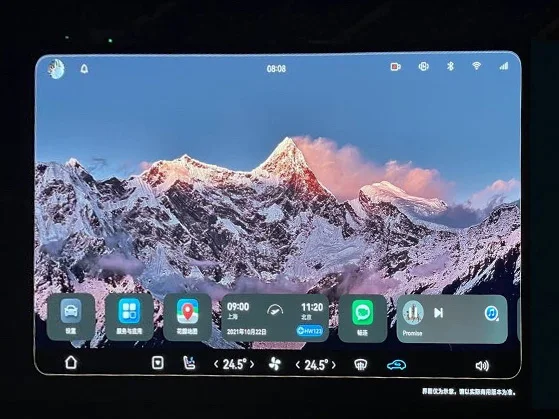
This is my straightened version; the resolution is somewhat low.
The Dock bar at the bottom consistently features the home button, seat ventilation controls, left/right zone air conditioning temperature and fan speed settings, and volume buttons. This design and layout were applied earlier in Tesla's infotainment systems. Other manufacturers, including Huawei, have adopted similar layouts for their Dock bars, indicating that this design has become an industry consensus.
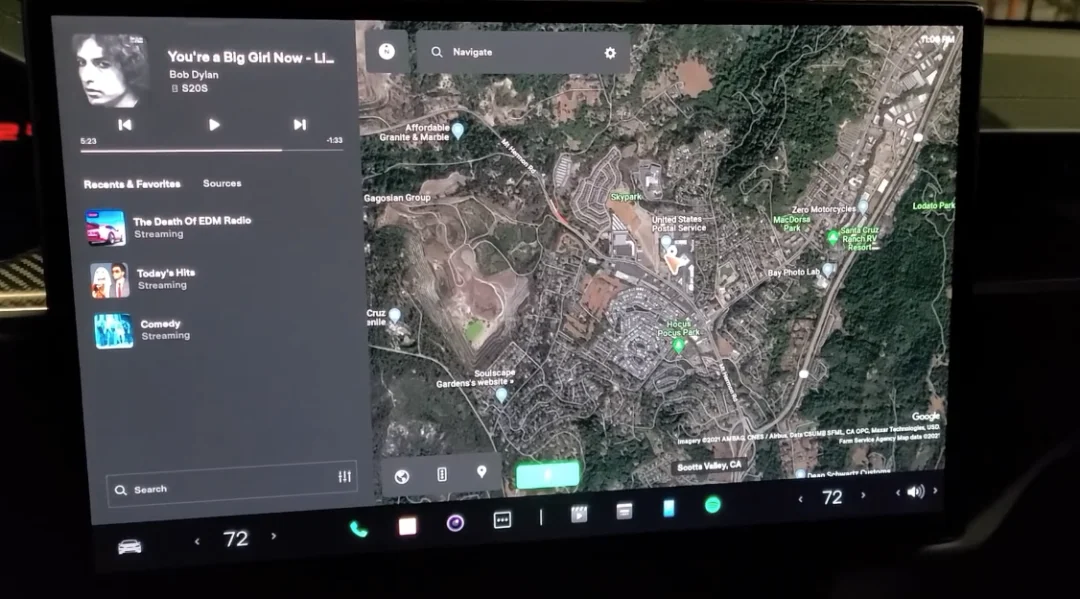
Model S Plaid V10.2
At the bottom of the infotainment screen, persistent icons include vehicle settings, an app drawer, Huawei Atom Service widgets (the image displays flight information, likely synced with a mobile account), and multimedia controls.
The top bar displays status indicators for the user account, reminders, time, dashcam status, wireless charging pad activity, Bluetooth, Wi-Fi, and signal strength.
Unlike typical infotainment systems that display maps on the central screen, this interface shows a wallpaper. This design may reserve customization space for manufacturers.
The UI design, main wallpaper display, and atomic components suggest that Huawei has integrated operational logic and usage habits from tablets and smartphones into its smart cockpit system. However, compared to previous demo versions, the differences are minimal.
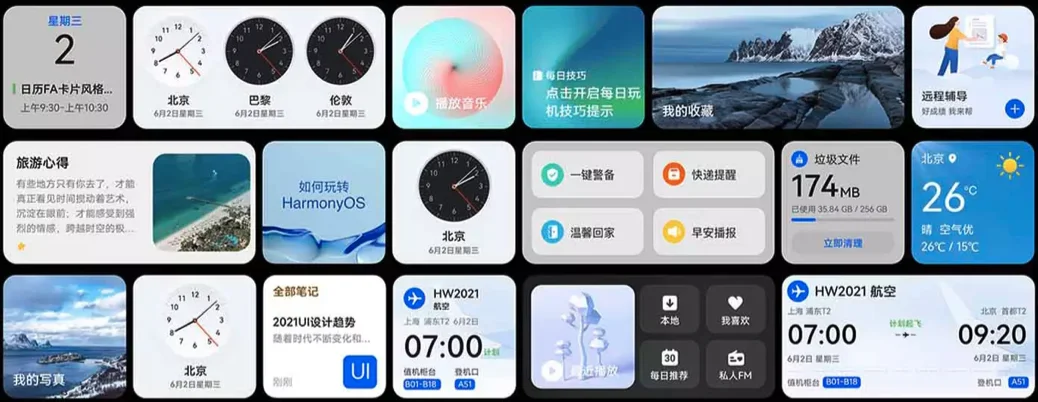
These 'atomic components'—small cards that can be resized, repositioned, skinned, and customized—are already familiar to iOS and Android users on their phones.
I am highly optimistic about this feature. On smartphones, domestic manufacturers have already granted users significant customization rights via atomic components. This functionality is expected to remain popular in vehicles, allowing consumers to 'decorate and build' their unique cockpit interfaces. This represents a significant advantage for Huawei over Tesla.
I largely agree with the logic that vehicle infotainment systems are trending toward tablet-like designs, but they need optimization for quick and precise touch operations as well as full-scenario voice control during driving. My colleague Lai Yinhate experienced Huawei's smart cockpit in a Huawei Demo Car back in July; Huawei Says HI! HarmonyOS Cockpit First Online Test you can refer to the video for details on these features, so I won't repeat them here.
Of course, once automakers confirm the use of HarmonyOS for their infotainment systems, they will inevitably customize the system with various themes. Therefore, the version we see here can be understood as NVIDIA’s reference design.
About the New Car
Richard Yu announced that the HarmonyOS smart cockpit will appear on the Jinkai SERES mid-size SUV as early as the end of this year or early next year.
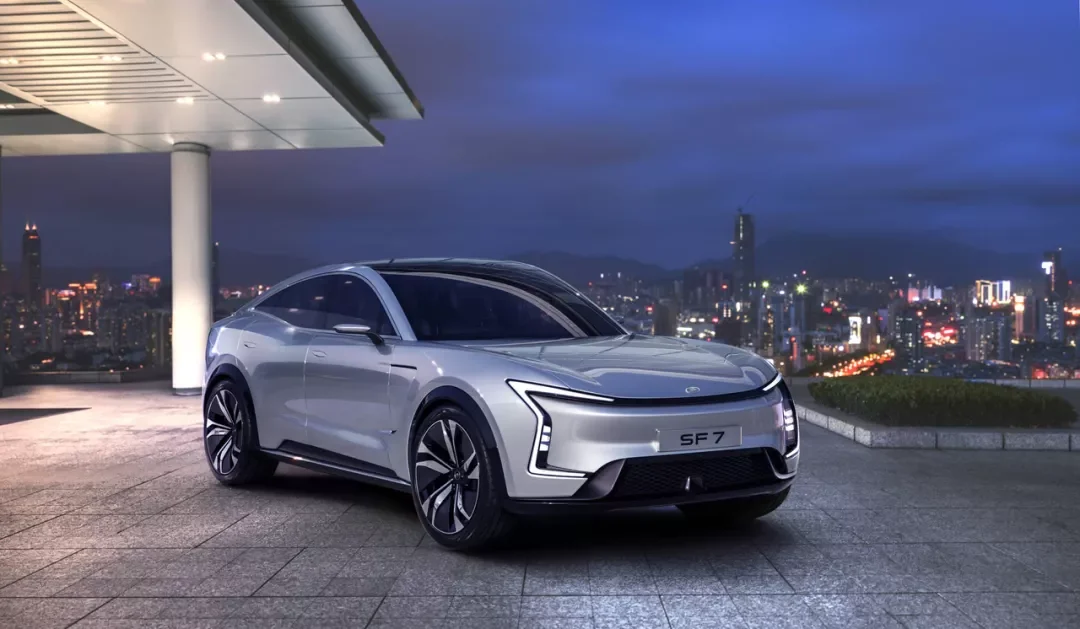
SERES had planned its SF series models early on, with the mid-size SUV corresponding to the SF7. However, there have been no further updates on this model.
On October 15, it was reported that Huawei and SERES are collaborating on their second model following the Huawei Smart Selection SF5: the Aotu.
It is said that this model will adopt Huawei's full suite of smart car solutions, with JinKang SERES playing a role more akin to "contract manufacturing." This implies that for this vehicle, Huawei may gain product definition rights as early as the pre-research phase, holding greater influence within the cabin than in the Jihu Alpha S Hi version. Of course, this news requires further confirmation.
AR-HUD
What is AR-HUD? To understand this, we need to look at the development path of HUDs:
C-HUD (Combiner HUD). This is an earlier type of HUD. When the vehicle starts, a transparent glass panel rises from the dashboard in front of the driver's seat. Optical images are displayed directly through this glass as a medium via refraction; it has relatively low design costs and complexity.
W-HUD (Windshield HUD). This is the more common HUD we see today, which projects images directly onto the windshield. However, achieving good visual quality requires high-precision aspherical mirrors specially tuned for the curvature and angle of the windshield, resulting in higher costs.
AR-HUD (Augmented Reality HUD). This is our main topic today. Literally, it creates an "augmented reality" effect by interacting with real-world objects. It is currently available on Volkswagen ID.4 models.
3D-AR HUD. This can be understood as an enhanced version of AR-HUD, primarily requiring autonomous driving capabilities to facilitate more realistic interactions.
Huawei's current AR-HUD offers a large field of view of 13° x 5°, projecting a display area equivalent to a 70-inch screen at a distance of 7.5 meters ahead, while occupying only 10 liters of volume.
I quickly typed up key points on my phone in a laboratory where photography and recording were prohibited. With the assistance of Huawei's Optical Product Line Automotive Light PR team, I obtained the images presented during that day's briefing.
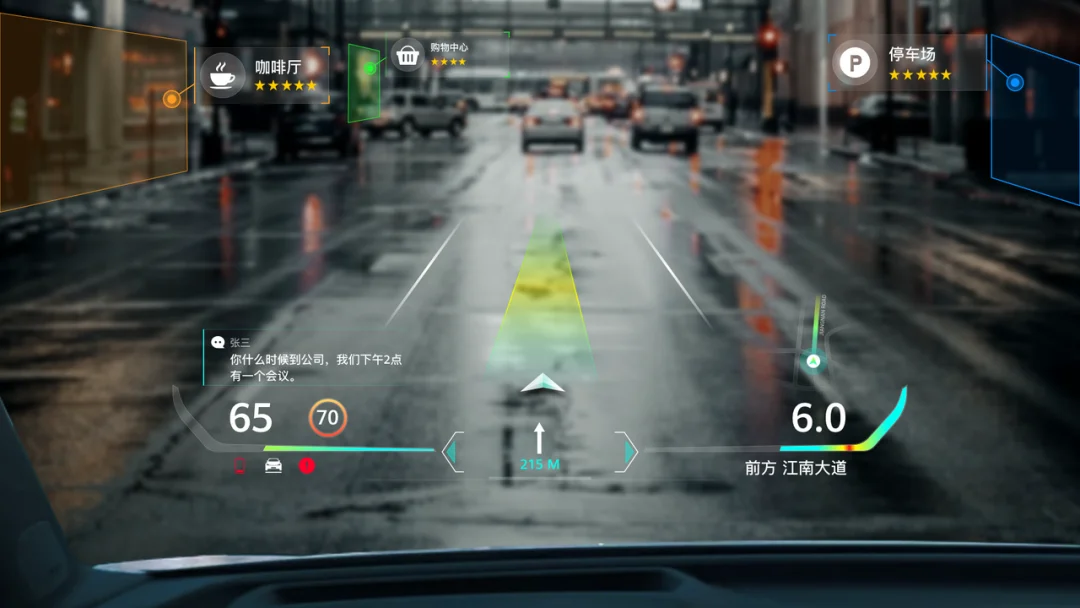
This is the key image presented at the event. As HUDs become larger, many people's imaginations hit a wall when facing technical challenges. Let's look at Huawei's content planning.
The main center area of the HUD still prioritizes the normal road view, with navigation guidance and lane lines projected as clear auxiliary enhancements. More interestingly, in the following image, we can see that during heavy rain, the AR-HUD directly uses prominent, hard-to-ignore icons to mark vehicles on the road, alerting the driver.
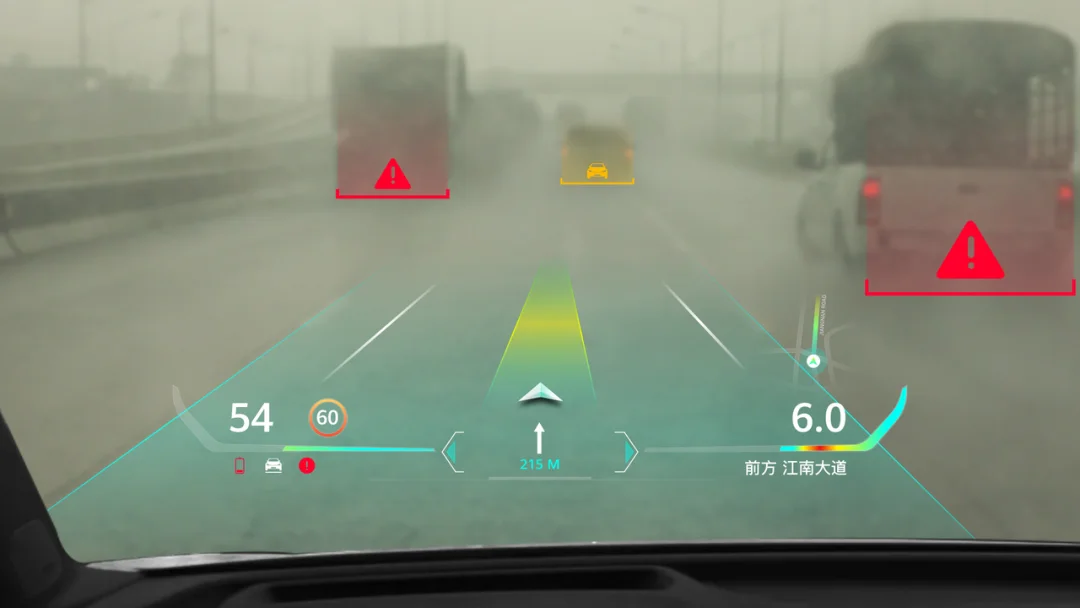
Essentially, this system is a specially tuned visual display version of an AR-HUD based on the perception hardware of driver assistance systems. However, the difficulty lies in the fact that this system requires precise annotation of the actual vehicle from the driver's perspective. Only promotional posters were available on site, so it is unknown how the actual experience would be.
The information density is highest in the bottom section, including driving status (battery level, speed, speed limit), navigation information (progress, mini-map), message displays, etc.
This type of display can already be achieved on models equipped with C-HUDs or W-HUDs.
In the top display area, we can see annotated points of interest such as cafes, parking lots, and shopping centers.
At first, I thought this would be a complex engineering challenge because it requires extremely precise matching between map data and real-time positioning, which could lead to a poor user experience. However, staff explained that the position of this 'box' is highly accurate, minimizing lag or delay issues. This feature has already been opened to automakers; for example, Huawei provided the interface for this function on the Shangqi R Pinpai ES33. We can look forward to seeing whether Shangqi R Pinpai will implement this feature in production.
Indeed, the final user experience of an AR-HUD system depends largely on brightness and resolution. Huawei currently achieves a peak brightness of over 12,000 nits. In the VR/AR field, resolution is not measured in standard terms like 1080p, 2K, or 4K, but rather by PPD (Pixels Per Degree), which indicates angular resolution. Theoretically, a higher value is better; Huawei’s AR-HUD system achieves a PPD of approximately 100.
However, in the actual testing environment of the laboratory, I used the projection function to watch movies and play games. From my practical experience, compared with current 4K and 8K monitors, there is still a significant room for improvement in resolution.
Staff also mentioned that the entire HUD system adjusts its viewing angle based on eye tracking via the DMS (Driver Monitoring System). For future 3D-AR HUDs, Huawei aims to make every piece of glass inside the vehicle a medium for information delivery.
However, observing Huawei’s yet-to-be-applied AR-HUD raised some questions, which are likely challenges all AR-HUD systems will face after mass production: How can display strategies be formulated—considering brightness changes, content layout, and viewing angles—to ensure that drivers’ actual driving remains safer and is not obstructed by visual interference across various scenarios?
Perception Hardware for Driver Assistance
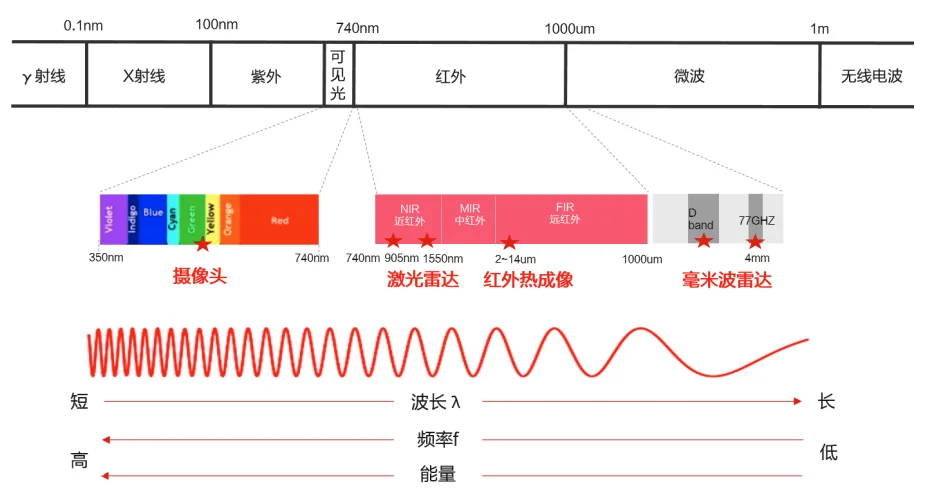
Regarding future perception hardware planning, besides high-megapixel cameras, 4D millimeter-wave radars, and LiDAR, Huawei has also planned for infrared cameras as part of its sensing pathway.
Currently, cameras have exposed certain limitations. For instance, in extreme low-light conditions at night or during heavy rain, snow, fog, and other harsh weather scenarios, a camera's perception capabilities are significantly compromised. Infrared cameras, however, use thermal radiation imaging; their sensors continue to function normally at night and possess strong penetration power against rain, snow, fog, and even sandstorms.
However, the cost of this solution remains relatively high, and it demands more rigorous perception fusion algorithms. Most importantly, these are sporadic extreme scenarios. Therefore, integrating this technology into vehicles may require waiting for lidar and 4D millimeter-wave radar to be better harmonized within algorithms.
Regarding the continuous optimization of future technologies and costs, Huawei has also predicted the developmental path for the form of future sensors. While the general approach across various companies is similar, we should note that Huawei’s advantage in domain breadth will give it an edge in sensor integration.
Distributed Antenna Deployment + Centralized Computing
For example, current millimeter-wave radars integrate front-end antennas with rear-end signal processing and perception processing in a single unit. In the future, this can be split: front-end perception data will be transmitted to the back-end domain controller for processing. The same evolutionary direction applies to lidars.
Body-Integrated Deployment
This trend is very definite, and many manufacturers have already made efforts. For instance, Baiteng, now defunct, integrated retractable lidars on both sides of its K-Byte concept car. In the future, we should expect to see lidars integrated into headlights. Additionally, external antennas could integrate GPS, 4G/5G, and FM signals.
Surface-Mounted Sensors
This represents the ultimate concept. Following the trajectory of hardware miniaturization and integration to its logical conclusion, sensor forms will tend toward a "flat" profile while pursuing plug-and-play functionality. Technologies such as microlens arrays, smart skins/conformal antennas, and silicon photonics may serve as technical breakthroughs for realizing this vision.
03Conclusion
At this HDC event, I observed that Huawei released more development tools for developers, who are already generating revenue and gaining recognition within HarmonyOS. Furthermore, the number of activated devices and active users demonstrates that HarmonyOS's ecosystem construction has initially taken shape, marking an excellent beginning for both HarmonyOS and Huawei.
Regarding the intelligent cockpit segment that I focus on, Huawei displayed a previously unreleased image of an in-car interface. This indicates that atomic components are beginning to emerge in the automotive domain. Simultaneously, Huawei showcased its pre-research and imaginative capabilities regarding various technologies for future intelligent vehicles.
Huawei, as an automotive Tier 1 supplier, attracts attention due to its powerful cross-domain technological strength. This enables Huawei, without manufacturing cars itself, to approach car-making with increasing proximity.
Written by: Liu Guangding Edited by: Daji