


Volkswagen ID.4 CROZZ Review: Conservative Tuning and Predictable Range
The ID.4 CROZZ has been on the market for over a year. As the sales backbone of the entire ID family in China, it achieves monthly sales of five to six thousand units.
I recently borrowed an ID.4 CROZZ for daily commuting and have gathered extensive insights from several days of use.
01A Standard Compact SUV
The ID.4 CROZZ measures 4,592 mm in length, 1,852 mm in width, and 1,629 mm in height, with a wheelbase of 2,765 mm. In terms of dimensions, it falls into the compact SUV category:
The Tuguan L measures 4,735 mm in length, 1,859 mm in width, and 1,677 mm in height, with a wheelbase of 2,791 mm;
The Tanyue measures 4,593 mm in length, 1,860 mm in width, and 1,665 mm in height, with a wheelbase of 2,731 mm.
This comparison is not based solely on dimensions; their pricing structure also reflects their competitive positioning:
The ID.4 CROZZ is priced from RMB 187,300 to RMB 287,300.
The Tanyue lineup is priced from RMB 204,900 to RMB 264,900, with widespread discounts of more than RMB 20,000.
The Tuguan L is priced from RMB 199,000 to RMB 283,800, also featuring discounts of around RMB 20,000.
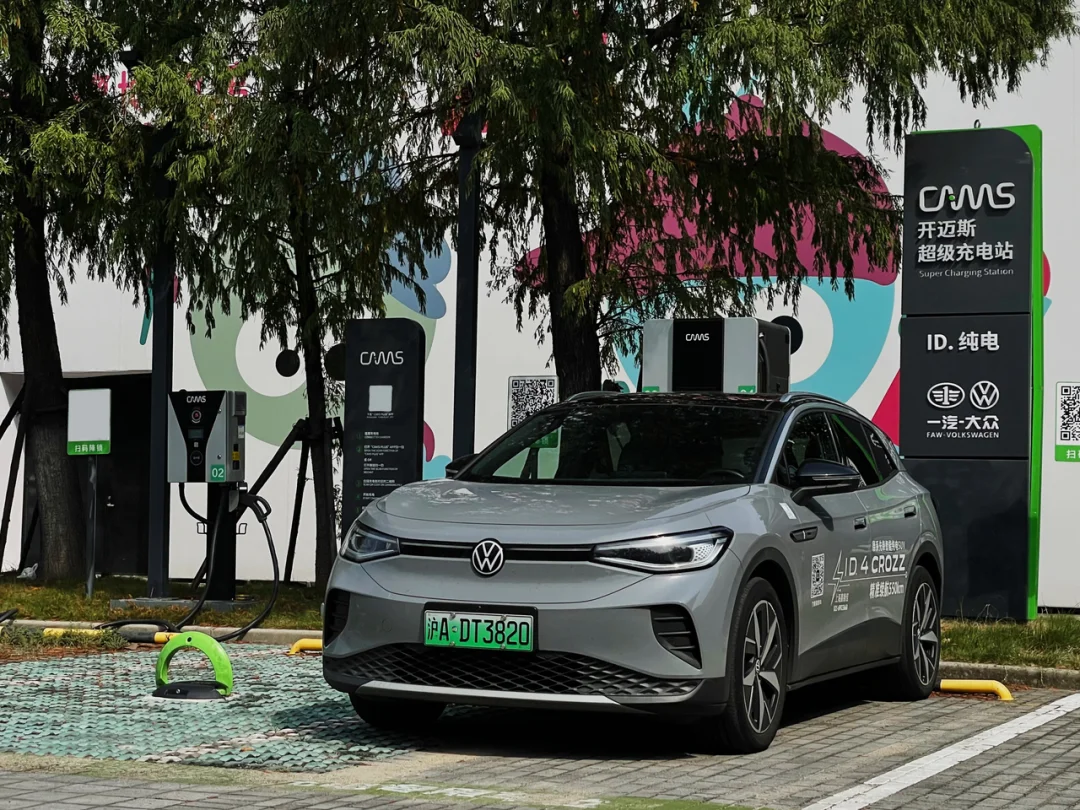
From the outside, the ID.4 CROZZ gives off a solid impression. Its body lacks straight, rigid curves; almost every surface is defined by rounded lines.
The exterior design may not offer the talking points typical of new energy vehicle startups, but its wide-base, narrow-top proportions create a strong sporty stance when viewed from a front 45-degree angle.
A parameter worth mentioning is the drag coefficient (Cd) of 0.28. Aerodynamic drag significantly impacts the range of pure electric vehicles, and this figure holds an advantage among peers in its class.
The appearance, which seems somewhat bulky during the day, transforms completely at night. As I approached the ID.4 CROZZ with my key, the lighting effects actually surprised me.
First, the Volkswagen logo illuminates, followed by the activation of the full-width light bar. The headlights then perform a lifting and lateral shifting motion to simulate blinking eyes.
Another subtle yet highly effective design detail on the exterior is the door handle.
To optimize aerodynamic drag and reduce battery load, new energy vehicle models have undergone significant exterior redesigns. A prominent example is the adoption of flush or pop-out door handles, intended to keep the vehicle's side profile as flat and smooth as possible during driving.
This design approach is sound and arguably more satisfying than many sensor-activated pop-out systems. However, it has introduced several issues: for instance, in cold northern winters, door handles can freeze shut after heavy snowfall, making the doors impossible to open; additionally, older drivers often find passive hidden handles confusing on their first attempt, sometimes requiring assistance from the driver.
The ID.4 CROZZ, along with other MEB platform vehicles, addresses these problems with semi-recessed hidden door handles. Their shape makes the operation method immediately obvious. When the user pulls the switch, the door lock automatically disengages and the door pushes outward slightly.
This design does not necessarily incur higher costs than pop-out handles, but it offers near-zero learning curve and superior convenience. This detail is highly commendable.
Regarding the core interior and exterior styling, 'conventional' is an appropriate description. The ID.4 CROZZ retains Volkswagen’s traditional model positioning, leveraging the advantages of its dedicated EV platform to provide a larger, wider, and flatter rear passenger space—a critical feature for family users.
02Driving Experience Retains Distinct German Character
Beyond size, the ID.4 CROZZ’s powertrain is broadly consistent with the two vehicles mentioned earlier.
For example, the 2.0T EA888 engine comes in DPL, DTH, and a low-output DPL variants, producing a maximum power of 137 kW and a peak torque of 320 N·m; there is also a DKX version with a maximum power of 162 kW and a peak torque of 350 N·m.
The ID.4 CROZZ offers a single rear motor for rear-wheel drive and a dual-motor setup for all-wheel drive. In terms of power output, it is available in three versions:
The rear-wheel-drive version with the smaller motor delivers a peak power of 126 kW and a peak torque of 310 N·m. This variant is equipped with a 55.7 kWh battery and has a CLTC range of 425 km.
The rear-wheel-drive version with the larger motor produces a peak power of 150 kW and a peak torque of 310 N·m. This version and those above feature an 84.8 kWh battery, yielding a CLTC range of 600 km.
The all-wheel-drive version retains the rear motor’s peak power of 150 kW and peak torque of 310 N·m, adding a second motor with a peak power of 80 kW and a peak torque of 162 N·m. Its CLTC range is 554 km.
I tested the 2022 ID.4 CROZZ Long Range Pro, which belongs to the rear-wheel-drive large-motor category. Its permanent magnet synchronous motor generates a maximum power of 150 kW and a peak torque of 310 N·m.
As a high-volume model, the ID.4 CROZZ is to take over part of the market from fuel vehicles. The ID.4 CROZZ needs to meet the needs of more consumers, especially most owners who have converted from fuel to electric vehicles. That is, it must retain Volkswagen's successful experience in fuel vehicles and create a family-oriented "German flavor".
In fact, the ID.4 CROZZ proves to be a well-handled and easy-to-drive family SUV.
When driving, the accelerator pedal exhibits some delay in its initial response. As you press deeper into the mid-range, power delivery becomes more responsive, creating a sense of ample thrust. Pushing the pedal fully to the floor reveals that the overall acceleration is not aggressive; its zero-to-100 km/h time exceeds eight seconds, which is comparable to the performance of the low-output EA888 DPL 2.0 T engine.
Having grown accustomed to EVs that accelerate in around six seconds, I can clearly perceive this lack of speed. Yet, during normal lane changes on elevated highways over several days, I found the acceleration entirely sufficient. Moreover, due to the electric motor’s faster response, overtaking at speeds below 80 km/h required no effort whatsoever.
This relatively sluggish initial throttle response is actually more friendly to the majority of 'ICE-to-EV' transitioners. It mimics the way an engine’s RPM builds up: if you need more power, simply press deeper. Setting aside my personal demands for rapid response and quick times, this acceleration level fully satisfies normal overtaking requirements.
The brake pedal offers a more nuanced feel. The initial response is somewhat laggy, mid-range braking force is not immediately obvious, and significant braking power only kicks in toward the end of the pedal travel, making the feel less linear.
The steering of the ID.4 CROZZ retains the tactile quality typical of Volkswagen’s ICE vehicles. Within a left-right range of about 10 degrees, a small amount of free play remains. However, the overall steering damping is slightly heavy, which might require some effort for female drivers.
It is worth emphasizing that the ID.4 CROZZ has a remarkably large steering angle. In many U-turns, I could complete the turn in a single motion, which is surprising for a vehicle with a wheelbase of 2,765 mm.
The front MacPherson strut and rear multi-link suspension setup is a hallmark of "German-style" tuning, designed to preserve road feel without transmitting every surface imperfection as directly as the Tesla Model Y. On rougher roads, vibrations are perceptible in the steering wheel and lower seat cushions. However, when traversing speed bumps, the vehicle remains composed, dissipating impacts within a few oscillations rather than feeling unsettled.
In terms of NVH, I think the ID.4 CROZZ performs very well.
The ID.4 CROZZ, equipped with single-layer glass, maintains a relatively quiet cabin at speeds below 80 km/h. However, distinct noise from the chassis seeps into the cabin when traversing expansion joints.
The driving experience of the ID.4 CROZZ test drive basically matched my initial expectations, and after driving it for these few days, I found that the most interesting aspect of the ID.4 CROZZ's driving dynamics is actually its regenerative braking! It has a very obvious characteristic: high-power regeneration, low perception.
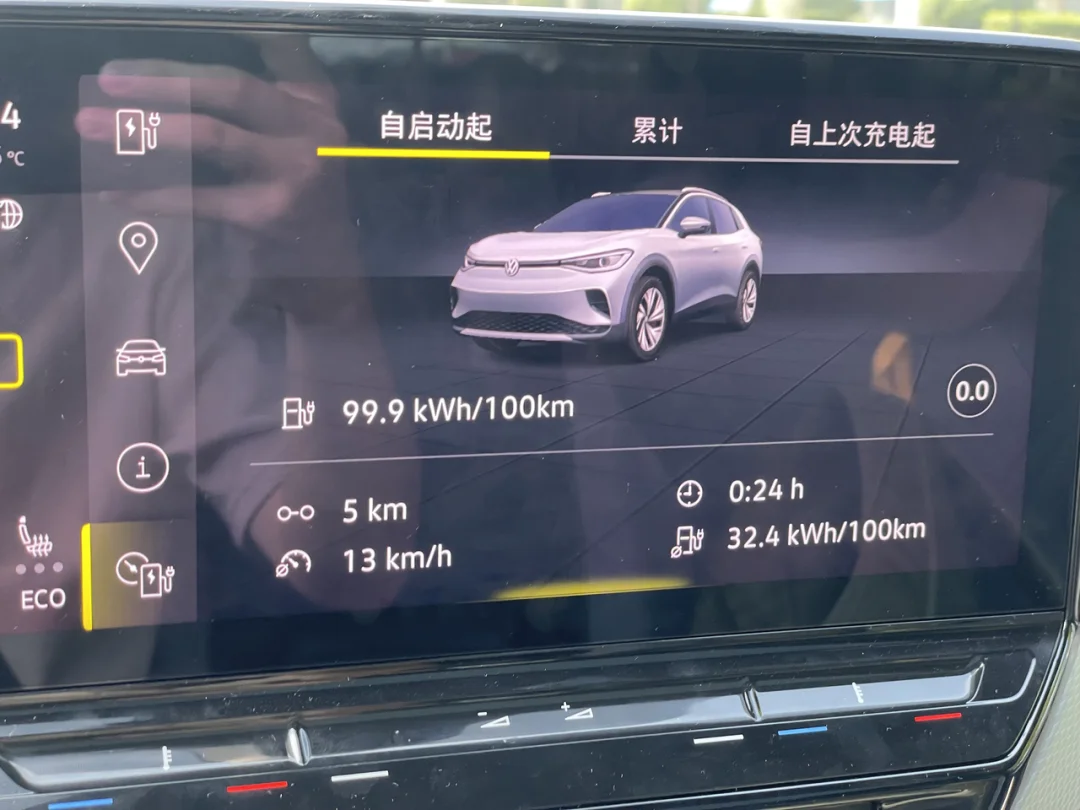
This image captures the peak regeneration power during deceleration at an intersection: 100 kWh. This figure is indeed impressive. I suspect the actual recovery power may be even higher, as the infotainment screen caps display at 99.9 kWh, highlighting this high-power characteristic.
Let’s delve deeper into the "low perceptibility" aspect.
Many people report motion sickness in electric vehicles, and some criticize Tesla’s one-pedal mode for being uncomfortable to drive. In contrast, the regenerative braking in the ID.4 CROZZ is so subtle that it is easy to overlook.
On the ID.4 CROZZ, energy recuperation operates in two distinct modes:
In D mode, energy recuperation during coasting produces almost no drag, making it similar to the coasting behavior of a conventional internal combustion engine vehicle.
My driving style in D mode is essentially identical to that in a fuel-powered car; the vehicle coasts forward based on inertia. I believe most drivers transitioning from gasoline vehicles to the ID.4 CROZZ will find the driving feel during coasting indistinguishable from that of a traditional car.
At this time, energy recuperation is primarily linked with braking. When the brake pedal is pressed, the initial phase relies on recuperation torque for deceleration, followed by hydraulic braking in the latter phase. This series-connected CRBS (Coordinated Regenerative Braking System) presents a challenge in seamlessly blending the brake pedal feel.
As mentioned earlier, this explains the significant drop in brake pedal feel in the ID.4 CROZZ. Upon closely observing the power display on the center console, I also noticed that energy recuperation nearly completely disengages only in the middle-to-late stage of brake pedal application, which corroborates the above analysis.
In B mode, energy recuperation engages during coasting, but the overall effect remains "gentle."
During coasting in B mode, the intensity of energy recuperation has a slight delay and increases linearly, yet it is not as strong as that in Tesla vehicles.
The physical design of the B-mode selector allows for quick switching during driving based on road conditions. I typically engage B mode when encountering downhill sections to maximize energy recovery through coasting.
After switching between Economy, Comfort, and Sport modes, I found that the differences in driving feel among them were not significant. The only exception was in Sport mode, where the regenerative braking intensity increased slightly; this logic setting is somewhat unusual, as most manufacturers reduce or even disable regenerative braking in Sport mode.
From a driving perspective, the ID.4 CROZZ is clearly tailored for former internal combustion engine (ICE) vehicle owners, with features such as accelerator pedal logic and low-profile regenerative braking. This makes it highly suitable for Volkswagen ICE users transitioning to electric vehicles, as the ID.4 CROZZ retains the familiar "German flavor" you know from VW.
03Range and Recharging
At a price point of over RMB 200,000, the ID.4 CROZZ is equipped with an 84.8 kWh ternary lithium-ion battery, offering a CLTC range of 600 km. Judging solely by the battery capacity, the ID.4 CROZZ demonstrates considerable sincerity.
However, the ID.4 CROZZ does not display a full 600 km range when fully charged, nor does it ever reach that figure. This is one of the most interesting aspects of the ID.4 CROZZ: it continuously adjusts the displayed remaining range based on my driving habits and load.
For example, turning on the air conditioning for cooling causes the displayed range to drop immediately by approximately 40 km. In my testing, the ID.4 CROZZ’s range depletion ratio was nearly 1:1 with actual consumption.
I set off with the battery at 67% state of charge and a displayed range of 278 km, under ambient temperatures of around 30°C with the air conditioning running simultaneously. After traveling 13 km to my destination, the battery level dropped to 65%, and the displayed range decreased almost exactly in sync with the distance driven, showing a remaining range of 264 km.
Based on this, I estimate that with the air conditioning running, the ID.4 CROZZ can achieve a real-world range of over 400 km. Combined with the real-time displayed remaining mileage, the ID.4 CROZZ allows for more precise planning of single-leg distances during long trips.
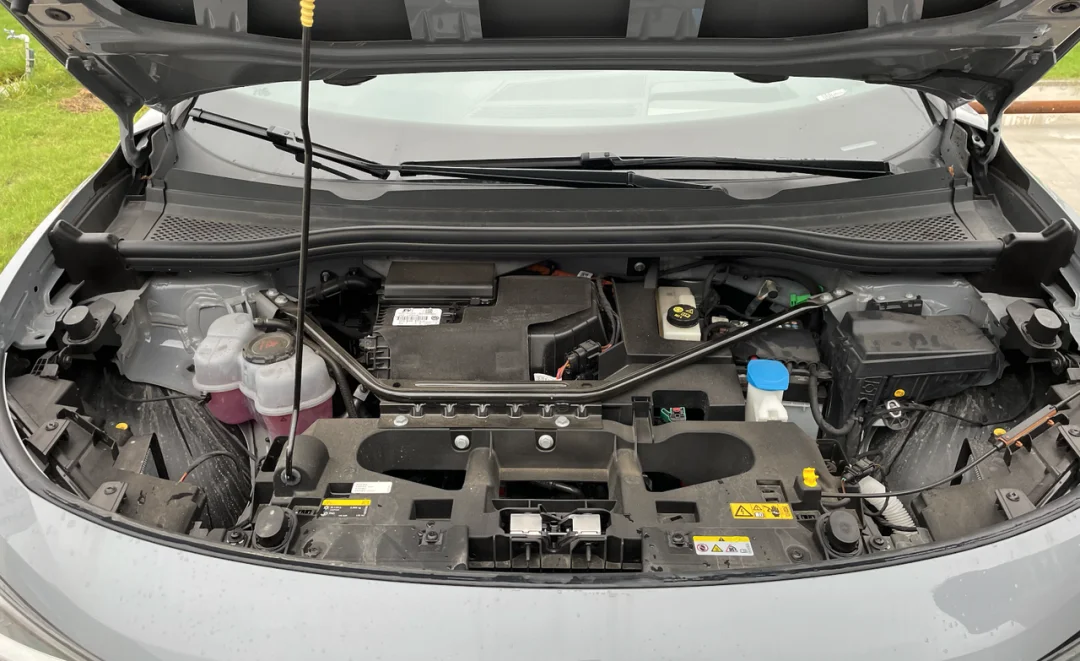
The first owners of the ID.4 CROZZ enjoy one year of free charging through Kaimaisi, a significant benefit for ID series owners at FAW-Volkswagen.
Kaimaisi is a charging service provider jointly invested in by FAW, Volkswagen, and Jianghuai. By the end of 2021, it had launched 607 stations with 3,411 charging piles and 5,797 charging terminals, indicating that its infrastructure rollout has outpaced vehicle sales growth.
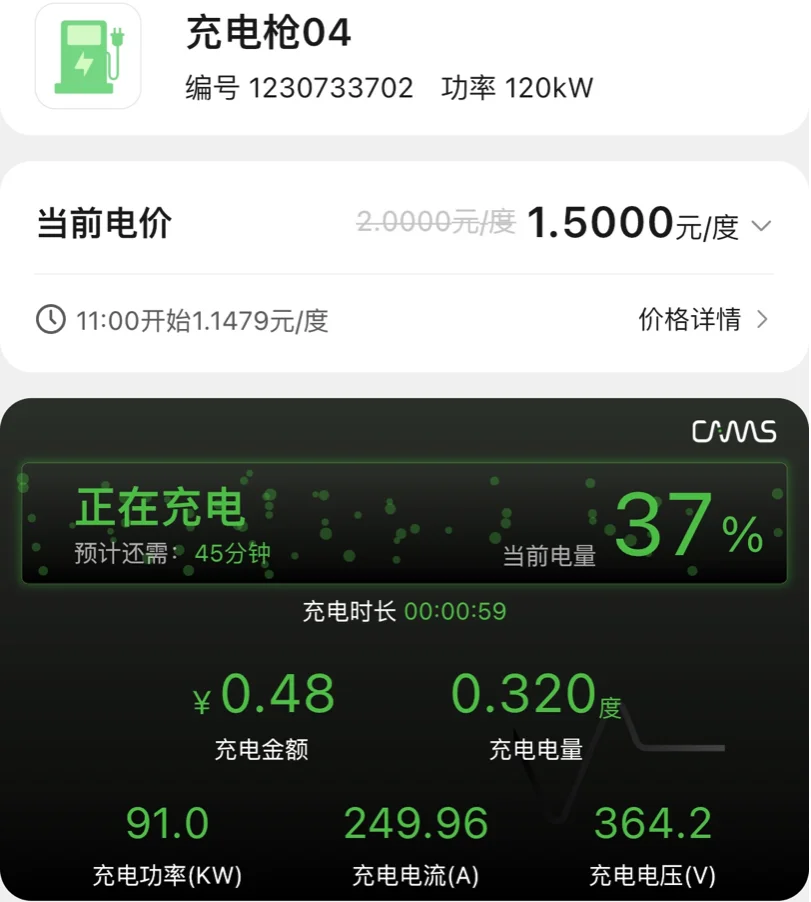
I specifically visited a Kaimaisi station to experience the entire charging process.
After scanning a QR code via the mobile app, the ground lock automatically lowers, preventing fuel vehicles from occupying EV charging spots—a common issue at third-party stations.
I used a 120 kW charger split from a charging cabinet. With no other users present, the charging current reached approximately 250 A while voltage remained around 260 V, delivering over 90 kW of power. Starting at 37% state of charge, the session added 23.5 kWh in 15 minutes, raising the battery level to 65%.
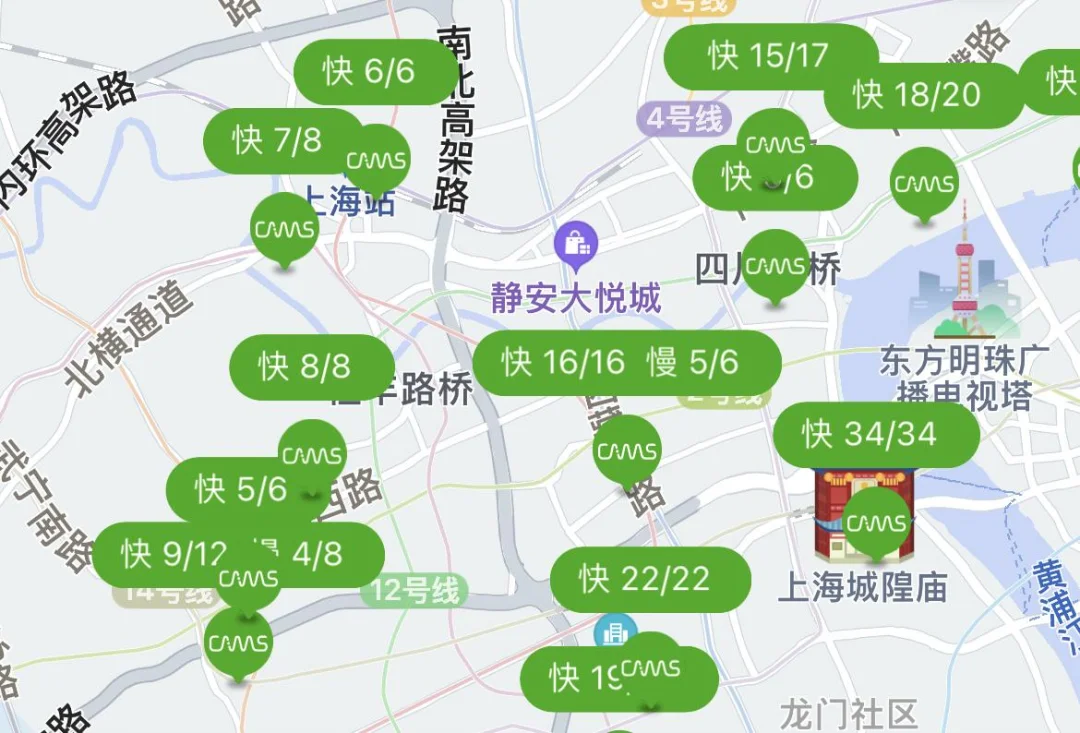
This replenishment speed is above average. The Kaimaisi app reveals a dense network of stations in Shanghai, largely meeting daily charging needs.
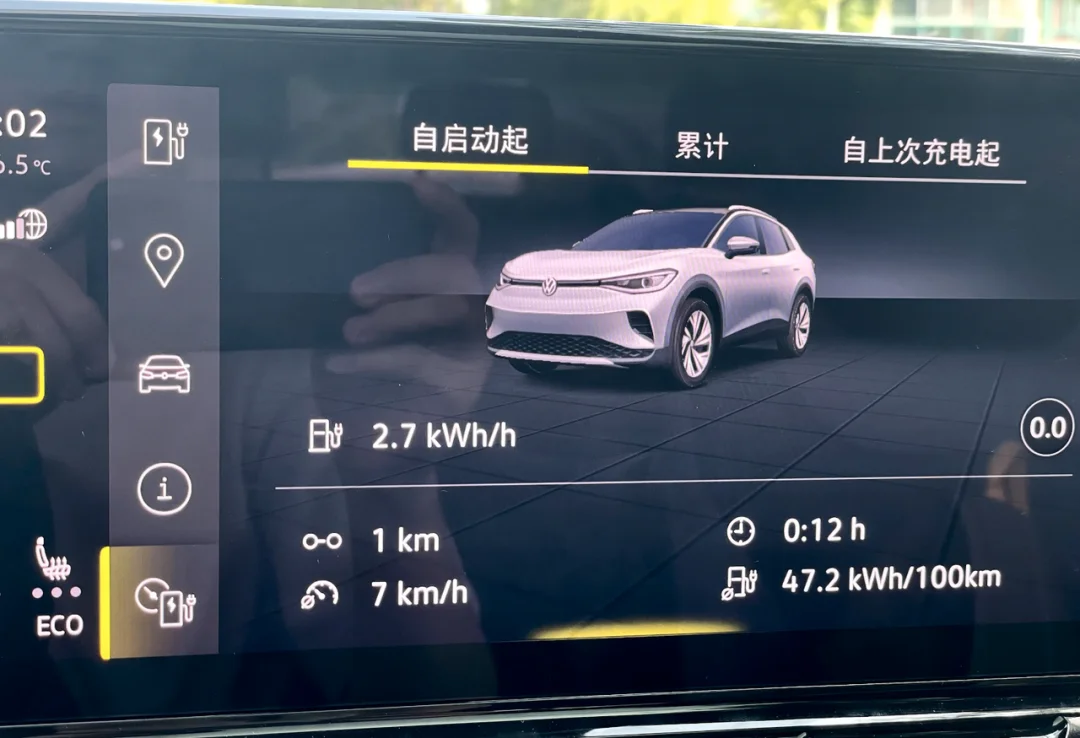
What’s interesting is that while I was parking to charge, I noticed the ID.4 CROZZ continued to display its real-time energy consumption output. With the air conditioning on, the consumption rate was 2.7 kWh/h.
So, looking at the ID.4 CROZZ as a whole: it has a substantial battery capacity, which provides a long single-charge range. Combined with Kaimaisi’s extensive charging network, this makes recharging convenient for owners.
04Some Small Details
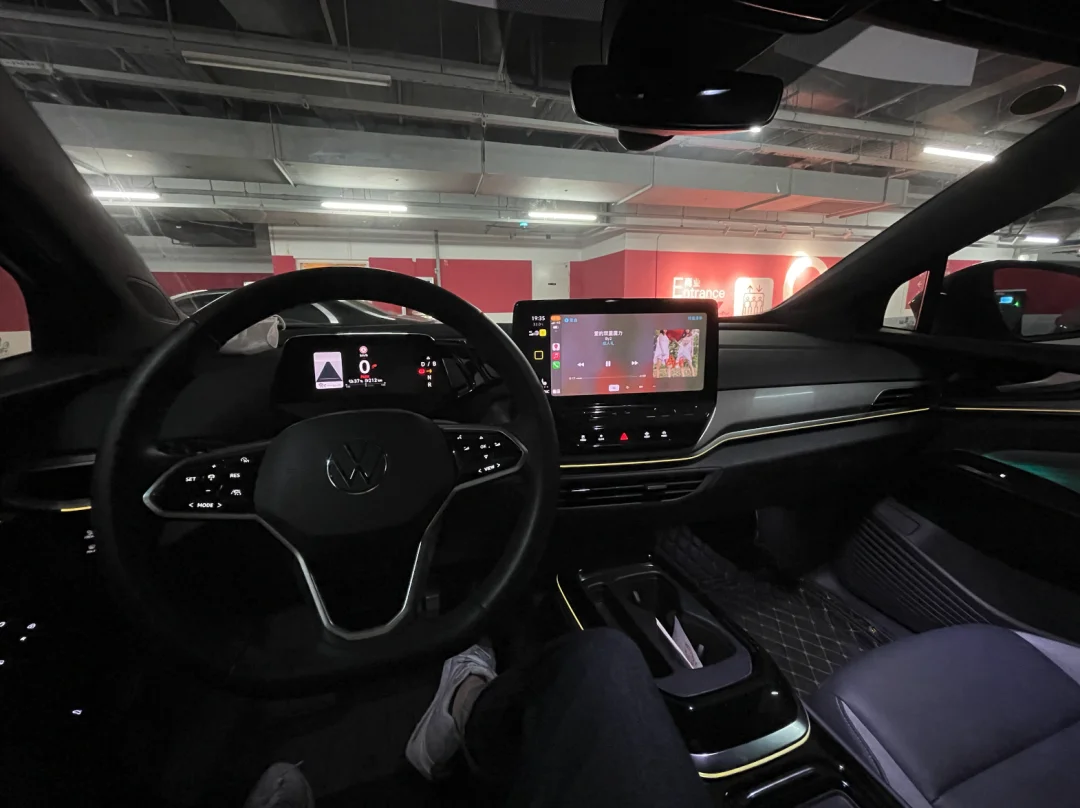
During my time using the ID.4 CROZZ as my daily driver, I found that this compact SUV—the sales leader for Volkswagen’s MEB electric platform in China—performs very “meticulously” in many areas.
Since the most interesting part isn’t the driving but rather these “details,” let’s start with the small things.
ID.Light Interactive Light Strip
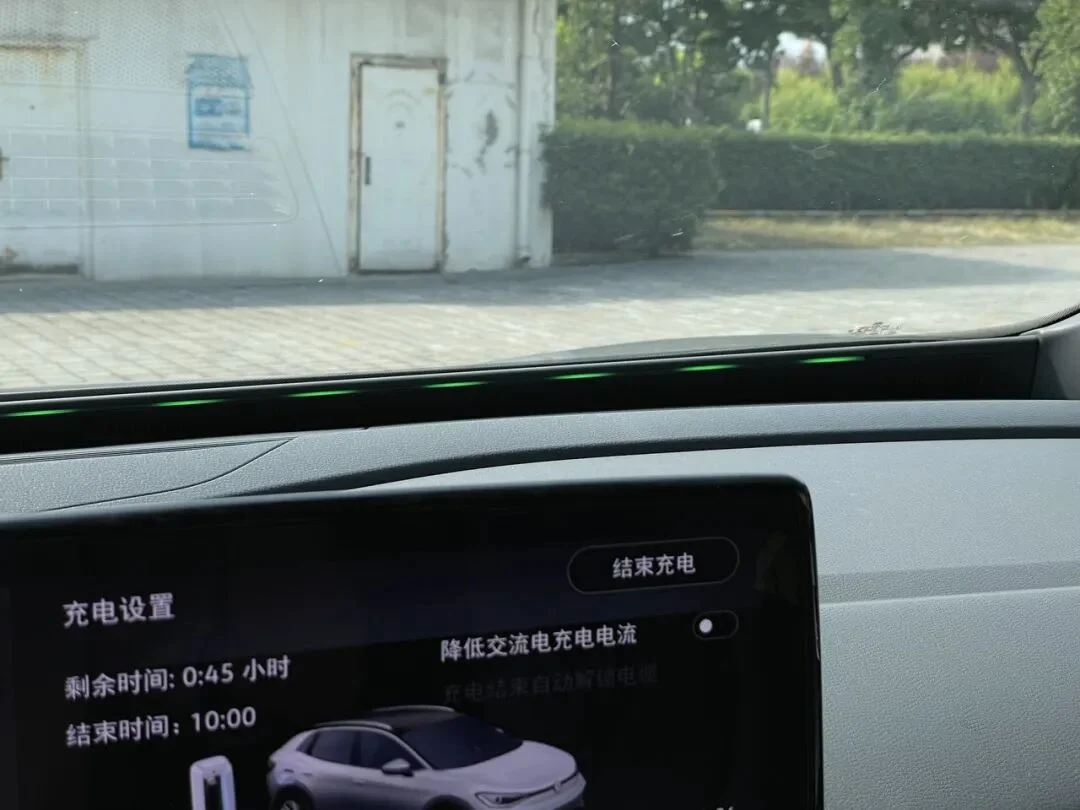
The ID.Light interactive light strip syncs with events such as AEB activation, charging, and infotainment navigation.
For example, it displays the charging status while charging. It also reacts during voice assistant wake-up and phone calls, providing a highly visible effect.
Upon close inspection, the light strip emits an even color, and its animations flow seamlessly without noticeable segmentation.
Proximity Sensing Animation
This is a traditional feature of Volkswagen, present on most models built on the MQB platform.
When a hand approaches the screen, infrared sensors located below detect the finger's position, triggering secondary menu options or displaying text.
Additionally, many users may not be aware that the ID.4 CROZZ supports gesture control, provided the gestures are performed within the infrared sensing zone.
05The Overlooked Driver Assistance
The 2022 ID.4 CROZZ lacks lane-change assist with turn signals and, consequently, highway navigation assist. However, its basic driving capabilities are solid.
The perception hardware for the ID.4 CROZZ is as follows:
Five cameras (one forward-facing + four surround-view);
Three millimeter-wave radars;
Eight ultrasonic sensors.
With this unpretentious hardware setup, the basic functions of Adaptive Cruise Control (ACC) and Lane Keeping Assist (LKA) perform reliably, staying centered in the lane without excessive weaving. When a lane change is needed, I simply activate the turn signal and gently nudge the steering wheel to initiate the maneuver. The required torque is low, and the steering wheel does not resist. After completing the lane change, the vehicle automatically recognizes the situation and resumes assistance.
Here, credit must be given to the capacitive steering wheel, a feature that urgently needs wider industry adoption. It provides a more seamless experience during driver assistance. The ID.4 CROZZ has also mastered the logic of the capacitive wheel: after the vehicle ahead comes to a stop, we only need to rest our hands on the steering wheel to resume following.
Additionally, the ID.4 CROZZ’s stop-follow distance is solid, typically maintaining a gap of about half a car length, which makes it difficult for other vehicles to cut in. Under normal driving conditions, when facing vehicles attempting to cut in, the ID.4 CROZZ handles medium- and long-range cut-ins adequately, but close-range cut-ins require manual intervention.
The human-machine collaboration in the ID.4 CROZZ deserves special praise.
For example, with ACC and LKA active, I can intervene in steering control relatively easily, as the system’s resistance is minimal. By contrast, Tesla’s Autopilot (AP) aggressively reclaims steering authority once activated, requiring significant force to override—a dangerous trait, especially on curves.
Furthermore, while ACC and LKA are engaged, I can lightly press the accelerator to temporarily exceed the set speed without disengaging the systems. I can even signal and change lanes, after which ACC and LKA seamlessly resume detection and operation.
Overall, the ID.4 CROZZ does not pursue the aggressive highway navigation capabilities centered on lane changes via turn signals that are common among leading new energy brands. However, its foundational Level 2 driver assistance performs reliably. Combined with the electric power steering and smooth human-machine collaboration, the overall assisted driving experience is excellent.
06Conclusion
As a pure-electric family five-seat SUV, the ID.4 CROZZ delivers a well-balanced performance across exterior design, interior space, driving dynamics, and even assisted driving features.
The only shortcoming of the ID.4 CROZZ is the intelligence level of its infotainment system. Yes, the full text does not mention the ID.4 CROZZ's infotainment because it indeed does not match the smart voice assistants and numerous features of domestic new forces; it merely supports localized applications such as NetEase Cloud Music and iQiyi apps. The ID.4 CROZZ seems to be aware of consumer needs, as it comes with built-in wireless CarPlay.
So, who should I recommend buying the ID.4 CROZZ for?
It is for family users with a firm need for a large five-seat cabin and long range. Of course, they do not care much about infotainment intelligence; most of the time, they rely on their phones for navigation.
This reflects the mindset of many Volkswagen owners transitioning from internal combustion engines to electric vehicles. They want a familiar driving feel, the tangible range provided by a large battery, and trust in the craftsmanship and quality of a traditional brand.
Written by: Liu Guangding Edited by: Liu San