


Q3 Gross Margin Hits Multi-Year Low: Will Tesla Continue Cutting Prices to Boost Sales?
After years of rapid growth, Tesla’s progress this year appears to have slowed, a trend particularly evident in its financial results.
On October 19, Tesla officially released its third-quarter earnings report.
Before the release of this earnings report, Mogenshidanli analysts stated that Tesla's gross margin might continue to decline to 17.5% in the third quarter. Meanwhile, there is a broadly pessimistic outlook regarding Tesla's Q3 financial data.
Let’s examine how Tesla’s third-quarter performance actually unfolded.
01Unappealing Yet Enviable
Tesla’s third-quarter financial report showed significant quarter-over-quarter declines across many metrics. While not encouraging for the company itself, these figures remain highly enviable when viewed against the backdrop of the entire new energy vehicle industry.
Key financial highlights are as follows:
Total revenue of USD 23.35 billion, up 9% year-over-year and down 6% quarter-over-quarter;
Total gross profit of USD 4.18 billion, down 22% year-over-year and down 7.8% quarter-over-quarter;
Gross margin of 17.9%, compared to 18.2% in the previous quarter;
Total automotive revenue of USD 19.625 billion, up 5% year-over-year and down 7.8% quarter-over-quarter;
Operating expenses of USD 2.41 billion, up 43% year-over-year and up 13.1% quarter-over-quarter;
Free cash flow of USD 850 million, down 74% year-over-year and down 15.6% quarter-over-quarter;
Cash, cash equivalents, and investments of USD 26.08 billion, up 24% year-over-year.
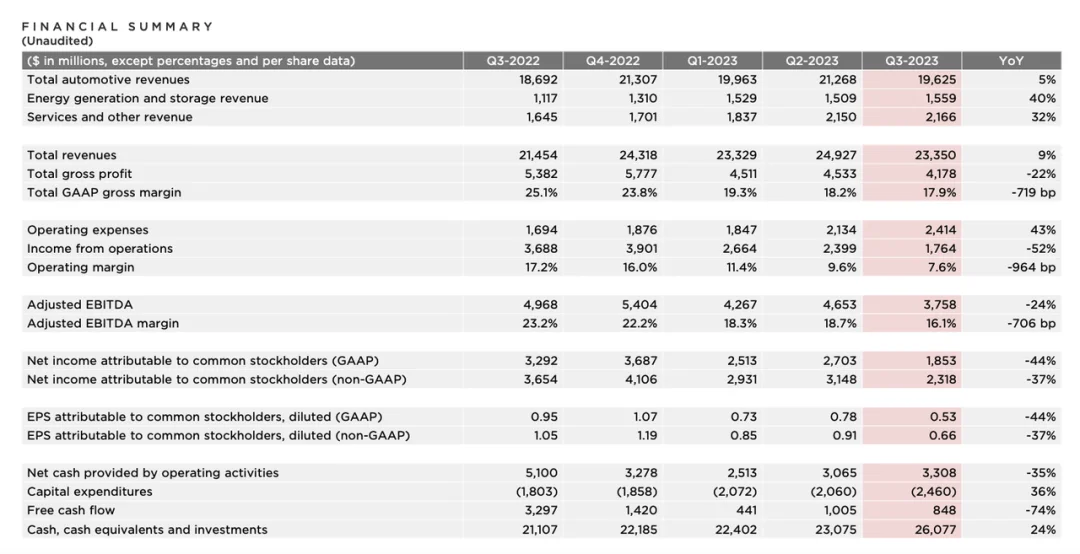
The data shows that while Tesla's revenue grew year-over-year in the third quarter, it primarily trended downward quarter-over-quarter. Meanwhile, expenses generally trended upward.
Tesla attributed the quarter-over-quarter decline in revenue mainly to lower average selling prices for its vehicles resulting from price cuts.
Regarding the rise in expenses, the earnings report indicated that R&D costs increased due to projects such as Cybertruck and AI in the third quarter. Additionally, factory upgrades temporarily drove up production costs.
Indeed, judging from a series of actions in the third quarter, Tesla did not deliver any new vehicles; Dojo began mass production in July; and factories halted production for upgrades. While revenue lacked new momentum, expenses continued to expand.
However, this also suggests that the third quarter was a phase for Tesla to slow down and accumulate energy, making the decline in financial metrics unsurprising.
This implies that in the fourth quarter, Tesla needs to release the accumulated energy from the third quarter to further improve its financial indicators.
After all, gross margins have hit their lowest point in nearly three years, and Tesla should demonstrate to the market the level it expects.
Additionally, it is worth noting that the growth in Tesla's other businesses is proceeding steadily.
Energy production and storage revenue reached USD 1.56 billion, up 40% year-over-year and 3.3% quarter-over-quarter.
Service and other revenue totaled USD 2.17 billion, up 32% year-over-year and 0.7% quarter-over-quarter.
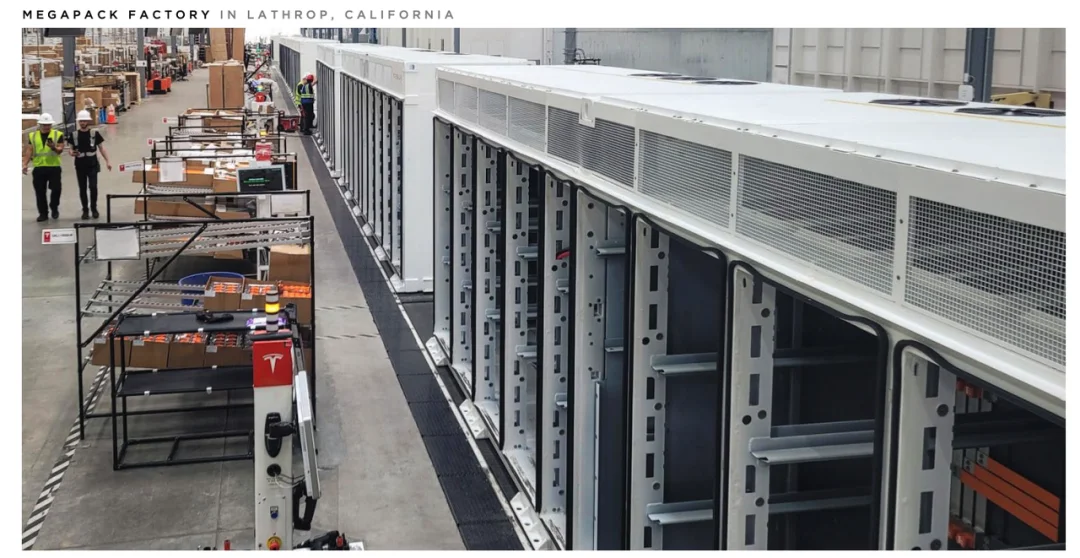
As the energy storage business expands and more automakers adopt Tesla’s NACS charging standard, Tesla’s energy ecosystem is growing larger and becoming a primary contributor to profitability.
Overall, although the third-quarter financial results may not appear to reflect Tesla’s typical performance, they remain strong and healthy. In its earnings report, Tesla stated:
We have ample liquidity to support our product planning, long-term capacity expansion, and other expenditures.
02Must Achieve Record Sales Volume
For Tesla, third-quarter production and delivery figures were also less than ideal.
In the third quarter, Tesla’s quarterly production and deliveries fell for the first time since the second quarter of last year, reaching 430,500 units and 435,100 units, respectively.
Specifically:
Model S / X production was 13,688 units, with deliveries of 15,985 units;
Model 3 / Y production was 416,800 units, with deliveries of 419,074 units.
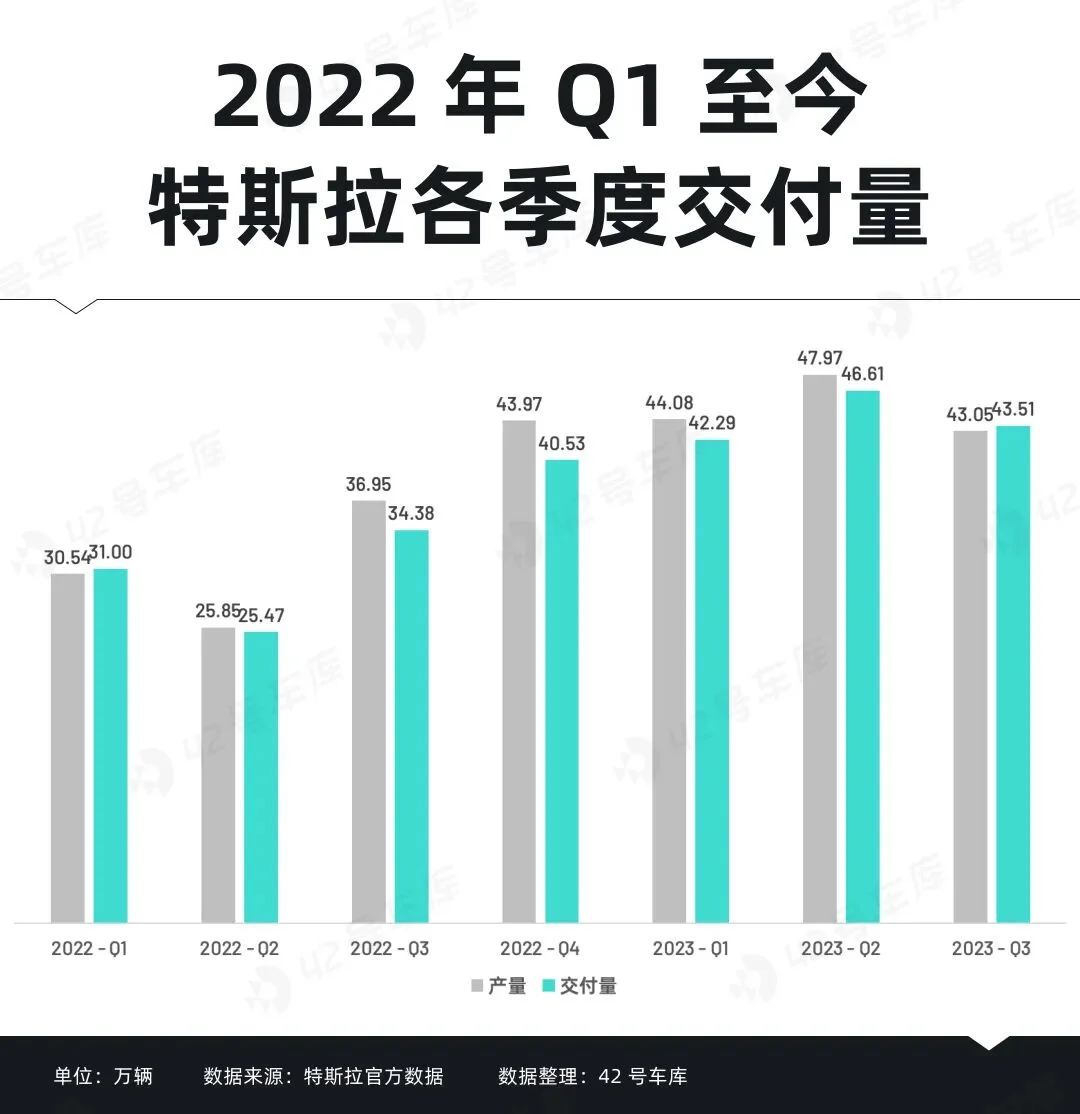
Tesla attributed the decline in production and deliveries primarily to factory shutdowns for upgrades.
Despite the simultaneous drop in both production and deliveries, Tesla reiterated that its annual sales target of 1.8 million vehicles remains unchanged, aiming to maintain a compound annual growth rate of 50%.
This means that in the fourth quarter, Tesla must deliver at least 475,900 vehicles. And 475,900 vehicles represents a new quarterly sales record high for Tesla. Even for Tesla, achieving such sales performance will face significant pressure.
Currently, two main factors support Tesla's ability to achieve an annual sales volume of 1.8 million units.
First, Tesla has completed factory upgrades.
During the Q2 earnings release, Elon Musk noted that Tesla's third-quarter production would see a slight decline due to factory shutdowns for upgrades. Therefore, despite the drop in capacity, this was expected.
With the factory upgrades completed, Tesla has ensured that its push for higher sales volume will not be hampered by production capacity constraints.
Second, the Huanxinban Model 3 will begin domestic deliveries in the fourth quarter.
The Huanxinban Model 3 represents a major product innovation for Tesla in the mainstream consumer market since the release of the Model Y in 2019, with significant changes in both design and configuration.
With the start of deliveries for the Huanxinban Model 3 in the fourth quarter and the clearance of inventory for the old Model 3, Tesla's sales growth has new room for imagination.
Additionally, according to Tesla's plan, the Cybertruck is expected to begin deliveries on November 30 this year.
Since its initial reveal in November 2019, the Cybertruck has faced numerous delays, with Elon Musk repeatedly setting deadlines for his employees that were as impossible to meet as the promises he made to customers.
Now, this cyberpunk-flavored promise is finally about to be delivered. According to the latest data, Cybertruck orders have surpassed 2 million units.
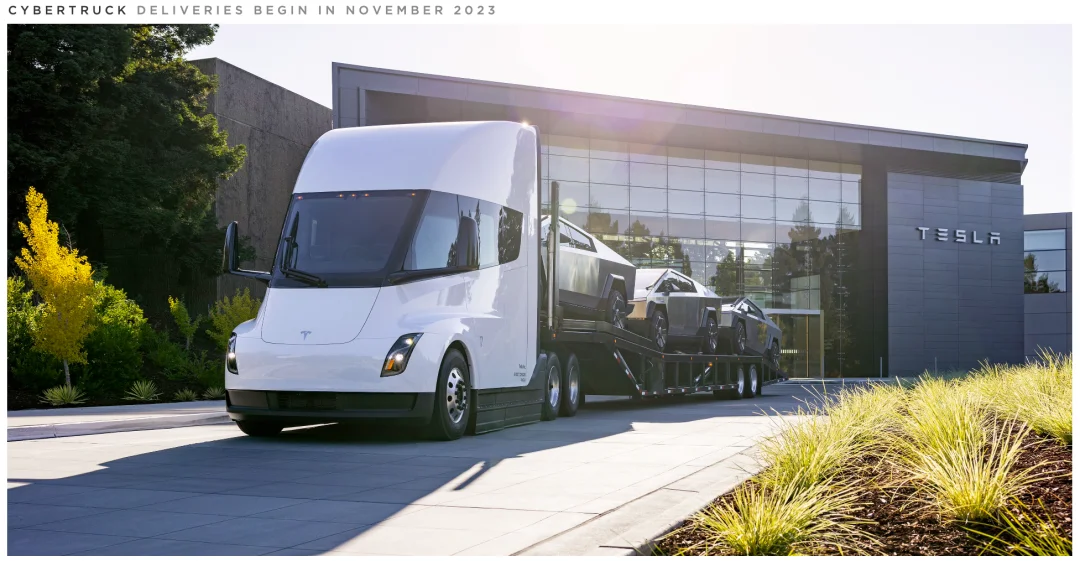
However, despite the Cybertruck's potential to contribute significantly to Tesla's delivery volume, it is not expected to make a substantial impact in the fourth quarter. During the earnings call, Elon Musk stated:
Cybertruck deliveries remain difficult to predict; annual production may reach 250,000 units by 2025, as Tesla must develop not only a new vehicle but also a manufacturing process for it.
So in the fourth quarter, Tesla's sales volume is still primarily driven by the Model 3 / Y. Achieving a record high of 475,900 units poses new challenges for Tesla's production capacity and sales strategy.
The situation appears challenging, but remember that Tesla holds the ace card of price cuts, backed by its unparalleled cost-control capabilities. Tesla stated:
In the third quarter, our per-vehicle cost of goods sold dropped to approximately USD 37,500. Although production costs at new factories remain higher than at existing ones, we upgraded facilities in Q3 to further reduce costs. We still believe industry leaders must become cost leaders.
03'Full Self-Driving' Arrives
Tesla made a significant advance in Full Self-Driving during the third quarter.
First, in July, Tesla began mass production of Dojo. Dojo is Tesla’s self-developed supercomputer, presented as a supercomputing cluster named ExaPOD, with the following key features:
It integrates 3,000 7-nm D1 chips and contains 120 training tiles;
Its peak BF16/CFP8 compute power reaches 1.1 EFlops (exaflops);
It includes 1.3 TB of high-speed SRAM;
And 13 TB of high-bandwidth DRAM.
Leveraging this powerful computing capability, Dojo can process massive amounts of road video data captured by Tesla vehicles for cloud-based training, helping to build a vision neural network that requires not a single line of code.
Latest financial data shows that Tesla FSD Beta has accumulated over 500 million miles of driving, with the figure continuing to grow at an exponential rate. This means the training data for Tesla's visual neural network is also expanding exponentially.
According to Tesla's plan, Dojo will become the fifth-largest computing power facility in the world by the first quarter of next year. By October of next year, its computing power will reach 100 EFlops.
With a solid foundation in computing power and data, Tesla is accelerating toward its goal of 'full self-driving.'
Secondly, in August, Elon Musk drove an older Model S equipped with HW 3.0 on the road to livestream a real-world test of FSD Beta V12. During the approximately 45-minute drive, there was one manual intervention, attracting 12 million viewers.
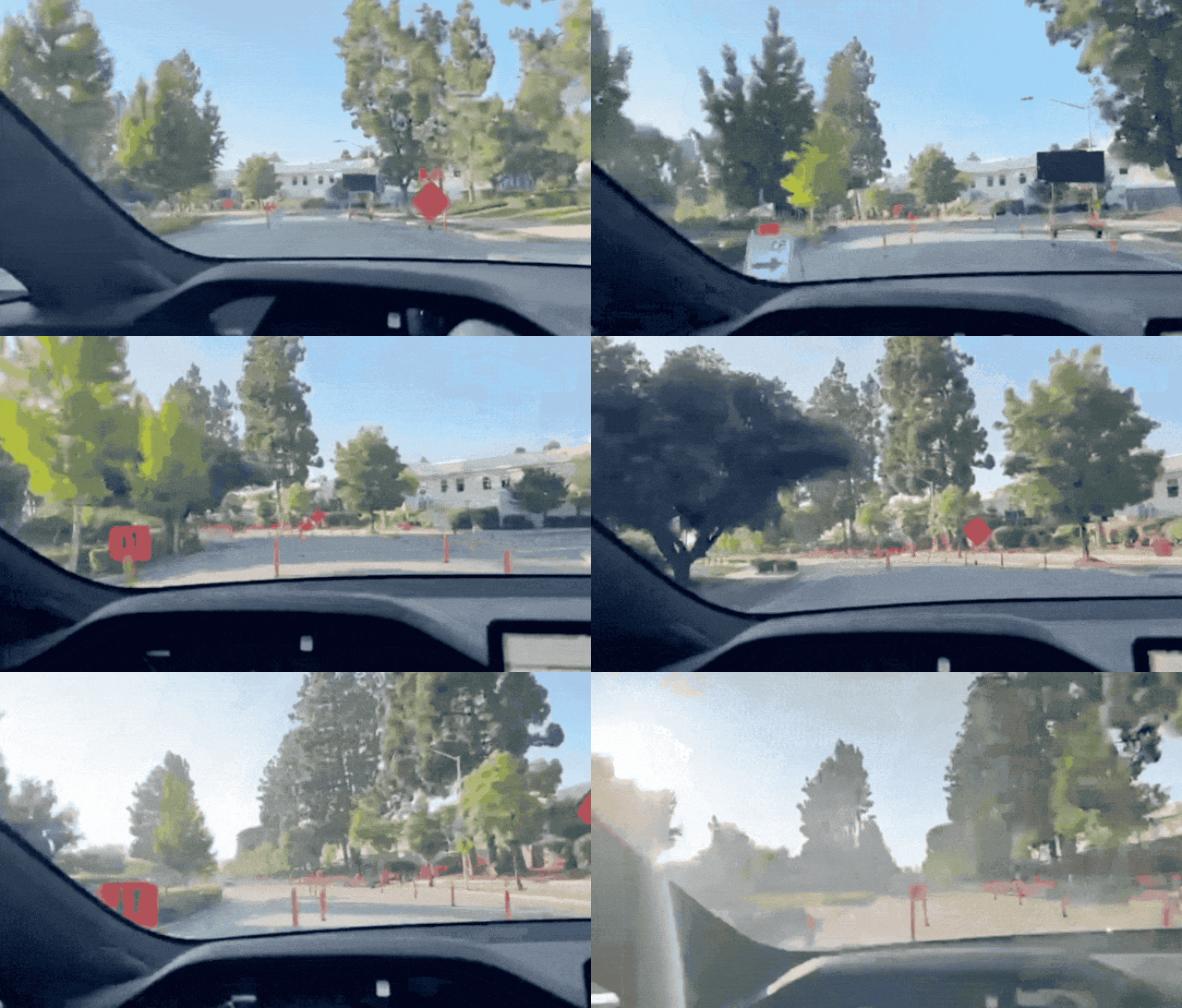
During the livestream, Elon Musk repeatedly emphasized that FSD Beta V12 does not rely on any line of code, but is entirely based on a visual neural network trained from video.
Although achieving true full self-driving still requires Tesla to continue extensively training its visual neural network, the livestream allowed Tesla to demonstrate its capabilities and convey confidence in full self-driving.
Finally, in September, Tesla's U.S. official website officially displayed support for the optional 'Full Self-Driving Capability' package, priced at USD 12,000.
Tesla officially stated that its "Full Self-Driving Capability" can achieve:
All functions of basic autonomous driving and enhanced autonomous driving;
Autonomous driving on city streets;
Recognition of traffic signals and stop signs, with appropriate reactions.
Meanwhile, Tesla’s Chinese website updated the price for "Full Self-Driving Capability" to RMB 64,000, but it remains "temporarily unavailable, to be launched later" due to "administrative approval" (Elon Musk stated that the price for "Full Self-Driving Capability" will continue to decrease).
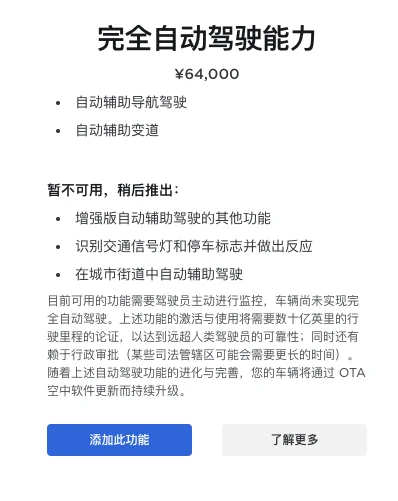
As Tesla steadily advances in full self-driving technology, its previous investments in this area are gradually shifting from a source of intense imagination for users to a usable reality.
More importantly for Tesla, the commercial closed loop of achieving profitability through software after hardware has been fully scaled is being further connected.
However, from the perspective of the Chinese market, domestic new energy vehicle manufacturers are aggressively expanding their autonomous driving capabilities to more cities, while it remains unclear when Tesla’s 'Full Self-Driving Capability' will be available in China.
Consequently, in the Chinese market, Tesla may lose some product appeal in urban autonomous driving, potentially leaving its software profitability in a relatively passive position.
In terms of intelligence, beyond autonomous driving, the Optimus humanoid robot is also being trained using vision neural networks. Tesla is upgrading its hardware; it can already automatically classify objects and perform simple yoga poses, with the potential to complete more complex tasks in the future.
Elon Musk has even suggested that the robot might be able to perform ballet dances within a few years.
Looking ahead, Tesla plans to continue increasing its investment in intelligence and believes these investments will yield returns in profit. Tesla stated:
We continue to innovate to reduce manufacturing and operating costs, but over time, we expect hardware profits to accelerate growth based on advancements in artificial intelligence, software, and automotive scale.
Written by: Isaiah Edited by: 308