


Is Farasis SPS the Optimal Solution for Soft-Pack Batteries?
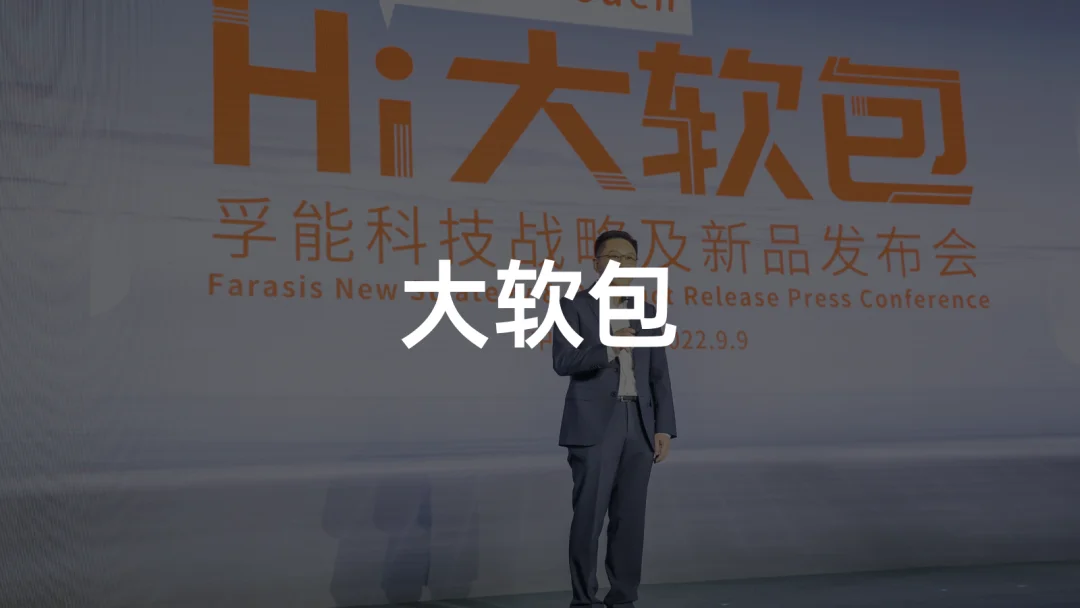
At last week's new product launch by Farasis Energy, Chairman Wang Yu stated: "If software defines the car, then pouch-type ternary batteries will define the next generation of power batteries."
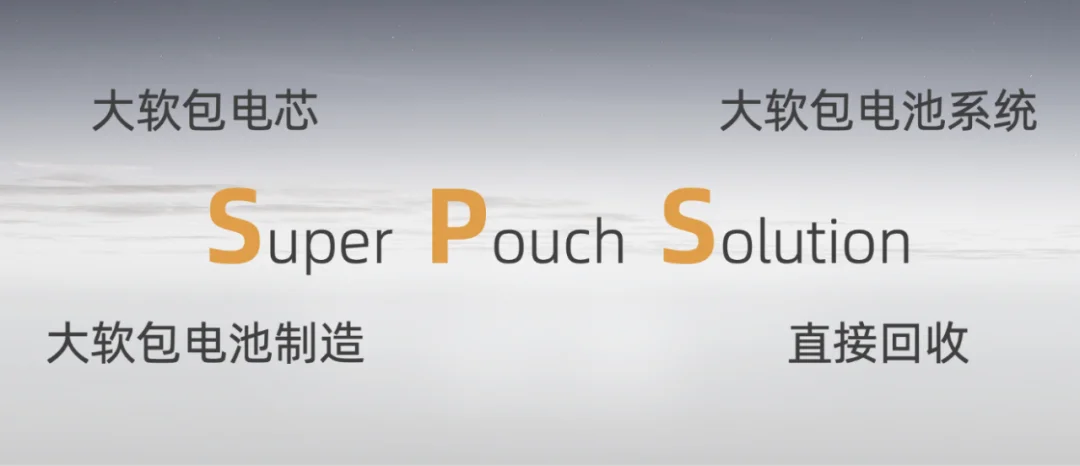
The backing for Wang Yu's bold claim is Farasis Energy's latest product—the SPS (Super Pouch Solution).
Below, I present a set of official data to illustrate the design capabilities of the SPS. Let the numbers speak for themselves:
Volume utilization reaches 75%
Battery system components are reduced by 50%
Material costs are lowered by 33%
Charging Rate Reaches 5C
Compared to the 4680, it offers a 12% higher volumetric utilization efficiency, three times the cycle life, and a 60% improvement in thermal conductivity.
These figures cover several key process aspects: integration density, charging efficiency. Wang Yu also specifically mentioned SPS's adaptability and cost, among other factors. Let’s take a closer look at the new player in the pouch battery field, SPS.
01Large Pouch CTC Solution
There are two ways to improve battery energy density. One is through chemical means, such as adjusting the NCM formula by increasing the nickel (N) content; high-nickel batteries refer to those with a high proportion of N.
The other approach is physical, which involves improving space utilization within the same pack volume to accommodate more cells. Going further, CTP (Cell-to-Pack) and CTC (Cell-to-Chassis) solutions integrate cells directly into the vehicle body.
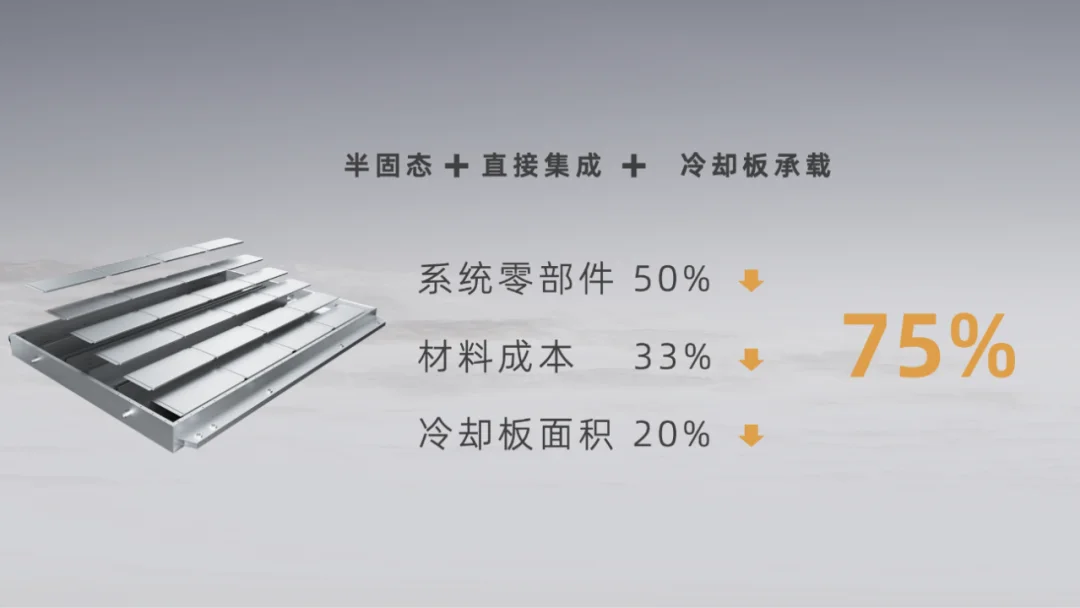
SPS adopts a physical method to increase utilization efficiency within the same pack volume. It features an integrated design where the liquid cooling plate and chassis are combined, with semi-solid pouch cells integrated directly into the system chassis. This raises volumetric utilization to 75%. The CTC solution also reduces system components by 50% and lowers material costs by 33%.
This volumetric utilization rate surpasses CATL’s 72% and the 4680’s 63%; indeed, horizontally oriented pouch cells inherently hold an advantage in volumetric utilization.
Wang Yu confidently stated that any battery supplied to customers using SPS sees its capacity increase by 30%. For example, if a current ternary lithium battery offers a range of 800 km, the new system can achieve 1,000 km.
025C Discharge Rate
Wang Yu noted that the current primary concern is not driving range but charging speed. Most vehicles now deliver over 400 km of real-world range, yet charging often takes more than an hour. Since most drivers would naturally stop for a break after traveling 400 km, refueling during a coffee break aligns with user habits.
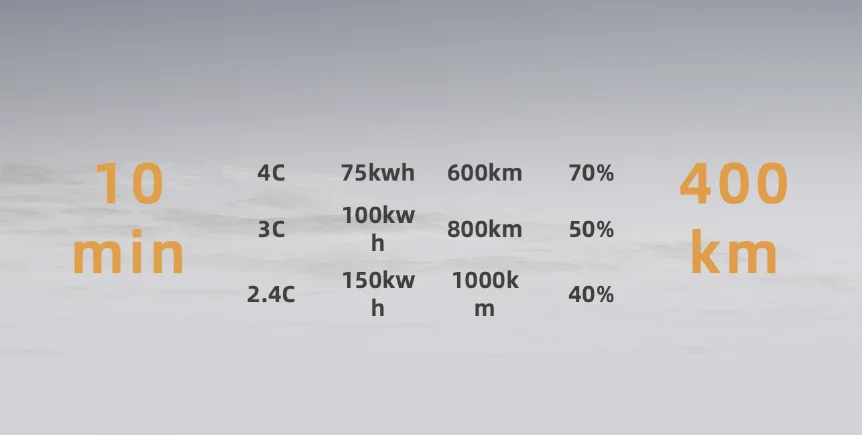
SPS demonstrates charge/discharge rates ranging from 2.4C to 4C, with different rates tailored to battery capacities and vehicle ranges.
For instance, a 150 kWh battery pack with a 1,000 km range uses a 2.4C charge rate, adding 40% capacity (equivalent to 400 km) in ten minutes;
a 100 kWh battery pack with an 800 km range uses a 3C charge rate, adding 50% capacity (equivalent to 400 km) in ten minutes;
and a smaller 75 kWh battery pack with a 600 km range uses a 4C rate, adding 70% capacity (420 km) in ten minutes.
You may have noticed that smaller battery packs actually employ high-rate charging. This is an optimal solution considering the power limitations of existing charging stations in China. If large battery packs were to use similarly high charging rates, the charging infrastructure would be unable to meet the demand.
03Adaptability
Wang Yu stated: By keeping the chassis dimensions of the battery system unchanged, SPS horizontal cells can flexibly adjust the chassis height of the battery system by varying the thickness of the horizontally arranged large-format pouch cells. In other words, a single chassis and one type of cell can be adapted for all passenger vehicle models.
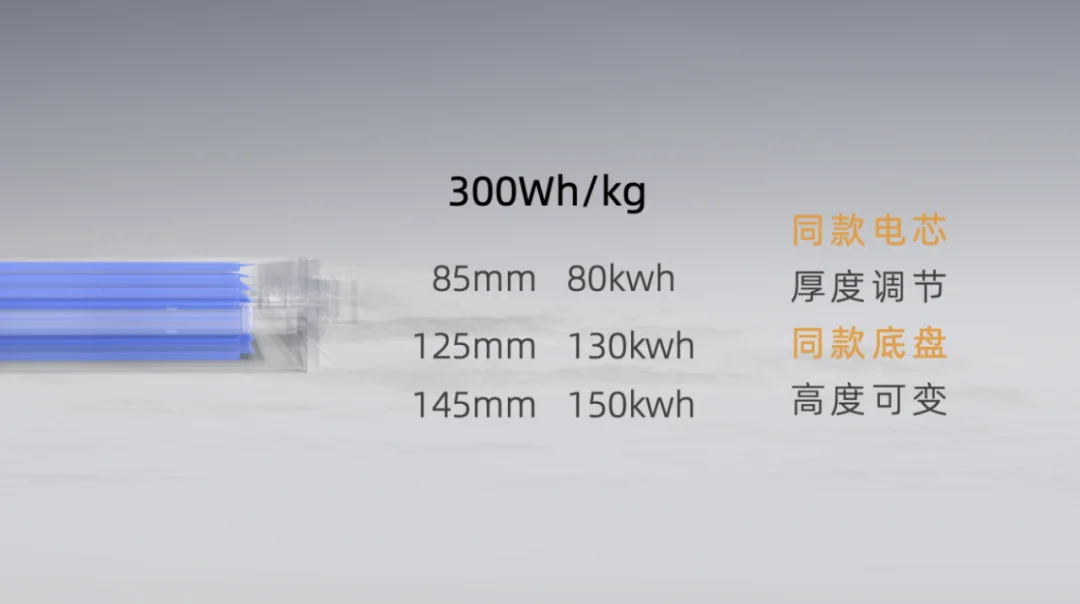
The thickness of SPS horizontal cells can be flexibly adjusted between 85 mm and 145 mm, with battery capacities ranging from 80 kWh to 150 kWh. This covers vehicle types from sedans to pickup trucks. For automakers, this approach can shorten R&D cycles and even enable cell adaptation across different models.
Beyond helping automakers save money, the manufacturing of large-format pouch cells also allows Farasis Energy to significantly reduce costs.
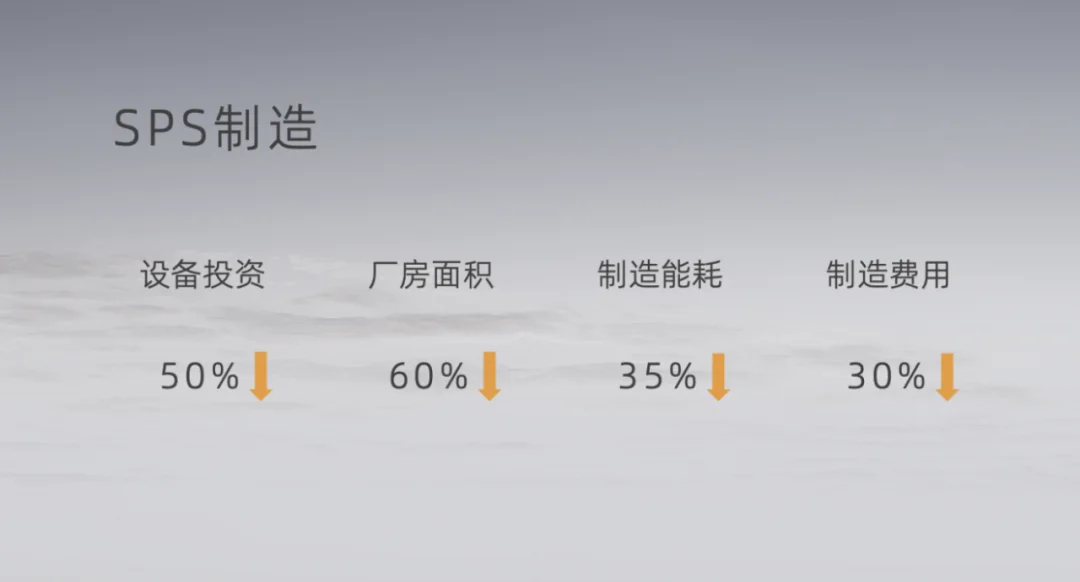
At the manufacturing level, the production of large-format soft-pack cells significantly reduces capital investment and processing costs. Farasis Energy states that SPS manufacturing cuts equipment investment by 50%, factory floor space by 60%, energy consumption by 35%, and overall costs by 30%.
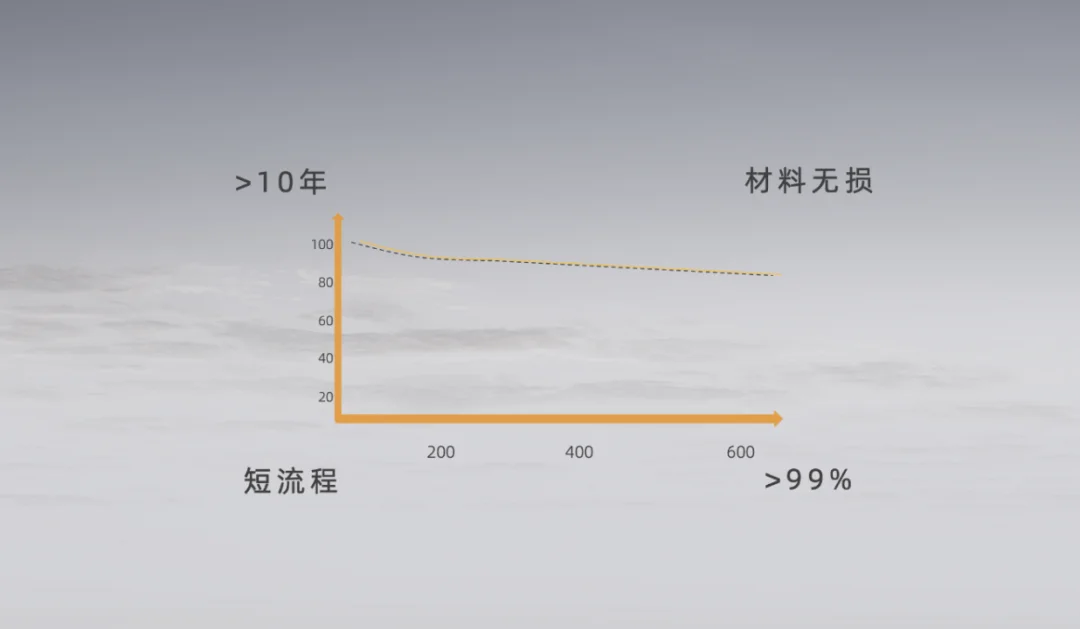
Additionally, Farasis Energy has spent nearly ten years developing and validating direct recycling technology for lithium-ion batteries, which preserves the crystal structure of materials for reuse. The company claims a material recovery rate of 99%. According to data from an independent U.S. laboratory, cells incorporating 25% directly recycled cathode material perform indistinguishably from those made with entirely new materials.
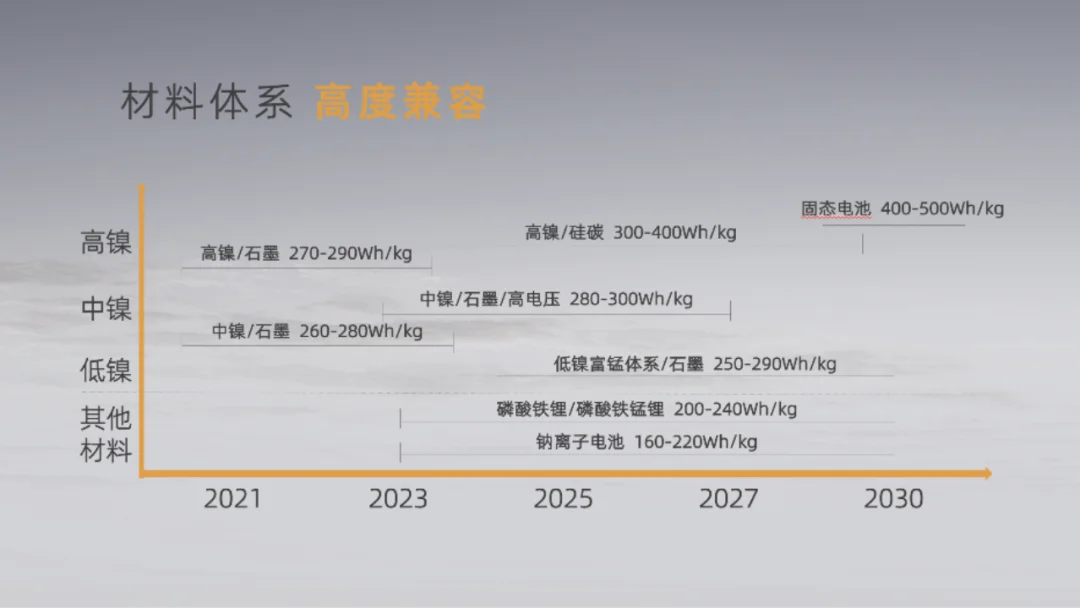
Furthermore, SPS plans to adopt other material systems for cell production in the future.
Specifically:
From 2021 to 2023, it launched medium-nickel and high-nickel cells with energy densities reaching 260–180 Wh/kg and 270–290 Wh/kg, respectively;
Between 2023 and 2027, it will introduce sodium-ion batteries alongside high-nickel cathode and silicon-carbon anode cells with energy densities of 300–400 Wh/kg, while also launching low-nickel manganese-rich system cells during this period;
In 2030, it aims to release solid-state batteries with energy densities of 400–500 Wh/kg.
04Safety
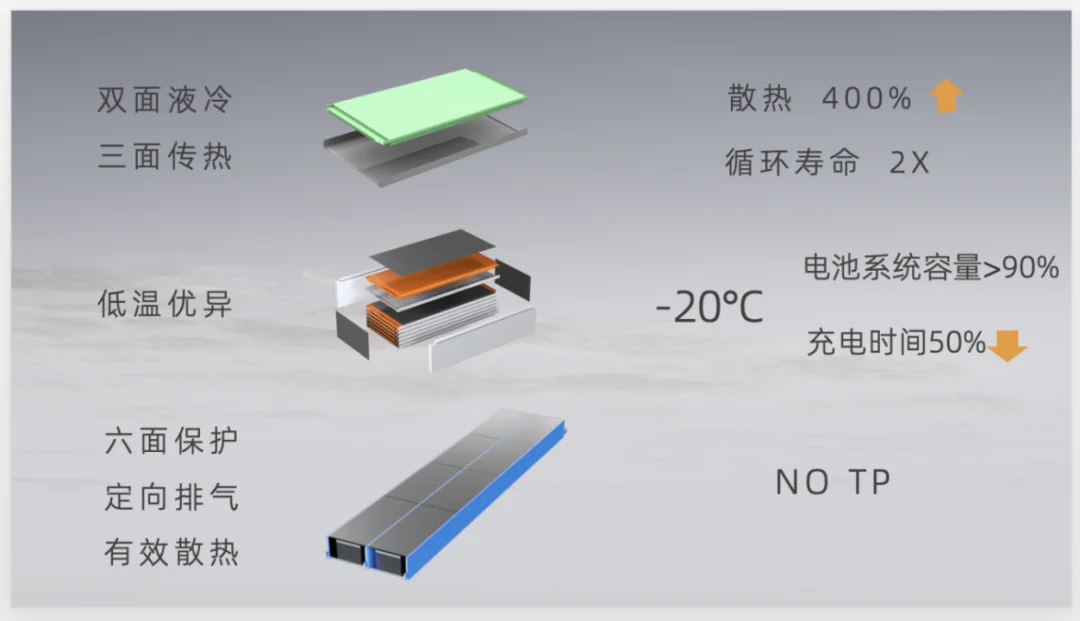
For high-utilization, large-capacity batteries, liquid cooling and thermal conductivity are critical.
SPS employs a composite design combining liquid cooling plates with thermal conductive sheets, providing "double-sided liquid cooling and three-sided heat dissipation" for the cells.
The liquid cooling plate also serves as a structural component to secure and protect the cells. Wang Yu stated that SPS battery systems have achieved a fourfold increase in heat dissipation efficiency; precise temperature control has extended the system's cycle life to over 3,000 cycles. Furthermore, due to SPS's six-sided protection capabilities, combined with exhaust channel design and thermal exchange capacity, the system can accommodate NCM 8-series or higher-nickel-content cells while preventing thermal runaway propagation from individual cells.
However, whether it delivers the safety and reliability claimed requires extensive market validation through vehicle deployments before conclusions can be drawn.
05Production Capacity Planning
Finally, regarding production capacity planning, Wang Yu announced at the press conference that Farasis Energy plans to achieve a total output of 150 GWh over the next four years, with 130 GWh planned for its domestic operations in China.
This 130 GWh will be completed across four major production bases nationwide. The Ganzhou headquarters will produce 46 GWh, while the joint venture factory with Geely is capable of manufacturing 12 GWh and is nearing completion. Additionally, Jiangsu Zhenjiang and Anhui Wuhu have each planned for 24 GWh, and the Southwest region has planned for 16 GWh.
Overseas, Farasis Energy plans to build factories in Turkey and Germany with a combined planned production capacity of 16 GWh.
However, after announcing the production capacity plan, Wang Yu added that capacity would change based on many factors related to factory construction and should ultimately be judged by actual capabilities.
Multiple domestic automakers have already established overseas factories in Germany. Recently, Fengchaonengyuan announced plans to build a cell factory in Brandenburg, Germany, targeting the European market. The facility is scheduled to begin production in 2025 with a planned annual capacity of 16 GWh. Earlier, CATL also disclosed its internationalization progress, stating that it would construct a cell factory in Thuringia, Germany. The initial cell output for the first phase of the factory is set at 8 GWh, with the first batch of cells aiming for completion by the end of 2022.
06Final Thoughts
Farasis Energy holds a prominent industry nickname: the first listed company specializing in pouch cells. Among China's top ten power battery manufacturers, it is the only one that continues to adhere to the ternary lithium pouch cell technology route.
According to the 2021 annual report, Farasis Energy achieved revenue of RMB 3.5 billion, a year-on-year increase of 212.6%, marking the highest level in nearly five years. However, the company's losses widened further. In 2021, net profit attributable to owners of the parent company was -RMB 953 million, a year-on-year decline of 187.83%; net profit after deducting non-recurring gains and losses attributable to owners of the parent company was -RMB 1.263 billion, a year-on-year decline of 132.82%.
The market landscape is highly favorable, yet Farasis Energy has seen revenue growth without corresponding profit increases, even resorting to volume-driven price concessions. Meanwhile, Farasis Energy’s customer base is concentrated, primarily serving OEMs such as Daimule and Guangqi. For a supplier, this represents a risky business model.
The launch of SPS significantly boosts cooperation confidence among Farasis Energy’s potential clients. Additionally, SPS serves as the company’s core competitive weapon against rivals in the near future, including Qilindianchi and 4680 large-format cylindrical batteries. Can this high-utilization, high-density soft-pack battery reverse the declining installation volume trend for soft-pack technology?
07Q&A
Reporter: As a representative enterprise in the soft-pack battery sector, how much market share do you believe soft-pack batteries can capture from prismatic batteries in the future?
Wang Yu: Before 2015, over 90% of the Chinese market was dominated by soft-pack batteries from LG and SK, with no prismatic presence. After the white paper was released, many soft-pack manufacturers could not sustain operations, and Farasis missed its best opportunity. Farasis was the first in the industry to solve the range problem for vehicles below the A0 class, achieving 300 kilometers, but we failed to keep pace in brand awareness and production capacity. Soft-pack was our initial proposal; subsequently, everyone worldwide adopted it, including LG. Essentially, the global market shifted to soft-pack, abandoning hard-shell designs.
However, analyzing from first principles, what kind of battery can meet the requirements of future automobiles? To ensure controllability over 15 to 30 years, it is essential to guarantee that all electrode sheets remain in an ideal configuration throughout their service life. Only soft-pack batteries can ensure this; others cannot.
Soft-pack batteries also have issues. Like a sheet of paper, they are difficult to control during manufacturing due to a lack of established processes and equipment, requiring new development. In contrast, cylindrical and prismatic batteries were already mature technologies developed by Japanese and Korean manufacturers. Production volumes for these formats increased rapidly starting from the nineties.
For those of us engaged in technology, the ultimate goal is to find solutions rather than go in circles. There will inevitably be difficult situations along the way, and we must strive to break through them. Our existence lies in finding directions and solving problems, not in avoiding challenges or seeking quick profits, which would negate the value of our years of dedicated research.
Q: You previously mentioned that pouch cells may be a more viable path toward solid-state batteries. However, the market share of pouch cells is currently declining. How do you evaluate current market trends, including those for pouch cells? Second, Farasis Energy is one of the constituents of the STAR 50 Index on the Science and Technology Innovation Board. Yet, in the stock market, companies like ours are not particularly prominent; there is still a gap compared to CATL and BYD. How can you instill confidence in investors?
Wang Yu: For Farasis, the timeline is long and the market is vast. We are just beginning, still in the 'race' phase, filling gaps, so battery companies are everywhere. I have experienced two waves of elimination. The first was in the United States, where Farasis was the only survivor among all battery companies, while many others were Fortune 500 giants.
The second wave came after the white paper, when roughly four companies ended up monopolizing nearly 90% of the battery market, with Farasis being one of them. Now, nine companies hold that same 90% share. How many of those nine will remain? The market is still expanding rapidly; it is too early to draw conclusions.
Ultimately, surviving companies must first rely on technology as their foundation. With technology comes all subsequent possibilities. Second, a team and a very clear strategy are needed to help you find your positioning during the race, just as Farasis has done. I have identified my niche; no matter how large the volume, you cannot eliminate me because I am 'indispensable.' In this process, I can continuously innovate, develop, and expand, eventually finding my correct position and market status.
Investors should focus on long-term investment, as investing is not day trading. During this process, you must identify value-investment opportunities so that you can benefit over the long term. Otherwise, even if you gain 8x or 10x returns now, you could suddenly 'go to zero.' The company's fundamentals are crucial.
Q: Farasis Energy is currently operating at a loss. According to previous statements, Mercedes-Benz EV sales and Farasis’s performance have had a significant impact. How do you plan to resolve profitability issues? How will cash flow improve?
Host: We will only answer questions pertaining to our section.
Wang Yu: Our Q2 financials have already reached profitability. Farasis focuses exclusively on automotive batteries, and our largest partner is Daimule. The industrialization cycle for Daimule is relatively long. During this industrialization phase, not producing batteries leads to amortization costs, which is a major cause of the losses.
To improve profitability, we need to increase and release production capacity. We must ensure cash flow and profit margins, as demonstrated in the second quarter. This is achievable.
Reporter: In the lithium-ion battery industry, structural innovation has been more prominent in cylindrical and prismatic cells than in pouch cells. Is structural innovation more difficult for pouch batteries? What impact will Farasis’s large-format pouch cell have on other pouch battery manufacturers?
How do you compare the advantages and disadvantages of Farasis’s large pouch cell, CATL’s Qilindianchi, BYD’s Daopiandianchi, and Tesla’s 4680 battery technologies?
Host: Today’s presentation evaluated several battery types. Many of the data points presented today focused on the 4680 battery. For instance, Farasis Energy’s SPS technology achieves a 12% higher volumetric utilization rate compared to the 4680.
Wang Yu: Pouch batteries are not innovating because they are already advanced. The first generation of pouch batteries achieved over 300 kilometers of range, and the entire world adopted them. Today, when it comes to energy density and driving range, pouch batteries enable the longest ranges; no other format can match this.
Technologies like CTP (Cell-to-Pack) are essentially trying to catch up to the energy density of pouch batteries while reducing costs. Previously, one cell design was adapted for seven different vehicle models, or seven different cell designs were used for seven models. This was inefficient and limited energy density gains, forcing the industry to innovate to close the gap with pouch batteries and eventually surpass them. However, our large-module approach remains leading.
For Farasis, we have not stopped for the past four years; we have been continuously seeking next-generation solutions. SPS is the result of these four years of research. Our solution is holistic, from source to end, rather than focusing solely on structural design. Like the establishment of the pouch battery technology route in the nineteen nineties, we analyze from first principles to establish a new technical route that leads the industry. We are not competing with prismatic batteries but are instead focusing on meeting the future needs of automakers.
Farasis always operates in uncharted territory. Looking back at the goal of 3500 Wh/kg, what did we aim to achieve each year and at each stage? This stage involves launching SPS to address this challenge. The previous stage focused on extending driving range, but consumers ultimately rejected excessively long ranges if charging infrastructure could not support them. Therefore, I am now addressing the issue of charging time.
The current energy density is relatively low. By achieving a higher energy density through another structural innovation, we can once again address concerns regarding safety, charging time, and lifespan.
As I mentioned earlier, battery performance in a lab setting is completely different from real-world operating conditions. How can we ensure the battery functions properly? A passive BMS cannot possibly analyze millions of different scenarios. Since it cannot, we need to develop an AI-BMS with self-driven intelligence. As vehicles undergo "four modernizations," batteries must also become "AI-enabled" to adapt to each individual's unique driving habits.
For example, if someone else drives your car today, their driving habits may differ. They might press the accelerator pedal at different times, resulting in varying current feedback and acceleration profiles, which in turn leads to different battery consumption rates. Under such operating conditions, I need to analyze what is happening with the battery, then immediately perform maintenance and adjustments to return the battery to its designed operating parameters. This ensures a 30-year lifespan and prevents all potential safety hazards.
When it comes to innovation, Farasis Energy had been preparing even before the 'wolf' arrived, but the urgency was not particularly high. In previous years, Farasis lacked production capacity, so launching the product would have been futile. Why launch it now? Because a significant portion of upcoming production capacity will be dedicated to this product, as everything is now ready. With such capacity, investment costs are reduced by 50%, the number of components is significantly decreased, and performance is excellent; the impact on the market is therefore predictable, which is exactly the effect Farasis aims to achieve.
Written by: Bobo Edited by: Liu San